



Here’s what most Austin business owners underestimate: your customers are shopping from their phones, on the couch, at 11 pm. And a mobile app converts those browsers far better than a mobile website does.
So the partner you pick to build that app shapes your revenue for years. The good eCommerce app development company in Austin helps you pick the right app type, features, and platform for your budget. The best ones are close enough to meet in person.
This guide walks you through what an eCommerce app development company actually does, the types of apps you can build, the process, how to vet a partner, and what it costs. Let’s get into it.
What Does an eCommerce App Development Company Actually Do?
Short answer: it designs, builds, launches, and maintains the mobile app your customers use to browse and buy from you.
That is a lot more than “make an app.” A real eCommerce app development company handles the full stack of things that make people trust their card to a small screen. The work usually breaks into a few clear areas:
- UX and store design: the layout, product pages, and search that make browsing feel effortless.
- Checkout and payments: secure, fast, PCI-compliant flows with the wallets your customers already use (Apple Pay, Google Pay, cards).
- Backend and integrations: connecting the app to your inventory, CRM, shipping, and existing website or platform (Shopify, WooCommerce, or custom).
- Launch and maintenance: getting through App Store and Play Store review, then keeping the app fast and bug-free after go-live.
Each of those is a discipline on its own, which is exactly why “my cousin can build an app” tends to end in a rebuild.
Ready to Turn Your eCommerce Store into a High-Converting App?
Talk to TekRevol's team and get an itemized project estimate within 48 hours.
Get a Free eCommerce App ConsultationTypes of eCommerce Apps
Before features or budget, you need to know what kind of app you are building, because the type drives everything downstream. The main models:
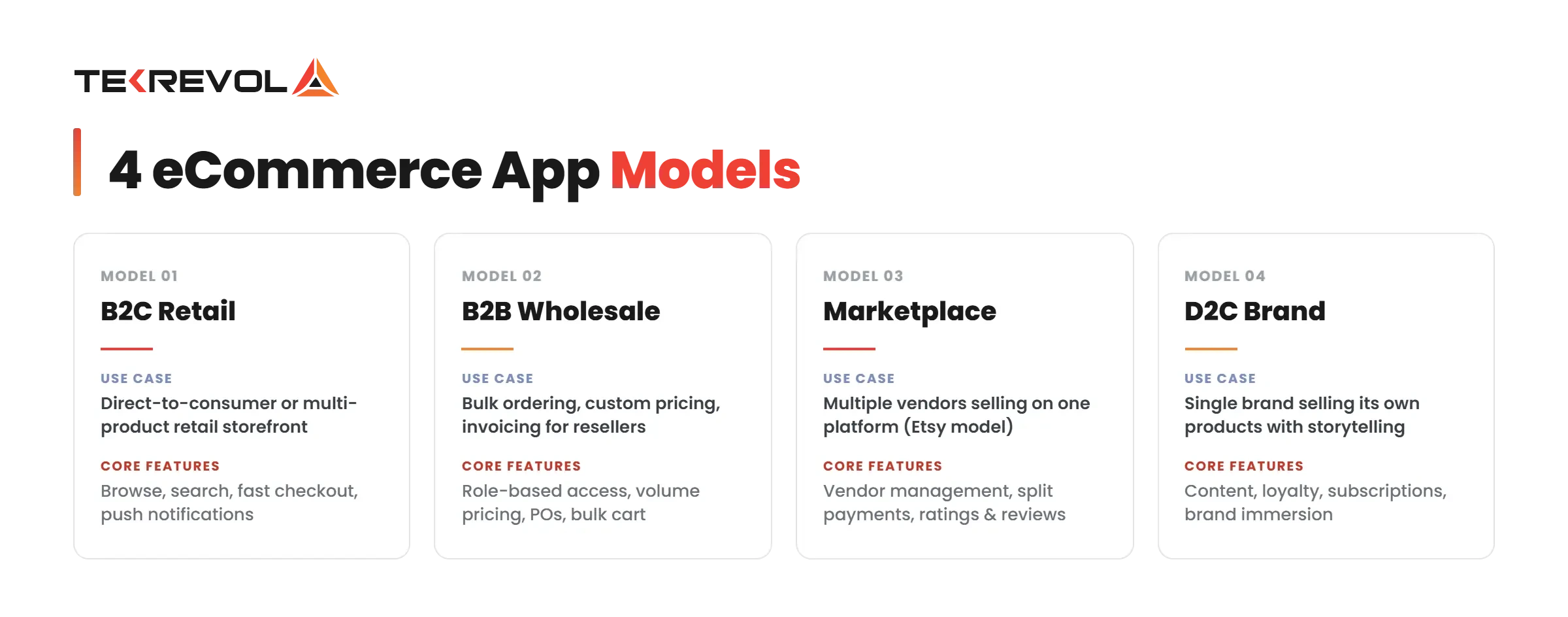
- B2C (business to consumer): the classic retail shopping app, where speed, product discovery, and easy checkout matter most.
- B2B (business to business): built for bulk orders, custom pricing, invoicing, and role-based accounts, so it needs heavier backend logic.
- Marketplace (multi-vendor): many sellers on one platform, which adds vendor management, split payments, and ratings.
- D2C (direct to consumer): a single brand selling its own products, usually focused on storytelling, loyalty, and retention.
Naming your model early saves money, because a B2B app and a B2C app are genuinely different builds, not the same app with a different logo.
Why Austin Businesses are Investing in eCommerce Apps Right Now
Austin isn’t a sleepy market. It is one of the fastest-growing metros in the country, packed with DTC brands, retail startups, and tech-savvy shoppers who expect a polished mobile experience.
That raises the floor. When your competitor down the street has a smooth shopping app, and you don’t, the gap shows up in your revenue.
Two forces make the case concrete:
- Mobile is where the sales are: Mobile commerce now drives the majority of eCommerce sales, according to Statista, so a mobile-first experience is the main event, not a side project.
- Bad checkout kills orders: The Baymard Institute puts the average cart abandonment rate at roughly 70%, much of it caused by slow, clunky, or untrustworthy checkout. A well-built app is one of the most direct ways to win back those orders.
Why it matters: in a competitive market like Austin, the app is the highest-intent sales channel you own, and small friction improvements compound into real money.
Features an eCommerce App Needs
Not every app needs every bell and whistle. But strong eCommerce apps tend to share a core set of features, so use this as your baseline checklist:
- User accounts and profiles: easy sign-up, saved addresses, and order history that make repeat buying frictionless.
- Product catalog with search and filters: so shoppers find what they want in seconds.
- Frictionless checkout: guest checkout, saved payment methods, and as few taps as possible.
- Secure, flexible payments: multiple gateways and digital wallets, built to PCI standards.
- Real-time inventory sync: so the app never sells something you are out of.
- Order tracking and notifications: live status plus push alerts for shipping, restocks, and abandoned carts (used sparingly, they convert).
- Admin dashboard: so your team manages products, orders, and promotions without calling a developer for every change.
Notice each feature names the payoff, not just the label. That is how you brief a developer and know nothing important got skipped.
Not Sure Which Features Your Budget Should Cover?
Get an eCommerce app quote scoped to your actual store and integrations, not a generic template.
Book a Free ConsultationHow eCommerce App Development Actually Works (the process)
A good partner follows a clear path from idea to launch, and understanding it helps you spot a team that is winging it. The typical stages:
- Discovery and strategy: defining your model, audience, must-have features, and success metrics.
- UX/UI design: wireframes and prototypes before a line of code, so you approve the flow early.
- Development: building the frontend, backend, and integrations, usually starting with an MVP (a lean first version with only core features) to validate demand before adding extras.
- QA and testing: functional, usability, and performance testing to ship bug-free.
- Launch: clearing App Store and Play Store review and going live.
- Maintenance and iteration: monitoring, fixing, and improving based on real user behavior.
The MVP-first point matters most: building a lean version first saves budget and tells you what customers actually use before you invest in advanced features.
How to Vet an eCommerce App Development Company in Austin (a 6-point Checklist)
Most “how to choose a developer” advice is generic. Here is a lens built specifically for choosing an eCommerce app partner in Austin. Weigh these six in order:
- eCommerce-specific portfolio: have they shipped actual stores, not just generic apps? Payments and inventory are where inexperienced teams break, so ask to see live shopping apps.
- Platform strategy: can they advise native vs. cross-platform for your budget and timeline, or do they push one answer for everyone?
- Local availability: can you meet the team, align on time zones, and reach a real person when something breaks? An Austin-based app development team removes a lot of friction.
- Integration depth: do they handle your existing stack (Shopify, ERP, CRM, eCommerce website), or hand you a disconnected island?
- Post-launch support: who fixes the checkout bug at peak holiday traffic? Confirm maintenance and SLAs before signing.
- Proof and reviews: verified ratings (Clutch, GoodFirms), named case studies, and references you can actually call.
Run every shortlisted company through those six points and the right partner usually becomes obvious fast.
How Much Does eCommerce App Development Cost?
Most eCommerce apps cost between roughly $30,000 and $150,000. A lean MVP with core shopping features sits at the lower end. A feature-rich, multi-platform app with deep integrations reaches the higher end, and complex builds can run past $200,000.
Treat those as planning ranges, not quotes. Anyone naming a flat price before seeing your store is guessing. Four variables move the number:
- Feature depth: a simple catalog-and-checkout app costs far less than one with subscriptions, AR try-on, or a loyalty engine.
- Platforms: one cross-platform build is usually cheaper than two separate native apps.
- Integrations: the more systems (inventory, ERP, payments) you connect, the more engineering involved.
- Design complexity: custom, brand-heavy interfaces take more work than template-based ones.
On timeline, most builds take three to six months from kickoff to launch. The exact span depends on complexity and how many systems need integrating. The reliable path is a scoped estimate against your feature list, which a good partner walks you through before you commit.
The Tech and Trends Shaping eCommerce Apps in 2026
You do not need to be technical to hire well, but a little context helps you ask sharper questions.
On the build side, most modern shopping apps use cross-platform frameworks like Flutter or React Native, which share a single codebase across iOS and Android. Native builds with Swift and Kotlin make sense when raw performance is the whole point. A capable mobile app development company recommends based on your goals, not a default.
On the capability side, a few trends are worth knowing:
- AI personalization: recommendations and search that adapt to each shopper, lifting average order value.
- AR try-on and previews: letting customers see products in their space or on themselves before buying.
- One-tap and wallet checkout: removing the friction that drives most cart abandonment.
You don’t need all of these on day one. The MVP-first approach lets you launch with the essentials and layer these in as you grow.
Why Choose TekRevol for eCommerce App Development in Austin
TekRevol is a global digital product company that builds eCommerce apps for businesses across the USA, including Austin.
A few things that matter for an eCommerce build specifically:
- A dedicated eCommerce practice: 50+ eCommerce developers and 150+ eCommerce apps delivered across 11+ industries, so payments and inventory aren’t new territory.
- Full-stack capability: from eCommerce app development to the connected eCommerce website, built to work together.
- Local presence: an app development team serving Austin you can actually engage with.
- Verified track record: rated 4.8/5 on Clutch, with named client results, not vague promises.
Ready to Launch an eCommerce App That Sells in Austin?
Talk to TekRevol's eCommerce app specialists and get a scoped, itemized project estimate within 48 hours.
Book a Free Consultation


