



- Hiring a dedicated app development team in Austin costs $8,000 to $25,000+ per developer per month, depending on seniority and specialization, versus $100 to $175/hr for project-based Austin agency work.
- A bad tech hire costs at least 30% of first-year earnings, according to the U.S. Department of Labor, and specialized roles run far higher. That risk is exactly what a dedicated team model is built to avoid.
- Austin’s tech labor market is split in two right now: generalist mobile and full-stack roles are growing just 1.5% and are relatively easy to staff, while AI/ML and cloud infrastructure roles sit at sub-1% effective unemployment. Which staffing model makes sense depends entirely on which side of that split your open role falls on.
- Dedicated team, staff augmentation, and project outsourcing solve different problems. Picking the wrong one is the most common reason Austin companies feel like they “tried outsourcing and it didn’t work.”
- TekRevol maintains a pool of 350+ pre-vetted IT professionals across 30+ technologies, with onboarding measured in days, not months.
Hiring a dedicated app development team in Austin costs $8,000 to $25,000+ per developer per month, depending on role and seniority, with most mid-size engagements landing between $12,000 and $18,000 per developer per month for a blended team of frontend, backend, and QA talent. That’s the number. What actually determines whether it’s the right number for your situation is which staffing model fits your problem, and whether you’re better served by building an in-house team or partnering with an established mobile app development company in Austin that already has one assembled.
This guide breaks down what a dedicated team actually is, how it differs from staff augmentation and project outsourcing, what it costs in Austin specifically, and why the answer to “should I hire locally or bring in outside help” depends on which role you’re trying to fill.
Trying to scale your engineering team without the six-month hiring cycle?
Talk to TekRevol about IT staff augmentation options and get a shortlist of pre-vetted developers within days
Get a Free ConsultationWhy This Decision Matters More Than the Rate Card
Every staffing decision has a hidden cost that never shows up on the invoice: the cost of getting it wrong. The US Department of Labor estimates a bad hire costs at least 30% of that employee’s first-year earnings once you account for recruiting, onboarding, and lost productivity. For a senior developer role, that number climbs fast, and it doesn’t include the sprint cycles lost while the seat sits empty or the team absorbs the ramp-up.
That risk is precisely what a dedicated team model exists to eliminate. Instead of betting six figures on a single hire who looks right on paper, you’re working with developers who are already vetted, already productive, and already working in a team structure built for exactly this kind of engagement.
Why this matters right now in Austin specifically:
The US Bureau of Labor Statistics projects 15% growth in software developer roles nationally through 2034, and Austin’s local market is absorbing more of that demand than most cities its size. A slow hiring process here doesn’t just cost you money. It costs you the calendar quarter while a competitor ships.
The stakes look different depending on what you’re building, too.
- A team doing EdTech app development in Austin racing to launch before the fall semester can’t treat a hiring delay the same way a mature company might.
- The same is true for developing a fintech app in Austin, where compliance has to be managed from day one.
- On-demand and gig-economy app development in Austin carries its own version of this pressure, since uptime is the product itself.
- The criteria for choosing an ecommerce app development partner in Austin face a version of the same problem: every hour spent screening candidates is an hour a competitor spends shipping features that shorten their checkout flow.
What “Dedicated Team” Actually Means (and How It’s Different From Your Other Options)
These terms get used interchangeably in sales conversations, and that’s exactly how companies end up in the wrong engagement model. Here’s the real distinction.
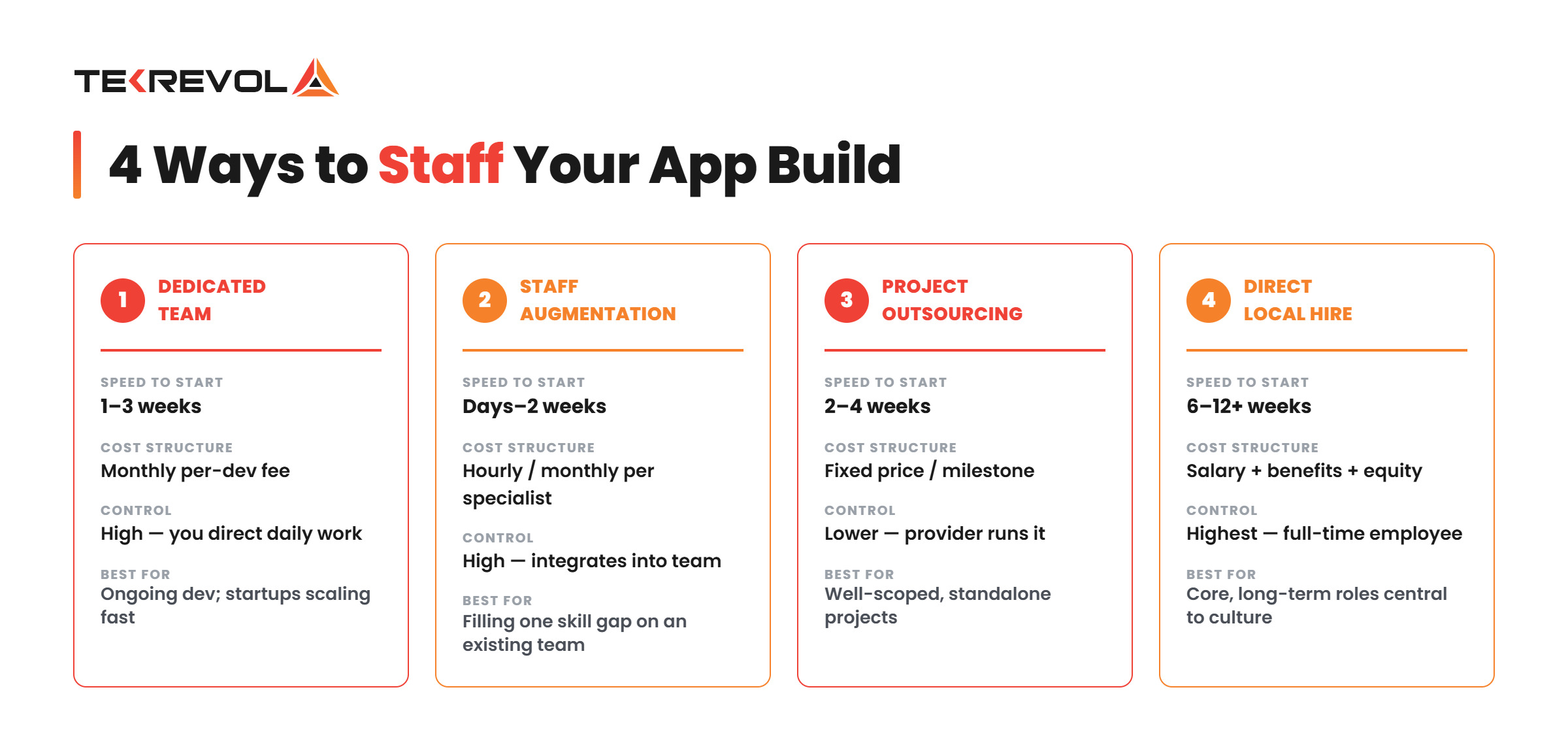
Dedicated development team means a group of developers who work exclusively on your product, full-time, for the duration of the engagement. They function as an extension of your team: same standups, same sprint cadence, same product context carried across weeks and months. The provider handles recruiting, payroll, and HR. You direct the work.
Staff augmentation means adding individual specialists, one or several, into your existing team and processes on a flexible basis. This is the right call when you have a functioning team with a specific skill gap: you need a senior React Native developer for four months, not a whole new team. TekRevol’s breakdown of staff augmentation benefits, use cases, and limitations covers this distinction in more depth if you’re still weighing the two models.
Project outsourcing means handing an entire, well-defined project to an external company that manages it end to end, with less day-to-day involvement from you. This works when the scope is fixed, and you don’t need the team to become an extension of your internal culture.
Direct local hire means recruiting, interviewing, and employing someone yourself, in Austin, as a full-time employee. This is the slowest and most expensive path to fill a seat, but it’s the right call for roles that are core to your long-term product vision and company culture, not a temporary capacity problem.
| Model | Speed to Start | Cost Structure | Control Level | Best For |
| Dedicated Team | 1–3 weeks | Monthly per-developer fee | High, you direct daily work | Ongoing product development, startups scaling fast |
| Staff Augmentation | Days to 2 weeks | Hourly or monthly per specialist | High, integrates into your team | Filling a specific skill gap on an existing team |
| Project Outsourcing | 2–4 weeks | Fixed price or milestone-based | Lower, provider manages execution | Well-scoped, standalone projects |
| Direct Local Hire | 6–12+ weeks | Salary + benefits + equity | Highest, full-time employee | Core, long-term roles central to company culture |
Not sure which model fits your situation? Book a free staffing consultation, and TekRevol will map your specific gap to the right engagement type before you commit to anything. If you’re still unsure whether you’re even at the “we need help” stage, TekRevol’s guide on when you need IT staff augmentation walks through the signals worth watching for.
The Austin-Specific Factor Most Staffing Guides Miss
Austin’s tech labor market isn’t one market. It’s two, and they behave completely differently.
Generalist software and mobile engineering roles in Austin are growing at only about 1.5% right now, effectively flat once AI coding tool productivity gains are factored in, according to labor market research firm KiTalent’s 2026 analysis. That means there’s a real supply for hiring iOS app developers, and finding Android developers in Austin is just as easy too.
React Native developers and Flutter developers in Austin fall into the same easy-to-source category as the rest of the city’s generalist mobile talent, for teams whose stack leans cross-platform rather than native.
AI/ML engineering and cloud infrastructure roles are the opposite story. These sit at sub-1% effective unemployment in Austin, with vacancy periods regularly exceeding 90 days, per the same analysis. If your open role is a machine learning engineer or a senior cloud architect, a pure local-hire strategy will cost you a full quarter or more before you have someone in the seat. This is exactly where a dedicated team or staff augmentation model, sourced from a broader talent pool than just the Austin metro, closes the gap that local hiring can’t close fast enough.
Practically, this means: don’t apply the same staffing strategy to every open role. A generalist mobile developer role and a machine learning engineer role in the same company, at the same time, may call for two completely different hiring approaches. Treating them the same is how companies end up with an open senior AI role for six months while junior generalist positions fill in weeks.
What a Dedicated Team Actually Costs in Austin
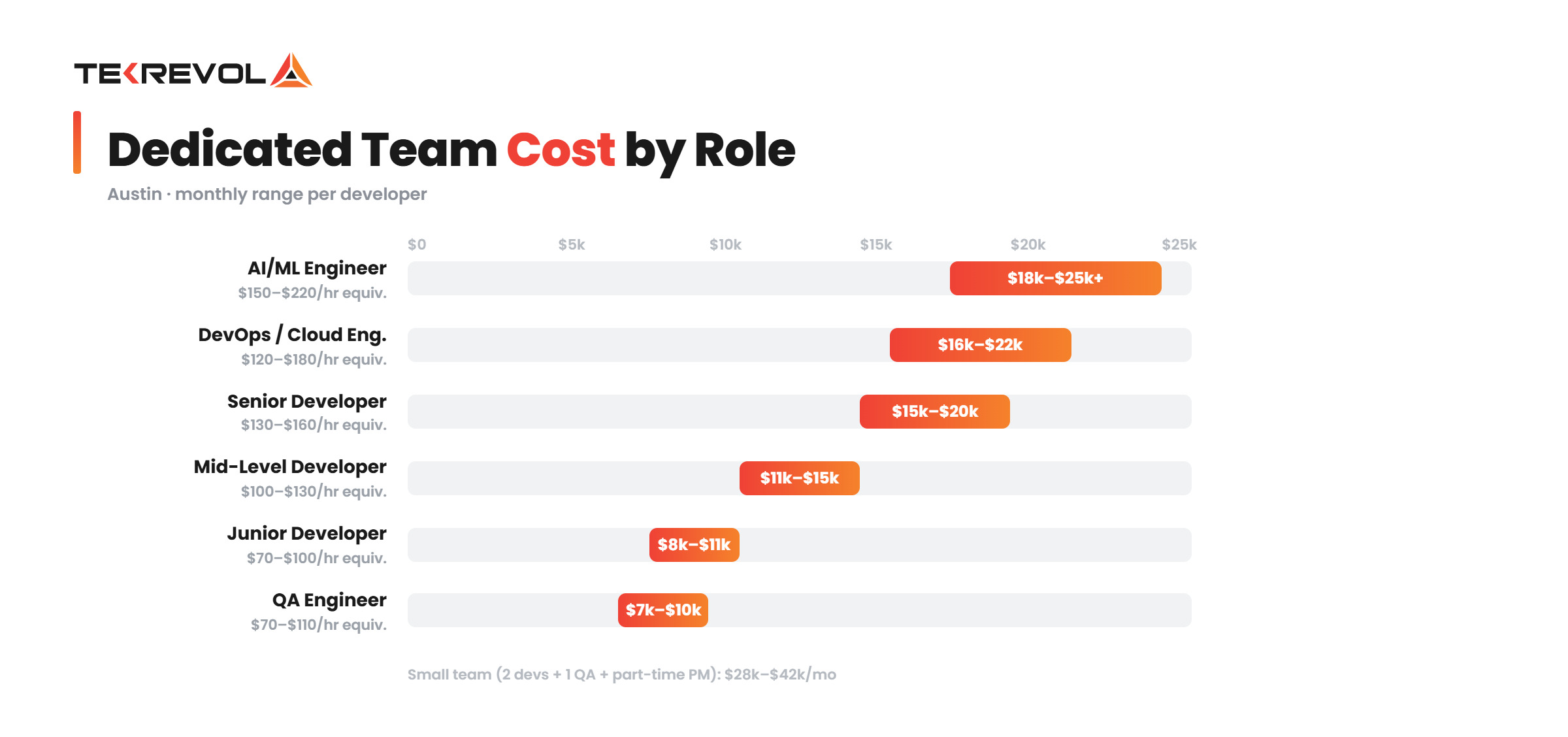
Dedicated team pricing is typically quoted per developer, per month, not as a project total, since the team scales with your roadmap rather than a fixed deliverable.
| Role | Monthly Cost (Dedicated Team) | Comparable Austin Hourly Rate |
| Junior Developer (iOS/Android/React Native) | $8,000–$11,000 | $70–$100/hr |
| Mid-Level Developer | $11,000–$15,000 | $100–$130/hr |
| Senior Developer | $15,000–$20,000 | $130–$160/hr |
| DevOps / Cloud Engineer | $16,000–$22,000 | $120–$180/hr |
| AI/ML Engineer | $18,000–$25,000+ | $150–$220/hr |
| QA Engineer | $7,000–$10,000 | $70–$110/hr |
A typical small dedicated team- two developers, one QA engineer, part-time PM oversight- runs $28,000 to $42,000/month. Compare that to the fully loaded cost of three direct local hires in Austin: salary, benefits, payroll tax, recruiting fees, and equipment typically push that same headcount past $55,000/month before anyone has shipped a single feature, and that’s before accounting for the 3 to 6 months it usually takes to fill all three seats.
Want to compare this to project-based pricing instead?
TekRevol's Austin app development cost guide breaks down project-based pricing by app type and feature set.
Talk to an App Cost ExpertHow TekRevol’s Dedicated Team Model Works
TekRevol maintains a pool of 500+ pre-vetted IT professionals across 30+ technologies, spanning mobile development, cloud, AI, and QA. Here’s what the engagement actually looks like.
- Requirements scoping. You share the role, tech stack, and team context you need filled. This isn’t a generic job description. It’s a conversation about your actual product and where the gap is.
- Candidate shortlist. Rather than a stack of resumes to screen yourself, you receive developers who’ve already passed technical screening, communication assessment, and a real-project evaluation. Most engagements move from requirements to a shortlist within days, not weeks.
- Integration, not just placement. Developers join your existing tools, sprint cadence, and communication channels. They align to your timezone and work hours for genuine day-to-day collaboration, not an asynchronous handoff that adds a day to every decision.
- Ongoing management support. Regular check-ins, performance reviews, and proactive issue resolution continue through the engagement. If a developer isn’t the right fit, that gets addressed and resolved, not left to become a six-month problem.
For a closer look at how this plays out on real projects, TekRevol’s Austin app development case studies walk through outcomes from several of these engagements.
Ready to see who's available for your stack?
Hire dedicated developers through TekRevol and get a shortlist scoped to your specific tech and team needs.
Get Started TodayTwo Realistic Staffing Scenarios
Scenario A: Austin SaaS Startup, Post-Seed Scaling
A 12-person SaaS startup just closed a seed round and needs to double engineering output over the next two quarters without doubling fixed payroll before the Series A is closed. They need two mid-level full-stack developers and one QA engineer, fast, with the option to convert to direct hires later if the product-market fit holds. TekRevol’s guide to scaling your development team covers this exact growth-stage staffing pattern in more depth.
- Approach: Dedicated team model, month-to-month after an initial 3-month commitment, with a defined conversion path to direct hire built into the contract.
- Estimated cost: $30,000–$38,000/month for the team of three | Time to first developer active: 1–2 weeks
For startups even earlier in the process, still validating the product itself before scaling a team around it, our guide to MVP development in Austin ahead of SXSW season is worth reading first.
Scenario B: Austin Healthtech Company, Specialized AI Hire
An established healthcare app development company needs a machine learning engineer to build a clinical triage model, but their internal recruiting team has had the role open for four months with no qualified local candidates.
- Approach: Staff augmentation for the single specialized role, integrated into the existing internal team rather than a full dedicated team, since only one skill gap needs filling.
- Estimated cost: $18,000–$24,000/month | Time to placement: 2–3 weeks, versus an open-ended local search
For a deeper look at what this actually costs and how HIPAA compliance factors into it locally, see our guide to healthcare app development in Austin.
Questions to Ask Before You Sign
The wrong staffing partner creates the exact problem you were trying to avoid: a mis-hire, just wearing a different contract structure.
- How are developers vetted before they’re presented to me? “We have a large network” is not vetting. Ask specifically what technical screening, communication assessment, and real-project evaluation looks like.
- What happens if a developer isn’t the right fit after two weeks? A credible partner has a clear replacement process built into the contract, not an awkward renegotiation.
- Who owns the IP for what gets built? This should be unambiguous and in writing before day one, not something you have to ask about after the engagement starts.
- What’s the actual time zone overlap? A “dedicated team” that only overlaps with your work hours for two hours a day isn’t functioning as an extension of your team, it’s outsourcing with extra steps.
- Can I speak to a current client with a similar engagement? A partner confident in their placements will make this easy, not awkward.
What a Dedicated Team Engagement Actually Looks Like
The theory is easy. The part that actually determines whether this works is what happens in month one, when a stranger’s code starts landing in your repo, and your team has to decide whether to trust it.
Security and IP protection have to be settled before day one, not negotiated after. A dedicated team should work inside your access-controlled repository from the start, under an NDA signed before any project details are shared, with IP ownership terms that are unambiguous in the contract rather than implied. If a provider is vague about any of these three things, that vagueness is the actual product you’d be buying.
One TekRevol client, the founder of a Breathalyzer-based alcohol monitoring company, described being initially hesitant about a remote development relationship because of past experiences with remote developers elsewhere. Their own words after working with TekRevol’s team: TekRevol “consistently exceeded our expectations with their top-notch communication and support.” That hesitation is common, and it’s a reasonable instinct. It just means the vetting questions above matter more than the rate card.
Nearshore, Offshore, or Onshore: How the Team Gets Sourced
Where your dedicated team is physically located changes cost, communication overhead, and time zone overlap, and it’s worth understanding before you commit to one.
Onshore (Austin or elsewhere in the US) gives you full time zone overlap and the easiest day-to-day collaboration, but it’s also where the labor market bifurcation described above hits hardest. For generalist roles, this is very workable. For specialized AI/ML or cloud roles, onshore-only sourcing is often the slowest and most expensive path.
Nearshore software development (Latin America) runs $40 to $80/hr, with 1 to 3 hours of time zone difference from Austin, meaning real-time collaboration during most of the workday. This is TekRevol’s most common recommendation for teams that want cost efficiency without sacrificing overlap hours, and it’s an explicit service line TekRevol offers alongside its Austin-based delivery.
Offshore (Eastern Europe or South Asia) runs $15 to $50/hr, the lowest cost per hour, but with meaningfully less daily overlap, often just a few hours of shared working time. This works well for well-documented, less ambiguous work where constant back-and-forth isn’t required, and less well for early-stage product work that changes direction week to week.
A hybrid model, Austin-based product leadership and architecture with a nearshore or offshore delivery team underneath, is what most mid-size Austin companies actually land on once they’ve tried a single-region approach and found its limits.
Red Flags During the Engagement, Not Just Before You Sign
The questions above catch problems before you sign. These catch problems that only show up after the engagement is already running.
Developers get swapped without notice. A provider that rotates people onto your project without telling you is treating your product context as disposable. Continuity is the entire value of a dedicated team; losing it silently defeats the purpose.
Sprint velocity looks fine, but nobody can explain the architecture. If your embedded developers can’t answer basic questions about why the codebase is structured the way it is, work is happening without real ownership.
Communication moves to async-only after the first month. A genuine dedicated team stays in your standups. If check-ins quietly disappear once the contract is signed, that’s a signal the “team” model has quietly become outsourcing.
Code review and QA get skipped to hit a deadline. A partner that lets quality slip under deadline pressure without flagging it to you is optimizing for looking productive over being productive.
Ready to Build Without the Six-Month Hiring Cycle?
Austin’s talent market rewards speed, and the company that gets a qualified developer in the seat this month is shipping while a competitor is still screening resumes.
Our pool of 500+ pre-vetted professionals across 30+ technologies means you’re not choosing between “fast” and “qualified.” It’s a big part of why Austin startups choose TekRevol as their staffing and development partner instead of building a recruiting pipeline from scratch.
Ready to see who’s available? Talk to TekRevol about IT staff augmentation and dedicated team options and get a shortlist within days, not months.
Have a role to fill?
Talk to TekRevol about IT staff augmentation and dedicated team options and get a shortlist within days, not months.
Talk to Our Experts


