

Stop Guessing Your Build Scope.
Get a $450-value strategy session at zero cost. We'll map your app idea and provide a realistic cost estimate before you begin.
Claim Your Free Consultation

If you think language learning app development like Duolingo is just about throwing vocabulary flashcards and multiple-choice quizzes into a pretty UI, you are on a fast track to burning your budget.
Duolingo has over 500 million registered users and a valuation north of $6 billion. The global language learning market is worth over $15 billion and is growing every quarter.
But here is what most EdTech founders miss:
The real magic here isn’t a colorful mascot. The actual value lies in the complex engineering hidden beneath the surface. If you want to claim your slice of this multi-billion-dollar pie in 2026, you cannot just build a lazy clone.
You need to know how to construct an algorithmic beast under the hood. Your app must mathematically predict the exact moment a user is about to forget a word, score messy real-world accents without bruising user egos, and hack human psychology to build unshakeable daily habits.
At TekRevol, we have spent years in the engineering trenches building these precise systems.
Drop the generic textbooks because this guide here has everything you need to know about language learning app development, like Duolingo.
The global EdTech market presents massive opportunities for language learning app development like Duolingo, crossing a $15 billion valuation with consistent quarterly growth. While Duolingo dominates casual, mass-market consumer attention, extensive niche sectors remain completely unserved.
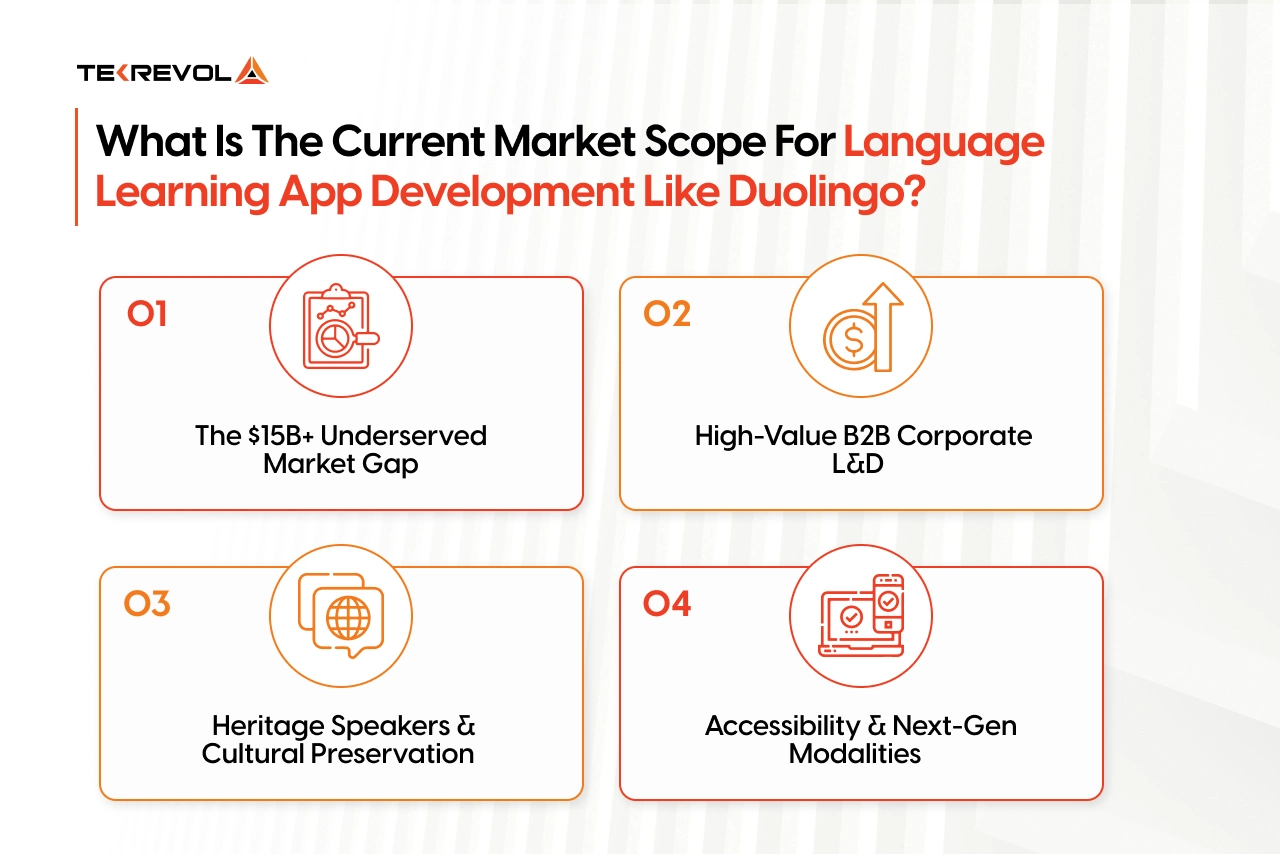
Smart EdTech founders are capitalizing on high-value segments that standard apps ignore, such as corporate L&D compliance training, heritage language speakers seeking deep cultural reconnections, regional dialect preservation, and interactive sign language learning using computer vision.
Building a successful app in 2026 does not require competing directly with market giants; instead, it requires deploying robust, specialized educational software tailored to these high-retention, high-paying target audiences.
TekRevol’s guide to top education apps maps this trend clearly: the fastest-growing EdTech products identify a learner segment with a high unmet need and build the curriculum and feature set around that segment’s specific constraints, not around a general user.
The four niche categories with the strongest commercial case right now:
The lesson for founders: Duolingo’s market share is a ceiling for Duolingo, not for you. The more specific your target learner, the lower your acquisition cost and the more defensible your product becomes over time.
Get a $450-value strategy session at zero cost. We'll map your app idea and provide a realistic cost estimate before you begin.
Claim Your Free ConsultationSuccessful language learning app development like Duolingo hinges on building a comprehensive learning loop that addresses four core cognitive modalities: listening, speaking, reading, and writing.
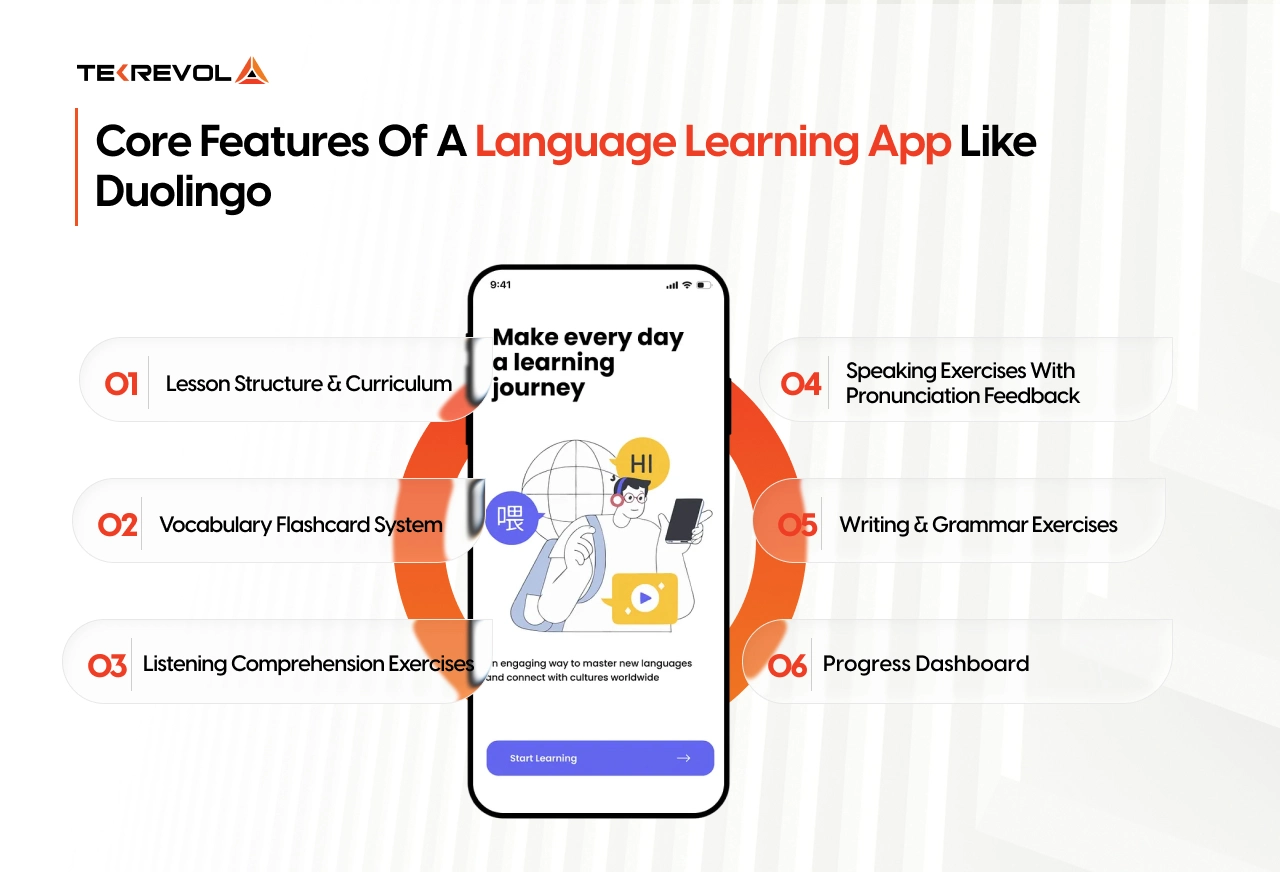
A premium product must seamlessly integrate a structured lesson curriculum with branching logic, a metadata-rich vocabulary flashcard system, audio comprehension exercises, and an interactive progress dashboard.
Prioritizing these unified, multi-modal features ensures your educational software transforms basic vocabulary quizzes into a highly immersive, premium digital learning experience that drives long-term user retention.
The highest-retention platforms in TekRevol’s educational software development portfolio share one characteristic: they treat all four modalities as mandatory, not optional upgrades.
The lesson module is the primary interaction surface of any language learning app. Each lesson should follow a predictable rhythm: introduce vocabulary, present it in context, test recognition, test recall, and close with a brief summary. The curriculum should be organized into units, sections, and individual lessons with clear progression gates between levels.
Every language learning app has flashcards. What separates good implementations from poor ones is metadata. Each card should carry a difficulty rating, a part-of-speech tag, a frequency score, how common this word is in native speech, and a set of example sentences.
These data points are what feed the spaced repetition engine. Without them, the flashcard system is just a quiz, not a learning tool.
Listening exercises train the learner’s ear to parse native-speed speech. A minimum viable implementation includes audio clips of native speakers, multiple-choice comprehension questions, and playback speed controls, 0.75x for beginners, 1.25x for advanced learners.
More sophisticated implementations use AI-generated dialogues so the audio library scales without expensive recording sessions for every new vocabulary unit.
This is the feature that defines perceived app quality in user reviews. Learners are unforgiving about a pronunciation scorer that is either too strict or too lenient.
A scorer that marks correct speech as wrong twice in a row will lose that user permanently. One that is too lenient trains bad habits. The implementation complexity here is the reason an entire section below is dedicated to speech recognition alone.
Writing exercises close the production loop. Fill-in-the-blank, sentence reordering, and free-response translation all serve different cognitive functions.
Grammar explanations should be embedded in context, triggered by a mistake, not front-loaded as a wall of rules. The single most effective grammar feature is real-time error feedback that explains why an answer is wrong, not just that it is wrong.
A progress dashboard is motivational infrastructure. It should show streak count, words learned, lesson completion by unit, and a weekly activity graph.
The smarter version uses AI in education to show users exactly when they will master a word list. It flags difficult words right when they are about to slip from memory, forcing a review before the user forgets them completely
At the core of premium language learning app development like Duolingo, the Spaced Repetition System (SRS) serves as the primary engine driving actual knowledge retention.
It is also the single most underestimated technical challenge in language learning app development for founders who have not built in this category before.
Spaced repetition is a learning technique grounded in the forgetting curve, first described by Hermann Ebbinghaus in the 1880s. The core insight: memory retention decays predictably over time, and the optimal moment to review a piece of information is just before you would forget it. Review it too soon, and you waste a session. Review it too late, and the memory has already degraded.
An SRS schedules each vocabulary item individually based on the learner’s past performance on that specific item. Words you know well get reviewed weekly or monthly. Words you struggle with get reviewed tomorrow. Every session maximizes retention per minute of study, a property no static flashcard deck or fixed review schedule can match.
The SM-2 algorithm, developed by Piotr Wozniak for SuperMemo in 1987, remains the foundation of most spaced repetition app development projects today. Its successor, FSRS (Free Spaced Repetition Scheduler), is more accurate for long-interval scheduling and is increasingly the default for new builds.
The way AI is revolutionizing mobile app development has extended into SRS, meaning modern implementations can now combine algorithmic scheduling with neural models that predict forgetting probability with far greater accuracy than SM-2 alone. A plain-language breakdown of how SM-2 works:
The practical outcome: a learner studying 20 new words per day will have their review load balanced automatically. Without SRS, they face 600 words to review after a month. With SRS, they review roughly 50–70 per day, each at the optimal retention moment.
Two options: implement SM-2 or FSRS yourself, or integrate an open-source library like Anki’s scheduler.
For most builds, TekRevol’s moble app development team recommends a hybrid approach: use the FSRS open-source implementation as the scheduling core, then wrap it in custom data models storing per-user, per-card performance history in your own database. This gives you the accuracy of a battle-tested algorithm with full control over your data architecture.
The key data points to store for each user-card pair: last review date, next review date, current interval, current ease factor, and a full review history log. Without the history log, you cannot audit learning outcomes, tune the algorithm, or migrate users to improved versions without losing their scheduling history.
Get the Exact Technical Roadmap for Your Language App, For Free.
Consult With Our Expert For FreeIntegrating precise speech recognition and real-time pronunciation feedback is one of the most critical phases in language learning app development like Duolingo. Saying that, it’s the most correlated feature that decides whether a user stays or churns after the first week.
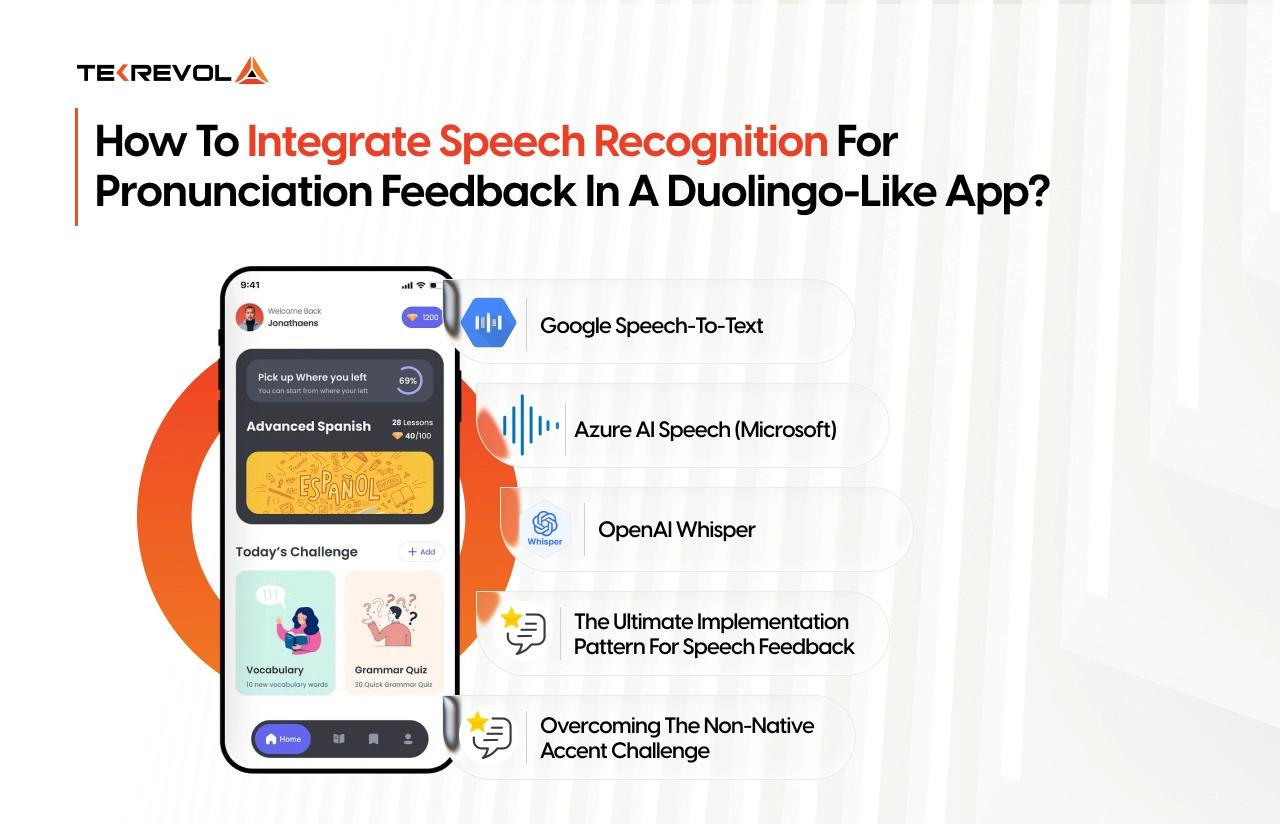
The technology landscape for speech recognition APIs has improved dramatically. Three options dominate production builds in 2026:
The implementation pattern that works best: record the learner’s audio, send it to the speech API with the expected target phrase as context, receive a confidence score and word-level alignment, then display color-coded feedback, green for correct, yellow for close, red for needs work, on each individual word.
Avoid binary pass/fail displays. Granular feedback is what keeps learners engaged with the speaking feature rather than avoiding it after a frustrating experience.
One challenge to plan for explicitly: non-native accent handling. A Mandarin speaker learning English has a different acoustic profile than a Spanish speaker learning English. Test your chosen API against your specific target learner demographic before committing to it in production.
Gamification is not an aesthetic afterthought; it is the load-bearing engagement framework for successful language learning app development like Duolingo.
The data on this is consistent: as documented in TekRevol’s gamification success stories across EdTech clients, gamified learning platforms show 40%–60% higher session frequency than non-gamified equivalents.
Duolingo’s gamification system is the most studied in the category, and each mechanic it uses has a specific psychological function worth understanding before you decide which ones to build.
The streak is Duolingo’s most powerful retention tool. A counter showing consecutive days of practice activates loss aversion, the cognitive bias where the pain of losing something is roughly twice as powerful as the pleasure of gaining it. A learner with a 45-day streak will do almost anything to avoid breaking it, including opening the app on a day they had no intention of studying.
Implementation requirements: a daily goal definition (what counts as completing a day), a streak freeze mechanic (one-time protection for missing a day), and push notifications firing 2–3 hours before the user’s usual practice time using loss-framing language. “Don’t lose your 30-day streak” consistently outperforms “Keep learning today” in every A/B test run on this mechanic.
Experience points (XP) serve as the currency of visible progress. Every completed lesson, every correct answer, every speaking exercise earns XP. The key design decision: XP should never decrease. It is a progress metric, not a performance metric. Separate the visible score from the SRS ease factors to avoid punishing learners for honest attempts at hard material.
The league system, weekly competitive pools grouped by XP earned that week, adds social pressure to the motivation stack. Being visible in a leaderboard triggers competitive instincts even in users who do not identify as competitive. The mechanic needs enough active users per cohort to feel real, so build the architecture from day one but consider holding the feature until you reach a few thousand daily active users.
Daily quests give learners a second hook beyond the lesson curriculum. A quest like “Complete 3 speaking exercises” or “Learn 10 new words” directs attention toward specific features that might otherwise go unused.
The psychological mechanism is goal gradient theory: people accelerate effort as they approach a clearly visible finish line. A progress bar from 0 to 3 exercises is more motivating than a general reminder that exercises exist.
The hearts system, lose a heart per mistake, run out, and the session ends, is psychologically grounded in consequence-based attention. It increases care per answer. It also creates a natural monetization hook: refilling hearts is an intuitive premium upsell.
The risk is frustration for beginners making expected mistakes. Design recommendation: give learners a full set at the start of each day and keep the refill timer short (four hours maximum) to avoid users feeling locked out of their own app.
The difference between a vocabulary quiz app and a genuine Duolingo clone development project is adaptive learning paths. A static curriculum serves every learner the same content in the same order regardless of performance.
An adaptive system adjusts the path in real time based on demonstrated mastery, and this distinction is what drives the retention numbers that attract investors to custom software development in this specific category.
Adaptive learning operates at three levels:
Branching lesson logic is the implementation mechanism behind all three. Each lesson node has multiple exit paths: mastered (advance), partial (review), failed (remediate). This requires a lesson graph architecture rather than a linear list, a schema decision that must be made at the start of the project, not retrofitted later.
The EdTech app development cost for a language learning platform spans a wider range than most app categories because the three core systems, SRS, speech recognition, and gamification, are each independently complex.
A founder who underestimates any one of them will either overshoot their budget or ship a product with a critical gap. TekRevol’s comprehensive guide to app development cost covers every variable from feature complexity to regional team rates. What follows are honest ranges specific to this category.
This tier is all about testing the waters. You get a basic flashcard setup with fixed review timers instead of a smart learning engine. Toss in a basic progress tracker and a simple streak counter, and you have a functional MVP. It is the perfect, low-budget way to validate your niche and grab real user feedback before dropping heavy cash on advanced tech.
| Phase | Estimated Hours | Estimated Cost |
| Discovery & Architecture | 40–60 hrs | $4,000–$7,000 |
| UI/UX Design | 60–80 hrs | $5,000–$9,000 |
| Core App Development | 150–220 hrs | $10,000–$18,000 |
| QA & Launch | 30–50 hrs | $2,000–$4,000 |
| Total Tier 1 | — | $20,000–$35,000 |
This is your weapon to go toe-to-toe with the big players.
Under the hood, a smart FSRS engine tracks exactly how every single user learns. It brings in high-end speech recognition via Azure AI Speech to score pronunciation on a granular level.
Users practice all four pillars: listening, speaking, reading, and writing. It comes loaded with the ultimate habit loops, streaks, XP, weekly leagues, daily quests, and a lives system.
The app even adapts in real time, making lessons easier or harder based on user performance, and gives you a full admin dashboard to control the curriculum.
| Feature Set | Estimated Hours | Estimated Cost |
| SRS Engine (FSRS implementation) | 150–250 hrs | $12,000–$25,000 |
| Speech Recognition & Pronunciation Scoring | 180–280 hrs | $15,000–$30,000 |
| Full Gamification Architecture | 120–200 hrs | $10,000–$20,000 |
| Lesson Module & Curriculum Builder | 200–300 hrs | $16,000–$28,000 |
| Adaptive Learning Path Logic | 100–160 hrs | $8,000–$16,000 |
| Admin Dashboard & Analytics | 80–120 hrs | $6,000–$12,000 |
| Total Tier 2 | — | $60,000–$120,000 |
This tier is engineered for founders chasing massive corporate L&D budgets instead of individual consumers. It features B2B multi-tenancy, meaning every corporate client gets their own private, branded learning environment.
Managers get detailed dashboards to track employee completion rates and performance metrics. The platform plugs directly into existing corporate HR software through standard LMS integrations like SCORM and xAPI.
It also includes custom course-building tools, ultra-secure Single Sign-On (SSO) login capabilities, and heavy-duty, reliable infrastructure.
Do not make the rookie mistake of thinking the spending stops after launch. Budget 15% to 20% of your initial build cost every single year just to keep the app running smoothly. Speech API costs are completely usage-based.
If you hit 100,000 daily active users and each person runs just three speaking exercises, you are burning through 300,000 API calls every single day. Map out these numbers before you launch, not after.
On top of API fees, your ongoing costs will come from fine-tuning the learning algorithm, uploading fresh content, and pushing updates to keep up with iOS and Android software releases.
When it comes to learning app development, the background of the team you choose has a significant impact on your cost. Here is what you can expect to pay the developers from different regions.
| Region | Hourly Rate |
| North America | $120–$200/hr |
| Western Europe | $90–$150/hr |
| Eastern Europe | $35–$65/hr |
| Southeast Asia | $25–$50/hr |
These timelines assume a dedicated team and client feedback returned within 48 hours of each milestone.
Speech recognition integration and SRS engine testing are the phases most susceptible to slippage; both require testing with real learners, not just QA engineers running scripted test cases.
| Phase | Tier 1 MVP | Tier 2 Full Build |
| Discovery & Architecture | Weeks 1–2 | Weeks 1–3 |
| UI/UX Design & Prototyping | Weeks 2–4 | Weeks 3–6 |
| Core App + SRS Development | Weeks 3–7 | Weeks 5–14 |
| Speech Recognition Integration | N/A | Weeks 10–18 |
| Gamification & Adaptive Logic | Weeks 6–8 | Weeks 12–20 |
| QA & Beta Testing with Real Learners | Weeks 8–10 | Weeks 18–24 |
| App Store Submission & Launch | Weeks 10–13 | Weeks 24–28 |
| Total | 10–14 Weeks | 20–28 Weeks |
Monetization strategy in language learning app development is more standardized than in most app categories; Duolingo’s scale has essentially proven the freemium plus subscription model. But the right model for your specific build depends entirely on your target audience.
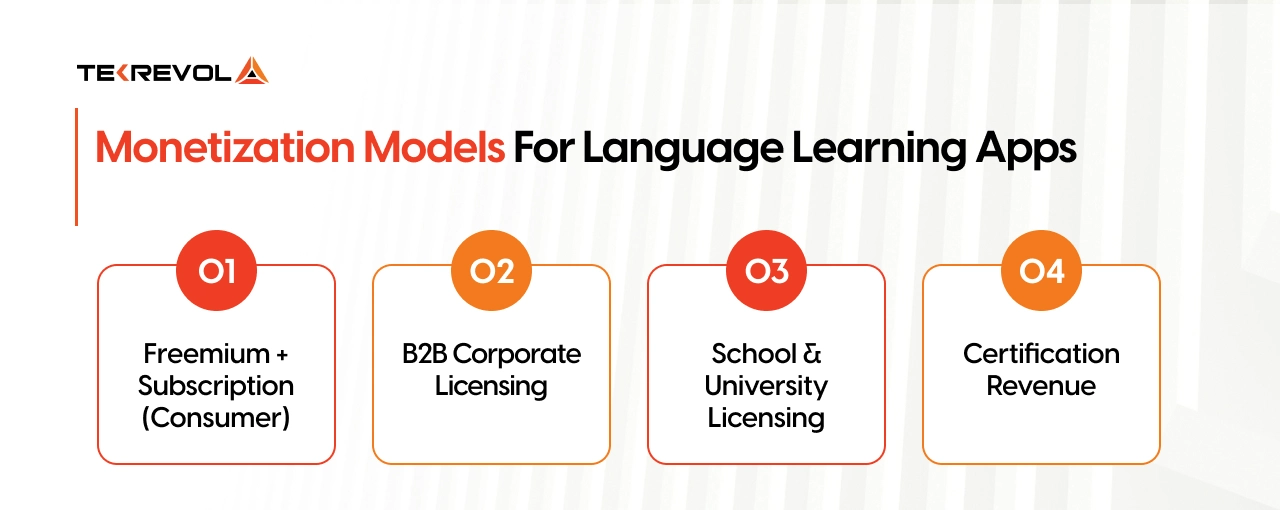
The general framework for how to make money from apps applies here, but language learning has category-specific dynamics worth understanding in detail:
The most common monetization mistake in this category: launching freemium without identifying the conversion trigger. The question is not what premium features to offer; it is what moment in the free experience creates the strongest desire to upgrade.
For streak-heavy designs, the streak freeze is the answer. For speech-enabled apps, unlimited speaking exercises are the answer. Map the conversion trigger before you map the pricing page.
The stack below reflects what we recommend for a 2026 language learning app targeting both iOS and Android.
The frontend choice deserves the most explanation: React Native app development is the strongest cross-platform option for this category because it gives enough room to developers to handle critical tasks like audio handling, microphone access, and offline storage.
| Layer | Technology | Why This Choice |
| Frontend | React Native | Cross-platform code with native audio, microphone, and offline storage support. |
| Backend | Python / Django | Ideal for ML/SRS logic integration and structured API delivery via DRF. |
| SRS Engine | FSRS (Server-Side) | More accurate than SM-2; server-side tracking allows continuous data tuning. |
| Speech Recognition | Azure AI Speech | Returns native phoneme-level pronunciation scores, cutting engineering by 60%. |
| AI / NLP | OpenAI / Custom Model | Generates AI dialogues, contextual grammar, and adaptive content dynamically. |
| Database | PostgreSQL | Ensures relational integrity for lesson graphs with JSONB for user states. |
| CDN / Media | Cloudflare R2 + CDN | Low-cost audio/video asset delivery with 40% cheaper egress than AWS S3. |
| Push Notifications | Firebase (FCM) / APNs | Cross-platform SDK to trigger high-engagement streak and quest reminders. |
One backend architecture decision worth flagging: the SRS scheduling engine must run server-side, not client-side.
Client-side scheduling is faster, but means you cannot audit learning outcomes, tune the algorithm based on aggregate data, or migrate users to improved algorithm versions without losing their history.
TekRevol’s cross platform app development team treats the server-side SRS engine as a core service from sprint one, never a utility function bolted on later.
Let’s be honest: language apps are incredibly easy to mess up, and users are completely unforgiving. If your SRS engine glitches, users get frustrated within a week. If your pronunciation scoring is inaccurate, they uninstall your app during the very first session. In this category of EdTech, shortcuts are immediately visible.
That is why you need a development partner who understands the underlying engineering, not just the visual interface. At TekRevol, we specialize in building the core architecture that drives long-term retention. Our team has hands-on experience deploying server-side FSRS algorithm modules, integrating advanced speech evaluation pipelines, and mapping out adaptive learning graphs.
We don’t just build pretty screens. We stress-test your core learning loops, handle complex non-native accent mechanics, and build scalable infrastructure that can expand from a consumer MVP to a major enterprise B2B platform. We build the tech right the first time, so your business can scale without limits
TekRevol has built SRS-based learning systems, speech-enabled apps, and gamified education platforms. Get your free scoping session today.
Get Your Free Scoping Session Today


A basic vocabulary and quiz MVP costs $20,000–$35,000. A full-featured language learning app with spaced repetition, speech recognition, and complete gamification runs $60,000–$120,000. An enterprise LMS platform starts at $150,000+. The biggest cost drivers are the SRS engine, pronunciation scoring API integration, and the gamification architecture.
A spaced repetition system schedules vocabulary reviews based on each learner’s individual forgetting curve, ensuring every session reviews items at the optimal moment, just before they would be forgotten. Without SRS, your app is a quiz tool. With it, it is a learning tool. Retention improvement over fixed review schedules is typically 40%–60% for long-term vocabulary recall.
Azure AI Speech is the strongest choice because it returns phoneme-level pronunciation scores as structured data natively, significantly reducing post-processing engineering. Google Speech-to-Text has broader language coverage across 125+ languages. OpenAI Whisper is the best self-hosted option for teams wanting to avoid per-call API costs at scale, though it requires additional engineering for pronunciation feedback.
A basic MVP takes 10–14 weeks. A full-featured platform with SRS, speech recognition, and gamification takes 20–28 weeks. Speech recognition integration and real-learner beta testing are the phases most likely to extend the timeline; budget additional time for both rather than treating them as standard QA sprints.
No. The streak mechanic is the highest-impact single feature and belongs in every language learning app. Beyond that, choose mechanics based on your target audience. Corporate learners respond poorly to hearts/lives systems. Consumer casual learners respond well to leagues and social competition. Heritage language learners respond best to progress visualization and milestone celebrations.
Yes. The SRS engine, speech recognition pipeline, and adaptive lesson graph described in this guide apply to any subject-matter learning app: music theory, coding practice, medical terminology, professional certifications. The frontend changes entirely; the backend architecture is nearly identical. This is one of the strongest arguments for building in this category: the platform you build is not one product; it is an infrastructure that can power multiple learning products over time.
Freemium with a premium subscription is the dominant model for consumer-facing language apps. B2B corporate licensing has significantly higher LTV and lower churn if your feature set supports enterprise requirements. Most successful platforms in this category run both a consumer freemium product for organic growth and an enterprise licensing arm for revenue stability.
Muhammad Ejaz Amir is an AVP and Mobile Development Team Lead at Tekrevol, with over 5 years of experience building polished and scalable mobile applications across diverse industries. Specializing in Flutter and native Android development, he brings deep expertise in mobile architecture and a sharp eye for performance. His ability to balance technical depth with strong leadership and cross-functional collaboration makes him a key driving force behind Tekrevol's mobile success.

There are many top tech companies making a splash in the digital world in the UAE. From a desert oasis to a technological powerhouse making a splash in the world, the Emirates has grown into a major tech hub. Like...
Read More
Two travel apps can look almost identical on a phone screen. Same clean search bar, same map, same tidy booking flow. One costs $38,000 to build. The other costs $210,000. Nothing about the screenshots tells you why, and that’s exactly...
Read More
The secret behind a successful restaurant operation is its proactive management. Keeping accurate inventory, keeping customers happy with top-notch services, and monitoring individual employee performance are all essential steps that make sure your restaurant business thrives. But it is challenging...
Read MoreGet valuable consultation form our professionals to discuss your projects. We are here to help you with all of your queries.
Collaborate with us and become a trendsetter through our innovative approach.


