



- Miami’s real estate market demands multilingual interfaces, seasonal-scale infrastructure, and luxury-tier media.
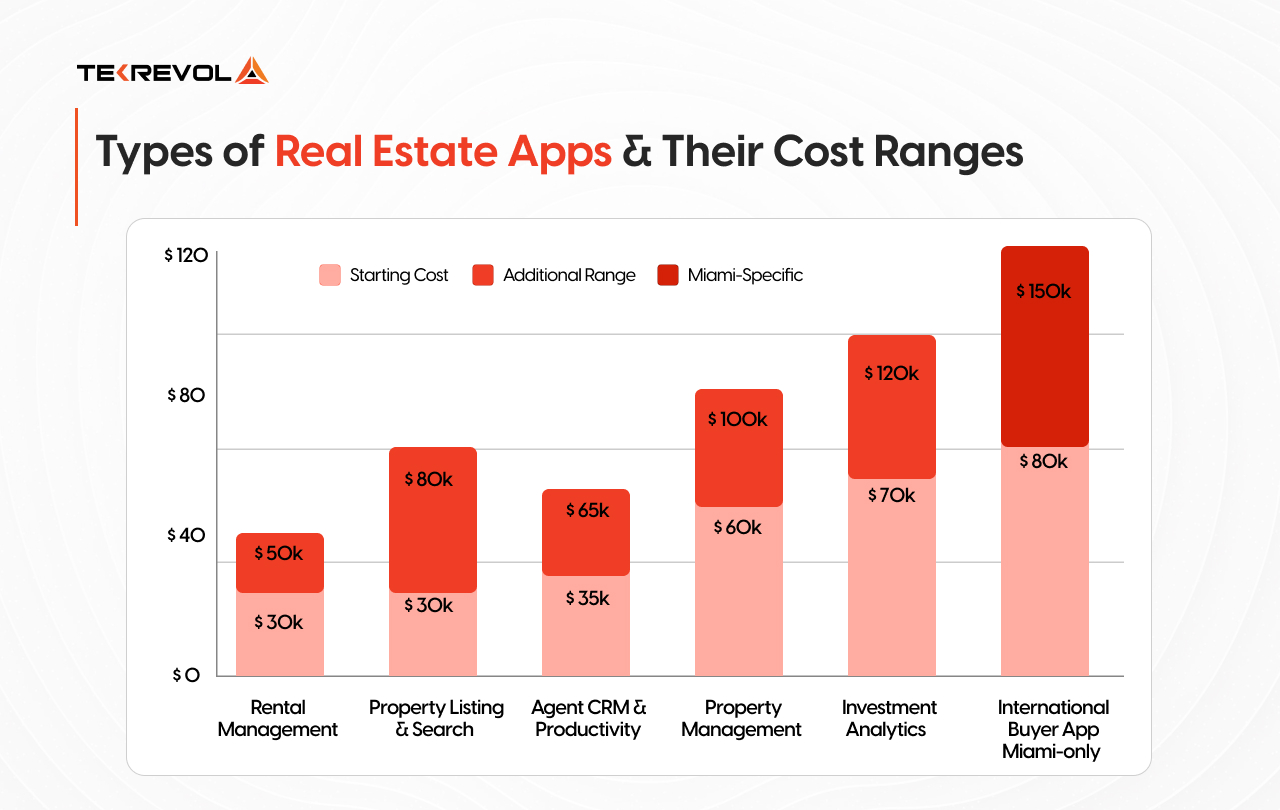
- Real estate app development in Miami costs between $30,000 for an MVP and $200,000+ for a full platform.
- Must-have features include MLS integration, virtual walkthroughs, HOA compliance, and WhatsApp-native communication for international buyers.
- Florida’s SB 4-D legislation requires condo apps to display inspection records and reserve fund compliance status inside listings.
- Cross-platform development using React Native or Flutter reduces build cost by 30–40% compared to building separate native apps.
- Choose a development partner with a verified real estate portfolio, local market knowledge, and a transparent pricing structure.
If you’re a realtor in Miami, you’ve probably noticed something shift lately. The clients who used to call you first are now comparing four listings on their phone. They’ve already done a virtual walkthrough, checked the Homeowners Association (HOA) fees, and mapped the commute all on a competitor’s app, before your name came up.
The difference comes down to one thing: a custom mobile presence built for how South Florida buyers behave. That means multilingual listings, luxury-grade media, and infrastructure that holds up during peak season. These demands make real estate app development in Miami different from anywhere else.
This guide walks you through how to build a real estate app in Miami. You’ll learn the types of apps that exist, the features needed in a real estate mobile app, and how to approach them. It also helps you choose the right app development company in Miami for your project.
Why Miami Real Estate Businesses Need a Custom App?
Miami’s real estate market ranks among the most competitive in the United States. Through custom real estate app development in Miami, businesses can reach mobile-first buyers and serve international clients.
Shared platforms built for a national audience fail to meet the city’s international buyer base, condo-heavy inventory, or multilingual market dynamics. When every broker on your platform looks the same, the one with a purpose-built app stands out.
Here’s what the data says:
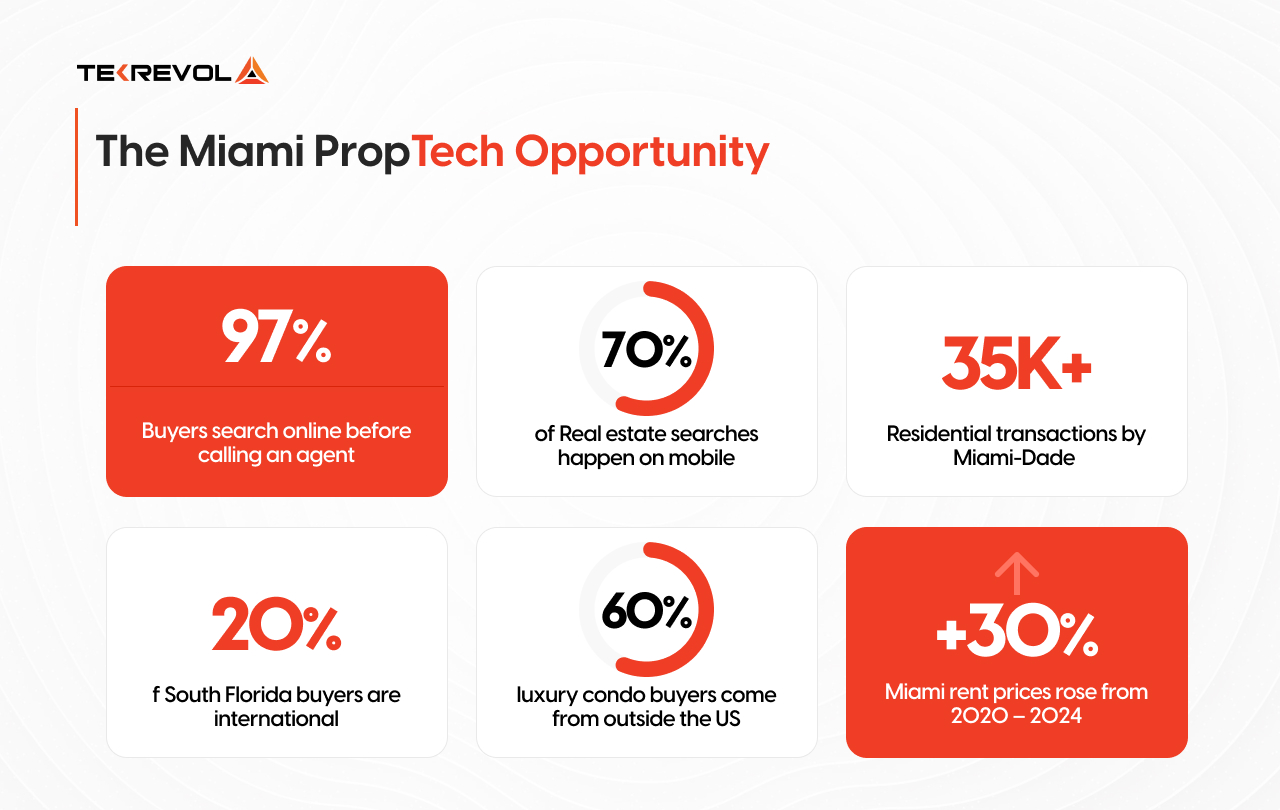
- 97% of homebuyers start their search online before speaking to an agent. (Source: National Association of Realtors)
- Miami-Dade recorded over 35,000 residential transactions in 2024. (Source: Miami Association of Realtors)
- International buyers account for nearly 21% of South Florida property purchases. (Source: National Association of Realtors International Transactions Report)
- Mobile devices drive over 70% of real estate searches across South Florida. (Source: Searchlab)
Each stat points to the same reality. Your clients are mobile-first, internationally diverse, and moving fast. A custom app meets them where they are.
The Miami PropTech Opportunity in 2026
Miami operates differently from any other US real estate market. Three factors drive that difference.
- International buyer volume. According to Miami Realtor, over 20% of South Florida buyers come from abroad. They search in Spanish and Portuguese. They use WhatsApp over traditional phone calls. A generic app misses all of this.
- Seasonal traffic spikes. Demand surges every winter as buyers from the Northeast, Canada, and Latin America enter the market. An app built for Miami needs infrastructure that handles that volume without slowing down.
- Luxury-tier media standards. Miami’s high-end listings compete globally. Buyers expect 4K virtual walkthroughs, aerial drone footage, and interactive floor plans. A standard listing app fails to meet that bar.
Who Benefits From a Custom Real Estate App
A well-built real estate app serves every role in the transaction.
- Buyers get fast property search, virtual walkthroughs, mortgage calculators, and neighborhood insights.
- Sellers get listing performance data, digital document tools, and direct agent communication.
- Agents and brokers get lead management, scheduling tools, and CRM integration.
- Property managers get tenant communication, HOA compliance tracking, and payment processing.
- Investors get cap rate calculators, market trend dashboards, and ROI analytics.
Miami’s market includes all five of these audiences, often within the same deal. That complexity is exactly what a custom app is built to handle.
Miami's Real Estate Market Is Going Digital-First
Early movers are already gaining a competitive edge. TekRevol helps you build and launch innovative real estate apps before the market becomes more crowded and the opportunity narrows.
Book Your Free App Consultation Now →Types of Real Estate Apps You Can Build for Miami’s Market
Miami’s real estate landscape covers multiple business models. You’ve got buyers chasing waterfront condos, landlords juggling short-term rentals, agents closing luxury deals in three languages, and investors analyzing cap rates from São Paulo.
The app you build needs to serve one of these worlds specifically, not all of them poorly. Here are the six main real estate app solutions and how each one fits Miami’s market.
1. Property Listing & Search Apps
These are the most common types of real estate apps. They let users browse, filter, and compare properties. Think Zillow or Trulia, but branded, faster, and built around your inventory.
Property listing app development for Miami goes beyond standard search filters that reflect the city’s distinct neighborhoods. A platform built for this market surfaces waterfront properties, pre-construction condos, and short-term rental eligibility alongside price and square footage.
Best for: Agencies, brokerages, and developers with large listing inventories.
2. Rental Management Apps
Rental apps connect landlords and tenants. They handle listings, applications, lease agreements, rent collection, and maintenance requests all on one platform.
Miami’s rental market is one of the busiest in the US. Research by Greater Miami & Miami Beach shows that rent prices in Miami-Dade rose over 30% between 2020 and 2024. A well-built rental app gives landlords full visibility and tenants a seamless experience.
Best for: Property management companies, independent landlords, and rental agencies.
3. Agent CRM & Productivity Apps
These apps help agents manage leads, track client communication, schedule showings, and monitor pipeline performance. They replace fragmented tools, spreadsheets, email threads, and calendar apps with a single mobile workspace.
Miami agents manage luxury listings across Brickell, Coconut Grove, Edgewater, and Miami Beach at the same time. A CRM app with WhatsApp integration and multilingual communication tools adds serious value for that audience.
Best for: Individual agents, boutique agencies, and mid-size brokerages.
4. Property Management Platforms
These platforms handle the operational side of real estate. They cover tenant onboarding, rent collection, maintenance scheduling, and financial reporting.
Miami’s condo market adds complexity here. Florida’s SB 4-D legislation introduced new inspection and reserve fund requirements for condo buildings. A property management app built for Miami needs to track and surface that compliance data automatically.
Best for: Condo associations, property managers, and real estate investment firms.
5. Investment Analytics Apps
These apps give investors the data they need to make fast decisions. They include cap rate calculators, market trend dashboards, ROI projectors, and comparative property analysis tools.
Miami attracts buyers from across Latin America and Europe who treat South Florida real estate as an asset class. An investment app tailored to this audience addresses a gap that generic platforms leave open. Multi-currency support and international market comparisons make it relevant.
Best for: Real estate investors, investment firms, and iBuyer platforms
6. International Buyer Apps (Miami-Specific)
This is the type most competitors overlook entirely. Miami’s buyer pool is unlike any other US city. Over 60% of luxury condo buyers in Miami come from outside the United States.
An international buyer app addresses this directly. It includes Spanish and Portuguese language support, international wire transfer integration, and currency conversion tools. WhatsApp-native communication and visa or residency information round it out. These features transform an app from useful to essential for Miami’s global buyer segment.
Best for: Luxury brokerages, international real estate agencies, and developers targeting foreign investment.
Each of these app types solves a different business problem. The right starting point depends on where your biggest operational gap sits.
Must-Have Features for a Real Estate App in Miami
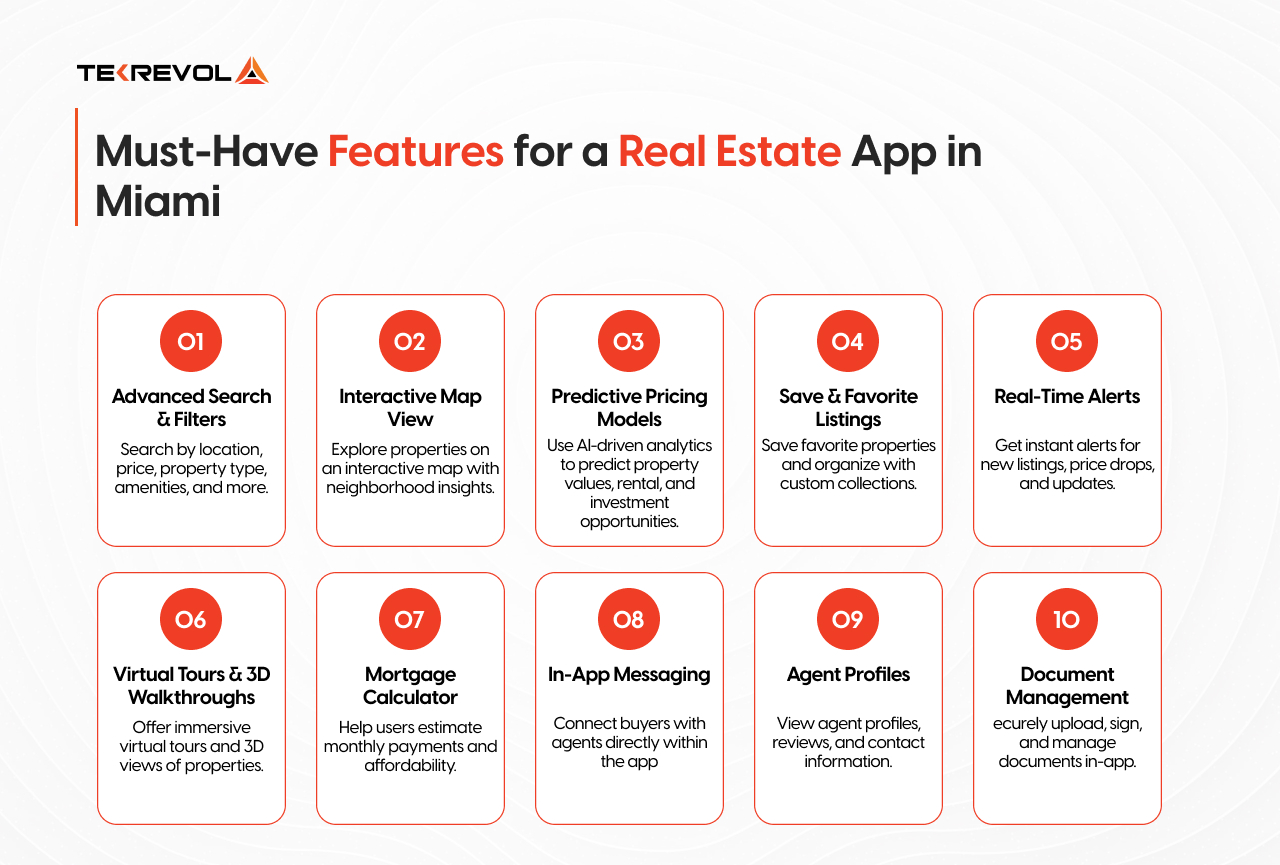
Real estate mobile app solutions for Miami realtors need property search, in-app communication, interactive maps, and user profiles at their core. Plus multilingual support, virtual walkthroughs, and HOA compliance tracking to compete in this market.
The features you choose determine how useful your app is and how often people return to it. Build too few, and it feels incomplete. Build the wrong ones, and you’ve spent budget on tools your users skip.
Here are the features needed in a real estate mobile app for Miami, broken into three layers.
A) Core Features (MVP Layer)
These are the features every real estate app needs on day one.
Property Search & Advanced Filters
Users need to find listings fast. Standard filters cover price, property type, square footage, and location. In Miami, add filters for waterfront access, building amenities, and condo association rules.
Interactive Maps
Map-based search allows users to explore properties by area. In Miami, you can also layer in neighborhood data such as school ratings, flood zone status, and proximity to transit.
User Profiles & Role-Based Access
Buyers, sellers, and agents each need a different experience. Role-based profiles give each user the tools that match their position in the transaction.
Photo Galleries & Media Upload
High-quality visuals drive decisions in real estate. Your app needs fast-loading image galleries, video support, and easy media upload tools for agents on the go.
In-App Messaging & Real-Time Chat
Direct communication between buyers and agents speeds up the process. Push notifications keep both sides informed when messages arrive or listing status changes.
Push Notifications
Price drops, new listings, and showing confirmations; push notifications keep users engaged and bring them back to your app.
B) Advanced Features (Growth Layer)
These features come in at stage two. They increase retention, improve conversion, and separate your app from basic listing platforms.
Virtual Walkthroughs & 3D Tours
In Miami, where international buyers purchase remotely, a fully immersive experience drives direct revenue. Augmented reality app development in Miami takes virtual tours beyond standard 360-degree photography. Buyers can place furniture, customize finishes, and explore spaces before scheduling a showing.
MLS / IDX Integration
Multiple Listing Service (MLS) and Internet Data Exchange (IDX) integration connects your app to the full regional listing database. It keeps inventory accurate and current without manual updates.
Mortgage Calculator
A built-in mortgage calculator helps buyers estimate monthly payments instantly. It reduces drop-off at the decision stage and keeps users inside your app.
AI-Powered Property Recommendations
Machine learning analyzes user behavior, searches, saves, and time on listings and surfaces relevant properties. The longer a user spends in the app, the sharper the recommendations get.
Digital Document Signing
E-signature tools let agents and clients execute agreements inside the app. It removes friction from the closing process and speeds up every transaction.
Saved Searches & Price Alerts
Users save their search criteria and receive alerts when matching listings appear, or prices change. This feature drives repeat opens and keeps your brand top of mind.
Predictive Pricing Models
An AI pricing engine analyzes comparable sales, market trends, and neighborhood data. It gives buyers real-time valuation estimates. In Miami’s fast-moving luxury market, this builds trust and speeds up decisions.
AI Chatbots for 24/7 Lead Capture
An AI chatbot handles inquiries, qualifies leads, and schedules showings around the clock. For Miami’s international buyers operating across time zones, automated responses keep deals moving.
C) Miami-Specific Features
Generic real estate apps cover the standard feature set. Here is what mobile app solutions for Miami realtors demand:
Spanish & Portuguese Language Support
Miami’s buyer pool speaks multiple languages. A multilingual interface removes friction for international buyers and signals your platform was built for this market.
WhatsApp-Native Communication
Latin American and European buyers use WhatsApp as their primary channel. Integrating it directly into your app meets them where they already operate.
International Wire Transfer Support
Foreign buyers fund purchases differently. Your app needs to support international payment methods and display pricing in multiple currencies.
HOA Compliance Tracker
Florida’s SB 4-D legislation requires condo buildings to meet new inspection and reserve fund standards. A compliance tracker surfaces this data inside the listing, giving buyers the information they need before they ask.
Seasonal Traffic Architecture
Miami’s market surges every winter. Your app’s backend needs to handle those spikes without slowing down. If you want to understand what powers the infrastructure, our backend app development guide covers database design, API architecture, and server-side logic.
How to Build a Real Estate App for the Miami Market?
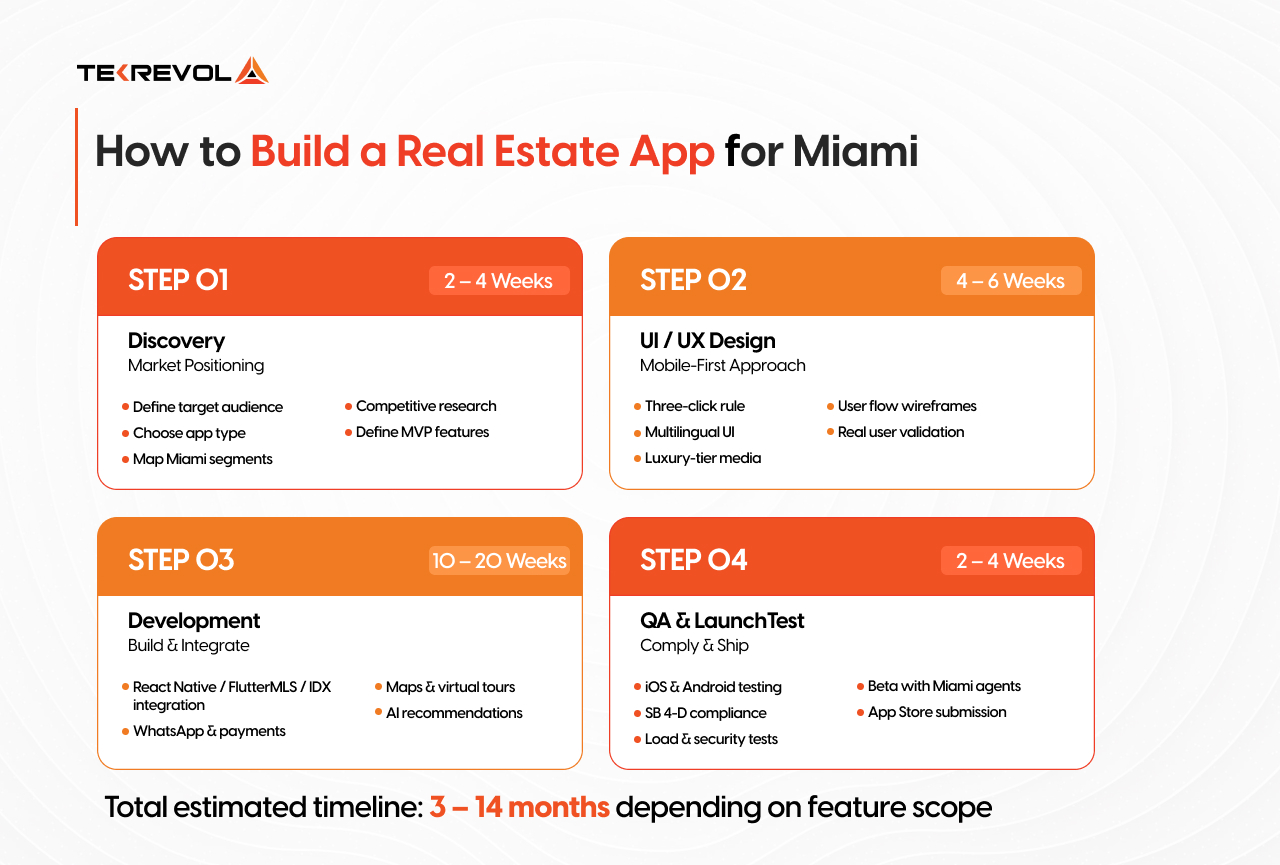
Building a real estate app follows five stages: discovery, UI/UX design, development, QA, and launch, with Miami-specific decisions built into each. Each stage builds on the last. Skip one, and you’ll spend twice as long fixing it later.
Here’s how the process of real estate app development in Miami works from start to finish.
Discovery & Market Positioning
Every successful real estate app starts with one question: Who is this for?
Miami’s market has five distinct buyer profiles: luxury investors, international buyers, first-time homeowners, seasonal renters, and commercial operators. Each one needs a different product. Trying to serve all five at once dilutes the product for everyone.
During discovery, you define:
- Your primary user and their core problem
- The app type that solves it (listing, rental, CRM, etc.)
- The Miami neighborhoods and buyer segments you target
- Your monetization model
- Your MVP feature set
This stage also covers competitive research. Look at what Zillow, Realtor.com, and local Miami brokerages currently offer. Find the gap. Build for that. If you want to match the functionality of major national platforms, our guide to building a real estate app like Zillow walks through the full technical approach.
UI/UX Design for Miami’s Mobile-First Buyers
Miami’s buyers are mobile-first and visually driven. Your app’s design needs to reflect both.
Good real estate UX follows three principles:
- The three-click rule. A user should reach any listing in three taps or fewer. Every extra step loses a potential lead.
- Multilingual by default. Spanish and Portuguese speakers make up a significant share of Miami’s buyer pool. Build language switching into the UI from day one, as retrofitting it later costs more time and budget.
- Luxury-tier media standards. Miami’s high-end listings compete with global inventory. Your image viewer, video player, and virtual walkthrough interface need to match that standard. Slow-loading media ends the session.
Wireframe every key user flow before development begins. Fixing UX problems caught at the wireframe stage costs a fraction of what they cost post-launch.
Development, API Integration & Tech Stack
The tech decisions you make here affect your app’s speed, scalability, and maintenance cost for years.
Recommended stack for a Miami real estate app:
| Layer | Technology Options |
| Mobile (Cross-Platform) | React Native, Flutter |
| Mobile (Native) | Swift (iOS), Kotlin (Android) |
| Backend | Node.js, Python (Django) |
| Database | PostgreSQL, Firebase, MongoDB |
| Cloud | AWS, Google Cloud |
| Maps | Google Maps API, Mapbox |
| Listings | MLS / IDX API |
| Payments | Stripe, international wire support |
| Communication | Twilio, WhatsApp Business API |
| Documents | DocuSign API |
MLS/IDX integration is the most critical API decision. It connects your app to live listing data across South Florida. For a full breakdown of the best options, see our guide to real estate data APIs.
QA & Launch
A real estate app handles financial details, personal identifiers, and legal documents. Your pre-launch app testing process needs to reflect that responsibility.
QA checklist before launch:
- Functional testing across iOS and Android devices
- Load testing for seasonal traffic spikes (Miami’s winter surge)
- Security testing for data encryption and user authentication
- Usability testing with real Miami buyers and agents
- MLS data accuracy verification
- Payment flow testing across international methods
App Store and Google Play submission takes 1–3 business days on average. Build that window into your launch plan.
How Much Does Real Estate App Development in Miami Cost?
Real estate app development in Miami costs between $30,000 and $200,000+. The final number depends on app type, feature complexity, platform choice, and your development team.
Here’s a breakdown of real estate app development costs in Miami by tier.
| App Tier | Estimated Cost | Timeline |
| MVP / Basic listing app | $30,000 – $50,000 | 3–4 months |
| Mid-tier with MLS + virtual tours | $60,000 – $100,000 | 5–7 months |
| Full-featured PropTech platform | $100,000 – $200,000+ | 9–14 months |
Most Miami real estate startups begin at the MVP tier. Through MVP development, they validate the product with real users, then invest in advanced features based on actual demand.
What Drives the Real Estate App Development Cost Up
Five factors determine where your cost for Miami apps lands on the cost spectrum.
1. Number of features
Every feature affects the time to design, develop, and test. An app with MLS integration, virtual walkthroughs, AI recommendations, and multilingual support costs far more than a basic listing app. Prioritize your MVP feature set before development starts.
2. Platform choice
The platform decision, iOS vs Android for your Miami app, shapes everything downstream, including your MLS integration approach and your timeline to first launch.
Building for iOS costs less than building for iOS and Android. Cross-platform app development (React Native or Flutter) covers both platforms from a single codebase. It reduces build cost by 30–40% compared to separate native builds.
3. Design complexity
Luxury real estate apps demand higher design standards. Custom animations, 4K media support, and polished UI all add to the timeline and budget.
4. API integrations
MLS/IDX feeds, Google Maps, WhatsApp Business API, DocuSign, and international payment gateways each add integration costs. Budget for API integration, licensing, and ongoing fees separately.
5. Development team location
Miami-based developers typically charge $100–$175 per hour. Offshore teams charge less but add communication overhead, timezone gaps, and quality variance. For a product built for Miami’s competitive market, local expertise pays for itself.
Real Estate Compliance Miami App Must Address
A Miami real estate app must comply with Florida’s SB 4-D condo safety laws, the 2024 NAR commission settlement, Fair Housing Act, and data privacy standards for user and payment data.
Florida’s SB 4-D — Condo Safety Compliance
Florida’s SB 4-D legislation was passed in the wake of the 2021 Surfside collapse. It requires condo associations in buildings three stories or taller to complete structural integrity reserve studies and maintain adequate reserve funds. (Source: Florida Legislature)
For your app, this means: every condo listing needs to surface compliance status. Buyers want to know if the building has completed its study, what the reserve fund status is, and whether any assessments are pending.
NAR Settlement & Commission Transparency
The 2024 NAR settlement changed how buyer agent commissions work across the US. Sellers are no longer required to offer buyer agent compensation through the MLS. Buyers and their agents must agree on compensation in writing before touring properties. (Source: National Association of Realtors)
Your app needs to reflect this. Commission information must display clearly on listings. Buyer agreement workflows need to sit inside the app before a showing gets scheduled. An app that skips this creates legal exposure for the agents using it.
Data Privacy & Security Standards
A real estate app collects sensitive user data: names, financial details, identity documents, and transaction history. Your app must handle all of it responsibly.
Key standards to build for:
- PCI DSS: Required for any app that processes payment card data
- CCPA: Applies to California residents using your Miami app
- Fair Housing Act: Your search algorithm and recommendation engine must treat all users equally. Filtering results by protected characteristics, even unintentionally, creates legal liability
- SSL encryption: All data in transit must be encrypted
- Two-factor authentication: Required for agent and admin accounts handling sensitive listings
Apps that skip proper data security measures face regulatory fines, damage user trust, and are removed from the app store. In Miami’s high-value real estate market, the stakes are higher.
How to Choose the Best Real Estate App Development Company in Miami, Florida
To choose a real estate/proptech app development company in Miami, look for a verified portfolio, MLS/IDX integration knowledge, local market understanding, transparent pricing, and post-launch support.
The company you choose shapes your product for years. A wrong hire at this stage costs more than the development itself. Here’s the full checklist:
Questions to Ask Before You Hire
- Have you built real estate apps before?
General platforms and real estate app experiences are different. MLS integration, compliance layers, virtual walkthrough support, and multilingual UI require domain-specific knowledge. Ask to see the portfolio. Look for live products with real users.
- How do you handle MLS/IDX integration?
This is the most technically complex part of a real estate app development. The top developers in Miami with real experience answer this question with specifics. A developer with less experience gives you a vague answer.
- What does your post-launch support look like?
An app needs maintenance, updates, and bug fixes after launch. Get the support terms in writing before you sign. With a monthly retainer, hourly rate, or included hours, you know exactly what you’re paying for.
- How do you handle scope changes?
Scope changes happen in every build. How a team manages them reveals how they operate. Ask for their change request process and how additional costs get approved.
- Can you provide client references in real estate?
Verified reviews on Clutch or Google carry more weight than testimonials on a company’s own site. Ask for direct references you can contact.
Warning Signs to Watch For
These signals indicate a development partner who will cost you more in the long run.
Vague pricing with zero itemization
A professional development company breaks down cost by feature, platform, and phase. A quote that says “$50,000 for a real estate app” with zero detail attached signals a poor process.
Portfolio with zero live products
Mockups and wireframes are easy to produce. Ask for App Store or Play Store links. If they struggle to provide them, treat that as a signal.
Timelines that sound too good
“We can build your full-featured app in six weeks” is a warning sign. A basic MVP takes three to four months. Anyone promising faster is cutting corners somewhere.
Offshore teams presented as local
Some companies market themselves as Miami-based but operate offshore. Ask where the development team is located. Ask who your day-to-day point of contact will be.
How TekRevol Can Help With Real Estate App Development in Miami?
Competing in Miami’s real estate market takes more than great listings. It takes a seamless digital experience. One that meets buyers on their phones, in their language, at any hour.
Whether you’re a Miami broker or a PropTech founder, TekRevol is your strategic partner right here in the city.
Located at 400 NW 26th St in Wynwood, we understand Miami’s unique market pulse. We engineer high-performance platforms that help real estate businesses own their client relationships and close faster.
Our Expertise in Real Estate App Development
- Custom Property Listing Platforms: We build branded, MLS-integrated apps that give buyers a faster, richer search experience. Your clients stay on your platform.
- Multilingual & International Buyer Features: From Spanish and Portuguese support to WhatsApp-native communication and international wire transfers, we build for Miami’s global buyer base.
- Compliance-Ready Architecture: We build SB 4-D compliance tracking, HOA data, and NAR settlement workflows into your app from day one. You launch ready.
- Luxury-Tier Media Standards: From 4K virtual walkthroughs to drone footage integration, we build media pipelines that match the standard Miami’s high-end listings demand.
- Seasonal-Scale Infrastructure: We architect backends that handle Miami’s winter demand surges without performance drops. A slow app during peak season costs more than a year of maintenance.
Ready to own your digital presence in Miami’s market? Our local team turns your vision into a real estate app built for this city.
Stop Renting Space and Build Your Real Estate Platform
Join Miami’s growing proptech market with a custom real estate app designed around your clients, business goals, and long-term growth strategy.
Secure Your Free Strategy Session →


