



- US game developers charge $30 to $200 an hour, with engine specialists commanding the top rates.
- Unreal specialists bill roughly 40 percent above Unity developers working at the same seniority level.
- A shippable game needs four to six people, so one developer’s rate never equals your budget.
- Art style moves cost more than engine choice, since photorealistic models cost ten times as much as pixel art.
- Marketing needs 15 to 20 percent of the total budget as a floor, and often 25 to 50 percent.
- Unreal takes 5 percent of lifetime gross revenue above one million dollars in qualifying sales.
Hiring a game developer can cost $30 to $200+ per hour in the US, or roughly $4,800 to $32,000 a month, depending on experience, engine, specialty, location, and project requirements. A simple 2D mobile game may need a small development team, while a multiplayer 3D title can require programmers, designers, artists, backend engineers, and other specialists.
If you plan to hire game app developers, their hourly rate is only one part of your budget. You also need to consider development time, platform requirements, engine royalties, store commissions, servers, certification, and post-launch support.
This guide breaks down game developer rates by experience, engine, specialty, location, and hiring model, along with the additional costs you should plan for before and after launch.
So, let’s get started!
How Much Does It Cost to Hire Game App Developers? A Quick Answer
Hiring game developers costs $30 to $200 per hour in the US, or roughly $4,800 to $32,000 monthly for full-time. Junior developers start near $30, mid-level sits around $50 to $100, and senior engine specialists reach $200 for console or graphics work.
| Level or specialty | Hourly (USD) | Monthly, full-time | What you’re paying for |
| Junior developer | $30 to $60 | $4,800 to $9,600 | Feature work under supervision, bug fixing, content implementation |
| Mid-level developer | $50 to $100 | $8,000 to $16,000 | Independent systems, gameplay features, integration work |
| Senior or lead | $100 to $200 | $16,000 to $32,000 | Architecture, technical direction, mentoring, hard problems |
| Unity specialist | $50 to $120 | $8,000 to $19,200 | Mobile and cross-platform builds, rapid iteration |
| Unreal specialist | $80 to $160 | $12,800 to $25,600 | High-fidelity 3D, C++ systems, console targets |
| Engine, graphics, or console | $120 to $200+ | $19,200 to $32,000+ | Rendering, optimisation, platform certification |
Note: Use these rates as a starting point, not a fixed project price. Your final cost will depend on the game’s scope, team size, development timeline, and the specialists you need.
6. Engagement model
The way you hire a game developer can affect both your upfront costs and overall development budget. Freelancers, in-house developers, and game development agencies each offer different levels of flexibility, expertise, and support.
| Model | Cost | Best for |
| Freelancer | $30 to $80 per hour | Discrete tasks, ports, single features |
| Marketplace hire | $48 to $71 per hour | Small-scoped jobs and prototypes |
| Agency or studio | $120 to $250 per hour | Full builds needing code, art, audio, and QA together |
| In-house | Salary plus 25 to 40 percent | Live-service games need constant iteration |
In-house means more control, though you’re not just paying salaries. You’re recruiting, covering benefits, buying software licences, and possibly finding desk space. For studios planning multiple titles, that investment usually pays off. For a single game, it rarely does.
7. Pricing model
How you’re billed matters as much as who you hire, and the two are separate decisions. Every pricing model is really a question about who carries the risk when the estimate is wrong.
| Model | How you pay | Who carries the risk | Best For |
| Fixed price | One agreed figure for an agreed scope | The studio, so they price a buffer in | Well-defined scopes, ports, prototypes |
| Time and materials | Hourly or monthly against actual work | You, since exposure is uncapped | Evolving scope, live iteration, R&D |
| Dedicated team | Monthly retainer for a reserved team | Shared, though you carry utilisation | Long-running projects and LiveOps |
Fixed pricing gives you budget certainty, but it often costs more. Studios usually add a premium for taking on project risk, and changes can lead to extra charges. For games, fixed pricing works well for prototypes and vertical slices, while full production is often better suited to time-and-materials or dedicated teams.
8. Art Design And Animation
Art style is the lever, and it costs more than most founders expect. The engineering to display a character is identical whether that character is sixteen pixels or a photorealistic model. What changes are the hours behind the asset.
| Art approach | Cost per character model | Best For |
| Pixel art | Lowest, often under $300 | Retro titles, small teams, fast iteration |
| Hand-drawn or stylised 2D | $300 to $800 | Mobile casual, puzzle, narrative games |
| Mid-quality 3D | $1,000 to $2,500 | Most mobile and mid-tier 3D titles |
| High-poly or photorealistic 3D | $3,000 to $10,000+ | Console, PC, high-fidelity showcases |
Multiply those by your character count, then again by environments, props, and UI. That’s why 2D indie and mobile budgets commonly land at $10,000 to $50,000, while mid-tier 3D runs $50,000 to $500,000 and up. So choosing a style is a budget decision disguised as a creative one.
Additional Factors That Can Increase Game Development Costs
Feature costs sit on top of your core build. Audio, AI, multiplayer, and monetisation each add engineering hours, and multiplayer is the one that reshapes a budget. Expect anywhere from a few thousand dollars for basic audio to $80,000 and up for real-time networked play.
Sound and music design
Audio sets the atmosphere and makes gameplay feel finished. Cost depends on whether you license existing assets or commission original work.
| Audio Scope | Cost |
| Sound effects | $500 to $3,000 |
| Original background music | $1,000 to $5,000+ |
| Professional voiceover | $500 to $5,000+ |
| Full custom audio package | $5,000 to $15,000+ |
Licensed and ready-made libraries keep this line small. Original music, voice acting, and bespoke effects are where it grows.
AI Integration
AI drives NPC behaviour, enemy logic, bots, and difficulty balancing. More capable systems need more development, testing, and tuning.
| AI feature | Cost |
| Basic NPC behaviour | $2,000 to $8,000 |
| Advanced enemy or combat AI | $5,000 to $20,000+ |
| Adaptive difficulty | $5,000 to $15,000+ |
| Multiplayer bots | $8,000 to $25,000+ |
| Generative AI features | $10,000 to $50,000+ |
Multiplayer and Server Setup
Multiplayer adds networking and backend requirements that reshape a budget rather than extend it. Cost tracks player count, game mode, and how real-time the play needs to be.
| Multiplayer component | Cost |
| Chat and communication | $3,000 to $10,000 |
| Matchmaking and lobbies | $5,000 to $15,000 |
| Dedicated server setup | $5,000 to $20,000+ |
| Basic multiplayer | $15,000 to $40,000 |
| Real-time multiplayer | $30,000 to $80,000+ |
| Advanced multiplayer with anti-cheat | $40,000 to $100,000+ |
Recurring server and cloud costs then run after launch, separately from the build. A fully multiplayer title built from the ground up is a different proposition again, which is why the game type table puts MMO projects above $1,000,000.
Monetization integration
Monetization is development work, and building it in from the start costs less than adding it later.
| Monetization feature | Build Cost |
| Advertising integration | $1,000 to $5,000 |
| Analytics and attribution | $2,000 to $8,000 |
| In-app purchases | $3,000 to $10,000 |
| Subscriptions | $3,000 to $10,000 |
| Battle pass | $5,000 to $15,000+ |
| Virtual currency and game economy | $5,000 to $20,000+ |
Note that these are build costs only. Platform commission and marketing spend sit in the post-hire section below.
What Does a Game Development Team Actually Cost to Assemble?
A game development team costs far more than one developer because games need art, audio, and QA alongside code. A minimum shippable team runs four to six people. Even a small mobile title typically needs a developer, an artist, a designer, and part-time QA. Here’s what a real team looks like at three scales.
| Role | Small mobile title | Mid-size 3D game | Larger multiplayer title |
| Game developers | 1 to 2 | 3 to 5 | 6 to 12 |
| Game designer | Part-time | 1 | 2 |
| 2D or 3D artist | 1 | 2 to 4 | 4 to 8 |
| Animator | Contract | 1 | 2 to 3 |
| Audio and sound design | Contract | Contract or 1 | 1 to 2 |
| Backend or multiplayer engineer | Not needed | 1 if online | 2 to 3 |
| QA | Part-time | 1 | 2 to 4 |
| Producer or project manager | Founder | 1 | 1 to 2 |
If you’d rather extend your own team than build one from scratch, our IT staff augmentation service covers that model, and it usually lands between freelancer and full-agency pricing.
Practical Tips for Planning a Game Development Budget
Budget a game development project by discipline rather than by developer count. Art and animation take the largest share at roughly 30 percent, with programming close behind at 27 percent. Then add contingency separately, and let your funding tier set the ceiling.
| Discipline | Share of build | $60,000 build | $150,000 build | $400,000 build |
| Pre-production and design | 10% | $6,000 | $15,000 | $40,000 |
| Programming | 27% | $16,000 | $40,500 | $108,000 |
| Art and animation | 30% | $18,000 | $45,000 | $120,000 |
| Audio | 5% | $3,000 | $7,500 | $20,000 |
| QA and testing | 13% | $8,000 | $19,500 | $52,000 |
| Project management | 10% | $6,000 | $15,000 | $40,000 |
| Launch and certification | 5% | $3,000 | $7,500 | $20,000 |
| Total build | 100% | $60,000 | $150,000 | $400,000 |
Art can be the highest cost on visually rich games, often exceeding programming. Build a 20%–30% contingency into your overall budget to cover unexpected changes.
Budgeting by Company Size
Game budgets vary with the size of your studio and how much funding you have available. A solo developer, an indie team, and an established studio will face very different costs, timelines, and resource requirements.
| Tier | Budget | Team Size | Timeline | What it realistically buys |
| Indie | $20,000 to $150,000 | 1 to 3 people | 3 to 8 months | One platform, 2D or stylised art, focused scope |
| Startup | $100,000 to $500,000 | 4 to 8 people | 9 to 18 months | Two platforms, mid-quality 3D, live features |
| Enterprise | $500,000+ | 8 to 20+ people | 18 months+ | Multiplayer, live ops, permanent team, multi-platform |
What each tier actually gets you
Indie, at $60,000: One developer, one artist, a part-time designer, and contract audio. Roughly $18,000 goes to art, $16,000 to programming, and $8,000 to QA. That buys a polished 2D mobile game with hand-drawn or pixel art on a single platform. What it doesn’t buy is 3D, multiplayer, or a marketing budget worth the name.
Startup, at $250,000: Three to five developers, two artists, an animator, a designer, dedicated QA, and a producer. Around $75,000 goes to art, $67,500 to programming. That buys a cross-platform 3D title with mid-quality models at $1,000 to $2,500 each, real progression systems, and enough left for a $30,000 launch push.
Enterprise, at $1,000,000+: Full studio structure, backend engineers, live-ops staffing, and infrastructure. That buys real-time multiplayer with anti-cheat at $40,000 to $100,000 on its own, server infrastructure, and the content pipeline to keep a live game running past launch.
What Costs Come After You Hire Game Developers?
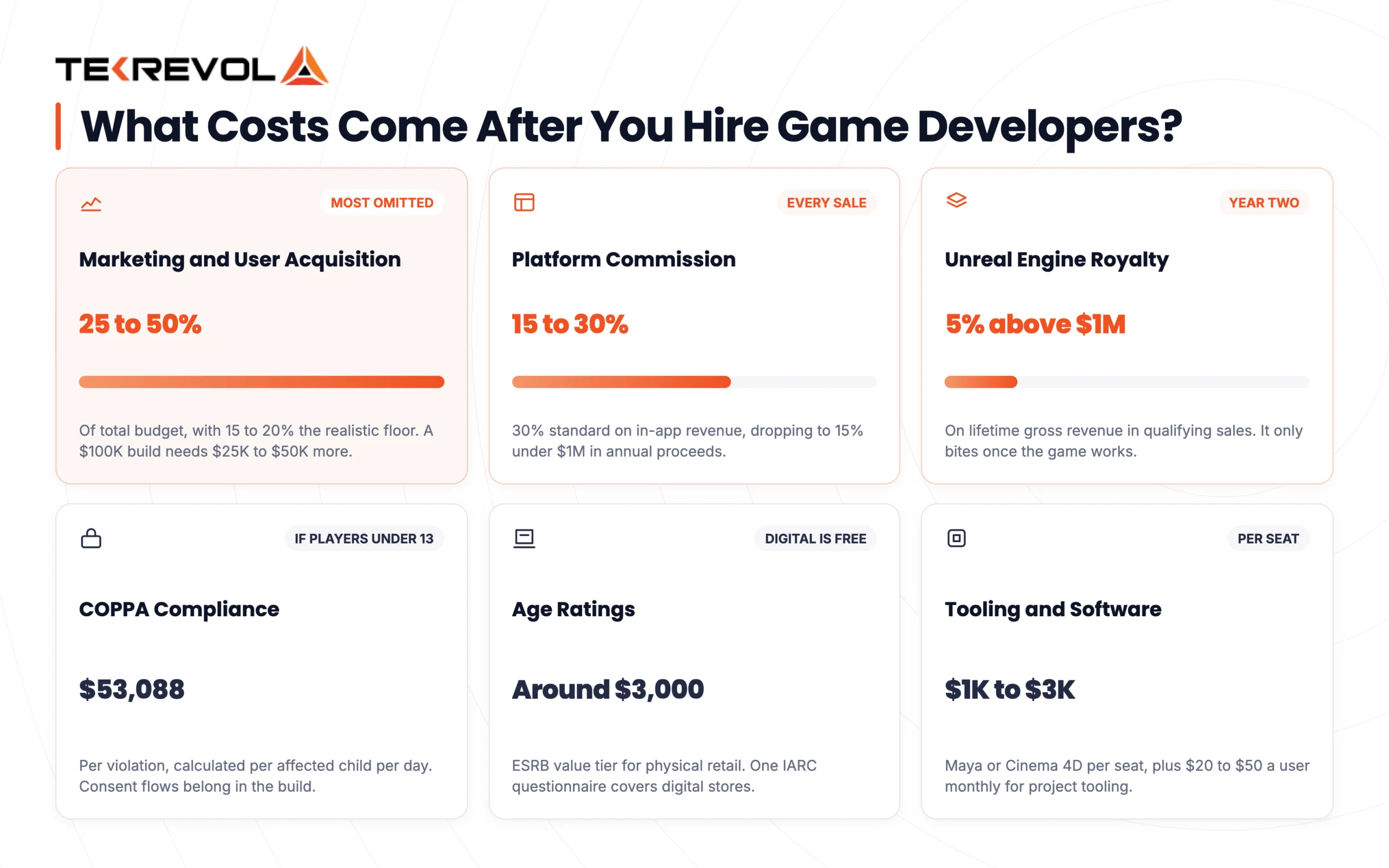
Costs that come after you hire game developers include engine royalties, tooling, age ratings, privacy compliance, platform commission, and marketing. Unreal takes 5 percent above $1 million, app stores take 15 to 30 percent, and marketing needs 15 to 50 percent of the budget.
Engine Royalties and Licensing
Unreal is free until your product passes $1 million in lifetime gross revenue. Above that, Epic charges a 5 percent royalty on revenue attributable to the product, per Epic’s licensing terms. Epic Games Store sales are excluded.
Seat-based licensing at $1,850 per seat per year applies to commercial licensees over $1 million who aren’t shipping royalty-bearing products. That covers non-game uses, not games.
Model the royalty into year two. It only bites once the game works.
Tooling is separate again. Modelling and animation suites such as Maya or Cinema 4D run $1,000 to $3,000 per seat, though Blender is free if your pipeline supports it. Project management tooling adds $20 to $50 per user monthly. Asset store purchases, plugins, and middleware for audio, physics, or analytics all sit outside the developer rate. So ask any studio whether tooling is included in their number or billed on top, because both are common.
For game asset creation, Maya and Blender offer different strengths. See our Maya vs. Blender comparison to choose the right tool for your project.
Age Ratings and Certification
Digital-only studios usually get ratings for free. Completing the IARC questionnaire once produces ratings for Google Play, Nintendo eShop, the Microsoft Store, PlayStation Store, Epic Games Store, Meta Quest, and Amazon Luna. Skip it on Google Play, and your game gets pulled from distribution.
Physical retail is where the cost sits. ESRB offers a value tier around $3,000 for studios under a $1 million budget that already hold a digital IARC rating, while PEGI physical certification runs from roughly €260 to €2,100 and up depending on budget and platform count. Apple sits outside IARC entirely and applies its own system.
Children’s Privacy and COPPA Compliance
Casual and mobile games skew young, whether you target children or not. Under COPPA, you need verifiable parental consent before collecting any personal information from a child under 13. Personal information is broad here. It covers cookies, device IDs, IP addresses, precise location, photos, audio, and chat logs.
The potential penalties are serious. Penalties reach $53,088 per violation, calculated per affected child per day. Epic Games paid $275 million in an FTC settlement. If your game may attract players under 13, privacy, analytics, advertising SDKs, and chat features should be considered during development rather than added later.
Platform Commission and Live Operations
Apple and Google take 30 percent of in-app revenue as standard, dropping to 15 percent for developers under $1 million in annual proceeds. Console platforms carry their own certification cycles, which cost as much time as money.
Live operations then run indefinitely: servers, updates, events, moderation, and player support. Online and live-service games carry the heaviest ongoing load here, so a game that succeeds costs more to run than one that doesn’t.
Marketing and User Acquisition
Marketing is the most commonly omitted line in a game budget. Published industry benchmarks place marketing and distribution at 25 to 50 percent of total project budget, with 15 to 20 percent treated as a realistic floor, scaling upward with platform competition and launch ambition.
A $100,000 build needs another $15,000 at minimum, realistically $25,000 to $50,000.
| Project type | Typical launch marketing spend |
| 2D puzzle mobile | $1,000 to $10,000 |
| Mid-tier mobile | $5,000 to $30,000 |
| Single-player PC | $5,000 to $50,000 |
| Multiplayer PC | $10,000 to $70,000 |
Those bands cover indie and mid-tier launches. Competitive commercial releases with paid user acquisition run far higher, into six figures. Contingency belongs alongside it either way, and standard practice allocates 20 to 30 percent of the total budget to it, which, on game projects, is routinely consumed rather than returned.
Have a Game Idea? Let’s Put a Budget to It
We'll assess your concept, features, and platforms to help you plan the right development budget.
Discuss Your Project!How to Hire Game Developers: A Step-by-Step Process
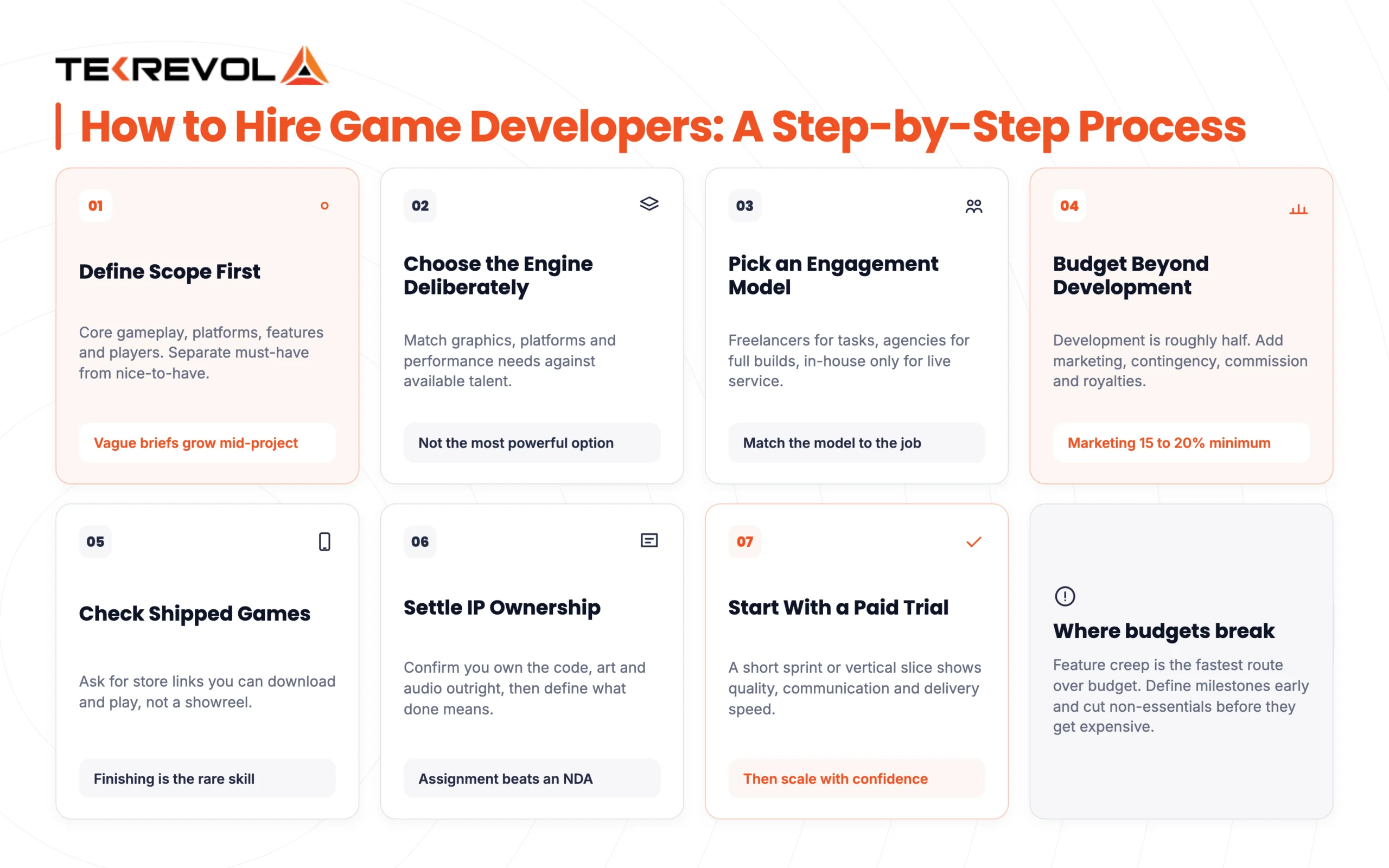
Hire game developers in seven steps: define scope, choose your engine, pick an engagement model, set a real budget, verify shipped work, settle contracts, then start with a paid trial. Most overspending traces back to skipping step one or step four.
1. Define your scope before you talk to anyone
Start with the core gameplay, target platforms, key features, and the type of players you want to reach. Separate must-have features from nice-to-have additions so developers can estimate the project based on a clear scope.
A detailed brief also makes quotes easier to compare. When the requirements are vague, the initial estimate may look affordable but grow as new features and changes are added during development.
2. Choose your engine deliberately
Your game engine affects both development cost and the type of developers you need. Unity is often a practical choice for mobile and cross-platform games, while Unreal Engine is better suited to high-end 3D, console, and visually demanding projects. Godot can reduce licensing costs and works well for smaller projects, but finding experienced developers may be more challenging.
Choose the engine based on your game’s graphics, platforms, performance needs, and available talent, rather than simply picking the most powerful option.
3. Pick an engagement model
Freelancers for discrete tasks at $30 to $80 hourly. Agencies for full builds needing code, art, audio, and QA together. In-house only if you’re running a live-service game long-term. The right model can help you control costs while giving you access to the skills your project actually needs.
4. Plan for Costs Beyond Development
Development is roughly half of it. Add marketing at 15 to 20 percent minimum, contingency at 20 to 30 percent, plus store commission, engine royalties, and post-launch running costs.
5. Check Shipped Games Before Hiring
Ask for store links you can download and play. A showreel proves someone worked on something. A live listing proves they finished it, and finishing is the rare skill here.
6. Clarify IP Ownership Before Development
An NDA protects your idea during conversations, which matters less than most founders think. What actually protects you is IP assignment in the contract: confirm you own the code, the art, and the audio outright. Then define milestone payments and what “done” means for each one, because “the combat system” can mean two weeks or two months depending on who’s reading it.
7. Use a Paid Trial Before a Long-Term Contract
Start with a short sprint or vertical slice to see how well the team understands your game and works with your process. It also gives you a clear sample of their quality, communication, and delivery speed. If the trial goes well, you can scale the team with greater confidence and a clearer idea of what the full project will require.
Partner With TekRevol for Game App Development
TekRevol brings development, art, audio, and QA together under one team, making it easier to manage your project from concept to launch. We also help identify licensing, rating, and privacy requirements early.
Our game development team covers Unity and Unreal builds across mobile, PC, and console, with dedicated practices for Unreal Engine and Web3 games.
We offer flexible engagement models, so you can bring in a single specialist or a full development team and scale as your roadmap evolves. Explore our full portfolio to see our work before getting started.
- Hire a single specialist or a complete game development team based on your needs.
- Get support for mobile, 2D, 3D, multiplayer, and other game formats.
- Add or reduce team members as your project scope and roadmap change.
- Get access to developers, artists, designers, audio specialists, and QA professionals.
Ready to build your game?
Contact TekRevol today and get your team assembled in as little as 48 hours.
Hire A Team Now!


