- ChatGPT-5 (GPT-5) launched on August 7, 2025 and became the default for all logged-in ChatGPT users.
- Its big idea: one system that switches automatically between fast answers and deeper reasoning.
- OpenAI shipped six updates in 11 months: GPT-5.1, 5.2, 5.3, 5.4, 5.5 and 5.6.
- The original GPT-5 was retired from ChatGPT on February 13, 2026.
- GPT-6 arrived in ChatGPT on October 7, 2026: GPT-6 Sol on paid plans, GPT-6 Luna on Free and Go.
- Building on OpenAI models? Plan for a new version every one to three months, not once a year.
ChatGPT-5 is OpenAI’s GPT-5 model running inside ChatGPT. It launched on August 7, 2025, and replaced the old model picker with one system that decides on its own when to answer fast and when to think harder.
Here’s the twist: if you open ChatGPT today, you’re not using GPT-5 anymore.
OpenAI retired the original GPT-5 from ChatGPT on February 13, 2026, after a run of point releases (5.1 through 5.6). Then, on October 7, 2026, GPT-6 took over the main chat for everyone.
If you have been wondering about the new ChatGPT-5 features, or want to know how GPT-5 OpenAI is different from GPT-4, you are in the right place.
Here’s everything confirmed so far about the new ChatGPT: when it came out, how you can use it, and what’s new as compared to the previous version.
What Is ChatGPT 5?
GPT-5 OpenAI may sound just like another version of ChatGPT; however, it was the biggest AI headline of 2025. This upgraded version was built to act as your working partner with more practical and deeper reasoning.
Before GPT-5, ChatGPT users had to choose between models like GPT-4o, o3 and o4-mini. GPT-5 replaced that menu with one unified system made of three parts, as OpenAI described in its launch announcement:
- A fast model that handles most everyday questions.
- A deeper reasoning model (“GPT-5 thinking”) for harder problems.
- A real-time router that picks between them based on the type of conversation, how complex it is, whether tools are needed, and what you ask for (typing “think hard about this” counted).
When you hit your usage limit, a mini version of each model took over the rest of your queries.
Building GPT-powered features into your product and need them to survive the next model update?
TekRevol is here to help you get the full potential out of OpenAI's latest models with smart integration and proper support.
Book a Free Strategy SessionIs ChatGPT-5 Still Available?
No. The original GPT-5 is no longer in ChatGPT. OpenAI retired GPT-5 (Instant and Thinking) from ChatGPT on February 13, 2026, along with GPT-4o, GPT-4.1, GPT-4.1 mini and o4-mini, according to OpenAI’s model release notes.
The GPT-5 family lived on through point releases. GPT-5.6 Sol was the flagship reasoning model for paid plans right up until GPT-6 arrived. Paid users can still switch back to GPT-5.6 Sol in the model picker to compare answers, Android Headlines reported on October 7, 2026.
Here’s who gets what today (October 2026):
| ChatGPT plan | Default model | Source |
| Free and Go | GPT-6 Luna (lighter model), rolling out from Oct 8, 2026 | OpenAI ChatGPT Release Notes |
| Plus, Pro, Business, Enterprise | GPT-6 Sol | OpenAI ChatGPT Release Notes |
| Pro (reasoning option) | GPT-6 Astra | OpenAI ChatGPT Release Notes |
Source: OpenAI ChatGPT Release Notes, October 7, 2026
How Many Different Models of GPT-5 Are There?
GPT-5 comes with 3 different models depending on your needs. These are GPT-5 Nano, GPT-5 Mini, and GPT-5 Standard. You will see that every model provides specific GPT-5 features with different reasoning power.
| Model | Best For | Speed | Cost | Reasoning Power | Example Use Cases |
| GPT-5 (Standard) | Deep reasoning, complex tasks, high accuracy | Medium | Higher | Highest | Medical analysis, advanced coding, research papers |
| GPT-5 Mini | Everyday tasks with a balance of speed and smarts | Faster | Moderate | Strong | Blogging, customer support, brainstorming ideas |
| GPT-5 Nano | Ultra-fast and lightweight responses | Fastest | Lowest | Basic | Chatbots, mobile apps, casual Q&A |
And now, there is something even better: GPT-5 OpenAI is a unified system. It means that you will not need to juggle between separate systems anymore, like GPT-4, 4o, and o3.
And you know the best part? It can automatically select the most profound mode for you, so the last thing that you need to worry about is its reliability.
Who Can Access GPT-5?
Are you curious to know who can actually benefit from all the ChatGPT 5 Features? The good news is, everyone can, but within a certain limit. Once that limit is fulfilled, you will revert to the model you were using before.
This is where the subscription tiers come in. It depends on what type of user you are.
The table below breaks down what each plan offers, so you can quickly figure out where you fit and how to make the most of GPT-5 OpenAI.
| Subscription Tier | Access & Features | Notes |
| Free Tier | Limited GPT-5 access, up to 10 messages every 5 hours | After the limit, users can still use GPT-5 Mini for lighter tasks |
| Plus Tier ($20/month) | Full GPT-5 access with increased usage limits | Ideal for casual power users |
| Pro Tier | Unlimited GPT-5 access, including GPT-5 Pro | Best for advanced tasks and intensive use |
| Team & Enterprise | Priority access, collaborative tools, and extended usage limits | Designed for organizations and educational institutions |
Each tier shows that now no one has to compromise on quality for cost. You can select the model as per your requirements, whether you are writing something or coding.
Take GPT-5 Further Beyond Limits
TekRevol is here to help you get into the full potential of GPT-5 with smart integration and proper support.
Let’s Get Started with GPT-5 Right Now.What’s New in OpenAI’s GPT-5?
You must be thinking that GPT-5 OpenAI is just an upgrade. Instead, it is a complete 180-degree shift in how we think and use AI every day. This version is here to make you feel like you are talking with an expert rather than a normal chatbot you use for different things.
What does this mean? This means you can now have a tool that naturally fits into the way you already work. In simple terms, the new ChatGPT-5 features make the experience more about collaborating.
A report by McKinsey shows that 21% of businesses that use generative AI have already made changes in their workflow, proving that GPT-5 is more than a tool.
Whether you are a developer or a business team looking for more control and faster outcomes, don’t worry; GPT-5 will adapt according to your needs with safety.
New Developer Controls
Let’s talk about the most discussed GPT-5 feature. It’s the new developer controls that any developer would wish for from their AI agent.
Now you can guide your GPT according to your work with simplified settings and knobs that allow you to set the style of each response, in-depth reasoning, and even verbosity.
Ever since this new feature rolled out, people are even more curious to know, “How many parameters are there in GPT-5?”
The truth is: no one knows since the exact number hasn’t been released. What truly matters is that developers have the leverage to shape the behavior of their model.
From building a smart all to testing new ideas, nothing can stop the creative edge of developers anymore with the flexibility offered by GPT-5 OpenAI.
Speed and Performance Upgrade
You can see a deadline at the edge by the corner of your eyes, but your AI agent does not care less. This will not be the case anymore. No one likes to wait, and this is where GPT-5 OpenAI steps in like a saviour.
The new model takes your commands and deadlines more personally, providing you with fast outcomes whenever you need, and thinks more deeply when the task is complex. There’s another catch: it is more efficient with tokens. Now what does that mean? It means you can get quicker responses without burning through your usage.
If you are using ChatGPT every day, you will experience smooth conversations throughout, and if you own a business, you will experience advanced benefits on a smaller budget. This is ChatGPT-5 OpenAI for everyone.
Improved Accuracy and Safer Responses
One thing that stood out the most among all the GPT-5 features is the accuracy rate. People have always been burning themselves out with prior models for accurate information. In large language models, accuracy has always been a major factor.
After the release of OpenAI’s GPT-5, the rate of hallucinations has been cut down to a minimum, making responses based on real facts rather than guesses. On top of that, there are new safety filters. It means that now, if your AI agent doesn’t know anything, it will admit it right away instead of giving out complete fluff.
For professionals working in the field of healthcare, customer support, or research, this improved accuracy and safer responses are going to make a huge difference for you.
Expanded Context & Multimodal Capabilities
GPT-5 can now handle larger conversations and mixed inputs. The expanded window means that it can now work smoothly with much longer documents and remember everything without losing track.
So, in this case, your new OpenAI GPT-5 can keep everything in view, whether you are analyzing a contract, coding across files, or writing a detailed report.
And let’s not forget that it is not limited to text only. The multimodal capabilities enable GPT-5 to process images, audio, and much more, opening doors for more creativity.
What GPT-5 Means for Businesses & Teams?
Let’s be honest, there’s a huge change in how businesses can actually get their work done through the upgrade of GPT-5 OpenAI.
With the new features in sight, you are basically adding a reliable working buddy to your team who is always there to handle the complex tasks. The new difference is more ike working with your friend rather than giving prompts to a chatbot.
Almost 96% of the companies are using AI as part of their work routine, proving that GPT-5 has become a big shift in how teams work at this moment.
For business owners, this is much of a huge deal. Now, you do not need to waste time doing repetitive work or juggling between loads of files just to find one particular thing. Your new AI partner is here to help you with all of your boring work, cutting the chase for your team to focus more on growth and strategy.
And you know what’s the best part? GPT-5 is made with teams in mind. No more solo use only. It keeps everyone in touch, making collaboration smoother than ever.
GPT-5 for Productivity at Scale
Productivity is one of the biggest components in every business. It can get you a bigger win or get you stuck in the middle of nowhere. This is where the features of ChatGPT-5 really shine. You can completely rely on it with the load of your boring and repetitive work, like writing reports, endless documents, or skimming through data for insights.
GPT-5 for Compliance & Governance for Enterprises
Let’s talk about compliance now. Enough to make or break the trust among the teams. With the new features, your enterprise can get a safe partner that sticks to the facts, eliminating all the false information, and keeping your data transparent. It will give a stronger sense of security while handling all the sensitive information.
Team Collaboration & Knowledge Sharing
The real problem among many teams is the communication gap. Everyone is working hard; however, there is no proper communication between the team members. Files and data are scattered across drives, and you are still looking for the answer you need.
Now, GPT-5 OpenAI steps up the game here as well. It now has an expanded context window and sharper reasoning that keep everyone working on the same page. One more thing that GPT-5 can switch between multiple tones and styles depending on the context, making collaboration easy.
You Need GPT-5 as Your Team Partner
We will help you in bringing GPT-5 into your business. You can focus on growth and let your AI organize everything.
Let’s begin today.Comparison between ChatGPT-4 and GPT-5
People always ask this one question whenever a new upgrade is announced by OpenAI:
“What’s different in this version as compared to the one already existing?” If you have been an everyday user of GPT-4, you already have an idea how useful it is, but here’s the catch: GPT-5 OpenAI takes things to new heights.
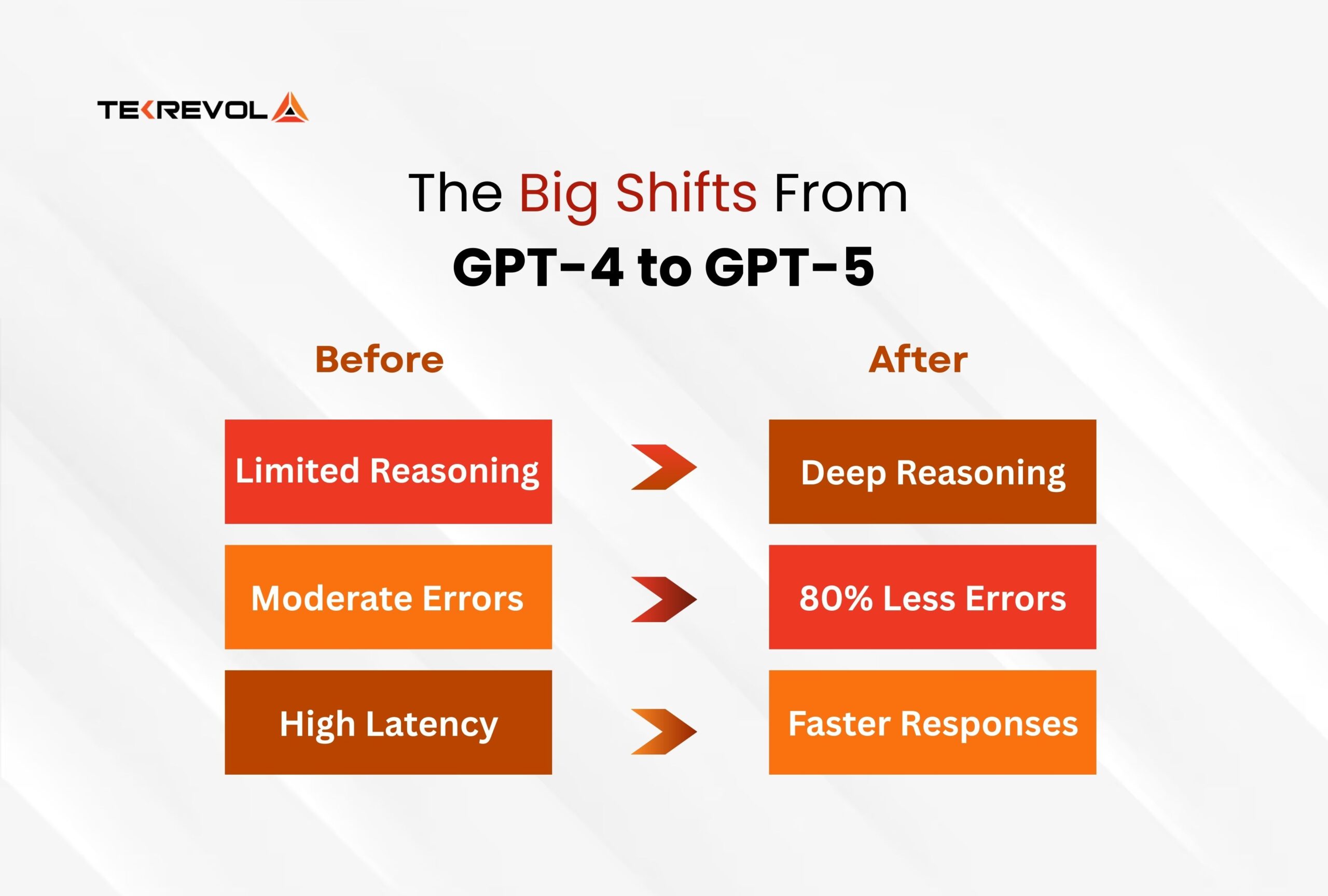
You can see the side-by-side comparison between the new features of GPT-5 and GPT-4.
| Feature | GPT-4 / GPT-4o | GPT-5 |
| Model Structure | Multiple separate versions | Unified system with smart routing |
| Reasoning & Intelligence | Strong, but limited | Deep reasoning (“thinking”), PhD-level across domains |
| Accuracy / Hallucinations | Moderate improvements | 45–80% fewer errors depending on mode |
| Speed & Efficiency | High latency, higher token usage | 50–80% fewer tokens, faster responses |
| Pricing | Higher input cost | Input cost cut roughly in half; lower tiers (Mini, Nano) |
| Emotional Tone | More conversational and warm | More factual, less “chatty” (mixed user feedback) |
| Access | Legacy models maintained | GPT-5 becomes default; old models retired |
You can see that it is very evident in the table that GPT-5 OpenAI has made a huge impact on the real workflows. GPT-4 is known as the model that introduced reasoning into the mainstream; however, GPT-5 made that reasoning more practical and usable.
Every ChatGPT-5 Version, From GPT-5 to GPT-6
OpenAI didn’t wait a year for the next big thing. It shipped a new GPT-5.x version roughly every one to three months.
Here’s the full timeline, with what changed in each one and where it stands today.
| Model | Released | What changed | Status (Oct 2026) |
| GPT-5 | Aug 7, 2025 | One model that switches between fast replies and deeper reasoning | Retired from ChatGPT Feb 13, 2026 |
| GPT-5.1 | Nov 2025 | Point release with Instant, Thinking and Pro versions | Retired from ChatGPT Mar 11, 2026 |
| GPT-5.2 | Dec 11, 2025 | Instant, Thinking and Pro modes; a January 2026 update made the default personality more conversational | Superseded |
| GPT-5.3 | Feb 2026 | GPT-5.3-Codex for agentic coding (about 25% faster); Instant update with more accurate answers and better web search | Superseded |
| GPT-5.4 | Mar 5, 2026 | Stronger tool use, document work and long-context reasoning; GPT-5.4 mini reached Free and Go users Mar 18 | Superseded |
| GPT-5.5 | Apr 2026 | Instant and Thinking; a May 28 update refreshed the response style and removed canvas | Superseded |
| GPT-5.6 | Jun 2026 (GPT-5.6 Sol in ChatGPT Jul 9) | Flagship reasoning model for paid plans | Still selectable on paid plans |
| GPT-6 (Sol, Luna, Astra) | Sep 2026 (Work and Codex); Oct 7, 2026 in ChatGPT | New default, launched with Intelligent UI | Current default |
Source: OpenAI Model Release Notes and ChatGPT Release Notes; Wikipedia, “ChatGPT”; TechCrunch, October 7, 2026
GPT-6: What Changed on October 7, 2026?
OpenAI brought GPT-6 to ChatGPT on October 7, 2026, after first releasing it to ChatGPT Work and Codex in September. It comes in three versions:
- GPT-6 Sol: the main model for Plus, Pro, Business and Enterprise users. It replaces “Latest” in the model picker.
- GPT-6 Luna: a lighter model for Free and Go users, rolling out from October 8.
- GPT-6 Astra: the deeper reasoning option on the Pro plan, first introduced on September 3.
Intelligent UI: Answers You Can Interact With
The most visible change is Intelligent UI. Instead of plain text, GPT-6 can build interactive charts, calculators, diagrams and maps right inside its answers, TechCrunch reported. If you prefer plain text, you can dial the visuals back.
GPT-5 vs GPT-6 at a Glance
| GPT-5 (Aug 2025) | GPT-6 (Oct 2026) | |
| Versions in ChatGPT | One system (fast + thinking + router) | Sol, Luna and Astra |
| Free users got | GPT-5 with limits, then GPT-5 mini | GPT-6 Luna |
| Answers | Text, images and code | Text plus interactive charts, calculators, diagrams and maps |
| Status | Retired from ChatGPT | Current default |
Source: OpenAI ChatGPT Release Notes; TechCrunch, October 7, 2026
Our take: GPT-6 is only days old. Independent benchmarks and real-world testing are still coming in, so treat any “X% better” claims you see this month with care. We’ll update this post as verified results come out.
What’s Next After GPT-6?
The model you build on today will be replaced within months.
If your team uses OpenAI models in a product, chatbot, or internal tool, here’s a five-step checklist to survive the next upgrade:
- Pin your model version. In the API, call a specific dated model, not a moving “latest” alias, so behavior doesn’t change overnight.
- Keep a test set. Save 50 to 100 real prompts with known good answers. Run them against every new model before you switch.
- Watch the retirement dates. OpenAI posts them in its release notes. GPT-5 lasted about six months as ChatGPT’s default.
- Keep prompts model-agnostic. Avoid tricks that only work on one model’s quirks.
- Budget for re-testing. Each switch needs a day or two of QA, not a full rebuild, if steps 1 to 4 are in place.
How TekRevol Helps Businesses Build on GPT Models
TekRevol designs and builds AI products that keep working as the underlying models change. Our artificial intelligence development services handle:
- Custom chatbots and AI assistants trained on your own data, through our chatbot development practice.
- Generative AI integrations inside web and mobile apps.
- Model evaluation and migration, so moving from one GPT version to the next is a tested upgrade, not a surprise.
Our AI division has delivered 200+ AI deployments for businesses that need AI to work reliably in production.
Struggling to keep up with AI upgrades?
Tekrevol simplifies integration with expert support and chatbot development services.
Book a Free Strategy Session