



- React and Next.js lead frontend technology in 2026, with TypeScript as the professional standard language.
- Node.js and Python are the top backend technologies, chosen based on app type and scaling needs.
- AI coding assistants like Copilot and Cursor are now a standard part of every developer’s workflow.
- WebAssembly and edge computing are the most important emerging technologies shaping web development in 2026.
- TypeScript adoption has crossed 80% among professional teams, replacing plain JavaScript as the default choice.
- Choosing the right stack depends on project type, not chasing the newest available technology trend.
The rapid evolution of web development technologies is changing the way modern websites and applications are built. From AI-powered tools to lightning-fast frameworks, the web is no longer just about putting pages online; it’s about building experiences that are smarter and more personalized than ever before.
The most widely used web development technologies in 2026 span frontend frameworks like React and Next.js, backend powerhouses like Node.js and Django, cloud platforms, and emerging AI-integrated stacks. Before you brief a web development company on your next project, knowing this stack gives you the clarity to ask the right questions and make smarter decisions.
With so many options available, picking the right stack can feel overwhelming. This guide cuts through the noise and walks you through the top web development technologies that are actively shaping the industry in 2026, so you can make more informed decisions for your next project.
What Are the Most Important Web Development Technologies in 2026?
The most important web development technologies in 2026 are React and Next.js on the front end, Node.js and Python on the back end, TypeScript as the default language for professional teams, and AI coding assistants as a standard part of the workflow. Each plays a distinct role in how modern applications get built, scaled, and maintained.
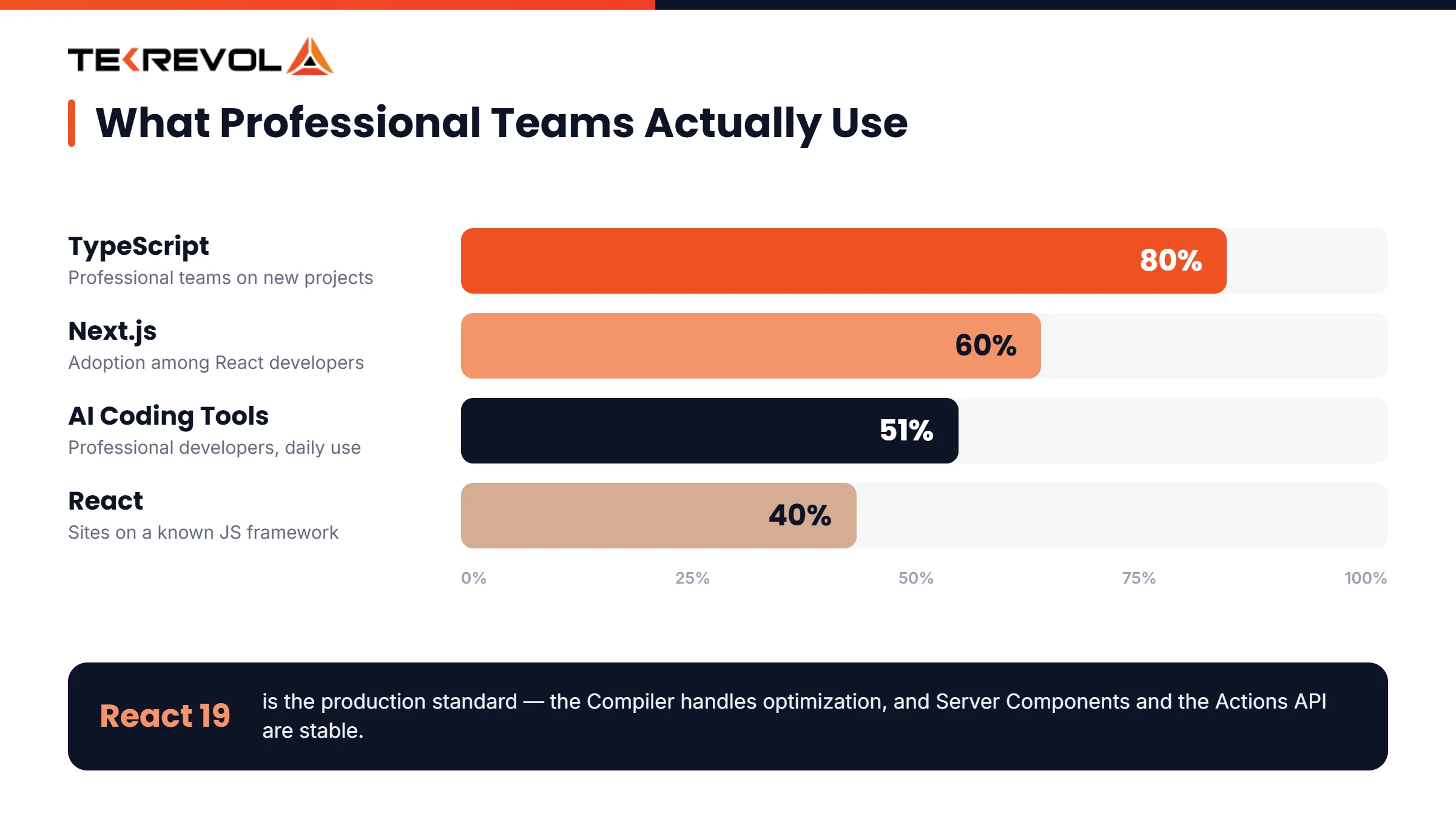
A few data points put this into perspective:
- 51% of professional developers now use AI tools daily (Stack Overflow Developer Survey 2025)
- React powers more than 40% of websites using a known JavaScript framework.
- TypeScript has overtaken plain JavaScript as the default choice for professional development teams on most new projects, with adoption among professional teams crossing 80% per the same survey.
- Next.js adoption has surged past 60% among React developers, making it the de facto meta-framework for server-side rendering.
- Python continues to dominate AI and data-driven web development, and that intersection is only growing.
The gap between teams using the right stack and teams stuck on outdated tools keeps widening, and that gap shows up directly in delivery time and maintenance cost, not just in developer happiness.
Build on the Right Tech Stack from Day One
Not every project needs the same stack. TekRevol's engineers help you choose the right technology before a single line of code is written.
Get a Free Tech Consultation!Before You Pick a Framework: The Three Core Web Technologies
Every frontend framework, React, Vue, Angular, and Svelte, is built on top of three foundational web technologies. Before choosing a framework, understanding what sits beneath it matters.
HTML (HyperText Markup Language) is the structural backbone of every webpage. It defines what content exists on a page, headings, paragraphs, images, links, and forms, and how that content is organized. Every website ever built starts with HTML.
CSS (Cascading Style Sheets) controls how that HTML content looks. Colors, fonts, layouts, spacing, responsive behavior across screen sizes- all of it is handled by CSS. Modern CSS, particularly with utility-first frameworks like Tailwind, has become significantly more powerful and developer-friendly than the CSS of even five years ago.
JavaScript makes web pages interactive and dynamic. Form validation, animations, real-time updates, button behavior- JavaScript handles everything that happens after the page loads. It is also the language that powers every major frontend framework on this list, and with Node.js, it runs on the server side too.
These three are not optional knowledge. They are the minimum foundation for any web developer, and every framework below is ultimately an abstraction built on top of them.
Top Front-End Web Development Technologies
The right front-end web development technologies, as recommended by top web development companies, enhance user experience, improve loading speed, and encourage users to return to your website.
In 2026, the most widely used front-end technologies include React, Next.js, Vue.js, Svelte, TypeScript, and Tailwind CSS. Each of these tools is suited to different team sizes, performance requirements, and levels of project complexity.
Here’s what’s been shaping the top front-end web development technologies in 2026:
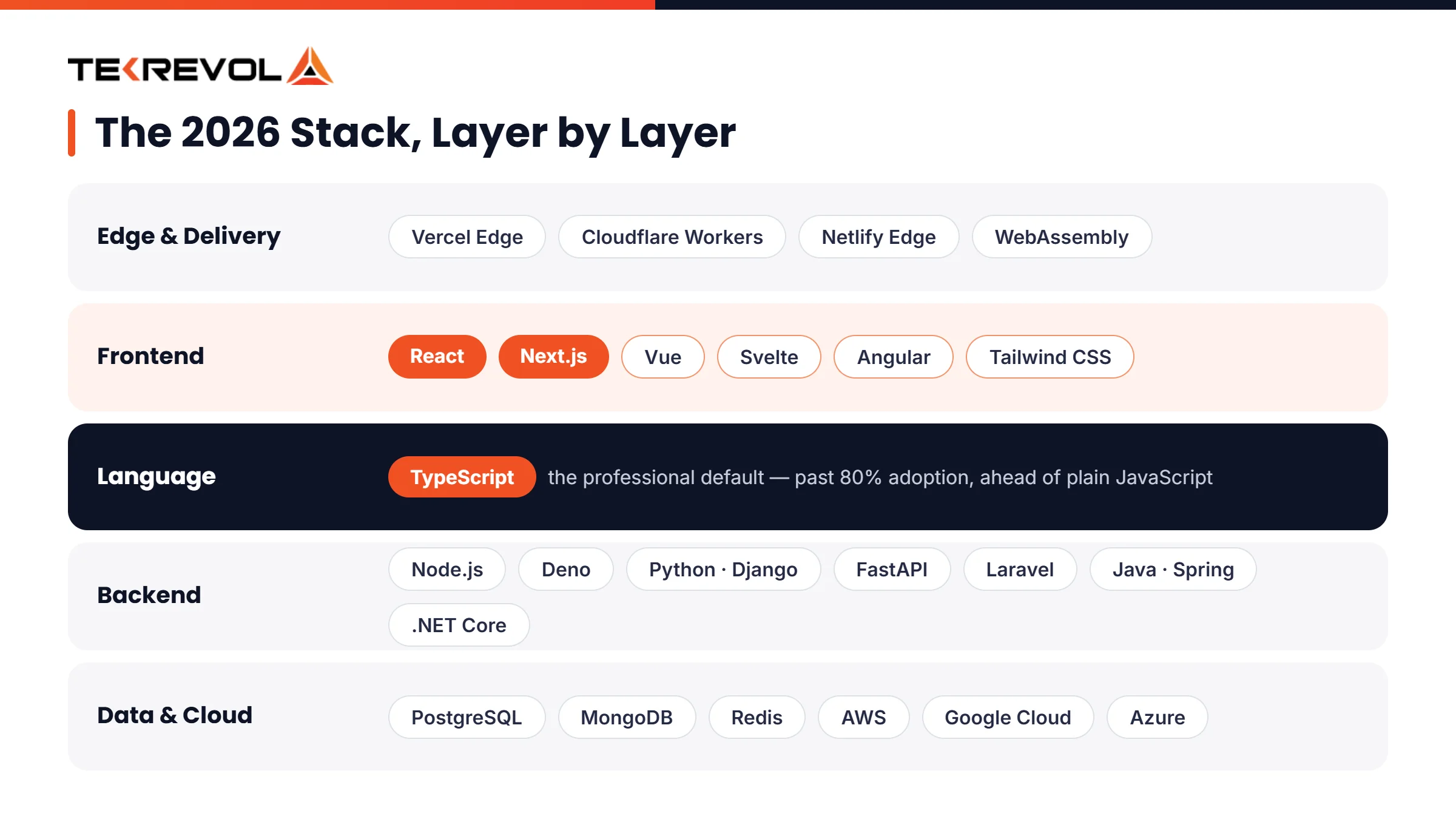
1. React
Flexibility, performance, and strong community support have kept React among the top web technologies for building front-end web applications.
You will be surprised to know that the most popular social platform, the one and only Facebook, is the mastermind behind React. This web technology was created to ease the development process of interactive UIs, especially for a single-page application that focuses on providing an outstanding user experience and reducing load time.
Why React Still Reigns Supreme in 2026?
- Performance and Optimization: React’s virtual DOM enables developers to build very dynamic interfaces without compromising on its speed.
- Vast Ecosystem: From Next.js for enabling server-side rendering and Redux for efficient state management, React’s rich ecosystem helps developers build feature-rich applications.
- Community and Support: The huge support from the community keeps React updated with the new best practices and integrations.
Main Updates in 2026:
With React 19 now the production standard, the new React Compiler automatically handles performance optimization, while Server Components and the Actions API have matured into stable, enterprise-ready features, reducing load times and streamlining data-heavy applications. These updates are a key reason React remains one of the best web development technologies heading into the future.
React Alternatives:
Although React is the leader of the pack, Vue and Svelte are also quite real rivals. So, let’s tackle those next.
2. Next.js — The Meta-Framework Taking Over in 2026
If React is the engine, Next.js is the fully assembled car. As one of the newest web development technologies to reach mainstream status, Next.js has become the standard starting point for most serious professional projects in 2026.
Next.js combines React’s component architecture with server-side rendering (SSR), static site generation (SSG), API routes, and edge-ready deployment, all in a single, cohesive framework.
Why Next.js is a Top Web Technology in 2026:
- Server-First Rendering: With React Server Components built in, Next.js sends only the JavaScript needed for interactivity, keeping pages light and fast.
- SEO Performance: Server-side rendering means pages are pre-built and fully indexable, giving you a significant edge in search rankings over client-side-only apps.
- Full-Stack Capability: Next.js API routes allow developers to build back-end logic directly alongside the front end, eliminating the need for a separate server for many use cases.
- Vercel Edge Deployment: Deploy Next.js applications on Vercel’s edge network and deliver content from the nearest geographic location to your users, dramatically cutting latency.
When to Use Next.js:
Next.js is the right choice when you need a production-grade web application with strong SEO requirements, fast page loads, and a clean developer experience. It’s widely used for e-commerce sites, SaaS dashboards, marketing pages, and content-heavy platforms.
3. Vue.js
Vue.js is a powerful and simple web technology and development framework. Since it was introduced to front-end developers, it has created quite a fandom of its own, especially in companies that require flexible and scalable web application development technologies due to its ease of learning curve and adaptability.
Why is Vue.js Gaining Popularity?
- Flexible and Lightweight: Vue can operate as a library while adding specific features to certain parts of a website or as a full-featured framework for creating complex applications.
- The Vue Ecosystem: Tools and plugins, including the Vue CLI, the router, and Vuex, help ensure smoother development, making this one of the most practical modern web technologies for most projects.
When to Choose Vue Over React?
Vue would be a good choice for projects where simplicity and speed to market are the main necessities. It’s most suitable for smaller projects or applications where extensive front-end functionality is not required.
4. Svelte
Svelte, one of the latest front-end web technologies to gain serious momentum, is proving to be revolutionary. It compiles components at build time to pure JavaScript, eliminating the need for a virtual DOM and thus reducing the burden on the browser.
The Advantages of Svelte:
- No Virtual DOM: Svelte compiles code during build time, making applications faster and more efficient.
- Fewer Bundle Sizes: As there is no framework code in the client bundle, applications developed on this web technology are lean and quick to load.
Why is Svelte Likely the Future of Front-End Development?
Svelte has specific strengths that make it a strong option for both small and large applications, especially if performance is the top priority. Being a leading web application development technology, Svelte appeals to developers looking to optimize resource usage, and it’s particularly useful in resource-intensive applications or edge computing scenarios.
5. TypeScript — The 2026 Professional Standard
If you’re building anything serious in 2026, you’re almost certainly writing it in TypeScript. A superset of JavaScript, TypeScript adds static typing to the language to improve code quality, readability, and maintainability.
TypeScript has now become the default language of choice for professional web development, not a nice-to-have. According to the State of JS 2025 survey, TypeScript adoption among professional teams has crossed 80%.
Why TypeScript is Critical in 2026:
- Error Prevention: TypeScript catches errors at compile time, which makes code much more reliable and dramatically reduces runtime bugs.
- Scalability: TypeScript is especially valuable for large codebases, making it easy to maintain and refactor code as projects grow.
- Broad Framework Support: TypeScript is the language of choice for Angular and is natively supported by React, Vue, Next.js, and Node.js — making it one of the most versatile web development technologies in the market.
Use Cases for TypeScript:
TypeScript is valuable for complicated or long-term projects. It uses autocompletion, refactoring tools, and static analysis to boost developer productivity, making it a widely used solution in modern web design technologies, especially for high-stakes applications where reliability matters.
6. Tailwind CSS
Although Tailwind is not a JavaScript framework, it is a utility-first CSS framework that has significantly influenced modern web design. It presents low-level utility classes that can be combined to build custom designs directly from HTML without leaving the document.
Benefits of Tailwind in Modern Web Design:
- Customizability: Tailwind enables developers to produce interesting, unique designs without writing much custom CSS.
- Responsive Layouts: The utility classes help implement responsive layouts and ensure a smooth user experience on all devices.
Tailwind vs. Traditional CSS Frameworks:
Tailwind is more flexible compared to traditional web development technologies such as Bootstrap. While Bootstrap’s components are predefined, Tailwind enables developers to create designs that don’t look like templated frameworks.
7. Angular
Angular, maintained by Google, is still hot in the market of web technologies. Particularly favored for large-scale applications, it is widely used because of its strong construction, modular architecture, and two-way data binding features.
Why Angular Remains Popular in 2026?
- Full Framework: Unlike lightweight libraries, Angular provides a fully featured framework including dependency injection, routing, and form handling.
- TypeScript Support: Angular is built in TypeScript, making web development more predictable and manageable, specifically in complex applications.
- Enterprise-Level Features: Angular’s extensive tooling and scalable architecture make it particularly necessary for enterprise applications where maintainability is the main concern.
Use Cases for Angular:
Angular is particularly suitable for web development technologies that demand a formalized approach, e-commerce platforms, CMS systems, and large dashboards where large teams need a highly organized, testable codebase.
To better understand the trade-offs between Angular and React, check out “Angular vs React: Which Frontend Framework Reigns Supreme?” It’s a solid comparison for developers and decision-makers.
8. Bootstrap
Among the most popular technologies for creating responsive and mobile-first websites, Bootstrap leads the pack. With pre-designed components and CSS utility classes, Bootstrap allows developers to create visually attractive, responsive websites with the bare minimum amount of custom coding.
Why Bootstrap is Preferable in Web Design in 2026:
- Pre-built Components: A library of pre-made elements, navigation bars, buttons, and forms that are easily customizable.
- Responsive Grid System: Bootstrap’s grid system offers developers layouts that adapt perfectly to various screen sizes.
- Use Cases: Perfect for projects that need a clean, professional look without heavy custom CSS work.
9. Backbone.js
Backbone.js is less common in new projects today but remains in active use at organizations maintaining older web codebases. Backbone.js is a small JavaScript library that provides structure for client-side code in web applications. It follows an MVC architecture and includes tools for creating models with key-value binding and custom events, making it easy to handle the complexity of dynamic applications.
Why Backbone.js Still Matters in 2026:
- Flexibility and Simplicity: Unlike full frameworks, Backbone is lightweight and allows developers to add only what they need.
- Increased Control: Backbone.js provides total control over architecture, making it highly adaptable to unique project requirements.
- RESTful API Compatibility: Since Backbone supports applications built on top of RESTful APIs, it lets developers sync the front end with back-end data with ease.
Front-End Web Technologies: Quick Comparison
| Technology | Best For | Learning Curve | Performance | Use in 2026 |
| React | SPAs, dynamic UIs, enterprise apps | Medium | high | Very high |
| Next.js | Full-stack, SEO-heavy, e-commerce | Medium | Very High | Very high |
| Vue.js | Startups, smaller projects, rapid dev | Low | High | High |
| Svelte | Performance-critical, edge apps | Low | Highest | Growing |
| Angular | Enterprise, large teams, complex apps | high | High | Steady |
| TypeScript | All serious professional projects | Medium | N/A (language) | Standard |
Top Back-End Web Development Technologies
Choosing the right back-end web development technologies is very important for efficient, scalable, and secure development. The best back-end web technologies in 2026 are Node.js, Python (with Django or FastAPI), Ruby on Rails, PHP with Laravel, Java, and C#/.NET, each chosen based on the kind of application being built and how the team plans to scale it.
Let’s dive deeper into some of the best ones to consider in 2026.
1. Node.js and Deno
Node.js is a revolutionary back-end web development technology that allows developers to use JavaScript on the server side. Deno, developed by the creator of Node.js, is a newer, secure runtime environment with TypeScript support built in.
Why you should go with Node.js in 2026:
- Asynchronous Processing: Node.js’s non-blocking architecture enables it to handle multiple requests simultaneously, making it perfect for high-traffic applications.
- Express.js and Nest.js: Express is minimalistic and flexible, while Nest.js is more structured, ideal for building enterprise-level applications.
Deno’s Growth:
Deno addresses most of Node.js’s security issues, provides default security measures, and supports TypeScript natively. It’s a strong choice for projects where security and modern standards are the priority.
2. Python and Django/FastAPI
Python continues to dominate as one of the most versatile technologies for web development, especially for applications that require rapid prototyping, data integration, and AI capabilities. Django and FastAPI are two of the best Python frameworks for different stages of the development process.
Why Python Continues to Thrive:
- Ease of Use and Readability: Python’s simple syntax makes it accessible and versatile for teams of all experience levels.
- Libraries and Tools: Python has an enormous collection of libraries, making it easy to integrate machine learning, data analysis, and AI directly into web applications, one of the major reasons it’s among the most relevant web technologies in 2026.
Choosing Between Django and FastAPI:
- Django is a comprehensive Python framework for full-stack web development, offering built-in features such as ORM, authentication, and a templating system.
- FastAPI is an asynchronous framework created for high-performance APIs. FastAPI is optimal when speed and performance are critical.
3. Ruby on Rails
Ruby on Rails, or simply Rails, is a mature and popular web technology. Since it makes development quick and is well-suited for MVPs and smaller projects, it’s loved by developers worldwide.
Ruby on Rails in 2026:
- Rapid Development: Many features of Rails are pre-configured through scaffolding, so applications can be quickly built and deployed.
- Great for Startups: Rails has been the choice for companies like GitHub, Shopify, and Airbnb due to its simplicity and scalability.
4. PHP and Laravel
Some people may think PHP is an outdated language, but frameworks like Laravel have taken PHP to a whole new level of modern web development.
PHP Endures in Web Development:
PHP powers a significant portion of the modern web, mainly because it is easy to work with and widely available in hosting services. Laravel has modernized PHP’s capabilities and features significantly.
Laravel is the Dominant PHP Framework:
Laravel contains all features of routing, middleware, and authentication, making it a solid candidate for any large-scale web application built on server-side web technologies.
View Case Study →
5. Java
Java is one of the most commonly applied programming languages in the world and remains strongly used for web application development in 2026. Java is portable, scalable, and secure, making it reliable for back-end development of complex, large-scale applications.
Why Java is Great for Back-End Development in 2026:
- Platform Independence: Java’s “write once, run anywhere” philosophy allows applications to be deployed across various platforms without modification.
- Scalability: Java fits enterprise-level web development projects where high reliability is needed.
- Vast Ecosystem: Frameworks like Spring and Hibernate, along with rich libraries, make back-end development easier for large teams.
6. JavaScript (Server-Side)
While most people think of JavaScript as a front-end language, with the rise of Node.js, it has become a popular web technology for back-end development too. Its ability to run on both the client and server sides makes JavaScript one of the most versatile web development technologies in 2026.
Why is JavaScript Perfect for Back-End Development?
- Unified Language Across the Stack: JavaScript on both front end and back end reduces context-switching for developers and produces a more unified codebase.
- Event-Driven Architecture: JavaScript is asynchronous and non-blocking, making it extremely efficient for real-time applications.
- Strong Community and Ecosystem: Node.js, Express.js, and a variety of other libraries make JavaScript a powerful option for building scalable, high-performance back-end systems.
7. C# and .NET
C# with the .NET framework remains a significant backend technology in enterprise web development, particularly in organizations already operating within the Microsoft ecosystem. ASP.NET Core, the modern cross-platform version of the framework, is widely used for building high-performance web APIs and full-stack web applications that integrate tightly with Microsoft Azure, Active Directory, and enterprise tooling.
Why C#/.NET Is Still Relevant in 2026:
- Enterprise-Grade Performance: ASP.NET Core is one of the fastest web frameworks available, consistently ranking at the top of independent benchmarks for throughput and response time.
- Microsoft Ecosystem Integration: For teams already using Azure, SharePoint, or Microsoft 365, .NET offers native integration that no other backend framework can match.
- Strong Typing and Tooling: Visual Studio and Rider provide best-in-class IDE support, making large-scale .NET codebases easier to maintain and refactor.
When to Choose C#/.NET:
C#/.NET is the right choice for enterprise teams building on Windows infrastructure, organizations deeply integrated with Microsoft Azure, or projects requiring high-performance APIs with long-term vendor support and stability.
Back-End Technologies: Quick Comparison
| Technology | Best for | Performance | AI/ML Support | Learning Curve |
| Node.js | Real-time apps, APIs, microservices | High | Moderate | Low-Medium |
| Python/Django | Full-stack, AI-integrated apps | Medium | Excellent | Low |
| Python/FastAPI | High-performance REST APIs | Very High | Excellent | Medium |
| PHP/Laravel | CMS, rapid web apps | Medium | Limited | Low |
| Java/Spring | Enterprise, banking, large-scale | Very High | Moderate | High |
| Ruby on Rails | Startups, MVPs | Medium | Limited | Low |
| C#/.NET | Enterprise, Microsoft stack, Azure apps | Very high | moderate | medium |
AI-Powered Web Development Technologies in 2026
AI in web development has shifted beyond basic autocomplete tools into an agentic system-level capability that reshapes how applications are architected, developed, and maintained.
With AI adoption among professional developers now crossing 51% for daily use and climbing fast, workflows increasingly rely on autonomous code changes, design-to-code automation, and AI-driven UX optimization
Here are the leading AI-powered web development technologies reshaping how developers work:
GitHub Copilot
GitHub Copilot, powered by OpenAI’s models, is the most widely adopted AI coding assistant in the market today. It integrates directly into VS Code, JetBrains IDEs, and other editors, suggesting code completions, full functions, and even entire components based on comments or context.
What Copilot does well: Boilerplate code generation, writing repetitive patterns, unit test drafting, and documentation. For experienced developers, it’s a time multiplier, not a replacement.
Cursor
Cursor is a code editor built from the ground up around AI. Unlike Copilot, which is a plugin, Cursor gives AI access to your entire codebase, letting it understand project-wide context to generate, refactor, or debug entire files at once.
Why developers love Cursor in 2026: It can read your full repository, answer questions about your code, and make sweeping multi-file changes from a single natural-language instruction. It’s become the tool of choice for teams building complex web applications where cross-file context matters.
Codeium
Codeium is a free alternative to GitHub Copilot that supports over 70 programming languages and integrates with more than 40 editors. For teams or individual developers who want AI assistance without the subscription cost, Codeium is one of the most capable and latest web development technologies to emerge in this space.
v0.dev by Vercel
v0.dev is a generative UI tool from Vercel that produces React and Tailwind CSS components from a natural-language description. You describe a UI, and it generates production-ready component code. It’s one of the most exciting new web technologies for front-end developers who want to move from concept to code at a fraction of the usual time.
Practical use: Describe a dashboard layout, a login form, or a pricing table; v0 produces the React + Tailwind code instantly. It’s not perfect for every case, but for rapid prototyping, it’s transformative.
How AI is Changing Web Development in 2026
The shift isn’t just about writing code faster. AI-powered development tools are changing where developer expertise gets applied. Instead of spending time on mechanical coding tasks, developers are spending more time on architecture.
For TekRevol clients, this means AI development services and web development are no longer separate conversations. The best web applications of 2026 are built with AI assistance at every layer of the stack.
What Emerging Web Technologies Should You Know in 2026?
When most people talk about new emerging technology trends in web development, the conversation defaults to frameworks and AI tools. But the two most consequential emerging web technologies in 2026 are WebAssembly and edge computing, both already running in production at companies like Cloudflare, Fastly, Shopify, and Figma, yet both remain underrepresented in most “top technologies” lists.
WebAssembly (Wasm)
WebAssembly is a binary instruction format that allows code written in languages like C, C++, and Rust to run in the browser at near-native speed. It’s not a replacement for JavaScript; it’s a complement to it, used for the performance-critical parts of an application where JavaScript alone isn’t fast enough.
Why WebAssembly Matters for Web Technology in 2026:
- Near-Native Performance in the Browser: Applications that previously required a desktop install, video editors, image processors, CAD tools, and games can now run entirely in the browser with WebAssembly.
- Language Flexibility: Teams that have existing C++, Rust, or Go codebases can compile those to Wasm and run them on the web without a full rewrite.
- Figma uses it: Adobe Photoshop on the web uses it. AutoCAD uses it. If you’re building anything computationally intensive for the browser, WebAssembly is one of the new web technologies you need to understand.
When to Use WebAssembly:
Use Wasm when JavaScript performance is the actual bottleneck, for things like real-time video processing, game engines, data visualization with millions of data points, or running machine learning inference in the browser. For most standard web application development, JavaScript or TypeScript remains the correct choice.
Edge Computing
Edge computing is another area where the newest web development technologies have arrived in full force. Traditionally, web applications ran on centralized servers, meaning every request had to travel to a data center, get processed, and travel back. Edge computing moves the computation closer to where the user is.
What Edge Computing Looks Like in Practice:
- Cloudflare Workers: Deploy JavaScript or WebAssembly functions that run across Cloudflare’s global network of 300+ data centers, milliseconds from virtually any user on earth.
- Vercel Edge Functions: Run Next.js middleware and API routes at the edge, so authentication checks, personalization logic, and redirects execute before the page even reaches the main server.
- Netlify Edge Functions: Similar edge-first deployment targeting Deno at the network edge.
Why Edge Computing is One of the Most Important Web Dev Technologies of 2026:
- Reduced Latency: Processing at the edge eliminates the round-trip to a central server, which can shave 50–200ms off response times.
- Cost-Effective Scaling: Serverless edge functions scale to zero when not in use and scale instantly to millions of requests without manual provisioning.
- Better Personalization: Deliver personalized content, A/B tests, and geo-specific experiences without adding server-side complexity.
Database and Cloud Technologies for Web Development
The most widely used database and cloud technologies for web development in 2026 are PostgreSQL for relational data, MongoDB for flexible document storage, Redis for high-speed caching, and AWS, Google Cloud, or Azure for infrastructure. Here are the most important ones every modern web development stack should account for.
PostgreSQL
PostgreSQL remains the most popular open-source relational database for modern web applications. Its support for JSON data, full-text search, and complex queries makes it highly versatile for both traditional and modern web technology stacks. Tools like Supabase have made PostgreSQL even more accessible by wrapping it in a Firebase-like developer experience.
MongoDB
MongoDB continues to be a top choice for applications that need flexible, document-oriented data storage. It’s especially popular in Node.js stacks due to its native JSON support and remains one of the most widely used database technologies for web development when schema flexibility is a priority.
MySQL
MySQL is still widely deployed, particularly in PHP-based stacks like Laravel. It’s reliable, well-understood, and supported by virtually every hosting provider, making it a practical choice for many web projects.
Redis
Redis is widely used as a caching layer, session store, and message broker. In 2026, it’s a standard component of high-traffic web architectures, dramatically improving response times for frequently accessed data.
Cloud Platforms: AWS, Google Cloud, Azure
The three major cloud providers continue to dominate infrastructure for web applications:
- AWS remains the most feature-rich option, with services like EC2, Lambda, S3, RDS, and CloudFront covering virtually every infrastructure need.
- Google Cloud Platform (GCP) is strong for AI/ML workloads and teams already in the Google ecosystem.
- Microsoft Azure is the choice for enterprise teams, particularly those using .NET and Microsoft tooling.
TekRevol’s cloud services include architecture design, migration, and ongoing support across all three major platforms, helping teams choose and implement the right cloud infrastructure for their specific web development technology stack.
Best Emerging Web Development Trends of 2026
Now that you know everything about the popular web development technologies, here are the key trending web development technologies and patterns shaping the industry this year:
| Trend | Description |
| AI-Driven Development | Make use of AI for generating, debugging, testing, and personalizing code. |
| Voice Search Optimization | Optimizing web applications for voice-activated search and voice-based features. |
| Micro-Frontends | Decomposing front-end apps into smaller and independent modules. |
| Progressive Web Apps | Continue growth in PWAs, especially in areas with low net connectivity |
| Low-Code Development | Allow users to build applications without extensive coding knowledge |
| Blockchain and Web3 Integration | Blockchain-backed security, decentralized data, and app development |
| Dark mode Standardization | Experience high accessibility and energy-saving on OLED screens with Dark mode |
| Improved Cybersecurity Standards | Enhanced focus on security protocols such as MFA, Zero Trust, and secure coding practices. |
| Microservices Architecture | Breaking large applications into independently deployable services for scalability |
| Web Performance Optimization | Improving load speed, Core Web Vitals scores, and user experience through lazy loading, code splitting, and edge caching |
1. AI-Driven Development
AI-driven development changes the way developers work, allowing them to automate tedious work and provide sophisticated tools for debugging, code generation, and even testing.
For instance, using GitHub Copilot and OpenAI Codex, programmers can accelerate their programming by generating code snippets and fixing mistakes more quickly. AI also enables personalized user experiences like intelligent recommendation systems and chatbot engagements that help improve user interactions. This is one of the most significant web development trends of 2026, and it’s only accelerating.
2. Voice Search Optimization
Voice search optimization has become indispensable due to the rise of smart speakers and voice-activated appliances.
Voice search-optimized websites rank higher, especially when users are on the go and depend on devices like Alexa, Google Assistant, and Siri to navigate the web. Websites optimized for voice search are not only better loved by users, but they also tend to attract organic traffic that traditional typed search might miss. As a current web development technology trend, voice optimization is increasingly built into frameworks and CMS platforms from the start.
3. Micro-Frontends
Micro-frontends are an emerging architectural style for highly complex front-end applications. By breaking a front-end application into smaller, independently managed modules, multiple teams can work in parallel, allowing more agile and scalable development.
Micro-frontends allow features to be deployed independently, which increases the velocity of updates and reduces the risk of a single front-end failure taking down an entire application. For large-scale web application development technologies, this pattern is increasingly becoming standard practice.
4. Progressive Web Apps (PWAs)
Progressive Web Apps (PWAs) are gaining popularity, particularly in areas with relatively low internet connectivity. PWAs enable an app-like experience on the web with features such as offline access, background sync, and push notifications to keep users updated.
PWAs are lightweight in footprint and easy to install; no app stores required. Compared to native apps, they’re a highly cost-effective choice, enabling businesses to grow their reach with minimal investment in developing separate mobile apps for iOS and Android.
5. Low-Code/No-Code Development
Low-code and no-code platforms allow both newcomers and professional developers to build applications with minimal coding. These platforms offer drag-and-drop interfaces, pre-built components, and visual workflows to accelerate prototyping and development.
Today, companies are using low-code solutions for internal tools, MVPs, and even full-scale applications, reducing the need for specialized programming skills and dramatically shortening time-to-market. As new web development technologies go, low-code is one of the fastest-growing segments in the industry.
6. Blockchain and Web3 Integration
Blockchain and Web3 integration are transforming web application development technology into decentralized, secure solutions. Web3 enables blockchain-based applications, often referred to as dApps, with a strong focus on user security, data ownership, and user control.
Web3 integration allows businesses to leverage decentralization and blockchain-based security. These emerging web technologies are already trending in finance, supply chain management, and even social media, and TekRevol’s blockchain development services help teams build and deploy dApps and Web3-integrated solutions.
7. Dark Mode Standardization
Dark mode has now become a standard expectation across all platforms, as users increasingly prefer darker interfaces. Beyond aesthetics, dark mode also improves accessibility for light-sensitive users and saves battery life on OLED screens, allowing devices to run longer between charges.
In 2026, dark mode is no longer just a visual preference. It’s a UX requirement, an accessibility standard, and increasingly expected as a default option in any serious web design technology stack.
8. Upgraded Cybersecurity Standards
Improved cybersecurity standards are critical in response to the growing frequency and sophistication of cyber threats. Developers are concentrating on protocols like Multi-Factor Authentication (MFA) and Zero Trust architecture to develop secure coding practices and protect user data.
Frameworks like Content Security Policy (CSP), routine vulnerability assessments, and penetration testing are becoming standard practice for safeguarding websites from threats like XSS and SQL injection. Security is no longer an afterthought in modern web development — it’s baked into the architecture from day one.
9. Scaling Large Products Through Microservices
Microservices remain a relevant architecture for scaling complex web applications across multiple cross-functional teams. If your web application spans multiple business domains or requires integration with legacy systems, microservices offer a modular approach to managing and maintaining different components independently.
With containerization tools like Docker and Kubernetes, development teams can divide web projects into isolated, deployable services, though careful planning and solution architecture expertise are essential to avoid unnecessary complexity.
10. Optimizing Web Performance Through Core Web Vitals
As Google continues to factor Core Web Vitals into search rankings, web performance optimization has moved from a nice-to-have to a development priority. Metrics like Largest Contentful Paint (LCP), Interaction to Next Paint (INP), and Cumulative Layout Shift (CLS) directly impact both user experience and organic visibility.
Modern web development practices like lazy loading, code splitting, and edge caching give teams practical tools to hit performance targets, making web performance a shared responsibility across frontend developers, backend engineers, and DevOps teams alike.
Which Web Development Technology Is Right for You?
One of the most common questions developers and business owners ask is: Which of these web technologies should I actually use? Here’s a practical decision guide based on your situation:
| Your Situation | Recommended Technology |
| Building a startup MVP quickly | Next.js + Tailwind + Supabase |
| Large enterprise application | Angular or React + TypeScript + Java/Spring |
| E-commerce platform | Next.js + Node.js/Laravel + PostgreSQL |
| Real-time app (chat, live data) | Node.js + React + Redis |
| AI-integrated web app | Python/FastAPI + React + PostgreSQL |
| Static/content-heavy site | Next.js (SSG) or Astro |
| Mobile-first progressive web app | React or Vue + Tailwind |
| Performance-critical browser app | Svelte or React + WebAssembly |
| Small business website | WordPress/Laravel + Bootstrap |
This kind of stack-matching exercise isn’t theoretical; it plays out in real client work. When NDE Offshore needed its web portal modernized to support faster, more reliable maintenance, TekRevol’s team rebuilt the underlying architecture around a leaner, better-documented stack rather than ripping out and replacing the entire system. The result was 40% faster portal maintenance and support, a useful reminder that picking the right web development technology for the job usually matters more than picking the newest one. (View the NDE Offshore case study)
Not Sure Where to Start?
Get expert guidance on the right tech stack for your goals, timeline, and budget.
Let's Talk About Your Project!How Much Does It Cost to Build With Modern Web Development Technologies?
Building a modern web application in 2026 typically costs between $15,000 and $150,000, depending on its scale and complexity. Ongoing maintenance can range from $50 to over $2,000 per month. Overall costs are largely influenced by the chosen architecture, such as Jamstack or full-stack frameworks, as well as whether you hire a freelancer, an agency, or build the project in-house.
| Project type | Typical cost | Timeline | Monthly maintenance | Common stack |
| Simple website/landing page | $15,000 – $30,000 | 2 – 6 weeks | $50 – $200 | Next.js, Tailwind, Vercel |
| SaaS/web app (MVP) | $30,000 – $80,000 | 2 – 4 months | $200 – $800 | React, Node.js, PostgreSQL |
| E-commerce platform | $50,000 – $150,000 | 3 – 6 months | $500 – $2,000 | Next.js, Laravel, Redis |
| Mid-complexity web product | $80,000 – $200,000 | 4 – 9 months | $800 – $3,000 | Angular, Java/Spring, AWS |
| Enterprise / AI-integrated platform | $150,000 – $500,000+ | 9 – 18+ months | $2,000+ | React + Python/FastAPI, GCP |
How TekRevol Can Help You With Web Development
TekRevol is a full-service digital transformation company that helps startups and enterprises across healthcare, fintech, e-commerce, and real estate build scalable, high-performance digital products using the latest web technologies. Every project starts with a strategy and ends with a product built to grow with your business.
From front-end to back-end, cloud to AI, TekRevol’s engineers work across the full modern web technology stack, so whether you’re launching from scratch or scaling an existing platform, you get the right tools, the right architecture, and a team that takes ownership of the outcome.
What TekRevol delivers:
- Full-stack web development across React, Next.js, Node.js, Python, and more, built for performance and long-term scale
- Custom e-commerce and web portals designed for high traffic, complex workflows, and seamless user experiences
- AI-integrated web applications with intelligent search, personalization, and automation built directly into your product
- Cloud architecture and deployment on AWS, GCP, and Azure, from initial setup to ongoing support
Ready to Build Your Next Digital Product?
From strategy to launch, TekRevol's full-stack team delivers scalable web solutions tailored to your goals, timeline, and budget.
Book a Free Consultation


