



- Website development cost in 2026 ranges from $500 (AI/DIY builders) to $500,000+ (enterprise web apps)
- A professional small business website typically costs $3,000–$15,000; e-commerce stores run $15,000–$80,000
- Freelancers charge $45–$150/hour; US agencies charge $100–$250/hour; offshore teams cost $25–$75/hour
- Ongoing website costs (hosting, maintenance, SSL) add $200–$2,000/month to every budget
- Third-party integrations are the biggest hidden driver of web development costs; each one adds $1,000–$10,000 to your project
- By building a website around a specific business outcome and scoped with realistic architecture, you get a revenue-generating asset that compounds in value.
Website development cost in 2026 runs from $500 to $500,000+. Most businesses land between $5,000 and $50,000. That’s still a huge range!
A $2,000 landing page and a $200,000 enterprise platform are not versions of the same product. They’re different products designed to accomplish completely different goals. Multiple variables, from your business type and scope to design approach, integrations, and team location, drive web development pricing.
As a web development company that has delivered 500+ websites across 30+ industries, TekRevol gives you the actual numbers (not inflated agency rates or optimistic DIY estimates).
By the end of this guide, you’ll know what your web development project should cost, what makes it go higher, and how to get an accurate quote before you talk to a single vendor.
How Much Does Website Development Cost in 2026?
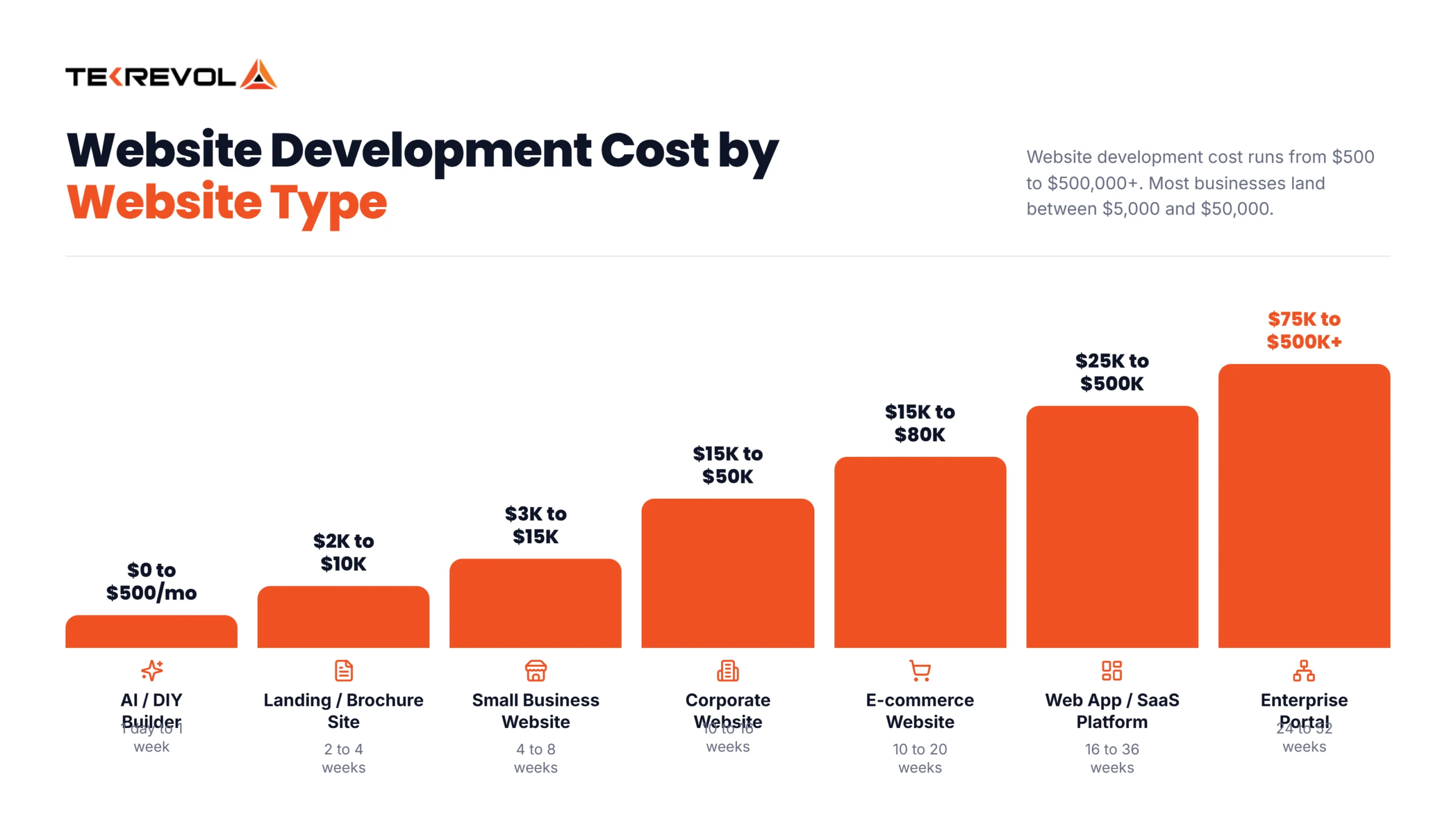
Average website development cost in 2026 ranges from $500 for an AI-powered builder to $500,000+ for a custom enterprise platform.
Here’s an overview of the full range by website type so you can find your starting point before diving into the details.
| Website Type | Cost Range (USD) | Timeline | Best For |
|---|---|---|---|
| AI/DIY builder | $0–$500/month | 1 day–1 week | Solopreneurs, test projects, simple landing pages |
| Landing page/brochure site | $2,000–$10,000 | 2–4 weeks | Local businesses, consultants, campaign pages |
| Small business website | $3,000–$15,000 | 4–8 weeks | SMBs need a professional online presence |
| Corporate website | $15,000–$50,000 | 10–16 weeks | Mid-market and enterprise brands |
| E-commerce website | $15,000–$80,000 | 10–20 weeks | Online stores with product catalogs and payments |
| Web app/SaaS platform | $25,000–$500,000 | 16–36 weeks | Platforms, dashboards, SaaS products |
| Enterprise portal | $75,000–$500,000+ | 24–52 weeks | Large organizations with complex integrations |
These ranges assume professional development. The sections below cover what pushes a project toward the top or bottom of each range.
Absence of high-performing website means your competitor owns your Google results.
Stop guessing your web development cost and get a scoped estimate from TekRevol that has delivered 500+ websites.
Let’s Connect Today!What Factors Drive Website Development Pricing [7 Real Cost Factors]
Website development pricing is not arbitrary. Every dollar in your quote maps back to one of 7 specific variables.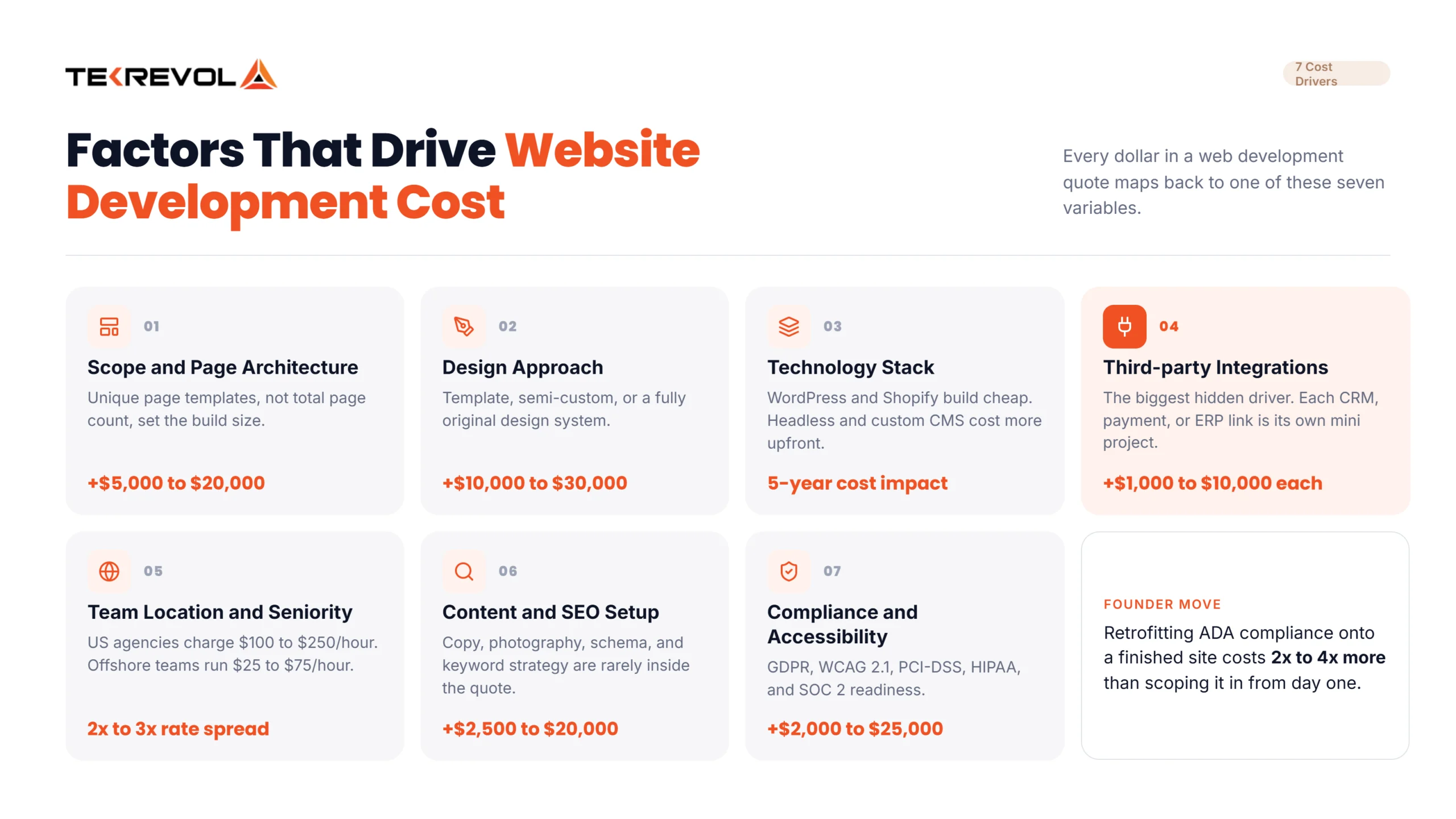 Here’s what founders need to look for to end up with better web development prices.
1. Scope and Page Architecture
The web development cost variable that surprises founders most: it’s not the number of pages you have. It’s how many unique page layouts your site needs.
A 20-page website where every page uses one of three templates is a simple build. Whereas a 10-page website, where each page has a completely different layout and content structure is 3× more expensive.
Before you ask for any quote, count your unique page types (not total pages). Home, About, Service, Blog Post, Contact. That’s 5 templates.
- Cost impact: Getting scope architecture wrong adds $5,000–$20,000 to the average mid-range build.
- Practical move: Tell your vendor, “we have X page templates, not X pages.” Watch how their estimate changes.
2· Design Approach: Template vs Custom
Choosing a custom design over a template can add $10,000–$30,000 to your build budget. For cost-factor purposes, here’s the quick math:
- Template customization: $500–$5,000 to a base build
- Semi-custom design (original layouts on a framework): $5,000–$15,000
- Fully custom design system (original components, brand-specific UI, motion design): $15,000–$30,000+
3· Technology Stack
Your stack decides build cost and every future change. WordPress builds cheap and costs more to maintain. Webflow sits in between. Next.js and headless setups cost the most upfront, though they perform best and stay predictable. Our roundup of web development tools covers the trade-offs.
| Platform | Build Cost | Monthly Maintenance Cost | Flexibility | Best For |
|---|---|---|---|---|
| WordPress | Low–medium | Medium–high (security, updates, plugins) | High | Content-heavy sites, blogs, and SMB builds |
| Webflow | Medium | Low (managed hosting, auto-updates) | Medium-high | Design-led sites, marketing teams who need control |
| Shopify | Low–medium | Low–medium (platform fees + apps) | Medium | Standard e-commerce |
| Next.js / Headless | High | Low–medium (depends on infra) | Maximum | Performance-critical sites, enterprise, SaaS |
| Custom CMS | High | Low (no vendor dependency) | Maximum | Enterprise, complex content workflows |
4· Third-party Integrations
Third-party integrations are where nearly every project exceeds its original estimate. Every integration has its own mini-project, i.e., authentication, data mapping, error handling, testing, and ongoing maintenance.
Here’s what they actually cost:
| Integration Type | Cost Range (USD) |
|---|---|
| CRM connection (Salesforce, HubSpot) | $2,000–$8,000 |
| Payment gateway (Stripe, PayPal, custom) | $1,000–$5,000 |
| ERP or inventory sync | $3,000–$10,000 |
| Marketing automation (Mailchimp, Klaviyo, ActiveCampaign) | $1,000–$3,000 |
| Booking/scheduling system | $1,500–$5,000 |
| Custom API integration (per integration) | $2,000–$10,000+ |
| SSO / identity management | $3,000–$8,000 |
This is the single most common source of scope creep. Write a complete list of every system, including API or third-party services, your website needs to link with. Put it in your brief before you send it to any vendor. Common ongoing API and their monthly service costs:
| Service Type | SMonthly Fee (USD) |
|---|---|
| Transactional email (SendGrid, Mailchimp API) | $15–$150/month |
| SMS notifications (Twilio) | $20–$200/month (usage-based) |
| Live chat (Intercom, Drift) | $39–$500/month |
| Search (Algolia, Elasticsearch) | $50–$500/month |
| Payment processing (Stripe) | 2.9% + $0.30 per transaction |
| Map APIs (Google Maps) | $0–$200/month (usage-based) |
| Video hosting (Vimeo, Wistia) | $20–$200/month |
5· Team Location and Expertise
Who builds your site determines as much of your final website development cost as what you’re building. A senior developer charges 2–3× more than a junior and delivers in half the time with a fraction of the rework.
Here’s the actual market rate breakdown for 2026:
| Region | Hourly Rate (USD) | Typical 15-Page Site | Notes |
|---|---|---|---|
| USA / Canada | $80–$250/hour | $12,000–$40,000 | Highest rates, strong accountability, fast communication |
| UK / Western Europe | $60–$150/hour | $9,000–$25,000 | Quality comparable to US, timezone advantage for EU clients |
| Eastern Europe | $35–$80/hour | $5,000–$14,000 | Strong technical depth, growing design quality |
| South Asia | $20–$60/hour | $3,000–$10,000 | Largest talent pool, widest quality range |
| Southeast Asia | $25–$70/hour | $4,000–$12,000 | Growing quality tier, strong for e-commerce builds |
6· Content Creation and SEO Setup
If your agency quote does not explicitly include content creation and SEO setup, assume they are not included. Here’s what “content” actually costs when you outsource it:
- Website copywriting (homepage, about, services): $300–$3,000
- Blog content: $100–$500 per post
- Product descriptions: $5–$50 per item
- Photography (brand shoot): $500–$3,000
- Video production (explainer, brand): $1,500–$10,000
- Technical SEO setup (meta, schema, sitemaps): $500–$3,000
- Initial keyword and content strategy: $1,000–$5,000
- Total “invisible” content cost range for a standard business website: $2,500–$20,000+
7· Compliance and Accessibility Requirements
Compliance requirements add $2,000–$20,000+ to web development prices. If you skip them, the fines can exceed your entire development budget.
- GDPR / CCPA compliance (cookie consent, data processing documentation, privacy policy infrastructure): $500–$3,000
- ADA / WCAG 2.1 accessibility (screen reader compatibility, contrast ratios, keyboard navigation): $2,000–$8,000
- PCI-DSS (for sites handling payment card data directly): $3,000–$10,000
- HIPAA (for healthcare, telehealth, or health-adjacent platforms): $5,000–$20,000
- SOC 2 readiness (for B2B SaaS selling to enterprise): $8,000–$25,000+
Healthcare and fintech founders, and anyone selling to the US government or large enterprise customers: build compliance into your initial scope. Retrofitting ADA compliance onto a finished site costs 2–4× more than building it in from the start.
What Does Website Development Cost by Complexity?
Website development cost by complexity splits four ways. Simple sites cost $2,000 to $10,000, standard business sites $10,000 to $30,000, complex sites $30,000 to $100,000, and enterprise builds start above $100,000. Complexity means functionality, not page count.
Simple Websites: $2,000 to $10,000
Simple sites present information. A landing page, a portfolio, a five-page brochure site for a local business. Content is static, forms send email, and nothing stores user data.
You get a responsive template with your branding, basic SEO setup, and a contact form. However, you don’t get custom functionality or a database that does anything interesting.
Standard Business Websites: $10,000 to $30,000
Standard sites add a CMS your team can actually use, 10 to 30 pages, a blog, and two or three integrations. Most professional services firms and mid-sized businesses live here.
The cost jump comes from custom design plus content structure. Someone has to model your content properly so editors aren’t fighting the CMS a year later.
Complex Websites: $30,000 to $100,000
Complex means the site does work. User accounts, gated content, booking flows, multi-language support, or a product catalog with search and filtering. Meanwhile, the backend stops being an afterthought.
Enterprise Websites: $100,000+
Enterprise builds connect to systems you already run. A CRM, an ERP, a customer data platform, single sign-on against a corporate directory, plus accessibility and security audits before launch.
| Complexity | Cost | Pages | Timeline | Backend needed |
|---|---|---|---|---|
| Simple | $2,000 – $10,000 | 1 – 8 | 2 – 4 weeks | None |
| Standard | $10,000 – $30,000 | 10 – 30 | 6 – 10 weeks | CMS only |
| Complex | $30,000 – $100,000 | 30 – 100 | 12 – 20 weeks | Custom |
| Enterprise | $100,000+ | 100+ | 24 – 52 weeks | Custom plus integrations |
That last column predicts your cost better than page count ever will. Fifty static pages cost less than five pages that each talk to a database.
Detailed Breakdown of Cost to Build a Website by Business Type
Custom web application development costs vary by type because different websites are different products, not different versions of the same thing. A landing page and an enterprise portal share a URL format and not much else.
Below, we cover the website development cost breakdown according to every major website type in 2026
Landing Page/Brochure Site
A professionally built landing page or brochure site costs $2,000–$10,000 and takes 2–4 weeks to build.
This 3–7 page website introduces your business, communicates your value, and gets someone to take a specific action (call, a form fill, a booking).
- Cost Drivers: custom design vs template, number of unique page layouts, animation complexity, and whether you need a CMS to manage content yourself.
- Red flag to watch for: If your business has more than 3–4 distinct service lines or serves multiple buyer types, a brochure site will feel cramped within 6 months. Build with your next phase in mind.
Small Business Website
This is the most common build type. A professional small business website costs $3,000–$15,000 and typically takes 4–8 weeks to build.
- The bottom of this range ($3,000–$5,000) means a semi-custom build with a solid WordPress or Webflow framework.
- The top ($10,000–$15,000) gets you an original design, a custom component library, and a back-end that doesn’t require a developer for routine updates.
What most founders get wrong here: they quote page count when they should be quoting page template count. A 20-page site with 3 unique templates is cheaper than a 10-page site with 8 unique templates.
Corporate Website
A corporate website typically costs $15,000–$50,000 and takes 10–16 weeks to build.
It’s not just a bigger category, but more architecturally complex. You’re building for multiple audiences (customers, investors, job candidates, press), multiple content workflows, and a brand system that needs to be consistent across 30–100 pages.
What makes corporate sites expensive isn’t the page count. It’s the information architecture decisions, the multi-stakeholder review process, the accessibility compliance (ADA/WCAG), the CMS that non-technical staff can actually use, and the brand governance system that keeps everything consistent as content teams grow.
The CMS development layer alone (building an editorial system that your marketing team can operate without developer support) often runs $8,000–$15,000 of a corporate build budget. That’s what makes the site operable in the long run.
E-commerce Website
E-commerce website development costs $15,000–$80,000, depending on catalog size, platform choice, and integration complexity.
Here’s the truth about pricing behind ecommerce website development: the platform is not the cost driver. Integrations are.
A basic Shopify store with 50 products and standard checkout costs $15,000–$25,000 to build professionally. Add a custom subscription flow, an ERP integration, a B2B pricing tier, and a custom checkout with split-payment logic, and you’re at $60,000–$80,000 before you’ve changed a single product image.
The ecommerce web decision tree that matters:
- Are you on Shopify or WooCommerce for a standard consumer store? That’s one cost profile.
- Are you building a multi-vendor marketplace or a D2C brand with subscription logic and a custom mobile-first checkout? That’s a completely different one.
Corporate Web Portal
A custom corporate web portal costs $30,000–$100,000+, depending on user roles, data complexity, and integration depth.
Portals are a distinct category from corporate websites. They’re not just information sites; they’re operational tools. A client portal, a vendor management system, a member dashboard — these are applications that happen to live in a browser.
As a custom web portal development company, TekRevol has built portals for automotive networks, and offshore inspection services, and the pattern is always the same: the portal cost is justified by what it replaces. A portal that eliminates 40 hours/week of manual admin work pays for itself in under 6 months.
What makes portals expensive: role-based access control (different users see different data), data security requirements, the number of internal systems they need to connect to (CRM, ERP, accounting), and the performance demands of users.
Web App/SaaS platform
Custom web application development cost starts at $25,000 and scales to $500,000+ for full SaaS products.
A web app is not a website with more features. It’s a different product category. The system processes, stores, and responds to users’ data. Real-time updates, multi-user environments, subscription billing, and API ecosystems are software engineering problems, not web design ones.
- The web app development cost for a basic CRUD app with authentication: $25,000–$50,000.
- A mid-complexity SaaS product with dashboards, API integrations, and multi-tenant architecture runs $80,000–$200,000.
- A full enterprise platform with compliance, SSO, and cloud infrastructure starts at $200,000 and scales from there.
What founders most often underestimate is back-end complexity. The back-end, with all its data logic, security layers, and integration surfaces, eats up 60–70% of the custom web application development cost.
Enterprise Portal/Platform
Enterprise platform development costs $75,000–$500,000+ and typically takes 6–12 months from discovery to launch.
This is the category where website development becomes systems engineering, incorporating
- Multi-region deployment
- Single sign-on (SSO) across organizational systems
- Cloud infrastructure with 99.9%+ uptime SLAs
- HIPAA, GDPR, SOC2, or PCI-DSS compliance
- Integration with ERP, CRM, HRIS, and data warehouse systems
- Role-based access at granular levels
Founders in this category are usually not asking “how much does a website cost?” They’re asking, “How do we build the digital infrastructure our organization runs on?” Those are different conversations with different cost drivers.
Phase-Wise Breakdown of the Cost of Web Development
Custom website development cost breaks down across 6 phases, from discovery and UI/UX design to front-end and back-end development. By understanding what each phase costs, you can spot a low-ball quote before you sign anything.
Here’s the full phase-wise breakdown of web development costs for 2026:
| Phase | Timeline | Cost (USD) | Covers | Cost Drivers |
|---|---|---|---|---|
| Discovery and strategy | 1–2 weeks | $2,000–$8,000 | user personas, information architecture, integration mapping, and content inventory | Integration complexity, stakeholder count |
| UI/UX design | 2–4 weeks | $5,000–$20,000 | Wireframes, high-fidelity mockups, interactive prototypes, design system creation, | Number of templates, research depth |
| Front-end development | 3–6 weeks | $8,000–$25,000 | HTML/CSS/JavaScript build, layout implementation, performance optimization, cross-browser testing | Animation complexity, accessibility |
| Back-end development | 4–10 weeks | $10,000–$40,000 | Server-side logic, database architecture, API development, authentication systems, third-party integrations, | Integration count, real-time features |
| CMS setup and content migration | 2–3 weeks | $3,000–$8,000 | CMS configuration, custom content block creation, editorial workflow setup, user permission levels, and roles | Content volume, migration complexity |
| QA, testing, and launch | 2–4 weeks | $3,000–$10,000 | functional testing, security audit and vulnerability scan, DNS migration, and post-launch monitoring setup | Test coverage, compliance depth |
What Does a Web Application Cost Compared to a Website?
The cost of web application development runs $25,000 to $500,000+, roughly three to ten times a comparable website. Websites serve content to visitors. Web applications run business logic, store user data, and handle permissions, so they’re software projects wearing a browser.
| Website | Web application | |
| Core job | Presents information | Performs tasks and stores data |
| Typical cost | $2,000 – $80,000 | $25,000 – $500,000+ |
| Users | Anonymous visitors | Authenticated accounts with roles |
| Backend | CMS, or none | Custom API, database, business logic |
| QA effort | 10% of budget | 20% of budget |
| Maintenance | $50 – $2,000 / month | $1,500 – $10,000 / month |
What Drives Custom Web Application Development Cost
Custom web application development pricing rests on three things: how many user roles exist, how much logic sits behind each screen, and how many systems it talks to. So a dashboard with one role and three screens costs a fraction of a marketplace with buyers, sellers, and admins.
| Web application type | Cost range | Timeline |
| Internal tool or admin dashboard | $25,000 – $60,000 | 8 – 16 weeks |
| Customer portal | $40,000 – $120,000 | 12 – 24 weeks |
| B2B SaaS platform | $60,000 – $250,000 | 16 – 36 weeks |
| Marketplace or multi-sided platform | $80,000 – $300,000 | 20 – 40 weeks |
| Enterprise platform | $150,000 – $500,000+ | 24 – 52 weeks |
If your site needs to remember who someone is between visits and change what they see because of it, you’re buying a web application. Price it as software, not as pages. Our custom software development cost guide covers how those estimates get built.
Not sure between website or a web app?
Send us your feature list. We'll tell you which side of that line you're on, price both if it's genuinely close, and explain what changes between the two approaches.
Book a Free Budget-Fit Session →Website Development Cost by Region
Website development cost by region varies by up to 12x for identical work. US developers charge $80 to $250 hourly. Western Europe charges $60 to $150. South Asia charges $20 to $60. Rate alone is a poor way to choose.
| Region | Hourly rate | Typical 15-page site | Overlap with US hours |
|---|---|---|---|
| USA and Canada | $80 – $250 | $12,000 – $40,000 | Full |
| UK and Western Europe | $60 – $150 | $9,000 – $25,000 | 3 – 5 hours |
| Australia | $70 – $150 | $10,000 – $25,000 | 2 – 4 hours |
| Eastern Europe | $35 – $80 | $5,000 – $14,000 | 2 – 4 hours |
| Latin America | $35 – $75 | $5,000 – $13,000 | 5 – 8 hours |
| Middle East | $35 – $85 | $5,000 – $15,000 | 1 – 3 hours |
| Southeast Asia | $25 – $70 | $4,000 – $12,000 | 0 – 2 hours |
| South Asia | $20 – $60 | $3,000 – $10,000 | 1 – 3 hours |
Website Development Cost in the USA
Website development costs in USA market run $80 to $250 per hour, the highest band here. You’re paying for full timezone overlap, contract enforceability, and accountability you can act on. For revenue-critical sites in regulated industries, that premium usually pays for itself.
Web application development rates run higher than brochure-site rates in every region, typically by 20% to 40%, because application work needs backend and architecture skills rather than front-end craft alone.
Still, the rate card matters less than throughput. A senior developer at $120 who ships in three weeks costs less than a junior at $45 who takes twelve weeks and needs supervision throughout. Therefore, compare web developer pricing on delivered outcomes rather than on the hourly figure.
Website Development Cost Breakdown by Vendor Types
The same 10-page business website can cost $300/year on Squarespace, $5,000 with a freelancer, or $18,000 with an agency. None of those numbers is wrong. They’re just different products with different outcomes.
Here are the four paths, what each actually costs, and when each one makes sense.
| Vendor Type | Cost Range | Vendor Timeline | Who Controls Quality | Best For |
|---|---|---|---|---|
| AI Builder | $0–$500/month | Hours | You (limited) | Solopreneurs, idea validation |
| DIY Builder | $200–$5,000/year | Days–weeks | You | Simple sites, budget-constrained starts |
| Freelancer | $1,500–$15,000 | 4–16 weeks | You + them | Custom features on a budget |
| Agency | $10,000–$250,000+ | 8–52 weeks | Them | Revenue-critical sites, complex builds |
AI Website Builders ($0–$500/month)
Tools like Wix AI, Framer AI, and Squarespace AI can generate a functional website from a text prompt in minutes. A solopreneur testing a business idea or a consultant who needs a quick digital presence can use AI for website development.
Here’s what they cost per month at each tier:
| Platform | Free Tier | Starter | Pro | Business/Commerce |
|---|---|---|---|---|
| Wix AI | Free (Wix branding) | $17/month | $29/month | $36–$159/month |
| Squarespace AI | No free tier | $23/month | $33/month | $65/month |
| Framer AI | Free (Framer branding) | $15/month | $30/month | $85/month |
| GoDaddy Airo | Free trial | $10/month | $21/month | $25/month |
DIY Website Builders ($17–$400/month)
DIY builders like Wix, Squarespace, and Webflow give you full editorial control over a template-based site for $17–$400/month (no developer required).
- What you get: decent design, fast launch, reasonable SEO basics, and a manageable monthly cost.
- What you give up: custom back-end logic, full SEO architecture control, complex integrations, unique design identity, and the ability to build anything that isn’t already a template feature.
Freelance Developers ($45–$150/hour)
Hiring a freelancer costs $45–$150/hour in the US, or $1,500–$15,000 on a fixed-project basis. Such price estimates make it the most flexible option for businesses that need something custom but can’t justify a full agency engagement.
Here’s what hourly rates look like by region:
| Region | Hourly Rate (USD) | Typical 10-Page Project Cost |
|---|---|---|
| USA / Canada | $75–$150/hour | $8,000–$18,000 |
| UK / Western Europe | $60–$120/hour | $6,000–$14,000 |
| Eastern Europe | $35–$70/hour | $4,000–$9,000 |
| South Asia | $20–$50/hour | $2,000–$6,000 |
| Southeast Asia | $25–$60/hour | $2,500–$7,000 |
Freelancers make sense for small projects with well-defined scope, businesses with in-house technical staff who can manage the relationship, and tight budgets on projects where custom features are needed but risk tolerance is low.
Web Development Agency ($10,000–$250,000+)
A professional web development agency typically charges $100–$250/hour or sets fixed project fees starting at $10,000. Here, you’re paying for an entire delivery system, not just a developer.
That’s worth a lot when the stakes are high. Agencies have experimented with the best web development tools for each step (Figma for design handoff, Jira for project tracking, Staging environments for QA), which reduces the risk of expensive mid-project surprises.
Agencies are the right call when: your project has real complexity (custom features, multiple integrations, compliance requirements), when the website is a primary revenue driver, or when you don’t have internal technical staff to manage a freelancer.
Essential Ongoing Web Development Costs
Every website has ongoing costs that start the day it goes live — typically $320–$9,570+/year before maintenance labor.
The build cost is one-time. The costs below are annual, and they continue whether or not you use them.
Domain name: $10–$50/year
Your domain name costs $10–$50/year for a standard .com registration, and this is the one non-negotiable line item. Without it, your name, address, and email are publicly visible in WHOIS records.
Website hosting: $25–$500+/month
Website hosting costs are the line item where cutting the budget has the most direct impact on your business outcomes.
Here’s the hosting tier breakdown:
| Hosting Type | Monthly Cost | Best For | Performance Level |
|---|---|---|---|
| Shared hosting | $3–$25/month | Personal sites, early-stage testing | Low — resources shared with thousands of other sites |
| VPS (Virtual Private Server) | $20–$100/month | Growing SMB sites, moderate traffic | Medium — dedicated resources, configurable |
| Dedicated server | $80–$300/month | High-traffic sites, custom configurations | High — full server resources |
| Managed WordPress hosting | $25–$150/month | WordPress sites needing managed updates | Medium-high |
| Cloud hosting (AWS, GCP, Azure) | $50–$500+/month | Scalable traffic, enterprise, web apps | High — scales automatically |
| Enterprise CDN + cloud | $200–$2,000+/month | Global brands, high-traffic platforms | Maximum |
SSL certificate: $0–$300/year
Any website without SSL shows “Not Secure” in Chrome. For a standard business website, free SSL is sufficient. When you pay for SSL:
- Extended Validation (EV) certificates ($100–$300/year): Display your organization’s name in the browser bar. Relevant for financial services, healthcare, and e-commerce brands where trust signals directly affect conversion.
- Wildcard certificates ($80–$200/year): Cover all subdomains on a single certificate. Relevant for SaaS products with customer subdomains or multi-region deployments.
Plugin and Software licenses: $200–$2,000/year
For WordPress sites in particular, plugin and software licenses are an ongoing cost that founders consistently underestimate at build time.
Here’s an annual license stack for a mid-size WordPress business site:
| Tool / Plugin | Annual Cost |
|---|---|
| Premium theme or page builder | $50–$200/year |
| SEO plugin (Yoast Premium, Rank Math Pro) | $99–$199/year |
| Security plugin (Wordfence, Sucuri) | $99–$249/year |
| Caching/performance plugin | $50–$100/year |
| Form builder (Gravity Forms, WPForms) | $99–$299/year |
| Backup solution | $50–$150/year |
| Analytics/heatmap tool | $100–$400/year |
| Total realistic annual stack | $547–$1,597/year |
These are infrastructure costs only; they do not include maintenance labor, content updates, or security monitoring. Those are covered in the Website Maintenance section below.
How Much Does It Cost to Maintain a Website?
Website maintenance costs $50–$5,000/month depending on your site type, traffic volume, and the level of support you need.
What does website maintenance include?
Most founders picture website maintenance as “fixing bugs.” That’s one part. Here’s the full picture:
- Security monitoring and patching
- Performance monitoring and optimization
- Software and plugin updates
- Content updates and minor feature additions
Website Maintenance Costs by Site Type
The most useful way to budget maintenance is by what your site actually needs to keep running well, which varies significantly by type.
Here’s the breakdown of how much does a website costs per month to maintain:
| Site Type | Monthly Cost (USD) | What’s Typically Included |
|---|---|---|
| Basic brochure site (WordPress / Webflow) | $50–$200/month | Security scans, plugin updates, uptime monitoring, and monthly backup verification |
| Small business site (10–20 pages, CMS) | $200–$500/month | Above + performance monitoring, monthly content updates (2–4 hours), broken link scans |
| E-commerce site (Shopify / WooCommerce) | $500–$1,500/month | Above + payment gateway monitoring, product catalog updates, checkout flow testing, security hardening |
| Corporate website (30–100 pages) | $500–$2,000/month | Above + multi-stakeholder content management, SEO monitoring, quarterly technical audits |
| Web app / SaaS platform | $1,500–$5,000+/month | Above + API monitoring, database optimization, bug triage, feature iteration, infrastructure scaling |
| Enterprise portal | $3,000–$10,000+/month | Dedicated support SLA, compliance monitoring, 24/7 uptime alerting, quarterly security audits |
Template vs Custom Website Development: What Should You Choose
The answer is simple: if you’re validating an idea or need a fast digital presence, start with a template. If your website is a primary revenue driver, go custom.
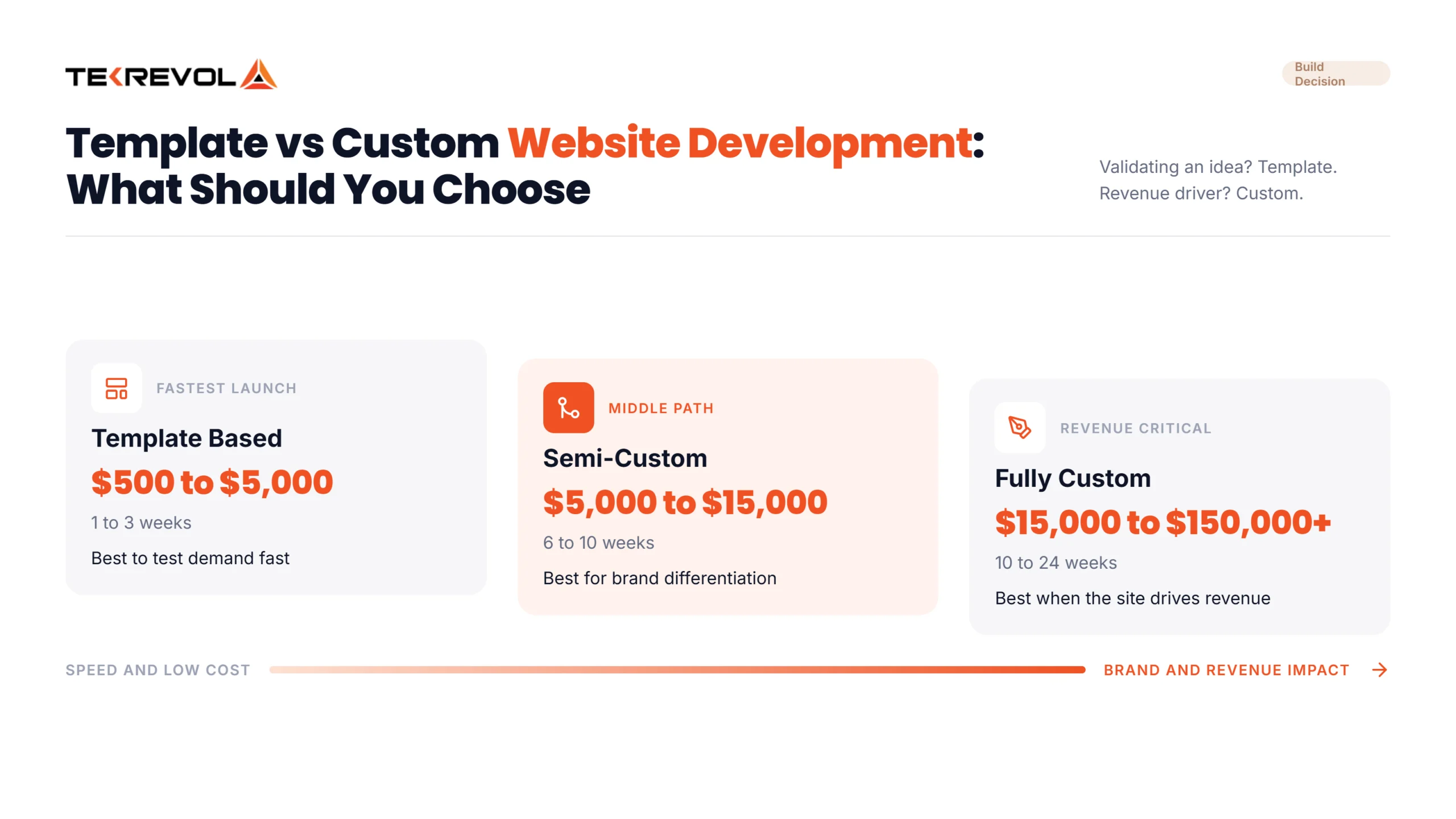
Here’s exactly what each path means, what it costs, and how to know which one fits where your business is right now.
Template-Based Website Development
Template-based development means building on a pre-built design framework (WordPress themes, Webflow templates, or Shopify’s theme library). A developer customizes the template to match your brand, adds your content, and configures the settings.
- Cost: $500–$5,000
- Timeline: 1–3 weeks
Custom Website Development
Custom development means building from a design system up. Your designer creates original wireframes and UI components specific to your brand, audience, and conversion goals. Your developer builds the front-end and back-end logic to match that design, not whatever a theme allows.
- Cost: $10,000–$150,000+
- Timeline: 8–24 weeks
This is more expensive because every element is built once, for you. A site built around your specific buyer journey performs differently from one built around a generic template. That’s one of the reasons TekRevol’s clients see 3× more leads after launching their new sites
The Middle Path: Semi-Custom Development
Semi-custom development means building a custom design on a proven technical framework, i.e., WordPress, Next.js, or Webflow, rather than starting from scratch.
You get an original brand design that looks and feels custom. The cost sits between a template build and a fully custom one.
Which Path fits your business?
| Approach | Cost (USD) | Timeline | Design Uniqueness | Scalability | Choose If… |
|---|---|---|---|---|---|
| Template + customization | $500–$5,000 | 1–3 weeks | Low | Limited | You need speed and low cost; idea validation |
| Semi-custom (custom design on framework) | $5,000–$15,000 | 6–10 weeks | Medium-high | Good | You want brand differentiation without full custom cost |
| Fully custom design + development | $15,000–$150,000+ | 10–24 weeks | Unique | Excellent | Website is revenue-critical; needs custom features or integrations |
Tips to Optimize Your Cost of Web Development
The best way to cut website development costs is not to find a cheaper vendor but to arrive better prepared. Implement the following six tips to reduce your total build cost by 25–40%:
-
1Scope an MVP
A $25,000 MVP that validates demand is better than a $100,000 product that validates nothing. Features that founders are rarely what users actually need.
-
2Deliver content before development
Designing around placeholder copy doubles revision cycles. Founders who deliver complete copy and brand assets finish builds 2–4 weeks earlier.
-
3List all integrations before requesting quotes
Every integration added after development costs 2–3× what it would have cost in discovery. Before sending a brief, list every single tool in your business.
-
4Choose a proven stack
Match your tech to your actual requirements. Choosing a premium framework for a 500-visitor/month website adds $10,000–$20,000 for no measurable benefit.
-
5Pay for discovery
Without discovery, your estimate is based on assumptions. A $4,000 discovery phase prevents $15,000–$25,000 in mid-project scope changes
-
6Negotiate a monthly retainer
Post-launch retainer rates negotiated during an active project are typically 15–25% lower than rates quoted to a new client cold.
How TekRevol Helps You Build a Website That Earns Its Cost Back
As an ISO 27001-certified web development company, TekRevol clarifies the scope and integration complexity to give you a realistic range of website development costs before you commit to anything.
Since 2018, we’ve delivered 500+ web development solutions, including websites, web apps, and digital platforms across 30+ industries for founders, operators, and enterprise teams who need results, not just deliverables.
Every TekRevol project starts with a discovery engagement that produces a specification detailed enough to generate a fixed-price quote you can hold us to. Our core project types:
- Custom business websites, from small business sites to multi-hundred-page corporate presences built on WordPress, Webflow, or Next.js
- E-commerce platforms: Shopify, WooCommerce, and fully custom builds for consumer brands, B2B sellers, and D2C companies
- Web applications and SaaS products: dashboards, portals, booking platforms, client-facing tools, and internal applications
- Enterprise portals: complex integration-heavy platforms built for organizations that run operations through their digital infrastructure
The solutions we deliver are built around one question: what does this website need to do for your business in the next 12 months? Everything else follows from that answer.
Build, Launch and Compound with TekRevol
Get a real number for your web project before someone else in your market does.
Book Your Consultation Today


