The SDLC is the full process of building software, and the STLC is the process of testing it. In SDLC vs STLC, the two cycles run alongside each other, so testing work starts long before the build ends. This guide explains how the SDLC and the STLC differ, shows where their phases line up, and gives a test for how tightly to tie them together on a custom software development project.
What is the SDLC?
The software development lifecycle is the process a team follows to plan, build, test, release, and maintain software. It usually runs through six phases: requirements, design, build, test, deploy, and maintain. Testing is only one of them, which is why the SDLC is the wider cycle in any software development life cycle vs software testing life cycle comparison.
What is STLC in software testing?
The software testing life cycle (STLC) is the set of planned steps a QA team follows to check that software meets its requirements. In TekRevol’s reading, that is the STLC meaning: a repeatable testing process with a clear start and end for each step. This guide uses a version with six phases: requirement analysis, test planning, test case development, test environment setup, test execution, and test closure.
The ISTQB syllabus calls the same work the test process. In TekRevol’s reading, STLC is the more common label in tutorials and interviews, and the STLC process and the test process describe the same activities.
SDLC and STLC phases side by side
Each STLC phase starts alongside one of the SDLC phases, so testing does not wait for the build to end. The diagram shows where each test phase begins, and the table shows what testers do and produce at each point.
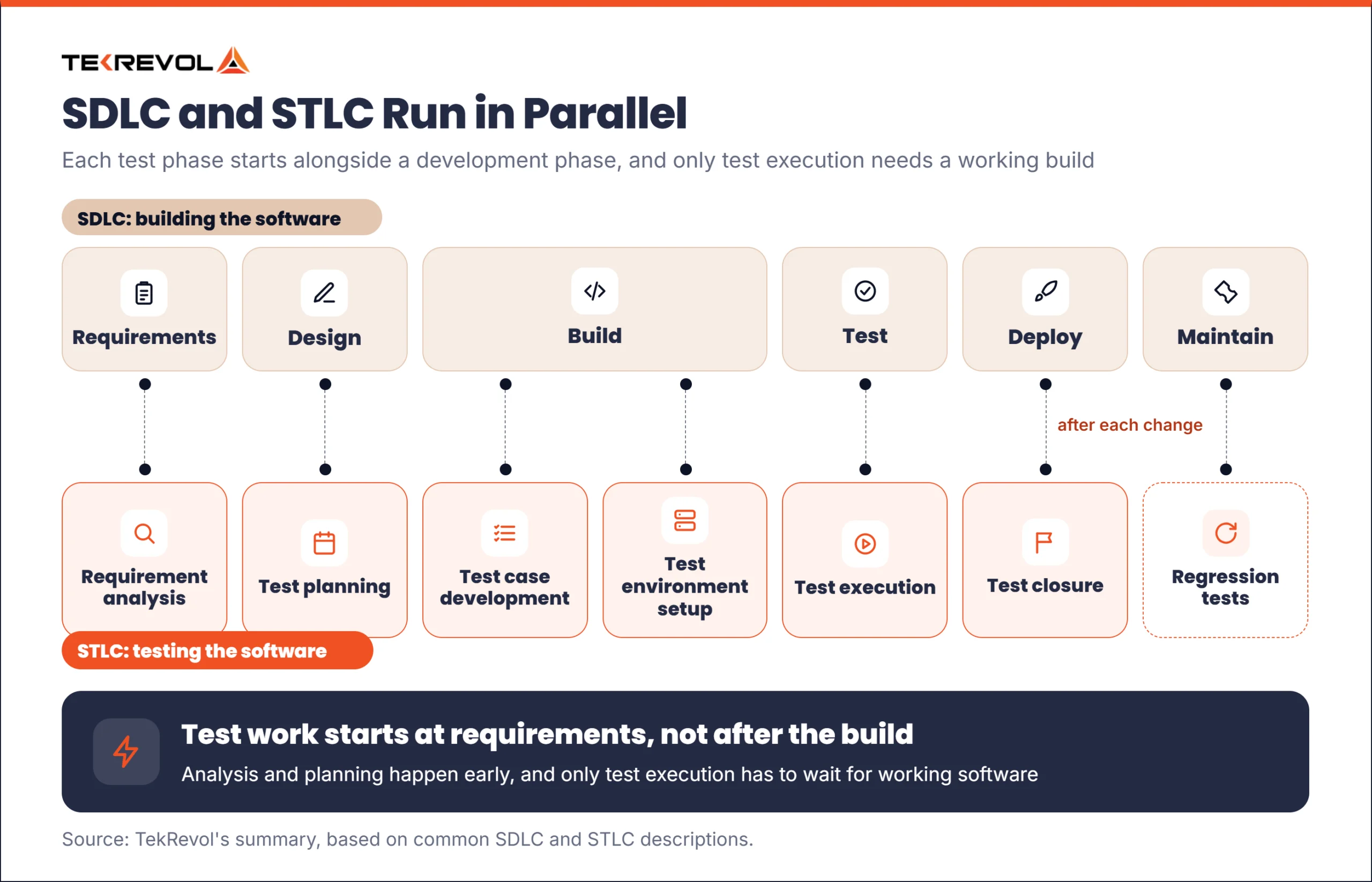
| SDLC phase | STLC activity running alongside | Output on the test side |
| Requirements | Requirement analysis: testers check that each requirement can be tested and note the risks | Testable requirements and a risk list |
| Design | Test planning: the team sets scope, approach, roles and tools | Test plan |
| Build | Test case development and environment setup: testers write cases and data and prepare a test environment | Test cases, test data and a ready environment |
| Test | Test execution: testers run the cases, log defects and retest fixes | Execution results and defect reports |
| Deploy | Test closure: the team reviews coverage and open defects and records lessons | Test summary report |
| Maintain | Regression testing: testers rerun key tests after each change | Updated regression suite |
The pairing is TekRevol’s reading, and teams shift the start points a little. Inside the SDLC’s own test phase, the usual SDLC testing phases are unit, integration, system, and acceptance testing.
Entry and exit criteria for each STLC phase
A phase should start when its inputs exist and end when a named output is accepted. The criteria below are TekRevol’s judgment, and teams should adjust them and record them in the test plan.
| STLC phase | Entry criteria | Exit criteria | Artifact |
| Requirement analysis | Requirements are written and reviewed | Each requirement is marked testable and open questions are logged | First version of the traceability matrix |
| Test planning | Requirements are agreed and the main risks are known | The lead and the product owner approve the plan | Test plan |
| Test case development | The test plan and design documents are approved | Cases and data are reviewed against the requirements | Test cases and test data |
| Test environment setup | A build is available and the environment needs are agreed | A smoke test passes on the environment | Ready test environment |
| Test execution | The environment is ready and the cases are approved | Planned cases have run, and no critical defect is open | Execution results and defect reports |
| Test closure | Test execution is complete | The summary report is accepted, and lessons are recorded | Test summary report |
Difference between SDLC and STLC
The SDLC builds the software, and the STLC checks it. STLC vs SDLC comes down to scope: the SDLC covers every stage of building software, and the STLC covers only the testing work within it.
| Aspect | SDLC | STLC |
| Scope | Every stage of building software | The testing activities within that work |
| Main goal | Deliver working software that meets the business need | Show that the software meets its requirements and find defects |
| Main question | Are we building the right thing, the right way? | Does it work as required, and where does it fail? |
| People | Analysts, designers, developers, testers, product owners and project managers | QA engineers, testers and test leads, with developers and product owners |
| Main outputs | Working software and its documentation | Test plan, test cases, defect reports and a closure report |
| Timing | Runs for the life of the product | Starts when requirements exist and repeats for each release |
Does the STLC start after development ends?
No, testers begin analyzing requirements and planning tests while the design is still open, and only test execution has to wait for a working build. In TekRevol’s reading, treating the STLC as something that runs after the SDLC mixes up the SDLC’s test phase with the whole test cycle. Seen that way, SDLC in testing is a thread that runs through every phase.
A worked example: a gift card at checkout
One feature shows how the two cycles move together. The example is TekRevol’s illustration: an online store lets shoppers pay part of an order with a gift card and the rest with a payment card.
| Stage | What the team does | What the STLC does | What the testing found |
| Requirements | Writes the rule for a part-paid order | Reviews the rule and asks what happens when the card balance is zero | A zero-balance case was missing and was added to the requirement |
| Design | Designs the checkout screen and the payment flow | Plans tests for part payments, expired cards and refunds | Refunds on part-paid orders were marked high risk |
| Build | Developers code the flow | Writes cases and data and sets up a test store with test gift cards | A missing kind of test data was created before testing began |
| Test | Runs the release candidate through the test phase | Executes the cases and logs defects | A refund on a part-paid order returned the whole amount to the gift card |
| Deploy | Releases the feature to shoppers | Closes testing and reviews the open defect list | Two low-risk defects were recorded and accepted by the product owner |
The zero-balance gap was caught during requirements, when the fix was one edited sentence, and the refund defect was caught in the test phase, before any shopper saw it. That timing is the point of running both cycles together. A real project would have many more cases.
The two cycles in Waterfall, V-model, Agile, and DevOps
Among the SDLC models, Waterfall runs the STLC late and the V-model plans it beside design. Agile and DevOps, two SDLC methodologies, run it inside each sprint and on every build.
| Approach | How the STLC relates | Where testing sits |
| Waterfall | The STLC mostly follows the build | In a test phase after development, so defects surface late |
| V-model | Test planning for each design level starts with that design | Planned beside design and run after coding |
| Agile | A small STLC runs in every sprint | Inside each sprint, with the developers |
| DevOps | Automated tests run on every build or change | Continuous, in the delivery pipeline |
Which approach fits depends mostly on how stable your scope is. Our guide to SDLC models explains when each one suits a project.
Why a team needs both
A team needs both because the SDLC gives testers something to test, and the STLC gives the team evidence that the work is done. Without a test cycle, defects reach users, and without a build plan, tests have nothing to check.
In TekRevol’s reading, a defect costs more to fix the later it is found, which is the main reason to start the STLC at requirements. A project can technically run an SDLC with no formal STLC. Testing then depends on individual habit.
Limits of the STLC
A formal STLC does not fix a weak design, and it can add more process than a small team needs. The points below are TekRevol’s judgment.
- Testing cannot replace quality in design. Tests find defects but do not remove them, so poor requirements still cost rework.
- Paperwork can outgrow the project. A small team may not need six formal phases with sign-offs. Keep the artifacts that people actually use.
- There is no single standard list. Lists run to five, six, or seven phases, so agree on one list for your team.
- Counts can mislead. The number of test cases run says little about whether the right risks were covered.
The STLC also covers only testing. The wider product life cycle, such as launch and retirement decisions, sits outside it, and SDLC vs PDLC compares that wider cycle with the SDLC.
How to align the two cycles
Align the two cycles by starting test work at requirements and tying every test back to a requirement. These five practices do most of the work, and they are TekRevol’s judgment:
- Involve testers in requirement reviews. They spot vague or untestable rules while a fix is still one edited sentence.
- Keep a requirements traceability matrix. It links each requirement to its design item and its test cases, so gaps show early.
- Set entry and exit criteria. Use the table above and record the criteria in the test plan.
- Automate repeat checks. Run regression tests automatically on every build and keep manual effort for new features and exploratory work.
- Track defect leakage. In TekRevol’s reading, it is the share of defects that reach users, and it is worth reviewing each release.
How tightly should your STLC sit inside the build?
The more your scope changes and the costlier a missed defect is, the tighter testing should sit inside the build. The TekRevol STLC Alignment Check turns that into five questions. The check is TekRevol’s judgment.
| Question | Points to testing inside each sprint | Points to a phased test cycle |
| How often does scope change? | Often, with new items every sprint | Rarely, with requirements signed off up front |
| How costly is a missed defect? | Moderate, and a fix can ship quickly | High, such as a safety or legal risk |
| Do auditors need test evidence? | No formal evidence is needed | Yes, each requirement must trace to a test record |
| How often do you release? | Often, every sprint or more | Rarely, in large planned releases |
| Do testers work inside the build team? | Yes, they sit with the developers | No, a separate QA team tests at set points |
Four or five answers in the middle column point to testing inside each sprint, and four or five in the last column point to a phased test cycle. Anything in between suggests a hybrid, such as a phased cycle for the riskiest modules and in-sprint testing for the rest.
Wondering how testing should fit your build plan?
If your team cannot say who tests what and when, settle that before the build starts. Bring your release plan and your current test process to a conversation, and we will help you decide how tightly testing should sit inside the build.
TekRevol is a software development company that makes testing a named stage of its custom software development process. QA engineers run functional, performance, security, and usability testing; defects are fixed in the same cycle, and each two-week sprint ends with working, tested software.
Choose the testing approach after you answer the five questions, not before. Start with a Free Consultation.