



- Agile vs waterfall comes down to one question: can your requirements survive contact with reality?
- The measured performance gap between the two software development approaches is far smaller than either camp claims.
- Your contract decides the method more often than your preference does, and nobody says so.
- Agile shifts real work onto the client, including decisions, sprint reviews, and an always-available product owner.
- Hybrid is the fastest-growing approach, and it isn’t a compromise so much as a boundary.
Did you know that over 65% of software projects fail or miss deadlines simply because teams pick the wrong management framework upfront? Choosing between Agile vs Waterfall isn’t just a technical decision; it determines your project’s speed, budget control, and overall market survival.
Waterfall fixes scope upfront and delivers once at the end. Agile commits in small increments and expects the plan to move. The right answer between Agile vs Waterfall depends on how stable your requirements really are, and on what your contract allows you to change later.
In this guide, we break down core differences between Agile and Waterfall, comparison metrics, and key decision factors. Then what the choice changes about your contract, and how hybrid delivery works when neither option fits, so you can pick the ideal software development methodology for your next business venture.
What Is Waterfall Software Development?
Waterfall runs the project as one pass through fixed phases of the software development life cycle: requirements, design, build, test, deploy. Each phase completes and gets signed off before the next begins. You see working software once, near the end.
The appeal is certainty. You know the scope, the price, and the date before anyone writes code, because all three were agreed in a document everybody signed. It’s still the default shape for a lot of custom software development work.
The cost is feedback timing. Nothing gets checked against reality until testing. By then, a wrong assumption in the requirements has been designed around, built on, and integrated with.
What Is Agile Software Development?
Agile is a set of values, not a methodology. It commits in short increments, ships working software frequently, and expects requirements to change. Software development methodologies built on it — Scrum, Kanban, XP — are where those values turn into process.
The Agile Manifesto, written by seventeen people at Snowbird, Utah in February 2001, states four values:
- Individuals and interactions over processes and tools
- Working software over comprehensive documentation
- Customer collaboration over contract negotiation
- Responding to change over following a plan
And then the clause everybody drops. “That is, while there is value in the items on the right, we value the items on the left more.” Agile doesn’t discard documentation or planning. It ranks them second.
We compare the frameworks that implement those values in software development methodologies.
Agile vs Waterfall: What Are the Key Differences?
Waterfall plans everything once and delivers once. Agile plans continuously and delivers repeatedly. The differences that actually change your project are the commercial ones: what your contract can say, who pays for a change, and how much of your own time it costs.
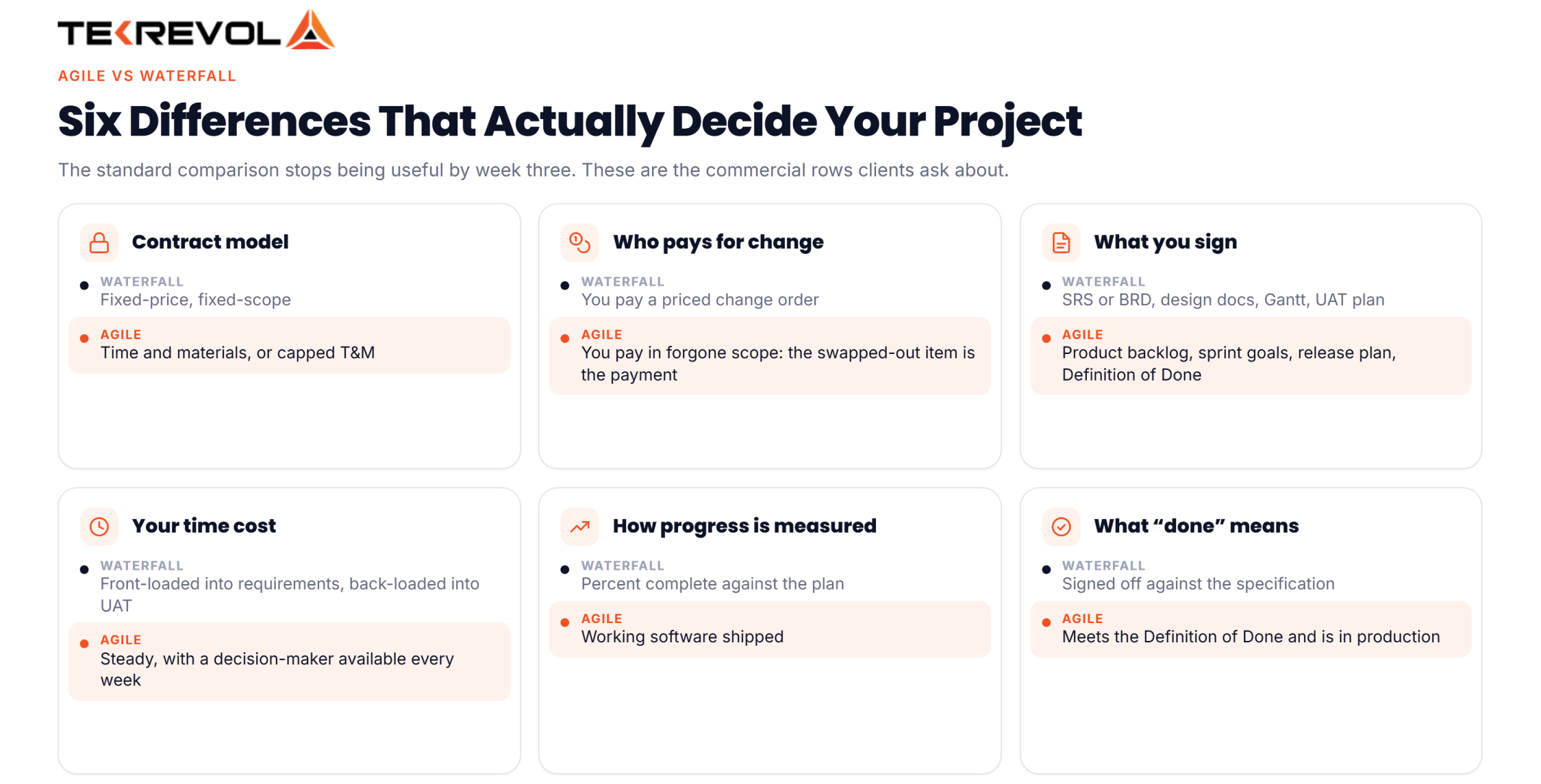
The table below describes waterfall as it’s commonly practised. The first nine rows cover the usual ground; the last six decide real projects.
| Dimension | Waterfall | Agile |
| Planning | All upfront, before build starts | Continuous, one increment ahead |
| Requirements | Fixed and signed off | Expected to evolve |
| Development | Sequential phases | Iterative cycles of 1–4 weeks, or continuous flow under Kanban |
| Delivery | One release near the end | Working software every iteration |
| Client involvement | Heavy at start and at UAT | Continuous, every iteration |
| Handling change | Formal change request, re-priced | Backlog reprioritisation |
| Testing | A phase after build | Alongside development, continuously |
| Documentation | Comprehensive, produced upfront | Lighter, produced as needed |
| Risk surfaces | Late, during testing | Early, every iteration |
| Contract model | Fixed-price, fixed-scope | Time and materials, or capped T&M |
| Who pays for change | You do, as a priced change order | You do, in forgone scope. the swapped-out item is the payment |
| What you sign | SRS or BRD, design docs, Gantt, UAT plan | Product backlog, sprint goals, release plan, Definition of Done |
| Your time cost | Front-loaded into requirements, back-loaded into UAT | Steady; a decision-maker available every week |
| How progress is measured | Percent complete against the plan | Working software shipped |
| What “done” means | Signed-off against the specification | Meets the Definition of Done and is in production |
Those last six rows are the ones clients actually ask about in week three, once the standard comparison has stopped being useful.
Not Sure Which Model Your Project Needs?
Send us the scope and your contract terms, and we'll tell you which delivery model fits your requirements.
Schedule Your Free ConsultationAgile vs Waterfall: When Should You Use Each One?
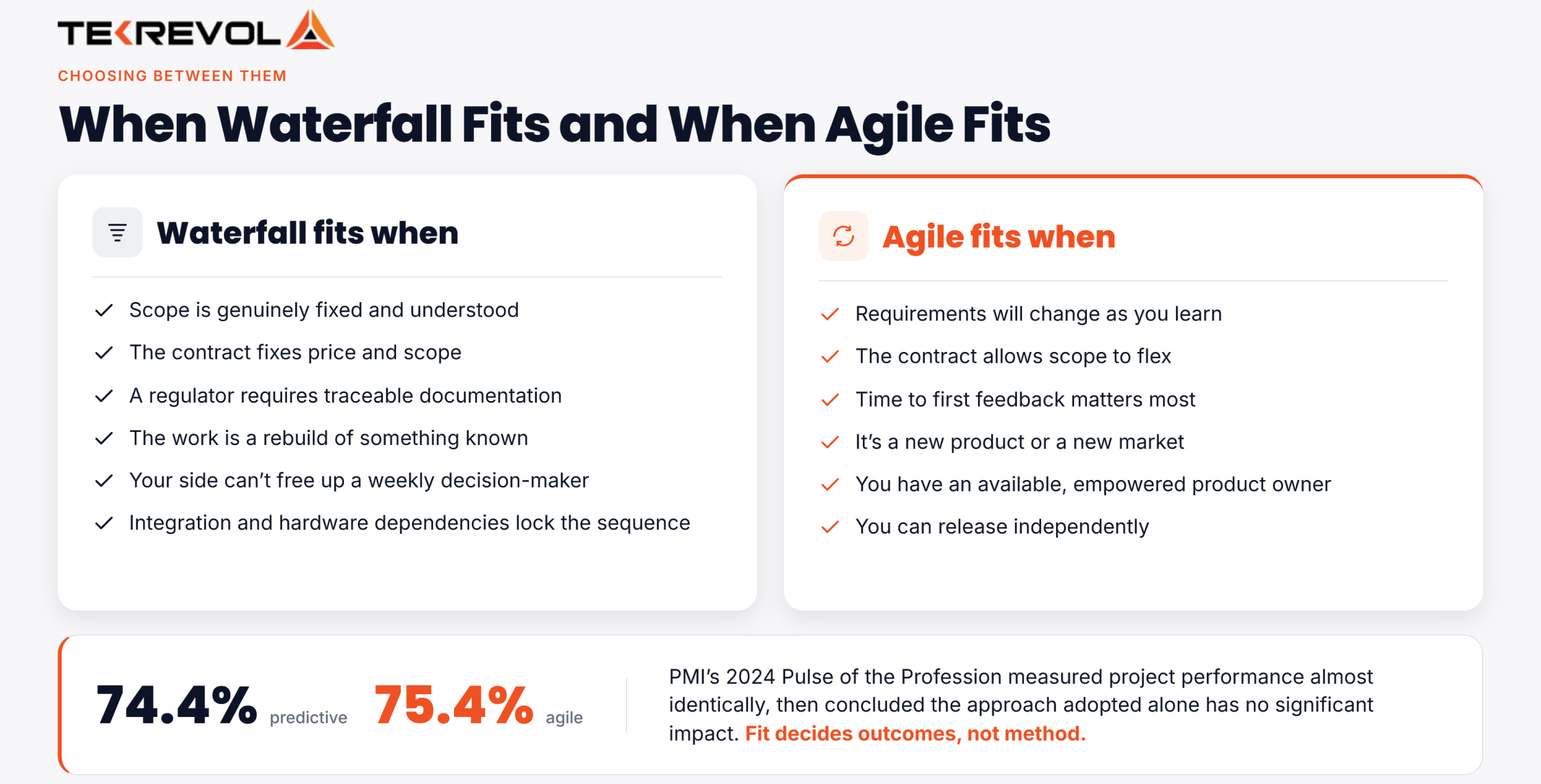
Choose waterfall when requirements genuinely won’t move, when a regulator wants traceable documentation, or when the contract is fixed-price; Agile earns its keep when requirement volatility is the default condition of the project; building something new, when users will teach you what’s needed, or when speed to first feedback matters more than schedule certainty.
| Waterfall fits when | Agile fits when |
| Scope is genuinely fixed and understood | Requirements will change as you learn |
| The contract fixes price and scope | The contract allows scope to flex |
| A regulator requires traceable documentation | Time to first feedback matters most |
| The work is a rebuild of something known | It’s a new product or a new market |
| Your side can’t free up a weekly decision-maker | You have an available product owner |
| Integration and hardware dependencies lock the sequence | You can release independently |
Two of these deserve expanding, because they’re where the decision usually goes wrong.
- “A regulator requires documentation” isn’t automatically a vote for waterfall
Traceability matrices, design history files and validation records are deliverables, not a delivery model. AAMI TIR45, an FDA-recognised consensus standard, exists specifically to map agile practice onto medical device software requirements like IEC 62304. What the regulator wants is the evidence, not the phase gate.
- “We can’t free up a product owner” is a real constraint, not an excuse
Agile transfers genuine obligation to the client someone available weekly, empowered to decide, attending reviews. If that person doesn’t exist on your side, agile degrades into waterfall with standups, and you get the overhead of both. Where the gap is capacity rather than authority, IT staff augmentation is often the cheaper fix.
What Does Agile vs Waterfall Change About Your Contract?
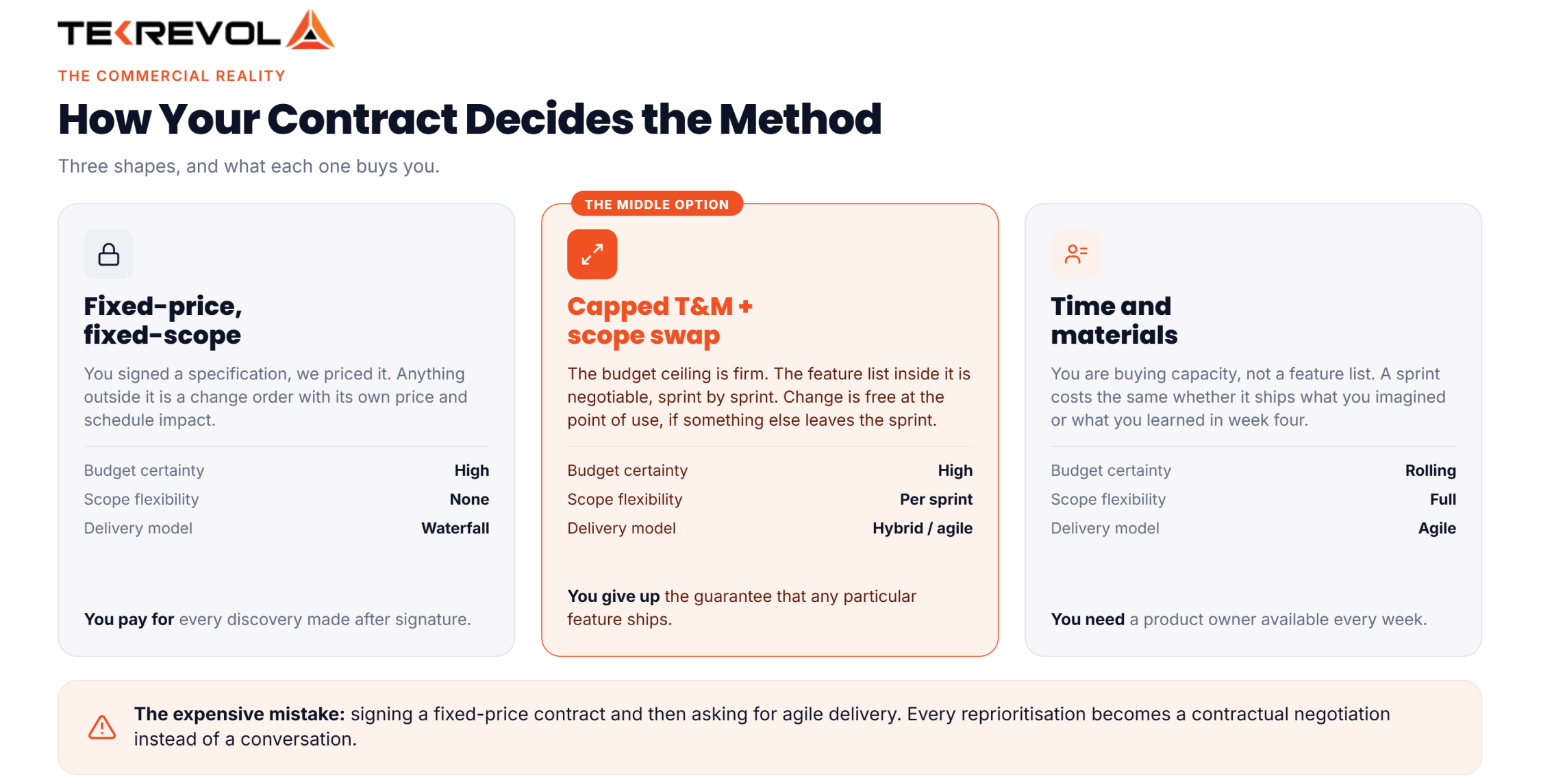
Waterfall supports a fixed-price, fixed-scope contract because both sides agreed the scope in advance. Agile usually works best under time and materials, or capped T&M with a scope-swap clause, because the whole point is that scope moves.
Under waterfall, the commercial logic is clean. You signed a specification, we priced it, and anything outside it is a change order with its own price and schedule impact. You get budget certainty and pay for every discovery made after signature.</p>
Under agile, you’re buying capacity rather than a feature list. A sprint costs the same whether it delivers the features you originally imagined or better ones you learned about in week four. Change is free at the point of use but only if something else leaves the sprint. That trade is the mechanism, and it’s the bit clients miss.
The middle option is capped time and materials with a scope-swap clause. The budget ceiling is firm. The feature list inside it is negotiable, sprint by sprint. Fixed-price agile does exist. But it needs the swap mechanism written into the contract. You get most of agile’s adaptability and most of waterfall’s budget discipline, and you give up the guarantee that any particular feature ships.
Getting this wrong is expensive in a specific way: signing a fixed-price contract and then asking for agile delivery. Every reprioritisation becomes a contractual negotiation instead of a conversation. It’s the single biggest factor in software development cost.
Stuck Between Fixed Scope and Flexible Delivery?
Send us the requirement, and we'll tell you which contract structure actually fits your project's needs.
Consult Our Strategy TeamCan You Combine Agile and Waterfall Into a Hybrid?
Yes, and most organisations now do. Hybrid usually means a waterfall wrapper: fixed budget, phase gates, and upfront architecture with agile delivery inside it. The prescriptive version of hybrid SDLC models is Agile-Stage-Gate, where gates release budget and sprints do the building.
The honest version is that hybrid isn’t a compromise. It’s a boundary drawn where each approach genuinely works better.
- Plan and architect once. System architecture, integrations, security model and compliance scope are expensive to change iteratively and rarely benefit from it. Do that upfront.
- Build and test iteratively. Features, interfaces and workflows are exactly where feedback pays. Run those in sprints with working software at the end of each.
- Gate at the money. Keep formal review points where budget is released, not between every phase. That satisfies governance without stopping delivery. The underlying phase-sequencing choices are covered in software development models.
How TekRevol Handles Agile vs Waterfall
We default to agile delivery inside a capped budget, and we say upfront which parts of your project genuinely aren’t negotiable, including the development team structure we assign to it.Where a fixed-price contract is required, we scope for it honestly rather than promising flexibility the paperwork won’t allow.
The distributed-team question is the one worth asking, because the Agile Manifesto’s sixth principle prefers face-to-face conversation and our engineering teams aren’t in your building.
Our answer is structural rather than aspirational. A named product owner on your side. One fixed weekly decision slot in your timezone. Decisions written into the backlog. And a demo of working software at the end of every iteration. If a decision can’t be reached in that slot, it becomes a spike rather than a blocker.
We also tell clients what agile is going to cost them in hours. In our engagements that’s roughly a half-day a week from whoever owns the product, more in the first month less than a dedicated product owner, because we carry the backlog work.
If your side can’t commit it, we’ll say so and scope a more sequential engagement instead, because agile without a decision-maker is the worst version of both approaches.
Agile vs Waterfall: So Which One Should You Pick?
The agile vs waterfall decision starts with two questions, in this order.
- What does your contract let you change after signature?
- Can you put an empowered decision-maker in a room once a week?
If the contract is fixed and the decision-maker isn’t available, run sequential and plan properly. If both are flexible, run agile and use it. In case of one is flexible and the other isn’t which is most projects draw the boundary deliberately rather than discovering it in month three.
The performance data on agile vs waterfall says the method matters less than the fit. What it doesn’t say, and what’s just as true, is that choosing the wrong one and then pretending otherwise is far worse than either.
Ready to Build Your Next Software Venture?
Choosing between Agile and Waterfall doesn't have to be a guessing game. Our experts will help you map out and execute the right development strategy.
Book a Strategy Consultation Today


