- Flutter delivers the fastest 2026 performance, with Impeller 2.0 holding 60 to 120 FPS at 250ms startup.
- React Native’s New Architecture uses Fabric and Hermes to cut cold start time by 20 to 40%.
- .NET MAUI consumes the least memory of the three frameworks, though its UI customization remains more limited.
- Xamarin can no longer receive updates since Apple’s iOS 26 SDK requirement blocks it from App Store submissions.
- React Native produces the largest app size while .NET MAUI ships the smallest, with Flutter falling in between.
- Flutter holds roughly 46% market share in 2026, ahead of React Native’s 35 to 42% share.
- No framework wins universally in 2026; your team’s skills and app type should guide the final decision.
React Native, Flutter, and .NET MAUI are the three frameworks worth comparing for cross-platform app development in 2026, and the direct answer is that there’s no single “best” one.
React Native remains the strongest choice for JavaScript-first teams building complex, native-feeling apps, backed by the largest developer talent pool of the three. Flutter is the fastest route to a visually consistent MVP across iOS and Android, because of its own rendering engine and mature tooling.
.NET MAUI, Xamarin’s official successor, is the right fit almost exclusively for C#/.NET-aligned teams or businesses migrating an existing Xamarin app.
Picking the right one depends less on trends and more on your team’s skills, timeline, and how deeply your app needs native device integration, which is exactly the kind of scoping decision a mobile app development company helps get right before development starts. This guide breaks down where each framework actually stands today.
Let’s start discussing the frameworks mentioned above.
A Quick Note on Xamarin
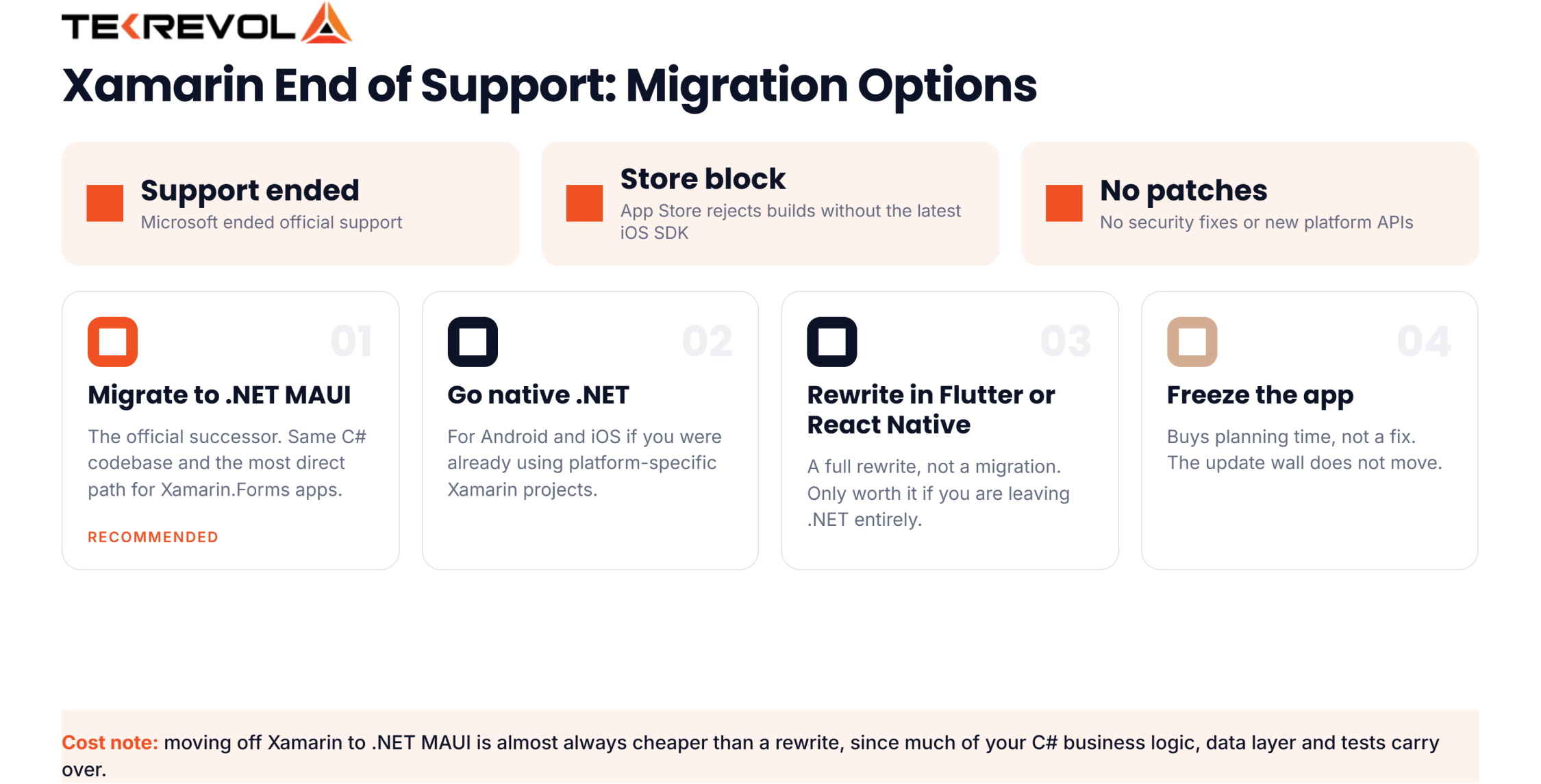
If you’re here because you remember this post comparing React Native, Flutter, and Xamarin, that comparison is out of date. Microsoft ended official support for Xamarin, including Xamarin. Forms, on May 1, 2024. No further security patches, bug fixes, or new platform APIs are being released. As of April 2026, Apple’s App Store Connect requires the iOS 26 SDK for all uploads, which Xamarin cannot target, meaning existing Xamarin iOS apps can no longer be updated at all.
If you have a Xamarin app today, your realistic options are:
- Migrate to .NET MAUI (Microsoft’s official successor — same C#/.NET codebase, most direct path for Xamarin.Forms apps)
- Migrate to native .NET for Android/iOS if you used platform-specific Xamarin projects
- Rewrite in Flutter or React Native if you’re leaving the .NET ecosystem entirely
- Freeze the app temporarily while you plan, but this only buys time, not a permanent fix
The rest of this post compares the three frameworks that teams are actually choosing for cross-platform app development in 2026.
React Native vs Flutter vs .NET MAUI at a Glance
Flutter is fastest for rendering, React Native is most balanced for app size and hiring, and .NET MAUI is the leanest on memory but the least flexible on UI.
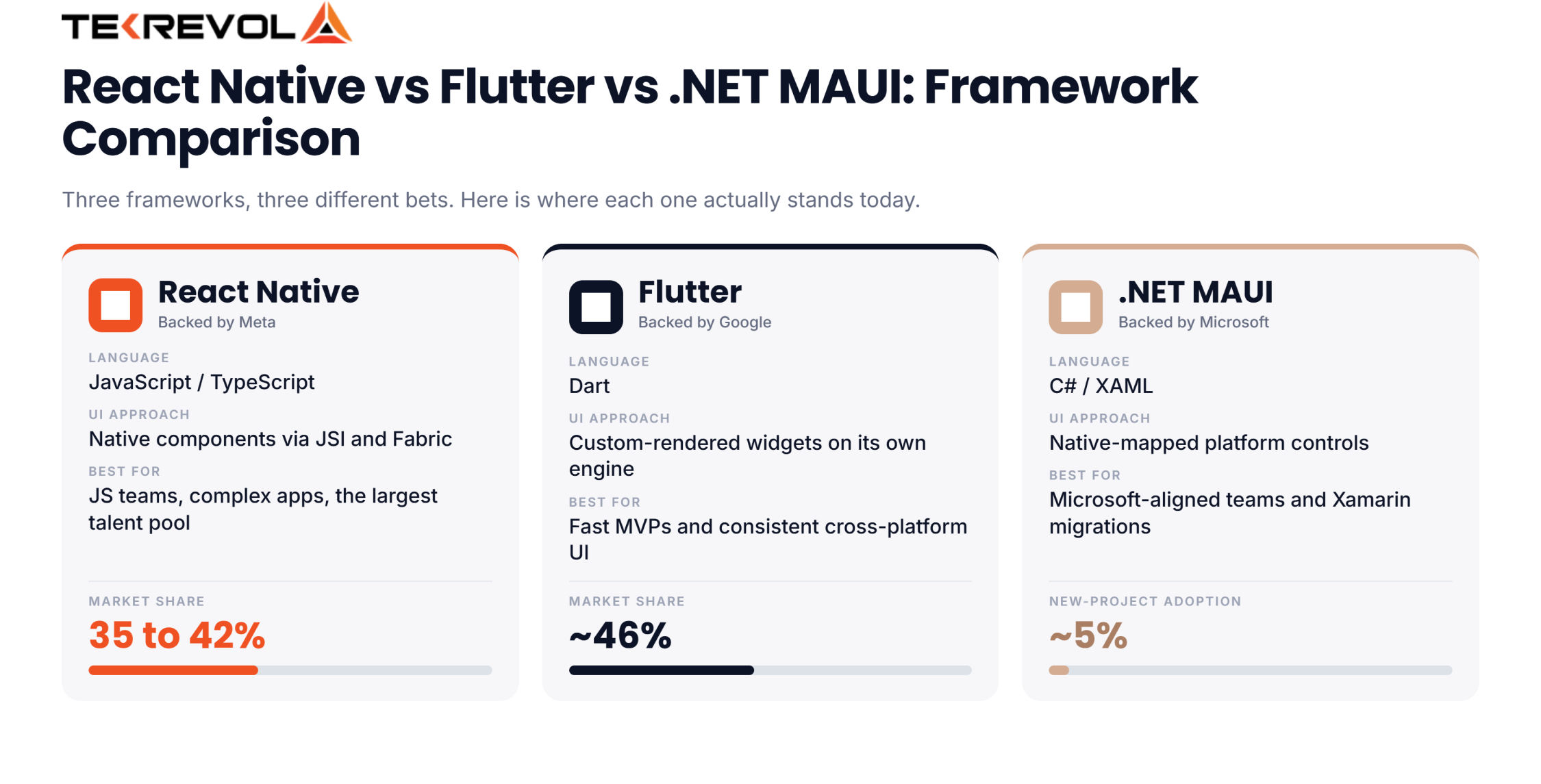
| React Native | Flutter | .NET MAUI | |
| Backed by | Meta | Microsoft | |
| Language | JavaScript / TypeScript | Dart | C# / XAML |
| UI approach | Native components via JSI/Fabric | Custom-rendered widgets (own engine) | Native-mapped controls |
| Best for | JS teams, complex apps, largest talent pool | Fast MVPs, consistent cross-platform UI | Microsoft/.NET-aligned teams, Xamarin migrations |
| ~Market share (2026) | 35–42% | ~46% | ~5% new-project adoption |
| Platforms | iOS, Android | iOS, Android, web, desktop | iOS, Android, Windows, macOS |
| 2026 status | Actively developed; New Architecture now default | Actively developed; expanding to web/desktop | Actively developed; Xamarin’s official successor |
Not sure which framework fits your app?
TekRevol's engineering experts can recommend the best framework based on your goals, budget, and timeline.
Get in TouchComparing React Native, Flutter, and .NET MAUI
Choosing the best cross-platform frameworks depends on your app’s goals, budget, and performance needs.
This comparison of React Native vs Flutter vs .NET MAUI helps you evaluate the top cross-platform frameworks and choose the best fit for your project in 2026.
React Native
Built by Meta and released in 2015, React Native remains one of the most widely used cross-platform frameworks for React Native app development. It enables developers to build iOS and Android apps using JavaScript or TypeScript and React while rendering native UI components for a smooth, platform-specific experience.
Modern React Native app development now relies on the New Architecture, including Fabric, JSI, and TurboModules, which replaces the legacy bridge for better performance. The Expo toolchain has also become a core part of the ecosystem, simplifying cloud builds, app store deployments, and over-the-air JavaScript updates without requiring a new app store review for every change.
Notable apps built with React Native: Instagram, Discord, Shopify, Bloomberg, Coinbase.
Why choose React Native in 2026
- Largest talent pool of the three frameworks, backed by the massive JavaScript and React ecosystem, making React Native developers easier to hire than specialists in Flutter or .NET MAUI.
- Over-the-air updates via Expo let you ship fixes instantly, without an app store review cycle
- Strong native module ecosystem and mature tooling
- Fast onboarding for teams that already write React for the web
- Competitive runtime performance: published 2026 benchmarks show the New Architecture cutting cold start time 20–40% versus the old bridge-based system, closing most of the historical gap with Flutter
Trade-offs
- Slightly behind Flutter on raw UI rendering performance for highly complex, animation-heavy interfaces
- Native-feel UI is a strength for platform authenticity, but achieving pixel-identical UI across iOS and Android takes more manual work than Flutter’s approach
Flutter
Flutter is Google’s open-source UI toolkit, first released in 2017, for building high-performance mobile apps. Flutter app development uses the Dart programming language and, unlike React Native, renders its own UI through a dedicated graphics engine (now Impeller) instead of relying on native platform components. This gives developers precise control over every pixel, resulting in smooth animations and a consistent user experience across iOS and Android.
Looking for a deeper dive into Flutter? Read our guide on the reasons CTOs choose Flutter for their mobile app strategy to see why it’s a top choice for modern cross-platform apps.
Notable apps built with Flutter: Google Pay, BMW, eBay Motors, Alibaba.
Why choose Flutter in 2026
- Currently holds the largest cross-platform market share, at roughly 46%
- Best-in-class rendering performance: 2026 benchmark testing shows the Impeller engine holding a stable 60–120 FPS on complex, animation-heavy UIs
- Design consistency across platforms is easier to achieve, since Flutter draws its own widgets rather than relying on native ones
- Clear path beyond mobile: Flutter has more mature desktop and embedded-device support than React Native if your roadmap extends there.
- Fast iteration via hot reload
Trade-offs
- Dart is a new language for most teams, so budget onboarding time before your first sprint
- Smaller hiring pool than React Native
- Third-party library coverage for niche integrations (certain payment systems, enterprise SDKs) still lags React Native’s ecosystem in places
.NET MAUI
.NET MAUI (Multi-platform App UI) is Microsoft’s official successor to Xamarin. Forms, built on .NET. It uses C# and follows the same core development philosophy as Xamarin. However, .NET MAUI introduces a new Handlers architecture that replaces Xamarin’s Custom Renderers, reducing memory overhead and improving app startup performance.
Why choose .NET MAUI in 2026
- By far the most direct migration path if you have an existing Xamarin.Forms codebase, much of your C# business logic and unit tests carry over with minimal changes.
- Keeps your team inside the .NET ecosystem if that’s where their skills and existing tooling already live.
- A single-project structure is simpler than Xamarin. Forms’ old multi-project setup.
- Actively developed and supported by Microsoft, unlike Xamarin.
Trade-offs
- Smallest community and third-party component ecosystem of the three.
- Migrating Custom Renderers to the new Handlers architecture is real work, not a find-and-replace; it’s typically the most time-consuming part of a Xamarin migration.
- Less momentum and fewer public case studies than React Native or Flutter, since it’s the newest of the three in its current form.
React Native vs Flutter vs .NET MAUI: The Full Performance Breakdown
Every performance difference between these three frameworks traces back to one architectural choice: what each one does with your UI at runtime. Here’s the full breakdown, metric by metric.
Rendering Architecture
Flutter draws its own pixels, React Native talks to native UI components, and .NET MAUI wraps native controls directly. That one architectural choice explains almost every performance gap on this page.
Flutter: Impeller 2.0 and drawing its own pixels
Flutter doesn’t use your phone’s native buttons or scroll views. It draws everything itself, pixel by pixel, through its own rendering engine. In 2026, that engine is Impeller 2.0, which fully replaced the older Skia renderer on iOS and is now the Android default too.
Because Dart compiles ahead of time into native ARM code, there’s no JavaScript bridge slowing things down. This consistent performance and smooth animation are key reasons many Flutter app development companies recommend Flutter for apps with custom UI and graphics-intensive experiences.
React Native: New Architecture, Fabric, TurboModules, Hermes
React Native used to run everything through a JavaScript bridge, which added lag whenever JS needed to talk to native code. The New Architecture killed that bottleneck. Fabric is the new renderer that lets JS and native code communicate directly.
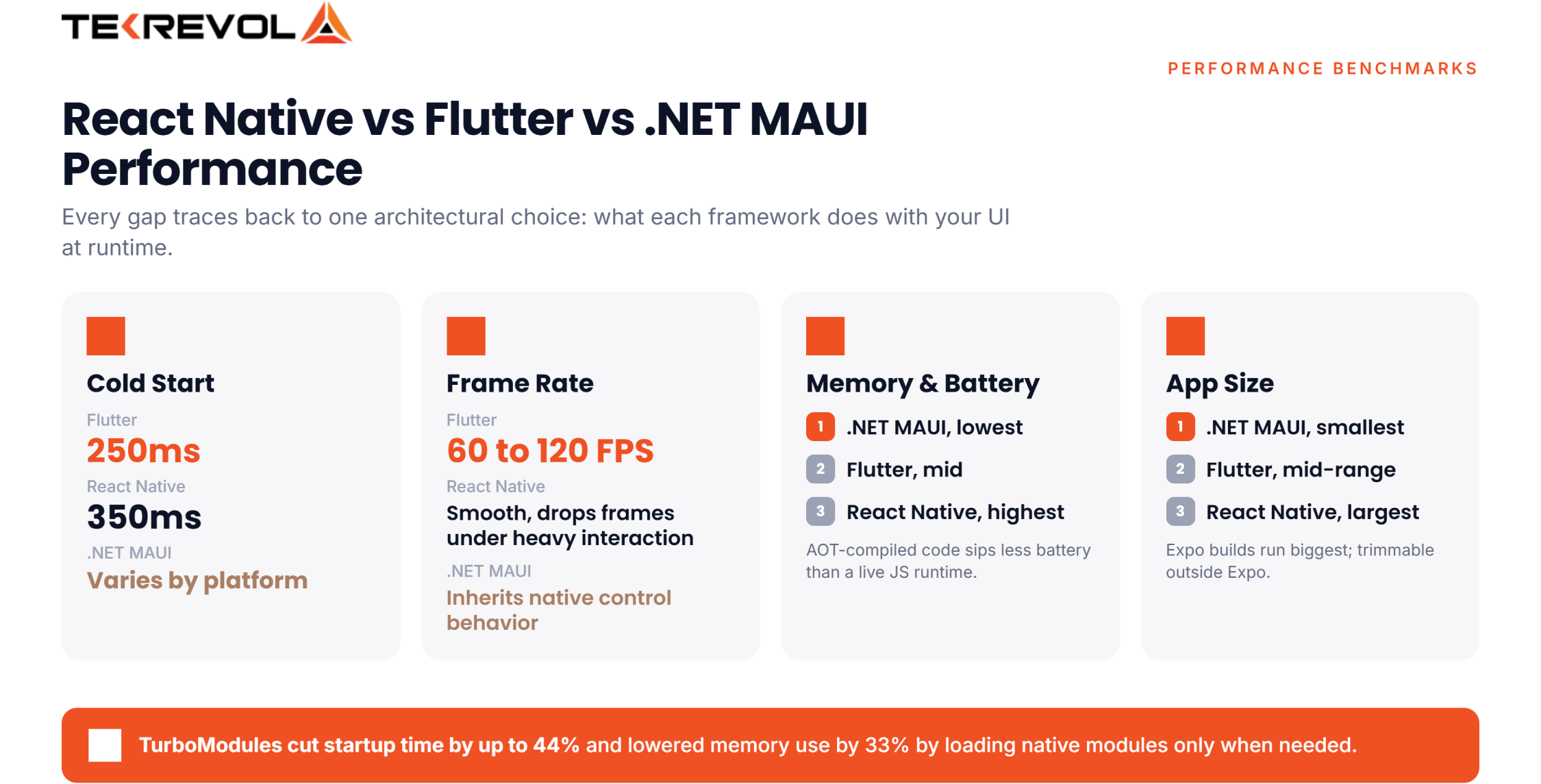
TurboModules load native code only when it’s actually needed, which trims startup memory. And Hermes precompiles your JavaScript into bytecode before the app even launches. Put together, that’s what got React Native’s cold start times down 20–40% from the old setup.
.NET MAUI: native control abstraction and .NET 9 gains
.NET MAUI doesn’t draw its own UI or run a JS bridge. It wraps the actual native controls on each platform: a real UIButton on iOS, a real native view on Android. That’s why memory usage tends to stay low. The tradeoff: you’re at the mercy of how consistently those native controls behave across platforms, and MAUI has picked up real performance gains through .NET 7, 8, and 9, but it’s still catching up on raw UI flexibility.
Startup Time Benchmark
Independent 2026 benchmarks put Flutter’s cold start around 250ms, React Native at roughly 350ms after its architecture upgrade, and .NET MAUI’s startup competitive but more variable by platform.
Flutter’s AOT compilation means there’s no JavaScript to parse or interpret when the app opens; it’s already native machine code. That’s the main reason it edges out the other two on a cold start.
React Native has closed a lot of this gap. Hermes precompiling bytecode, plus TurboModules only loading what’s needed, means the “React Native is slow to open” complaint from a few years ago doesn’t really hold up anymore.
.NET MAUI’s story is more “it depends.” Because it leans on native controls, startup can feel fast on one platform and sluggish on another, depending on how well that platform’s native rendering pipeline is optimized. Android tends to need more tuning than iOS or Windows here.
Memory Usage & Battery Life
.NET MAUI uses the least memory at idle, Flutter sits in the middle with efficient AOT-compiled code, and React Native runs highest due to its JavaScript runtime overhead.
Memory differences mostly come down to what’s running under the hood. MAUI’s native controls are lightweight by nature; there’s no extra rendering engine or JS runtime sitting in memory.
Flutter bundles its own rendering engine, which adds some baseline memory, but Dart’s AOT compilation keeps it efficient once running. React Native still carries a JavaScript engine (Hermes) in memory at all times, which is the main reason it runs heavier, even with recent optimizations.
Battery life follows the same logic. AOT-compiled code (Flutter and MAUI’s native path) tends to sip less battery than a JS runtime interpreting and executing code on the fly. React Native has improved a lot here with Hermes, but it hasn’t fully caught up.
FPS, Animations & UI Smoothness
Published 2026 benchmarks show Flutter delivering the most consistent 60–120fps performance, React Native staying smooth in normal use but dropping frames under heavy interaction, and .NET MAUI’s smoothness varying by which platform’s native controls you’re using.
This is where Flutter’s rendering engine stands out. Because Flutter controls every pixel on screen through Impeller 2.0, it eliminates shader compilation jank and delivers smooth, consistent animations across platforms. That’s one of the key technical advantages a Flutter app development company will highlight when building apps with complex user interfaces, custom animations, or graphics-intensive experiences.
React Native’s Fabric renderer made big strides here too; it can prep multiple UI updates at once instead of queuing them, which smooths out gesture-driven animations. But in genuinely complex, animation-dense screens, some frame drops still show up, especially on iOS.
.NET MAUI inherits whatever the native platform is capable of. That’s usually fine, but it means your animation performance can differ meaningfully between iOS, Android, and Windows without extra tuning work on your end.
App Size Comparison
.NET MAUI ships the smallest app size, Flutter lands in the middle, and React Native, particularly with Expo, produces the largest binaries.
| Framework | Typical size range | Why |
| .NET MAUI | Smallest | No bundled rendering engine or JS runtime |
| Flutter | Mid-range | Bundles its own rendering engine, adding baseline size |
| React Native | Largest (Expo especially) | Bundles JS runtime plus native dependencies; trimmable outside Expo |
If app size is a priority, especially for users in regions with slower internet speeds or entry-level devices, this comparison can help guide your decision.
React Native vs Flutter vs .NET MAUI: Cost Comparison
Framework choice affects your budget in two separate ways: developer day rates and how much calendar time it takes to ship.
Developer Availability Drives Rate
React Native’s larger talent pool generally means more competitive hiring rates and faster staffing, which can help reduce overall React Native app development costs compared to frameworks with smaller developer ecosystems. Flutter developers are becoming increasingly available, while .NET MAUI specialists remain the hardest to hire, often resulting in higher hourly rates or longer recruitment cycles. However, organizations with an existing C#/.NET team can offset these costs by upskilling their current developers instead of hiring new talent.
Development Speed Drives Timeline Cost
Flutter’s single rendering engine and widget consistency often shave real time off UI development and cross-platform QA, since you’re not reconciling two different native rendering behaviors. React Native can offset this with its OTA update pipeline, which reduces the cost of post-launch iteration even if initial UI polish takes a bit longer.
Migration Cost is its Own Category
If you’re moving off Xamarin, .NET MAUI is almost always the cheaper path versus a full rewrite in React Native or Flutter, since a meaningful share of your C# business logic, data layer, and tests can carry over. A full rewrite in a different language typically costs significantly more and takes longer — budget for that difference before assuming a “fresh start” is the safer choice.
Enterprise Considerations: AI, security, and long-term maintainability
For consumer apps and fast-moving MVPs, performance and development speed often drive framework selection. For enterprise applications expected to support complex workflows and evolve over many years, factors like AI integration, security, maintainability, and long-term platform support become equally important.
AI and Cloud Integration
.NET MAUI offers the most seamless integration with the Microsoft ecosystem, including Azure AI, Semantic Kernel, and Microsoft.Extensions.AI. This makes it a strong choice for organizations planning AI-powered document processing, enterprise copilots, intelligent automation, or other cloud-native AI capabilities.
React Native and Flutter also support AI integration through cloud SDKs, REST APIs, and community packages. While they don’t provide the same level of first-party AI tooling as .NET, they can efficiently integrate with services such as OpenAI, Google AI, Firebase AI, Azure AI, and AWS AI to deliver production-ready AI features.
Security and Compliance
All three frameworks can meet enterprise security and compliance requirements when implemented correctly. .NET MAUI offers tighter integration with Microsoft Identity, Azure Active Directory, Microsoft Endpoint Manager, and Azure compliance services, making it particularly attractive for organizations already using Microsoft’s enterprise ecosystem.
React Native and Flutter support enterprise-grade security through mature libraries and platform APIs, including secure storage, biometric authentication, certificate pinning, code obfuscation, and encrypted communication. Both frameworks are widely used in industries such as healthcare, finance, and retail that require strong security and regulatory compliance.
Architectural Maintainability at Scale
.NET MAUI encourages a structured development approach through the MVVM architectural pattern and Visual Studio tooling, helping large engineering teams maintain consistency across long-term projects.
Flutter and React Native provide greater architectural flexibility. Flutter supports established patterns such as BLoC, Riverpod, Provider, and Clean Architecture, while React Native commonly uses React’s component architecture together with state management solutions like Redux, Zustand, or MobX. Although neither framework enforces a single architecture, well-defined engineering standards can make both highly maintainable at enterprise scale.
Vendor Roadmap and Long-Term Support
All three frameworks are backed by major technology companies, Meta for React Native, Google for Flutter, and Microsoft for .NET MAUI, ensuring continued investment and active development.
For organizations prioritizing long-term stability, .NET benefits from Microsoft’s Long-Term Support (LTS) release cycle and predictable update schedule. This is particularly valuable for businesses migrating from Xamarin following its end of support, while React Native and Flutter continue to evolve rapidly with frequent feature releases and growing enterprise adoption.
Which Framework Should You Pick? (Decision Framework)
Selection based on your team’s skills and your app’s UI demands, not the benchmark numbers alone, all three frameworks are fast enough for most apps in 2026.
Choose Flutter if…
- Your app leans on custom, animation-heavy, or highly branded UI
- You want pixel-identical results across platforms
- You’re eyeing desktop or embedded targets down the road
Our Flutter development team has taken native apps through full Flutter migrations that cut long-term maintenance costs by up to 50% while unifying the codebase, worth a look if fragmentation across iOS and Android is already costing you engineering time.
Choose React Native if…
- Your team already knows JavaScript
- You need to hire fast and want the biggest talent pool
- You’re leaning on a mature ecosystem of ready-made packages (auth, payments, maps, analytics)
Choose .NET MAUI if…
- You’re already deep in the Microsoft/.NET stack
- You’re building for Windows as a first-class target
- Memory footprint and native-control consistency matter more to you than UI customization
If your team is already running on .NET, MAUI lets you extend that same skill set into mobile without retraining developers on Dart or JavaScript.
2026 Architecture Updates You Need to Know
All three frameworks shipped major performance-focused updates in the last year: Impeller 2.0 for Flutter, the New Architecture with Hermes for React Native, and .NET 9 gains for MAUI.
Flutter Impeller 2.0
Fully replaced Skia on iOS and became the Android default. Removed shader compilation jank and pushed stable 60–120fps rendering, even in real-time, animation-heavy use cases.
React Native’s New Architecture + Hermes
Fabric renderer and TurboModules removed the old async bridge bottleneck. Hermes precompiles JS to bytecode. Together, these are the reasons React Native stopped being the “slow one” in most 2026 comparisons.
.NET MAUI on .NET 9
Continued rendering and startup improvements building on .NET 7 and 8. Still catching up to Flutter and React Native in community size and third-party tooling, but the performance ceiling keeps rising.
The Bottom Line
Here’s the truth nobody wants to put in a headline: performance differences between these three frameworks are close enough in 2026 that they shouldn’t be your only deciding factor. Flutter wins on rendering consistency. React Native wins on ecosystem and hiring speed. .NET MAUI wins on memory efficiency and Microsoft-stack integration.
Pick the one that matches your team and your product, not the one with the flashiest benchmark chart. If you’re still stuck, start with what your developers already know — that’s usually the fastest path to shipping something fast. Or skip the guesswork entirely and talk to TekRevol’s engineers, we’ll scope the right framework for your project in a free consultation.
Ready to build?
Get a free technical consultation and a framework recommendation matched to your product, team, and timeline.
Get in Touch