The product development life cycle (PDLC) covers everything that turns an idea into a supported product, while the software development life cycle (SDLC) covers how the software inside that product is built, tested, released, and maintained. In short, PDLC vs SDLC is a question of scope. The PDLC decides what to build and why, and the SDLC decides how to build it well.
This guide defines both PDLC and SDLC, compares them, shows how they fit together, and explains when you need one or both on a custom software development project.
What is the PDLC, and what does it mean in software engineering?
PDLC stands for product development life cycle. It is the staged process a team follows to turn a product idea into a launched, supported product. PDLC in software engineering covers the product decisions around the code: who the product is for, whether it is worth building, how it launches, and how it develops afterward.
The PDLC exists because building software well does not guarantee that anyone wants it. It puts the questions of demand and fit ahead of the engineering work, so a team spends build effort only on ideas that have survived those questions.
A typical PDLC process has eight stages, which some lists call phases: idea generation, screening and feasibility, concept and planning, design and prototyping, development and engineering, testing and QA, launch and go-to-market, and post-launch optimization. Our guide to the product development life cycle walks through the stages.
Many companies add decision points to the process. In a post on the PDMA site, Robert Cooper describes Stage-Gate, a framework that divides product work into stages and places a gate between them, where management decides to go, kill, hold, or recycle a project. He adds that modern versions borrow agile methods from software, such as sprints inside a stage.
In PDLC product management, product managers and business leaders usually lead, which is why success is measured in adoption, revenue, retention, and customer satisfaction. That is our reading of common practice, not a standard.
What the SDLC covers
The software development lifecycle (SDLC) is the order of work for building software: planning, requirements analysis, design, development, testing, deployment, and maintenance. It tells a team what happens first and what comes next, and it names who signs off before work moves on.
The SDLC planning stage often includes a feasibility and go or no-go check. The SDLC’s first questions are about requirements and feasibility, not about whether the market wants the product. Our guide to the seven phases of the SDLC covers each software stage in detail.
The international standard ISO/IEC/IEEE 12207, in its 2026 edition, defines software life cycle processes for acquiring, supplying, developing, operating, maintaining, and disposing of software. It does not identify or require any specific software life cycle model, and it applies to agile approaches and methods.
PDLC and SDLC: the main differences
The PDLC decides what to build and why, and the SDLC decides how to build it well. The table compares them on six points. It is our summary of the scope of each process, not a single source’s definition.
| Aspect | PDLC | SDLC |
| Core question | Is this product worth building, and for whom? | How do we build this software correctly and reliably? |
| Starting point | A market opportunity or customer problem | An approved requirement or product concept |
| Scope | Market research, concept, design, launch and ongoing product management | Planning through maintenance of the software |
| Main owners | Product managers and business leaders | Engineers, QA staff, technical leads and architects |
| How success is measured | Adoption, revenue, retention and customer satisfaction | Quality, stability, delivery speed and defect rates |
| Typical decisions | Fund, pause, change or stop the product | Choose the architecture and decide whether a release is ready |
The split mirrors the standards. ISO/IEC/IEEE 15288:2023 covers the life of a human-made system, including conception, development, production, utilization, support and retirement, while ISO/IEC/IEEE 12207 covers software life cycle processes. In our reading, that is the same relationship as the PDLC to the SDLC: the wider cycle contains the software one.
So is the SDLC part of the PDLC? In TekRevol’s judgment, yes. SDLC and PDLC are partners, not alternatives, because a team can run both on the same product.
Our illustration: for a fitness app, the PDLC asks whether enough people would pay for guided workouts and which features they would use first. The SDLC asks how to build the workout tracker and release updates without breaking it.
How the PDLC and SDLC fit together
The SDLC runs inside the PDLC, starting with planning at PDLC stage 2 and requirements analysis at stage 3, and ending with maintenance at stage 8. The diagram and the table show where they line up.
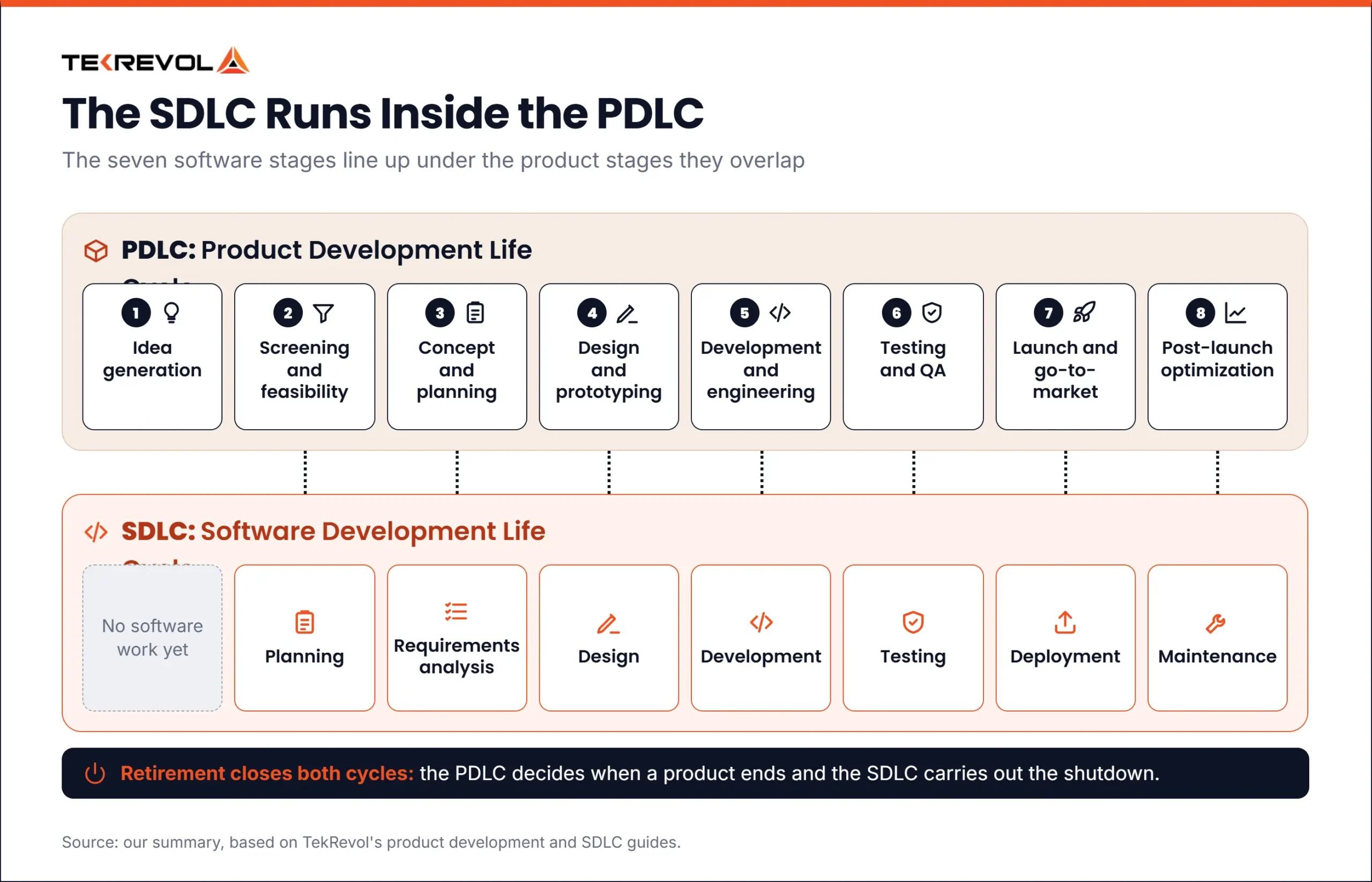
| PDLC stage | Matching SDLC stage | Who usually leads |
| 1. Idea generation | None yet | Product management |
| 2. Screening and feasibility | Planning, as a feasibility input | Product management with engineering input |
| 3. Concept and planning | Requirements analysis, with planning detail | Product management and engineering |
| 4. Design and prototyping | Design | Designers and architects |
| 5. Development and engineering | Development | Engineering |
| 6. Testing and QA | Testing | QA and engineering |
| 7. Launch and go-to-market | Deployment | Product and marketing, with engineering on deployment |
| 8. Post-launch optimization | Maintenance | Product management and engineering |
The mapping is our reading, and teams draw the lines differently.
Two stages share a name but not a meaning. In TekRevol’s judgment, design in the PDLC shapes the user experience and builds prototypes that test the concept, while design in the SDLC defines the architecture and interfaces the software needs.
In the same way, testing in the PDLC asks whether customers want the product, and testing in the SDLC asks whether the software meets its requirements. That is our reading of the usual validation and verification split.
The overlap is where most confusion starts. In our judgment, one rule settles it: the PDLC owns the decision to launch, and the SDLC owns the evidence that the software is ready.
In TekRevol’s judgment, retirement closes both cycles. Also, the PDLC decides when a product ends, and the SDLC carries out the technical shutdown, such as data migration and notice to users.
The TekRevol Handoff Map: what each life cycle hands to the other
The PDLC and the SDLC depend on four handoffs. We call the set the TekRevol Handoff Map, and it is our judgment, not a standard.
| Handoff | Direction | What passes across | What goes wrong without it |
| 1. The build decision | PDLC to SDLC | A validated problem, ranked priorities, a success measure, and a scope boundary | The team builds software nobody asked for, or builds the right thing with no way to tell it worked |
| 2. The release | SDLC to PDLC | A working release, test evidence, known defects and release notes | Launch decisions rest on opinion instead of evidence |
| 3. Post-launch feedback | Both ways | Usage data, support tickets, defect reports and feature requests | Bug fixes and roadmap decisions drift apart |
| 4. The retirement | PDLC to SDLC | A shutdown date, a migration plan, a data retention rule, and a notice to users | Old versions keep running with no owner |
In TekRevol’s judgment, the first handoff is the one teams skip most often. A build decision with no success measure leaves engineers guessing what done means, and leaves the product team with no way to judge the release.
Write each handoff down as a short checklist, and name one owner for it. In our judgment, a handoff that lives only in people’s heads fails the first time the team changes.
Do you need a PDLC, an SDLC, or both?
You need both when you are deciding what to build, and the SDLC alone when the scope is already fixed. The table matches four common situations to what each needs. It is our judgment.
| Your situation | What you need | Why |
| A client hands you a fixed specification | SDLC | The product decisions are made, so the work is building it well |
| You are building a new product for a market | Both | Someone has to decide what to build before anyone builds it |
| You are building an internal tool for a known process | SDLC with a light PDLC | The problem is known, but you still need to check that people will use it |
| You are maintaining a live product | Both | The SDLC keeps it running, and the PDLC decides what it should become |
Our illustration: a founder with a new app idea starts in the PDLC, with market research and a concept test, and hands a scoped build to the SDLC only after that. An agency given a signed specification starts in the SDLC, because the client’s PDLC happened earlier.
In TekRevol’s judgment, Agile teams still use both. Also, the sprints are SDLC work, and the decision about which problem the next sprint should solve comes from the PDLC.
Four mistakes show up when teams mix the two. These are our judgments:
- Treating the SDLC as the whole product process, so nobody asks whether the product should exist.
- Skipping validation because the build plan looks sound.
- Giving post-launch decisions no owner, so the product drifts.
- Turning the PDLC into paperwork, with gates that approve everything.
Plan and build your product with TekRevol
If you have a product idea and need a team to turn it into working software, start by agreeing what the build must prove. As an expert software development company, TekRevol begins the development process with discovery and a validation stage, where an MVP tests the critical technical assumptions before the main build. In the design stage, systems architects and UX designers work in parallel, and the build runs in two-week agile sprints.
Bring your idea, your target users, your success measure, and your budget. Start with a Free Consultation.