
Key Takeaways:
- Typical mobile game development cost ranges from $20,000 to $80,000, depending on the scope and complexity of the game.
- Mobile game development cost ranges from $15,000 for a simple hyper-casual game to $3 million or more for a AAA battle royale title.
- A casual puzzle or match-3 game typically costs between $60,000 and $250,000, while mid-core RPGs can range from $300,000 to $1.5 million.
- The main factors affecting cost are game genre, complexity, development team location, testing, and marketing budget.
- AI tools are now reducing asset creation and coding costs by up to 20%, making game development more affordable in 2026.
- Unity and Unreal Engine, which are the most commonly used mobile game engines, do not have a direct influence on the mobile game development cost.
There’s a question that keeps entrepreneurs and investment strategists intrigued: how much does mobile game development cost? Well, understanding the complexities of development costs is crucial for those looking to invest in this booming industry.
As mobile gaming keeps surging in popularity, statistics reveal impressive revenue figures and ever-growing user numbers, making it clear that the investment potential in this sector is undeniable.
However, the mobile gaming market is not an easy ground; it’s a progressive and lucrative field where success is closely tied to understanding the complexities of development costs.
This complete guide is designed to help you navigate the important insights of mobile game development expenses.
It will cover various aspects, from the typical costs of game app development to the stages involved, the factors influencing the cost, and even technologies and strategies for reducing expenses.
This guide will equip you with the knowledge to make informed decisions and better estimate the investment required for your mobile game development journey.
So, let’s get started with the mobile game development cost breakdown.
Mobile Game Development: What Statistics Suggest?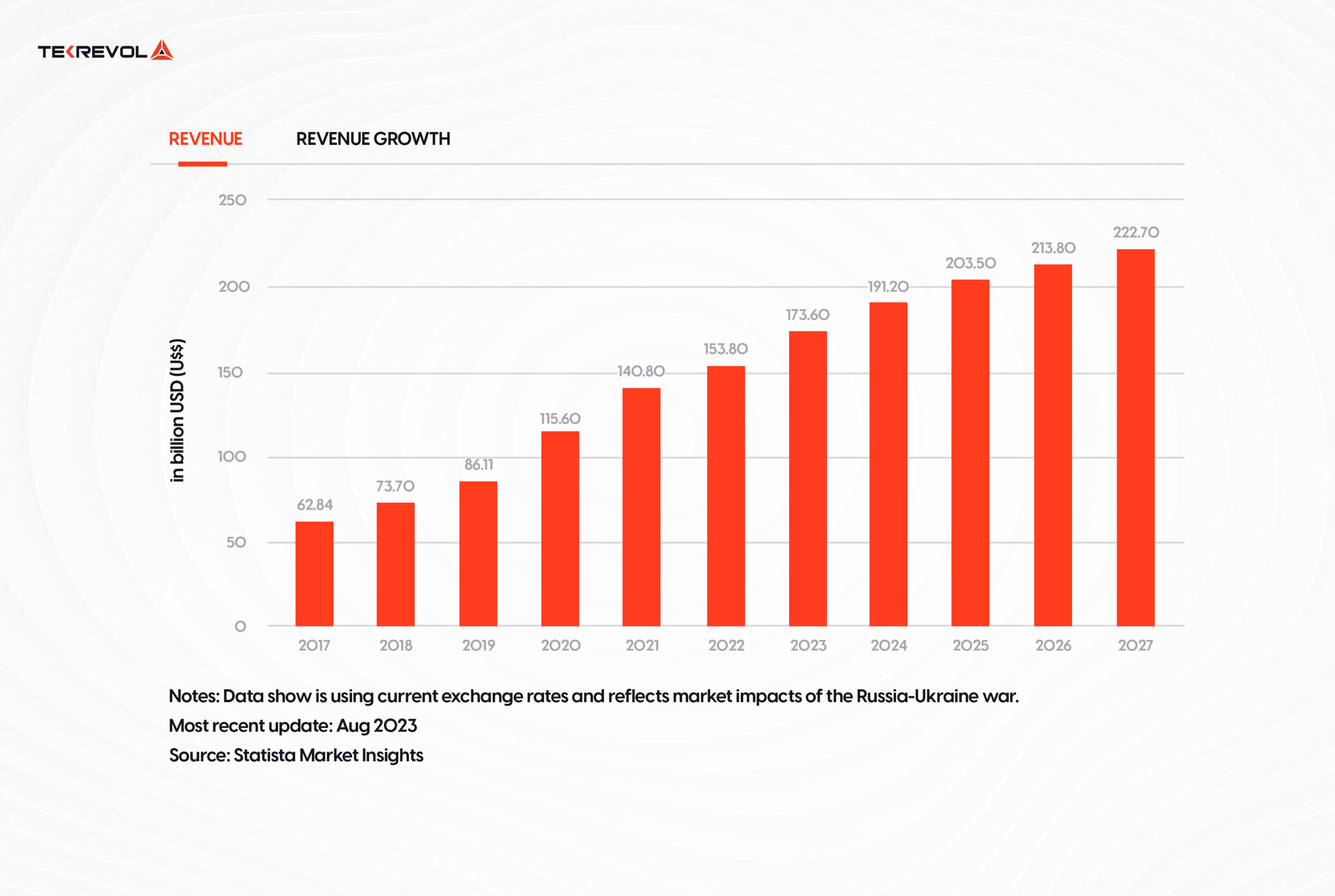
Here are some of the fascinating statistics on mobile gaming, according to Statista:
- Market Growth: Global mobile gaming revenue is projected to surpass $280 billion by 2027, maintaining a steady compound annual growth rate (CAGR) of over 7%.
- User Base: The number of active mobile gamers is expected to hit 2.4 billion globally by 2027.
- Regional Leader: The United States continues to lead in revenue generation, with an estimated $55 billion in 2025 alone.
- Monetization Shift: In-app advertising (IAA) and hybrid monetization (combining ads with in-app purchases) now account for over 60% of total revenue for casual and mid-core games.
- AI Impact: Nearly 70% of studios now report using Generative AI to reduce asset creation time, which is shifting the “cost-per-asset” model in 2025.
As a significant part of these stats comes down to the ever-growing rise of mobile game development company, we have the ultimate investment guide for all the entrepreneurs, app developers, and investment strategists to help you through mobile game app costs.
If you are in any way linked with mobile application development, you would know that a lot goes into it. Just in case you’re not aware of that then reading through how to make a mobile app can be very helpful.
What is the Typical Game App Development Cost?
The total cost of developing a typical game app can be as low as $20,000 or as high as $80,000.
A game app that includes only a minimal set of features often referred to as a “minimum viable product” or MVP, will come at a lower cost compared to an app that includes all intended functionality.
Other than that, the development cost of any game is dependent on factors like the game genre, complexity, game engine, development time, and more.
At TekRevol, our recent project data shows that while core development costs have stabilized, the investment in Post-Launch LiveOps (updates and seasonal content) has become a larger percentage of the total budget to ensure long-term player retention.
Saying that, we can still give you an estimate for your mobile game idea. All you have to do is give the cheeky little button below a push to calculate your mobile game app development cost.
- Stop Guessing. Start Building with AI-Optimized Budgets.
- See how much you can save on development using our 2026 AI-native workflows. Get your specialized quote before your competitors do.
What are the Stages of Mobile Game Creation?
You need to start with the basics and work your way up to where your money is being spent while creating your mobile game application.
Here are the 8 stages of mobile game creation:
| Stage | Action | Description | Duration |
|---|---|---|---|
| Stage 1 | Market Intelligence | AI-driven competitor analysis & “White Space” identification. | 1-2 Weeks |
| Stage 2 | Technical GDD | Defining the LiveOps roadmap and monetization hooks. | 2 Weeks |
| Stage 3 | Vertical Slice | Creating a high-polish “playable” to test the core loop fun-factor. | 3-4 Weeks |
| Stage 4 | Production | Core coding + AI-assisted art/asset generation. | 3-8 Months |
| Stage 5 | LiveOps Integration | Setting up servers, battle passes, and event triggers. | 3 Weeks |
| Stage 6 | QA & Security | Penetration testing & device fragmentation (Foldables/Tablets). | 2-4 Weeks |
| Stage 7 | Soft Launch | Technical testing in a tier-2 market (e.g., Canada/Philippines). | 1 Month |
| Stage 8 | Global Launch | App Store (ASO) and user acquisition kick-off. | Ongoing |
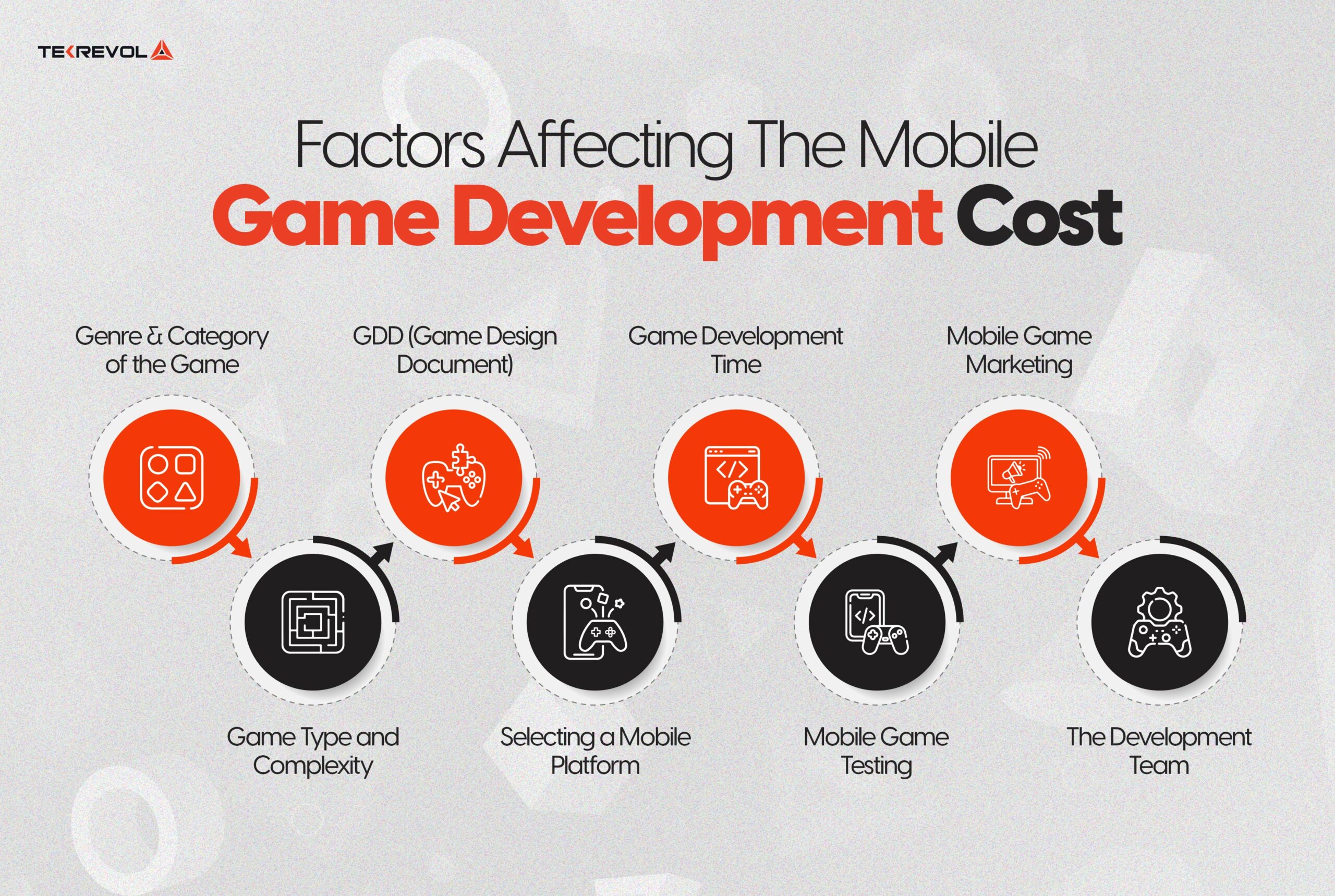
Factors Affecting The Mobile Game Development Cost
Here are the key factors that have a direct influence on the overall mobile app game development cost:
1. The AI Efficiency Dividend
In 2026, AI is no longer a “future trend”; it’s a budget-saver.
- Asset Creation: Generative AI tools can now automate up to 60% of background art and basic NPC dialogue, potentially reducing art costs by 15-20%.
- Coding & QA: AI-native workflows (like GitHub Copilot) allow developers to write boilerplate code faster, while automated AI testing bots find “game-breaking” bugs in hours rather than weeks.
- Caution: While AI reduces time, you still need senior “human-in-the-loop” designers to ensure the game doesn’t feel generic, which keeps the cost of high-tier games steady.
2. Genre and Category of the Game
The genre and category of a mobile game plays a pivotal role in shaping the overall development cost.
Mobile game genres can be categorized based on multiple criteria, such as the platform, game modes (single-player, multiplayer, PvP, etc.), and narrative themes (horror, mystery, and more).
The chosen genre has a direct impact on the development cost. For example, developing a multiplayer open-world game would be more challenging and costly than a single-player puzzle game.
However, it’s important to note that genre alone does not provide a precise cost estimate.
That’s because there is further categorization within genres like adventure-based games, fighting games, puzzles, RPGs, simulations, sports games, strategy games, etc.
Each of these subcategories demands distinct gameplay mechanics.
For example, strategy games require the creation of extensive economic systems, while fighting games necessitate diverse fighting styles for different characters.
These complexities contribute to the overall mobile game development costs.
3. Game Type and Complexity
The complexity of a game directly correlates with its cost. Every additional feature and element adds to the overall expense.
Mobile games can be categorized as small, medium, or large in terms of scope and complexity, and they can also fall into different types like casual games, social games, business game apps, or mid-level and high-level games.
The other factors that significantly impact the development cost include animation style (2D or 3D) with 3D games requiring higher budgets.
4. GDD (Game Design Document)
GDD or Game Design Document is precisely what it sounds like, a comprehensive written document that encapsulates every crucial detail about your game.
The importance of a well-structured Game Design Document cannot be overstated in the mobile game development process. It serves as the roadmap to a successful end product.
However, it’s important to recognize that creating a high-quality GDD is not only integral but also a resource-intensive task, demanding a significant investment of time and money.
A typical Game Design Document is organized into sections and subsections that present the details of all the essential aspects of your mobile game.
The key sections typically include:
- General Game Descriptions: This section provides a comprehensive look at the game, including its story, setting, and the overall concept that shapes the gaming experience
- Design Essentials: This section delves into the core game mechanics, describing gameplay features, objectives, and user interactions, which are fundamental to the player’s experience.
- Technical and Business-Related Information: This part covers the technical requirements, platform considerations (such as iOS or Android compatibility), monetization strategies, and other business-related aspects that influence development and cost.
5. Selecting a Mobile Platform
Unity and Unreal Engine, which are the most commonly used mobile game engines, do not have a direct influence on the mobile game development cost.
However, if a mobile game’s requirement becomes overly complex and there is a need for changing the mobile game engine during the development process then it will lead to additional costs.
The primary strategy when selecting a mobile platform is to opt for cross-platform game engines.
This approach allows for the simultaneous deployment of the game on both iOS and Android, minimizing the need for separate development efforts for each platform.
Some of the leading game engines that are optimized for multiple platforms include:
- Unity
- Unreal Engine
- Construct 3
- Defold
- Game Maker Studio 2
- Godot
For more insights on the development cost of hybrid game apps, here is our article on all cross-platform games and their revenues.
6. Game Development Time
The time required to develop a mobile game varies significantly based on the game’s scope and complexity.
Developing a small mobile game with straightforward gameplay and no complex storyline typically falls within the timeframe of 2 to 4 months.
However, as the size and complexity of the game increase, so does the development timeline. Large and complex games may necessitate one year or more to reach completion.
Another critical aspect affecting mobile game development costs is the geographical location of the development team.
For example, game development services in the US can cost between $100 to $150 per hour, depending on the game’s complexity and the expertise required.
Moreover, grand and complex games often demand the expertise of various professionals, including game and narrative designers, producers, artists, writers, testers, and numerous other specialists.
Their collective contributions further influence the development timeline and, subsequently, the cost.
7. Mobile Game Testing
Testing in the domain of mobile game apps is not just a supplementary process; it is equally as crucial as the development phase.
Gamers in today’s market have grown increasingly impatient with game-related bugs and issues.
The importance of a smooth and bug-free gaming experience cannot be overstated. Players have little patience for games marred by bugs or sluggish performance.
They demand a gaming experience that is not only without issues but also provides a rich and immersive user experience.
Typically, game app development companies incorporate testing services as an integral part of the overall project lifecycle.
It’s a crucial step in making a game, as no game should come out without thorough bug testing
Furthermore, it is essential to note that the complexity of your game directly corresponds to the level of testing required. Mobile game testers often charge hourly rates, and the more complex the game, the more extensive the testing required.
Consequently, the thoroughness of your testing process is not only an essential aspect of development but also a critical factor influencing the overall cost of mobile game development.
TekRevol is a top-class iPhone and Android game app development company that has a bug-free game testing process to ensure that your game not only meets industry standards but exceeds them.
We leave no stone unturned in the quest for perfection.
Our team of skilled testers rigorously examines every aspect of your game, from its functionality and performance to its user interface and overall gameplay experience.
8. Mobile Game Marketing
Developing an excellent game is merely a starting point; true success comes through smart marketing.
It’s a common fallacy to assume that a remarkable game app will automatically gain market traction on its own. However, the success of your game app hinges on the strategic efforts put into marketing.
To make your game app go viral and gain the visibility and rankings necessary for success in the Apple and Google Play stores, you must allocate a budget for effective marketing. This strategic marketing approach is often referred to as App Store Optimization (APO).
Games are developed to generate revenue, and achieving a return on investment necessitates a proactive and well-planned marketing strategy.
9. The Development Team
One of the most critical decisions you’ll face is selecting who will bring your game idea to life: freelance developers or a professional mobile app development company.
Each option has its distinct advantages and disadvantages. The complexity of your game is a crucial consideration when choosing your development team.
For simpler and less intricate game projects, freelance developers can be a cost-effective choice. They can efficiently create straightforward games, helping to reduce overall expenses.
Other than that, for larger and more complex game development projects, enlisting the expertise of a professional development team is often the more prudent choice.
These teams bring a wealth of experience and skill to the table, ensuring that your game meets the highest quality and functionality standards.
However, it’s important to be prepared to meet their rate expectations, which may be higher than those of freelance developers.
Additionally, exploring the option of outsourcing development to other countries can yield significant cost differences.
Different regions offer game developers with varying hourly rates, which can have a substantial impact on your game development cost.
TekRevol stands as a distinguished Android and iPhone game development company that prides itself on offering not only exceptional game development services but also highly reasonable prices for creating game apps.
Our commitment to affordability is deeply ingrained in our ethos, and we firmly believe that groundbreaking game development should be accessible to all.
The 2026 “Hidden Costs” of Mobile Gaming
Many founders budget for the build but forget the “LiveOps” required to keep a game alive. In 2026, a mobile game is a service, not a product.
- Marketing & User Acquisition (UA): For most successful games, the marketing budget in the first 6 months is 100% to 200% of the development cost. Average Cost Per Install (CPI) in 2026 for casual games is around $2.50 – $4.00.
- Server & Infrastructure: A simple multiplayer game can cost $500/month at launch, but viral success can push cloud hosting (AWS/Google Cloud) to $20,000+/month almost overnight.
- LiveOps & Maintenance: Plan to spend 20% of your initial development budget annually on bug fixes, OS updates (iOS/Android compliance), and fresh content updates (Battle Passes/Seasonal Events).
TekRevol stands as a distinguished Android and iPhone game development company that prides itself on offering not only exceptional game development services but also highly reasonable prices for creating game apps.
Our commitment to affordability is deeply ingrained in our ethos, and we firmly believe that groundbreaking game development should be accessible to all.
- Your Vision Needs a 2026 Growth Engine
- 95% of games fail due to poor Day-1 retention. Partner with TekRevol to build a retention-led masterpiece. Let's get started before your competitors own the niche.
Development Costs for Popular Mobile Game Apps
The development costs for popular mobile game apps can vary widely, influenced by factors such as complexity, platform, and design.
These successful games often entail significant investments, reflecting the competitive and dynamic nature of the mobile gaming industry.
Here are the details on the mobile app game development cost for popular genres:
| Game Genre | Game Name | Estimated Development Cost |
|---|---|---|
| Hyper-Casual | Flappy Bird clones | $15,000 – $40,000 |
| Casual/Puzzle | Match-3 | $60,000 – $250,000 |
| Mid-Core/Strategy | RPGs | $300,000 – $1,500,000+ |
| AAA Mobile | Battle Royales | $3,000,000+ |
Which Technologies To Use For Game App Development?
Opting for a specific gaming engine to develop your mobile game app has an undeniably essential share in the entire app development cost.
Although there are many successful technologies and trends in mobile game development, including some highly preferred gaming engines. Here are some of the popular ones:
1. Unity
The most preferred game engine in the world, with all the essential features and functionalities, Unity is one of the favorite game development engines at TekRevol.
Developed for multi-platform gaming app development, it comes as a complete package and is free for start-up-level app developers, having annual earnings of less than $100K.
However, with additional features and more technical business requirements, it incorporates additional subscription charges.
- Unity Pro edition: USD185/mo per seat or USD2,040/year per seat
- Unity Industry edition: USD450/mo per seat or USD4,950/year per seat
Despite the subscription charges, the engine works well for all mobile, desktop, web, and console platforms and is highly compatible with 2D and 3D games.
To name a few, Escape Plan, Angry Birds 2, Wasteland 2, and Temple Run Trilogy are some of the high-level games developed on Unity.
For more insights, visit our detailed blog on how to get started with Unity3D.
2. Cocos2d-X
An open-source, cross-platform game development engine based entirely on the C++ language, the engine is widely preferred for GUI-focused game apps.
Also, incorporated with JavaScript and Lua bindings, it is easy to learn and highly functional.
One of the significant reasons TekRevol highly prefers this game engine is that it is lightweight, robust, and highly result-driven.
Plus, it speeds up the game development process by optimizing the overall app performance.
Castle Clash, Dragon City, Clash of Kings, and Badland are some of the most played games developed with Cocos2d-x.
- Ready to Transform Your Vision into Gaming Brilliance?
- Partner With Our Industry-Recognized Game Developers.
Regional Mobile Game Development Cost In 2026
Choosing where to build is the most significant “cost-lever” for any founder. While North America offers unparalleled proximity to the world’s largest gaming market, global hubs in Eastern Europe and South Asia have closed the quality gap using AI-native development workflows.
| Development Hub | Average Hourly Rate | Typical MVP Budget | Core Advantage |
|---|---|---|---|
| USA / Canada | $150 – $280 | $80,000+ | High-tier IP security & cultural alignment for US markets. |
| Western Europe (UK/DE) | $100 – $190 | $65,000+ | Exceptional UI/UX design and GDPR-compliant security. |
| Eastern Europe (PL/UA) | $50 – $95 | $35,000+ | Deep engineering talent; the “sweet spot” for 3D RPGs. |
| South Asia (IN/PK) | $25 – $60 | $20,000+ | Scalability for asset-heavy titles and 2D casual games. |
Mobile Game Monetization Trends for 2026
In 2026, the most profitable games don’t rely on a single revenue stream. Instead, they use Hybrid Monetization, which balances player experience with high LTV (Lifetime Value).
The entire purpose of including a monetization strategy in your mobile app is to make sure that every time a user downloads your app, you earn some bucks.
Generally, there are different app monetization strategies that can help you generate revenue from mobile gaming. Here are the details:
1. Hybrid Monetization (The Gold Standard)
The “miracle” strategy of 2026. This combines In-App Advertising (IAA) for casual players and In-App Purchases (IAP) for “power users.”
- Example: A player watches a Rewarded Video to get a “Revival Pack” after failing a level, but can also buy a $4.99 “Starter Bundle” to skip ads entirely and get premium skins.
- Impact: Hyper-casual games using this model saw an 80% revenue surge this year.
2. Battle Passes & Seasonality
Borrowed from mid-core games, Battle Passes are now appearing in casual titles. They provide a recurring revenue stream similar to a subscription but feel more rewarding to the player because they are tied to progression.
3. D2C (Direct-to-Consumer) Web Stores
To bypass the 15-30% “App Store Tax,” many studios now launch official web stores. Players are incentivized with 10% more “gems” if they buy directly on the developer’s website instead of inside the app. This can increase your net profit margins by up to 25%.
4. AI-Driven Ad Mediation
Using platforms like AppLovin (MAX) or Unity LevelPlay, AI now predicts exactly which ad network will pay the highest price for a specific player’s impression in real-time.
Due Diligence: 5 Questions to Ask Before Hiring a Game Dev Agency
To avoid “Feature Creep” and “Technical Debt,” you must vet your partner beyond their portfolio. Not everything that looks nice from the outside is actually nice from the inside too. Here are our best pick for due diligence your next game development company.
1. “What is your LiveOps and Post-Launch Retainer structure?”
In 2026, a game is a service. If an agency doesn’t have a plan for bi-weekly content drops or seasonal events, your retention will drop, and your ROI will vanish.
2. “How do you handle AI-Asset Integration and IP Rights?”
If they use Generative AI for your character art, ensure the IP ownership is legally sound. Most modern contracts now include an “AI-Transparency Clause.”
3. “Can you provide a ‘Vertical Slice’ within the first 6 weeks?”
Don’t wait 6 months to see if the game is fun. A reputable agency should deliver a “Vertical Slice”, a fully polished, playable 5-minute loop, early in the production phase.
4. “How do you optimize for device fragmentation?”
With the rise of foldable phones and high-refresh-rate screens, ask how they ensure the game runs smoothly on everything from a $200 Android to a $1,500 iPhone.
5. “What is your ‘Cost Per Install’ (CPI) prediction logic?”
A great dev partner understands the market. Ask if their design choices (like art style) are based on current marketability tests to ensure your UA costs stay low.
How To Ensure You Are Reducing Game Development Costs?
Reducing game development costs requires a strategic approach to budgeting, resource allocation, and efficiency. Here are key steps to ensure cost reduction:
Plan Your Budget Early
Start your project with a well-defined budget plan that encompasses all development costs.
Creating a comprehensive financial plan before initiating the project empowers you to track spending and manage finances more effectively throughout the development process.
Prioritize Features
Identify the core features of your game and prioritize them based on their importance and impact on gameplay.
By focusing resources and time on essential features, you can ensure that the critical aspects of your game are well-developed without unnecessary expenses.
Consider Outsourcing
Outsourcing certain elements of the game development process, such as art and sound design, can be a cost-effective strategy.
It not only saves money but also alleviates the workload on your in-house team, allowing them to concentrate on core development tasks.
Use Open-Source Tools
Explore open-source alternatives for game development tools and software.
These cost-effective options can serve as viable substitutes for expensive proprietary tools while maintaining the quality of your project.
Test and Iterate
Regular testing and iteration are invaluable for cost reduction.
By identifying and addressing issues early in the development cycle, you can prevent costly delays and ensure that the game maintains a high level of quality.
Continuous testing and improvement throughout the development process can lead to a more efficient and cost-effective outcome.
The Roadmap to Profitable Mobile Game Ventures
As mobile gaming continues to grow in popularity and revenue, understanding the complexities of development costs is crucial.
This complete guide has provided valuable insights into the typical costs of game app development, the stages involved, and the various factors that influence these costs.
By considering factors like game genre, complexity, development team, and monetization strategies, you can better estimate the investment required for your mobile game development journey.
Remember, planning your budget, prioritizing features, and exploring cost-reduction strategies are key to managing development costs effectively.
Also, keep in mind that the secret to ranking in the 2026 App Store isn’t just a low development cost; it’s Retention-Led Growth. If your D1 (Day 1) retention is below 35%, no amount of marketing spend will save your ROI. Budgeting for LiveOps (fresh content every 2 weeks) is now just as important as budgeting for the initial launch.
As the mobile gaming market continues to thrive, it’s an exciting time to embark on your mobile game development journey and tap into the industry’s immense potential.
Bring Your Game Idea into Reality with TekRevol
Ready to bring your mobile game idea to life? TekRevol specializes in turning concepts into engaging, profitable games. Our Game Development Services include:
- Custom Game Development: Tailored solutions that align with your vision and budget.
- Expert Consultation: Guidance on best practices, monetization strategies, and market trends.
- End-to-End Support: From initial concept to post-launch maintenance, we’ve got you covered.
- Stop Watching the Market Pass You By