



- Deploy a three-tier architecture combining a responsive frontend (React Native), an orchestration layer (LangChain), and powerhouse LLMs like GPT-4o or Claude 3.5 for high-performance conversational engagement.
- Implement Retrieval-Augmented Generation (RAG) and vector databases like Pinecone to provide “grounded” responses, ensuring your AI cites verifiable data and avoids hallucinations during complex user interactions.
- Prioritize Stateful Architecture and “Memory as a Service” to track user sentiment and history, creating a persistent “digital twin” effect that significantly boosts long-term user retention.
- Building a basic AI bot starts at $5,000, while a comprehensive, enterprise-grade generative AI system with agentic workflows and advanced safety protocols typically ranges from $70,000 to $200,000+.
- Utilize context-aware moderation layers and semantic guardrails to differentiate between creative roleplay and prohibited content, ensuring compliance with global data regulations and protecting brand reputation.
We’ve officially moved past the era of “dumb” chatbots that respond to every complex query with, “I’m sorry, I didn’t quite get that.”
In 2026, if your chatbot isn’t anticipating user needs, remembering past conversations, or exhibiting a distinct personality, it’s basically just a glorified FAQ page.
To build an AI chatbot app that actually ranks and converts, you need a three-tier architecture: a slick front-end (React Native or Flutter), a robust orchestration layer (think LangChain), and a powerhouse LLM integration (GPT-4o, Claude 3.5, or Llama 3).
With the explosion of platforms like Janitor AI, the market has shifted from simple utility to high-engagement, character-based interactions. But for the C-suite and product founders in the USA, the real goldmine isn’t just “chatting”, it’s conversational AI app development that solves enterprise-grade problems while maintaining that addictive, human-like engagement.
At TekRevol, we’ve seen the “under the hood” reality of these systems. This guide is your flagship roadmap to navigating the complexity of AI chatbot app development, from selecting the right tech stack to ensuring your bot doesn’t go rogue on its first day of work.
The AI Chatbot Market: Where the Opportunity Lies
The AI chatbot market is projected to reach $27 billion by 2030, driven by a massive shift toward custom AI chatbot development in the enterprise sector.
While consumer apps like Janitor AI focus on character engagement, businesses are prioritizing large language model integration to automate internal workflows, enhance customer support ROI, and secure data through advanced AI safety and moderation protocols.
Market Snapshot: 2026 AI Growth Metrics
| Segment | Projected Value (2030/32) | Key Driver |
| Global GenAI Market | $1.3 Trillion | Enterprise Adoption & Automation |
| Chatbot Segment | $27 Billion | NLP & Character-based AI |
| Economic Impact | $15.7 Trillion | Global GDP Contribution (AI-wide) |
Why “Character AI” is the New Enterprise Standard?
Don’t let the “fun” side of character AI development fool you. The reason platforms like Janitor AI exploded is that they solved the “engagement gap.” For a developer looking to build AI companion app features, the lesson is clear: users want empathy and context, not just a search bar.
In the USA, conversational AI app development is no longer a luxury for tech giants. We’re seeing small-to-mid-sized firms hiring enterprise chatbot development companies to build:
- Context-Aware Assistants: Bots that use natural language processing to “remember” a client’s last five orders.
- Operational Agents: Moving from “chat” to “action” via AI agent development that can book meetings or update CRMs.
- Safe-Bet Solutions: Systems that pass the “SGE test” by being helpful, factual, and strictly moderated.
At TekRevol, we focus on this intersection of engagement and utility. Whether you’re interested in generative AI for creative workflows or natural language processing services for data analysis, the market opportunity lies in creating a bot that actually “gets” your brand voice.
Claim Your AI Strategy Roadmap Worth $500, Absolutely Free!
Speak with TekRevol’s expert architects to outline a high-retention AI app strategy designed to stand out, scale effectively, and compete in the evolving 2026 character AI market.
Get My Free RoadmapJanitor AI and Similar Apps: What They Got Right?
If you’re wondering why a platform like Janitor AI can command millions of users while some enterprise bots struggle to get a “thank you,” the answer is architectural empathy. In 2026, the leading AI apps have moved beyond simple query-response loops.
They have mastered the art of natural language processing to create experiences that feel less like a search engine and more like a collaboration.
For developers, these aren’t just “apps”; they are high-performance case studies in custom AI chatbot development.
Here are the 5 Top AI architectures redefining the market:
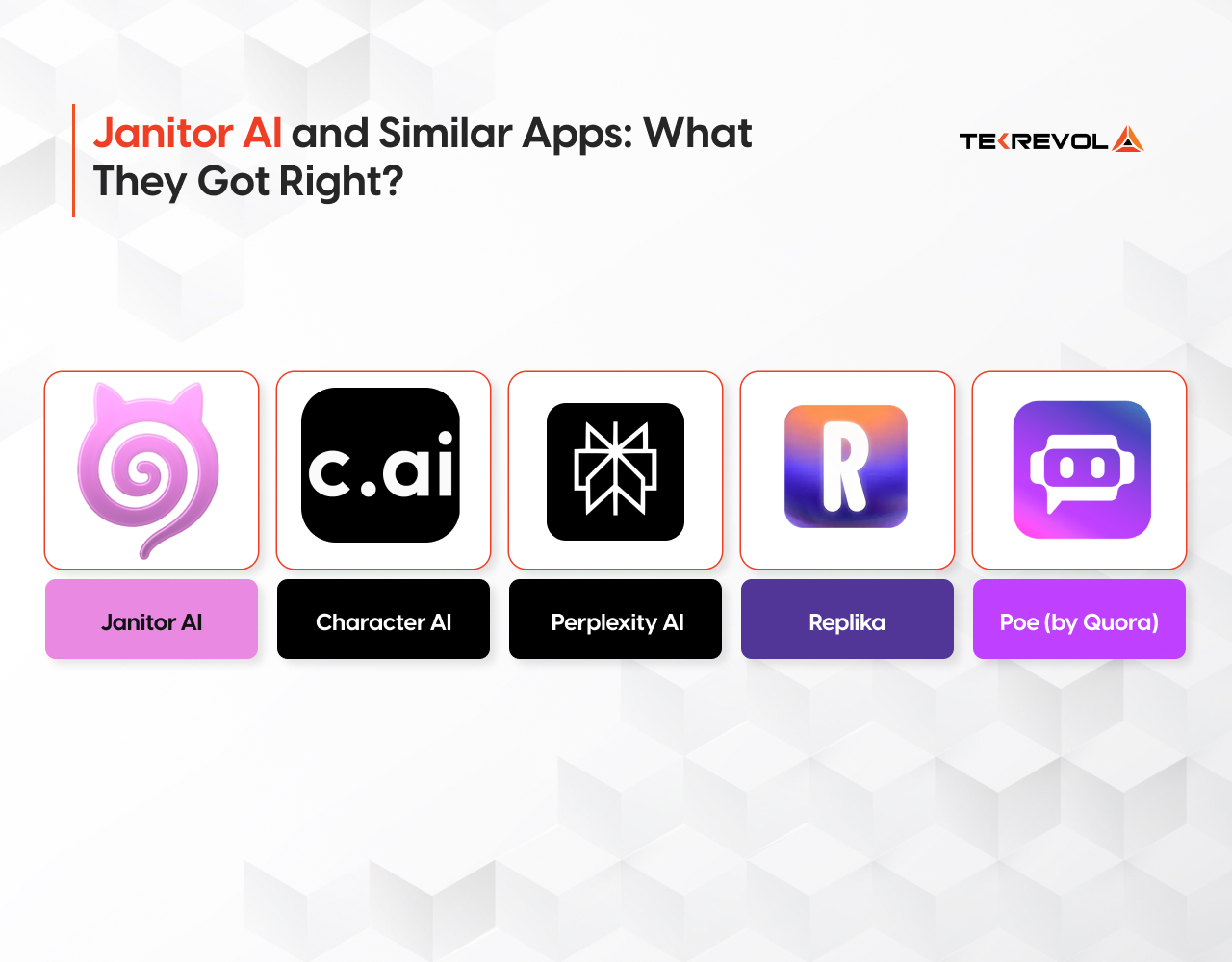
1. Janitor AI
Janitor AI succeeded by prioritizing unrestricted persona flexibility through modular API hooks and sophisticated character AI development. Unlike rigid corporate bots, Janitor AI allows for deep, JSON-based character definitions (often called “Character Cards”).
From a developer’s perspective, they nailed the “System Prompt” architecture, proving that the most engaging generative AI apps are those that give users the tools to define the bot’s personality, boundaries, and speaking style with granular precision.
2. Character AI
Character AI set the gold standard for low-latency, multi-turn dialogue management at a massive scale. Their technical win lies in their proprietary model optimization, which ensures that the “time-to-first-token” is nearly instantaneous.
If you want to build an AI chatbot app that users actually stick with, the lesson here is that speed is a vital feature. By minimizing the “thinking” delay, they maintain the illusion of human-to-human conversation, which is critical for high-retention conversational AI app development.
3. Perplexity AI
Real-Time Web Indexing & SGE Dominance Perplexity AI dominates the “Search-as-an-Answer” space by perfecting large language model integration with live web indexing. Instead of relying solely on static training data, Perplexity uses a RAG (Retrieval-Augmented Generation) pipeline to cite sources in real-time.
This is the blueprint for any enterprise chatbot development company building “truth-dependent” tools, proving that an AI’s value is often measured by its ability to prove its answers with verifiable data.
4. Replika
Replika remains a leader in long-term user bonding through memory persistence. By leveraging advanced natural language processing to track user sentiment and history over the years, they created a “digital twin” effect.
Technically, this involves a sophisticated vector database architecture where every interaction updates the user’s unique profile. It shows that for a successful build AI companion app project, the bot must evolve alongside the user, making every conversation feel like a continuation rather than a reset.
5. Poe (by Quora)
Poe cracked the code on platform-agnostic model orchestration. By allowing users to toggle between GPT-4o, Claude 3.5, and Gemini within a single UI, Poe proved that the “orchestration layer” can be more valuable than the underlying LLM.
For developers, this is a masterclass in custom AI chatbot development; it demonstrates that building a flexible interface that can swap out “brains” as better models emerge is a more sustainable strategy than being locked into a single provider.
The Technical “Secret Sauce” of 2026
What did these apps get right collectively? They stopped treating AI as a feature and started treating it as the core infrastructure. Leading platforms now use “Memory as a Service,” leveraging Vector Databases like Pinecone to ensure a bot doesn’t “forget” mid-conversation. Furthermore, they utilize a hybrid model strategy, routing simple tasks to fast, low-cost models like Llama 3 while saving the heavy reasoning for powerhouses like Claude 3.5.
At TekRevol, we apply these same high-engagement principles to AI development. Whether you’re building a companion or an enterprise tool, the takeaway is simple: Context is king, but memory is the kingdom.
Types of AI Chatbot Apps You Can Build
While many look to build standard assistants, the gold rush in 2026 is in High-Fidelity Persona Roleplay (the Janitor AI model). This isn’t just a ‘chat’ app; it’s an immersive storytelling engine.
Specifically, if you want to build an app like Janitor AI, you aren’t just building a chatbot; you are building a Roleplay & Persona Engine.
This requires a technical focus on ‘System Prompting’ and ‘Lore Persistence’, features that allow a bot to stay in character regardless of how complex the user’s input becomes.”
1. AI Customer Service & Support Bots
The modern customer service bot has evolved from a simple decision tree into a sophisticated generative AI development that functions as a 24/7 conversion engine.
Unlike the frustrating bots of the past, today’s versions utilize large language model integration to handle complex logic, such as processing returns or tracking multi-stage shipments in real-time.
By integrating these systems directly with your CRM, you aren’t just answering questions; you’re creating a seamless transactional layer that can reduce operational overhead by up to 80% while significantly boosting CSAT (Customer Satisfaction) scores.
2. AI Companions and Virtual Personas
Inspired by the massive success of platforms like Janitor AI, the demand for digital companions is skyrocketing for both entertainment and therapeutic use cases.
When you build AI companion app features, the focus shifts toward character AI development and high “stickiness” factors. These apps rely on advanced memory persistence, typically powered by vector databases, to ensure the bot remembers user preferences and past conversations over months of interaction.
This creates an emotional resonance that drives user retention rates far beyond traditional SaaS metrics, making it a goldmine for engagement-focused startups.
3. Educational and EdTech Tutors
Education is seeing a massive pivot toward “AI-First” learning, where bots act as personalized, 1-on-1 tutors that adapt to a student’s individual pace. To build an AI chatbot app for the educational sector, the technical architecture must prioritize “groundedness” via RAG (Retrieval-Augmented Generation).
This ensures the AI provides factually accurate information from verified textbooks rather than hallucinating answers. By providing instant feedback and personalized study plans, these tools are closing the achievement gap and becoming essential components of the modern digital classroom.
4. Enterprise Knowledge Assistants
For the B2B sector, the “Corporate Oracle” is the new standard. Enterprises are increasingly hiring enterprise chatbot development companies to build internal assistants that are indexed on private company data, from HR policies to complex technical documentation.
The hallmark of these systems is a heavy focus on AI safety and moderation, ensuring that sensitive data remains “air-capped” and never leaks into public training sets. These assistants empower employees to find information in seconds that would otherwise take hours to locate, driving massive productivity gains across departments.
To see these technical principles in action, look at how specialized AI can eliminate misinformation in data-heavy environments. TekRevol’s Truth GPT case study demonstrates the successful deployment of a “truth-centric” AI chatbot designed to provide fact-based, transparent responses by indexing verified information sources—a blueprint for any founder building an enterprise-grade knowledge oracle.
5. HR and Recruitment AI Agents
A rapidly emerging category is the AI recruitment agent, designed to streamline the talent acquisition pipeline from initial screening to onboarding. These bots use conversational AI app development techniques to conduct initial interviews, rank candidates based on objective skill sets, and answer candidate FAQs about company culture.
By removing manual administrative bottlenecks, these agents allow HR teams to focus on the human element of hiring.
At TekRevol, we view AI agent development in this space as a critical tool for scaling companies that need to hire quality talent at high velocity without compromising on candidate experience.
Core Features to Build An AI Chatbot App Like Janitor AI
To build an AI chatbot app like Janitor AI that competes in the 2026 landscape, you cannot rely on a basic “input-output” loop. Modern users and enterprise clients demand an ecosystem that feels intuitive, safe, and contextually aware.
If you’re working with an enterprise chatbot development company, these are the non-negotiable architectural pillars that separate a “toy” from a production-ready generative AI app.
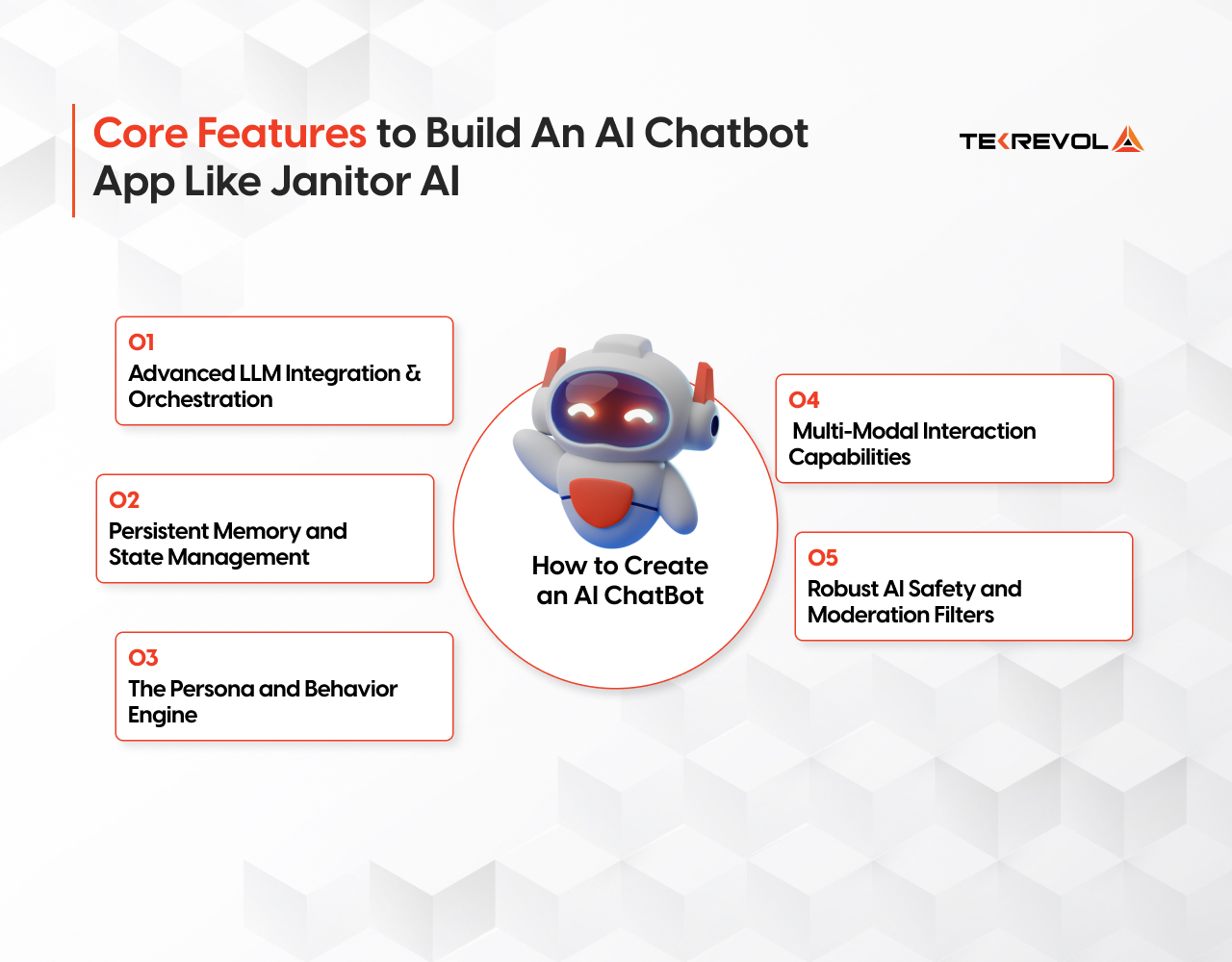
1. Advanced LLM Integration & Orchestration
The “brain” of your application is the Large Language Model, but the magic lies in how you integrate it. Large language model integration today involves more than just hitting an API. It requires an orchestration layer, using frameworks like LangChain or LlamaIndex, to connect the LLM to live data sources and third-party tools.
This allows your bot to move beyond static conversation and perform actual tasks, such as querying a database or generating a real-time report, making conversational AI app development a core driver of business automation.
2. Persistent Memory and State Management
One of the biggest trust signals in AI is continuity. A high-performing bot must remember user preferences, past interactions, and the specific context of a long-running project.
This is achieved through “Stateful Architecture,” where the app uses vector databases (like Pinecone or Weaviate) to store “embeddings” of past conversations.
By implementing custom AI chatbot development with long-term memory, you ensure the bot doesn’t ask the same question twice, which significantly boosts user retention and creates a personalized “thinking partner” experience.
3. The Persona and Behavior Engine
Whether you are building a professional corporate assistant or building an AI companion app project, the “personality” of the bot is what defines the brand experience. A sophisticated persona engine uses “System Prompting” and fine-tuning to dictate the bot’s tone, humor, and boundaries.
This ensures that the natural language processing isn’t just accurate, but also aligns with your brand voice.
To truly mirror the Janitor AI experience, developers should implement JSON-based Character Cards. This allows users to define a bot’s specific traits, backstory, and ‘OOC’ (Out of Character) boundaries, giving the app the modular flexibility that made Janitor AI a viral success.
At TekRevol, we emphasize natural language processing services that allow for granular control over how an AI represents your company to the world.
4. Multi-Modal Interaction Capabilities
In 2026, a “chatbot” isn’t limited to text. The most successful generative AI apps are multi-modal, meaning they can “see” images, “hear” voice notes, and “read” PDFs.
Integrating vision-language models (like GPT-4o) allows users to upload a screenshot of an error or a photo of a receipt and get an instant, context-aware response.
This multi-sensory approach is a game-changer for industries like healthcare and retail, where visual context is often more important than a text description.
5. Robust AI Safety and Moderation Filters
For any enterprise chatbot development company, security is the top priority. AI safety and moderation filters act as the guardrails of your application, preventing the LLM from generating biased, harmful, or off-brand content.
These filters also include Data Loss Prevention (DLP) protocols that screen for sensitive information like credit card numbers or internal passwords.
By building “Responsible AI” into the foundation, you protect your brand’s reputation and ensure compliance with global data regulations, which is a massive trust signal for high-ticket enterprise buyers.
Choosing the Right AI Model for Your App
During custom AI chatbot development, the choice is often between corporate-aligned ‘safe’ models and unrestricted creativity. For those building a Janitor AI clone, Llama 3 (Open-Source) or proprietary ‘JLLM’ style builds are the preferred choice.
These models allow developers to bypass the ‘moral lecturing’ of standard APIs, providing the nuanced and unscripted roleplay that Janitor AI users demand.
Why? Because Janitor AI’s success proved that users want models that can bypass corporate ‘moral lectures’ and handle nuanced, adult, or highly creative roleplay without constant filtering.
To build an AI chatbot app like Janitor AI that actually scales, you need to understand where each model excels and where it might leave your budget, or your users, hanging.
1. GPT-5 (OpenAI)
GPT-5 remains the gold standard for versatility and ecosystem integration. If your goal is ChatGPT API integration with a focus on multi-modal capabilities, like a bot that can “see” a customer’s broken product through a photo and troubleshoot it, this is your go-to.
It offers the most robust developer tools and a massive library of documentation, making it the safest bet for a fast time-to-market.
2. Claude 3.5 Sonnet (Anthropic)
Claude 3.5 Sonnet has quickly become the favorite for enterprise chatbot development companies that prioritize human-like nuance and coding proficiency. Claude excels at “steering”, following complex instructions without going off the rails.
It’s particularly effective for character AI development, as it tends to have a warmer, more relatable tone and a massive “context window,” allowing it to read and remember entire books’ worth of data in a single prompt.
3. Gemini 1.5 Pro (Google)
Gemini 1.5 Pro is the king of context. With a context window that can handle up to 2 million tokens, it’s the definitive choice for large language model integration where the bot needs to process massive video files or thousands of lines of enterprise documentation.
If your app is part of the Google Cloud ecosystem, the seamless integration with Vertex AI provides a level of scalability that is hard to beat for high-volume generative AI apps.
4. Llama 3 (Meta) and Open-Source Models
Llama 3 (Meta) and Open-Source Models represent the “sovereignty” play. For businesses that are strictly focused on AI safety and moderation, open-source models allow you to host the “brain” on your own private servers.
This ensures that sensitive data never leaves your infrastructure. While they require more DevOps heavy lifting, the lack of per-token API costs makes them the most sustainable choice for high-traffic conversational AI app development.
Here is a comparison table for you to see facts more clearly:
| Model | Primary Strength | Best For… | Developer Catch |
| GPT-4o | Multi-modal & Versatility | High-speed, visual-heavy apps | Higher costs for high-volume visual tasks. |
| Claude 3.5 | Reasoning & Human Tone | Build AI companion app / Coding | Slightly more restrictive safety filters. |
| Gemini 1.5 | Massive Context Window | Enterprise “Knowledge Oracles” | Can have higher latency on massive prompts. |
| Llama 3 | Privacy & Cost Control | On-premise enterprise systems | Requires significant server infrastructure. |
At TekRevol, we often recommend a hybrid approach. For example, using a powerhouse like Claude for complex reasoning while routing simple, repetitive queries to a lightweight open-source model.
This strategy ensures your generative AI services remain both “genius-level” and cost-effective.
Tech Stack for an AI Chatbot App Like Janitor AI
Choosing a tech stack for a generative AI app in 2026 is no longer just about “coding an interface”; it’s about building a multi-layered ecosystem that can handle high-dimensional data and real-time reasoning. To build an AI chatbot app like Janitor AI that is both scalable and secure, you need a stack that balances performance with flexibility.
At TekRevol, we focus on a “Modular AI Architecture” that allows you to swap out components as better models and tools emerge.
1. The Backend: Python and Node.js Dominance
Python remains the undisputed king of custom AI chatbot development because it is the native language of the AI research community. Frameworks like FastAPI and Django are the go-to choices for building the logic layer, as they offer seamless integration with machine learning libraries like PyTorch and TensorFlow.
For teams that prioritize real-time, event-driven performance, especially in high-concurrency conversational AI app development, Node.js remains a powerful contender for managing the WebSocket connections required for fluid chat experiences.
2. The Memory Bank: Vector Databases and Embeddings
Traditional SQL databases are great for structured data, but they fail when it comes to “understanding” meaning. To give your bot long-term memory, you need a Vector Database like Pinecone, Weaviate, or Milvus.
- Embeddings: This is the process of converting text into numerical vectors. Using models like text-embedding-3-small from OpenAI, your app can turn a user’s query into a coordinate in a high-dimensional space.
- Semantic Search: The vector database then performs a “similarity search” to find the most relevant pieces of information from your knowledge base, which is the foundation of large language model integration through RAG (Retrieval-Augmented Generation).
3. The Orchestration Layer: LangChain and LlamaIndex
A standout feature of Janitor AI is the ability for users to switch between different LLM ‘Backends.’ Your orchestration layer should be built to handle multiple API keys (OpenRouter, OpenAI, or Proxy URLs), giving your power users total control over their AI’s ‘brain’.
Think of the API layer as the “Project Manager” of your app. Tools like LangChain or LlamaIndex act as the glue between your LLM, your vector database, and external APIs.
This layer handles “Prompt Chaining”, the ability to break a complex user request into smaller, manageable steps, and manages the conversation’s “State,” ensuring the bot doesn’t lose the plot halfway through a discussion.
This is a critical trust signal for enterprise chatbot development companies that need to ensure their bots follow specific logical workflows.
4. The Frontend: React Native, Flutter, and Next.js
The “face” of your application needs to be fast and responsive. For cross-platform mobile development (iOS and Android), React Native and Flutter are the industry standards, providing the smooth animations and low latency required for a build AI companion app project.
For web-based AI tools, Next.js is preferred for its superior SEO capabilities and server-side rendering, ensuring that your AI interface loads instantly while being highly discoverable by search engines.
5. The API Layer: Secure Gateways and Real-Time Streaming
Finally, your app needs a robust API layer to communicate with the “brain” (the LLM). Whether you are using ChatGPT API integration or hosting your own Llama 3 instance, your gateway must support Server-Sent Events (SSE).
This allows for the “streaming” effect, where the bot types out its response word-by-word, which is essential for reducing perceived latency and making the natural language processing feel truly conversational.
AI Safety & Content Moderation (Non-Negotiable)
If there is one thing that keeps CTOs up at night in 2026, it’s the thought of their chatbot going “rogue.” Whether it’s a hallucination that gives a customer incorrect legal advice or a breach in AI safety and moderation that allows toxic content to slip through, the reputational risks are massive.
Unlike a standard enterprise bot, a Janitor AI-style app requires a Dynamic Moderation Layer. You aren’t just blocking words; you are building a system that understands the difference between ‘In-Character’ roleplay and ‘Out-of-Character’ abuse.
To build an app like Janitor AI, your safety filters must be ‘context-aware,’ allowing for creative freedom while strictly preventing non-consensual or illegal content, essentially mirroring Janitor AI’s own community-led moderation approach.
At TekRevol, we consider safety to be a core feature of custom AI chatbot development, not an afterthought.
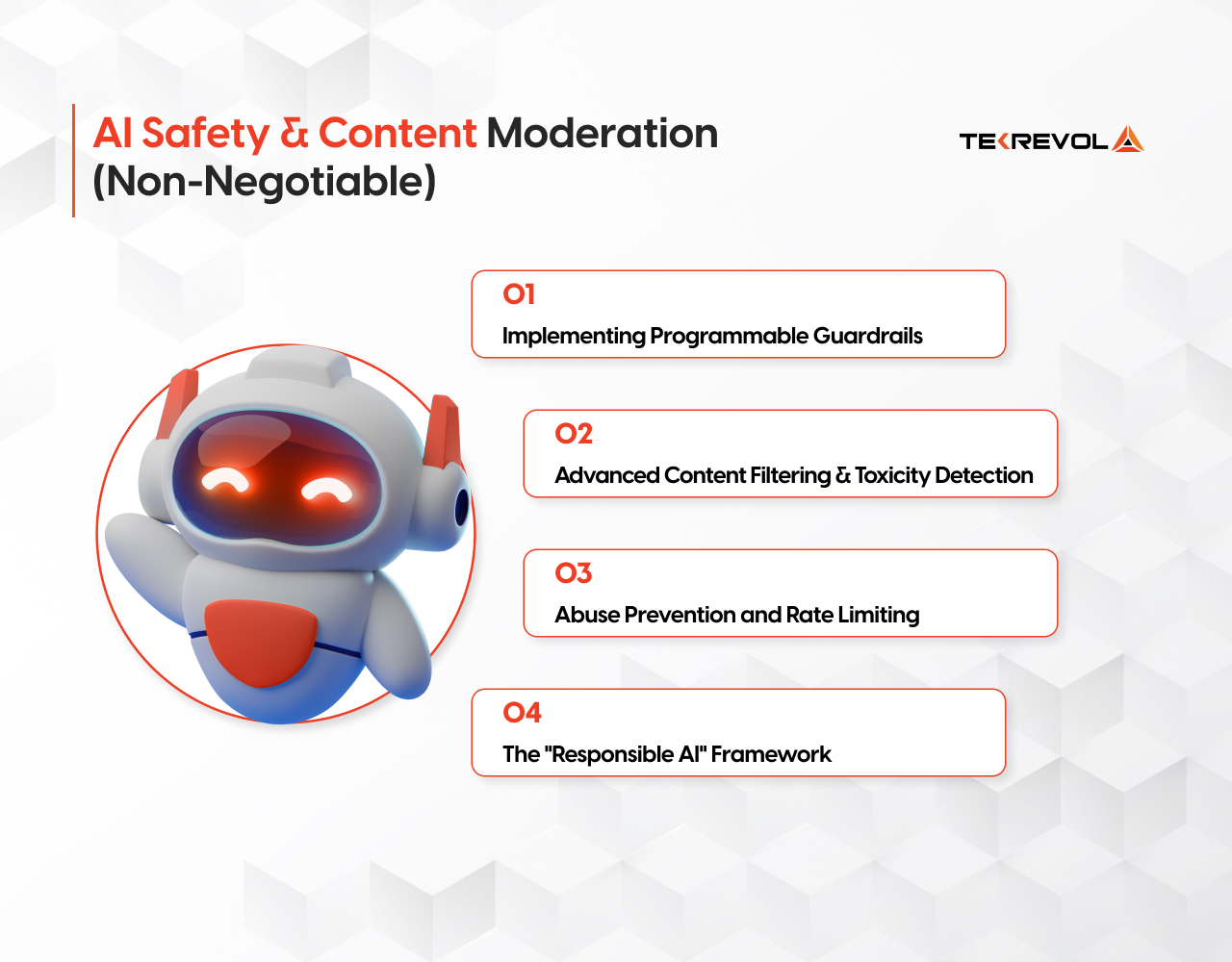
1. Implementing Programmable Guardrails
The first line of defense in conversational AI app development is the implementation of semantic guardrails. Using tools like NVIDIA’s NeMo Guardrails or bespoke middleware, developers can define “No-Go Zones” for the LLM.
These guardrails monitor both incoming user queries and outgoing AI responses in real-time. If a user tries to “jailbreak” the bot or steer the conversation toward prohibited topics, like sensitive financial advice or hate speech, the system automatically reroutes the interaction to a safe, pre-scripted response.
2. Advanced Content Filtering and Toxicity Detection
To build an AI chatbot app that maintains professional integrity, you need a multi-layered content filtering system. This involves using specialized natural language processing models that are trained specifically to detect nuance, sarcasm, and hidden toxicity that a standard keyword filter might miss.
By integrating high-performance moderation APIs, your generative AI app can identify and block PII (Personally Identifiable Information) leaks, ensuring that credit card numbers or home addresses are never stored in your training data or displayed in chat logs.
3. Abuse Prevention and Rate Limiting
Beyond the content of the chat, you must protect your infrastructure from malicious actors. Abuse prevention involves setting up intelligent rate-limiting and behavior-based monitoring.
This prevents “Prompt Injection” attacks and ensures that a single user cannot overwhelm your large language model integration with thousands of complex requests, which could lead to skyrocketing API costs or system downtime.
For an enterprise chatbot development company, ensuring 99.9% uptime while defending against bot-driven exploits is essential for maintaining client trust.
4. The “Responsible AI” Framework
In 2026, the most successful AI companion app projects are those that adopt a “Responsible AI” framework. This means the AI is transparent about its nature, it should always identify itself as an AI, and it should have “bias-detection” protocols.
By regularly auditing your bot’s outputs for systemic bias, you ensure that your custom AI chatbot development remains inclusive and aligned with modern corporate social responsibility standards. This proactive approach to safety is what ultimately secures the “green light” from legal departments and enterprise security teams.
Cost to Build an AI Chatbot App Like Janitor AI
One of the most frequent questions we field at TekRevol isn’t just “how” to build a bot, but “how much.” In 2026, the cost to build an AI chatbot app is no longer a single flat fee; it’s a sliding scale based on the “intelligence” and integration depth your business requires.
Whether you’re a startup looking for a lean MVP or a Fortune 500 company needing a secure, custom-trained “Corporate Oracle,” understanding the pricing tiers is essential for a high-ROI investment.
The total cost of custom AI chatbot development is driven by three main factors: the complexity of the natural language processing model, the number of third-party integrations (like CRMs or ERPs), and the ongoing API/token costs associated with large language model integration.
AI Chatbot Development Pricing Tiers: 2026 Benchmarks
| Project Tier | Estimated Cost (USD) | Best For… | Key Technical Components |
| Basic AI Bot | $5,000 – $15,000 | Startups & Small Businesses | Simple FAQ handling, lead capture, and basic website integration. |
| Full LLM App | $20,000 – $60,000 | Mid-market & SaaS Products | ChatGPT API integration, vector databases (memory), and custom persona engines. |
| Enterprise System | $70,000 – $200,000+ | Large Organizations | Multi-modal AI, agentic workflows, on-premise hosting, and advanced AI safety and moderation. |
The Architecture of the Invoice: What are you paying for?
When you hire an enterprise chatbot development company, the budget is allocated across several critical technical layers. Skipping any of these usually results in an “AI hallucination” or a security breach that costs more to fix than to build.
1. The Intelligence & Orchestration Layer (30% of Budget)
- This covers the natural language processing setup. It’s not just “calling an API”; it involves building the “Logic Chains” (using LangChain or LlamaIndex) that allow the bot to think through multi-step problems.
- Includes fine-tuning models if your industry uses highly specialized jargon (e.g., Medical, Legal, or niche FinTech).
2. Data Infrastructure & Memory (25% of Budget)
- To build an AI chatbot app with a memory, you need a Vector Database (Pinecone/Weaviate). Setting up the data pipelines to “chunk” and “embed” your company’s documents into these databases is a labor-intensive but vital step for RAG.
3. Security, Safety & Moderation (20% of Budget)
- Non-negotiable for the US market. This includes building custom “Guardrails” to prevent the bot from being manipulated. It also covers PII (Personally Identifiable Information) masking to ensure your generative AI app is compliant with SOC2 or HIPAA standards
4. Integration & UI/UX (25% of Budget)
- Connecting the bot to your existing tech stack (Salesforce, Zendesk, SAP). The frontend must also be optimized for conversational AI app development, ensuring that multi-modal inputs (voice/images) are handled with zero lag.
Ongoing Operational Costs (The “Run” Phase)
Beyond the initial build, you must account for the monthly “fuel” that keeps the AI running:
- Model Tokens: Depending on usage, API costs for models like GPT-4o or Claude 3.5 can range from $500 to $5,000+ per month.
- Vector Database Hosting: Storing and querying high-dimensional data usually starts at $100 – $300/month for production-grade instances.
- Model Maintenance: AI “drifts” over time. Budgeting for quarterly performance audits and prompt engineering tweaks is a hallmark of a mature custom software development strategy.
Get A More Powerful Tool Than Janitor AI With TekRevol
Building a production-ready AI app is vastly different from running a few prompts through a web interface. It requires a synergy of creative vision and rigorous engineering. At TekRevol, we don’t just “deploy” AI; we architect intelligent ecosystems. Our approach is rooted in bridging the gap between raw generative AI potential and the high-stakes demands of the enterprise world.
Through our specialized Generative AI and NLP services, we’ve helped businesses move from “experimental” to “essential” by focusing on three core pillars: Intent, Context, and Safety.
Our Generative AI & NLP Service Framework
When you partner with an enterprise chatbot development company like TekRevol, you aren’t just getting developers; you’re getting AI strategists. We treat natural language processing as the heartbeat of the application, ensuring that every interaction is meaningful and every data point is actionable.
- Custom LLM Fine-Tuning: While generic models are great, industry-specific excellence requires precision. We fine-tune models to understand your niche, whether it’s the legal intricacies of real estate or the technical jargon of healthcare, ensuring your custom AI chatbot development delivers 100% brand-aligned responses.
- Agentic Workflow Design: We go beyond the chat box. Our AI agent development services focus on creating autonomous agents that can execute tasks, like scheduling, data retrieval from legacy systems, or generating complex reports, without human intervention.
- Semantic Intelligence & RAG: Using advanced natural language processing services, we build Retrieval-Augmented Generation pipelines. This allows your app to “read” your private company documents in real-time, providing answers that are grounded in truth rather than “hallucinated” from general training data.
The “TekRevol Edge” in 2026
What sets our conversational AI app development apart is our commitment to AI safety and moderation. We understand that for a US-based firm, a single rogue response can be a liability. That’s why we bake in proprietary “Ethical AI” layers that screen for bias, toxicity, and PII leaks before a single word reaches your user.
Whether you’re looking to build an AI chatbot app that disrupts the consumer space or a private generative AI app for internal efficiency, our team of 250+ AI experts ensures your product is built on a foundation of scalability and security. We don’t just follow the trend; we engineer the standard.
To further boost the authority and reach of your flagship guide, we need to address the specific, high-intent questions that are currently triggering featured snippets and AI overviews (SGE) in 2026.
These FAQs are structured with direct “answer-first” definitions followed by strategic technical context, designed to be scraped and cited by search engines.
Unlock Your Private AI Consultation, 100% Free!
Partner with TekRevol’s expert engineers to design an enterprise-grade AI solution that streamlines operations, enhances user experiences, and supports long-term business growth.
Build Your AI Empire Today


