The healthcare sector is going through a huge digital overhaul. Today, it is no longer sufficient for healthcare organizations to merely provide a good patient experience. Instead, they need to offer the same level of convenience and personalization that patients get from their favorite apps.
They should be able to do things such as book appointments easily, receive immediate test results, or simply have a conversation with their doctor from home. Changing patient expectations of healthcare could mean that healthcare organizations will have to transform care delivery, their core operations and patient engagement radically.
It is still the case in most healthcare institutions that they use generic, one-size-fits-all software programs that were not designed by and for their specific workflows. These very systems rarely solve the problems they cause; clinicians are compelled to work with the system’s shortcomings, manually re-enter the data between platforms, and miss the point of the whole exercise as they end up spending a significant amount of their time on paperwork rather than with patients.
The advantages of a healthcare app development company become very obvious when healthcare providers acknowledge that custom-built solutions could totally eliminate such operational challenges.
Here are the benefits of Custom app development that are helping healthcare organizations to modernize their operations, improve patient outcomes, and build a foundation for sustainable growth.
Whoever you are: a hospital administrator, a clinic manager, a healthcare IT leader or any other personnel in the healthcare industry, you will find out from here why it is crucial to stay competitive and deliver quality care by investing in tailor-made digital solutions.
Why Generic Healthcare Software Falls Short for Modern Organizations
Most healthcare organizations start with off-the-shelf software because it seems like the practical choice. It’s accessible, has a lower initial cost, and it takes care of the basics. However, as operations grow and workflows become more complicated, these standard solutions show their shortcomings in ways that negatively affect both patient care and organizational efficiency.
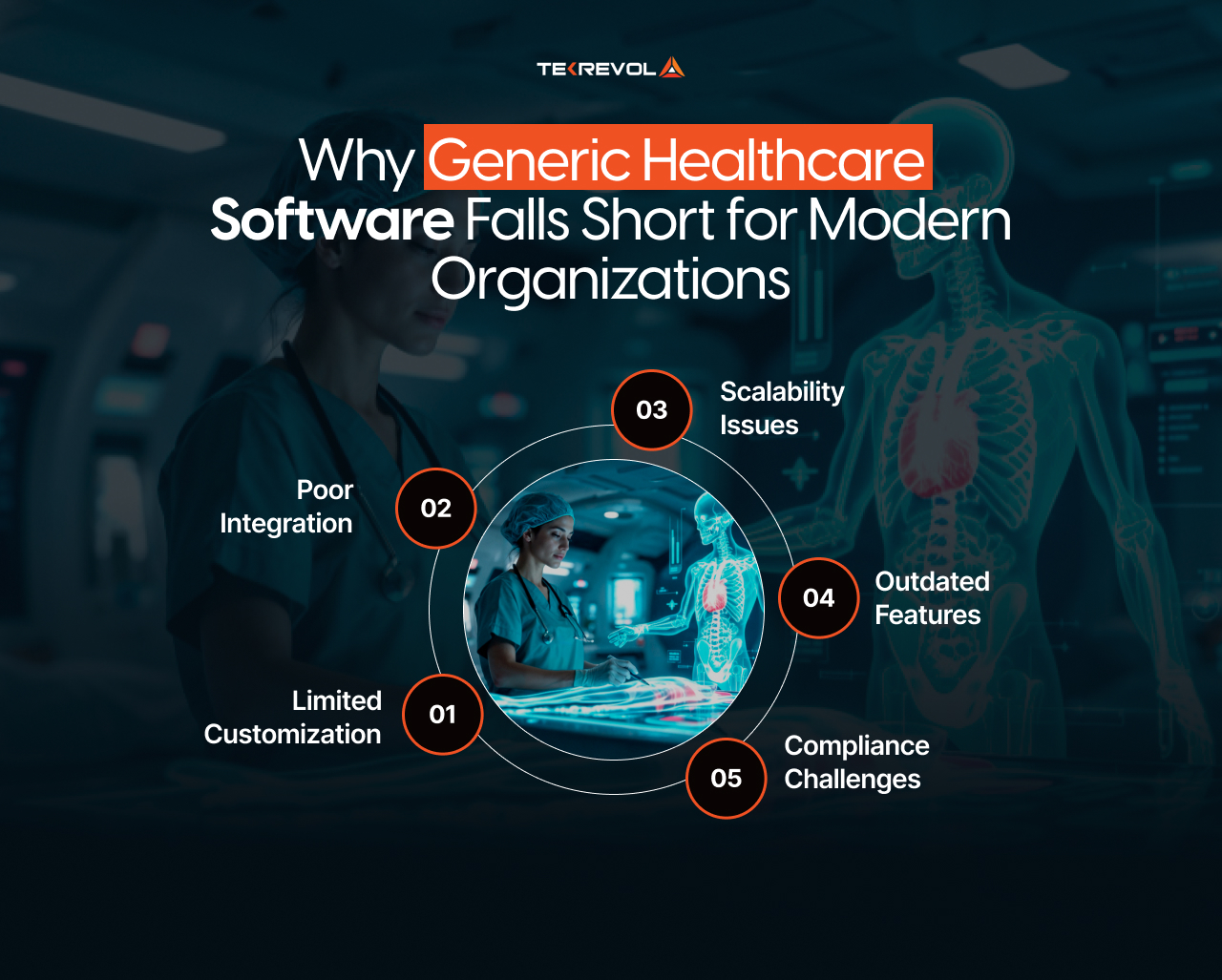
Generic healthcare software is designed for the typical healthcare provider, which means it’s really not suitable for anyone in particular. Your cardiology department has different requirements than your orthopedics team. Your rural clinic is a completely different setting compared to your urban medical center.
Thus, such generic software integrated by a mobile app development company basically puts out a set of rigid workflows for everyone to follow, no matter what specialty, patient population, or organizational structure you have.
The real price of generic solutions isn’t usually obvious in the initial cost. It manifests itself in several troublesome facets:
- Wonder how care is compromised when clinicians are overburdened with different systems? Clinical staff are kept from delivering patient care by the need to enter data manually in various systems.
- Very often, patients express dissatisfaction with complicated portals that, moreover, cannot be conveniently accessed via mobile phones.
- By taking third-party software pieces and integrating them, it becomes inevitable that the resultant software will have security issues, as these pieces were not originally meant to be combined.
- These changes have become very difficult to the extent that if the company wants to offer new services, it has to bear the cost of pricey workarounds, in addition to getting the regulatory authorizations.
Top healthcare companies globally also face the hidden burden of maintaining systems that can’t scale with their growth. Adding a new location means duplicating inefficient processes. Launching a new service line requires custom workarounds that increase complexity. This is exactly where the advantages of healthcare mobile apps are evident – tailor-made solutions expand along with you instead of limiting you.
Transform Your Healthcare Experience Today
Discover how custom healthcare apps can streamline operations, enhance patient care, and future-proof your organization.
Claim Your Free Strategy CallExploring the Idea of Custom App Development in the Healthcare Sector
Companies understand that custom app development in healthcare means designing software that is tightly integrated with the company’s needs, workflows, and objectives of your organization. Instead of offering configurable software, which only allows you to choose among predefined options, custom development thus delivers an application that is literally designed according to the way your teams work and the precise needs of your patients.
In fact, the healthcare app development field has witnessed quite a drastic shift in the last several years, mainly because of technological innovations and patients’ changing preferences. Industry data reveals:
- The global healthcare app market is forecasted to reach $861.40 billion by 2030, which shows a major shift towards digital healthcare solutions
- Health care professionals disclose that customized mobile health apps could be a major key in reducing their administrative costs by up to 30% as a result of automation of workflows and more efficient procedures
- Global telemedicine use has experienced significant growth, with telehealth consultations rising by as much as 30% annually, signaling a shift toward remote healthcare services.
These figures indicate a straightforward message: healthcare institutions investing in iOS or Android app development companies are not simply updating themselves with the latest technology; they are fundamentally changing their care delivery and business operation models.
What Actually Defines a Healthcare App as Being Custom
In essence, customizing a healthcare app implies dedicating it thoroughly to your clinical and operational workflows. Therefore, a healthcare software development company identifies the actual processes in use and develops the required digital solutions that support those processes for the benefit of the staff, rather than the staff having to get used to generic templates.
It is of paramount importance to grasp the difference between configurability and true customization:
Configurable Systems:
- Toggle features on and off from predetermined options
- Core functionality remains identical for all users
- Limited ability to match unique workflows
True Custom Development:
- Builds exact features you need from scratch
- Implements the specific logic your workflows require
- Creates functionality that doesn’t exist in off-the-shelf solutions
Custom healthcare apps also integrate seamlessly with your existing technology ecosystem, creating native connections that make data flow naturally between your EHR, lab systems, billing platforms, and other critical tools.
Types of Custom Healthcare Applications Organizations Build
Custom applications are being created by healthcare providers to cover all aspects of their operations. By giving what patients want most in health application i.e patient engagement and care apps, they can do things like schedule appointments, get medical records, talk to providers, and manage their health conditions.
Custom healthcare apps present their most compelling advantages in the case of patient-facing apps, especially when these are designed for specific localities.
Patient Engagement and Care Apps:
- Appointment scheduling and management
- Access to medical records and test results
- Secure messaging with healthcare providers
- Medication reminders and tracking
- Telehealth consultation capabilities
Clinical Workflow and Provider Apps:
- Streamlined clinical documentation
- Real-time access to patient records
- Decision support and clinical guidelines
- Secure team communication
- E-prescribing with drug interaction alerts
Administrative and Operational Platforms:
- Advanced scheduling and resource allocation
- Revenue cycle management
- Staff scheduling and credentialing
- Compliance tracking and reporting
Key Benefits of Custom App Development for Healthcare Organizations
Healthcare app development benefits all aspects of healthcare delivery and operations.
Patient Experience and Engagement Personalized
Custom patient-facing apps are able to deliver experiences that seem personal and very relevant to the patient. Rather than giving every patient the same generic interface, custom app development is solving healthcare challenges and risks by advancing the health sector.
For example, a diabetic patient uses the app for blood sugar monitoring and gets medication reminders. A patient who has undergone surgery is provided with post-surgical instructions and the tracking of recovery milestones.
Key Personalization Features:
- Customized health dashboards based on medical conditions
- Tailored educational content relevant to diagnoses
- Personalized appointment reminders and care instructions
- Condition-specific tracking and monitoring tools
One of the most important assets are successful custom app features, which allow the whole spectrum of patients to participate in their healthcare.
The patient’s age, technical knowledge, or any disabilities they might have are no barriers when you create interfaces with bigger fonts for elderly patients, voice navigation for people with vision issues, or simplified workflows for cognitively challenged patients.
Improved Clinical Workflow Efficiency
Doctors, nurses, and other clinical professionals are spending excessive time on paperwork and administration that is taking away from patient care. Healthcare apps that are personalized can help with this by documenting your regular contact with the patient, bringing up the paperwork automatically with the patient’s already recorded data, and using clever workflows that change depending on what type of visit or procedure it is.
Workflow Efficiency Improvements:
- Automated clinical documentation with smart templates
- Voice-to-text for hands-free charting
- Pre-populated forms using existing patient data
- Quick access to clinical protocols and guidelines
Do you know why a custom app is better than ready made app? It drastically cuts the amount of time spent on non-patient-related work so you can return to your patients instead of getting buried in paperwork. Custom workflow apps reduce redundant data entry and eliminate unnecessary steps that generic systems often require.
Seamless Data Integration and Interoperability
Healthcare organizations typically operate multiple systems that don’t communicate well with each other. Custom app development breaks down these silos by creating unified platforms that pull data from all sources and present it coherently.
Integration Capabilities:
- Bidirectional sync with EHR/EMR systems
- Real-time lab result integration
- PACS connection for medical imaging
- Pharmacy system integration for e-prescribing
- Billing and claims management connectivity
Getting rid of data silos results in having one source of truth for patient information. If everyone is working off the same unified data, you will not only eliminate discrepancies but also reduce errors and ensure that clinical decisions are made based on the full information.
Increase Data Security and Ensure Regulatory Compliance
Custom security architecture that is meant specifically for healthcare data can give a level of protection that general solutions cannot match. By developing a custom healthcare app, you can create app security protocols that are exactly what you need for your risk profile, types of data, and operations.
Security Features of Custom Apps:
- Complete encryption of data both during transfer and storage
- Multi-factor authentication for all users
- Biometric login options for mobile devices
- Automated session timeouts
- Regular security audits and penetration testing
Compliance with HIPAA, GDPR, and local healthcare regulations is built into custom apps from the ground up. This includes audit trails that track every data access, consent management that respects patient privacy rights, and data handling procedures that meet regulatory standards.
Scalability to Support Organizational Growth
Healthcare organizations that plan to grow need systems that can expand with them. Custom mobile apps in healthcare are built with scalability in mind, allowing easy expansion across multiple facilities without requiring complete system overhauls.
Scalability Advantages:
- Cloud-based architecture that grows with demand
- Support for multiple locations and facilities
- Easy addition of new users and departments
- Modular design for incremental expansion
When you decide to incorporate new care models like virtual care programs, specialty clinics, or new treatment modalities, your custom applications can be adapted to these initiatives.
Cost Optimization and Operational Savings
Healthcare organizations can witness direct cost savings from the reduced paperwork and manual processes. The digital conversion of each form, the change of every manual workflow into an automated one, and the elimination of every duplicate data entry are all ways of saving time and money.
Areas of Cost Reduction:
- Elimination of paper forms and manual filing
- Reduced data entry and administrative staffing needs
- Fewer errors result in fewer insurance rejections
- More accurate billing and quicker reimbursement
- Efficient utilization of resources, thus reducing waste
Custom apps that enforce data validation, provide decision support, and automate error-prone manual processes significantly reduce costly mistakes and improve overall operational efficiency. Moreover, A clear breakdown of healthcare app development costs helps organizations budget effectively and avoid unexpected expenses.
Support for Telemedicine and Remote Care
Secure virtual consultations and messaging have become essential capabilities for modern healthcare organizations. Custom telehealth applications are a type of telehealth solution that offers HIPAA-compliant video consulting, secure messaging between patients and healthcare providers, and digital examination tools allowing healthcare providers to continue serving patients beyond the limits of physical locations.
Telemedicine Features:
- Video conferencing is secure and compliant with HIPAA
- Text and voice messaging is secure
- Digital examination tools and assessments
- E-prescription during online medical consultation
- Virtual waiting room and online appointment system
Remote patient monitoring (RPM) is a game-changer for managing chronic diseases and providing post-acute care. Besides wearable health trackers, custom apps can communicate with various home healthcare devices to provide doctors with live patient data even when the patient is not physically present in the clinic.
Using Data Analytics for Decision Making
Live dashboards illustrating the current state of various performance metrics are capable of providing healthcare executives at all levels with the required data on a timely basis for decision-making. Tailor-made analytics applications might, for instance, allow the data to be presented in a way most suitable for each user by delivering high-level metrics for executives, tracking operational performance by department heads, and clinical outcomes to the quality teams.
Analytics and Reporting Capabilities:
- Live operational dashboards
- Tracking clinical quality metrics and outcomes
- Financial performance monitoring
- Patient satisfaction scores and trends
- Predictive analytics for patient outcomes
Predictive analytics can identify patients at risk for readmission, predict resource needs based on seasonal patterns, and flag potential quality issues before they become serious problems. That’s why generative AI can help the healthcare industry easily with its advanced technology and tools.
Simplify Operations, Delight Patients
Integrate all your healthcare systems seamlessly with our tailor-made solutions.
Get Your Custom SolutionWhy Custom App Development Plays a Key Role in Healthcare Digital Transformation?
Healthcare digital transformation is about fundamentally reimagining how healthcare organizations operate and deliver care. Custom app development plays a central role in this transformation by providing the tools needed to modernize legacy systems and enable innovative new capabilities.
Modernizing Legacy Systems
Many healthcare organizations are still running on technology that’s decades old. These legacy systems are expensive to maintain, difficult to integrate with modern tools, and increasingly unable to meet current demands. Custom development enables gradual migration strategies where new custom apps coexist with legacy systems during transition periods.
Enabling Innovation Through Technology
Enhancing technologies like artificial intelligence is transforming healthcare, and custom apps provide the platform for implementing AI-driven diagnostics and insights. Machine learning models can be integrated into custom clinical apps to provide decision support, identify patterns in medical imaging, or predict patient risks.
AI Applications in Custom Healthcare Apps:
- Automated medical image analysis
- Predictive risk scoring for patient outcomes
- Natural language processing for clinical documentation
- Chatbots for patient triage and support
- Personalized treatment recommendations
Internet of Things devices are proliferating in healthcare, from wearable monitors to smart hospital beds. Custom healthcare app development creates the platforms needed to collect, analyze, and act on data from these devices.
What Should You Consider Before Creating a Custom Healthcare App?
Building a custom healthcare app requires careful planning and realistic expectations. Success depends on understanding your needs clearly, planning for security and compliance from the start, and selecting the right development partner.
Assessing Organizational Needs
Defining clear goals, identifying all users, and mapping existing workflows are essential first steps. A thorough needs assessment ensures that custom development efforts focus on creating real value rather than just digitizing existing inefficiencies.
Key Assessment Questions:
- What are the primary pain points in current workflows?
- Which processes consume the most staff time?
- Where do errors or delays occur most frequently?
- What integrations are essential?
- How will success be measured?
Security and Compliance Planning
Data protection requirements must be defined before development begins. Answering these questions upfront allows security to be built into the app’s architecture rather than added later as an afterthought.
Security Planning Checklist:
- Data encryption methods for storage and transmission
- Authentication and access control requirements
- Audit logging and monitoring needs
- Backup and disaster recovery plans
- Third-party security assessments
Selecting the Right Development Partner
Healthcare domain expertise is crucial when selecting a mobile app development company for your custom healthcare application. Choosing the right app development partner is very important because technology firms that specialize in healthcare understand the unique workflows, regulatory requirements, and user needs that generic software developers might miss.
What to Look for in Development Partners:
- Proven experience with healthcare projects
- Understanding of HIPAA and healthcare regulations
- Knowledge of healthcare interoperability standards
- References from similar healthcare organizations
- Ongoing support and maintenance capabilities
Partnering with top healthcare app development companies that take a strategic, long-term approach provides greater value than working with firms focused only on project delivery.
How Tekrevol Helps Healthcare Organizations Build Custom Apps
Healthcare organizations partnering with Tekrevol gain access to a development team that combines deep healthcare industry knowledge with technical excellence in custom mobile app development.
Our healthcare-centric approach ensures that every application we build reflects a genuine understanding of clinical workflows, regulatory requirements, and patient needs.
Healthcare-Centric Strategy and Design
We collaborate with your team to understand how care is actually delivered, where current processes break down, and how technology can make meaningful improvements. We conduct user research with your specific populations, create interfaces optimized for healthcare environments, and test designs with real users before development begins.
End-to-End Custom App Development
We work with your team to define requirements, create technical architecture, develop and test functionality, and deploy applications into your production environment. We have extensive experience integrating custom applications with major EHR platforms, laboratory information systems, billing platforms, and other healthcare IT infrastructure.
Secure, Scalable, and Future-Ready Solutions
We build custom healthcare applications with HIPAA compliance, data protection, and audit capabilities as foundational elements. We design systems that can accommodate increased user volumes, expanded functionality, and integration with new technologies as they emerge.
We provide ongoing maintenance, implement regulatory updates, add new features as your needs evolve, and optimize performance based on real-world usage.
Scale Your Healthcare Services with Innovative Apps
Partner with TekReVol to deliver secure, compliant, and future-ready digital healthcare solutions.
Book Your Free Consultation