



- AI solutions in healthcare are no longer experimental; they’re actively cutting diagnostic errors, reducing hospital costs, and saving lives at scale in 2026.
- AI-powered diagnostic tools can analyze medical imaging up to 40x faster than human radiologists, with accuracy rates exceeding 94% in early cancer detection.
- AI automation in healthcare is slashing administrative costs. Hospitals using AI for billing and coding report 30–40% faster reimbursement cycles and near-zero claim rejections.
- Predictive analytics AI can identify high-risk patients up to 72 hours before a critical event, giving clinicians time to intervene before emergencies happen.
- AI health tech is making care more accessible, virtual AI assistants handle 64% of routine patient queries, freeing up clinical staff for complex, high-value care.
- Custom AI-driven healthcare solutions built by specialists like TekRevol deliver HIPAA-compliant, EHR-integrated systems tailored to your specific clinical and operational needs.
AI in healthcare isn’t something coming down the road. It’s already in the exam room, the emergency ward, and the billing department right now. And if your organization isn’t paying attention, the gap between you and the ones who are is growing every single day.
The numbers make this impossible to ignore. The global AI healthcare market is on track to surpass $45 billion in 2026, and that figure isn’t driven by hype. It’s driven by hospitals cutting diagnostic errors, clinics slashing wait times, and insurers automating processes that used to eat up entire teams.
What’s actually fueling all of this? The applications of artificial intelligence in healthcare have expanded so rapidly that most decision makers are still trying to wrap their heads around what’s available right now, let alone what’s coming next.
This guide is here to fix that. From real-time diagnostic imaging and AI-powered patient monitoring to predictive risk scoring and automated billing, we’re breaking down every major use case with real numbers, real outcomes, and zero fluff. Whether you’re a hospital administrator, a health tech founder, or someone just trying to understand where this is all heading, by the end of this, you’ll have a clear picture of what’s already working and what your organization should be thinking about next.
What Are AI Solutions in Healthcare?
AI solutions in healthcare are technology systems powered by machine learning, natural language processing, and computer vision that assist clinicians, administrators, and patients with diagnosis, treatment, operations, and engagement. They range from FDA-cleared imaging tools to back-office automation platforms, all built to make care faster, cheaper, and smarter.
| Category | Examples | Key Benefit |
| Diagnostic AI | Medical imaging analysis, pathology AI | 40x faster reads, 94%+ accuracy |
| Clinical Decision Support | Predictive analytics, EHR AI | Earlier intervention, fewer errors |
| Administrative AI | Billing automation, claims coding | 30–40% faster reimbursements |
| Patient Engagement | Chatbots, virtual nurses | 24/7 access, reduced call volume |
| Drug Discovery AI | Genomic sequencing tools | 70% faster trial matching |
| Surgical AI | Robot-assisted surgery | Reduced blood loss, infection risk |
Not Sure Where to Start? That's Exactly What We're Here For.
Tell us about your biggest operational challenge, and our healthcare AI specialists will identify where AI can deliver the greatest impact while aligning with your workflows and compliance requirements.
Talk to a Healthcare AI SpecialistAI-Powered Diagnostic Imaging: The Biggest ROI in Healthcare AI Right Now
The biggest and most proven ROI in healthcare AI is diagnostic imaging. AI models trained on millions of scans can detect anomalies in X-rays, MRIs, CT scans, and pathology slides faster and often more accurately than unaided radiologists.
How does it work?
Convolutional neural networks (CNNs) analyze pixel patterns in medical images, flagging areas of concern and correlating findings against a patient’s EHR data. Multi-modal AI systems combine imaging with lab results and clinical notes for richer, more accurate reads.
Real-World Numbers
- AI detects lung nodules in CT scans with sensitivity rates reaching over 95%, compared to 52–67% for unassisted radiologists.
- AI-driven stroke detection tools like Viz.ai cut time-to-treatment by an average of 31 to 39.5 minutes across multiple clinical studies.
- AI assistance in radiology has been shown to improve nodule detection accuracy by up to 46% points and significantly reduce read burden on radiologists, with AI-assisted reads outperforming solo radiologist reads across multiple imaging tasks.
Applications of AI in Diagnostic Imaging
- Radiology triage — Flagging life-threatening findings (stroke, pulmonary embolism, hemorrhage) within seconds of scan completion
- Pathology AI — Detecting cancerous cells in biopsy slides with sub-human error rates
- Ophthalmology AI — Screening for diabetic retinopathy and macular degeneration at scale
- Dermatology AI — Classifying skin lesions from smartphone images with clinical-grade accuracy
TekRevol’s AI development service builds custom diagnostic support tools integrated directly with your existing PACS and EHR systems. No ripping out old infrastructure. Just smarter clinical workflows layered on top of what you already run.
AI-Powered Healthcare Applications for Clinical Decision Support
Clinical decision support (CDS) AI directly answers one of medicine’s biggest problems: information overload. Clinicians today face more data (labs, vitals, imaging, genetics, medications) than any human brain can process in real time. AI changes that.
Predictive Analytics
Predictive AI analyzes time-series patient data (vitals, labs, mobility data from wearables) and surfaces deterioration risk before it becomes a clinical emergency.
- Sepsis prediction models flag at-risk patients up to 6 hours earlier than conventional screening
- ICU deterioration AI reduces unexpected cardiac arrests by up to 35%.
- Readmission risk models help discharge teams target the right patients for post-acute follow-up.
AI-Driven EHR Intelligence
Natural language processing (NLP) turns unstructured clinical notes into structured data — surfacing drug interactions, missing diagnoses, and billing discrepancies that would otherwise be buried in free-text fields.
Genomics and Precision Medicine
AI platforms like Tempus integrate genomic sequencing with patient health records to recommend targeted cancer therapies. Trial-matching engines scan patient profiles against thousands of clinical trials in seconds, matching patients to experimental treatments that would have taken weeks to find manually.
| CDS AI Application | Clinical Impact |
| Sepsis Early Warning | 6-hour earlier detection |
| Drug Interaction Alerts | 40% reduction in adverse events |
| Clinical Trial Matching | Weeks → minutes |
| Readmission Prediction | 20% reduction in 30-day readmissions |
| Genomic Therapy Matching | Personalized treatment for complex cancers |
Fixing the $380B Administrative Problem Through AI Automation in Healthcare
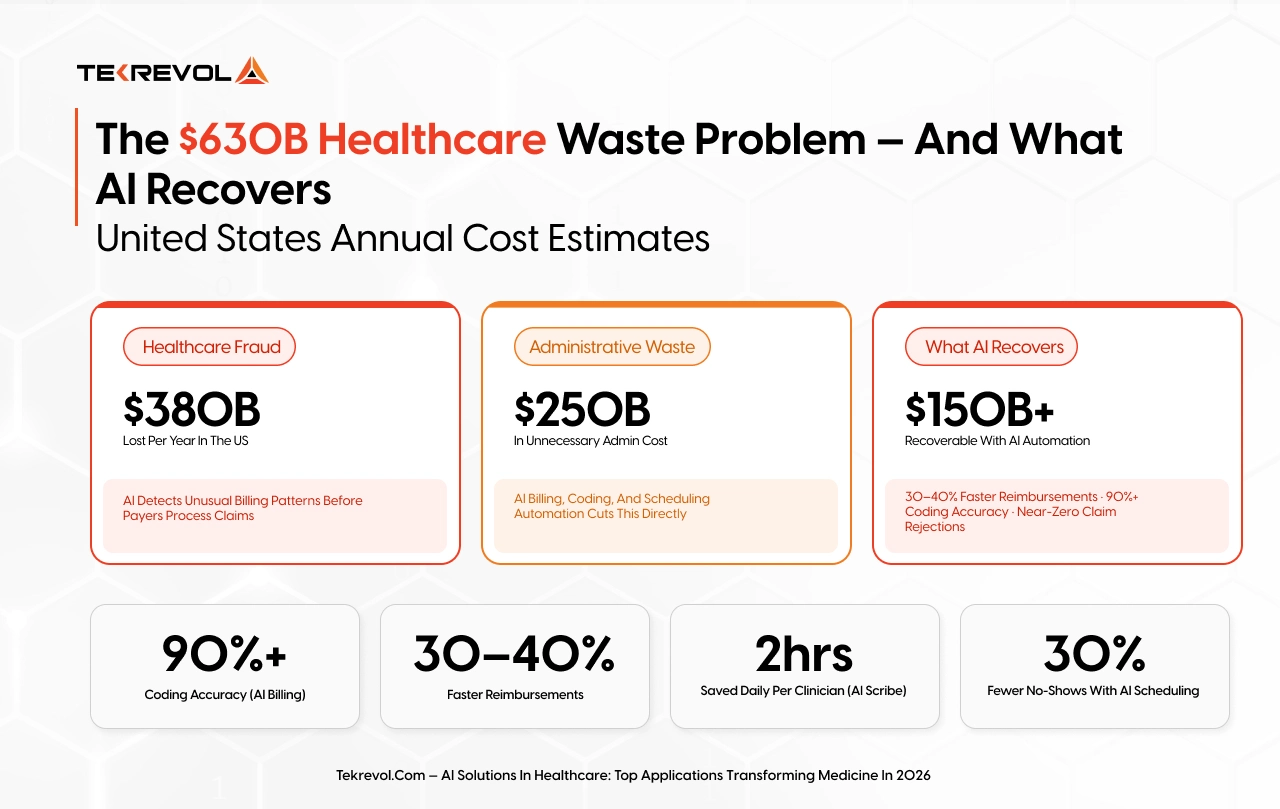
AI automation in healthcare is solving a crisis hiding in plain sight. Healthcare fraud alone costs the U.S. $308.6 billion per year. Administrative waste adds another $265.6 billion on top of that. And clinicians are now spending nearly 2 hours on paperwork for every 1 hour with a patient, a ratio that is burning people out of the profession entirely. AI is the fix.
Medical Billing and Claims Automation
AI billing platforms like RapidClaims use NLP to read clinical notes, auto-generate billing codes, and validate claims before submission. The result:
- 90%+ coding accuracy on first pass
- Hundreds of charts processed per minute
- Fewer rejected claims, faster reimbursement cycles
- Automated fraud detection flagging unusual billing patterns before they hit the payer
AI for Clinical Documentation
AI scribes listen to patient-clinician conversations and auto-generate structured clinical notes inside the EHR. Microsoft Dragon Copilot (formerly DAX) is the flagship example, integrating with Epic and Oracle Cerner to give clinicians back 2+ hours per day in documentation time.
Scheduling and Operational AI
- Smart scheduling — AI fills appointment slots dynamically, reducing no-shows by up to 30%
- Supply chain AI — Predicts medication and supply demand, cutting waste and stockouts
- Staffing optimization — Predictive models match nurse-to-patient ratios to real-time census data
AI Health Tech for Patient Engagement and Virtual Care
AI health tech is redefining what “patient care” even means, extending it beyond the four walls of a clinic into patients’ homes, phones, and daily routines.
Virtual Nursing Assistants
AI-powered chatbots and apps handle routine patient queries, 24/7 medication reminders, appointment scheduling, triage questions, and post-discharge follow-up. A study found 64% of patients are comfortable using AI for around-the-clock nursing support. This frees clinical staff for the complex, high-judgment interactions only humans can handle.
Remote Patient Monitoring (RPM)
Wearables and IoT devices stream continuous health data, heart rate, oxygen saturation, glucose levels, and sleep patterns to AI platforms that flag anomalies and alert care teams. For chronic disease management, RPM with AI oversight is transformational:
- Diabetics using AI-integrated CGM devices see HbA1c reductions of 0.5–1.2%
- Heart failure patients on RPM programs have 25–50% fewer hospital readmissions
- AI catches dosage errors in insulin administration in up to 70% of cases (Nature Medicine)
Mental Health AI
NLP and sentiment analysis tools screen patient-generated data, app journals, voice tone, activity patterns for early signs of depression, anxiety, or suicidal ideation. These tools extend mental health screening to populations that would otherwise never be reached.
AI for Medical Robotics and Surgical Assistance
AI-assisted surgery is making operations more precise, less invasive, and safer for patients. Robotic systems guided by real-time AI inference can navigate around sensitive tissue, minimize incision size, and reduce post-operative complications.
Key Applications
- Robotic surgical systems — AI guides instrument movement with sub-millimeter precision, reducing blood loss and infection risk
- Intraoperative imaging AI — Real-time analysis of surgical field video to flag tissue types and warn of anatomical risk zones
- HeartFlow FFRCT — AI analyzes CT coronary scans and creates 3D blood flow simulations, eliminating unnecessary invasive catheterizations
Surgical AI by the Numbers
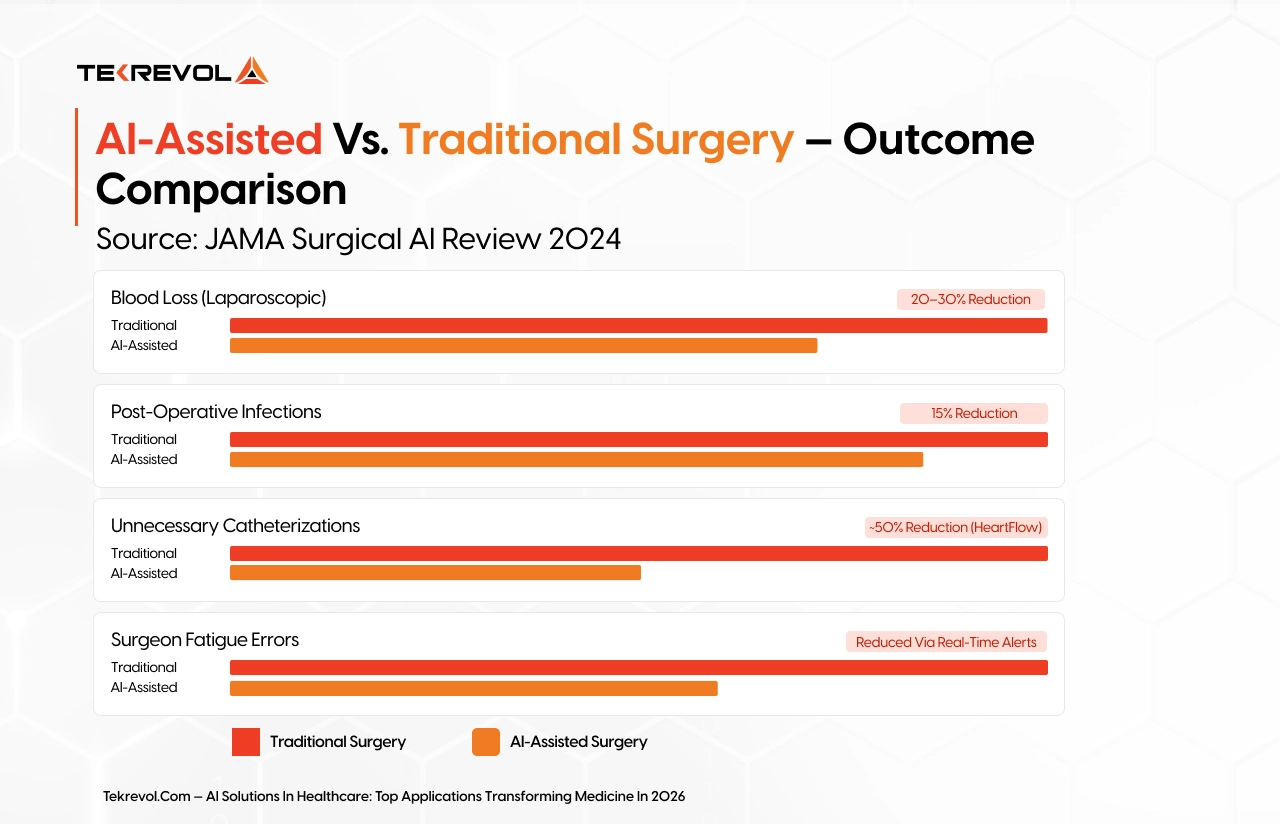
| Metric | Without AI | With AI |
| Blood loss (laparoscopic) | Baseline | 20–30% reduction |
| Post-op infections | Baseline | 15% reduction |
| Unnecessary catheterizations | High | Reduced by ~50% (HeartFlow) |
| Surgeon fatigue errors | Standard risk | Reduced via real-time alerts |
Drug Discovery Timeline and AI
AI is compressing the drug discovery timeline from 10–15 years down to 2–4 years for certain molecule classes. That’s not hype. That’s what’s happening right now in pharma labs that have adopted AI-driven healthcare solutions.
How AI Accelerates Drug Discovery
- Generative AI designs novel molecule structures that fit target proteins, no more blind trial-and-error synthesis
- ML models predict toxicity, bioavailability, and off-target effects before a single lab test is run
- AI trial matching (as used by Tempus) connects patients to the right clinical trials in minutes, not weeks
- Genomic AI identifies biomarkers that predict which patient populations will respond to a specific treatment
Real-World Impact
| Phase | Traditional Timeline | AI-Accelerated |
| Target identification | 2–3 years | 6–12 months |
| Lead optimization | 3–4 years | 12–18 months |
| Preclinical testing | 2–3 years | 12–18 months |
| Patient-trial matching | Weeks per patient | Minutes per patient |
Healthcare AI Applications Across Specialties
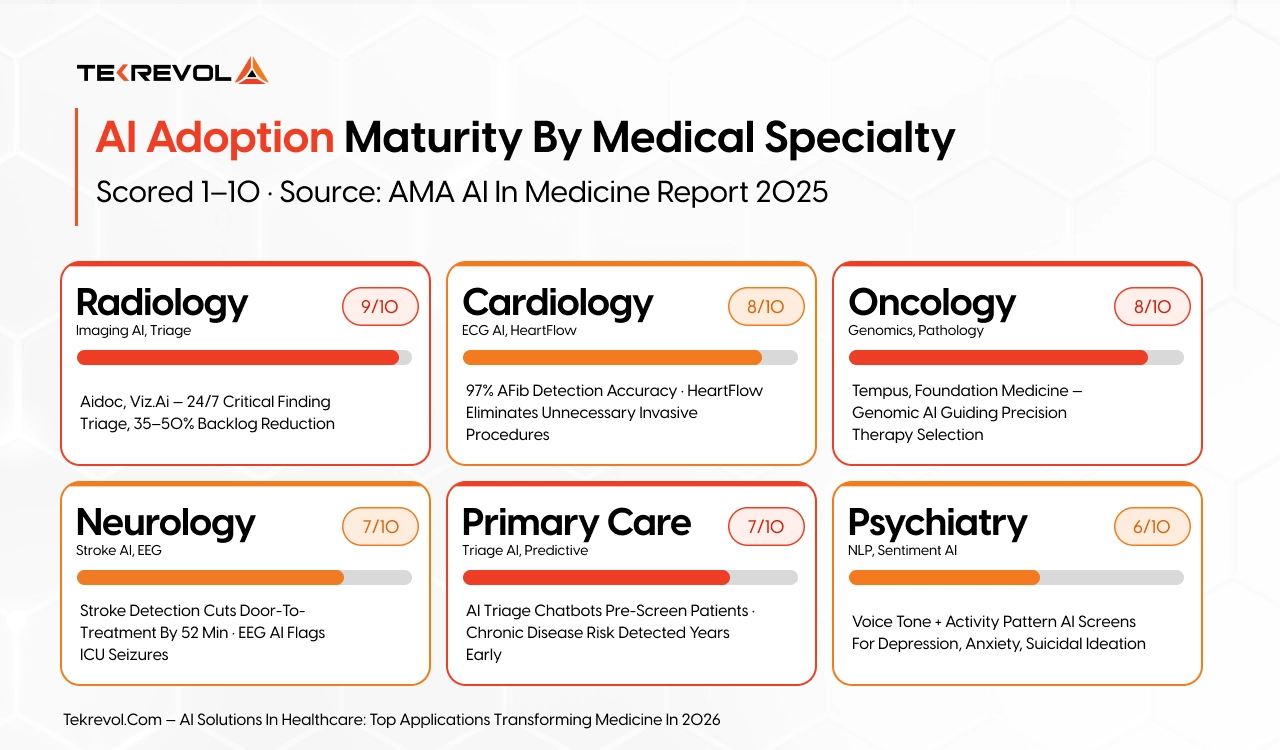
Every medical specialty has a specific AI use case that’s delivering results today. Here’s a rapid-fire breakdown:
Cardiology
- AI ECG analysis detects atrial fibrillation with 97% accuracy
- HeartFlow eliminates unnecessary catheterizations for hundreds of thousands of patients annually
Oncology
- AI pathology tools detect cancer cells in biopsies faster and with comparable accuracy to senior pathologists
- Genomic AI platforms (Tempus, Foundation Medicine) guide precision therapy selection
Radiology
- Aidoc and Viz.ai triage critical findings across neuro, chest, and cardiovascular imaging 24/7
- AI reduces radiologist reading backlogs by 35–50% in high-volume systems
Neurology
- Stroke detection AI cuts door-to-treatment time by 52+ minutes
- EEG AI identifies seizure patterns in ICU patients who cannot self-report symptoms
Primary Care
- AI triage chatbots pre-screen patients before appointments, surfacing red flags for clinicians
- Predictive analytics identify chronic disease risk years before symptom onset
Core Technologies Powering AI-Driven Healthcare
Understanding what’s under the hood matters, especially if you’re buying or building a healthcare AI solution.
| Technology | Role in Healthcare AI |
| Machine Learning (ML) | Classification, risk scoring, predictive models |
| Deep Learning / CNNs | Medical imaging analysis |
| Natural Language Processing | Clinical notes, coding, chatbots |
| Computer Vision | Surgical guidance, pathology, dermatology |
| Large Language Models (LLMs) | Clinical documentation, patient Q&A |
| Federated Learning | Training AI on distributed hospital data without sharing PHI |
| FHIR/HL7 Interoperability | Connecting AI outputs to existing EHR systems |
| Edge Computing | Real-time inference in ORs, ICUs, remote monitoring |
Interoperability is the silent killer of healthcare AI projects. An AI tool that can’t connect to your EHR, PACS, or billing system is worthless. Any custom software developed by TekRevol is designed to be FHIR-compliant from day one, so your AI works within your ecosystem, not in spite of it.
Challenges You Need to Know of AI Solutions in Healthcare
No honest conversation about healthcare AI skips the hard stuff. Here are the real challenges and how they’re being solved.
Data Privacy and HIPAA Compliance
AI systems that process PHI must be HIPAA-compliant, which adds architectural constraints around data storage, access logging, and model training. Federated learning and on-premise deployment options address the toughest cases.
Bias in AI Models
AI trained on non-representative datasets can underperform for minority populations. Responsible AI development requires diverse training data and ongoing bias audits. TekRevol builds bias review into every model deployment.
EHR Integration Complexity
Legacy EHR systems are notoriously hard to integrate with. FHIR APIs have improved this dramatically, but integration still requires domain expertise.
FDA Regulatory Clearance
AI tools used for clinical decision-making may require FDA 510(k) clearance. Understanding the regulatory pathway early is critical.
Clinician Adoption
The best AI tool fails if clinicians don’t trust it. Explainability showing why an AI made a recommendation is non-negotiable for clinical adoption.
Why Choose TekRevol for AI-Driven Healthcare Solutions?
TekRevol isn’t just an app development shop. We’re a healthcare AI partner who’s already done what you’re trying to do.
Here’s what sets us apart:
- 150+ Healthcare App Developers with deep domain expertise in clinical workflows
- HIPAA-Compliant by Default — security and compliance baked in from architecture to deployment
- ISO 27001 Certified — enterprise-grade information security standards
- Full-Stack AI Capability — from NLP and computer vision to LLM integration and predictive analytics
- EHR Integration Experts — FHIR-compliant integrations with Epic, Cerner, and legacy systems
- End-to-End Ownership — discovery, design, development, deployment, and ongoing optimization
- Proven Track Record — Kinekt, Your Nurse, Libido Health, and dozens more live healthcare products
We don’t just build AI. We build AI that works inside real clinical environments, survives real audits, and actually gets used by real clinicians.
Your competitors already have AI working for them. The question is: will you catch up — or get left behind?
AI isn’t a someday investment anymore. Every month you wait, your clinical operations are slower, your costs are higher, and your patients are getting a worse experience than they deserve.
TekRevol has built HIPAA-compliant, production-grade AI healthcare solutions for brands just like yours. Let’s build yours next.
Get Your Free AI Healthcare Consultation — Worth $300
Our AI healthcare experts will evaluate your existing workflows, identify the highest-impact AI opportunities, and provide a clear implementation roadmap tailored to your organization—all at no cost.
Book My Free Session NowThe Future of AI Solutions in Healthcare
The healthcare AI you see today is just the beginning. Here’s what’s coming in the next 2–3 years:
Agentic AI in Healthcare
AI agents that don’t just analyze data, they take action. Scheduling follow-ups, ordering labs, flagging billing issues, and routing patients to specialists. Autonomous agents that manage entire care pathways end-to-end.
Multimodal AI Diagnostics
AI that simultaneously reads imaging, lab values, clinical notes, and genetic data, generating a unified clinical picture that no single-modal tool can match.
Ambient Clinical Intelligence
Always-on AI that passively listens to patient-clinician conversations, auto-documents, flags risks, and surfaces relevant clinical guidance in real time, with zero additional input from the clinician.
Federated Learning at Scale
Hospitals sharing AI model improvements without sharing patient data, creating network effects that make every organization’s AI smarter as the overall system learns.
AI in Supply Chain and Staffing
Predictive AI is now managing hospital inventory, forecasting surgical supply needs, and optimizing nurse staffing ratios dynamically in ways that reduce both waste and burnout at the same time.
How to Choose the Right AI Healthcare Solution for Your Organization
Not every AI tool is right for every healthcare organization. Here’s a quick framework:
| Consideration | Questions to Ask |
| ROI Priority | Where is our biggest cost bleed or quality gap? |
| Data Readiness | Is our data structured, accessible, and clean? |
| Integration | Does this AI connect to our existing EHR/PACS/billing systems? |
| Compliance | Is it HIPAA-compliant? FDA-cleared if clinical? |
| Explainability | Can clinicians understand why the AI made a recommendation? |
| Vendor Track Record | Has this been deployed in a real clinical environment? |
| Build vs. Buy | Do off-the-shelf tools fit our workflow, or do we need custom? |
If you’re unsure where to start, the answer is almost always administrative AI first, the fastest payback, the lowest regulatory risk, and the quickest way to build internal AI confidence before tackling clinical applications.
Why Choose TekRevol?
Stop paying for off-the-shelf tools that don’t fit your clinical reality.
Generic AI products are built for the average hospital. Your organization isn’t average. You have unique workflows, legacy systems, specific patient populations, and compliance requirements that no SaaS product was built to handle.
TekRevol builds healthcare AI from the ground up, for you. HIPAA-compliant, EHR-integrated, and actually adopted by the clinical staff who use it every day.
Let's Build Something That Actually Works
No cookie-cutter demos or off-the-shelf solutions—just a focused conversation about your unique challenges, business goals, and how a custom AI solution can deliver measurable results.
Start My Custom AI Project


