



- Medical AI is changing the way diagnosis, treatment, and clinical decision-making are done in healthcare.
- AI supports diagnostic imaging, clinical decision support, drug discovery, predictive analytics, surgery, and medical documentation, among other areas.
- Currently, there are over 950 FDA-cleared AI medical devices that are being used regularly in clinical settings.
- The major challenges for adoption are EHR integration, clinician trust, and data quality.
- TekRevol creates HIPAA-compliant, FDA-aware medical AI solutions for healthcare organizations of today.
Medical AI is moving beyond research environments and into real-world clinical and patient-facing workflows, improving both healthcare accessibility and operational efficiency. It providers improve diagnostics, streamline workflows, and support faster decision-making.
Yet much of the conversation around medical AI falls into two extremes: hype about replacing doctors or highly technical discussions that offer little practical guidance. Healthcare leaders need a clearer understanding of where AI delivers value, where its limitations remain, and what it takes to implement it successfully.
This guide cuts through both. It covers six proven clinical application areas, the FDA-cleared tools doctors are actually using in 2026, and the real risks no one wants to talk about. Also, the adoption challenges that slow even well-funded health systems down, and how a reliable healthcare app development company is required to overcome all risks.
What Is Medical AI? Definition and Scope
Clinical teams aren’t short on expertise; they’re short on time. Medical AI is artificial intelligence applied directly to patient care, diagnosis, treatment planning, clinical documentation, and care monitoring.
It is narrower than a digital healthcare solution, which also covers billing, supply chain, and administrative operations. And it is far more consequential, because errors carry clinical risk.
AI has rapidly become part of clinical practice, with 81% of physicians reporting that they use AI tools in their practice in 2026, more than double the 38% adoption rate reported in 2023.
The core technologies power medical AI:
- Machine learning (ML): Algorithms that learn patterns from large clinical datasets, imaging studies, lab results, and EHR records to make predictions or classifications.
- Computer vision: AI trained to interpret medical images: X-rays, CT scans, MRIs, pathology slides, dermatology photos.
- Natural language processing (NLP): AI that reads, understands, and generates clinical text, notes, reports, referrals, and discharge summaries.
- Large language models (LLMs): Foundation models like those behind ambient AI scribes and clinical question-answering tools. These are the newest entrants and carry both the most promise and the most risk.
Medical AI vs. Healthcare AI vs. Health IT: What’s the Difference?
These terms get used interchangeably. They shouldn’t.
- Health IT covers electronic health records (EHRs), hospital information systems, and data infrastructure. It’s the plumbing.
- Healthcare AI is broader; AI is applied anywhere in the healthcare system, including revenue cycle management, staffing optimization, and supply chain forecasting.
- Medical AI (also referred to as clinical AI) is the subset that touches patient diagnosis, treatment, or monitoring directly. This is where regulatory scrutiny is highest, and where the potential and the stakes are greatest.
Turn Medical AI Into Reality
TekRevol develops HIPAA-compliant medical AI solutions that integrate seamlessly into real clinical workflows.
Book Your Free Discovery CallWhat Does AI Medical Mean in Clinical Context?
In clinical shorthand, “AI medical” refers to AI-powered tools deployed at the point of care, tools embedded in imaging workflows, EHR systems, or clinical decision support systems that a clinician interacts with during patient care.
The term is also used in FDA regulatory classification, where Generative AI solutions help medical devices, which are a formal device category subject to premarket review.
Why Medical AI Matters Now
Healthcare isn’t struggling because of a lack of clinical expertise; it’s struggling because growing patient demand and rising volumes of clinical data are overwhelming traditional workflows. Physicians must make faster decisions while managing increasing documentation and administrative responsibilities.
Medical AI helps bridge this gap by improving diagnostics, reducing documentation burden, and supporting faster clinical decision-making. Today, healthcare organizations are no longer asking whether to adopt medical AI; they’re evaluating which use cases deliver measurable improvements in patient outcomes, clinician productivity, and operational efficiency.
Want a practical perspective? Listen to our TekRevol’s CMO Abeer Raza, with healthcare experts, discuss how medical AI is being adopted in real clinical settings, the challenges organizations face, and what it takes to implement AI successfully.
6 Clinical Applications of Medical AI
Medical AI in the clinical setting falls into six proven application areas. Each is at a different stage of maturity. Some are FDA-cleared and in daily clinical use, while others are emerging from trials. Here’s where the technology actually stands in 2026.
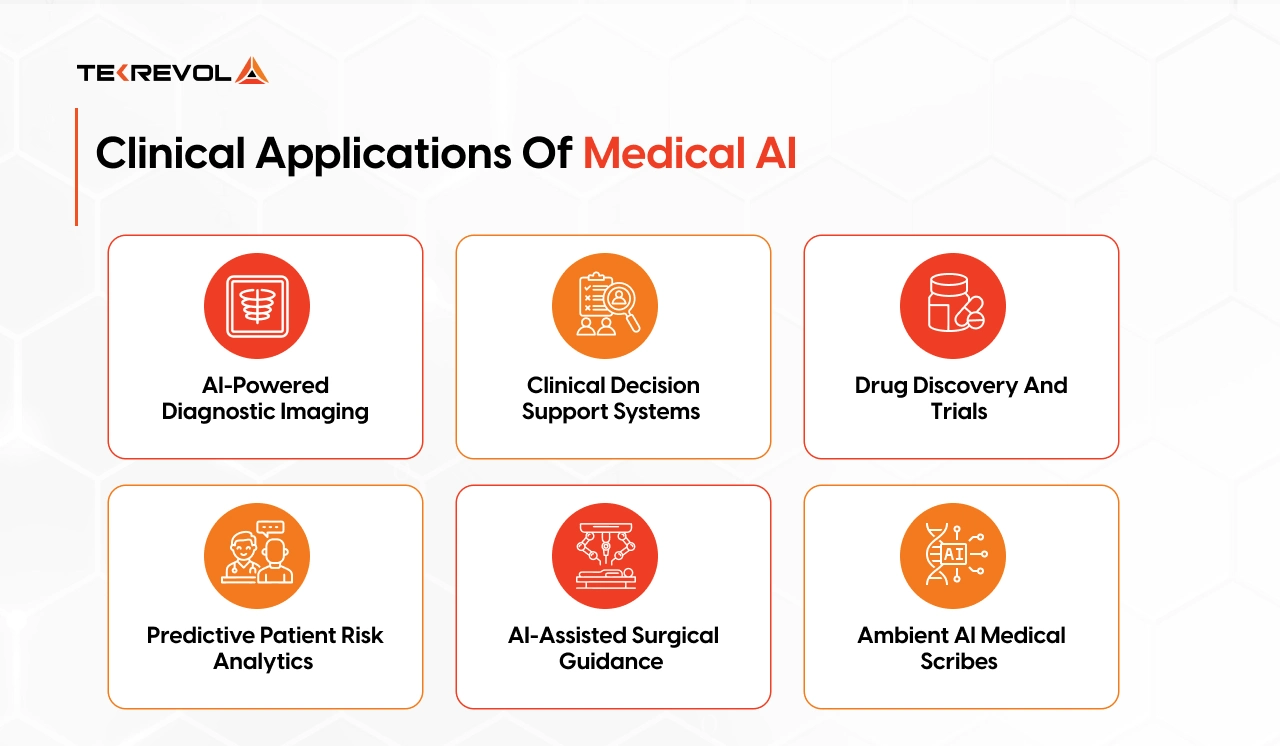
1. Diagnostic Imaging: Radiology, Pathology, and Dermatology AI
This is the most mature area of medical AI, which is why many hospitals begin their AI journey with imaging rather than more complex clinical workflows. Algorithms trained on millions of imaging studies can now detect abnormalities with accuracy that matches, and in specific tasks, exceeds, board-certified specialists.
Where it’s proven:
- Radiology: AI tools flag pneumothorax, pulmonary embolism, intracranial hemorrhage, and lung nodules in CT and chest X-ray workflows. Aidoc, Viz.ai, and Nuance’s PowerScribe are FDA-cleared and active in hospital systems across the US.
- Pathology: Digital pathology AI analyzes whole-slide images for cancer grading. Paige.ai received the first FDA approval for a primary diagnosis AI tool in pathology, which detects prostate cancer with greater sensitivity than pathologists reviewing slides alone.
- Dermatology: AI systems trained on millions of dermoscopy images now match or exceed dermatologists at classifying melanoma, basal cell carcinoma, and other skin lesions. Google’s DERM Assist and DermTech are among the tools gaining clinical traction.
The honest limitation: These tools perform best on the data distributions they were trained on, making AI-enabled transformation in the healthcare industry. A model trained predominantly on imaging from one patient population can underperform on others, a documented source of algorithmic bias that regulators and researchers are actively working to address.
2. Clinical Decision Support: AI at the Point of Care
Clinical decision support systems (CDSS) have existed for decades, including drug interaction alerts, dosing calculators, and evidence-based order sets.
AI-powered CDSS takes this further by synthesizing patient data in real time to generate risk scores, flag deteriorating patients, and surface relevant clinical evidence during a patient encounter.
Active examples:
- Sepsis prediction: Epic’s Sepsis Prediction Model and Dascena’s Sepsis Alert are deployed in hospital systems to flag patients at risk of sepsis hours before clinical symptoms become obvious.
- Early deterioration: AI models monitoring vital sign trends, lab values, and nursing notes generate deterioration alerts that give care teams a response window they wouldn’t otherwise have.
- EHR-embedded recommendations: Tools like Nuance DAX and Microsoft’s Azure Health Bot are now embedded directly into EHR workflows, surfacing evidence-based recommendations without requiring clinicians to leave their documentation environment.
The central challenge in this space is alert fatigue. If a system flags too many low-confidence warnings, clinicians tune it out. The best CDSS implementations are designed with specificity, high-confidence alerts for high-stakes events, not broad low-threshold noise.
3. Drug Discovery and Development: Target Identification and Trial Matching
AI in the medical field is compressing timelines that once spanned decades. Traditional drug discovery identifies a target, screens compounds, tests in vitro, tests in animal models, moves to trials, takes 10–15 years, and costs over $2 billion on average. AI is cutting both.
Where the gains are real:
- Target identification: ML models analyze genomic and proteomic datasets to identify disease targets that human researchers might not find for years.
- Compound screening: AI can virtually screen billions of molecular compounds against a target in the time it would take a lab to screen thousands physically.
- Clinical trial matching: NLP tools match patients to eligible trials by reading unstructured EHR data, a process that used to require manual chart review.
Insilico Medicine, Recursion Pharmaceuticals, and Schrödinger are among the companies running fully AI-native drug discovery pipelines.
Insilico’s AI-designed drug for idiopathic pulmonary fibrosis became the first AI-discovered and AI-designed drug candidate to enter Phase II clinical trials in 2023, a genuine landmark.
4. Predictive Analytics: Sepsis, Readmission, and Deterioration
Predictive analytics in medicine uses AI to answer one question: which patient is going to get worse, and when? The clinical value is clear.
Early intervention changes outcomes. Readmissions are expensive and preventable. Deterioration caught six hours earlier is the difference between an ICU transfer and a code.
Proven applications:
- Hospital readmission risk: CMS penalizes hospitals for excess readmissions. AI models trained on discharge data, social determinants of health, and prior utilization now generate readmission risk scores that care coordinators use to target post-discharge follow-up.
- Sepsis and deterioration: As covered in Section 3, sepsis prediction models are among the most clinically validated AI tools in hospital settings.
- Chronic disease progression: AI models are being validated for predicting diabetic retinopathy progression, CKD staging, and heart failure decompensation — allowing intervention before acute events occur.
The limitation here is the same as imaging AI: these models perform well in the hospital systems they were trained on.
Generalizing across different EHR environments and patient populations requires careful validation, not just trust in a vendor’s published accuracy figures.
5. AI-Assisted Surgery: Robotic Guidance and Real-Time Systems
AI development services in surgical settings operate on a different frontier. Robotic surgery systems like the da Vinci platform have existed since the early 2000s, but the current generation adds AI-powered features that go beyond mechanical assistance.
Current capabilities:
- Intraoperative guidance: AI systems analyze real-time surgical video to identify anatomical structures, flag proximity to critical tissues (nerves, vessels), and provide augmented reality overlays during laparoscopic and robotic procedures.
- Skill assessment: AI tools trained on surgical video can assess technique and flag deviations from evidence-based practice — early applications are in surgical training and credentialing.
- Autonomous robotic elements: Fully autonomous surgical AI is not in clinical use. But semi-autonomous features, like the da Vinci’s tremor filtering and motion scaling, are established and cleared.
This is the area where the line between “AI augmentation” and “AI autonomy” is being actively negotiated by regulators, hospitals, and surgeons. The FDA’s action plan for AI/ML-based software as a medical device is the key regulatory document to follow here.
6. Medical Documentation: Ambient AI Scribes and Clinical NLP
This is the fastest-growing adoption area in 2026, and for good reason. Physician burnout is a crisis. Administrative documentation, not patient care, now consumes an estimated 35–50% of a physician’s working day.
AI scribes are one of the most reliable AI solutions offered by a mobile app development company, where the ROI is immediate, the risk is manageable, and adoption is accelerating.
How it works: Ambient AI scribes (like Nuance DAX Copilot, Abridge, and Suki) listen to the patient-physician conversation with consent, generate a structured clinical note in real time, and push it to the EHR for physician review and sign-off.
The physician edits, not writes. Time savings: 30–45 minutes per physician per day in validated deployments.
Beyond scribes: NLP tools are also being used to:
- Extract structured data from unstructured clinical notes for quality reporting
- Identify patients with undiagnosed conditions buried in free-text documentation
- Generate patient-facing summaries from clinical notes in plain language
This is an area where LLM hallucination risk is clinically relevant. A scribe who inserts a medication the physician didn’t prescribe, or documents a symptom that wasn’t discussed, creates a patient safety event.
Every deployed system requires mandatory clinician review before any note is finalized.
AI Tools Doctors Are Actually Using in 2026
In 2026, the FDA has cleared over 950 AI-enabled medical devices. Most are in radiology and cardiology. A growing number cover pathology, ophthalmology, and neurology. Here is what the active clinical landscape actually looks like, not what’s in development, but what’s deployed.
Categories of FDA-Cleared Medical AI Tools
| Category | What It Does | Example Tools |
| Imaging AI | Detects abnormalities in radiology and pathology images | Aidoc, Viz.ai, Paige.ai, Nuance PowerScribe |
| Ambient AI Scribes | Auto-generates clinical notes from patient-physician conversations | Nuance DAX, Abridge, Suki |
| Diagnostic Decision Support | Surfaces differential diagnoses and clinical evidence during encounters | Isabel DDx, DXplain |
| Remote Patient Monitoring AI | Analyzes wearable and home monitoring data for deterioration signals | Current Health, Biofourmis |
| Clinical NLP | Extracts structured data from unstructured clinical text | AWS HealthLake, Google Cloud Healthcare NLP |
Open Evidence: AI-Powered Clinical Evidence at the Point of Care
Open Evidence is an AI platform trained specifically on peer-reviewed medical literature. It allows clinicians to query clinical questions in natural language and receive answers grounded in published evidence, with citations.
It represents a new category: AI for doctors that functions less like a diagnostic tool and more like an always-available clinical librarian.
The value is in specificity. General-purpose LLMs like ChatGPT hallucinate clinical details at rates that make them unsafe for clinical use without expert review. Tools like Open Evidence, trained and validated on medical literature, narrow that risk significantly, though they don’t eliminate it.
What to Look for When Evaluating Medical AI Tools
Before any clinical AI tool goes into use, ask:
- Is it FDA-cleared or CE-marked? Cleared ≠ and approved, but it means the FDA has reviewed the evidence for safety and effectiveness for a specific intended use.
- What was the training data? Was the model trained on a population similar to yours? Demographic mismatches are a documented source of performance degradation.
- How does it handle uncertainty? Good clinical AI should surface confidence levels, not just outputs.
- What is the human review requirement? No AI clinical output should reach a patient without clinician sign-off. If a vendor implies otherwise, walk away.
- How does it integrate with your EHR? A tool that requires manual data entry defeats the purpose.
Ready to Integrate an FDA-Cleared AI Tool?
TekRevol builds secure healthcare platforms around AI-powered solutions with EHR integrations, HIPAA-compliant architecture, and workflows designed to support real-world clinical use.
Let's Talk About Your IntegrationBenefits and Risks of AI in Clinical Settings
AI in medicine delivers four core clinical benefits, and carries four serious risks that no serious discussion of medical artificial intelligence should gloss over.
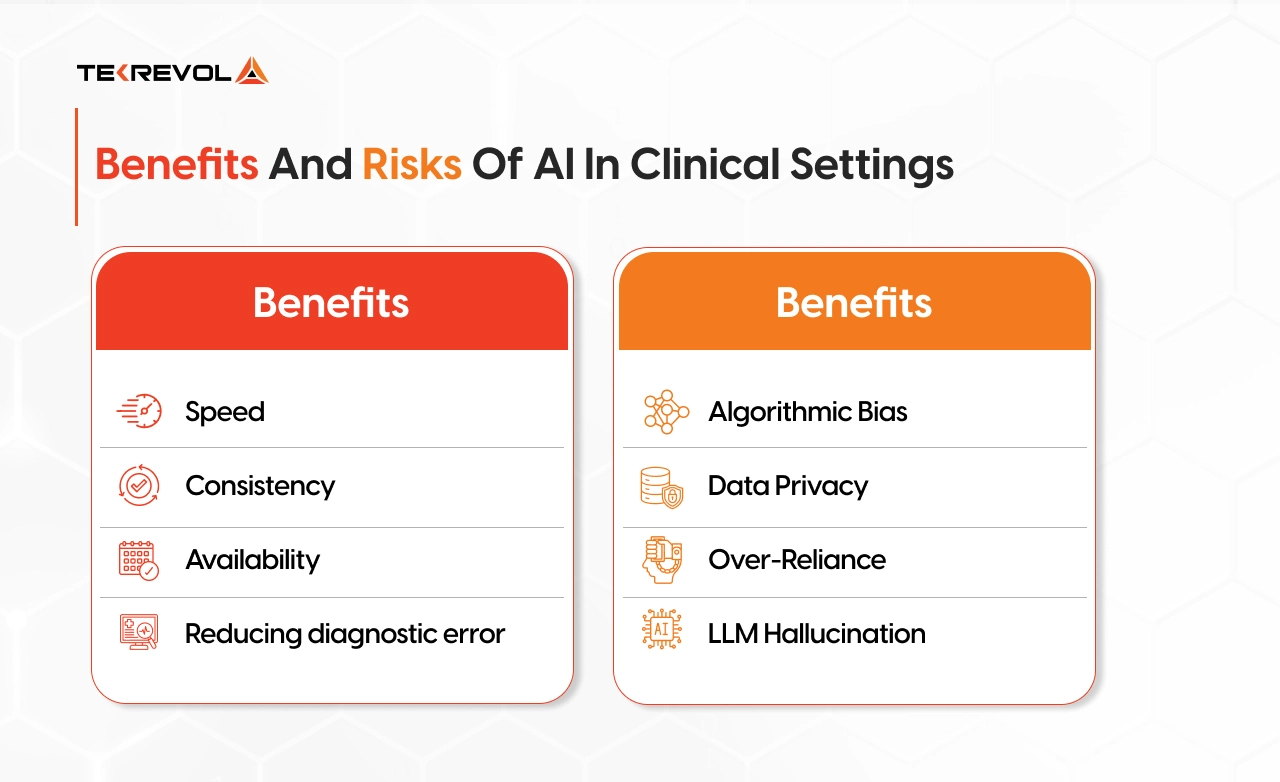
Benefits
Below are the benefits of AI in clinical settings:
Speed
AI reads a chest CT for intracranial hemorrhage in seconds. In stroke care, every minute matters. An AI development tool that flags a hemorrhage and routes it to the right team before the on-call radiologist has opened the study is not theoretical; it is saving lives in emergency departments that have deployed it.
Consistency
Humans are inconsistent. A radiologist reads a study differently at 8 AM than at 10 PM after a 14-hour shift. AI applies the same algorithm every time. In screening programs, mammography, lung cancer, and diabetic retinopathy, consistency at scale is enormously valuable.
Availability
AI doesn’t sleep. Remote hospitals with limited specialist access can run an AI-powered diabetic retinopathy screening program without an on-site ophthalmologist. IDx-DR, the first autonomous AI diagnostic system cleared by the FDA, does exactly this.
Reducing diagnostic error
Diagnostic error affects an estimated 12 million Americans annually. AI as a second-read tool, not replacing clinician judgment, but flagging what might have been missed, has shown measurable reductions in false negative rates in several clinical trial settings.
Risks
Here are risk of AI in clinical settings:
Algorithmic bias
If a model was trained predominantly on data from one demographic group, it may perform poorly on others. Pulse oximetry algorithms that overestimate oxygen saturation in patients with darker skin tones are a documented, deadly example. Medical AI inherits the biases of its training data.
Data privacy
Medical AI requires access to patient data, often large volumes of it. HIPAA compliance is the floor, not the ceiling. De-identification, federated learning, and differential privacy are technical approaches that are now standard expectations in responsible medical AI development.
Over-reliance
Automation bias is real. When a system presents a confident output, humans tend to defer to it, even when their own judgment might have caught an error. Clinical AI training for users must explicitly address this.
LLM hallucination
Large language models generate plausible-sounding text. In a clinical note, a hallucinated drug dose or a fabricated lab value is a patient safety event. This is the defining challenge of NLP-based medical AI in 2026, and every deployed system requires mandatory human review as a safeguard.
The Human-in-the-Loop Principle
This is the governing principle of safe medical AI deployment: AI augments clinical judgment; it does not replace it. Every AI output that reaches a clinical decision point must pass through a clinician who reviews, accepts, rejects, or modifies it. The physician remains accountable. The AI is a tool, a powerful one, but a tool.
The FDA’s regulatory framework for AI/ML-based software as a medical device is built on this principle. The EU AI Act, which classifies medical AI as high-risk by default, enforces it through conformity assessments and post-market monitoring requirements.
Challenges to Medical AI Adoption in Hospitals and Clinics
The main challenge to medical AI adoption is not the technology; it is the environment in which the technology has to work. Hospital systems are complex, regulated, risk-averse, and historically slow to change. Here’s where the friction actually lives.
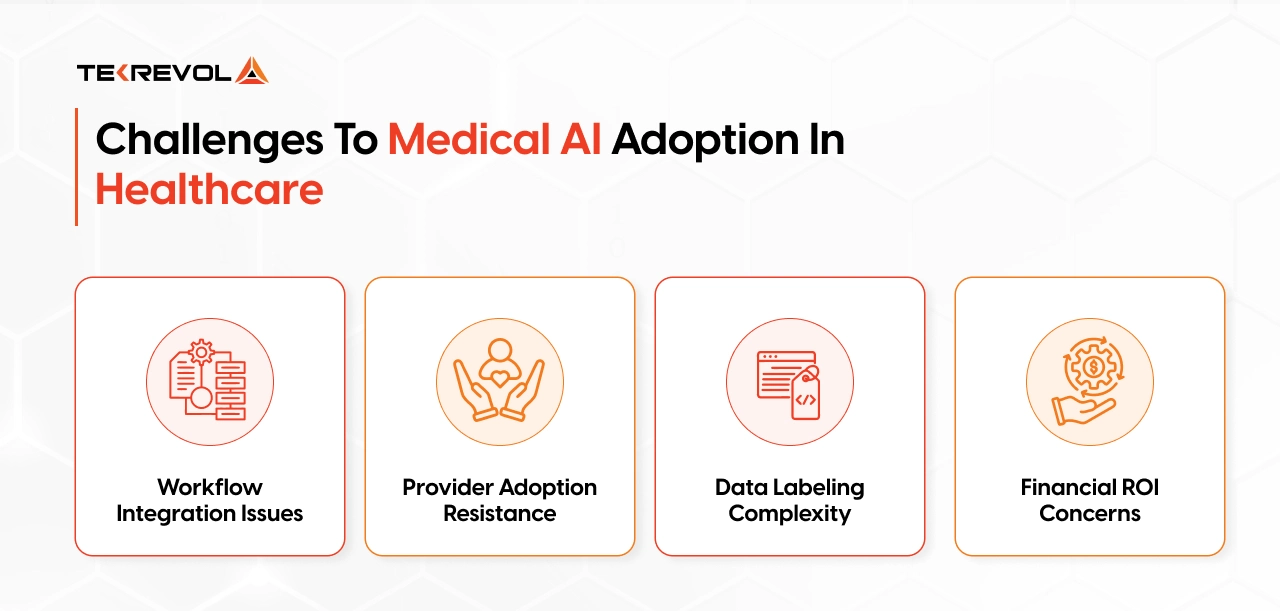
EHR Integration and Interoperability
Most hospital AI tools need to sit inside an EHR workflow to have clinical value. Epic and Oracle Health (formerly Cerner) dominate the US EHR market, and both have app marketplaces with vetted AI tools. But integration is not plug-and-play.
HL7 FHIR APIs have improved interoperability significantly, but legacy EHR configurations, custom workflows, and IT security requirements create real friction for every deployment.
Clinician Trust and Change Management
Physicians are trained to be skeptical. That is a feature, not a bug. But it means that AI tool adoption requires more than a vendor demo; it requires evidence, transparency about model limitations, and time for clinicians to develop calibrated trust.
Peer-reviewed evidence published in relevant journals, departmental champions who drive adoption from inside, and structured training programs are all necessary for successful rollouts. Technology alone does not drive adoption. People do.
Data Quality and Labeling
Medical AI models are only as good as the data they were trained on. Clinical data is notoriously messy, with inconsistent coding practices, incomplete records, free-text notes that require natural language processing services just to parse, and imaging studies from different scanners with different acquisition protocols.
Labeling that data for AI training requires clinical expertise. That is expensive and slow.
Cost and ROI
Hospital systems are under intense financial pressure. AI tools carry licensing costs, integration costs, training costs, and ongoing maintenance costs. ROI calculations need to account for all of them.
The clearest ROI cases in medical AI right now are ambient scribes (physician time savings), sepsis prediction (reduced ICU stays and readmissions), and imaging AI (increased radiologist throughput). Vague “improving outcomes” claims don’t survive a CFO review.
The Future of Artificial Intelligence in Medicine and Patient Care
The next five years of AI in medicine will be defined by four developments: multimodal foundation models, AI in precision medicine, AI agent development services, and the maturation of the regulatory framework.
Multimodal Foundation Models for Clinical Data
The most significant shift underway is the development of foundation models trained on multiple clinical data types simultaneously, including imaging, genomics, EHR data, clinical notes, wearables, and pathology.
Google’s Med-PaLM 2 and Microsoft’s BioGPT are early examples. The goal is a model that can reason across data types the way a senior clinician does, not just reading a chest X-ray, but interpreting it in the context of the patient’s labs, history, and medications.
AI in Precision Medicine and Genomics
Artificial intelligence medicine is finding some of its most powerful early applications in genomics. AI models can now analyze whole genome sequences to predict disease risk, identify pharmacogenomic factors that affect drug response, and match tumor genomic profiles to targeted therapies.
This is the foundation of precision medicine, treating the individual patient, not the average patient.
Agentic AI in Clinical Settings
Agentic AI refers to AI systems that don’t just answer questions; they take sequences of actions autonomously to complete complex tasks.
In medicine, this is still emerging, but early applications are appearing: AI systems that autonomously monitor a patient’s remote data, trigger alerts, schedule follow-ups, and draft care plans, then hand off to a clinician for review.
This is where the human-in-the-loop principle will be most tested. And it is where regulatory frameworks will need to evolve fastest.
The Regulatory Maturation
The FDA’s 2021 action plan for AI/ML-based SaMD (software as a medical device) established the framework for how adaptive AI models that learn and update after deployment will be regulated.
The EU AI Act added another layer of international regulatory complexity for companies operating in both markets. In the next five years, regulatory clarity will either accelerate or constrain medical AI adoption more than the technology itself will.
How TekRevol Helps Healthcare Organizations Build Medical AI Applications
TekRevol builds HIPAA-compliant, clinically aware AI applications for healthcare organizations, from patient-facing mobile apps to backend AI infrastructure integrated with major EHR systems.
Building medical AI is not the same as building a standard software product. The regulatory requirements are different. The data handling requirements are different. The QA standards are different. And the consequences of getting it wrong are different.
Here is how TekRevol approaches medical AI development:
HIPAA-compliant architecture from day one
Not bolted on at the end. Every data pipeline, storage layer, and API endpoint is built to meet HIPAA’s technical safeguard requirements, encryption at rest, encryption in transit, audit logging, and role-based access control.
FDA regulatory awareness
We work with clients to understand whether their product falls under FDA jurisdiction as a Software as a Medical Device (SaMD), and what that means for their development and validation process. We don’t replace regulatory counsel, but we build software that doesn’t create regulatory problems.
EHR integration expertise
TekRevol has built HL7 FHIR-compliant integrations with Epic and Cerner environments. We know where the integration friction lives and how to navigate it without creating security gaps.
AI model integration, not just UI
We integrate validated AI models, whether third-party APIs, open-source clinical models, or client-proprietary models, into production clinical workflows. We build the connective tissue between the AI and the product the clinician actually uses.
Ongoing support and compliance monitoring
Medical software doesn’t stand still. OS updates, EHR version changes, and evolving regulatory requirements mean post-launch maintenance is not optional. TekRevol’s retainer model provides continuous development support so your product stays compliant, current, and performant.
Whether you’re a health system exploring AI-assisted documentation, a startup building a diagnostic support tool, or a digital health company adding clinical AI features to an existing platform, TekRevol has the technical depth and healthcare domain knowledge to build it right.
Don’t Build HealthTech Without Medical AI
TekRevol develops HIPAA-compliant AI healthcare applications, from AI-powered documentation assistants to predictive care platforms, helping organizations deliver smarter and more efficient patient experiences.
Start with a Free Discovery Session


