Monolith to microservices migration is the gradual move of capabilities out of one application and into independent services, done one service at a time. In TekRevol’s judgment, a team that tries it in one step risks a stalled rewrite, which is why this guide uses a repeatable loop.
This guide gives a step-by-step plan with a check for each step, and it says when to stay with the monolith on a custom software development project. The plan is TekRevol’s judgment: the sources support each technique, and TekRevol set the sequence.
What does it mean to migrate a monolith to microservices?
It means making a series of small extractions, each moving one business capability out of the monolith and into its own service. A monolith is one application that ships as a single deployable unit, and the goal of the move is to let parts of it be released and scaled on their own. Teams also call the work refactoring a monolith to microservices or migrating to microservices, and the target is the style described in TekRevol’s guide to microservices architecture.
A monolithic to microservices architecture change is gradual, because the monolith keeps running while services are extracted.
Should you migrate at all?
Migrate only when the monolith blocks releases or scaling in a way that cleaner code inside the monolith cannot fix. The move adds network calls and many deployments, and it splits the data. TekRevol’s monolith versus microservices comparison covers the trade-offs, and the table below turns them into a gate.
| Question | Points to migrate | Points to stay |
| Do teams block each other’s releases? | Yes, one team’s change waits on another’s | No, one team releases everything |
| Is the problem tangled code or an oversized release unit? | The structure is sound, but the release unit is too big | The code is tangled, and a modular monolith would fix it |
| Can you run many services? | Deployment and monitoring are automated | Releases and monitoring are still manual |
| Can the data be split? | Each capability has its own tables | Most features read and write the same tables |
The gate is TekRevol’s judgment. If most answers fall in the last column, clean up the monolith into modules first. TekRevol’s guide to legacy system modernization covers other options, such as rehosting and replatforming.
The TekRevol Extraction Loop: the plan at a glance
Pass the readiness gate once, then repeat five steps for each service. The TekRevol Extraction Loop is TekRevol’s judgment, and each pass moves one capability out of the monolith. A microservices migration is the sum of many loops.
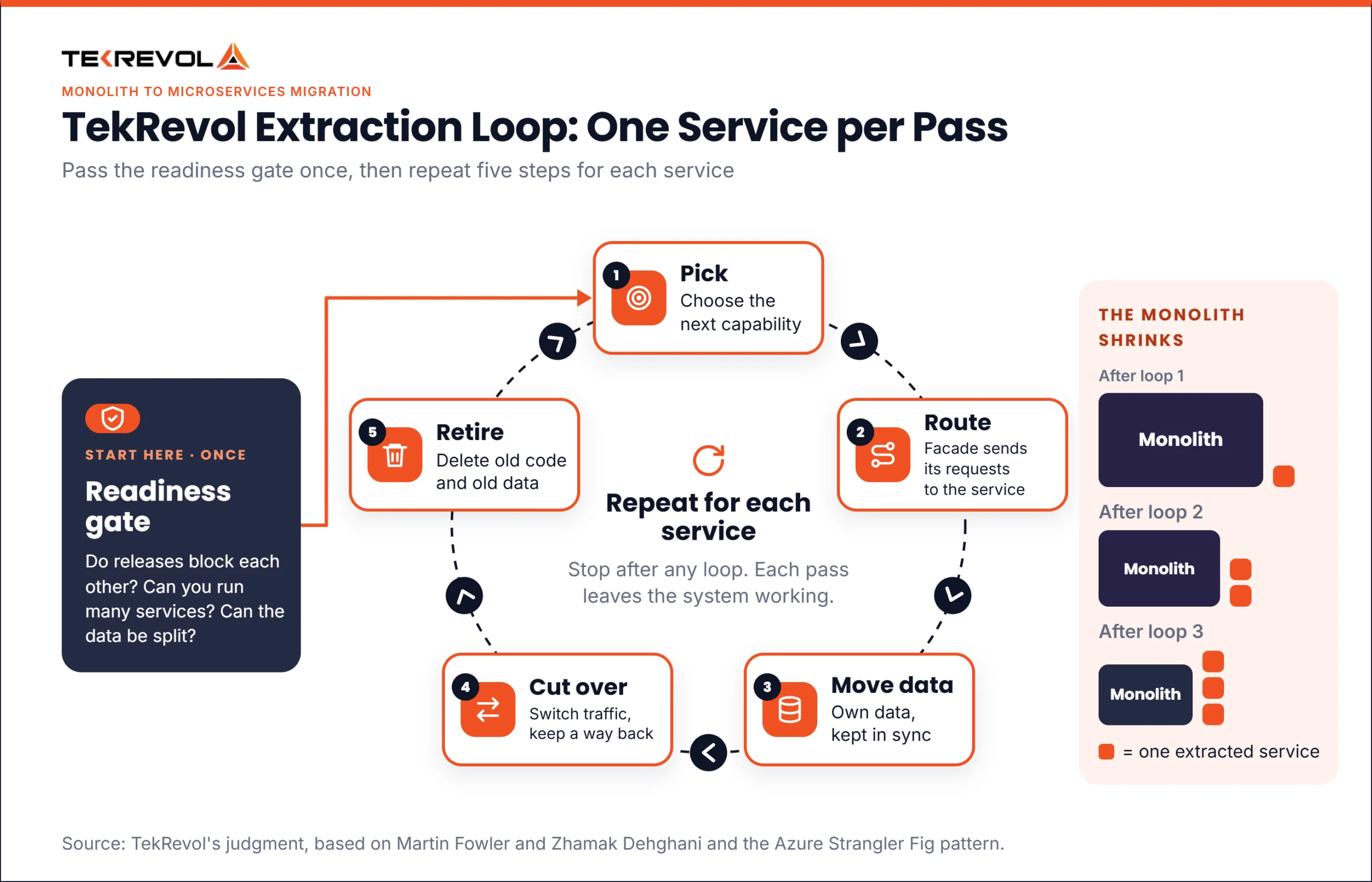
| Step | What you do | Done when |
| 1. Pick | Choose the next capability to extract | The capability has a named owner and few calls back into the monolith |
| 2. Route | Put a facade in front and send that capability’s requests to the new service | The facade can send requests to either side |
| 3. Move data | Give the new service its own data and keep it in sync | The new data matches the old |
| 4. Cut over | Switch traffic to the new service with a way back | The new service handles all the traffic and the old path can be restored |
| 5. Retire | Remove the old code and the old data objects | Nothing in the monolith still uses the capability |
Each pass leaves the system working, so you can stop after any loop. That safety is the main reason to prefer the loop over a rewrite.
Map the monolith before you cut
Map how modules call each other and which tables they share, then check the change history, because these decide which capability to extract first. Fowler and Dehghani suggest mining code commit history and checking it against business priorities to find the capabilities that change most often.
| What to map | Why it matters | How to check |
| Calls between modules | A capability that many others call is hard to pull out | List which modules call it and which it calls |
| Tables each capability uses | Shared tables decide how hard the data move will be | List the tables per capability and mark the shared ones |
| Change history | Code that changes often gains most from independent releases | Count commits per module, then compare with the product roadmap |
The check column is TekRevol’s reading, except the commit history idea, which comes from Fowler and Dehghani.
How to break up a monolith into microservices: pick the first service
Pick a simple capability with few calls back into the monolith as the first service, so the team learns the process on low-risk work. Fowler and Dehghani’s guidance calls this a warm-up and suggests an edge capability such as authentication. They then recommend extracting the capabilities that matter to the business and change often, and starting with larger services around a domain concept before splitting them further.
| Criterion | Good first candidate | Better saved for later |
| Dependencies | Few calls back into the monolith | Many calls in both directions |
| Data | Owns its tables or needs few shared ones | Shares most tables with other modules |
| Business risk | A failure is easy to notice and recover from | A core flow such as checkout |
| Size | A domain-aligned chunk | A tiny slice that only moves data |
The table is TekRevol’s reading of that guidance.
Route traffic with the strangler fig pattern
Put a facade in front of the monolith and move one request path at a time to the new service. Azure’s Strangler Fig guidance describes a facade that intercepts requests and routes each one to the old application or the new services, so clients keep the same interface throughout. The same page warns that the facade must not become a single point of failure or a bottleneck.
When the new service still needs something from the monolith, both Fowler and Dehghani and Azure recommend an anti-corruption layer, a translation layer that keeps the monolith’s concepts out of the new service. In TekRevol’s judgment, a microservices migration strategy built on this pattern stays reversible, because the facade can send traffic back.
Azure also lists cases where the pattern does not fit, such as when requests cannot be intercepted or when the system is small enough to replace outright.
Migrating monolith data and microservice reference data
Move each capability together with its data, and do not leave two services on one shared database. Fowler and Dehghani call this decoupling vertically, and they warn against moving only the facade or the back end while the data stays shared. Azure describes the database move as extracting the domain’s tables, keeping them in sync, validating consistency, and then cutting over one domain at a time.
Reference data that several services need is read-mostly, such as a list of countries or product categories.
| Data type | Where it lives after the move | Watch for |
| Data only the capability uses | In the new service’s own store | Old code still reading the old table |
| Reference data many services read | Owned by one service, copied read-only to the others | Copies that go stale |
| Data that several capabilities update | Split by owner, with each change going through the owner’s API | A change that spans services needs a plan for partial failure, such as a saga |
The last two rows are TekRevol’s reading.
Cut over with a rollback plan
Keep the old path working until the new service has proven stable, and plan the way back before you switch traffic. In TekRevol’s judgment, run the old and new paths side by side for a period and compare their results, which catches differences but cannot prove that none exist.
Rollback gets harder as the move advances. Azure’s guidance says the team can roll back to the monolith’s database during the sync phase and at the start of cutover, but after legacy objects are removed, it requires restoring them and replaying data changes, which is costly and risky. Treat removing old data objects as a deliberate final step after validation.
| Phase | Rollback | Done when |
| Sync, with both stores updated | Switch traffic back, because the old data is still complete | The new data matches the old over a period you set |
| Cutover begins | Route back to the monolith, as long as the old store is still kept current | Traffic is on the new service and the results look right |
| Old objects removed | Restore the objects and replay data changes, which is costly and risky | You chose removal after validation, as a separate step |
The Rollback column follows Azure’s guidance for databases. The Done when column is TekRevol’s reading.
Retire the old code and repeat
A step is done only when the old code path is gone, because stopping halfway leaves the system more complex than before. Fowler and Dehghani describe each migration step as a complete unit: build the new service and redirect its consumers, then retire the old code in the monolith.
| Check | What to confirm |
| Old data | Old tables are removed only after validation |
| Monitoring | Alerts and dashboards cover the new service |
Return to step 1 and pick the next capability. Repeat until the remaining monolith is small enough to keep, or gone.
What the team needs before the second service
Automate deployment and monitoring before you extract the second service, because every service adds a deployment to run and watch. Fowler and Dehghani describe building this operational readiness on the first simple service, which is why the first pick should be low risk.
In TekRevol’s judgment, each new service also needs a named owner, so that no extracted capability is left without a team.
A worked example: migrating a retail monolith
The example is TekRevol’s illustration of a four-loop move for an invented retailer and uses no real numbers.
| Order | Capability | Why this order |
| 1 | Notifications | Few calls back, so it is a safe warm-up |
| 2 | Product search | Changes often, and its data can be copied |
| 3 | Customer accounts | Needs an anti-corruption layer |
| 4 | Orders and payments | Most dependencies, so it moves last |
Planning a migration of your own?
If you want a second opinion on your plan, start with the first capability you would extract and the data it touches.
As a software development company, TekRevol lists data migration as one of its cloud application development services, and its process there runs from architecture design through deployment to monitoring and optimization. That matters for a migration, because each loop ends with data moved and a service watched.
Bring your monolith’s module list and its shared tables, and ask which capability to extract first and how you would roll back. Move one service at a time. Start with a Free Consultation.