



- Retail app development cost in 2026 ranges from $30,000 for an MVP to $450,000 for enterprise builds.
- POS, inventory, and ERP integration drives more budget overruns than any other line item in retail.
- The initial build is only about a third of what you actually spend over three years.
- Feature-level pricing matters more than tier labels, since two “mid-range” apps can differ by $60,000.
- Retail apps convert far better than mobile sites, but only after you pay to acquire the installs.
- Cutting scope beats cutting rates, because cheap teams usually cost more once rework starts.
You asked three vendors what a retail app costs. You got $40,000, $120,000, and “let’s schedule a call.” That’s not a pricing problem. That’s a scoping problem, and it’s the single most frustrating part of budgeting for a retail app.
Here’s the short version. Retail app development cost in 2026 sits between $30,000 and $450,000, and where you land depends far less on how the app looks than on what it has to talk to. A single-store app with a Shopify backend is cheap. The same app wired into a legacy POS, a warehouse system, and a loyalty database is not.
This guide breaks down that number properly: cost by complexity tier, feature-by-feature pricing, real timelines, a three-year cost of ownership model, and a calculator you can score yourself against. We’ve priced these builds for years as a mobile app development company, and we’re showing you the same math we use internally.
How Much Does Retail App Development Cost by Complexity?
Retail app development cost by complexity runs from $30,000 for a single-store MVP to $450,000 or more for a national chain platform. Most mid-market retailers land between $60,000 and $120,000. Complexity here means integrations and store count, not screen count.
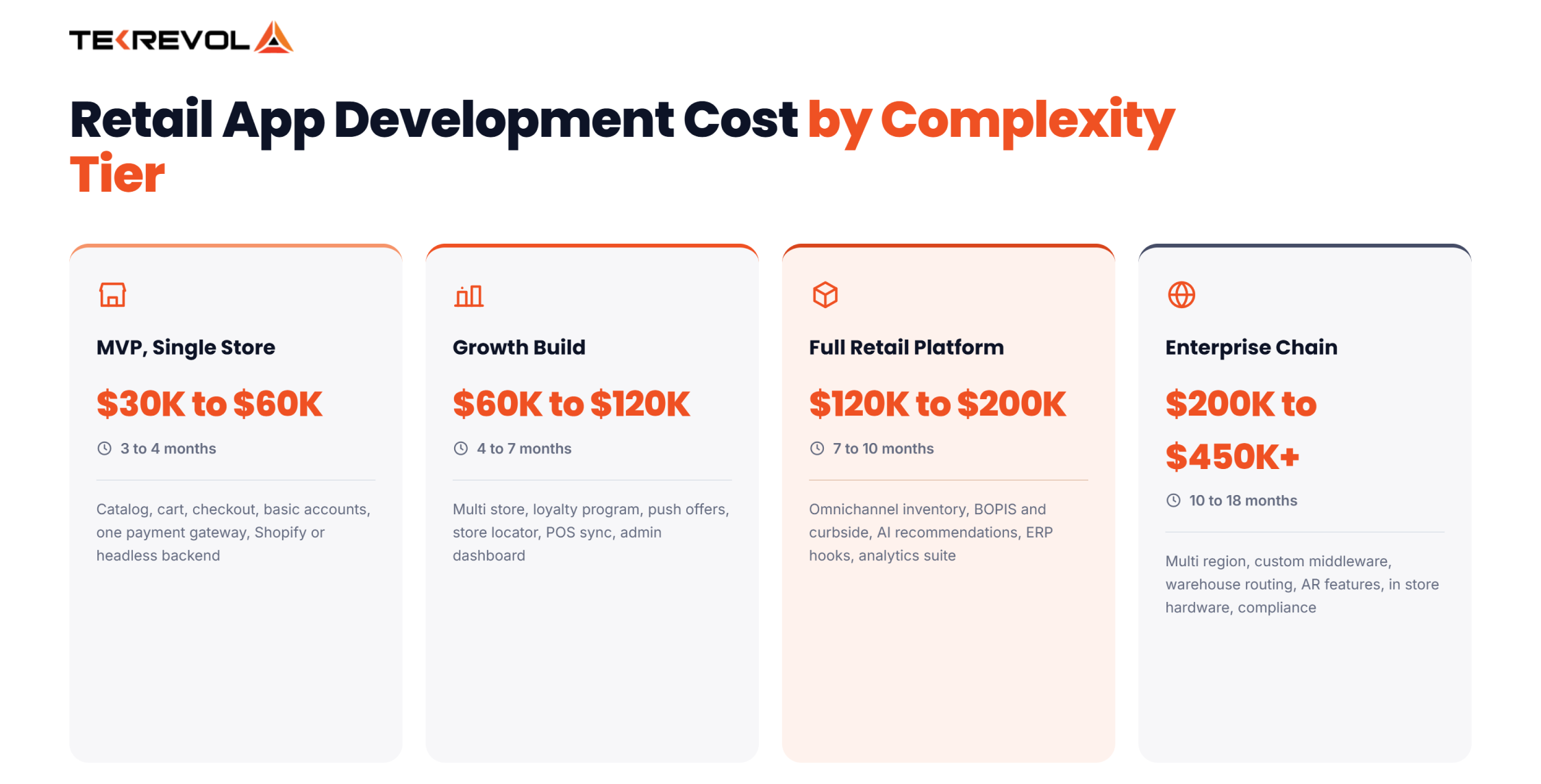
Here’s how we tier it when we scope a build:
| Tier | What it covers | Cost range | Typical timeline |
| MVP / single store | Catalog, cart, checkout, basic accounts, one payment gateway, Shopify or headless backend | $30,000 – $60,000 | 3 – 4 months |
| Growth build | Multi-store, loyalty program, push offers, store locator, POS sync, admin dashboard | $60,000 – $120,000 | 4 – 7 months |
| Full retail platform | Omnichannel inventory, BOPIS and curbside, AI recommendations, ERP hooks, analytics suite | $120,000 – $200,000 | 7 – 10 months |
| Enterprise / national chain | Multi-region, custom middleware, warehouse routing, AR features, in-store hardware, deep compliance | $200,000 – $450,000+ | 10 – 18 months |
Notice that the jump from tier two to tier three roughly doubles the cost while the feature list barely does. That’s integration work. Once your app has to reconcile stock across physical stores in near real time, you’re building a data problem, not an app.
Worth flagging: these are build costs, not the total. We’ll get to that difference in the ROI section, because it changes how most retailers should budget.
Not Sure Which Tier Fits Your Store?
Send us your features and POS setup. We'll give you a realistic cost range and flag any unnecessary spend.
Book Your Free Retail App Scoping Session →What Do the Retail App Market Numbers Say in 2026?
Retail app market numbers in 2026 point to a mobile-first shopping environment, growing AI influence, and stronger investment in digital experiences. The numbers also show why retailers are putting more focus on apps that improve convenience, personalization, and loyalty.
- US retail sales are forecast to reach $5.6 trillion in 2026, up 4.4% from 2025, according to the National Retail Federation.
- Mobile accounted for 54.2% of online sales during Prime Day 2026, generating $14.2 billion in spend, according to Adobe Analytics.
- AI-referred traffic to US retail sites increased 235% year over year from January through May 2026, and those visitors converted 40% better than non-AI channels such as paid search, email, and social.
- Worldwide IT spending is projected to reach $6.37 trillion in 2026, with software spending growing 15.5%, according to Gartner.
These numbers show why retail apps are becoming more than another sales channel. They sit at the intersection of mobile commerce, AI-driven discovery, and customer loyalty.
Sephora, for example, had nearly 46 million Beauty Insider members at the end of 2025, with 30% participating in its in-app Beauty Insider Challenges.
What Does Feature-Based Pricing Look Like for Retail Apps in 2026?
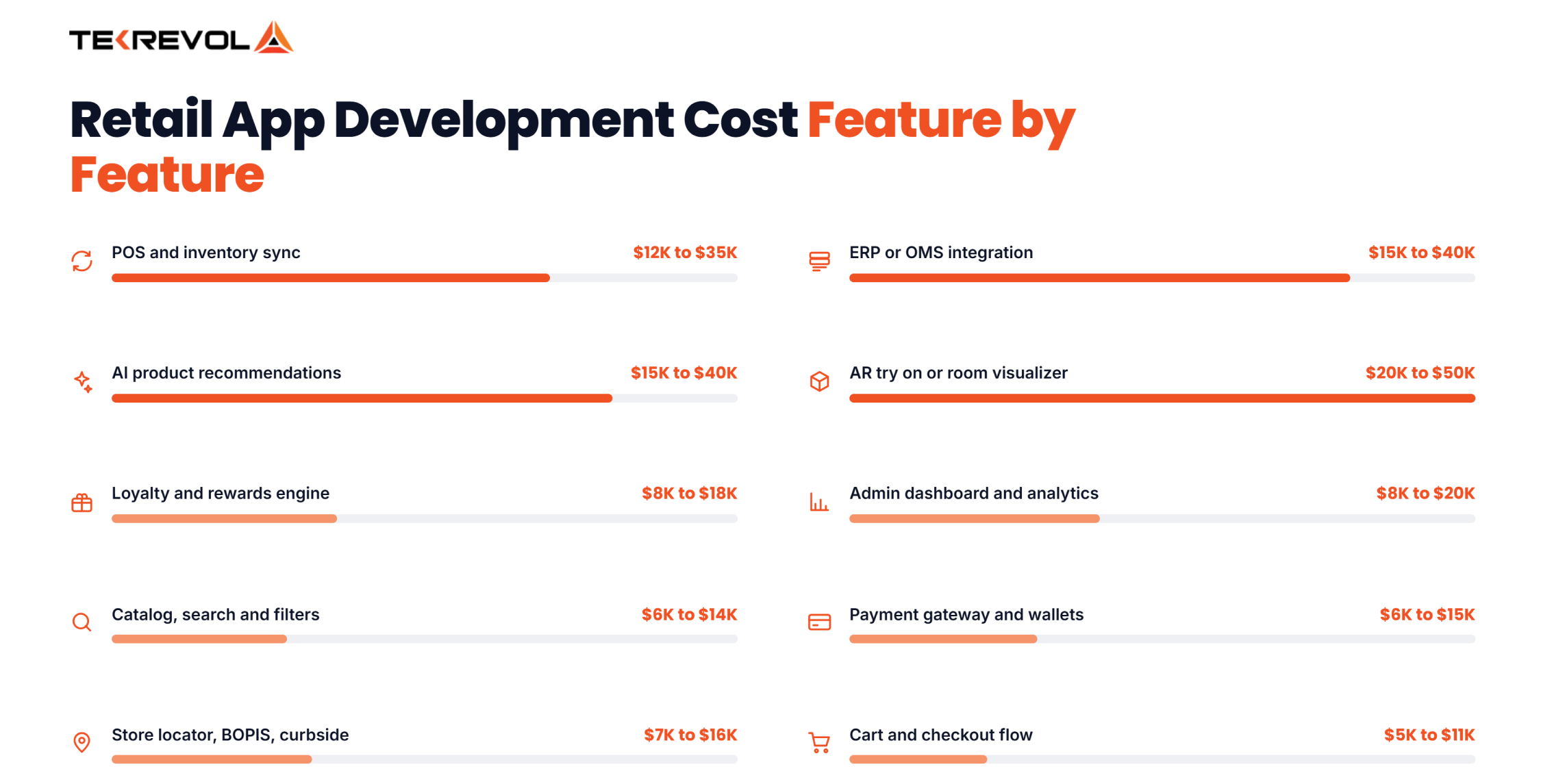
Feature-based pricing for retail apps ranges from $3,000 for user onboarding to $50,000 for AR try-on. Most retailers spend the bulk of their budget on three things: checkout, loyalty, and inventory sync. Everything else is comparatively cheap.
| Feature | Cost range (iOS + Android) | Notes |
| Onboarding, accounts, social login | $3,000 – $7,000 | Cheap unless you need SSO with an existing loyalty database |
| Product catalog, search, filters | $6,000 – $14,000 | Scales with SKU count and attribute complexity |
| Cart and checkout flow | $5,000 – $11,000 | Guest checkout adds a little; saved carts add more |
| Payment gateway and wallets | $6,000 – $15,000 | Apple Pay, Google Pay, BNPL each add integration time |
| Loyalty and rewards engine | $8,000 – $18,000 | Cheaper if you’re wrapping an existing program |
| Push and personalized offers | $4,000 – $10,000 | Segmentation logic is where the hours go |
| Store locator, BOPIS, curbside | $7,000 – $16,000 | Needs live per-store stock to be useful |
| POS and inventory sync | $12,000 – $35,000 | The biggest swing factor in most retail quotes |
| ERP or OMS integration | $15,000 – $40,000 | Legacy systems without an API sit at the top |
| AI product recommendations | $15,000 – $40,000 | Service-based is cheaper than training on your own data |
| AR try-on or room visualizer | $20,000 – $50,000 | Strong for furniture, eyewear, cosmetics |
| Admin dashboard and analytics | $8,000 – $20,000 | Skipping this is a false economy |
Two apps can both be called “mid-range” and differ by $60,000 depending on which four rows they pick. That’s why tier labels are nearly useless on their own, and why we price the feature list instead.
How Long Does Retail App Development Take in 2026?
Retail app development takes 3 to 4 months for an MVP and 10 to 18 months for an enterprise platform in 2026. Most growth-tier retail apps ship in 4 to 7 months. Integration testing, not design or coding, is what usually slips the date.
Here’s how a typical growth-tier build breaks down:
| Phase | Duration | What actually happens |
| Discovery and scoping | 2 – 4 weeks | Feature list, POS audit, data mapping, tech decisions |
| UX and UI design | 3 – 5 weeks | Wireframes, design system, prototype, usability review |
| Core development | 10 – 16 weeks | Front end, back end, API layer, admin panel |
| Integration and QA | 3 – 6 weeks | POS, payments, inventory, device testing, load testing |
| Launch and store review | 1 – 2 weeks | Store submissions, soft launch, monitoring, hotfixes |
The integration and QA window is the one people underestimate. If your POS vendor takes three weeks to provision sandbox credentials, your timeline moves three weeks. We now start integration discovery in week one for exactly this reason.
Budget another two to four weeks of buffer for app store review. Apple’s review is fast now, but a rejection on a payments detail can cost you a full sprint.
What ROI Should You Expect From a Retail Mobile App in 2026?
Retail mobile app ROI in 2026 typically shows up as higher conversion and repeat purchase rates rather than new customers. Well-executed apps commonly break even in 12 to 18 months. The catch is that the build is only about a third of your three-year spend.
| Cost line | Year 1 | Year 2 | Year 3 | 3-year total |
| Initial build | $85,000 | – | – | $85,000 |
| Maintenance and support (~18% of build/yr) | $7,600 | $15,300 | $15,300 | $38,200 |
| Cloud, hosting, third-party services | $6,000 | $7,200 | $8,400 | $21,600 |
| App store fees and payment tooling | $1,800 | $2,400 | $3,000 | $7,200 |
| Feature roadmap (2 – 3 releases/yr) | $12,000 | $22,000 | $22,000 | $56,000 |
| User acquisition and app marketing | $20,000 | $15,000 | $12,000 | $47,000 |
| Total | $132,400 | $61,900 | $60,700 | $255,100 |
The build is 33% of the three-year number. Most retailers budget for the 33% and get blindsided by the rest, particularly acquisition. An app nobody downloads returns nothing, and installs cost real money.
Retail Mobile App vs Mobile Website: Which Costs Less in 2026?
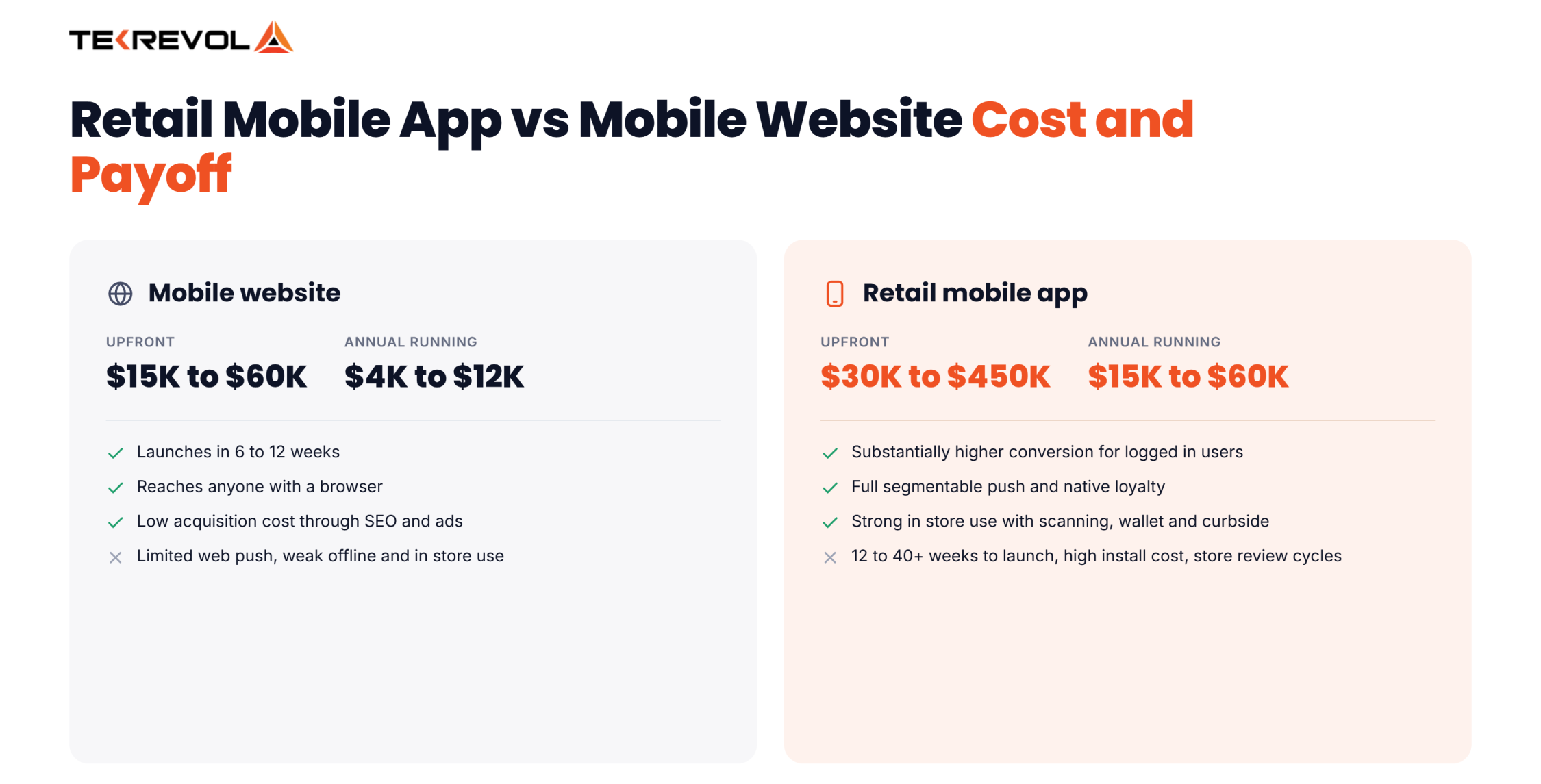
A retail mobile app costs more than a mobile website, usually two to four times more upfront. A responsive retail site runs $15,000 to $60,000. The app wins on repeat purchase, loyalty, and push, and loses on reach and acquisition cost.
| Factor | Mobile website | Retail mobile app |
| Upfront cost | $15,000 – $60,000 | $30,000 – $450,000 |
| Annual running cost | $4,000 – $12,000 | $15,000 – $60,000 |
| Time to launch | 6 – 12 weeks | 12 – 40+ weeks |
| Reach | Anyone with a browser | Only people who install |
| Acquisition cost per user | Low (SEO, ads) | High (install campaigns) |
| Conversion rate | Baseline | Substantially higher for logged-in users |
| Push notifications | Limited web push | Full, segmentable, high open rates |
| Offline and in-store use | Poor | Strong (scanning, wallet, curbside) |
| Loyalty integration | Workable | Native and much stickier |
| App store dependency | None | Review cycles and platform rules apply |
The honest recommendation: if you have fewer than roughly 20,000 monthly online shoppers or no loyalty program, fix the mobile site first. Apps pay off on repeat behavior. If most of your traffic buys once and leaves, you’re funding retention infrastructure for customers who don’t come back.
If you do have repeat buyers, the app usually justifies itself within two purchase cycles. Our ecommerce app development company runs this comparison before every engagement.
Worried Your POS Won't Play Nicely With a New App?
We'll audit your current stack for free and tell you exactly what it can and can't support, plus what the integration will realistically cost.
Request Your Free Integration AuditWhat Tech Stack Is Used to Develop a Retail App?
The tech stack used to develop a retail app in 2026 is usually React Native or Flutter on the front end, Node.js or Python on the back end, and PostgreSQL for data. Your stack choice affects cost by 20% to 30%, mostly through cross-platform savings.
| Layer | Common choices | Cost impact |
| Cross-platform front end | React Native, Flutter | Saves 25 – 40% vs. two native builds |
| Native front end | Swift (iOS), Kotlin (Android) | Higher cost, better for AR and heavy device features |
| Back end | Node.js, Python (Django), .NET | Comparable; team familiarity matters more than the language |
| Database | PostgreSQL, MongoDB, Redis for caching | Minor cost impact, major performance impact |
| Cloud | AWS, Azure, Google Cloud | $500 – $3,000/month depending on traffic |
| Commerce backend | Shopify, BigCommerce, headless (Commercetools, Medusa) | Platform backends cut build cost sharply |
| Payments | Stripe, Adyen, Braintree, Apple Pay, Google Pay | $6,000 – $15,000 to integrate, plus per-transaction fees |
| Search and analytics | Algolia or Elasticsearch; Firebase or Mixpanel | $200 – $2,000/month at retail catalog scale |
For most retailers, cross-platform app development service is the right call. You get one codebase, one team, and one release cycle. Go native only if AR try-on, complex camera work, or in-store hardware is central to the product.
What Do POS, Inventory, and ERP Integrations Really Cost?
POS, inventory, and ERP integrations really cost $12,000 to $75,000 combined, and they’re the most common source of retail app budget overruns. The deciding factor is whether your existing systems expose a modern API or need custom middleware built around them.
This section exists because almost every retail app quote we’ve reviewed underprices this layer. Here’s the actual pattern:
- Modern cloud POS with a documented API (Square, Shopify POS, Lightspeed) costs $12,000 to $20,000 to integrate. Webhooks exist, docs exist, sandbox access is quick. This is the good case.
- Established enterprise POS (Oracle Retail, NCR, Toshiba) costs $25,000 to $45,000. APIs exist but are older, rate limits are real, and you’ll spend weeks on data mapping rather than coding.
- Legacy or on-premises systems with no usable API cost $40,000 to $75,000 or more. You’re building middleware, a sync layer, and a reconciliation process. Sometimes you’re reading from a nightly file drop, which changes what “real-time stock” can even mean.
The practical move is to run an integration audit before you approve a budget, not after. We’ve seen retailers approve $90,000 for an app and then discover the POS work alone eats half of it. If you already run retail software solutions with a clean data layer, you’re in better shape than you think.
How Can You Reduce Retail App Development Costs Without Sacrificing Quality?
You can reduce retail app development costs by cutting scope rather than cutting rates. Ship a focused MVP, use cross-platform development, lean on platform backends, and defer AI and AR to phase two. Realistic savings run 30% to 45% without touching quality.
Here’s what actually works, in rough order of impact:
Ship an MVP that does one job well
Pick the behavior you most want to change, usually repeat purchase or in-store pickup, and build only for that. Every feature you defer to phase two is a feature you might discover you never needed.
Choose cross-platform over dual native
One React Native or Flutter codebase instead of separate Swift and Kotlin builds typically saves 25% to 40% on the front end, with no meaningful quality trade-off for standard retail features.
Use a commerce platform backend
Building custom catalog, cart, and order management from scratch can add $25,000 or more. Shopify, BigCommerce, or a headless commerce backend gives you that for a subscription.
Run a proper discovery phase
It feels like paying for nothing. It’s the cheapest insurance available. A $6,000 discovery that prevents one wrong integration decision pays for itself several times over.
Don’t chase the lowest hourly rate
A $20 per hour team that needs three attempts costs more than a $70 per hour team that needs one. Rework is invisible in the quote and brutal in the invoice. Look at delivered outcomes, not rate cards.
Defer AI and AR
Both are valuable, and both are expensive. Launch, gather usage data, then decide whether personalization is worth $30,000. Often the data tells you to spend it on search instead.
Why Choose TekRevol for Retail App Development?
Choose TekRevol for retail app development when you want a partner who understands the systems behind the storefront, not just the app itself. We’ve delivered 800+ projects across 11+ industries, with retail builds scoped around your existing POS, inventory, and operational setup rather than a one-size-fits-all template.
Three things set our approach apart:
- We audit your stack before quoting. We look at your POS, APIs, inventory flow, and existing systems before estimating the project, so integration costs don’t become surprises later.
- We’ll tell you when an app isn’t the right move. If your business would benefit more from improving its mobile site or loyalty program first, we’ll say so—even when that means delaying the app.
- We build the infrastructure that keeps retail running. Inventory sync, admin dashboards, order reconciliation, and system integrations may not be flashy, but they’re what make the customer-facing experience work reliably.
TekRevol has a 4.8/5 rating on Clutch across 83 verified reviews and offices in Houston, Chicago, San Francisco, and Austin. Our commerce portfolio includes projects such as Al Hussaini Trading, Stock n Ship, and Save & Win.
For businesses evaluating the local market, our Austin retail app development guide covers the costs, features, and considerations specific to building a retail app in Austin.
Ready to Put a Real Number on Your Retail App?
You'll leave with a scoped feature list, an integration risk assessment, and a cost range you can actually take to your board.
Schedule Your Free Consultation →


