



- A software development team structure defines who does what, who decides, and who answers for outcomes.
- Most effective delivery teams run five to nine people, because coordination cost rises faster than output.
- The developer hierarchy runs junior, mid, senior, staff, then principal, often labelled L1 through L4.
- A fully loaded US developer costs about $190,400 a year once benefits are counted in.
- One QA engineer per four developers and one designer per six is a workable starting ratio.
- Structure follows the work, so copying a big company’s org chart at startup scale fails reliably.
Six developers, no QA, one designer shared with marketing, and a product owner who’s also the CEO. That’s not a team structure; that’s a group of people who happen to share a Slack channel. It works right up until two of them build the same feature differently in the same sprint.
A software development team structure is the arrangement of roles, seniority, and reporting lines that turns a group of skilled people into a team that ships. It covers who builds, who tests, who decides scope, and who owns the outcome when something breaks at 2 am.
This guide covers the whole picture, drawn from how we staff projects as a software development company. You’ll get every core role, and what it actually does, the seniority ladder from junior to principal, the three team shapes, agile versus waterfall, ideal sizes, staffing ratios, real costs, and three worked examples at different company stages.
What Is a Software Development Team Structure?
A software development team structure is how roles, responsibilities, and decision-making are arranged across the people building your software. It defines who writes code, who tests it, who sets priorities, and who owns delivery when things go wrong.
Structure sounds like red tape. It isn’t. It answers four questions that otherwise get settled by whoever talks loudest.
- Who decides what gets built?
- Who decides how it gets built?
- Who checks that it works?
- Who is on the hook when it doesn’t?
Get those clear and a team of five beats a muddled team of twelve. Leave them vague, and you get double work, choices nobody recalls making, and a live bug where four people each assume someone else is on it.
Team shipping slower as it grows?
Book a free structure review, and we'll map your current roles against your roadmap and tell you which hire actually unblocks delivery next.
Consult Our Strategy TeamWhat Are the Key Roles and Responsibilities in a Software Development Team?
The key roles in a software development team are product owner, project manager, business analyst, software architect, frontend and backend developers, UX/UI designer, QA engineer, and DevOps engineer. Small teams combine several of these into one person.
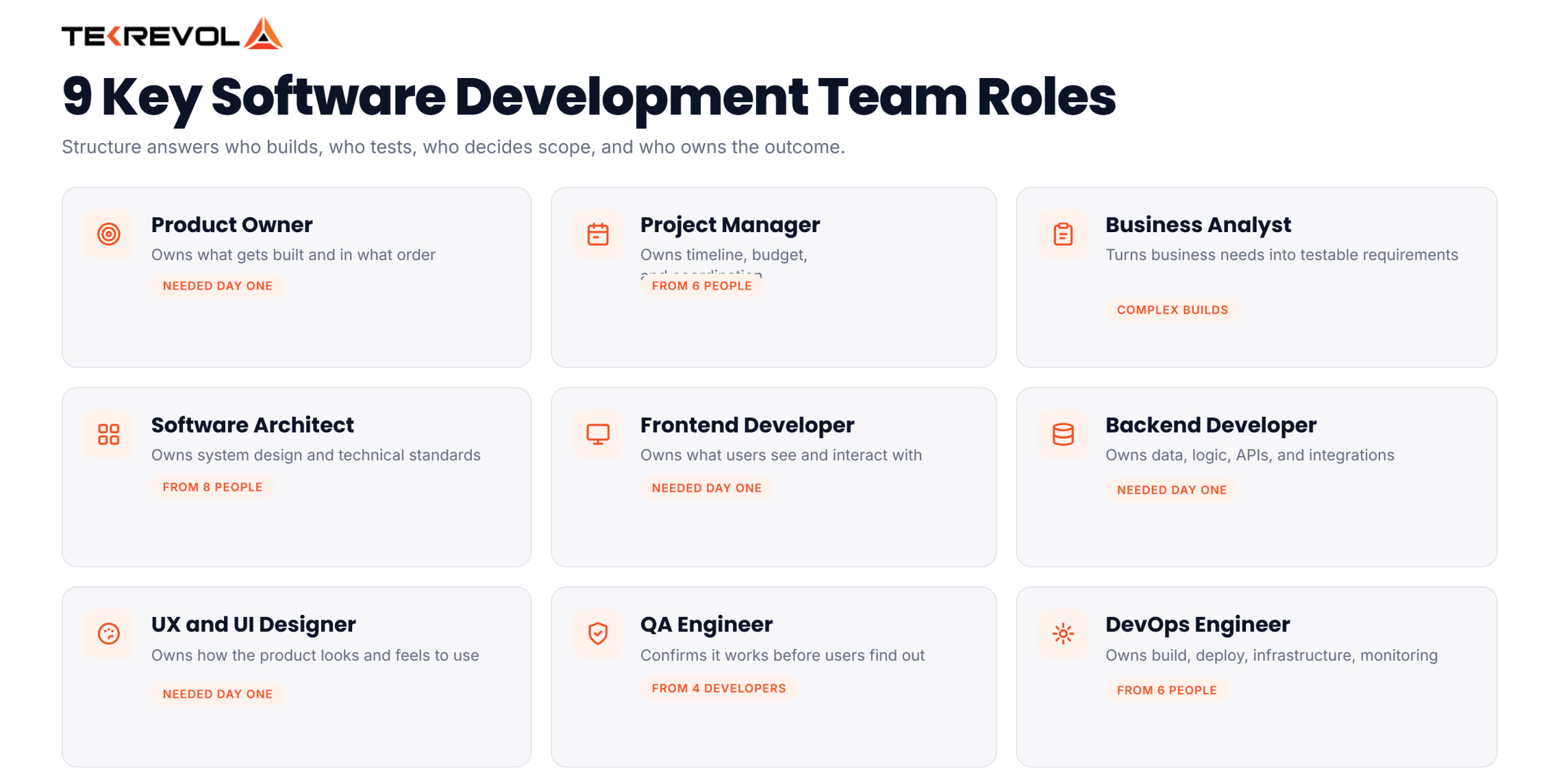
Here’s each role and what it’s genuinely accountable for.
| Role | Owns | Typically needed from |
| Product owner | What gets built and in what order | Day one |
| Project manager | Timeline, budget, and coordination | 6+ people |
| Business analyst | Turning business needs into testable requirements | Complex or regulated builds |
| Software architect | System design and technical standards | 8+ people, or complex systems |
| Frontend developer | What users see and interact with | Day one |
| Backend developer | Data, logic, APIs, and integrations | Day one |
| UX/UI designer | How the product looks and feels to use | Day one |
| QA engineer | Confirming it works before users find out | 4+ developers |
| DevOps engineer | Build, deploy, infrastructure, and monitoring | 6+ people, or frequent releases |
| Scrum master | Process health and removing blockers | Agile teams of 6+ |
The Roles People Confuse
Product owner vs project manager:
The product owner decides what to build and why. The project manager makes sure it lands on time and on budget. One faces the market, the other faces the plan. Small teams merge them, and it usually works until priorities and deadlines start conflicting.
Project manager vs scrum master:
A project manager owns the outcome. A scrum master owns the process and has no authority over scope. They’re genuinely different jobs, and giving one person both titles quietly turns the scrum master role into nothing.
Business analyst vs product owner:
The product owner sets direction. The business analyst translates that direction into requirements a developer can build and a tester can verify. Skip the BA and that translation still happens, just informally and inconsistently.
Architect vs senior developer:
A senior developer makes good decisions inside a system. An architect decides what the system is. Below about eight engineers, you rarely need a dedicated one.
What Is the Hierarchy of Software Developer Roles?
The hierarchy of software developer roles runs junior, mid-level, senior, staff, then principal engineer. Companies often label these L1 through L4 or higher. Each step up shifts the job from writing code toward making decisions that affect other people’s code.
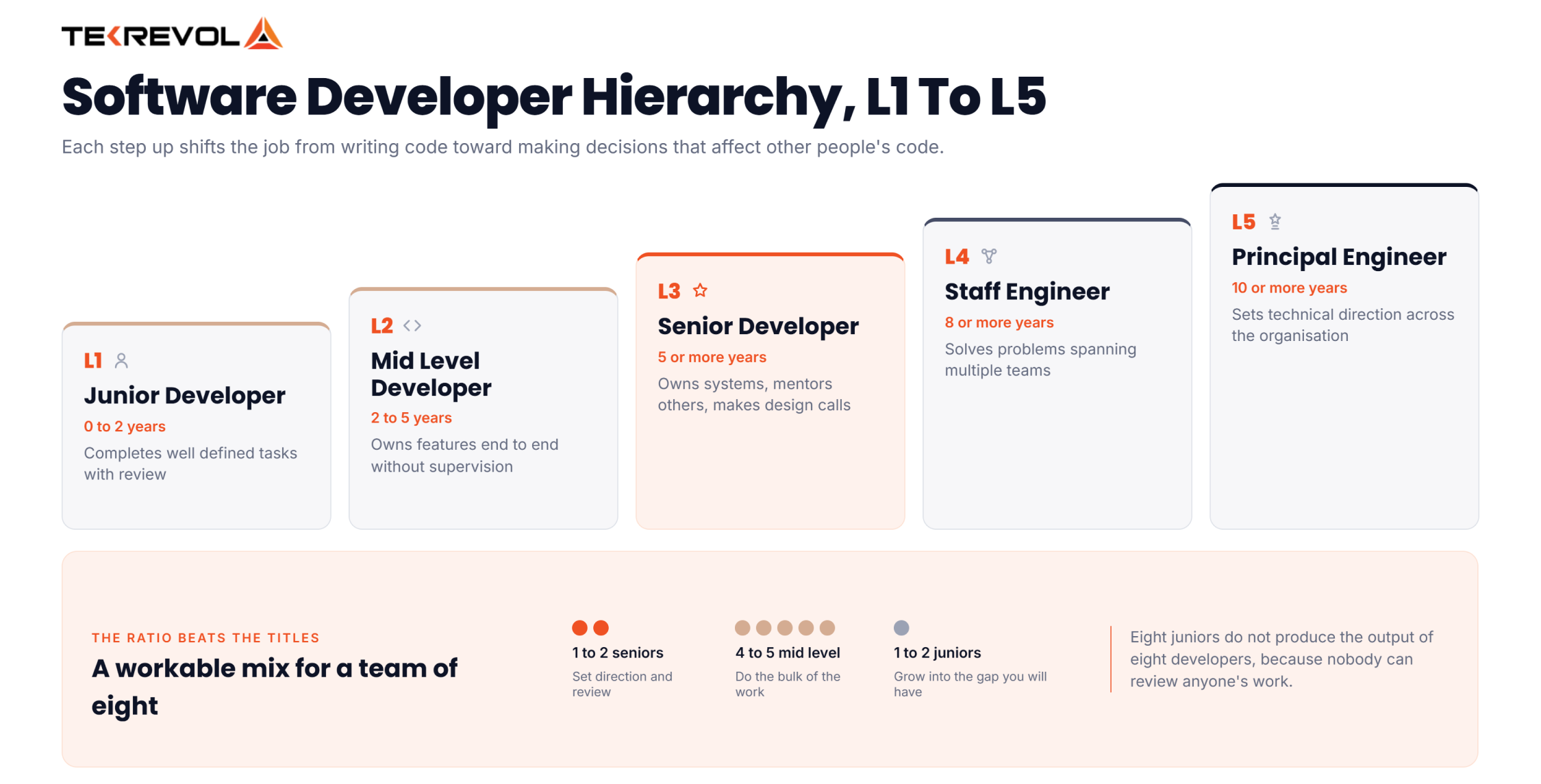
Almost every guide on team structure lists roles and skips this entirely, which is odd, because seniority mix matters more than headcount.
| Level | Common title | Typical experience | What actually changes |
| L1 | Junior developer | 0 to 2 years | Completes well-defined tasks with review |
| L2 | Mid-level developer | 2 to 5 years | Owns features end-to-end without supervision |
| L3 | Senior developer | 5+ years | Owns systems, mentors others, makes design calls |
| L4 | Staff engineer | 8+ years | Solves problems spanning multiple teams |
| L5 | Principal engineer | 10+ years | Sets technical direction across the organisation |
The Ratio Matters More than the Titles
Seniority mix is where teams get this wrong. Eight juniors don’t produce the output of eight developers, because nobody can review anyone’s work and every design call gets escalated.
A workable mix for a team consists of one or two senior developers, four to five mid-level, and one or two juniors. Senior developers guide and review. Mid-levels do the bulk of the work. Juniors grow into the gap you’ll have in eighteen months.
What Are the Types of Software Development Team Structures?
The three types of software development team structures are generalist, specialist, and hybrid. Generalist teams cover broad ground with full-stack people, specialist teams go deep in defined areas, and hybrid teams combine a generalist core with specialists brought in as needed.
| Structure | How it works | Best for | The trade-off |
| Generalist | Full-stack developers who can pick up most tasks | Startups, MVPs, small teams | Depth suffers on hard technical problems |
| Specialist | Deep experts in defined areas | Complex systems, regulated builds, scale | Handovers and dependencies slow things down |
| Hybrid | Generalist core, specialists added where needed | Growing teams, most mid-sized projects | Needs deliberate management or it drifts |
Hybrid is what most teams end up with, whether or not they chose it. A generalist core keeps things moving, and you pull in a security specialist, a data engineer, or a mobile developer when the work genuinely calls for it.
There’s a fourth model worth naming, because it’s shaped a lot of modern thinking. Team Topologies, the framework from Matthew Skelton and Manuel Pais, defines four team types: stream-aligned teams that own a product flow, platform teams that build internal tooling, enabling teams that spread capability, and complicated-subsystem teams for genuinely specialist components. It’s designed for organisations running several teams rather than one, so it’s over-engineered for a single team of eight.
How Does an Agile Software Development Team Structure Differ From Waterfall?
An agile software development team structure is small, cross-functional, and self-managing, with the team deciding how to deliver each sprint. A waterfall structure is larger and hierarchical, with roles working in sequence and decisions flowing down from a project manager. How agile and waterfall compare on planning, documentation, and change control explains why the org charts diverge.
| Agile team | Waterfall team | |
| Typical size | 5 to 9 people | Up to 15 people |
| Decision-making | Distributed within the team | Centralised with the project manager |
| Role boundaries | Deliberately blurred | Clearly separated |
| How work flows | Everyone works on the same increment | Handed from phase to phase |
| QA involvement | Throughout the sprint | After development completes |
| Changes scope | Expected between sprints | Formal change control |
| Best suited to | Evolving requirements, product work | Fixed scope, regulated, contract-driven |
The practical difference is when QA gets involved. In waterfall, testers receive finished work and find problems late. In agile, testers sit in the same team and find them the same week.
How Big Should a Software Development Team Be?
A software development team should be five to nine people for most projects. Below five, you lack coverage across roles, and above nine, communication overhead grows faster than output. Larger products split into multiple small teams rather than one big one.
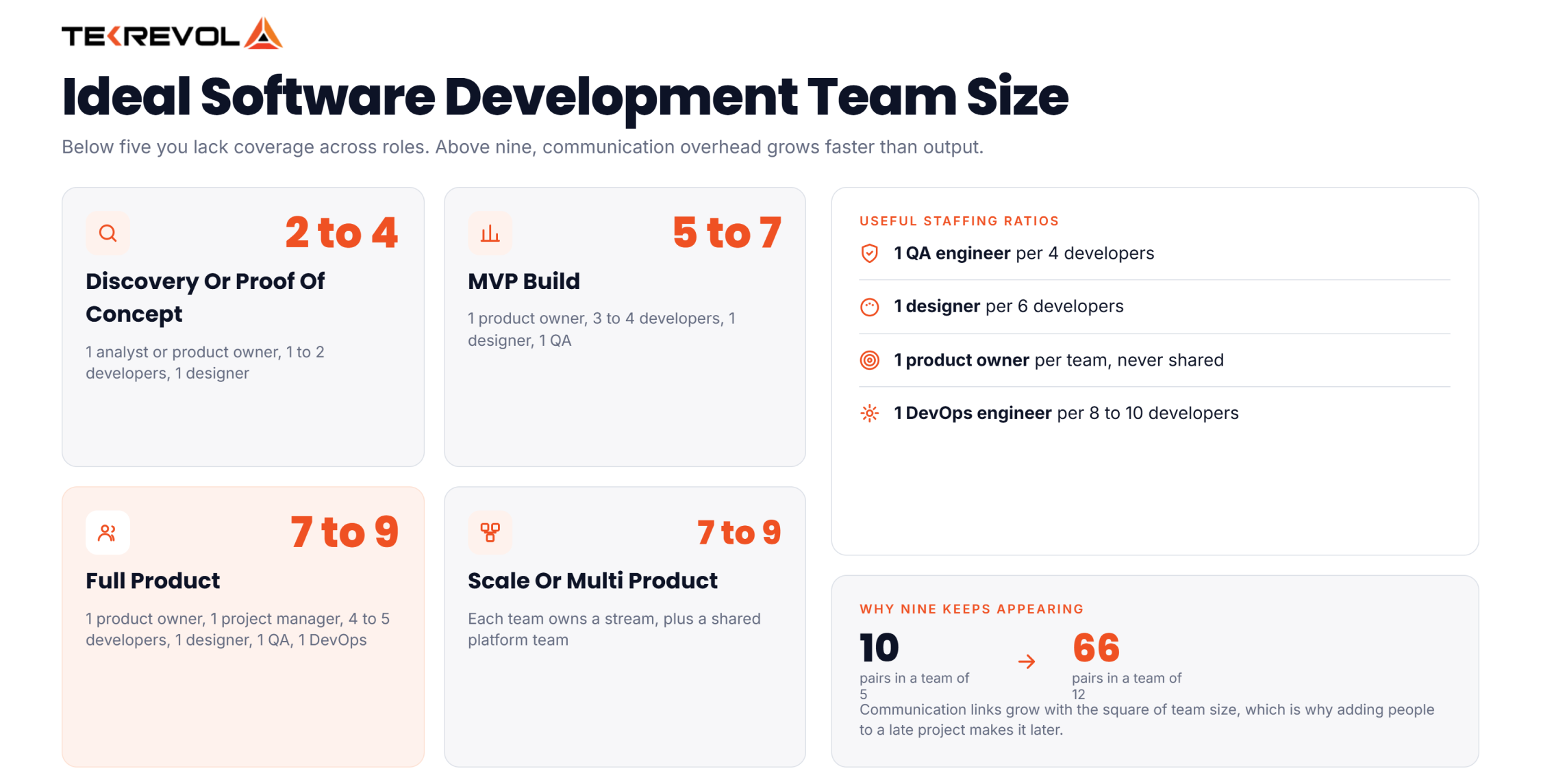
Team size by project stage:
| Stage | Team size | Typical composition |
| Discovery/proof of concept | 2 to 4 | 1 BA or PO, 1 to 2 developers, 1 designer |
| MVP build | 5 to 7 | 1 PO, 3 to 4 developers, 1 designer, 1 QA |
| Full product | 7 to 9 | 1 PO, 1 PM, 4 to 5 developers, 1 designer, 1 QA, 1 DevOps |
| Scale / multi-product | Multiple teams of 7 to 9 | Each team owns a stream, plus a shared platform team |
The reason nine keeps appearing is arithmetic. Communication links grow with the square of team size, so a team of five has ten possible pairs while a team of twelve has sixty-six. That’s why adding people to a late project famously makes it later.
Useful staffing ratios
These aren’t laws, but they’re a sane starting point:
- 1 QA engineer per 4 developers. Fewer, and testing becomes a bottleneck at release.
- 1 designer per 6 developers. Designers work ahead, so one can usually feed several.
- 1 product owner per team. Never share one across two teams if you can avoid it.
- 1 DevOps engineer per 8 to 10 developers. Below that, developers handle it part-time.
If you need a specific skill for a few months rather than permanently, IT staff augmentation services fill the seat in weeks instead of running a full hiring cycle.
Not sure which role to hire next?
Tell us your team makeup and roadmap. We'll show you where the bottleneck sits, and whether it's a hire, a process fix, or a short-term augmentation.
Consult Your Staffing NeedsWhat Does a Software Development Team Cost?
A software development team costs roughly $190,400 per US developer annually once benefits are included, based on federal data, and headcount is the single largest driver of custom software build costs.
The US Bureau of Labor Statistics Occupational Outlook Handbook puts the median software developer wage at $133,080 as of May 2024.
Salary isn’t the full cost, though. The BLS Employer Costs for Employee Compensation release for March 2026 found benefits account for 30.1% of total compensation for private industry workers, with wages making up the other 69.9%.
Apply that ratio, and a median developer costs about $190,400 fully loaded, or roughly $91.50 an hour.
| Team | Composition | Rough annual cost, US in-house |
| MVP team | 4 developers, 1 designer, 1 QA, 1 PO | ~$1.2M to $1.4M |
| Full product team | 5 developers, 1 designer, 1 QA, 1 DevOps, 1 PM | ~$1.6M to $1.8M |
| Two-stream setup | 2 teams of 8 plus shared platform | ~$3.5M+ |
Developer figures derive from BLS median wage and benefits ratio. Designers, QA, and product roles vary and are estimated within the ranges shown. Recruitment, equipment, and tooling sit on top.
Those numbers explain a lot of structural decisions. A startup runs generalists because it can’t afford nine specialists. An enterprise runs specialists because a single missed compliance requirement costs more than the salary difference. Neither is wrong for its situation.
What Do Real Software Development Team Structure Examples Look Like?
Real software development team structure examples vary sharply by stage. A startup runs four generalists with merged roles, a scaleup runs eight people with dedicated QA and DevOps, and an enterprise runs several stream-aligned teams sharing a platform team.
Example 1: Early-stage Startup Building an MVP
Four people: One technical co-founder acting as architect and backend developer, one full-stack developer, one frontend developer who also handles design, and the CEO as product owner.
No QA, no DevOps, no project manager. Testing is done by whoever didn’t write the feature, and deployment is automated once and left alone. This works because the codebase is small and everyone knows everything.
Example 2: Funded Scaleup With a Live Product
Eight people: One product owner, one project manager, two backend, two frontend, one QA engineer, one designer. DevOps is a shared contractor two days a week.
Roles are now distinct. Requirements get written down because verbal handover stopped working around month four. Releases are fortnightly rather than whenever something’s ready.
Example 3: Enterprise With Multiple Products
Three stream-aligned teams of eight, plus a five-person platform team. Each stream team owns a product area end to end. The platform team builds shared infrastructure, CI/CD, and internal tooling so the stream teams don’t each solve the same problems.
There’s a principal engineer across all of them setting technical direction, and a security specialist who reviews rather than builds.
How Do You Build a Software Development Team?
Build a software development team by defining the work first, then the roles it requires, then the seniority mix, and only then the individuals. Start with the smallest team that can ship something, and add roles when a specific bottleneck justifies each one.
- Step 1: Define the work, not the org chart. What are you shipping in the next six months? The roadmap determines the roles, not the other way around.
- Step 2: Fill core roles first. Product owner, developers, designer. Everything else is a response to a problem you don’t have yet.
- Step 3: Set the seniority mix deliberately. Use the ratio above. All-junior is slow, all-senior is expensive and often bored.
- Step 4: Add QA at four developers. This is the most commonly delayed hire and the most commonly regretted one.
- Step 5: Decide permanent versus temporary for each gap. A skill you need forever is a hire. A skill you need for one project is augmentation. Our guide on scaling a development team covers where that line sits.
- Step 6: Review the structure every quarter. Teams outgrow their shape quietly. The standup length is a surprisingly good diagnostic.
Why Choose TekRevol for Software Development?
As a custom software development company, TekRevol builds teams around your roadmap rather than selling you a fixed package. That means the structure changes as the work changes, which is the whole point of everything above.
How we handle team structure on client work.
| What we do | Why it matters |
| Right-size at the start | We propose the smallest team that can ship, not the biggest one you’ll approve |
| Deliberate seniority mix | Seniors to set direction, mid-levels to deliver, so you’re not paying principal rates for routine work |
| QA from the start | Testing sits inside the team, not after it, which is where late defects come from |
| Scale up and back down | Add people for a heavy phase, release them after it, without severance exposure |
| You interview everyone | We shortlist, you decide. Nobody joins your team sight unseen |
Two things worth knowing.
We’ll tell you if you don’t need a full team. Plenty of projects need two developers and a designer, not the nine-person structure a proposal document would justify. That conversation happens before you sign.
Augmentation and full delivery are both on the table. If you have a team and a process and just need hands, our IT staff augmentation model plugs people into your structure. If you need the whole thing built and run, we do that instead.
We’ve assembled teams across 800+ projects in 11 industries, from four-person MVP squads to multi-team enterprise programmes.
Need a team assembled around your roadmap?
Send us your scope and current setup. We'll come back with a proposed team structure and the seniority mix behind it at no charge.
Let's Connect!


