



- AI software is split into four layers: end-user apps, models, developer platforms, and features within other tools.
- ChatGPT, Claude, and Google Gemini lead the market as the most used generative assistants globally.
- ChatGPT is the app, and GPT is the model, which is why the two names get confused all the time.
- Nearly all major AI software examples have a free tier, limited by usage quotas rather than missing features.
- Building custom AI software eliminates third-party subscriptions while keeping your enterprise data private and secure.
OpenAI is retiring DALL·E. The DALL·E GPT will leave ChatGPT on 30 August 2026, and the API versions went in May. Image generation now runs on ChatGPT Images 2.0, with gpt-image-2 as the API model.
That’s how fast the AI software category moves. Mistral renamed Le Chat to Vibe. Azure AI Studio is now Microsoft Foundry. Amazon’s CodeWhisperer became Amazon Q Developer, and Grammarly’s parent company became Superhuman while the product kept its name.
The renaming isn’t the real problem, though. It’s that “AI software” covers four different things. A chat app you buy per seat, a model you call by the token, a platform you build on, and a feature inside software you already own carry completely different price structures.
This guide explains what AI software is, 25 AI software examples by category, the four types of AI, how to choose in each category, the free tiers, and what you can build on.
What Is AI Software?
AI software is any program trained on machine learning algorithms, deep neural networks, or natural language processing rather than the hand-written rules of conventional software development. That covers chat assistants, image generators, coding tools, and the recommendation engine inside apps you already use. Most of it wraps a model you never see.
Traditional software follows fixed, hard-coded rules. Artificial intelligence, however, identifies patterns within large datasets to improve its execution over time.
For an e-commerce brand, basic software processes checkout orders. An AI system analyzes visitor buying trends to forecast seasonal inventory needs. It recommends relevant products to individual shoppers and automates round-the-clock customer support.
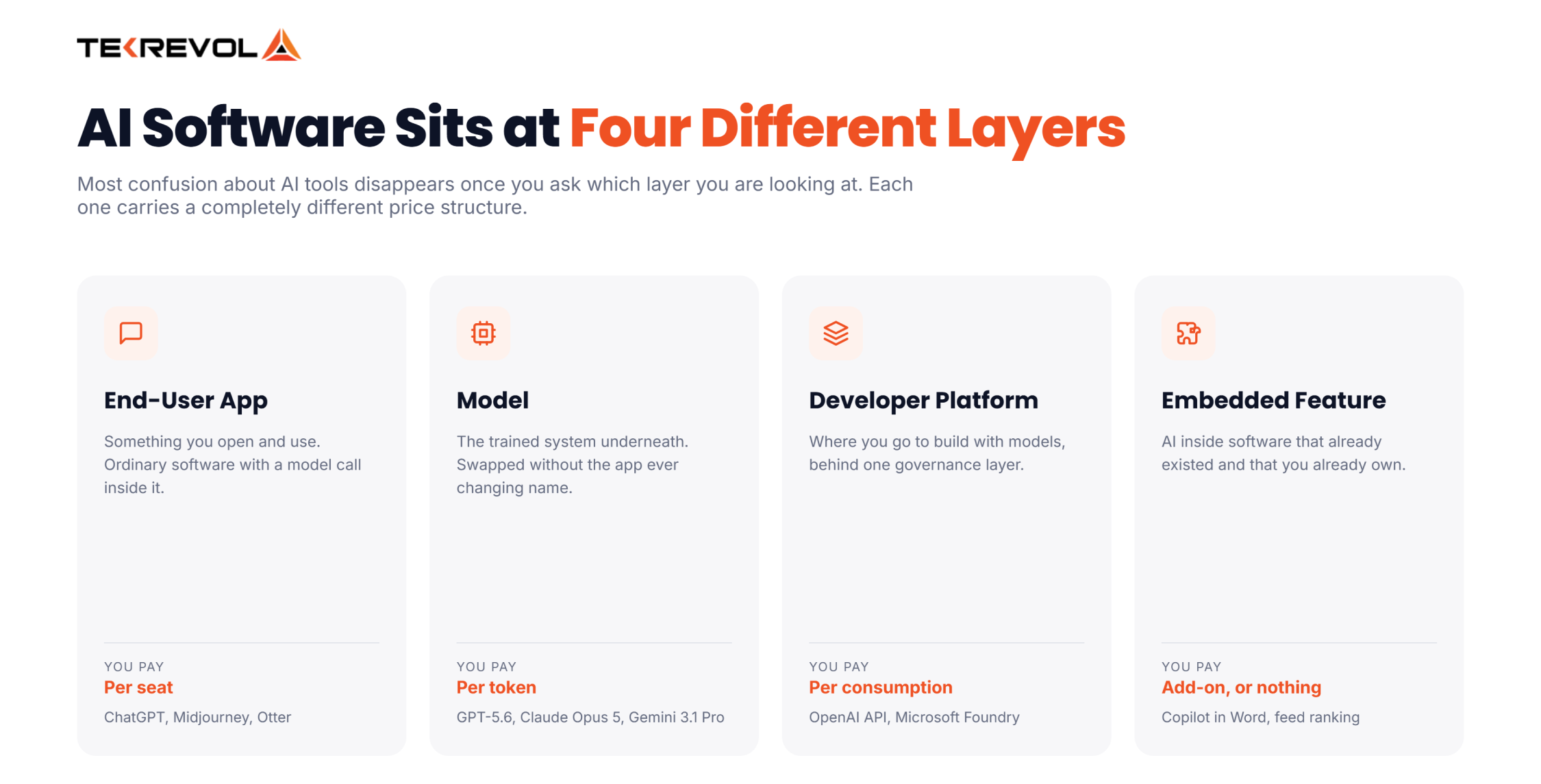
The useful thing to understand is that the AI software examples sit across four different layers.
- An end-user app is something you open and use, like ChatGPT, Midjourney, or Otter. You pay per seat, the same way you’d pay for any SaaS product. Building one of these is ordinary software development with a model call inside it.
- A model is the trained system underneath, such as GPT-5.6, Claude Opus 5, or Gemini 3.1 Pro. You pay per token, usually through an API, and models get swapped without the app changing name. Choosing and tuning that layer is what AI development actually involves.
- A developer platform is where you go to build with models, including the OpenAI API and Microsoft Foundry. You pay for consumption rather than seats.
- An embedded feature is AI inside software that already existed, like Copilot in Word or the ranking model in your social feed. You usually pay for it as an add-on, or not at all.
Most confusion about AI software examples dissolves the moment you ask which of those four layers you’re actually looking at.
Need Custom AI Built for Your Infrastructure?
TekRevol builds scalable AI software solutions engineered to perform seamlessly across any enterprise ecosystem.
Talk to AI Software Experts TodayCore Categories of AI Software
Core categories of AI software include generative AI, natural language processing tools, computer vision platforms, predictive analytics engines, machine learning frameworks, and autonomous robotic process automation systems. Each is engineered to address distinct business and operational functions.
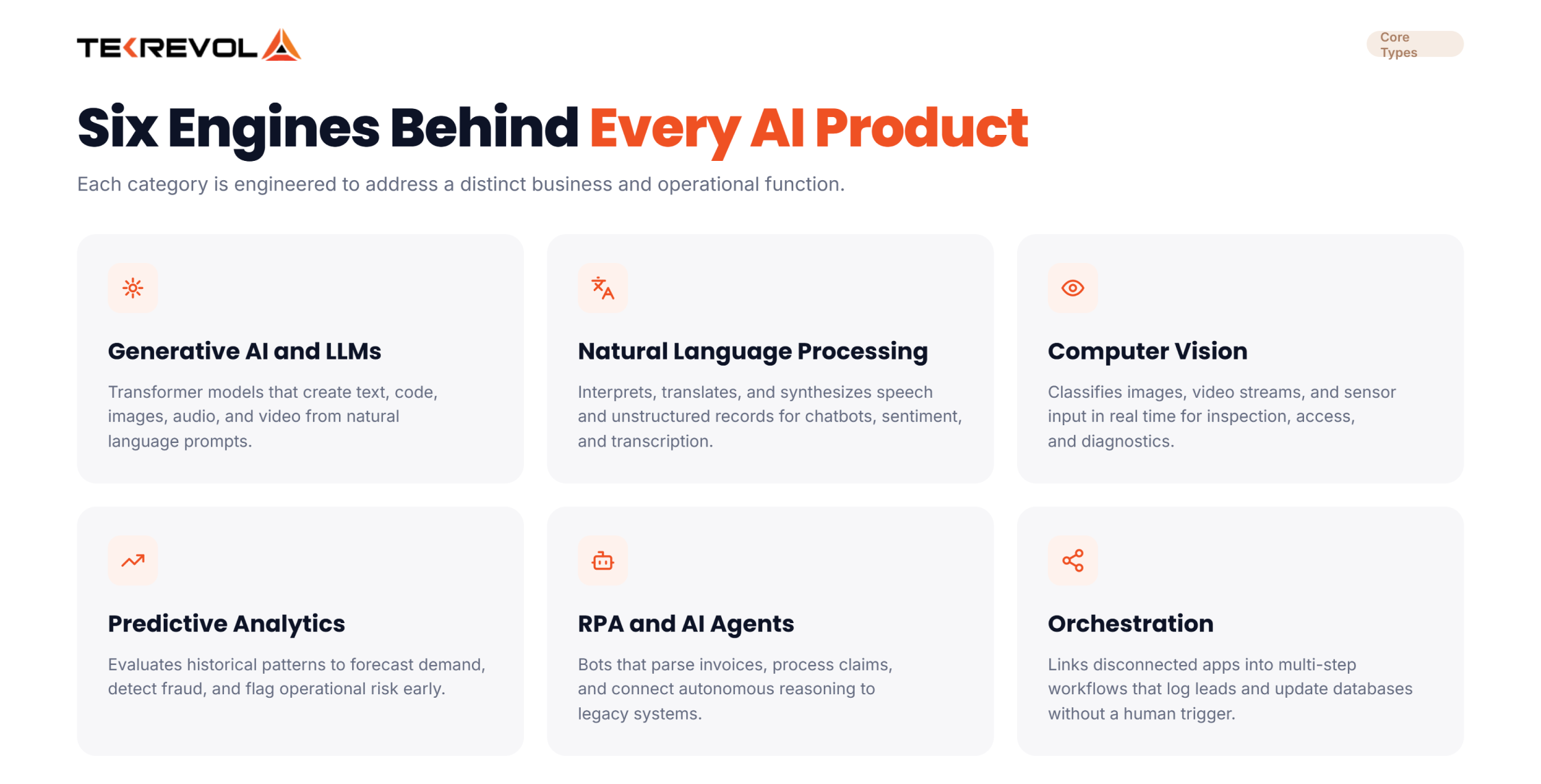
While AI tools evolve rapidly, most AI software examples fall under six main operational categories:
Generative AI & Large Language Models (LLMs)
Generative AI tools create original text, code syntax, images, audio clips, and video sequences directly from natural language prompts. These systems rely on transformer-based neural network architectures trained on massive datasets. They accelerate marketing copy creation, software engineering sprints, and visual design workflows. Exploring dedicated generative AI development helps deploy proprietary text and media models safely.
Natural Language Processing (NLP) Tools
Natural language processing tools enable machines to analyze, interpret, translate, and synthesize spoken human speech and unstructured text records. Businesses deploy NLP to power automated customer service chatbots, analyze customer feedback sentiment, and transcribe multi-party meetings. Investing in specialized natural language processing services gives companies the ability to parse complex legal or financial records automatically.
Computer Vision Platforms
Computer vision software processes, classifies, and extracts insights from digital images, video streams, and sensor inputs. These tools analyze visual inputs in real time to power quality inspection on manufacturing assembly lines, identify facial features for security access, and read medical diagnostic scans. They allow automated hardware to perceive physical environments accurately.
Predictive Analytics & Machine Learning Engines
Predictive analytics engines evaluate historical data patterns to forecast future outcomes, consumer trends, and operational risks. Financial institutions use these algorithms for fraud detection and algorithmic trading, while retail brands rely on them for demand forecasting. They help decision-makers mitigate financial losses before operational bottlenecks occur.
Robotic Process Automation (RPA) & AI Agents
Robotic process automation combines rule-based software bots with machine learning models to handle high-volume administrative data tasks. These systems parse unstructured PDF invoices, execute claims processing, and automate employee onboarding sequences. Building custom workflows through AI agent development allows enterprise teams to connect autonomous reasoning agents directly to legacy software systems.
AI Orchestration & Productivity Automation
AI orchestration tools link disconnected software applications together into unified, automated workflows. These platforms trigger intelligent multi-step actions across your entire application ecosystem without requiring manual user intervention. Businesses use them to log leads, summarize customer communication, and push database updates automatically.
List of 25 Best AI Software Examples
The most widely used AI software examples are ChatGPT, Google Gemini, Claude, and Microsoft Copilot among assistants; GitHub Copilot and Cursor for coding; Adobe Firefly and Runway for media; and OpenAI’s API and Microsoft Foundry as developer platforms. Most of them now sit in the modern development tool stacks.
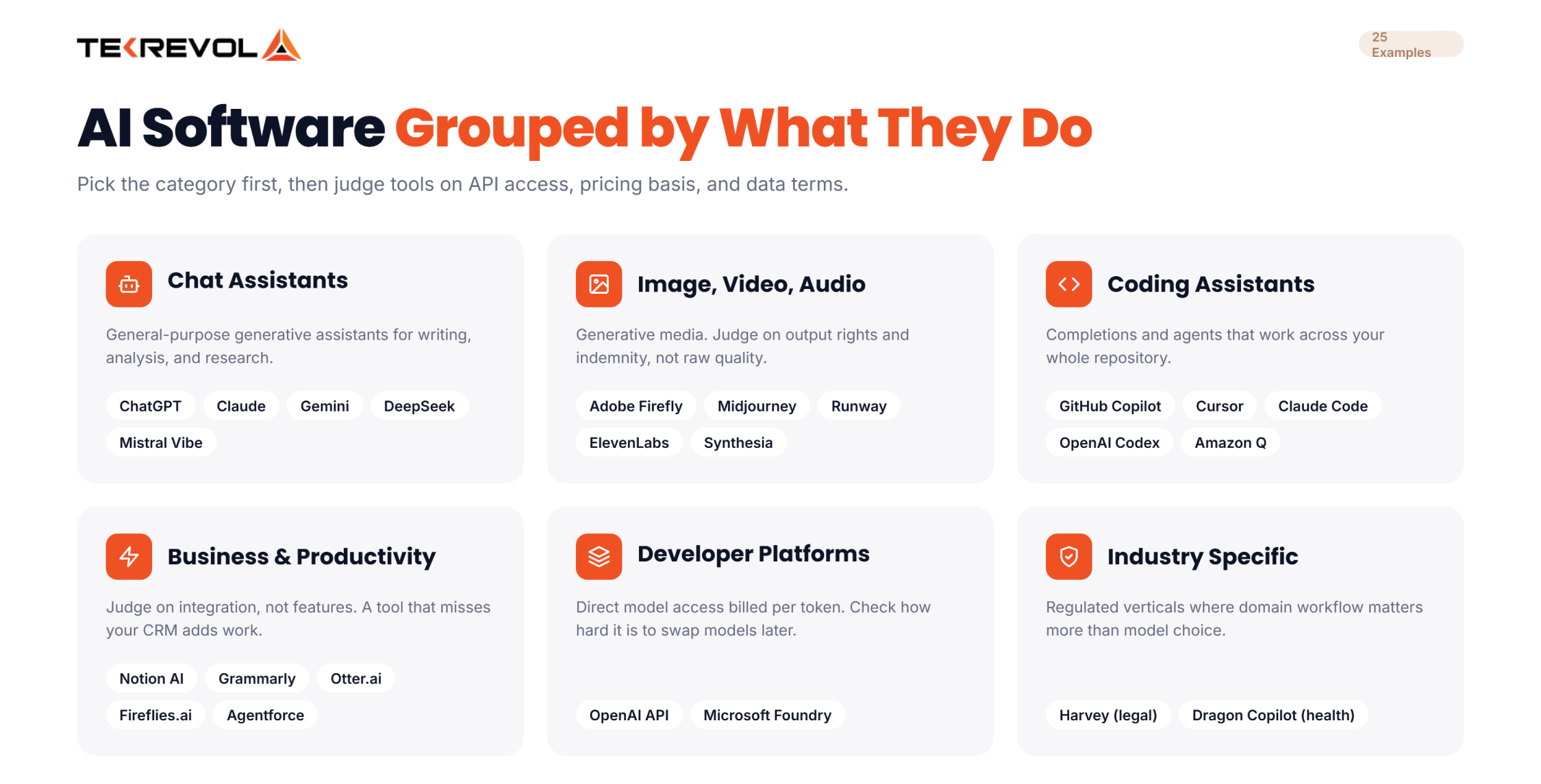
Here are 25 AI software examples, grouped by what they do. Each entry gives the current name, the entry price, and whether there’s a public API you can build on. Detailed notes on every entry follow underneath the table.
| AI software | Category | What it does | Entry price | Public API |
| ChatGPT | Chat assistant | General-purpose assistant on the GPT-5.6 family | Free, then $8 | Yes |
| Claude | Chat assistant | Long documents, analysis, and code | Free, then $17 annual | Yes |
| Google Gemini | Chat assistant | Assistant tied into Google Workspace and Search | Free, then $4.99 | Yes |
| Microsoft Copilot | Embedded assistant | AI inside Word, Excel, Teams, and Outlook | $18 per user, business | Via Foundry |
| DeepSeek | Chat assistant | Open-weight models at very low cost | Free web chat | Yes |
| Mistral Vibe | Chat assistant | European-hosted assistant, formerly Le Chat | Free, then $14.99 | Yes |
| Adobe Firefly | Image and video | Commercially safe generation inside Creative Cloud | Free daily, then $9.99 | Limited |
| Midjourney | Image | Highest-quality image generation, now on v8.2 | Paid only | No |
| Runway | Video | Video generation and editing on Gen-4.5 | Free credits, then $12 | Yes |
| ElevenLabs | Audio | Voice synthesis, speech-to-text, music | Free tier, then $6 | Yes |
| Synthesia | Video | Presenter-led video for training and comms | Free tier, then $18 | Creator tier up |
| GitHub Copilot | Coding | Completions and agents inside your editor | Free, then $10 | Yes |
| Cursor | Coding | AI-first code editor built on VS Code | Free, then $20 | No |
| Claude Code | Coding | Terminal-based coding agent | In paid Claude plans | Via Claude API |
| OpenAI Codex | Coding | Agentic coding across CLI, IDE, and CI | In ChatGPT plans | Yes |
| Amazon Q Developer | Coding | AWS-native assistant, formerly CodeWhisperer | Free, then $19 | Yes |
| Notion AI | Productivity | Writing, search, and agents inside Notion | Bundled from $20 | Yes |
| Grammarly | Writing | Grammar, clarity, and tone correction | Free, then $12 | Limited |
| Otter.ai | Meetings | Live transcription and meeting summaries | Free, then $8.49 annual | Yes |
| Fireflies.ai | Meetings | Transcription with unlimited free capture | Free, then $10 annual | Yes |
| Salesforce Agentforce | Enterprise agents | Customer and employee agents inside Salesforce | Consumption-based | Yes |
| OpenAI API | Developer platform | Direct model access, billed per token | Pay as you go | Yes |
| Microsoft Foundry | Developer platform | 11,000+ models behind one governance layer | Pay per service | Yes |
| Harvey | Legal | Contract intelligence and legal knowledge search | Not published | Not published |
| Microsoft Dragon Copilot | Healthcare | Ambient clinical documentation | Not published | Not published |
Chat Assistants and General-Purpose AI
- ChatGPT (OpenAI): The most-used AI app in the world, running the GPT-5.6 model family across web, mobile, and desktop. Its public API is the most common way teams add language features to their own products.
- Claude (Anthropic): Built for long documents, analysis, and code, with Fable 5 as the first release of Anthropic’s Mythos class. Claude Code is included rather than sold separately, which makes it unusually good value for engineering teams.
- Google Gemini: Wired into Search, Workspace, and Android, which makes it the default assistant for anyone already inside Google’s ecosystem. Note the plan names changed in 2026, so “Gemini Advanced” and “Google One AI Premium” no longer exist.
- Microsoft Copilot: Less a standalone app than a layer inside Word, Excel, Teams, and Outlook, which is exactly why enterprises adopt it first. It reaches your documents and email, so the value depends on how much of your work already lives in Microsoft 365.
- DeepSeek: Open weights and aggressive pricing make it the cheapest credible way to run a capable model at volume. Teams use it for high-throughput tasks where per-token cost dominates the decision.
- Mistral Vibe: Formerly Le Chat, renamed in 2026, and hosted in Europe, which settles a lot of data-residency conversations before they start. It ships work and code modes rather than positioning itself purely as a chat window.
Image, Video, and Audio Generation AI Software
- Adobe Firefly: Adobe’s pitch is commercial safety rather than raw quality, which matters if you publish at scale and need indemnity. It now routes to third-party models as well as Adobe’s own, so the output is less uniform than it was.
- Midjourney: Still the reference point for image quality among designers and art directors, currently on version 8.2. It has no public API, so it stays a creative tool rather than something you embed.
- Runway: Video generation and editing on the Gen-4.5 model, aimed at people producing finished footage rather than clips. It has a public API, which is rare in this category.
- ElevenLabs: Voice synthesis is good enough that most listeners cannot pick it out, plus speech-to-text, sound effects, and music. It is one of the most widely embedded voice engines in other companies’ products.
- Synthesia: Presenter-led AI video aimed at training, onboarding, and internal comms rather than marketing. API access opens up on the Creator tier and above, which makes bulk generation practical.
Coding Assistants
- GitHub Copilot: Routes to models from Anthropic, OpenAI, and Google rather than one house model, so you aren’t betting on a single lab. It works both as inline completion and as an agent that changes multiple files.
- Cursor: An AI-first editor from Anysphere, built on VS Code, favoured by developers who want the agent in the editor rather than a sidebar. Its strength is understanding your whole repository rather than the file in front of you.
- Claude Code: Anthropic’s terminal agent, included in every paid Claude plan and sharing that plan’s usage limits. It runs where developers already work, which is why it spread faster than its marketing did.
- OpenAI Codex: An agentic coding product with CLI, IDE, and API-key access for CI pipelines, unrelated to the 2021 model that shared the name. It is included in ChatGPT plans rather than sold on its own.
- Amazon Q Developer: Formerly CodeWhisperer, and built for teams already inside AWS. The feature that wins evaluations is its Java version upgrade, because doing that work by hand is slow and costly.
Business and Productivity AI Software
- Notion AI: No longer a separate add-on, since it’s bundled into Notion plans along with Notion Agent. If your documentation already lives in Notion, the AI reaches it without any integration work.
- Grammarly: The default writing assistant, enhancing written communication by suggesting real-time tone adjustments, grammar corrections, and sentence rewrites across desktop apps.
- Otter.ai: Live meeting transcription and summaries, and the most recognised name in the category. The free tier is capped by minutes rather than features, which suits occasional use.
- Fireflies.ai: The main Otter alternative, with unlimited transcription even on the free tier. It also ships a documented public API, which makes it the easier of the two to build workflows around.
- Salesforce Agentforce: Enterprise AI agents priced by consumption rather than seats, which changes the budgeting exercise completely.
We went wider on this category in our roundup of AI productivity tools.
Developer Platforms
- OpenAI API: Direct model access billed per token, with a context window just over a million tokens. This is where you go when building a product rather than using an assistant.
- Microsoft Foundry: Formerly Azure AI Studio, then Azure AI Foundry, renamed again at Ignite in November 2025. It hosts more than 11,000 models from OpenAI, Anthropic, Meta, and Google behind one governance layer, which is the point for regulated buyers.
Industry-specific AI Software Examples
- Harvey: Legal and professional services AI, with modules for contract intelligence, document vaults, and knowledge search. Named customers include Vinson & Elkins and Reed Smith.
- Microsoft Dragon Copilot: A clinical assistant that listens to the visit, pulls up the notes a doctor needs, and drafts the letters and codes afterwards. Microsoft publishes a migration path from Dragon Medical One.
Trying to Work Out Which Software You'd Actually Build On?
Send us the problem you're solving, and we'll tell you which of the four layers it belongs at and what the API route would cost.
Schedule Your Free ConsultationHow Do You Select the Best AI Software in Each Category?
Selecting the best AI software requires evaluating data privacy compliance, API integration flexibility, custom model training capabilities, long-term per-user licensing costs on the same basis as the SaaS tools you already pay for, and how cleanly the software embeds into your team’s existing operational workflows.
To select the best software, pick the category first, then judge the AI software examples on four things:
- whether there’s a public API
- what the price actually scales with
- how the vendor treats your data, and
- whether the product will still exist in two years
Selection criteria differ by category far more than a flat ranking of AI software examples suggests. Here’s what actually matters in each one.
Chat Assistants
Judge on context window, data retention terms, and how the vendor handles your inputs. Free tiers almost always carry weaker data terms than paid ones, which matters the moment somebody pastes a contract in. Also check whether the assistant can search the web and read your files, because that’s where the real productivity gain sits.
Media Generation
Judge on output rights and licensing, not image quality. The models are converging on quality; they are not converging on indemnity. Adobe Firefly’s pitch is commercial safety, and that’s a genuine differentiator if you’re publishing at scale. Check what the terms say about training on your uploads too.
Coding Assistants
Judge which models the tool routes to, and how it handles your repository. GitHub Copilot’s advantage is that it runs Anthropic, OpenAI, and Google models rather than one house model, so you aren’t betting on a single lab. Then check whether it works agentically across files or only completes lines.
Business and Productivity Tools
Judge on integration rather than features. A transcription tool that doesn’t reach your calendar and CRM creates work instead of removing it- the same test that decides any enterprise software rollout. This is the category where the tool usually loses to the workflow, which is why integrating AI into systems you already run often beats buying another subscription.
Developer Platforms
Judge on cost basis and portability. Per-token pricing behaves nothing like per-seat pricing: a feature nobody uses costs nothing, and one that goes viral can cost a great deal. Check how hard it is to swap the underlying model later, because you will.
What Are the Best Free AI Software?
Almost every major AI tool has a free tier, and the limits are usually quotas rather than missing features. ChatGPT, Claude, Gemini, DeepSeek, GitHub Copilot, ElevenLabs, Runway, Synthesia, Fireflies, Otter, and Adobe Firefly all publish one.
Free tiers work differently here than in other software. You rarely lose features; you run out of usage. Here’s what the AI software examples above actually publish as limits which changes the cost of a custom build considerably
| Tool | What the free tier gives you |
| ChatGPT | Free plan with usage limits; runs a current GPT-5 series model |
| Claude | Free plan with daily message limits |
| Google Gemini | Free tier with Gemini 3.6 Flash, image generation, and Deep Research |
| DeepSeek | Free web chat on the V4 family |
| Mistral Vibe | Free web and mobile with limited messages and coding sessions |
| GitHub Copilot | 2,000 code completions a month, no card required |
| Amazon Q Developer | 50 agentic requests a month |
| Cursor | Hobby tier, free, with limited agent requests |
| ElevenLabs | 10,000 credits a month plus three Studio projects |
| Synthesia | 1,200 credits a month, roughly ten minutes of video |
| Runway | 125 one-time credits |
| Adobe Firefly | Daily generations across image, video, and audio, no plan needed |
| Otter.ai | 300 transcription minutes a month |
| Fireflies.ai | Unlimited transcription, 400 minutes of team storage |
| Notion | Free plan with a trial of Notion AI |
Two things are worth knowing before you build a workflow on a free tier.
- Quotas get revised, frequently downward, and they are the first thing vendors adjust when inference costs bite.
- Free tiers also carry different data-retention terms than paid ones, which matters enormously if you’re putting anything confidential into them.
Which AI Software Examples Are Out of Date?
Several widely listed AI software examples have been renamed or retired: DALL·E is being retired through 2026, Mistral’s Le Chat is now Vibe, Azure AI Studio is now Microsoft Foundry, CodeWhisperer is Amazon Q Developer, and Gemini Advanced no longer exists as a plan name.
This category renames faster than any other, so published AI software examples go stale in weeks rather than years.
| Was called | Now called | What happened |
| DALL·E | ChatGPT Images 2.0 (API: gpt-image-2) | API versions removed in May 2026; the DALL·E GPT leaves ChatGPT on 30 August 2026 |
| Le Chat (Mistral) | Vibe | Renamed in 2026; Mistral’s own page says “formerly Le Chat” |
| Azure AI Studio | Microsoft Foundry | Renamed to Azure AI Foundry, then Microsoft Foundry at Ignite in November 2025 |
| Amazon CodeWhisperer | Amazon Q Developer | The current AWS pricing page no longer mentions CodeWhisperer |
| Codeium, then Windsurf | Windsurf, a Cognition product | Google licensed the tech and hired the CEO in 2025; Cognition acquired the rest |
| Gemini Advanced / Google One AI Premium | Google AI Plus, Pro, and Ultra | Neither old plan name appears on Google’s current subscriptions page |
| Grammarly (the company) | Superhuman | The company rebranded in October 2025; the writing product is still Grammarly |
Three more that are simply out of date but continue to appear on AI examples lists as a current digital assistant.
- Runway Gen-4 has been superseded by Gen-4.5
- Midjourney V7 is a major version and two point releases behind V8.2
- Veo 3 was superseded by Veo 3.1, and paid Google AI plans have since been replaced with Gemini Omni
Why Choose TekRevol for AI Software Development?
TekRevol is an AI development company that builds AI into products rather than reselling tools. We pick the model, price the token cost before you commit, and build the parts vendors leave to you: data pipelines, evaluation, guardrails, and fallbacks for when the model is wrong.
Most AI projects don’t fail on the model. They fail on everything around it: messy data, no way to measure whether output is good, and no plan for the cases where it isn’t.
TruthGPT, a fact-checking platform we built for real-time verification. It reports a 40% improvement in accuracy. That kind of work sits closer to the model layer than to any of the AI software examples above.
If the answer turns out to be a good API call rather than a custom model, we’ll say so. That conversation is part of custom software development done properly, and it costs nothing.
Got an AI Idea and No Sense of What It Costs to Run?
Describe the workflow, and we'll model the token economics with you so you can understand your expected AI operating costs.
Book a Free Strategy Call Now


