



If you’re building a fintech product in Dubai, here’s the truth: this market doesn’t forgive bad decisions, especially your first one: “Jurisdiction” – the legal and regulatory zone you operate under. Pick it wrong and everything downstream breaks.
Licensing stalls. Architecture needs rework. Your wallet product needs a CBUAE license, but your current setup cannot support it. Budget overruns follow.
Dubai is not one regulatory market. It has three parallel jurisdictions: DIFC, ADGM, and the UAE Mainland, each with its own regulator, its own licensing requirements, and its own restrictions on who you can actually serve. Your jurisdiction decision determines your SVF eligibility, your KYC architecture, your data residency obligations, and your go-to-market timeline before a single feature is scoped.
This guide is written for founders and CTOs who are past the “should we build in Dubai” stage and into the “how exactly do we build here correctly” stage. We cover jurisdiction selection, compliance architecture, core features, tech stack, and real 2026 cost figures, with no filler.
If you are working with a mobile app development company in Dubai on a fintech product, this is the brief you need before that first meeting.
Why Dubai Is the Most Consequential Fintech Market in 2026
Dubai’s fintech market generated over AED 75 billion in 2024, roughly 10% of the national GDP, and is accelerating, not plateauing.
Here is what that number means for builders:
- DIFC hosts 4,500+ companies, including global banks and fintech firms. This is the densest concentration of regulated financial infrastructure in the region.
- Over $2 billion in fintech investment has flowed through the DIFC ecosystem. The capital is here.
- The UAE was removed from the FATF grey list in February 2024. This is significant. Correspondent banking relationships that were restricted are now reopening. International payment rails that were difficult to access are available again.
- The Cashless Dubai initiative targets 90% digital transactions by 2026. Consumer behaviour has already shifted. The infrastructure demand is real.
- Islamic fintech is projected to reach $179 billion globally by 2026. It remains an underbuilt segment in a market where Sharia-compliant products are not a niche — they are a mainstream expectation.
- Dubai dominates the UAE fintech landscape, capturing 59.68% of total market share in 2025, while emerging as the fastest-growing hub with a projected CAGR of 13.74% through 2031
The Central Bank Fintech Strategy 2023–2026 is not a vision document. It has produced active regulatory output: the Open Finance framework, the digital banking license pathway, and Federal Decree-Law No. 6 of 2025, which expanded CBUAE’s regulatory perimeter to cover open finance and virtual asset payments starting September 2025.
Understanding why Dubai leads app development in the Middle East comes down to this: regulatory clarity, capital availability, and consumer readiness arrived at the same time. That window is open now.
The UAE’s Three-Jurisdiction Regulatory Map: Every Fintech Builder’s First Decision
The most important decision in a Dubai fintech build is not which features to build, but which jurisdiction to incorporate and license under. Each one unlocks different capabilities and locks out others.
DIFC + DFSA — The International Standard
DIFC operates as an independent common-law jurisdiction inside Dubai. The DFSA (Dubai Financial Services Authority) is the regulator, with standards comparable to the UK’s FCA.
- Licensing timeline: 3–6 months
- Innovation Testing License (ITL): The regulatory sandbox path for startups testing a live product before full authorization. Requires innovative technology use, a regulated financial service activity, and readiness for real customer testing.
- Best for: International B2B fintech, investment platforms, crypto-adjacent services, financial infrastructure
- Key limitation: DIFC-licensed entities face restrictions on directly serving UAE mainland consumers without a separate CBUAE arrangement.
- First-year cost range: AED 500,000–1,500,000
DIFC has its own data protection law, independent of the UAE mainland PDPL. The DFSA also has its own AML Module, and the DFSA expects dynamic, behaviour-based risk scoring. Static customer risk categories are not sufficient.
ADGM + FSRA — The Abu Dhabi Alternative
ADGM (Abu Dhabi Global Market) operates under English common law with the FSRA as regulator.
- Licensing timeline: 4–8 months
- Cost advantage: 20–30% cheaper than DIFC for similar operations
- Best for: Asset management, Islamic fintech, regional institutional plays
- First-year cost range: AED 400,000–1,200,000
UAE Mainland + CBUAE — The Consumer-Facing Choice
For any fintech product targeting UAE residents directly — payment wallets, neobanks, remittance — the mainland CBUAE path is typically mandatory.
- Federal Decree-Law No. 6 of 2025 expanded CBUAE’s licensing perimeter to include open finance, virtual asset payments, and tech-enabled financial services.
- SVF (Stored Value Facility) Regulation applies to digital wallets and prepaid facilities. SVF applicants cannot be incorporated in DIFC or ADGM — this is a mainland-only license.
- RPSCS (Retail Payment Services and Card Scheme Regulations) governs payment service providers.
- Licensing timeline: 6–18 months
- First-year total cost: AED 700,000–2,500,000
- Best for: Consumer payment apps, digital wallets, neobanks serving UAE residents
VARA — For Virtual Asset Fintech
VARA was established under Dubai Law No. 4 of 2022. It covers Dubai (excluding DIFC and ADGM). All VASPs operating in Dubai must be VARA-licensed. The SCA governs virtual assets in all other Emirates outside Dubai.
| Factor | DIFC/DFSA | ADGM/FSRA | Mainland/CBUAE | VARA |
| Legal System | Common law | Common law | Federal UAE law | Dubai law |
| Licensing Timeline | 3–6 months | 4–8 months | 6–18 months | 3–9 months |
| Serve UAE Residents | Restricted | Restricted | Yes | Yes (Dubai) |
| SVF/Wallet License | Not available | Not available | Yes | N/A |
| First-Year Cost | AED 500K–1.5M | AED 400K–1.2M | AED 700K–2.5M | AED 300K–1M |
| Best For | International B2B | Asset mgmt, Islamic | Consumer apps | Crypto/VASPs |
Confused About Fintech Compliance in Dubai?
TekRevol helps you map your product to the right jurisdiction, licensing framework, and regulatory pathway from day one—reducing risk and accelerating your route to market.
Map My Compliance Requirements →What Type of Fintech App Are You Building?
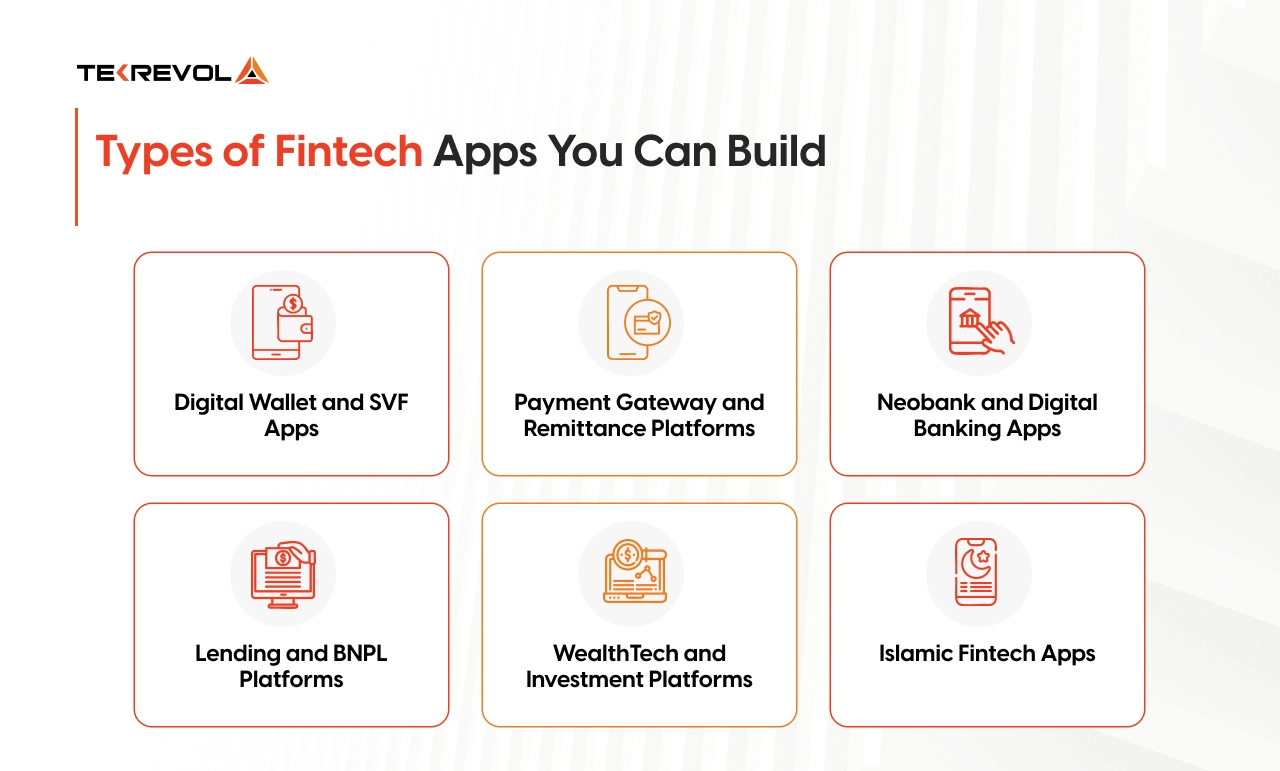
Your product category determines your regulatory path, your technical architecture, and your cost tier before a single feature is scoped.
| App Type | License Required | Regulator | Build Cost | Timeline |
| Digital Wallet / SVF | SVF License | CBUAE only | AED 220K–550K | 3–5 months |
| Payment Gateway | RPSCS License | CBUAE | AED 294K–734K | 4–6 months |
| Neobank / Digital Bank | Digital Banking License | CBUAE | AED 1.5M–5.5M+ | 12–24 months |
| Lending / BNPL | Finance Company License | CBUAE / DFSA | AED 550K–1.5M | 6–10 months |
| WealthTech / Investment | SCA or DFSA Auth | SCA / DFSA | AED 734K–1.8M | 8–12 months |
| Islamic Fintech | Sharia Board + License | CBUAE / DFSA | AED 734K–1.8M | 9–14 months |
| Crypto / Virtual Assets | VARA License | VARA / SCA | AED 300K–1M | 3–9 months |
Digital Wallet and SVF Apps
Requires SVF license from CBUAE. Cannot be issued under DIFC or ADGM.
Key integrations: Telr, PayTabs, Network International, Apple Pay UAE, Google Pay. Build complexity: Medium — AED 220,000–AED 550,000
Payment Gateway and Remittance Platforms
Licensed under RPSCS Regulations by CBUAE. Covers payment initiation, e-money issuance, and money remittance.
High AML monitoring requirement — real-time transaction monitoring plus sanctions screening. Build complexity: Medium-High — AED 294,000–AED 734,000
Neobank and Digital Banking Apps
Most complex regulatory category. The CBUAE digital banking license framework is being finalized as of 2025. Alternative path: partner with a licensed bank and build the UX layer on top.
A minimum of AED 2 billion paid-up capital for a full bank license. This is not a startup path; it is an enterprise or institutional play. Build complexity: Very High — AED 1,468,000–AED 5,505,000+
For teams exploring earlier-stage validation, reviewing a scoped MVP app development in Dubai for startups can reduce risk before committing to full licensing.
Lending and BNPL Platforms
Regulated by CBUAE (mainland) or DFSA (DIFC). BNPL frameworks in the UAE are still evolving; continuous regulatory monitoring is required.
Build complexity: High — AED 550,000–AED 1,468,000
WealthTech and Investment Platforms
SCA regulates capital market activity on the mainland. DFSA governs within DIFC. Sharia compliance certification is required for Islamic investment products.
Build complexity: High — AED 734,000–AED 1,835,000
Islamic Fintech Apps
Sharia compliance board certification is required. Product constraints include the prohibition of riba (interest) and the mandatory use of profit-sharing models.
This is the fastest-growing segment in the market, $179 billion globally by 2026, and it remains underserved.
Build complexity: High — same cost as category above, plus Sharia compliance architecture
UAE Fintech Compliance: What Your App Must Be Built to Do
UAE fintech compliance is not a checklist you review before launch. It is the architecture you design in sprint one. Here is what that means in practice.
KYC Architecture
Every UAE-resident onboarding flow must include:
- Emirates ID verification — mandatory for UAE residents
- UAE PASS integration — government digital identity; 1–2 weeks integration time; enables instant KYC for UAE nationals and residents
- Liveness detection — biometric match against Emirates ID photo; required for remote onboarding
- Ongoing KYC — periodic re-verification for high-risk customer categories
Technical requirement: data residency must comply with the UAE PDPL. UAE customer financial data stays in the UAE-region infrastructure.
AML/CFT and GoAML Reporting
All UAE financial institutions must register with the FIU’s GoAML portal for suspicious activity reporting.
- AML compliance failures account for 68% of financial services penalties in UAE (2024–2025)
- Average fine: AED 15 million per violation
- Sanctions screening must be continuous, not just at onboarding, against UN, US, EU, and UK lists
- Dynamic risk scoring is the DFSA and CBUAE expectation. Static customer risk categories are no longer sufficient.
- Beneficial ownership identification was strengthened under Federal Decree-Law No. 20 of 2018 amendments
UAE PDPL Compliance
Federal Decree-Law No. 6 of 2025 is effective January 1, 2026, with full compliance required by January 1, 2027.
For fintech apps: documented legal basis for all data processing, right-to-erasure workflows, privacy impact assessments before new features, and consent management in the onboarding layer.
Open Banking and Open Finance
CBUAE’s Open Finance Regulation requires API-based data sharing between licensed entities. This means OAuth 2.0 authorization frameworks, ISO 20022 messaging standards, and third-party risk assessments are ongoing obligations, not one-time tasks.
Core Features of a Dubai Fintech App
Every CBUAE or DFSA-licensed fintech app shares a non-negotiable feature baseline before any product differentiation begins. These are the requirements your mobile app development company in Dubai must deliver before a single differentiating feature is discussed.
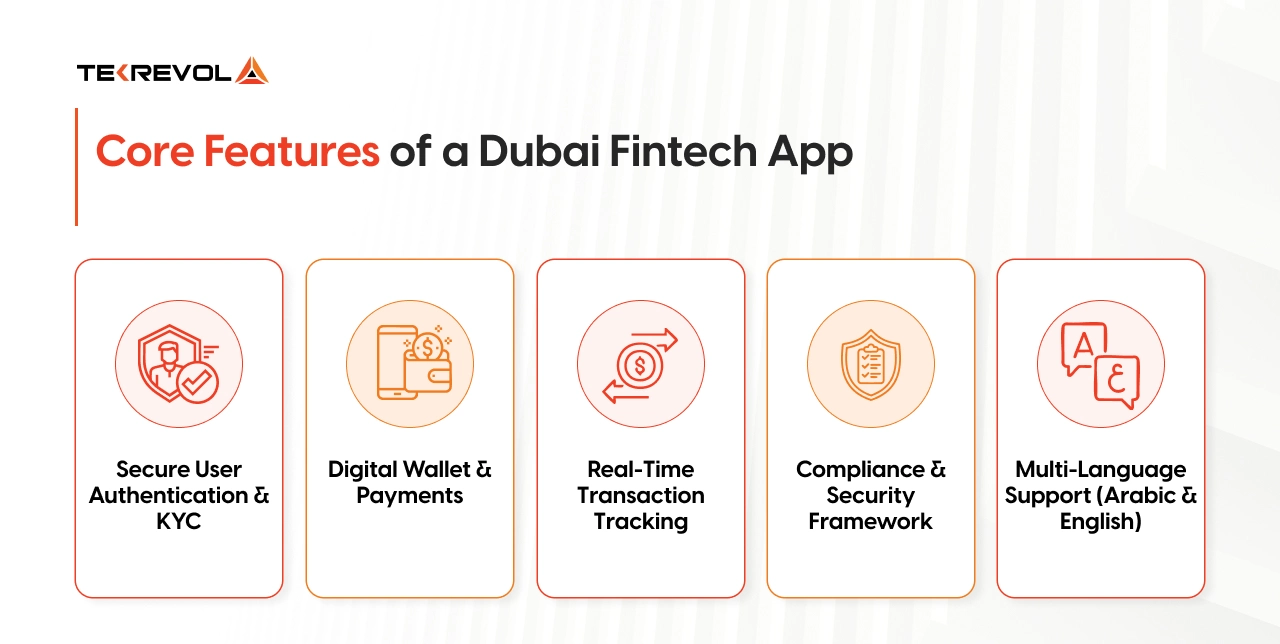
Non-Negotiable Baseline
- Emirates ID scan + OCR extraction
- UAE PASS SSO integration
- Biometric liveness check + face match
- Arabic and English bilingual onboarding (RTL-first)
- Multi-currency wallet (AED primary)
- Real-time transaction feed
- Domestic UAE banking rails transfers
- QR code payment (UAE standard)
- Bill payment — DEWA, du, Etisalat
- Virtual card issuance
- Apple Pay and Google Pay UAE tokenization
- GoAML report generation and submission pipeline
- Sanctions screening audit trail
- Biometric device authentication (Face ID / Touch ID)
- End-to-end encryption on all financial data
Admin Compliance Dashboard
Every CBUAE or DFSA-licensed fintech needs an internal tool for:
- Customer risk tier management
- Suspicious transaction flagging and case management
- GoAML submission workflow
- Regulatory report generation in CBUAE-compliant format
This is mandatory. It is what regulators review during audits.
In any application that handles payments, compliance cannot be an afterthought. Whether you’re building a fintech platform or following an eCommerce app development guide to integrate payment and wallet features, KYC, AML, and robust data protection measures should be embedded into the product architecture from the very beginning.
AI Features That Create Competitive Differentiation
The baseline Dubai fintech apps share the same compliance infrastructure. AI is where the product gap opens.
Features the leading Dubai fintech apps are building now:
- AI-powered fraud detection and behavioural biometrics — real-time anomaly detection beyond static rules
- Arabic NLP chatbot — contextual financial query handling in Modern Standard Arabic and Emirati dialects. Arabic app development supports regional language variations; essential for fintech applications to deliver accurate, personalized, and culturally relevant user experiences.
- Alternative credit scoring — using UAE-specific data signals: utility payments, telecom data, social signals
- Open finance data aggregation — multi-bank view for UAE customers
- Predictive cash flow for SME banking apps
- Sharia compliance engine — automated product screening for Islamic fintech
- Dynamic AML risk scoring — behaviour-based, replacing static customer risk categories
- Digital Dirham (CBDC) readiness architecture — CBUAE’s CBDC infrastructure is in active development
For teams integrating these capabilities, AI-powered app development requires machine learning infrastructure decisions to be made at the architecture stage—not added later as enhancements. Partnering with the best AI consulting companies in Dubai can help define these foundations early.
| Feature | Basic ($60K–$150K) | Standard ($150K–$400K) | Enterprise ($400K+) |
| KYC | Manual + Emirates ID | Automated liveness + UAE PASS | Full biometric + ongoing KYC |
| AML | Rule-based monitoring | ML anomaly detection | Dynamic risk scoring + GoAML automation |
| Payments | Single gateway | Multi-gateway + rails | Full rails + card issuing |
| Analytics | Transaction history | Spend categorization | Predictive + open finance |
| Languages | Arabic + English | Arabic + English + RTL CMS | Full bilingual with Arabic NLP |
Tech Stack for Dubai Fintech App Development
Technology choices in UAE fintech are not just about performance; they are about compliance, data residency, and certification.
In most cases, these decisions also align with broader product strategy considerations, such as custom vs off-the-shelf app development, where architecture flexibility and regulatory control often determine the final stack.
Mobile Layer
- iOS (Swift) — Secure Enclave for key storage; native Face ID. Required if issuing cards or handling biometric authentication natively.
- Android (Kotlin) — Android Keystore; Samsung Pay UAE integration
- Flutter — viable for most fintech apps in 2026; native biometric support; reduces timeline by 20–30%. The native vs cross-platform decision for fintech typically favours Flutter unless card-present hardware integration is required.
- React Native — strong track record in UAE fintech deployments
Backend
- Node.js (Fastify) or Python (FastAPI) — API layer and transaction processing
- Java / Kotlin (Spring Boot) — high-throughput core banking logic
- Rust — cryptographic components requiring memory safety
Database
- PostgreSQL — primary relational database with field-level encryption
- Redis — session management, real-time fraud signal processing
- TimescaleDB — time-series transaction data for ML fraud detection
Security and Compliance Infrastructure
- AWS UAE Region (me-south-1) or Azure UAE North — UAE data residency compliance
- HashiCorp Vault — secrets and encryption key management
- Sumsub or Jumio — KYC/identity verification with UAE PASS integration
- ComplyAdvantage or Refinitiv — AML and sanctions screening API
Payment Integrations
- Telr API — primary UAE payment gateway; sandbox credential initiation takes 1–2 weeks
- PayTabs — strong UAE and GCC coverage; supports Arabic interface
- Network International — card processing and acquiring
How to Build a Fintech App in Dubai: Step-by-Step
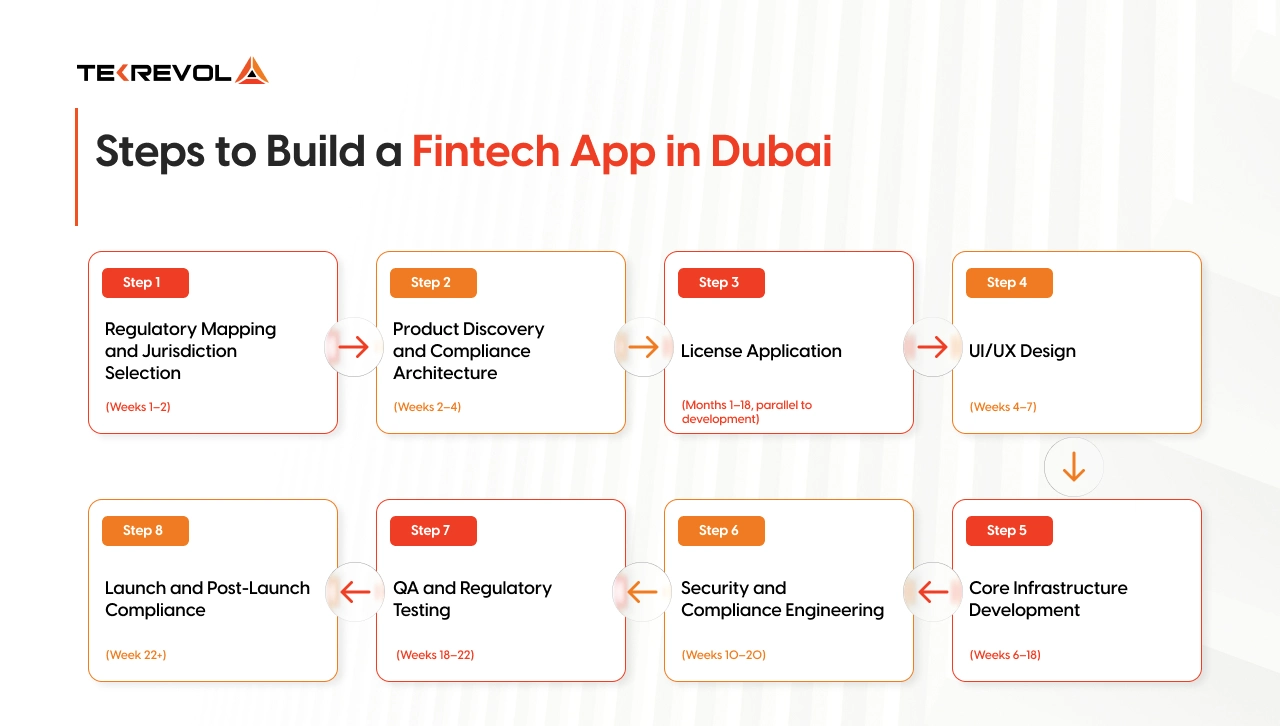
The correct sequence for Dubai fintech development starts with regulation, not with wireframes. Here is the process:
Step 1 — Regulatory Mapping and Jurisdiction Selection (Weeks 1–2)
Determine product category. Select DIFC, ADGM, or mainland CBUAE. Map all applicable licenses. Engage UAE fintech legal counsel before any design work. Legal pre-flight budget: AED 50,000–150,000.
Step 2 — Product Discovery and Compliance Architecture (Weeks 2–4)
Feature specification with compliance requirements mapped to each feature. Data architecture designed with PDPL controls built in. Third-party integration mapping: UAE PASS, Telr/PayTabs, GoAML, and banking rails.
Step 3 — License Application (Months 1–18, parallel to development)
Do not wait until the app is built to start this. Waiting adds 6–18 months to launch. The DIFC ITL and CBUAE license applications run simultaneously with development.
Step 4 — UI/UX Design (Weeks 4–7)
Arabic RTL wireframes are built before English counterparts, not as a translation layer but as the primary design surface. Every compliance-required UI element, consent flows, risk disclosures, and transaction confirmations are in the design system. The mobile app development timeline in Dubai is also very important for typical milestone planning.
Step 5 — Core Infrastructure Development (Weeks 6–18)
It includes authentication, KYC onboarding, wallet/account/payment engine, UAE-specific integrations, and an admin compliance dashboard. At this stage, choosing the right mobile app developers in Dubai becomes critical to ensure secure, regulation-ready execution.
Step 6 — Security and Compliance Engineering (Weeks 10–20)
This step includes end-to-end encryption, independent penetration testing, PDPL compliance audit of all data flows, AML monitoring tuning, and GoAML pipeline testing with FIU.
Step 7 — QA and Regulatory Testing (Weeks 18–22)
Functional testing in Arabic and English. Payment gateway certification. Compliance documentation package ready for CBUAE/DFSA submission. If on DIFC ITL: live testing phase with customer number caps and enhanced DFSA supervisory oversight.
Step 8 — Launch and Post-Launch Compliance (Week 22+)
App Store submission. GoAML portal registration. First reporting cycle. Ongoing CBUAE/DFSA reporting. Annual PDPL compliance review. AML model retuning.
Choosing the Right Fintech Jurisdiction?
Avoid costly mistakes with expert guidance on DIFC, ADGM, and CBUAE licensing requirements. TekRevol helps you select the right regulatory path based on your business model and growth goals.
Talk to a Fintech Expert →How Much Does Fintech App Development Cost in Dubai? (2026)
Fintech app development in Dubai costs between AED 220,000 for a payment MVP and AED 5,505,000+ for a full licensed digital banking platform. The regulatory path determines the floor more than the feature set.
Cost by Product Tier
| Tier | Product Type | Cost Range | Timeline |
| Payment MVP | Digital wallet / SVF | AED 220,000–AED 440,000 | 3–5 months |
| Standard Fintech App | Payment platform / BNPL | AED 440,000–AED 1,100,000 | 5–8 months |
| Advanced Platform | Neobank UX / WealthTech | AED 1,100,000–AED 2,202,000 | 8–12 months |
| Enterprise / Licensed Bank | Full digital bank | AED 2,202,000–AED 5,505,000+ | 12–24 months |
For a deeper breakdown of real-world pricing structures, regulatory overhead, and development variables, our app development cost in Dubai highlights how compliance requirements, infrastructure decisions, and licensing paths directly shape total build cost.
Cost by Component
| Component | Estimated Cost |
| UAE PASS + Emirates ID KYC integration | AED 44,000–AED 92,000 |
| AML transaction monitoring system | AED 55,000–AED 147,000 |
| GoAML reporting pipeline | AED 29,000–AED 66,000 |
| Telr / PayTabs payment integration | AED 29,000–AED 55,000 per gateway |
| Core banking API integration | AED 110,000–AED 294,000 |
| ML fraud detection layer | AED 73,000–AED 184,000 |
| Arabic RTL bilingual design and QA | AED 37,000–AED 73,000 |
| PDPL compliance architecture | AED 29,000–AED 73,000 |
| Independent security audit/pen test | AED 55,000–AED 184,000 |
| Annual maintenance and compliance updates | 15–20% of the build cost/year |
UAE-Specific Costs That Global Estimates Miss
- Legal pre-flight for CBUAE/DFSA license: AED 50,000–150,000
- DIFC ITL application + legal support: AED 80,000–200,000
- Mainland CBUAE first-year licensing total: AED 700,000–2,500,000
- VARA license application: AED 100,000–400,000
What Moves Cost Up
- Full bank license vs. payment service provider license
- DIFC full authorization vs. ITL sandbox
- Multi-jurisdiction compliance simultaneously (CBUAE + DIFC + GDPR)
- Custom ML fraud detection model training
- Sharia compliance board certification
How to Keep Cost Controlled
- Pre-built UAE integration library (UAE PASS, Telr, PayTabs, GoAML) — eliminates 30–40% of custom development
- Flutter cross-platform — reduces timeline by 20–30% vs. dual native
- ITL route before full DFSA authorization
- Regulatory mapping in discovery — prevents costly architectural rework
What Extends Your Dubai Fintech Development Timeline
- Waiting to start license application until the app is built: +6–18 months
- Discovering compliance requirements after architecture is designed: +2–4 months
- Late UAE PASS or Telr sandbox credential initiation: +1–3 weeks per integration
- Arabic content delivered after design phase begins: +2–4 weeks
- App Store rejection for missing Arabic privacy policy or payment disclosure: +1–2 weeks per rejection
- DIFC ITL customer cap reached before full authorization: testing pause until authorization
- CBUAE requesting additional documentation during license review: unpredictable, 4–12 weeks additional
When comparing platform approaches for cost control, the iOS vs Android decision in fintech often leans toward cross-platform (Flutter) unless card hardware or biometric certification requirements dictate otherwise, as seen in iPhone app development in Dubai where native iOS development is prioritized for secure, hardware-level integrations and performance-sensitive financial applications.
DIFC Fintech App Development — The Deep Dive
DIFC is the fastest legitimate path to a regulated international fintech product operating in Dubai, and the Innovation Testing License (ITL) is how most startups should enter it.
The DIFC Innovation Testing License
Eligibility requirements:
- Product uses innovative technology
- Activity involves a regulated financial service
- Ready for live customer testing
ITL conditions during the testing period:
- Customer number caps apply
- Transaction value limits apply
- Enhanced DFSA supervisory reporting is required
Duration: Typically 12–24 months, with a structured path to full DFSA authorization.
Budget: AED 80,000–200,000, including legal support. Lower than full authorization, but legal counsel is important.
DFSA AML Module Obligations
The DFSA AML Module is the primary compliance framework for DIFC fintech license holders. Key requirements:
- Dynamic risk scoring — not static customer categories
- Beneficial ownership identification with enhanced due diligence
- GoAML registration (required for certain activities even within DIFC)
- Continuous sanctions screening against UN, US, EU, UK lists
- Customer risk profiles must be updated based on actual transaction behaviour
The average AML penalty in UAE financial services in 2024–2025 was AED 15 million. Compliance failures account for 68% of all financial services penalties.
DIFC Data Protection and API Security
DIFC’s Data Protection Law applies independently of the UAE mainland PDPL. For fintech apps: OAuth 2.0 is mandatory for API authorization. Third-party risk assessments cover every cloud provider and SaaS vendor that touches customer data. Anomaly detection on API traffic is an active monitoring requirement, not a configuration.
DIFC Crypto Token Framework
In force since 2022. Covers digital asset custody, trading, and financial services involving crypto tokens within DIFC. This is separate from VARA (which covers the Dubai mainland). Any fintech app integrating digital asset payments or custody within DIFC infrastructure is subject to this framework.
How TekRevol Builds Fintech Apps in Dubai
TekRevol’s Dubai fintech practice starts with regulatory mapping, before any wireframe, before any architecture decision.
Here is what that looks like in practice:
- The discovery phase includes a regulatory mapping session. Every data flow, every third-party integration, and every user interaction is mapped against applicable CBUAE, DFSA, and PDPL requirements before sprint one begins.
- Pre-built UAE integration library. UAE PASS, Telr, PayTabs, Network International, GoAML pipelines — configured and tested, not built from scratch. This eliminates 30–40% of the integration cost and 4–6 weeks of the timeline.
- Compliance engineering is embedded from sprint one. Retrofitting compliance after development adds 30–50% to the total project cost. We don’t build that way.
- DIFC ITL support. We have supported clients through the ITL program — building the compliance dashboards, AML monitoring systems, and audit-ready documentation that DFSA expects.
- Track record across fintech categories: payment services, digital wallets, Islamic fintech, and enterprise treasury management across the UAE and GCC.
For founders evaluating partners, knowing how to choose the right company for a fintech build in the UAE comes down to: regulatory depth, UAE integration experience, and compliance architecture capability, not just mobile development track record.
Whether you are building a real estate app development platform with payment features or a standalone financial product, TekRevol’s engineering team builds for UAE regulatory readiness from day one.
Build a Compliant, Scalable Fintech App in Dubai
TekRevol combines proven regulatory expertise with pre-built UAE integrations to accelerate development. From payment MVPs to full-scale neobank platforms, we help you build securely, compliantly, and right the first time.
Get a Free Fintech Consultation →





![How to Develop a Food Ordering Website [2026 Guide with Cost & Frameworks]](https://assets.tekrevol.com/images-tek/uploads/2026/03/imgi_1_Tek-Feature-3-1-400x182.webp)


