



- MVP app development helps Dubai startups validate ideas, launch fast, and reduce risk before full-scale investment
- Startups prioritize MVP-first builds due to the Dubai 2033 Agenda (D33) and its investor-driven ecosystem
- MVP vs Prototype vs PoC depends on your goal: validation, visualization, or feasibility testing
- MVP development in Dubai costs between AED 18,000 and AED 180,000+, depending on complexity and features
- Essential MVP features in Dubai include multilingual support, Emirates ID KYC, and WhatsApp-first support
- Choosing the right development partner improves speed to market, product fit, and funding readiness
Dubai’s startup ecosystem now ranks #44 globally, and it’s still climbing. That growth means more competition and more pressure to launch smart. Most founders know they need an app. The question is how to build one without losing six months in the process.
Well, the smartest teams start with Minimum Viable Product (MVP) app development in Dubai. A MVP is the leanest working version of your app, built with only the features that test whether your idea works. This way, you avoid spending AED 200,000 on features nobody asked for.
This article gives you the full picture of what startup app development in the UAE looks like. You get an idea of what drives MVP costs in Dubai, how to scope your startup app development smartly, and what separates the best app development company in Dubai that ships from the ones that stall.
What is MVP App Development, and Why Dubai Startups Built it First
MVP app development in Dubai helps you launch a working product with the fewest features needed to test your core idea. It cuts wasted build time, surfaces real user feedback early, and lets you validate demand before you commit your full budget.
MVP-First: The Dominant 2026 Strategy in Dubai
Dubai’s startup ecosystem grew 33.4% in 2025, the fastest growth among major ecosystems in the Arab world, as stated in the StartupBlink 2025 report.
According to Gulf News, the city also holds the #1 ranking in the Gulf for startup ecosystem value. Over 580 digital startups received backing in the first nine months of 2025 alone.
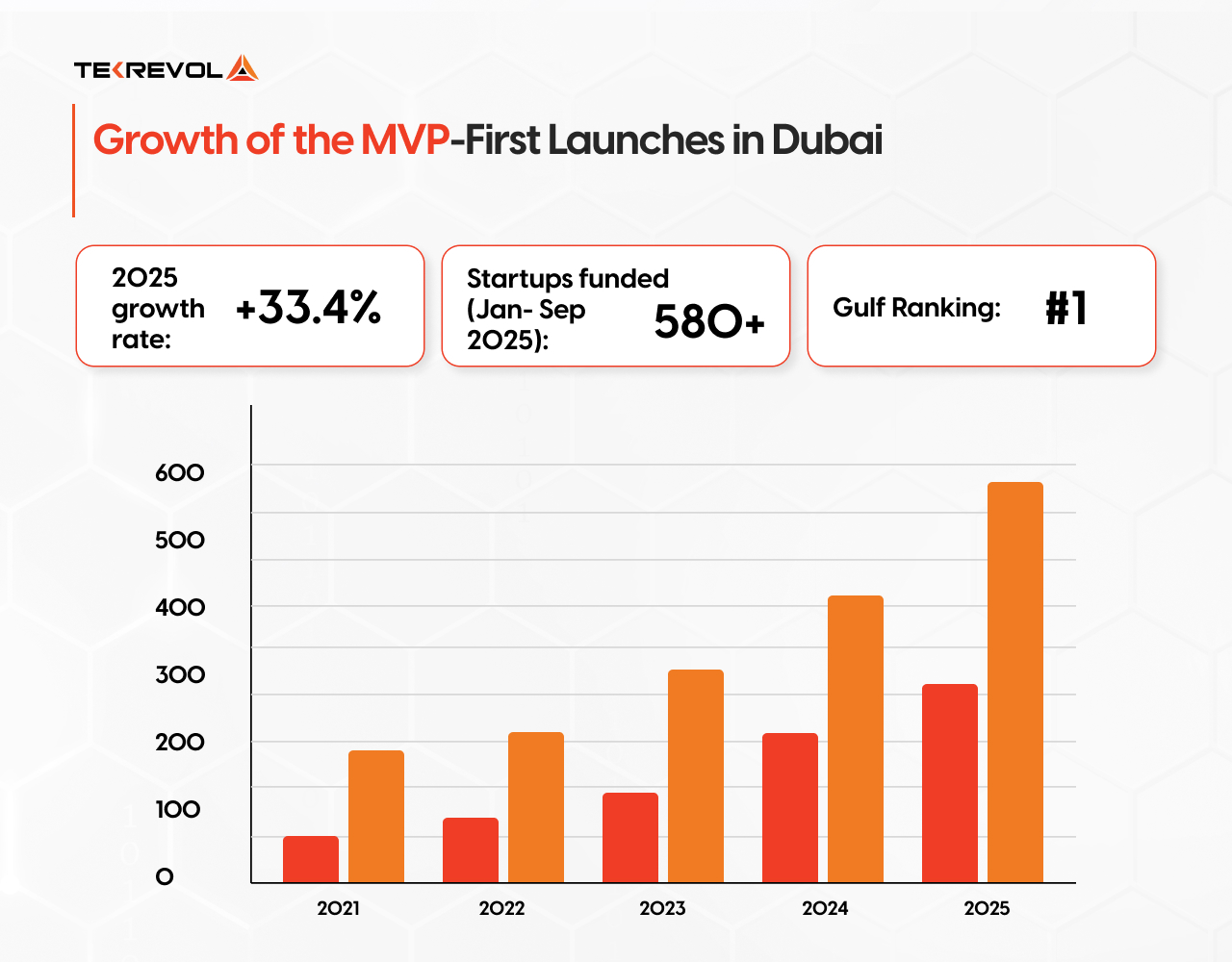
Startups in Dubai move fast because the infrastructure supports speed. Regulators, free zones, and accelerators all push toward rapid product validation. MVP-first fits that environment exactly. You launch, collect real data, and make decisions based on what users actually do.
And the local proof is hard to ignore.
Careem started as a basic web booking tool. Dubizzle launched as a simple expat classifieds board. Fetchr built its first version around GPS pins because street addresses didn’t work in the region. These successful MVPs share one approach: ship the minimum, prove the concept, then build.
For more real-world cases like these, see our roundup of minimum viable product examples that went on to dominate their categories.
Dubai's market moves fast. If you see the opportunity, scope it now.
Share your idea with TekRevol. We’ll hand you a fixed proposal to turn it into a shippable product!
Book Your Free 30-minute ConsultationMVP vs Prototype vs PoC: Which One Does Dubai Startups Actually Need?
Most Dubai founders use these three terms interchangeably. That’s an expensive mistake. Each one answers a different question, and building the wrong one first wastes time and budget.
A prototype is a clickable design; it looks real, but doesn’t work. A proof of concept tests whether something can be built at all. An MVP is a live product that people use.
Not sure which stage you’re at? Here’s the clearest breakdown:
| Type | Core purpose | Who uses it | Right stage |
| Proof of Concept | Prove the tech can work | Dev team internally | Before any product work |
| Prototype | Test look, feel, and flow | Investors, early users | Pitching or UX testing |
| MVP | Validate real market demand | Live users in your market | First public launch |
Most founders in Dubai need to start with an MVP, not a prototype. If you’re unsure which one fits your situation, our guide on PoC vs MVP gives you a clear answer based on where your idea actually stands.
How Much Does MVP App Development Cost in Dubai? (2026 Breakdown)
MVP app development in Dubai costs between AED 18,000 and AED 180,000+. Your final number depends on your feature set, your platform choice, and whether your product operates in a regulated space.
That’s a wide range. So here’s exactly what sits at each level and what moves the number up or down:
| Factor | Basic MVP | Mid-Tier MVP | Premium MVP |
| Cost (AED) | AED 18,000 – 70,000 | AED 70,000 – 180,000 | AED 180,000+ |
| Timeline | 8 – 14 weeks | 10 – 18 weeks | 18 – 32 weeks |
| Platforms | Single (iOS/Android) | Cross-platform | Cross-platform + Web |
| Post-launch support | Basic bug fixes | 30-day support window | Ongoing support + iterations |
| Best for | Single-idea validation | Multi-flow user testing | Regulated or complex products |
Before diving into MVP-specific pricing, it helps to understand how Dubai’s market sets the baseline. For a broader breakdown of digital product budgets in the UAE, see the detail analysis of cost of app development in Dubai.
What Drives Startup App Development UAE Cost Up Specifically
Arabic RTL design. Your app needs to work in both Arabic and English. Right-to-left layouts require separate design passes. Navigation, typography, and button placement all shift. Budget for this from day one.
DIFC and ADGM compliance modules. If your product handles payments, user data, or financial transactions and operates under DIFC or ADGM (Abu Dhabi Global Market) jurisdiction, you need compliance-ready architecture baked in. Adding it later costs more than building it upfront.
Bilingual UX. Arabic and English users behave differently inside the same app. Content length changes. Flows need testing in both languages. A bilingual UX audit adds time but protects your launch.
Cross-platform development. Choosing Flutter or React Native over separate native builds cuts your timeline and budget significantly. For most startup app development UAE projects, cross-platform is the right call at this stage.
Minimum viable product app Dubai budgets that ignore these factors routinely run 20–30% over estimate.
How Long Does MVP App Development Take in Dubai?
A startup MVP in Dubai takes 8 to 14 weeks from kickoff to launch. That covers design, development, testing, and deployment. Here’s what each phase looks like and how long it actually takes.
| Phase | What Happens | Timeline |
| Discovery & Scoping | Define features, user flows, tech stack | 1 – 2 weeks |
| UX/UI Design | Wireframes, visual design, prototype sign-off | 2 – 4 weeks |
| Development Sprint | Frontend, backend, and integrations built | 6 – 12 weeks |
| QA & Testing | Bug fixes, device testing, performance checks | 1 – 2 weeks |
| Launch | App store submission, go-live | 1 week |
| Total | 8 – 14 weeks |
Each phase feeds directly into the next. Delays in discovery push your design. Delays in design push your development. The timeline is only as strong as your weakest handoff.
What Kills MVP Timelines
Most MVP development timeline overruns in the UAE don’t come from technical problems. They come from four recurring issues.
- Scope creep is the most common. You add a feature here, adjust a flow there. Each change feels small. Together, they add weeks.
- An unclear brief forces the team to guess. Every guess costs revision time. A vague brief at the start always produces a longer build.
- Founder indecision on design or features stalls sprints. Development teams can’t build what hasn’t been approved.
- The wrong vendor costs the most time. A team that doesn’t understand agile development workflows, or that juggles too many projects at once, will miss sprint targets consistently.
How TekRevol Keeps Your Dubai MVP on Schedule
TekRevol builds every MVP on a fixed-price proposal. You know exactly what you’re getting and what it costs before a single line of code is written.
We used this structured approach to engineer Mdrouz (an ecommerce app), delivering a high-velocity solution that met strict Dubai market timelines. You know exactly what it costs before we even begin.
Every sprint closes with a weekly demo, so you see real progress every seven days. You won’t wait for responses from another time zone, as development happens during UAE business hours.
Following the same roadmap we used for Mdrouz, we ensure your decisions are implemented instantly to keep your launch on track.
What Does the MVP App Development Process Actually Look Like?
Knowing the cost and timeline is one part of the picture. Understanding the process is what separates founders who launch on time from those who don’t.
Here’s how a well-run MVP build works phase by phase.
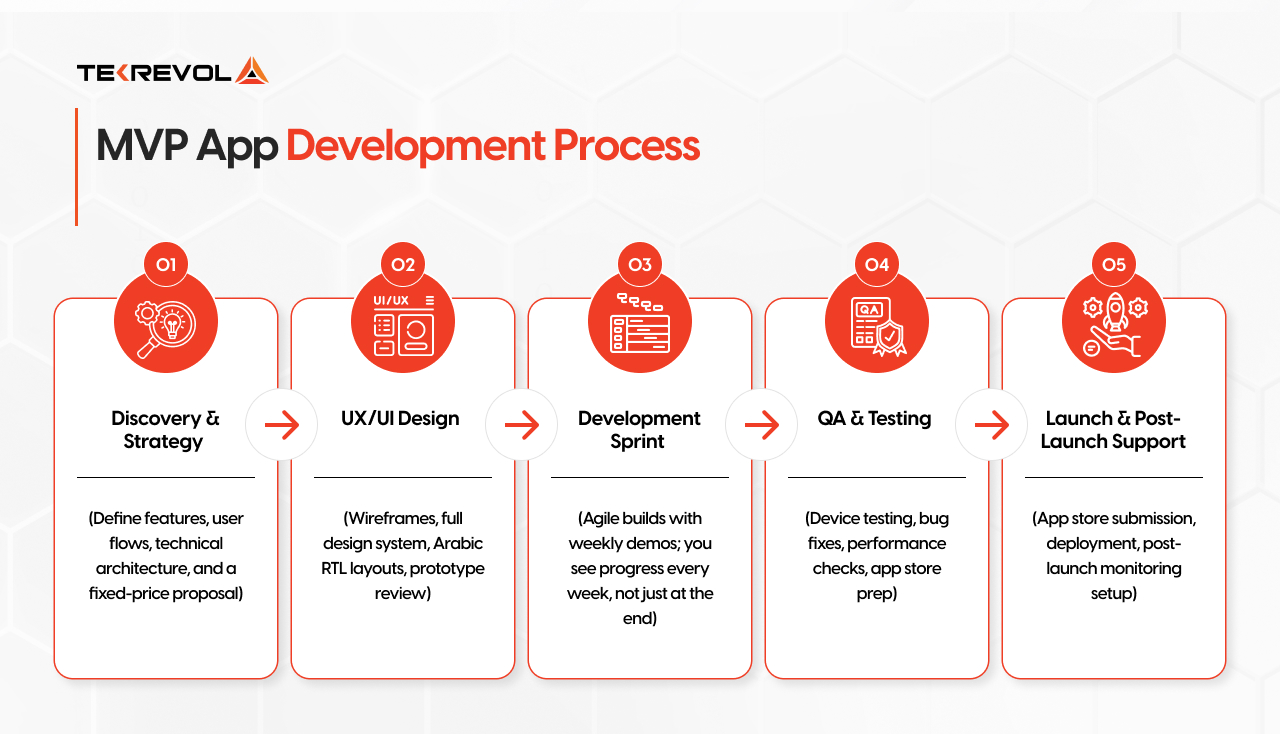
1st: Discovery & Strategy
Before a single design screen is made, map your user flows, define core features, and identify technical dependencies. The output is a locked scope document and a fixed-price proposal.
This phase takes one to two weeks and protects every phase that follows. A good scoping session also forces a feature prioritization exercise. Features that don’t test the core idea get moved to a V2 roadmap.
Skipping this phase to save time is the most expensive shortcut in product development. Every unclear requirement at this stage turns into a change order mid-build.
2nd: UX/UI Design
UX design defines how users move through your product. UI design defines what they see. Both matter. In Dubai’s market, that also means bilingual layouts, RTL-tested screens, and a visual language that builds trust fast.
This phase produces wireframes, a full component design system, and a clickable prototype. You review and sign off before development starts. Changes at the design stage cost a fraction of what they cost once code is written.
3rd: Development Sprint
Development runs in structured sprints. Each sprint has a defined output. You see working features every week. Nothing goes dark for six weeks and comes back broken.
Your team handles frontend, backend, and third-party integrations in parallel. Every sprint closes with a working demo you can test yourself. You see progress every week and flag issues before they compound.
4th: QA & Testing
QA is not a final checkbox. It runs alongside development from the first sprint. Bugs caught early cost less than bugs caught at launch.
Testing covers device compatibility, load performance, Arabic and English flows, and edge cases your users will find on day one. A product that breaks in QA never reaches the app store. A product that skips QA breaks in front of your early users, and early users don’t come back.
5th: Launch & Post-Launch Support
Launch is the start of your feedback loop. App store submission, go-live coordination, and first-user monitoring all happen in this phase.
Post-launch support means your team stays on after launch, actively tracking performance, fixing issues, and preparing your V2 scope. An app development company that disappears after go-live leaves you rebuilding with someone who doesn’t know your codebase.
The Step Most Teams Skip: Feature Prioritisation
The biggest risk to any MVP isn’t bad code. It’s too many features.
Before development starts, every feature in your brief should go through one filter: Does this test our core hypothesis, or does it just make the product feel more complete?
If it doesn’t test the hypothesis, remove it from V1. Add it to a V2 roadmap. For a deeper walkthrough of this process, our guide on how to build an MVP step by step covers every decision point from idea to launch.
Not sure where your idea fits in this process?
Our 30-minute scoping session gives you a feature list, a realistic timeline, and a fixed-price proposal.
Let's Connect!Dubai-Specific MVP App Features You Can’t Skip
Building a minimum viable product app in Dubai is quite different from building one for London or New York. The market has specific technical, cultural, and regulatory requirements, and most of them need to be in V1, not V2.
Here are the features that Dubai-specific MVPs need and why skipping them costs more than building them in.
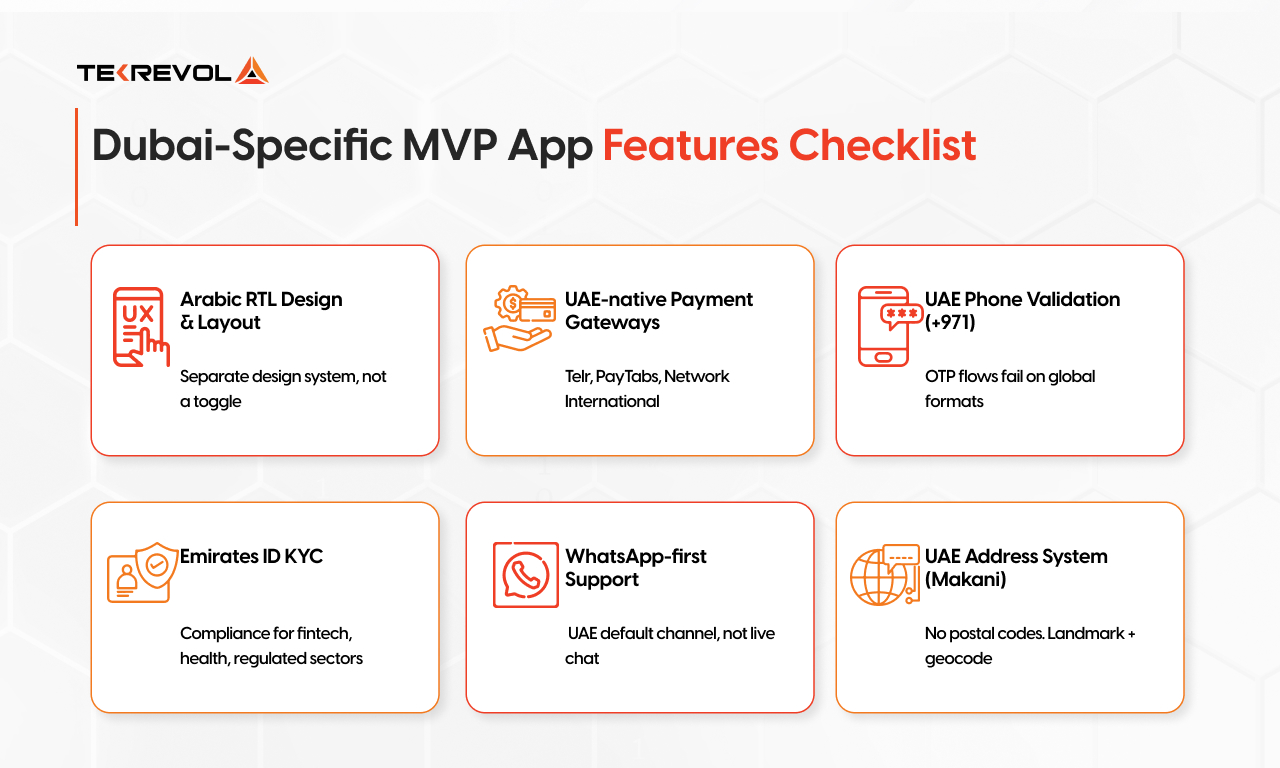
A) Structural Features
The features below affect your app’s architecture, database schema, and UI component library. Adding them after launch means partial rebuilds. Every week you delay them in planning adds three weeks of work post-launch.
Arabic RTL Design and Layout
Right-to-left text rendering affects every navigation direction, button placement, form fields, typography, and icon alignment. It’s a separate design system. Build it alongside your English layout from week one of the design phase.
UAE-native Payment Gateways
Stripe has limited UAE coverage. Your MVP needs integration with popular UAE gateways (Telr, PayTabs, or Network International). For e-commerce and delivery apps, cash-on-delivery is still the preferred payment method for a significant portion of the UAE market.
UAE Phone Number Validation (+971)
OTP-based authentication built on global phone formats fails on UAE numbers. Your login and registration flows need UAE number format support from the first build. A broken sign-up screen is the fastest way to lose a new user before they see your product.
Emirates ID-based KYC
This is required for fintech, healthtech, and any regulated service in the Emirates. UAE-compliant KYC needs Emirates ID scanning, face-match verification, and data handling that meets UAE PDPL (Personal Data Protection Law) standards.
B) Features that Shape User Trust (Include Where Relevant)
WhatsApp-first Support Channel
WhatsApp is the dominant communication channel in the UAE. Users expect to contact support via WhatsApp, not a ticket form or email. A WhatsApp CTA in your app’s help flow converts significantly better than live chat for UAE consumer audiences.
UAE Address System Support
The UAE does not use a standard postal code system in most areas. Delivery and location-based apps need to support landmark-based addressing and Makani numbers, the UAE’s official geocoding system. Standard Google Maps address autocomplete alone won’t cover this.
MVP App Development in Dubai by Industry: Top Sectors and Their Build Requirements
Dubai’s startup funding doesn’t spread evenly across industries. It concentrates, and where funding concentrates, MVP activity follows.
Here are the five sectors with the highest MVP development activity in Dubai and the build requirements that most generic development briefs miss.
| Vertical | Dubai market signal | Critical V1 requirement |
| Fintech | 35% of startup funding | KYC flows + Central Bank API compliance |
| Healthtech | DHA-regulated sector | Patient data compliance + DHA licensing |
| Proptech | #1 real estate volume in MENA | Dubai REST API + Arabic-first UX |
| E-commerce | 23% YoY growth | Cash-on-delivery + Arabic product UX |
| Logistics | D33 priority sector | Multilingual interface + UAE address system |
Fintech
Fintech attracts 35% of Dubai startup funding in 2025, according to the Dubai International Financial Centre (DIFC). It’s the most active vertical and the most technically demanding.
But a fintech MVP here is not just a payments screen. It requires KYC flows, UAE Central Bank API compliance, and secure payment gateway integration. Building without these and retrofitting later is expensive and often requires a full rebuild.
If you’re in payments, lending, or wealth management, compliance architecture is a V1 requirement. As a regulated fintech app development company, we build compliance into the architecture from day one.
Healthtech
The UAE’s push toward digital health makes it an attractive space for founders. Healthtech MVPs in Dubai must account for DHA (Dubai Health Authority) data compliance and patient privacy standards. Telemedicine features require specific licensing.
A healthtech MVP that launches without them risks app store removal and user trust that takes years to rebuild. Our healthtech app development services are scoped with compliance built in from the first sprint.
Proptech
Dubai’s property market is one of the most active in the world. Rental platforms, buyer tools, agent dashboards, and investment trackers all have room to grow.
A proptech MVP built for Dubai needs live listing data, bilingual Arabic-English UX, and DLD (Dubai Land Department) system integrations to earn credibility. Your MVP needs to feel reliable before it’s fully featured.
E-Commerce
UAE shoppers have specific expectations. Dubai’s e-commerce MVPs need cash-on-delivery as a payment option (still the dominant method for many segments), Arabic product descriptions, and UAE-specific logistics integrations.
Launching with a Western default checkout flow loses a significant portion of your addressable market. Build the full local purchase experience from the start. That’s what makes UAE e-commerce MVPs succeed.
Logistics & Delivery
Logistics MVPs in Dubai face a unique set of constraints. GPS accuracy matters more here because address systems across the UAE are inconsistent. Your app needs to handle GPS-pin-based delivery, in addition to street address input.
The founders who scope this correctly from the start build products that work for real delivery teams from day one. Those who don’t spend V2 rebuilding what should have been in V1.
If you’re building in this space, our logistics solutions development practice covers every constraint listed in this section.
Freelancer vs Agency for MVP App Development in Dubai
The cheapest option at the start is rarely the cheapest option at the end. That’s the core truth behind every freelancer vs agency decision a Dubai founder faces. Here’s what the full picture actually looks like.
| Factor | Freelancer | Local Agency | TekRevol |
| Cost | Lowest upfront | Mid-to-high | Fixed-price, no surprises |
| Speed | Fast to start, slow to finish | Structured timeline | Sprint-based, weekly demos |
| Accountability | Single point of failure | Team structure | Dedicated PM, Dubai timezone |
| IP Ownership | Often unclear | Usually included | NDA + full source code |
| Scalability | Stops at MVP | Depends on agency size | Built for V2 and beyond |
| Post-launch support | Inconsistent | Varies by contract | Structured support window included |
How to Choose the Right MVP App Development Company in Dubai
Most Dubai founders evaluate agencies on price and portfolio alone. That’s not enough. Here’s the exact checklist to use before you sign anything.
- Fixed-price proposal before commitment. You should know exactly what you’re paying before a single line of code is written. Hourly billing at the MVP stage is a budget risk you don’t need.
- NDA signed on day one. Your idea, your data, and your user research need protection from the first conversation, not after the contract is signed.
- Arabic RTL experience. If your agency has never built a bilingual Arabic-English product, your MVP will expose that gap fast. Ask to see examples.
- Dedicated PM in your timezone. A project manager based outside the UAE means decisions wait 24 hours. In a sprint-based build, that delay compounds fast.
- IP ownership on final payment. You need full source code ownership transferred to you at the end of the project. Confirm this is in the contract before you start.
- Post-launch support included. Launch is not the finish line. Bugs surface after go-live. Your agency needs to be there when they do.
- Proven UAE portfolio. Ask for case studies from Dubai or the wider UAE market. Local experience means your agency already understands compliance, bilingual UX, and regional payment integrations.
It’s the recommended way to hire app developers in Dubai. Start every conversation with these seven questions, instead of a price comparison.
3 Red Flags That Are Expensive to Ignore
These three signs tell you to walk away before the build starts.
No written scope before development begins. A verbal brief is not a scope. Without a documented feature list and timeline, every disagreement becomes a negotiation you’ll lose.
No QA phase in the proposal. QA is not optional. An agency that skips it is planning to hand you untested code and move on.
No post-launch roadmap. Your MVP needs a V2. An agency without a plan for what comes after launch has no interest in your product’s success, only your first invoice.
Every item on this checklist maps to what the best relationships with app development company in Dubai look like in practice. Make it your standard.
Why Choose TekRevol for MVP Development in Dubai
MVP development in Dubai works when the team behind it knows the market. TekRevol has delivered 80+ projects across the UAE and GCC, spanning fintech, healthtech, proptech, e-commerce, and logistics.
Startups have trusted our MVP development services to take their idea from brief to launch. ISO certification backs every project we deliver.
Proven Across Dubai’s Biggest Verticals
From DIFC-compliant fintech platforms to DHA-ready healthtech apps, TekRevol has built across every major Dubai vertical. Bilingual UX, UAE payment gateway integrations, and DLD system connections are standard on every relevant build. We recently showcased this expertise with Tamreeni, a specialized fitness platform designed to bridge the gap between trainers and athletes in the UAE.
A Process Built Around Your Timeline
Every project starts with a signed NDA and a fixed-price proposal. Weekly demos keep your build visible and on track. Full IP and source code ownership transfers to you on final payment. A dedicated PM operates in the Dubai timezone, so decisions move at the speed your build requires.
Ready for V2 Before V1 Launches
Dubai investors want a product that a CTO can audit. Early users want a product that improves quickly. Every TekRevol MVP is scoped and documented with the next phase in mind, so your V2 starts from a strong foundation, not a rebuild.
Ready to build? Here's Your Next Step
Partner with Dubai’s MVP team that launches on schedule.
Start Your Build Today


