



- Dubai app takes about 8-12 weeks for the MVP, 3-6 months for a standard app, and 6-12+ months for complex enterprise platforms.
- UAE-specific features like Arabic RTL, UAE PASS, and PDPL compliance add 2–6 weeks to any project type.
- Discovery and planning is where Dubai app timelines are won or lost, skipping it costs months, not days.
- Developing apps in cross-platform (Flutter or React Native) reduces the timeline by 20-30% compared to building native iOS and Android separately.
- TekRevol’s 4-week sprint model with pre-built UAE integrations gives Dubai businesses a faster, milestone-driven path from idea to launch.
You have an app idea. You need to know one thing before the proposal, before the agency calls, before anything else: how long is this actually going to take?
Here is the straight answer.
Building a mobile app in Dubai takes 8–12 weeks for a focused MVP, 3–6 months for a standard app with UAE payment integration and bilingual design, and 6–12+ months for a complex enterprise or regulated platform. If anyone quotes you something dramatically faster without seeing your requirements, that is a red flag, not a good deal.
The UAE market has specific requirements that global timeline estimates do not account for, something any experienced mobile app development company in Dubai will factor in from day one.
Arabic RTL interfaces, UAE PASS integration, Telr or PayTabs payment gateways, and PDPL compliance architecture are not optional in Dubai. They are baseline requirements, and each one adds real development time.
This guide breaks down the full app development timeline in Dubai, phase by phase, app type by app type, and delay caused by delay. By the end, you will know exactly what to expect and how to protect your timeline from the start.
How Long Does Building a Mobile App in Dubai Actually Take?
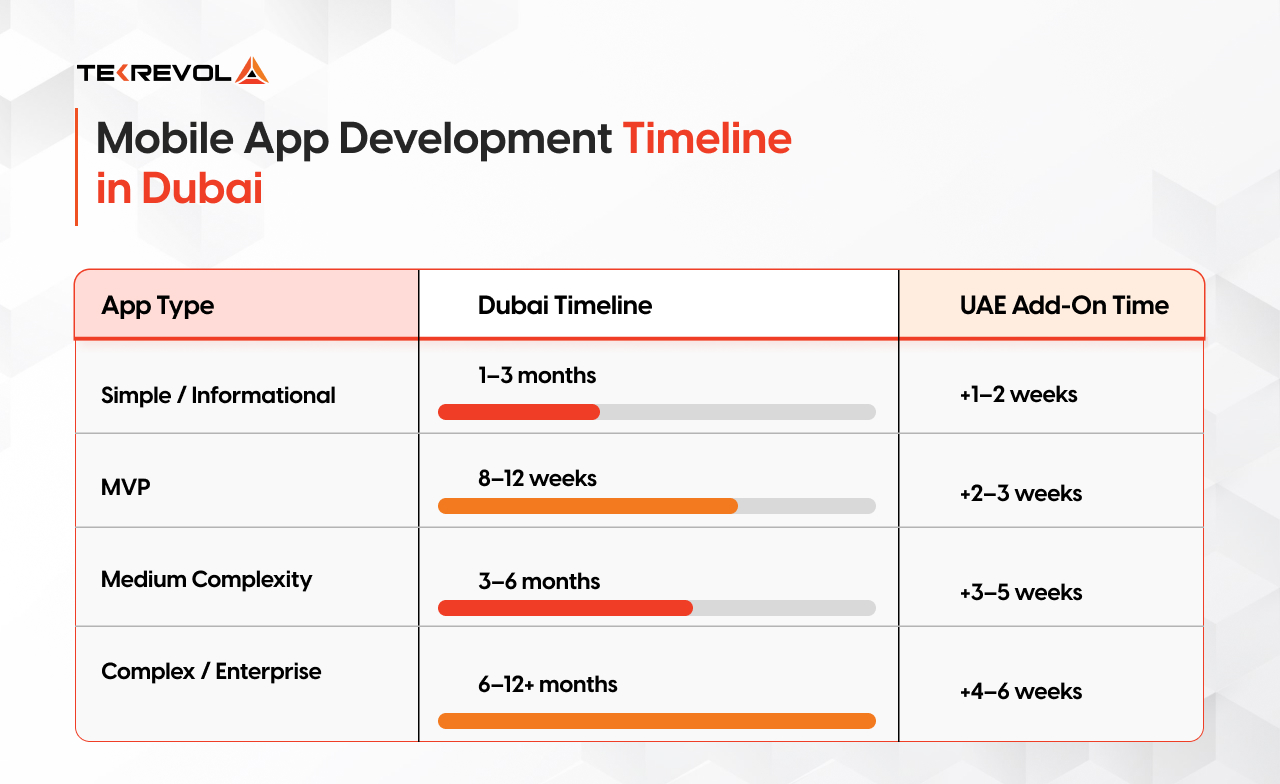
Building a mobile app in Dubai takes a minimum of 8 weeks for a simple MVP. And up to 14 months for a regulated enterprise platform, with the exact timeline. This timeline is determined by complexity, platform choice, Arabic localization scope, and UAE-specific compliance requirements.
Here is the quick reference table before anything else:
| App Type | Typical Use Cases | Dubai Timeline | UAE Add-On Time |
| Simple / Informational | Business profiles, directories, and basic booking | 1–3 months | +1–2 weeks |
| MVP | Startup validation, pilot product | 8–12 weeks | +2–3 weeks |
| Medium Complexity | E-commerce, on-demand, delivery apps | 3–6 months | +3–5 weeks |
| Complex / Enterprise | Fintech, logistics, SaaS, healthcare | 6–12+ months | +4–6 weeks |
Do you know that the UAE digital transformation market is growing at 21% CAGR (2026–2033), driven by enterprise digital adoption.
Many top-notch mobile app development companies underestimate UAE-specific requirements. A Dubai app isn’t just a global product with Arabic text added; it demands localization at every level.
It requires Arabic-first RTL design, bilingual content management, local payment gateway integration, and data architecture that satisfies UAE privacy law. Every one of those requirements takes real development time.
Plan for them from day one. Do not discover them in week six.
Need a Clear App Development Timeline?
TekRevol breaks down your idea into phases, cost, and delivery milestones tailored for Dubai.
Get Your Timeline →What Are the Stages of Mobile App Development in Dubai and How Long Does Each Take?
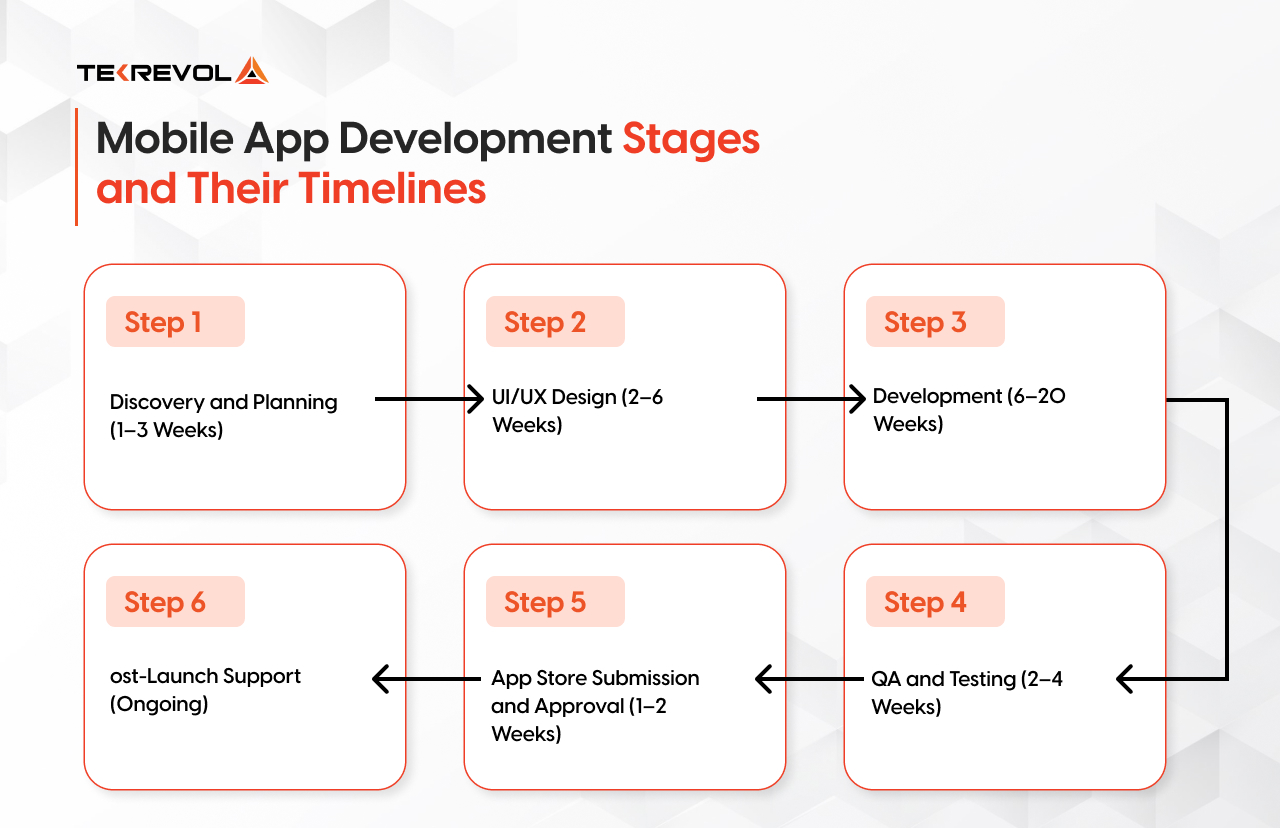
Mobile app development in Dubai typically moves through six key phases, starting with discovery, followed by UI/UX design and development, then QA and testing, App Store submission, and ongoing post-launch support.
Each phase has its own timeline, and UAE-specific requirements at every stage can further extend the overall development time depending on the app’s complexity.
This is where the time actually goes. Understanding each phase protects you from surprises.
Stage 1 — Discovery and Planning (1–3 Weeks)
This is the phase most Dubai businesses rush, and the one that determines whether the entire project stays on schedule.
Discovery covers:
- Business goals and target audience definition
- Feature prioritization with a signed-off MVP scope
- Technical feasibility and architecture planning
- UAE regulatory mapping — PDPL, DHA, DIFC, or ENSA, depending on app category
- Platform decision — iOS, Android, or cross-platform
- Arabic localization scope and bilingual content strategy
Regulatory scoping must happen here, not mid-development. A healthcare app needs DHA licensing scoped before a single wireframe is drawn, something a reliable healthcare app development company in Dubai will always prioritize from the start.
A fintech app needs ENSA requirements mapped before the architecture is designed. Discovering these requirements at stage three adds months, not weeks.
The deliverable at the end of discovery is a signed-off feature specification and a realistic timeline with milestones. Without it, you are building on assumptions, and assumptions break timelines.
Stage 2 — UI/UX Design (2–6 Weeks)
Design in Dubai is not straightforward. The multicultural audience, Emirati nationals, South Asian expats, Western residents, and international visitors require a design language that works across cultural contexts simultaneously.
What happens during design:
- Arabic-first RTL wireframes (before English counterparts — not after)
- Visual design with Dubai-appropriate aesthetics
- Interactive prototype for user testing
- Bilingual design system covering all screens in both Arabic and English
Building Arabic RTL wireframes before English wireframes adds 1–2 weeks compared to English-only design. But doing it the other way, building English first, then adapting to Arabic, costs more time in rework and produces inferior results. Arabic is not a translation overlay. It is a completely different interface layout.
Typography matters here, too. Cairo, Tajawal, and IBM Plex Arabic are the standard Arabic mobile fonts. Generic system fonts render Arabic poorly on mobile and immediately signal a non-native product to local users.
Design sign-off timing directly affects the development start date. Every week of design revision delays development by a week. Build structured review checkpoints into the design phase, typically two rounds of revisions maximum before sign-off.
At TekRevol, Arabic-first design is not a separate workstream; it is built into the standard design process for every UAE market app. Our design system includes pre-built RTL component libraries that reduce Arabic interface design time by 30–40% without compromising quality.
Stage 3 — Development (6–20 Weeks)
Development is where your app stops being a concept and starts becoming something real users can actually touch, tap, and rely on.
This is where timelines either stay on track or start slipping if scope and structure aren’t tightly managed, especially when working with an experienced android app development company in Dubai that understands how to balance performance from day one.
At this point, everything from UI screens to backend logic, APIs, databases, and integrations comes together in one continuous build cycle.
Development covers:
- Frontend build (what users see)
- Backend API development (the logic and data layer)
- Database architecture and setup
- Third-party API integrations
- UAE-specific integrations
UAE-specific integrations and their time cost:
| Integration | Estimated Time |
| Arabic/English bilingual CMS | +1–2 weeks |
| Telr or PayTabs payment gateway | +1–2 weeks per gateway |
| UAE PASS integration | +1–2 weeks |
| UAE PDPL compliance architecture | +1–2 weeks |
| Apple Pay UAE configuration | +3–5 days |
| Google Maps UAE (address system) | +3–5 days |
Platform choice has the biggest single impact on development timeline:
- Cross-platform (Flutter or React Native): 20–30% faster than dual native. Arabic RTL support is native in both frameworks in 2026. Recommended for most UAE market apps.
- Native iOS only or Android only: Baseline timeline. Appropriate when platform-specific features are core.
- Dual native (separate iOS and Android builds): 40–60% longer than single platform. Justified only when performance requirements or hardware integration demand it.
The scope creep problem: Adding features mid-development is the most consistent cause of timeline overruns in Dubai’s market. Every significant feature added after sign-off typically costs 1.5–2x what it would have cost if planned from the start. The pressure to add features from GITEX demos, competitor launches, or investor feedback is real. Resist it until version two.
Stage 4 — QA and Testing (2–4 Weeks)
Testing feels like it slows things down. It does not. It prevents the kind of post-launch problems that take months to fix and damage App Store ratings permanently.
QA in a Dubai context covers:
- Functional testing — every user flow in both Arabic and English
- Device testing — Samsung and iPhone models dominant in UAE; test on actual devices, not simulators
- Performance testing — UAE has 90%+ 5G coverage; users expect app performance that matches the network
- Security testing — UAE PDPL requires demonstrable data security; security testing is a compliance requirement, not optional
- UAT (User Acceptance Testing) — real users in Dubai testing both language interfaces
Arabic interface QA is a separate testing cycle. Navigation flows, button placement, text rendering, and right-to-left scroll behavior all need independent verification. Automating English tests and assuming Arabic works is one of the most common QA shortcuts, and one of the most expensive.
Bugs caught during QA cost a fraction of what they cost post-launch. An App Store update after a critical bug takes 1–2 weeks to review and publish. A critical bug during the first week of launch does brand damage that takes far longer to recover from.
Stage 5 — App Store Submission and Approval (1–2 Weeks)
Both Apple App Store and Google Play have review processes that are outside your development team’s control.
Apple App Store: 24–48 hours standard. Up to 7 days if flagged for additional review.
Google Play: 3–7 days standard.
Common rejection reasons in the UAE market apps:
- Missing Arabic privacy policy (required for UAE-market apps)
- VoIP features without UAE TRA licensing disclosure
- Payment features without proper App Store payment disclosure
- Age rating misclassification for content
Each rejection adds 1–2 weeks to your launch date. The fix is a compliance review of all App Store metadata before submission, conducted by someone with UAE App Store submission experience.
Apps in regulated sectors have an additional step before App Store submission. These regulatory reviews are completely outside the development team’s control and must be started early, ideally in parallel with development, not after it.
TekRevol runs an App Store compliance review as part of QA before submission. This single step has eliminated App Store rejections on client launches for the past three years. This review assesses metadata, privacy policy completeness, payment disclosures, age rating systems, and compliance with UAE regulatory requirements.
Stage 6, Post-Launch Support (Ongoing)
The moment of launching the product should not be considered as the end of the line. Rather, it is the time when genuine users have their first experience of the product.
Budget 15–20% of your initial development cost annually for post-launch maintenance. This covers iOS and Android OS update compatibility, PDPL compliance updates as UAE enforcement tightens in 2026, performance monitoring, and user-driven feature iterations.
Apps that treat launch as the finish line consistently underperform apps built with a 90-day post-launch roadmap already planned.
From the first day to 30 days: The focus is on identifying bugs that could potentially be harmful, keeping track of performance, gathering user opinions, and handling the management of App Store ratings.
From day 30 to day 90: It is most often the case that the data gathered from the analytics of the actual user behavior is quite different from the assumptions made during the planning phase. Feature updates can be done by making use of this data.
The regulatory frameworks of the UAE are evolving, and PDPL compliance will become a strict enforcement issue in 2026. From the start, make sure your budget accounts for the mobile app development cost in Dubai to avoid unexpected compliance and maintenance expenses.
SSSA needed to modernize its legacy infrastructure with a secure and scalable digital platform. TekRevol developed an integrated mobile and web ecosystem with role-based access control, enabling real-time communication, seamless integration across 10+ security systems, and compliance with government security standards.
How Long Do Specific Dubai App Categories Take to Build?
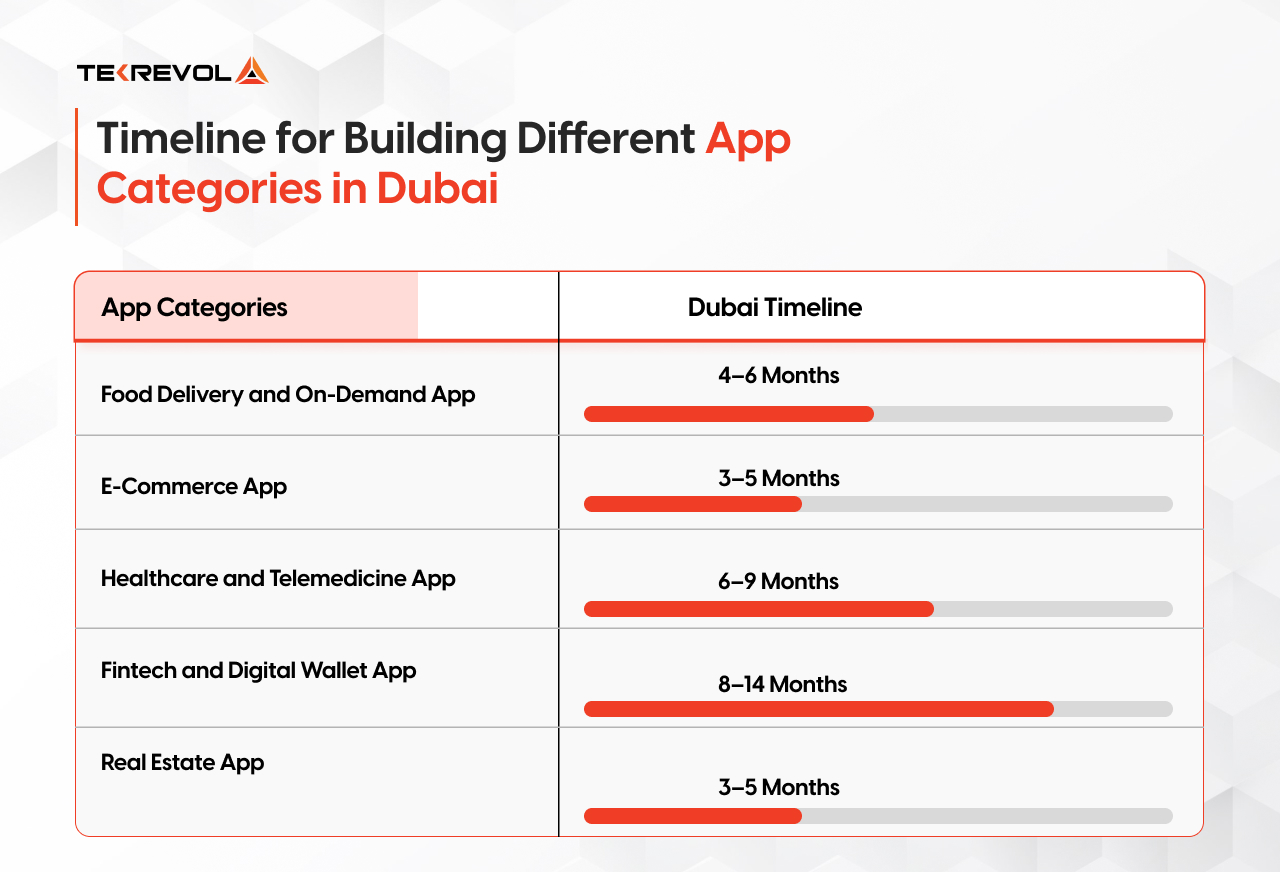
Different app categories in Dubai follow predictable development timelines, but these are generally longer than global averages due to UAE-specific integrations, bilingual requirements, and compliance needs.
Food delivery apps typically take 4–6 months, e-commerce apps 3–5 months, telemedicine platforms 6–9 months, fintech apps 8–14 months, and real estate apps around 3–5 months.
Food Delivery and On-Demand App (4–6 Months)
A genuine on-demand delivery app in Dubai is four separate products: customer app, driver app, restaurant or merchant dashboard, and admin panel. That is the baseline.
Key integrations: Telr or PayTabs, Google Maps UAE, SMS OTP, push notifications, Arabic RTL across all four interfaces.
UAE-specific additions: Cash on delivery logic (still widely used across the Emirates), UAE address system integration, Arabic menu, and product content.
What extends the timeline: Multi-restaurant marketplace architecture vs. single restaurant. Loyalty points system. Scheduled delivery slots.
E-Commerce App (3–5 Months)
Core build: Product catalog, search and filter, cart, checkout, order tracking, returns management.
Key integrations: Telr or PayTabs, Aramex or Fetchr UAE shipping APIs, VAT calculation (5% UAE VAT must be clearly displayed at checkout — regulatory requirement).
UAE-specific: Arabic product descriptions and RTL catalog browsing, Arabic customer support chat.
What extends the timeline: Multi-vendor marketplace architecture doubles the timeline to 6–9 months. The loyalty and rewards program adds 4–6 weeks.
When planning to build an ecommerce mobile app in Dubai, these requirements directly impact both the architecture and development timeline, especially for multi-vendor setups.
Healthcare and Telemedicine App (6–9 Months)
This is the most compliance-heavy category in Dubai. DHA (Dubai Health Authority) and MOH licensing add 2–4 weeks of regulatory review that is outside the development team’s control.
Key features: Appointment booking, teleconsultation video, patient records, prescription management, and insurance integration.
UAE-specific: Arabic patient interface, DHA-compliant data handling, integration with UAE health ID systems.
What extends the timeline: Integration with DHA or SEHA systems, insurance validation flows, and specialist referral management.
Fintech and Digital Wallet App (8–14 Months)
The regulatory timeline is the dominant factor here. ENSA licensing, DIFC or ADGM framework clearance, and UAE Central Bank approval can each take months, independent of development progress.
Start regulatory applications on day one of the project. Run compliance work in parallel with development. Do not wait for the app to be built before starting the regulatory process.
Key features: Account management, transfers, payment processing, transaction history, and KYC verification.
UAE-specific: Nafath/UAE PASS KYC integration, AML monitoring system, Arabic and English interface.
If you are evaluating budget and scope for this type of app, it’s important to understand the real investment required. Understanding the cost to build a digital wallet app in UAE helps you make more informed decisions before finalizing your product plan.
Real Estate App (3–5 Months)
Key features: Property listings with search and filter, virtual tour integration, agent profiles, inquiry management, and mortgage calculator.
UAE-specific: RERA-compliant agent registration display, Dubai Land Department API integration for verified listings, Arabic and English property descriptions.
What extends the timeline: Escrow management features, DLD blockchain-verified listings integration.
Note: It is essential to understand these features as you create a real estate app like Bayut, because they directly impact functionality, user experience, and overall project success.
Want to Launch Faster Without Compromising Quality?
TekRevol uses agile sprints and pre-built UAE integrations to accelerate your app launch.
Schedule a Strategy Call →What Factors Delay App Development Timelines in Dubai Most Frequently?
The five most common causes of app development delays in Dubai include unclear initial scope, late Arabic content delivery, and payment gateway sandbox delays. They also include App Store compliance rejections and UAE regulatory clearance timelines, which often run sequentially instead of in parallel with development.
Unclear Initial Scope
Starting development without a locked feature specification. The symptom: “We want it like Careem but also like Noon.” That is two different products. The fix: signed feature specification before any design work begins.
Late Arabic Content Delivery
Development blocks for content. Arabic product descriptions, UI copy, and marketing content must be delivered on a schedule. In Dubai, where Arabic-first is non-negotiable, content delays hit the most critical part of the build disproportionately.
Fix: Arabic content calendar with hard deadlines built into the project plan from week one — not discussed after the design phase.
Payment Gateway Sandbox Delays
Getting sandbox credentials from Telr, PayTabs, or Network International takes 1–3 weeks. If this is not initiated at project start, it becomes a blocker during the payment integration sprint.
Fix: Initiate merchant registration and sandbox access on day one — not when the development team reaches the payment sprint.
App Store Compliance Rejections
A single App Store rejection adds 1–2 weeks. Three rejections add a month. All are preventable with a compliance review before submission.
Fix: Dedicated App Store compliance review before any submission.
Regulatory Clearances Run Sequentially
Healthcare and fintech founders often wait for app completion before starting regulatory applications. That turns a parallel process into a sequential one, adding months to launch.
Fix: Start DHA, ENSA, or DIFC applications on day one. Run regulatory and development in parallel.
TekRevol Expert Note: The two delays we see most consistently in Dubai app projects are late Arabic content delivery and payment gateway sandbox initiation. Both are client-side dependencies that stop development entirely.
TekRevol’s project kick-off includes a dependency checklist that captures all client-side deliverables, Arabic content, payment gateway registration, and third-party API access, with hard dates assigned at project start. This single practice eliminates the most common mid-project timeline failures.
Can You Speed Up App Development in Dubai Without Sacrificing Quality?
Yes, you can reduce your Dubai app development timeline by 20–40%. That’s through MVP-first development, locked scope before kickoff, cross-platform development, and partnering with an agency that has pre-built UAE integrations.
Build an MVP First
The biggest timeline mistake Dubai businesses make: trying to build everything in version one.
An MVP with core features launches in 8–12 weeks. Adding every feature to v1 extends that to 6+ months, before you have validated a single user assumption.
What belongs in a Dubai app MVP:
- Core user journey — the one thing your app must do perfectly
- Authentication — email, social, UAE PASS if required
- One payment gateway — Telr or PayTabs
- Arabic and English interface
- Basic push notifications
- App Store-ready compliance
What belongs in version two:
- Loyalty programs and referral systems
- AI-powered recommendations
- Advanced analytics dashboard
- Additional payment gateways
- Multi-vendor architecture
Noon launched with limited categories. Careem launched with basic ride-booking. Both were MVPs that became dominant UAE platforms. The lesson has not changed.
Lock Your Scope Before Development Begins
Every significant feature added mid-sprint costs 1.5–2x what it would have cost if planned from the start. Sign off on the feature list in writing. Changes after sign-off go through a formal change order with documented timeline implications.
Choose Cross-Platform Development
Flutter and React Native app development in Dubai both support Arabic RTL natively in 2026. For most market apps, cross-platform delivers 85–90% of native quality at 60–70% of the timeline.
Native is worth it when: deep hardware integration, ultra-high performance (gaming, real-time video), or platform-specific UI patterns are core to the product.
For e-commerce, on-demand healthcare, and most B2B apps in Dubai, cross-platform is the right call.
Partner With Pre-Built UAE Integration Experience
An agency that has already integrated Telr does not spend two weeks building it. They spend two days configuring it. Pre-built UAE integration experience reduces the time cost of each local requirement by 50–70%.
TekRevol Project
Alif Play needed a scalable mobile platform capable of delivering smooth performance and engaging digital learning experiences. TekRevol developed a feature-rich app with intuitive UI/UX, optimized performance, and a scalable backend, resulting in improved engagement, stable content delivery, and support for future growth.
How Much Does It Cost to Build a Mobile App in Dubai in 2026?
Mobile app development costs in Dubai follow the same variables as timelines, complexity, platform choice, UAE-specific integrations, and compliance requirements, all of which affect the final number.
Here is the realistic cost breakdown by app type:
| App Type | Estimated Cost | Timeline |
| Simple / Informational App | $8,000 – $15,000 | 1–3 months |
| MVP (Startup Validation) | $15,000 – $35,000 | 8–12 weeks |
| Medium Complexity App | $35,000 – $80,000 | 3–6 months |
| Complex / Enterprise Platform | $80,000 – $200,000+ | 6–12+ months |
UAE-specific cost additions that global estimates miss:
- Arabic RTL design and QA: +$2,000 – $5,000
- Telr or PayTabs payment integration: +$1,500 – $3,000 per gateway
- UAE PASS integration: +$1,500 – $2,500
- PDPL compliance architecture: +$2,000 – $5,000
- DHA or ENSA regulatory compliance (healthcare/fintech): +$5,000 – $15,000
What moves the cost up: Multi-vendor marketplace architecture, custom AI features, real-time tracking, and dual native iOS and Android builds all push costs toward the upper end of each tier.
What keeps costs controlled: Cross-platform development (Flutter or React Native), a locked MVP scope, and an agency with pre-built UAE integrations reduce both cost and timeline simultaneously. TekRevol’s pre-built UAE integration library eliminates 30–40% of the custom development cost that teams building these integrations from scratch absorb on every project.
Annual maintenance typically runs 15–20% of the initial build cost, covering OS updates, PDPL compliance changes, and feature iterations based on real user data.
How Does TekRevol’s 4-Week Sprint Model Work for Dubai Businesses?
TekRevol delivers structured mobile app development for Dubai businesses through a 4-week sprint model. With milestone-based delivery, pre-built UAE integrations, and a named project manager accountable for every phase from discovery through launch.
Here is how it works in practice:
- Sprint 1 (Weeks 1–4): Discovery, regulatory scoping, architecture design, UI/UX wireframes. Deliverable: signed-off feature specification and Arabic-first wireframes.
- Sprint 2 (Weeks 5–8): Visual design, interactive prototype, user testing. Deliverable: approved bilingual design system ready for development.
- Sprint 3+ (Development sprints): Two-week development cycles with a working demo at the end of each sprint. Client reviews happen at sprint boundaries, not continuously, which eliminates the revision chaos that derails most projects.
- Pre-built UAE integration library: Arabic RTL design system, Telr and PayTabs integration, UAE PASS authentication, UAE PDPL compliance architecture, App Store compliance checklist. These are not built from scratch for each client. They are configured. That difference eliminates weeks from the standard timeline.
- Post-launch: 30-day bug warranty, named support contact, maintenance retainer available. Full credential handover at launch, App Store accounts, hosting, source code, all under your ownership.
TekRevol Dubai has delivered 500+ apps across the UAE and GCC and the average MVP delivery timeline is 10 weeks from signed discovery to App Store submission. If you are planning an app launch in Dubai in 2026, the conversation starts with a discovery call, not a proposal.
Looking for a Reliable Mobile App Development Partner?
TekRevol delivers end-to-end app solutions with transparent timelines and milestone-based execution.
Connect With Us →


