- A book tracking app MVP costs $15,000–$30,000 and takes 10–14 weeks to launch.
- Book search, reading status, progress tracking, shelves, and ratings are non-negotiable MVP features.
- React Native, Node.js, PostgreSQL, and Google Books API make the ideal 2026 tech stack.
- Start with Open Library for MVP, migrate to Google Books API once you hit real user volume.
- Launch with freemium, add subscriptions at 1,000 users, and monetize publishers at scale.
- TekRevol builds book tracking apps end-to-end — from MVP scoping to App Store launch and beyond.
Readers have their own struggles, and the world goes unheard. And the primary one is what’s next to read.
That single frustration has kept Goodreads relevant for over a decade, despite its clunky interface, outdated design, and features that haven’t meaningfully evolved in years. Yet 150 million readers still show up, because nothing better exists. That’s not loyalty. That’s a market waiting to be disrupted.
The opportunity is real. But most founders who try to chase it stumble at the same hurdle: they don’t know where to start.
Building a book tracking app starts with validating your market, defining your MVP features, choosing the right tech stack, and understanding your total development cost. Done right, it takes 10–14 weeks and starts at $15,000–$30,000. Get those decisions wrong, and you burn budget before your first user signs up.
We’ve done this before. Every recommendation in this guide comes from hands-on experience building apps that launched, retained users, and scaled, the kind of experience only a battle-tested mobile app development company can bring to the table.
The Book Tracking App Market in 2026: Why Now Is the Right Time to Build
The reading app space is having a quiet renaissance. Audiobooks are booming, BookTok has turned reading into a cultural moment, and readers are more engaged than ever, yet the tools they use haven’t kept pace. Here’s what the market looks like right now:
- 150M+ active Goodreads users, the dominant player, yet consistently rated poorly for UX and design. Goodreads alternative app development is one of the most searched intents in the reading app space, with no dominant winner yet.
- The global e-book reader market is projected to reach $11.58 billion by 2031, reflecting sustained demand for digital reading and reading-adjacent products.
- BookTok has become a major driver of Gen Z reading habits and book sales, fueling demand for more modern and community-focused reading platforms.
- No clear Goodreads alternative has achieved mainstream adoption, leaving a well-funded gap in the market.
- In 2025, global eBook consumption is expected to reach $15.5 billion, according to Statista.
- Subscription and freemium models are proving highly viable in niche lifestyle apps, making monetization more predictable than ever.
Our Read on This Market
At TekRevol, we’ve watched this category evolve from a single dominant player (Goodreads) to a fragmented, opportunity-rich space. We’ve built social platforms, EdTech products, and API-heavy community apps, and we can say with confidence: the product-market fit for a modern reading tracker is already validated.
For founders pursuing a Goodreads alternative app development specifically, the timing has never been more favorable.
View a Full case study →
Core Features Every Book Tracking App Must Have to Succeed
Before you scope your project, understand which features readers will miss from day one — and which ones can wait for Phase 2.
After carefully analyzing various book tracking apps and examining their features, we’ve compiled a list of essential elements that can be game-changers for your app’s success.
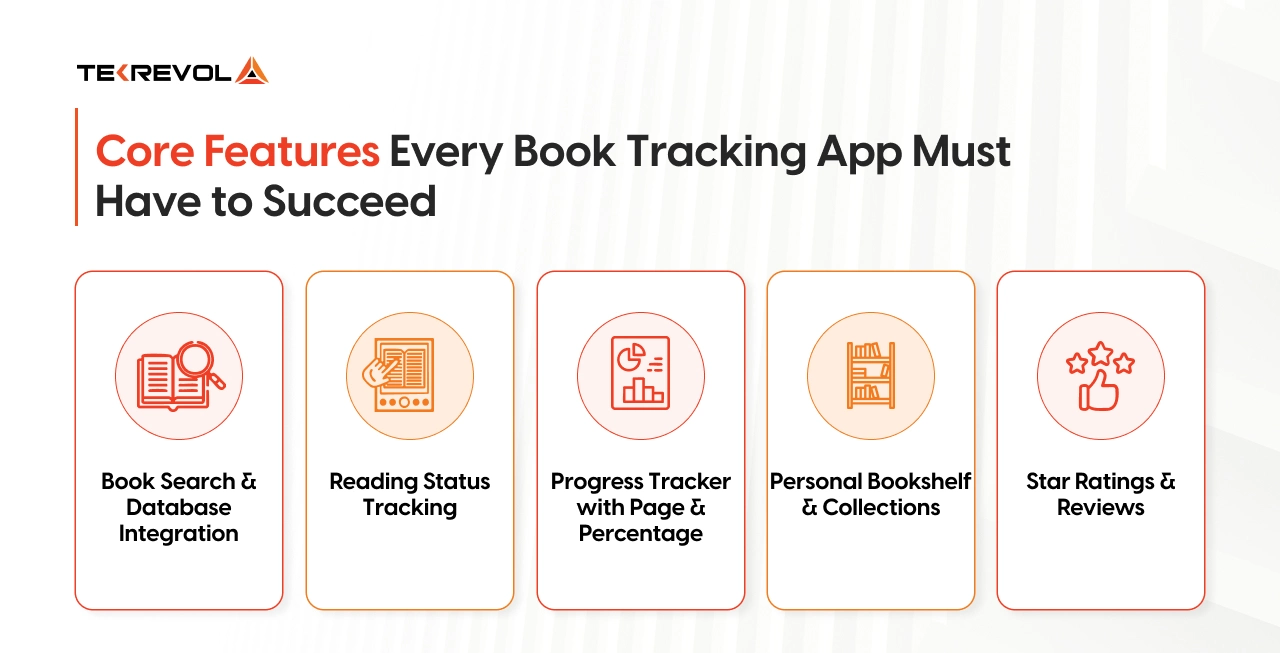
Book Search & Database Integration
If readers can’t find their books instantly, they won’t use anything else your app offers. Integrating the Google Books API or Open Library solves this from day one.
- Access to millions of titles, cover images, and metadata out of the box
- Search by title, author, or ISBN without building your own database
- Barcode scanning support for physical book collections
- Accurate edition matching so readers log the right version
When a user searches for a book in your app, that search doesn’t hit your own database; it hits an external book database through an API. Most founders underestimate this decision. The API integration services provider you work with determines your catalog size, your search speed, your cover image quality, and how much rework you’ll face six months into growth.
Choosing between the two comes down to where you are in your build:
| Open Library | Google Books API | |
| Cost | Free, no limits | Free up to 1,000 req/day, paid beyond |
| Catalog size | 20M+ books | 40M+ books |
| Cover image quality | Limited | High quality |
| Metadata accuracy | Community-sourced, inconsistent | More reliable |
| Best for | MVP / early stage | Scaling beyond 10K users |
Reading Status Tracking
This is the core mechanic everything else is built around. Get this right, and you’ve built the habit loop that brings readers back daily.
- A three-state system that mirrors how readers already think
- One-tap status updates with smooth, satisfying transitions
- Clear visual separation between each reading state
- Foundation for recommendations, stats, and social features down the line
Progress Tracker with Page & Percentage
A reading progress tracker turns a passive hobby into something measurable and motivating. It’s the single feature most responsible for daily active usage.
- Supports both page numbers and percentages for every reader type
- Visual progress bar that makes the finish line feel reachable
- Daily logging builds a reading habit without feeling like a chore
- Reading pace calculation so users know when they’ll finish
Personal Bookshelf & Collections
Readers don’t just want to track books; they want to own their reading experience. Custom shelves make your app feel personal from day one.
- Custom collections beyond the default three reading states
- Organize by genre, mood, source, or anything the reader chooses
- Drag-and-drop shelf management for intuitive organization
- The personalization layer that keeps users from switching to a competitor
Star Ratings & Reviews
Every finished book deserves a reaction. A simple rating and review system closes the reading loop and quietly builds valuable content on your platform.
- Five-star rating system that takes one second to use
- Optional review field with zero mandatory requirements
- Personal reading diary that grows richer over time
- Foundation for community and social features in future versions
Reading Statistics & Yearly Goals
Readers are motivated by progress and proud of their numbers. A clean stats dashboard with yearly goals turns casual users into committed ones.
- Books read, pages turned, and average pace tracked automatically
- Yearly reading goal with visual progress and gentle reminders
- Genre breakdown and reading trends over time
- The one-screen users screenshot and share on social media
These six features are your foundation. But the retention that turns a useful app into a daily habit comes from the social layer you’ll build on top of it in Phase 2
Feature Priority for Your Book Tracking App MVP
Not every feature belongs in your MVP development. Here’s exactly what to ship on day one, what to add in month three, and what to save for when you have real user data telling you to build it.
| Feature | Priority |
| Book search & database integration | Must have |
| Reading status tracking | Must have |
| Progress tracker (page/%) | Must have |
| Personal shelves & collections | Must have |
| Star ratings & reviews | Must have |
| Reading stats & yearly goals | Must have |
| Barcode scanning | Nice to have |
| Push notifications | Nice to have |
| Friend activity feed | Post launch |
| Reading challenges | Post launch |
| Book clubs | Post launch |
| AI recommendations | Post launch |
| Shared shelves | Post launch |
Social & Community Features (Post-MVP)
Goodreads is proof that a social layer outlasts a bad product. Readers don’t stay because it’s good; they stay because everything they care about is already there. Your Phase 2 goal is to build that same lock-in, with a product that’s actually worth staying for.
Friend Activity Feed
Nothing motivates a reader like seeing someone they know finish a book they’ve been putting off. A friend activity feed brings that feeling into your app, a live stream of what people in your network are reading, rating, and reviewing. It creates conversation, sparks recommendations, and gives users a reason to open the app even on days they haven’t read a single page.
- Follow specific friends or discover readers with similar tastes
- React to updates and start conversations around specific books
- Get notified when a friend finishes a book you’re both tracking
- Activity feed doubles as a passive discovery engine for new titles
Reading Challenges
Challenges turn reading into a shared experience with a finish line. A yearly reading goal is personal; a reading challenge is communal. Whether it’s “read 5 books this summer” or “finish one classic this month,” challenges give readers a reason to stay active, log consistently, and feel accountable to something bigger than themselves.
- Annual, monthly, and themed challenge formats
- Community-wide and friend group challenges
- Progress tracking with leaderboards and milestone badges
- The single biggest driver of consistent daily app opens
Book Clubs
Book clubs have existed for centuries because they work. Bringing them inside your app creates a closed-loop reading experience: pick a book together, read on your own schedule, and come back to discuss. For your platform, book clubs mean longer sessions, deeper engagement, and users who recruit other users to join their group.
- Create or join clubs around any book, genre, or theme
- Shared reading timelines and group progress tracking
- In-app discussion threads tied to specific chapters
- Natural viral growth as club members invite friends
Shared Shelves
A shared shelf is half personal library, half social signal. Let users make any collection public, their all-time favorites, their 2026 reads, their best thriller recommendations, and your app suddenly has user-generated content that drives discovery without a marketing budget. Shared shelves get screenshotted, linked, and talked about.
- Make any shelf public or shareable via a direct link
- Set visibility controls — public, friends only, or private
- Allow followers to save a shared shelf directly to their own library
- Surface trending community shelves on the discovery page
Recommended Tech Stack for Building a Book Tracking App in 2026
The recommended tech stack for a book tracking app in 2026 is React Native for the frontend, Node.js for the backend, PostgreSQL as the primary database, and either the Open Library or Google Books API for book data, hosted on AWS.
These are our recommendations based on book tracking app projects we’ve shipped, but every tool has a valid alternative depending on your team’s strengths, timeline, and budget. Here’s the full breakdown:
| Layer | Technology | Why |
| Frontend | React Native/ Flutter | Cross-platform, fast iteration |
| Backend | Node.js or Django/Python | Real-time, scalable, JS ecosystem |
| Database | PostgreSQL, or Firebase Firestore | The relational model fits perfectly |
| Cache / Real-time | Redis | Feeds, notifications, performance |
| Book Data | Open Library → Google Books | Free MVP, rich metadata at scale |
| Barcode | ML Kit + Vision framework | Native, accurate, fast |
| Storage | AWS S3 | Covers, avatars, attachments |
| Hosting | AWS EC2 + RDS | Production-grade from Day 1 |
| Auth | Firebase Auth | Fast to implement, battle-tested |
| Analytics | Mixpanel | Retention and behavior tracking |
| Crash Reporting | Sentry | Post-launch monitoring |
How to Build a Book Tracking App: Step-by-Step Process
Every step below has a direct impact on what you ship, how fast you ship it, and how much it costs. Follow this in order, and you’ll avoid the expensive mistakes most first-time founders make.
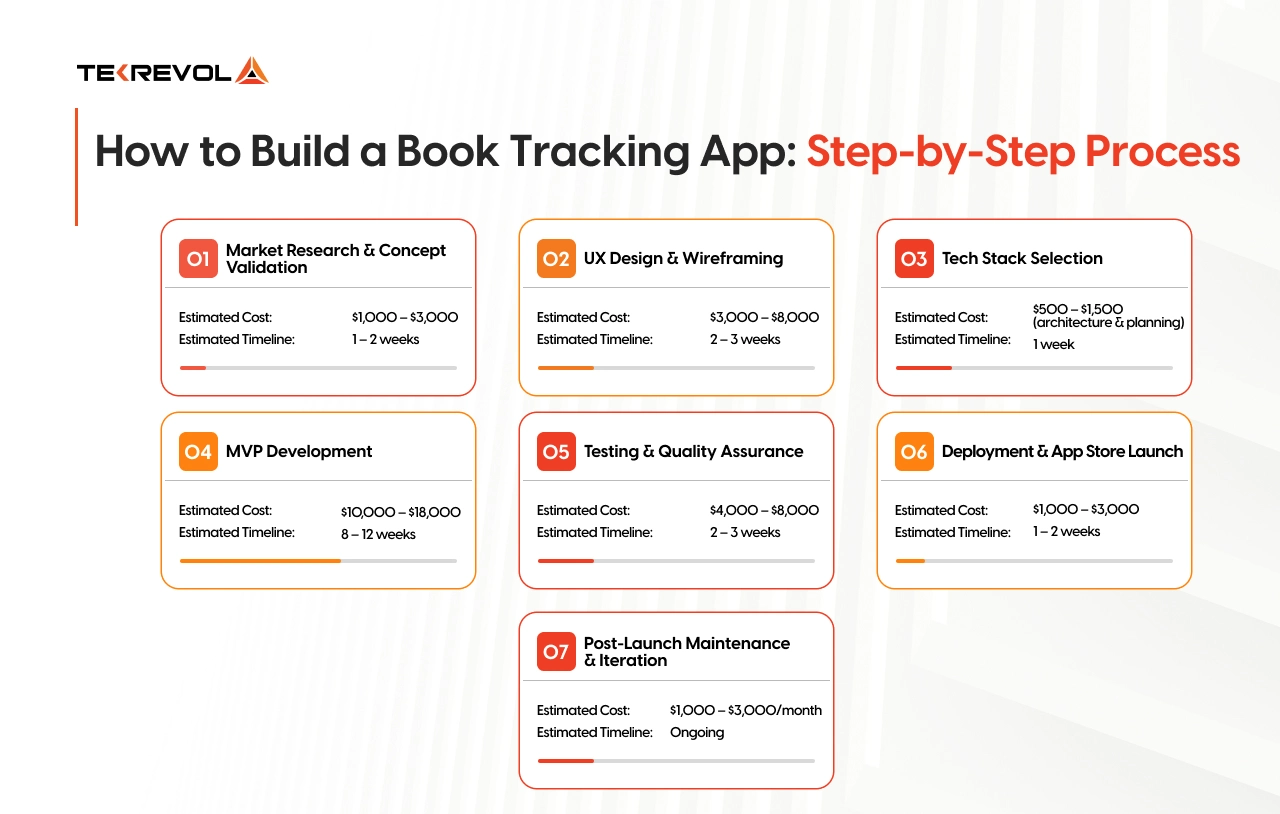
Step 1: Market Research & Concept Validation
Estimated Cost: $1,000 – $3,000
Estimated Timeline: 1 – 2 weeks
Study what’s broken in existing apps before building your own. Goodreads, StoryGraph, and Bookly all have vocal user bases; their complaints are your roadmap.
- Audit competitor apps and mine their 1-star reviews for patterns
- Build a specific user persona, not a broad demographic
- Identify your one differentiator before a single screen is designed
- Validate with real users through surveys or interviews before committing to the budget
Step 2: UX Design & Wireframing
Estimated Cost: $3,000 – $8,000
Estimated Timeline: 2 – 3 weeks
For book apps specifically, wireframe the book search flow and reading status update first; these two flows have the highest abandonment rate if the UX isn’t immediate and frictionless.
- Wireframe every screen and user flow in Figma or Sketch.
- Run usability tests with real users via Maze or Lookback.
- Follow Material Design for Android, HIG for iOS.
- Lock in a design system before handing it off to developers.
Step 3: Tech Stack Selection
Estimated Cost: $500 – $1,500 (architecture & planning)
Estimated Timeline: 1 week
Wrong stack decisions made here become expensive problems six months into development. Choose for scalability, not familiarity.
- Frontend: React Native or Flutter for one codebase across iOS and Android
- Backend: Node.js for real-time, scalable server logic
- Database: PostgreSQL for reading data, Redis for caching, and feeds
- Book Data: Open Library for MVP, Google Books API at scale
- Auth: Firebase Authentication for fast, secure login
Step 4: MVP Development
Estimated Cost: $10,000 – $18,000 | Part of the $15,000 – $30,000 total MVP
Estimated Timeline: 8 – 12 weeks
Build in two-week agile sprints. Ship only what’s on the MVP list: book search, status tracking, progress logging, shelves, ratings, and stats. Every feature added mid-sprint costs more than it looks.
- Start with book search and API integration; nothing else works without it
- Run frontend and backend development in parallel to save time
- Use Jira or Trello to manage sprints and keep scope locked
- Share internal builds weekly for early bug catching
Step 5: Testing & Quality Assurance
Estimated Cost: $4,000 – $8,000
Estimated Timeline: 2 – 3 weeks
For book tracking apps, load tests your book search API calls specifically, a 3-second delay on search is the single biggest reason users uninstall on day one.
- Functional testing across every core user flow
- Device compatibility across iOS and Android screen sizes
- Load testing on the book search and activity feeds specifically
- Full regression testing before App Store submission
Step 6: Deployment & App Store Launch
Estimated Cost: $1,000 – $3,000
Estimated Timeline: 1 – 2 weeks
Getting your app live is its own process. Both the Apple App Store and Google Play Store have submission requirements, review periods, and guidelines that can delay your launch if you’re not prepared.
- Submit to App Store and Google Play with all guidelines met upfront
- Set up AWS EC2 and RDS for production-grade hosting
- Configure the CI/CD pipeline for fast future updates
- Soft launch to a small audience before full public release
Step 7: Post-Launch Maintenance & Iteration
Estimated Cost: $1,000 – $3,000/month
Estimated Timeline: Ongoing
Apps that stop updating lose users within 90 days. Your real product roadmap starts the day you launch.
- Monitor crashes in Sentry and behavior in Mixpanel from day one
- Read every app store review, and users tell you exactly what to fix
- Ship OS compatibility updates and bug fixes quarterly
- Build Phase 2 features based on actual usage data, not assumptions
How to Promote a Book Tracking App
Developing a feature-rich book tracking app is only half the journey; the second half is ensuring it reaches your target audience. Promoting your book tracking app effectively is essential for gaining users and building a loyal community.
Here are some comprehensive strategies to consider:
Own BookTok Before You Launch
BookTok has driven hundreds of millions of book sales and built reading communities no other platform has matched, and it’s completely underutilized as an app launch channel.
- Partner with micro-influencers (10K–100K followers) in specific genres before launch
- Give them early access and let their audiences become your first users
- Focus on “reading tracker” and “what I’m reading” content formats
- Seed two to four weeks before the public launch for organic momentum
Run a Goodreads Migration Campaign
Your most motivated early users are already on Goodreads, frustrated, and actively searching for something better.
- Build a one-click Goodreads data import into your onboarding flow
- Target “Goodreads alternative” keywords in both paid and organic search
- Run targeted campaigns on r/books, r/goodreads, and r/52books communities.
ASO Built Around Reading-Specific Keywords
Readers search for very specific terms; your App Store listing needs to match exactly what they type.
- Primary: “book tracker,” “reading log app,” “Goodreads alternative.”
- Secondary: “reading challenge app,” “book list organizer,” “what to read next.”
- Feature: ISBN barcode scanning prominently in screenshots — it’s a high-converting visual
Miss the right keywords, and you’re invisible to the exact people your app was built for. This is where investing in app store optimization services early pays back in organic installs long before paid acquisition kicks in.
Build Inside Reading Communities First
Reddit’s r/books has 23 million members. r/52book runs an annual challenge with hundreds of thousands of participants. These communities will adopt a tool that solves a real problem if you show up authentically.
- Launch in r/52book during January when the annual reading challenge peaks
- Offer free premium access to community moderators and power users
- Ask for feedback publicly, and reading communities respond well to founder transparency
How Much Does It Cost to Build a Book Tracking App in 2026?
Reading app development costs in 2026 start at $15,000–$30,000 for a focused MVP, while feature-rich social reading platforms can exceed $100,000 depending on AI features, real-time systems, and scalability requirements.
| App Tier | Cost | Timeline | What you get |
| MVP | $15,000 – $30,000 | 8 – 14 weeks | Book search, reading status, progress tracker, personal shelves, ratings, and basic stats- foundation ready for social features in Phase 2. |
| Medium Complexity | $40,000 – $80,000 | 14 – 20 weeks | Everything in MVP + barcode scanning, social feed, challenges, push notifications, and advanced stats |
| Full Featured | $80,000 – $150,000+ | 20 – 32 weeks | Everything in Medium + AI recommendations, book clubs, audiobook sync, marketplace, and admin dashboard |
Wondering About the Exact Cost of Your Book Tracking App?
Share your requirements with TekRevol’s experts to receive a detailed cost breakdown, or use our Cost Calculator for an instant, tailored estimate based on your features and scope.
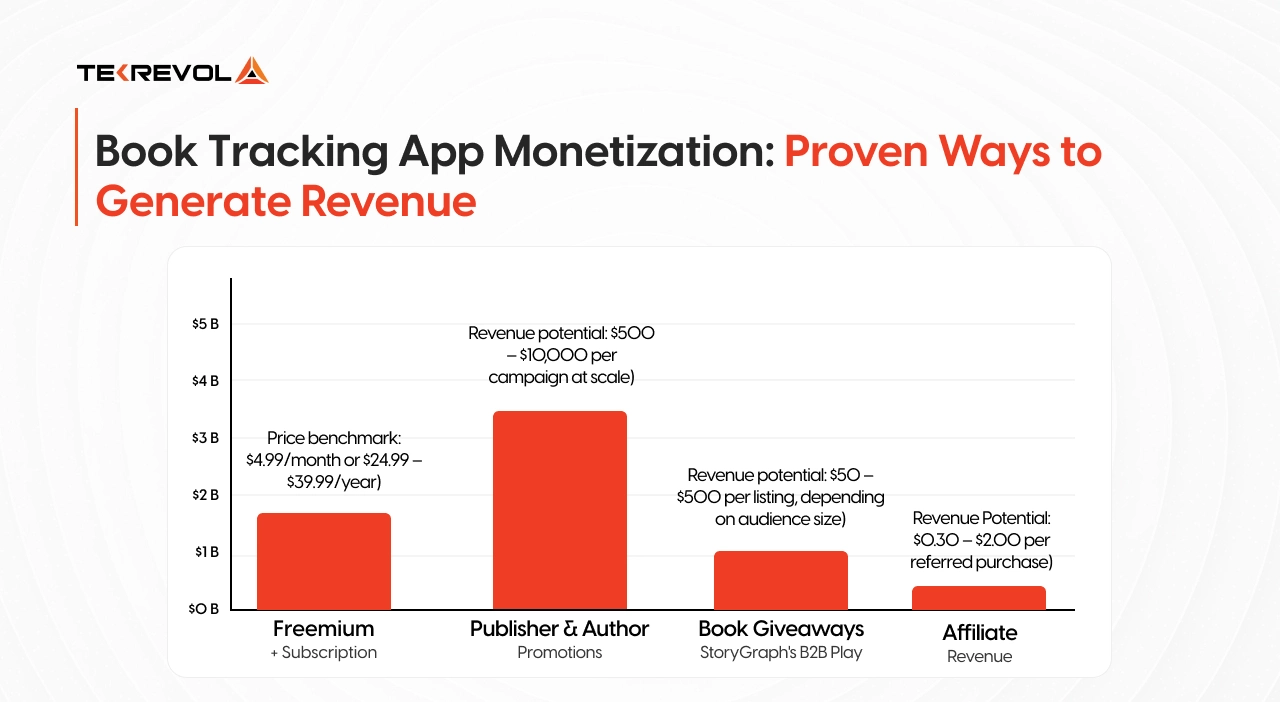
Calculate Now!Book Tracking App Monetization: Proven Ways to Generate Revenue
The smartest way to figure out monetization is to study what’s already working. Goodreads, StoryGraph, and Bookly have each taken a completely different approach to revenue, and the gaps between them are where your opportunity sits.
Freemium + Subscription
The model every successful book tracking app runs on. The free tier builds the habit; the paid tier monetizes loyal users.
- Bookly charges $4.99/month or $29.99/year for unlimited tracking, reading infographics, and cloud sync
- Shelf undercuts the market at $18/year — 64% cheaper than StoryGraph Plus — with a genuinely useful free tier.
- Annual billing retains subscribers far better than monthly plans
Price benchmark: $4.99/month or $24.99 – $39.99/year
TekRevol Recommendation: Always launch with freemium. Validate that users find enough value to pay before building a subscription system. Once validated, Stripe + RevenueCat handles billing cleanly and integrates with React Native in under a week.
Publisher & Author Promotions
This is how Goodreads makes the bulk of its money, and most competitors ignore it entirely. Top revenue streams include sponsored newsletters, author spotlights, personal selection emails targeting an author’s fans, and sponsored homepage placements.
- Featured new release placements in the discovery feed
- Author spotlight inclusions in weekly reader newsletters
- Genre-targeted campaigns for precise audience matching
Revenue potential: $500 – $10,000 per campaign at scale
Book Giveaways — StoryGraph’s B2B Play
Authors and publishers pay to host giveaways on StoryGraph. One indie debut novel generated 62,000 impressions and 2,500 entries, no ads in the feed, no sponsored content disguised as recommendations. Readers get free books, publishers get exposure, and you get paid.
- Charge authors per giveaway listing
- Offer premium placement for higher visibility
- Genre-targeted giveaways for precise reader matching
Revenue potential: $50 – $500 per listing, depending on audience size
Affiliate Revenue
Zero friction, always on. Goodreads earns a commission every time a user clicks through to Amazon to purchase a book. Set it up on day one and let it run.
- Amazon Associates: 4 – 8% per book purchase
- Audiobook deals via Audible or Libro.fm
- Indie bookstore partnerships for Amazon-averse readers
Revenue Potential: $0.30 – $2.00 per referred purchase
Why Choose TekRevol to Build Your Book Tracking App?
TekRevol is a mobile app development company with a proven track record of shipping social platforms, EdTech products, and API-heavy community apps across multiple verticals, and we bring that real, shipped-product experience directly to your reading app build. We don’t learn the hard lessons on your budget.
We’ve already solved the problems you’re about to face: complex API integrations, cross-platform performance, community feature architecture, and phased roadmaps that actually scale.
From social reading platforms to library app development for institutional clients, TekRevol has shipped across the full reading app spectrum.
- Book app expertise: We’ve integrated Google Books API, Open Library, Libby/OverDrive, and ISBN barcode scanning on real shipped products — not sandbox demos.
- React Native specialists: Our team has solved the hard stuff: large book list performance, offline reading state, and lag-free barcode scanning.
- Transparent pricing: Our estimates don’t change when you sign; a phased structure means you validate before you scale
- Dedicated squads: Our team stays with your product from start to finish, not developers juggling four clients at once
Claim Your Free Strategy Session — Worth $500!
Walk away with a scoped MVP plan, an honest cost estimate, and a clear launch roadmap tailored to your idea—built to help you move from concept to execution with confidence.
Book A FREE Call Now!