



You are going through web pages, comparing bids from every mobile app development company in Saudi Arabia, and they are all telling you different things. One swears custom development is the only way. Another guarantees you will be live in weeks with a white-label solution. In the meantime, you are simply attempting to make sense of what is viable to your business.
The thing is that both methods are amazing. Yet they are solving completely different problems. White-label applications are the speed track, and can cost you SAR 15,000 and up, and take weeks to get up and running.
On the other hand, Custom development is the strategic play. Beginning with SAR 80,000 and more, you are creating something completely your own, with custom features, enhanced security, limitless scalability, and features that other companies cannot match.
Though there is no universal solution. Your industry, budget, timeframe, and long-term vision are all important. In this blog, we will take a closer look at custom vs. white-label mobile app development and the actual differences between the two techniques, helping you make an informed decision with the support of a trusted mobile app development company in Saudi Arabia that can propel your business forward.
Saudi Arabia’s Booming Mobile App Market: Opportunities for Startups and Enterprises
Saudi Arabia leads the Middle East’s digital market, driven by tech-savvy youth and NEOM city’s Vision 2030 economic transformation. In all the major industries, mobile apps are transforming the lives of Saudis in terms of how they live, work, and shop.
Key Market Statistics:
- The penetration of smartphones among Saudi Arabs is over 95 percent, which generates colossal expectations of mobile-first services and digital solutions among these people.
- Riyadh is the most active startup hub in Saudi Arabia, with a position of 23rd place among the top 100 emerging startup cities in the world.
- The market of mobile apps in Saudi Arabia is estimated to grow to over 4.7 billion by 2027, and smartphone adoption is at an all-time high of 97 percent. It has never been more important to learn the differences between custom vs white-label mobile app development.
Make the right investment in your digital future.
We help you choose the right approach with transparent pricing, expert guidance, and proven results.
Talk to Our Experts!What is Custom App Development?
Custom mobile application development refers to the process of creating a digital solution directly designed to meet your business objectives, to embrace your customers, and to work in the manner of your business. Rather than reformatting your operations to fit an existing template, you get software that fits you.
Research conducted by Grand View Research indicated that the custom software development market in Saudi Arabia will grow to US$ 2,406.1 million by the year 2030. This expansion indicates the rising trend of more businesses resorting to custom software development companies to have customized solutions to meet their specific operations.
Instead of accepting the generic platforms, organizations are now investing in custom software development services that provide organizations with control and flexibility and a competitive advantage.
Key Advantages of Custom Apps
- Total Brand Control: Your application is an absolute continuation of your brand. Everything carries your business personality in colour scheme and typography, user flow, and animation.
- Scalability Inherent: Custom applications expand as your business expands. Have to add functionality as your firm grows? Need to install with certain systems? These changes can be easily covered by custom software development.
- Competitive Advantage: When all people use the same software, no one is a standout. Custom apps enable you to create something that cannot be easily replicated by your competitors, be it an AI-based recommendation, purpose-built workflow, or new service models.
- Personalized Performance: Custom apps are created to match your use case, i.e., they can be fine-tuned to the specific functionality you require, but do not carry the additional bloat that you do not need.
- Full Ownership: You have full rights to the intellectual property and source code. This allows you to customize, upgrade, or change the course of your app without being locked-in to your vendor.
- Security You Control: In the case of banks, hospitals, and government agencies, security is no longer an option. Custom applications allow you to enforce the most effective security practices and regulatory features your business needs, including encryption and data residency regulations.
- Connects With Your Systems: Custom applications are implemented to work with your existing applications, such as ERP, CRM, accounting software, and inventory systems. All this is automated and does not need manual data input across platforms.
- Greater Long-term Value: Custom development costs more upfront; however, in the 2-3-year timeframe, most businesses achieve higher ROI due to zero-recurring fees, its best fit with the business, and technology that does not require upgrades as you grow.
The Challenges
- Greater First Investment: Custom development is a heavy, initial, capital-intensive process. You are paying the cost of design, development, testing, and deployment.
- Delayed Time to Market: It is time-consuming to create something out of nothing, and the time needed to create an app in Saudi Arabia differs widely. It could take 3-6 months or more to launch, depending on the complexity.
- Continued Maintenance Liability: You will also have to allocate money to continued maintenance in the form of bug fixes, security patches, and feature additions.
- Technical Skills Needed: Technical skills are often needed to handle a custom application; they are either in-house technical expertise or a long-lasting relationship with your developer.
Why and When Businesses Choose Custom App Development?
- Complex Business Logic: In case your business entails proprietary procedures, specialized procedures, or individual data systems that cannot be benefited by an off-the-shelf resolution, custom coding is vital.
- Competitive Differentiation: In cases where your application is central to your business model, like Noon’s e-commerce platform or Jahez’s food delivery service, when you build a competitive advantage directly into your platform, a custom build will enable you to do so.
- Long-Term Strategic Asset: For those who consider their app a long-term investment, to which they will grow as their business expands, custom development offers the ability to scale, pivot, and get creative over time.
- Certain Regulatory Requirements: Sectors such as healthcare (the introduction of telemedicine with HIPAA-equivalent standards), fintech (needed to be compliant with the Central Bank of Saudi Arabia), or government services need custom-made compliance frameworks.
What is White-Label App Development?
White-label app development refers to using a ready-made application framework and making it your own by adding your own company branding. You are not creating software; you are renting a tested technology and making it appear to belong to you, just as store brands do with a generic product.
A vendor offers a pre-constructed base where an individual can build a food delivery app or other apps, such as e-commerce or fitness apps, instead of creating one on their own.
Key Advantages of White-Label App Development
Understanding white-label app advantages and disadvantages is essential before choosing your development approach.
- Speed to Market: Takes weeks to launch. White-label solutions are ready-to-go and tested app development tools, which enable you to quickly get to the market and capture the opportunities in the market before your competition does.
- Reduced Upfront Costs: It is usually 60-80 per cent lower than custom development. Rather than spending SAR 300,000 – 450,000, you can save capital, marketing, and customer acquisition.
- Time-tested Technology: These services are used numerous times over. With proven core features, validated workflows, and stable infrastructure, technical risks are minimized.
- No Technical Team Needed: Vendors are in charge of hosting, security, updates, and maintenance. A professional mobile app can be run without having to employ developers or deal with technical infrastructure.
- Low Risk of Testing: Ideal for testing business concepts prior to a big investment. Experiment with the market, collect user data, and demonstrate your idea without making any costly bespoke developments.
- Ready to use Feature Set: Get the baseline functionality right away: user registration, payments, notifications, admin panels, and analytics, without having to write your own application.
- Predictable Costs: No surprises when it comes to the development costs that will be clearly outlined in licensing fees. You know exactly what you’re paying for, making budgeting and financial planning straightforward.
Challenges of White-Label App Development
- Minor Customization: You can only use what the vendor has ready-built. It can be hard, costly, or even impossible to add in some functionality that your business will be differentiated by.
- No Ownership: There is no ownership of the code, infrastructure, or intellectual property. You are basically leasing technology, and this implies that the software has no equity in it.
- Vendor Dependency: All the updates, fixes, and improvements are based upon the schedule and priorities of the vendor. Unless they emphasize a feature you require, you are forced to wait or do without.
- Hard to Be Different: There can be several rivals who can operate on the same white-label platform, and your app will look and work in a similar way. The only way of differentiation is that of branding and marketing.
- Scalability Limits: With the expansion of your business, you might be able to overcome the limits of the platform. The framework may fail to cater to the user scale, complicated functions, or integrations.
- Unseen Long-Term Costs: It may be less expensive in the short term, but costs to maintain the license, per-user pricing, and costs on features are cumulative. In 3-5 years, the total costs can be close to or even more than custom development.
Why and When Businesses Choose White-Label Development
- Speed to Market Priority: Where time-to-market is of the essence, such as when you need to enter a competitive market or seize a trending opportunity, white-label solutions can cut your time-to-market by 4-8 weeks compared to 6-12 months.
- Budget Constraints: Startups and SMEs with restricted funds can use enterprise-level functionality at a small fraction of the cost of development. The cost of white-label platforms would generally be between SAR 18,750 and SAR 75,000 ($5,000 and $20,000) compared to SAR 112,500 and above (custom).
- Market Validation: Before investing heavily in a business concept, it is always best to test it out with white-label solutions to build an MVP product. Launch, get user feedback, and determine product-market fit, after which the decision would be whether to switch to custom development or not.
- Basic Functionality Requirements: In case your application needs are in line with general use-cases, booking, e-commerce catalog, content management, and entry-level CRM, white-label applications already address these issues effectively.
Custom Vs White Label Mobile App Development: Cost Comparison
When evaluating custom vs white label mobile app ROI, cost is one of the most important factors influencing long-term returns.
To know the actual cost of mobile app development in Saudi Arabia, you should look at the app development timeline and cost comparison between these two approaches, not just the upfront expenses, but the ongoing costs that many don’t anticipate.
Custom Mobile App Development Costs
| App Type | Price Range | Timeline | What’s Included |
| Basic Apps | SAR 80,000 – 150,000 | 2-3 months | Simple features, standard design, limited functionality |
| Mid-Complexity Apps | SAR 150,000 – 300,000 | 4-6 months | Custom design, third-party integrations, standard features |
| Advanced Apps | SAR 300,000 – 600,000 | 6-9 months | Complex features, multiple user types, sophisticated backend |
| Enterprise Solutions | SAR 600,000+ | 9-18 months | Extensive functionality, high security, complex integrations |
White-Label App Development Costs
| Package Type | Price Range | Timeline | What’s Included |
| Basic Package | SAR 15,000 – 30,000 | 2-4 weeks | Standard features, basic branding, and app store submission |
| Standard Package | SAR 30,000 – 60,000 | 4-8 weeks | More features, enhanced customization, and training |
| Premium Package | SAR 60,000 – 100,000 | 8-12 weeks | Advanced features, deeper branding, priority support |
Ready to invest in the right solution? .
Request a custom quote today and discover which development path delivers the best ROI for your business.
Schedule Consultation!Custom vs White-Label Mobile App Development: Understanding the Key Differences
The choice between custom vs white-label mobile app development isn’t about better or worse; it’s about what your business actually needs right now and where you’re headed in the future.
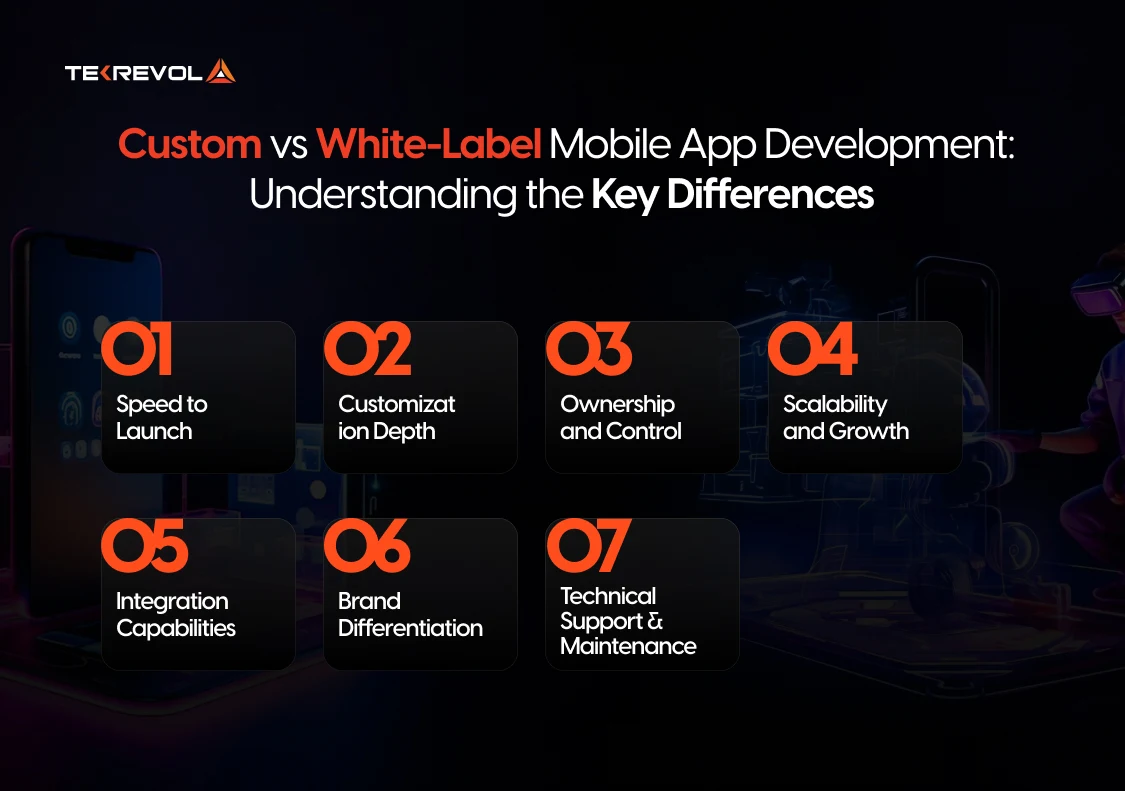
Speed to Launch
- Custom Development: Custom development is built to order with a minimum timeline of 3-6 months. Each feature, each screen, each integration will be crafted and written to your needs. This schedule does not indicate a slow build; it is a deliberate build.
- White-Label Solutions: Readymade solutions are released in just 3-6 weeks. The technology is already developed and has been implemented in several deployments. You are setting up and branding, not starting from scratch.
- The Reality: White-label speed is beneficial to startups that are in a race to market or even experimenting with unproven concepts. Custom development is worth the time investment for businesses whose competitive advantage depends on unique, differentiated products.
Customization Depth
- Custom Development: No idea is too complex. Whether it’s Arabic voice search, delivery routes aligned with prayer times, smart recommendation algorithms, integrations with Saudi banking systems, or custom industry workflows, it can all be designed to match your vision.
- White-Label Solutions: You are able to change branding aspects such as logos, colors, fonts, and certain interface text. The functionality, user flows, and set of features are predefined. When it is not available on the platform, you either modify your business or get another vendor.
- The Reality: When your competitive edge has to do with proprietary features or customized workflows, white-label constraints will ultimately hold growth back. Template features usually do the trick when you are providing ordinary services in mature markets.
Ownership and Control
- Custom Development: You are the owner of the source code, the intellectual property, the data architecture, everything. The app is an intangible asset. You are free to alter it, sell it, license it, or even reassemble portions of it without anybody’s authorization.
- White-Label Solutions: You are licensing the technology of another person. The vendor retains all ownership and has control of pricing, features, updates, and the existence of the platform. The success of your business is based on its business decisions.
- The Reality: Companies building long-term enterprise value need ownership. Short-term projects or businesses testing concepts can accept the risks of licensing.
Scalability and Growth
- Custom Development: Built to align with your growth roadmap, the system provides tailored, scalable solutions that support long-term business expansion. Need to support 10x more users? Add infrastructure. Want new revenue streams? Build the features. Expanding internationally? Adapt the platform. You are in charge of the roadmap.
- White-Label Solutions: You scaled up to the parameters of the platform. Certain white-label solutions can easily cope with the explosion of growth; others have strict ceilings. In any case, you will be reliant on what the vendor chooses to do with their infrastructure and whether they will suit the needs of your business.
- The Reality: Companies that have aggressive or uncertain growth patterns require architectural flexibility. Businesses in predictable markets are usually able to grow effectively using white-label platforms.
Integration Capabilities
- Custom Development: Full integration with any platform,m like your ERP, CRM, inventory management, old databases, government systems, dedicated Saudi payment gateways, or custom tools. All ties together perfectly since it is custom-built.
- White-Label Solutions: Integration is restricted to what is already developed by the vendor. There are usually common connections (Stripe, basic payment gateways). Niche integrations usually do not. It may not be possible or may be very costly to connect to special systems.
- The Reality: Custom should be selected in businesses that have complicated existing systems or unique integration requirements. White-label integration options can usually be applied to companies that have a simple tech stack.
Brand Differentiation
- Custom Development: It is your app, unique in its user interface, functionality, and user experience. There is nothing that appears and functions like a template. The brand identity is present in all of its interactions.
- White-Label Solutions: White-label solutions provide customization of branding, although similarities tend to be observed. Templates are familiar to the users of the platform. There is a possibility of going through several competitors sharing the same white-label vendor, which produces similar experiences across various brands.
- The Reality: Custom development in competitive markets with the user experience as a competitive advantage establishes distinct separation in the crowded market. White-label templates can be used in markets where the primary criterion of competition is service quality or pricing.
Technical Support and Maintenance
- Custom Development: You do updates, security patches, bug fixes, and improvements, either an internal group or a paid development partner. This involves continuous technical funding, but you are at liberty to decide on priorities and timing.
- White-Label Solutions: The company handles all the technical aspects such as hosting, security, updates, and infrastructure. You are so involved in business activities that you have no concern for technology management.
- The Reality: The vendor-managed infrastructure is of great help to teams that lack technical expertise. Direct control may be desirable for such companies as have development resources or are mission-critical in terms of reliability.
Custom vs White-Label Mobile App Development: Which Path Is Right for You?
Different businesses need different solutions, and mobile app development companies in Saudi Arabia typically recommend one of two paths based on your specific needs. Here’s a simple breakdown of which approach works best.
Bootstrap Startups (Limited Capital)
White-label solutions are the best app development approach for startups working with tight budgets. Investing SAR 50,000 in a proven platform will allow you to hold up capital until what matters most in the first place, customer acquisition and market validation. It is much smarter than spending SAR 250,000 on developing it specially, without having even demonstrated that people are interested in your product.
Funded Startups (SAR 500K – 2M Funding)
If your app is your core product and you have real funding, custom development makes strategic sense. You’re not just building an app, you’re creating defensible intellectual property and competitive advantages that white-label solutions simply can’t deliver. If you have adequate capital, focus on creating long-term advantages that protect your business.
Established SMEs (Proven Revenue)
Think of a hybrid solution in the event that you already have revenue and you wish to go digital. Rapidly launch on the white-label solution, check the market demand, and begin to receive returns. When you have already established product-market fit and know precisely what features are making you successful, transition to custom development, having clear requirements and being confident in your investment.
Enterprise Organizations (SAR 1M+ Budgets)
The most logical level of custom development is usually the enterprise level. You have complex integration demands, required regulatory compliance demands, and digital platforms, which are strategically important to your operations. Control, security, and positioning of competition make fully owned and customized solutions worth the investment.
Real Success Stories: White-Label Solutions That Transformed Businesses
White-label platforms have a proven track record, driving some of the most successful digital transformations across multiple industries. Here’s how major companies leveraged existing technology to enter new markets quickly and scale rapidly.
| White-Label Platform | Who Used It | Results |
| Uber Eats | Carrefour, Albertsons (grocery chains) | 150%+ delivery growth; millions served without building custom logistics |
| Standard Package | SAR 30,000 – 60,000 | 425M+ customers; rapid digital banking launch at lower cost |
| Premium Package | SAR 60,000 – 100,000 | Branded transportation for attendees without custom development |
Real Success Stories: Custom Apps That Transformed Saudi Businesses
Saudi companies that chose custom development didn’t just launch apps; they built market-leading platforms that competitors couldn’t replicate. Here’s proof that tailored technology delivers real results.
| App Name | What They Built | Results |
| Mrsool | On-demand delivery with unique price negotiation | 10M+ users, 200K couriers; market leader since 2015 |
| Danube Online | Grocery e-commerce across six cities | First-mover advantage; won Retail Technology Award 2018 |
| AlGooru | EdTech platform connecting students and tutors | Top 50 education companies in MENA |
| Seha Virtual Hospital | Virtual healthcare connecting 224 hospitals | Guinness World Record for Largest Virtual Hospital 2024 |
Partner With TekRevol for Your Custom Mobile App Development in Saudi Arabia
As a leading mobile app development company, TekRevol helps businesses in Saudi Arabia turn complex ideas into powerful, scalable mobile applications. Whether you need white-label solutions for rapid market entry or a full-stack web and mobile app development solution in Saudi Arabia specific to your unique requirements, we deliver technology that drives real business results.
We have a proven record of building successful custom software like Al Hussaini and Equitrip, which showcases our expertise in creating solutions that scale across industries and markets.
If you’re looking for a team that understands the Saudi market, TekRevol makes hiring app developers in Saudi Arabia straightforward, giving you a trusted partner for turning ambitious ideas into market-leading apps.
You can share your idea with our team, and our consultants will guide you on which platform—custom or white-label- will help your business thrive.
Not sure whether custom or white-label is right for you?
We help you evaluate your options and create a development roadmap tailored to your goals.
Book A FREE Call Now!


