



Building a healthcare app means dealing with HIPAA compliance from day one. Skip it, and you’re looking at fines of up to $141 to over $2 million per violation. But here’s the frustrating part: nobody gives you a straight answer on costs.
Ask three different healthcare app development company teams, and you’ll get three wildly different numbers. Some quote $45,000, others say $150,000 or more. Why such a huge range?
The HIPAA-compliant mobile app development is not a one-size-fits-all solution. A simple appointment scheduler is far less expensive than a telemedicine system that supports live patient interaction. The last cost will be based on your features, data storage needs, and the nature of the users.
Furthermore, the compliance is not over at the launch. It will require continuous security patches, risk measurements, and training of the staff, as well as updates to the infrastructure. Think of it not like buying a car, but like maintaining one; there are upfront costs and ongoing expenses.
Before we discuss costs, let’s discuss what HIPAA compliance is for healthcare apps and explain what factors influence your budget.
Why HIPAA Compliance Is Non-Negotiable in Healthcare App Development
Before diving into healthcare app development costs, let’s clarify what HIPAA stands for.
HIPAA is a short term that stands for the Health Insurance Portability and Accountability Act. The American law that took effect in 1996 protects individuals’ private medical information.
HIPAA has strict requirements for the storage, sharing, and access to healthcare data in a manner that does not disclose such data without reasonable approval.
Healthcare apps are transforming patient care by providing medical services in more accessible, convenient ways. If a mobile app deals with patient information in any way, it needs to follow HIPAA rules. This applies to telemedicine platforms, medication trackers, and EHR systems alike.
The U.S. Department of Health and Human Services reports that 133 million or more people were victims of healthcare data breaches in 2023 alone. The HIPAA fines system establishes multiple violation categories, which can lead to penalties that reach 1.5 million dollars per category in a single year, while major cases result in total fines that exceed multiple million dollars.
Essential Requirements for HIPAA-Compliant Mobile App Development
Before diving into costs, let’s clarify what HIPAA compliance actually involves. A, Healthcare app development is solving healthcare’s biggest challenges, but these innovations should be supported by a base of regulatory compliance and data security.
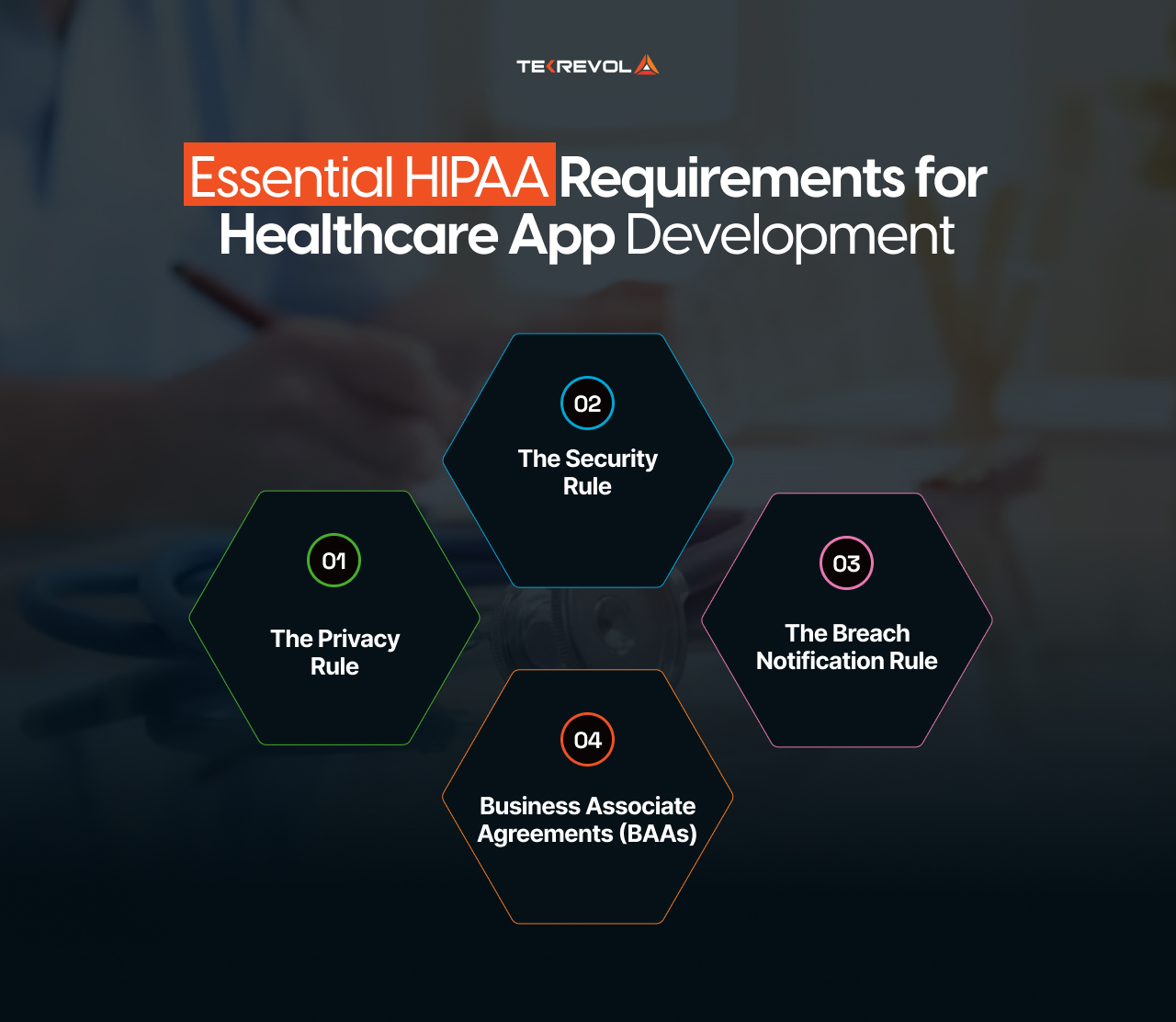
HIPAA compliance for healthcare apps can be broken down into various areas that secure the information of patients
The Privacy Rule
This regulation applies to your collection, utilization, and distribution of PHI. Your app should have explicit privacy policies, mechanisms to obtain consent from the users, and rigid restrictions on access to patient data. Any collection of health information must be intentional, authorized, and tied to a valid purpose.
The Security Rule
This is where the technical heavy lifting occurs. The security rule requires:
- Administrative controls: Workforce training, contingency planning, and administrative security management process.
- Physical protection: Facilities access controls, workstations, device and media controls.
- Technical controls: Access control, encryption, audit control, and security in transmission.
The Breach Notification Rule
You must notify the injured patients within 60 days in case a data breach occurs. Your application must possess mechanisms for detecting violations, documenting violations, and communicating violations accordingly. The average cost of breaches of healthcare data is 10.93 million dollars, which is the highest of all industries.
Business Associate Agreements (BAAs)
A BAA must be signed with all third-party services that have access to, store, or process PHI, such as cloud providers, analytics providers, and payment gateways. This makes them legally responsible for HIPAA standards.
Wondering If Your Budget Can Handle HIPAA Compliance?
Our team delivers healthcare app development and compliance roadmaps that protect your data without overspending.
Schedule A FREE Consultation!How Much Does HIPAA Compliance Cost for Healthcare Apps?
After reviewing dozens of healthcare solutions and speaking with healthcare professionals, the following is what you can reasonably expect to pay for a HIPAA-compliant mobile app development:
Initial Development Costs by Complexity
Not every healthcare application is equally expensive to comply with. The cost of your budget greatly relies on whether you are creating a simple health tracker or an all-purpose telehealth platform.
| App Complexity | Typical Cost Range | Development Time | Key Features |
| Basic/Simple App | $35,000 – $80,000 | 4–6 months | Appointment scheduling, secure messaging, basic data collection (e.g., patient portal, simple telehealth app) |
| Mid-Level App | $80,000 – $160,000 | 6–12 months | EHR integration, payment processing, advanced reporting, multi-user roles (typical telemedicine platforms) |
| Complex/Enterprise App | $160,000 – $500,000+ | 12+ months | Full EHR systems, remote patient monitoring, device integration, practice management, multi-facility platforms |
HIPAA Security Features for Healthcare Apps
Security is what makes a regular app HIPAA-compliant. It’s not about adding a single feature. It’s about fundamentally changing how developers handle medical data encryption and safety at every level of your application.
Adding these features usually increases your base development cost by 20–40%.
| Feature | Whatit Covers | Estimated cost |
| Encryption | AES-256 at rest, TLS 1.3 in transit, end-to-end encryption, key management | $12,000 – $60,000 |
| Access Controls | MFA, role-based access, biometrics, session timeouts, password rules | $12,000 – $60,000 |
| Audit & Monitoring | Full audit logs, tamper-proof tracking, real-time monitoring, and 6-year log retention | $12,000 – $60,000 |
| Data Protection | Secure disposal, remote wipe, automated backups, patching, and intrusion detection | $12,000 – $60,000 |
Cloud Infrastructure & Hosting
Cloud computing in healthcare requires choosing the right setup for HIPAA compliance. Costs vary depending on provider, storage, and services used.
| Cloud Provider | HIPAA Features | Typical Cost |
| AWS (Amazon Web Services) | EC2 for computing, S3 for encrypted storage, RDS for database management, CloudTrail for audit logging | $5,000 – $25,000/month |
| Microsoft Azure | Azure Health Data Services (FHIR-compliant APIs), Azure Confidential Computing, built-in compliance monitoring | $5,000 – $25,000/month |
| Google Cloud Platform | Healthcare API with FHIR, HL7v2, and DICOM support, customer-managed encryption keys, Cloud Security Command Center | $5,000 – $25,000/month |
What we mean by this is that the keyword here is eligible; simply the fact that AWS provides services that are HIPAA-eligible does not necessarily mean that your setup is compliant. You should set all things in place and sign a BAA.
Core Components of a HIPAA-Compliant Healthcare App
A good backend and frontend architecture is not merely a good practice, but an absolute requirement for healthcare applications that are revolutionizing patient care.
Backend Development:
A secure, compliant backend app development is the foundation; without it, your app won’t survive stress or scale.
Budget: 30–40% | Cost: $30,000 – $100,000
Key Points:
- HIPAA-compliant server architecture
- Database encryption (at rest & in transit)
- Secure API development with authentication
- Data backup & disaster recovery
- Real-time synchronization
Frontend Development:
The interface your users see must be smooth, secure, and HIPAA-ready, protecting data everywhere it goes.
Budget: 25–35% | Cost: $25,000 – $87,500
Key Points:
- User authentication interfaces
- Secure mobile data handling
- Offline functionality with encrypted local storage
- Push notifications with encrypted content
- Biometric login (Face ID, Touch ID)
Legal & Compliance Consulting
Budget: $10,000 – $50,000+
Look, I get it, this feels expensive. But trust me, hiring HIPAA experts upfront will save you exponentially more in the long run. You need:
- Initial risk assessment and gap analysis
- Policy and procedure documentation
- Business Associate Agreements (BAA) drafting
- Privacy policy creation (HIPAA-specific)
- Incident response planning
- Employee training program development
A single compliance mistake could cost you millions in fines.
Security Testing & QA for Healthcare Apps
Proving your app is secure is no longer optional; it’s mandatory under HIPAA and industry standards. Security testing typically accounts for 20–30% of your development budget.
| Testing Type | Key Focus | Estimated cost |
| Vulnerability Assessments | Identify potential security gaps in code and infrastructure | $1,000 – $5,000+ per test |
| Penetration Testing | Simulate attacks to find weaknesses | $3,000 – $15,000+ per test |
| HIPAA Compliance Testing | Ensure all features meet HIPAA rules and standards | $2,000 – $10,000+ |
| Usability Testing (Security Features) | Test login flows, MFA, encryption interfaces for user-friendliness | $1,500 – $5,000 |
| Load & Scalability Testing | Verify performance under heavy usage without security breaches | $2,000 – $8,000 |
Third-Party Integrations
Budget planning should involve networking with the current healthcare systems. Integration of cloud platforms with EHR, billing, and patient management systems is quite fundamental and requires professional API integration services providers.
- EHR system integration: +$35,000 – $100,000
- Telemedicine video functionality: +$25,000.
- Integration of payment processing: +15,000 -30,000.
- Lab system connectivity: +$20,000 – $50,000
- Medical device data integration: + 30,000 +.
Every integration is complex and has to undergo its own security audit.
How to Budget for HIPAA Compliance: Key Cost Factors
HIPAA-compliant mobile app development cannot be a one-size-fits-all. The price of HIPAA compliance will vary depending on the level of security and sophistication of your application and functionality.
App Complexity and Features
Cost Impact: $20,000 – $150,000+
A basic wellness device is much cheaper than a complete telemedicine system. The development of telemedicine apps, including EHR integration, video calls, prescription management, and secure messaging take more time to develop. Every feature requires encryption, security testing, and compliance checks, which directly affect your budget.
User Roles and Access Control
Cost Impact: $10,000 – $50,000
Various users, patients, physicians, nurses, and administrators complicate the matter even more. Each role should be assigned its own permissions, personalized interface, and various security controls.
Each additional user role requires separate permissions and audit trails, directly impacting your HIPAA-compliant mobile app development budget and timeline.
Data Type and Volume
Cost Impact: $15,000 – $75,000
It is easier to manage general wellness data as compared to sensitive records such as mental health notes or genetic records. PHI with a high risk mandates increased security. Also, managing records for millions of patients demands more robust infrastructure and backup solutions than handling hundreds of users.
Authentication Requirements
Cost Impact: $8,000 – $30,000
Simple passwords are not sufficient. HIPAA-compliant mobile app development requires multi-factor authentication, automatic timeouts of the sessions, verification of the devices, and complex passwords. The development of these security layers in a proper manner is a huge undertaking to implement and test.
Third-Party Integrations
Cost Impact: $15,000 – $60,000 per integration
Wearable integration for Android and iOS complicates healthcare app development. Integrating fitness devices and smartwatches with laboratories and pharmacies, as well as insurance companies, should be structured and implemented in a secure manner.
All the integration processes imply vendor screening, signed BAAs, secure API connections, and constant monitoring.
Compliance Expertise
Cost Impact: $10,000 – $40,000
The HIPAA laws are complex. This is why it is essential to collaborate with a mobile app development company that has previous experience in the healthcare sector, since they have contacts in compliance consultants that focus on risk assessment, security assessment, and compliance documentation, as well as audit preparation. This kind of expert typically costs 10-15 percent of the total development costs, yet they do not make expensive mistakes in multiplying your budget.
Development Partner Choice
Cost Impact: 20-40% variance in total project cost
The generic agencies are cheaper by the hour, yet lack experience in the field of healthcare, and thus lead to delays and missed compliance. Top Healthcare development companies charge higher prices, but provide tested architectures, supplier ties, and audit-ready solutions to HIPAA-compliant mobile app development, which frequently lead to lower overall costs and decreased risk.
Tired of Getting Different Answers About HIPAA Costs?
Partner with Tekrevol for straight talk, transparent pricing, and healthcare app development expertise you can actually depend on.
Get Started Today!How to Navigate HIPAA Requirements in App Development
Developing a medical app that complies with HIPAA needs a systematic development and implementation work. This is how to go about development in the right direction.
Learn the Requirements
Take time to learn the three fundamental elements of the HIPAA Privacy Rule (how PHI can be used), the Security Rule (how to protect it), and the Breach Notification Rule (what should be done when the situation goes wrong) before a single line of code is written.
Don’t guess at compliance. Early bring in a healthcare compliance consultant. They will assist you in understanding the regulations to be applied to your own application and see the requirements that you may not have realized. This initial investment will avert expensive errors in the future.
Map Your Patient Data
Trace every user path throughout your application to identify every health information touchpoint. Decide on the data you are gathering, its location, and accessibility, as well as the movement of the data between systems.
Create a comprehensive data inventory. Determine all PHI in your application, such as medical records, appointment usages, prescription details, insurance usages, and GPS locations of where patients visited healthcare institutions. Protected Health Information involves any identifiable data about the patient that is related to the patient’s health, medical care, or healthcare transactions.
Design Secure Systems
App Security is not an option to be added afterward, but it is an essential part of your app architecture. Base your system on the following basic defenses:
- Encryption as a matter of course: All PHI should be encrypted when it is on its way across the internet, in your database, or even stored in your back-ups. Encrypt data at rest with industry-standard protocols such as AES-256 and data in transit with TLS 1.2 and above.
- Effective authentication: Activate multi-factor authentication for all accounts that access PHI. The passwords are not sufficient. Enable automatic session time-outs to ensure inactive devices do not pose a security risk.
- APIs that you trust: Your connection between your application and systems must be authenticated, encrypted, and rate-limited.
Manage Access
Not everyone should see everything. A nurse doesn’t need billing information. A scheduler doesn’t need lab results. Design granular permission systems where each user role has clearly defined access limits.
Build audit trails that log every interaction with PHI, who accessed what data, when, and why. Make these logs tamper-proof and searchable. They’re your evidence if regulators come asking questions.
Test Regularly
Schedule penetration testing before launch and quarterly afterward. Bring security experts to breach your system and record weaknesses. Fix what they find.
Carry out internal security audits on a monthly basis. Look at the access logs for any suspicious patterns. Test your encryption. Ensure that it can be authenticated at every entrance point.
Prepare for Breaches
Breaches happen even to well-protected systems. Your response determines whether it’s a manageable incident or a company-ending catastrophe.
Develop an elaborate incident response plan: Who is notified? How quickly? What steps stop the breach? At what time do you call the police? What is your method of informing patients who are affected? Write down all the points and rehearse with your team.
Install an automated, encrypted backup and test your backup periodically. Understand precisely the timeframe to bounce back from various disaster events.
Train Your Team
Data is secured by technology, but the most important decisions are made by people. Train all team members about the basics of HIPAA,d their individual areas of compliance, and how to identify a security threat.
Make training role-specific. Developers must be familiar with secure coding. The support staff must be aware of how to check user identity.
Maintain Compliance
Your app will change. Regulations will change. Threats will evolve. Compliance is a continuous cycle, not a destination.
Schedule quarterly compliance reviews. Reassess your risk profile as you add features. Update your policies when regulations change. Renew vendor BAAs annually. Keep your security patches current.
After Launch: The Hidden Costs of Staying HIPAA-Compliant
Most healthcare startups focus on launch day. But here’s the reality: your biggest compliance expenses start after your app goes live. Understanding these ongoing costs isn’t just good financial planning; it’s essential for sustainable growth.
Maintenance and Updates
Your app needs regular attention to stay secure and functional. Security patches address newly discovered vulnerabilities. Performance updates keep the system running efficiently. Compatibility fixes can be used to make sure that your app is compatible with the latest operating systems and devices.
Collaborating with app maintenance and support services providers keeps your healthcare app compliant over time. Frequent updates will eliminate security issues, keep up with iOS and Android updates, and keep your app abreast of changes in HIPAA standards.
Hosting and Infrastructure
As your user base grows, so do your infrastructure costs. Enterprise-grade cloud hosting for PHI isn’t cheap, but it’s non-negotiable. You’re paying for military-grade encryption, redundant backups, 24/7 monitoring, and the kind of uptime guarantees that keep patient care uninterrupted. Then there’s the administrative burden: tracking and renewing Business Associate Agreements with every vendor in your ecosystem, annually.
Audits and Compliance Monitoring
Compliance in healthcare doesn’t stand still. HIPAA interpretations change, states add new rules, and security standards get stricter. Frequent audits assist in identifying the risks in the initial stages and enhancing accountability. Omitting them creates loopholes that go unnoticed.
Training and Vendor Management
The most sophisticated security system fails when an employee clicks the wrong link. Continuous HIPAA training isn’t optional. It’s your human firewall protecting against costly mistakes and preventable breaches.
Every team member, from engineers to customer service, needs to understand how their actions affect patient privacy. Don’t overlook third-party services. Each one, whether email, CRM, or support platform, needs proper BAA coverage. A single non-compliant vendor can put your business at risk.
What Happens When You Skip HIPAA Compliance
Cutting corners on HIPAA-compliant mobile app development might save money upfront, but the consequences can destroy your business. Here’s what’s actually at stake.
Financial Impact: More Than Just Fines
HIPAA fines vary by intent. An honest mistake costs $127 per violation. Deliberate neglect? That’s $63,973 per violation, and they add up fast. Healthcare startups have faced million-dollar penalties that ended their operations.
Fines are only part of the cost. Add legal fees, security audits, crisis consultants, and patient settlements, and one breach can deplete your entire budget.
Trust: The Asset You Can’t Rebuild
As soon as patients find out their personal health data is revealed, they are gone. No marketing campaign will be able to compensate for that damage. The headline of a data breach becomes viral immediately, and it can be disseminated via the press, social media, and word of mouth. Your brand is associated with the company that leaked medical records. Trust is not a feature of healthcare; it is your whole value proposition.
Legal Chaos and Operational Paralysis
A single breach triggers class-action lawsuits from thousands of patients. Legal defense costs accumulate quickly, even if you win. Government investigations demand documentation, interviews, and system audits that consume weeks of leadership time.
Your team shifts from building features to managing the crisis. Product development stops. Customer support becomes overwhelmed. In severe cases, regulators may suspend your operations until security gaps are fixed, eliminating revenue while expenses continue.
The Opportunities That Disappear
Healthcare organizations won’t partner with a non-compliant vendor. Hospital systems, insurance companies, and large medical groups all require proof of HIPAA compliance before they’ll even consider integration. Without it, you’re locked out of the most lucrative market segments.
Investors follow the same logic. VCs and health-focused funds won’t touch a company with compliance issues. It’s an existential risk they simply won’t accept.
Does Your App Even Need HIPAA Compliance?
Too many developers spend unnecessary money over-engineering apps that HIPAA doesn’t even cover.
When HIPAA Applies to Your App
HIPAA compliance is mandatory when your app handles PHI for healthcare providers, health plans, or healthcare clearinghouses, either directly as a covered entity or as a business associate.
Applications, which will need to comply with HIPAA:
- The use ofa telemedicine platform between patients and doctors.
- Electronic Health Records (EHR) systems.
- Remote patient monitoring apps that sync with clinical systems
- Healthcare insurance apps processing claims
- Any app that creates, receives, maintains, or transmits PHI for a covered entity
Apps that Don’t need HIPAA compliance:
- Fitbit devices that users are in charge of.
- Diet and nutrition applications are lacking interventions with healthcare providers.
- Wellness or meditation applications are not coupled with clinical systems.
- Applications in which patients report data themselves and do not share it with the providers.
Partner With Tekrevol for Your HIPAA-Compliant Healthcare App Development
Your development partner can make or break your healthcare app. Teams without healthcare experience create compliance problems that cost hundreds of thousands to fix. Experienced partners build it right the first time.
As a leading healthcare software development services provider, we specialize in transforming complex regulatory requirements into seamless, secure solutions.
Our teams have proven HIPAA expertise. We’ve successfully completed regulatory audits, negotiated Business Associate Agreements with major vendors, and resolved the technical complexities that surface during healthcare app development.
We integrate AI agents into healthcare apps to streamline diagnostics, personalize patient care, and automate administrative tasks, all while maintaining strict HIPAA compliance and data security.
We’ve successfully launched platforms like The Nurse Practitioners app, which transformed healthcare delivery for providers, and Libido Health, serving 10,000+ users with a secure sexual wellness platform.
We bring deep healthcare tech expertise: HL7/FHIR standards, encrypted communications, audit logging, EHR integrations, and continuous compliance monitoring. From design to deployment and beyond, we’ve got you covered.
Ready to Build Your HIPAA-Compliant Healthcare App?
Talk to our HIPAA compliance specialists and get a clear roadmap for your project.
Schedule Free Consultation!


