



- The cost to build an app like Uber in 2026 typically ranges from $30,000 to $75,000 for a Basic MVP, while complex Enterprise solutions with AI-driven features can exceed $130,000.
- Development costs and feature requirements vary significantly by region. TekRevol specializes in localized solutions, adapting UX/UI for high-density markets and the rapidly growing digital economies of the UAE and MENA region as well.
- Total expenditure is primarily driven by the Rider App, the Driver App, and the Admin Dashboard, with advanced integrations like real-time GPS tracking and secure multi-currency payment gateways being non-negotiable for success.
- Integrating AI for predictive ride-matching and automated surge pricing is no longer optional. These technologies optimize “unit economics” by reducing rider wait times and maximizing driver earnings per hour.
- The “Uber-for-X” model has expanded beyond taxis into Healthcare (NEMT), Logistics, and Fleet Management, where real-time visibility is projected to drive the global logistics market to $8.1 trillion by late 2026.
- To ensure long-term viability, prioritize a robust backend architecture (Node.js/Python) that can handle thousands of concurrent requests.
You know the day is not in your favor when you miss an alarm to attend an important meeting at first in the morning, and your car is not in the mood to soothe you. You pull out your phone, open an app, and within 10 minutes, you’re in a moving vehicle heading exactly where you need to be.
That’s not luck. That’s what a well-engineered ride-hailing app does. It turns real-world urgency into a solved problem, every single time.
If you’ve been thinking about building your own ride-hailing platform, the most important thing you can do right now is understand the cost to build an app like Uber. Because costs in this space vary wildly from a $30,000 MVP to a $300,000+ enterprise build that’s designed to scale across cities and countries.
This guide walks you through features and development stages, so you can make a confident, informed decision before you start. And if you want to get there faster, partnering with an experienced on-demand app development company like TekRevol means you’re not figuring it out alone.
A Quick Overview of the Cost to Build an App Like Uber
Creating a taxi app includes the combination of smart design, powerful technology, and last but not least, good planning. Every feature that you encounter in the application impacts the overall experience.
Here’s a straightforward breakdown so you know what to expect before a single line of code gets written.
| Tier | Features | Estimated Cost (USD) | Notes |
| Basic (MVP) | Core Rider & Driver apps, Booking & Payments, Admin Panel | $30,000 – $75,000+ | Minimal features, suitable for testing market demand |
| Intermediate | Adds UI/UX polish, Notifications, Analytics, Loyalty programs, and Surge pricing | $75,000 – $130,000 | Balanced features for a smooth user experience and moderate scalability |
| Advanced (Enterprise) | AI-driven ride matching, Dynamic pricing, In-app chat/voice, Blockchain integration, Advanced analytics | $130,000+ | Fully featured, highly scalable, optimized for large markets |
These tiers are starting points, not ceilings. What pushes a project from $30K to $300K is almost always the same thing: scope creep that wasn’t planned for.
There are multiple cost factors included in every tier, so before you jump to look for an answer to your query like “how to make an app like Uber”, you have to consider every feature, tech stack, and development process that combine to make your dream come true.
Creating such app requires time and patience, as you would know that Uber reportedly has around 180 million monthly active users worldwide as of mid‑2026.
The Blueprint for Your Next Market Leader
Don't guestimate your launch costs. Get a precise investment breakdown tailored to your business model and see how TekRevol accelerates your path to market-ready deployment.
Get Your Free Investment AnalysisCost Breakdown by Features
Features are where your budget lives or dies. Each one adds real development hours, and those hours add up faster than most first-time founders expect.
Each and every feature adds a unique function while also carrying its own time and cost in development. From simple booking screens to advanced analytics dashboards, every element shapes the usability of your platform.
However, according to a Statista report, in 2026, the worldwide ride‑hailing market alone is forecast to go much beyond US$180 billion.
Now, let’s find out the most important feature in ride-sharing app development, and see how much you will have to invest in each feature.
Booking and Navigation System
The booking and navigation system is where users set their pick and drop locations, choose the type of their ride, and check their driver’s progress in real-time. Reliable GPS matters more than most people realize, a 2-second map lag is enough to make a rider cancel and switch apps.
This isn’t a feature you optimize later, you need to build it right from day one.
- Cost: $5,000 – $20,000
- Time: 3 -8 weeks
Payment Gateway Integration
A secure payment gateway is a major feature to entice users to use apps like Uber. In our opinion, payment trust is something what gets the users to keep coming back.
In the current digital age, riders look for different payment options like credit/debit cards and even digital currencies, while drivers look for quick and secure payouts.
The development of this system requires integration with third-party gateways, encryption standards, and fraud-prevention protocols to protect all types of sensitive and personal information.
- Cost: $3,000 – $12,000
- Time: 2 – 5 weeks
Notifications and Alerts
Push notifications and alerts inform users about different activities within the app, such as ride status, arrival of the driver, ride cancellations, and payment confirmations.
This keeps riders and drivers in sync. From a business perspective, alerts can also be used for launching new updates and loyalty rewards.
- Cost: $2,000 – $7,000
- Time: 1 – 3 weeks
Driver and Rider Management
Another essential feature to build an app like Uber is structured management. This includes rider and driver profiles, verifications, trip history, and monitoring account activity. Admins can remove all the inactive accounts and resolve all types of disputes, making this feature important for safety and trust.
- Cost: $4,000 – $15,000
- Time: 3 – 6 weeks
Analytics and Reporting Tools
Behind every successful Uber clone app development is strong data analysis. Tools for data analytics give insights into completed rides, the performance of every driver, revenue generated, and the behavior of customers. These dashboards help businesses keep improving their strategies smartly.
- Cost: $5,000 – $18,000
- Time: 4 – 8 weeks
Cost Breakdown by Technology Stack
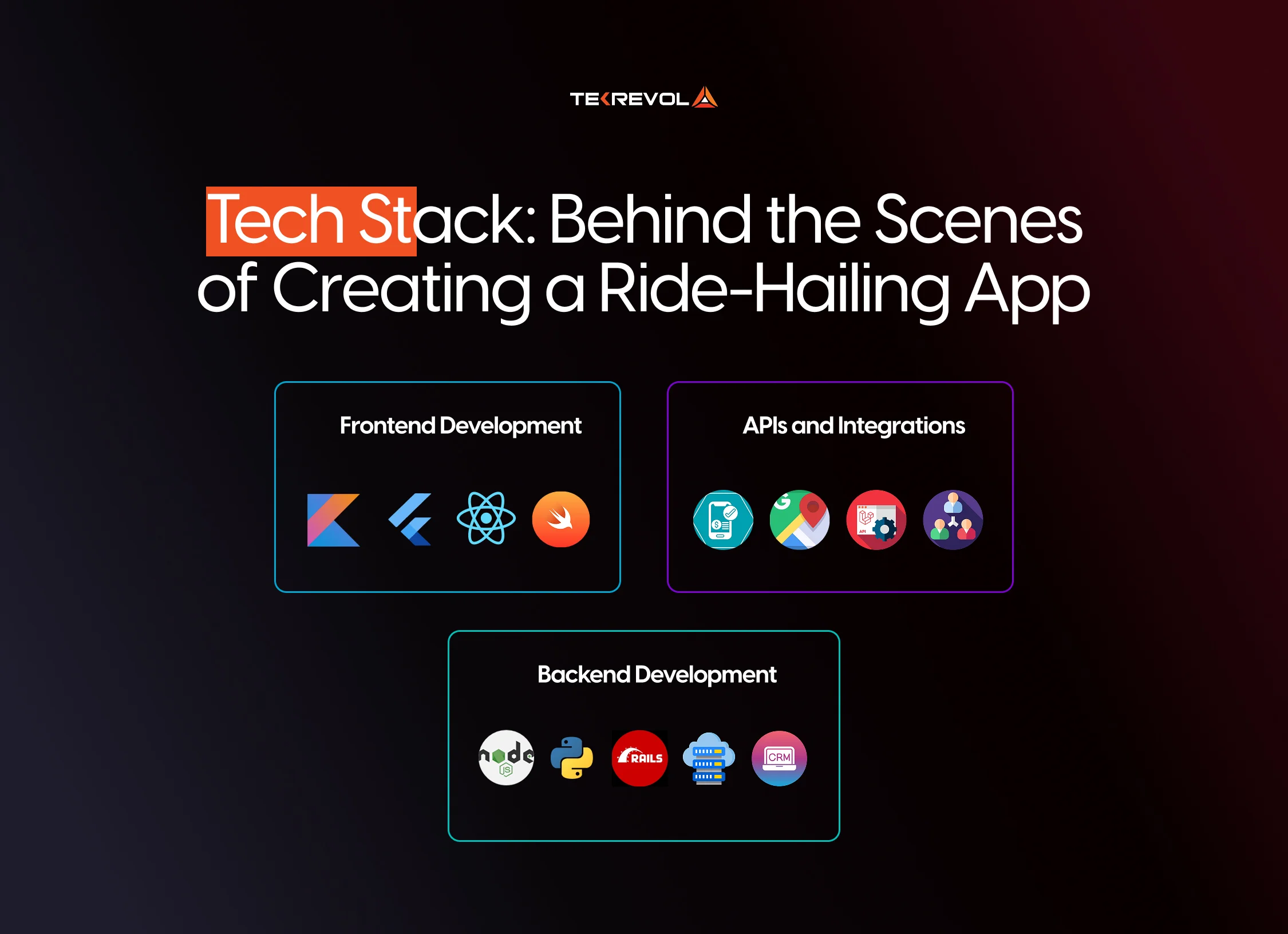
Your desired tech stack also plays a crucial role in the cost to build an app like Uber. From frontend to APIs that connect everything, each layer has a different price tag and timeline. Choosing the right tech stack affects performance and long-term scalability.
Frontend Development
Every interaction a user has, from tapping a destination to watching their driver move on the map, hitting “confirm ride”, that’s all frontend work. Getting it right means the difference between an app people enjoy using and one they quietly delete.
Using platforms like Swift for iOS, Kotlin for Android, and React Native and Flutter for cross-platform app development allows for the creation of smooth and responsive user interfaces.
- Cost: $8,000 – $25,000
- Time: 4 – 10 weeks
Backend Development
The backend development is what actually runs the show. When 50,000 users book rides simultaneously during rush hour, it’s your backend that decides whether the app holds up or crashes.
It is commonly built by using tech stacks like Node.js, Python/Django for backend development, or Ruby on Rails for speed and security. Meanwhile, Cloud servers focus on reliability; meanwhile, advanced platforms often use CRM development services to manage and create operational workflows.
- Cost: $15,000 – $50,000
- Time: 6 – 12 weeks
APIs and Integrations
APIs are the connectors of your platform, which adds to the cost of building an app like Uber. Features like payment gateways, maps, and third-party services are all connected through APIs, which allows smooth communication between multiple app components. Without them, your app will not be able to work as a unified system. This step requires constant support to make sure everything goes smoothly.
- Cost: $5,000 – $20,000
- Time: 3 – 6 weeks
Don't let technical debt kill your startup. Choose the stack that scales your revenue
Consult with TekRevol’s on-demand specialists to select a tech stack optimized for low-latency performance in high-density urban markets.
Speak with a Technical ArchitectIndustries That Can Benefit from an Uber-Like App
The Uber model didn’t just disrupt taxis. It gave every industry with a scheduling problem a new playbook. In 2026, the ride sharing app development rules are fueling innovation across multiple sectors.
Whether it’s logistics or healthcare, the opportunity to create an app like Uber has grown from taxis to a growth model of businesses.
Automotive
The automotive industry is growing faster than ever, and the growth numbers are proof of it. According to a study, the global fleet management market is expected to nearly hit $55.6B by the year 2028 at a CAGR of 14.2%.
For fleet managers, a platform similar to Uber provides real-time tracking, maintenance alerts, and dashboards to check performance that keep every vehicle accountable.
Car rental companies and operators providing taxi services can also stay competitive by introducing personalized booking, transparent fare systems, and dynamic pricing, building a customer experience that feels trustworthy and modern.
Logistics and Delivery
Logistics is all about speed and precision, and the market is already reflecting its urgency. A study revealed that logistics are valued at $5.7 trillion and are expected to hit $8.1 trillion by 2026.
Courier services and e-commerce owners are already adapting to build an app like Uber to handle tracking, driver’s location, and route optimization. These applications minimize delays in delivery and build loyalty among customers.
For logistics, investing in Uber clone app development means creating solutions where every mile counts, regardless of making food deliveries or time-critical shipments.
Healthcare
In the healthcare sector, a delayed transport isn’t just an inconvenience, it can be the difference between a patient making their dialysis appointment or missing it entirely. The healthcare transportation services are on track to reach $83.4 billion by 2030. These rising numbers are creating an urgency in the industry to build an app like Uber to provide medical transportation services
Hospitals and care providers can use driving apps like Uber to simplify their schedules for ambulances or delivering lab samples and medicines. These apps are quite critical for the healthcare industry, and are more about life-saving accessibility than a luxury. If you are ready to build or scale such applications, then get in touch with a leading healthcare app development company in the region, like TekRevol.
Another thing is that they also cut waiting times and reduce booking friction for patients, which helps people suffering from mobility challenges to travel easily for their routine checkups.
Education
There has always been a certain pressure on educational institutions to provide safe transport for students and faculty. With limited budgets and security concerns, it becomes crucial to build an app like Uber.
For instance, transport applications integrated with school systems can centralize routes and maintain transparency among parents.
Schools and universities can lower costs by arranging shared rides and providing real-time updates to parents and admins.
Almost every industry is reshaping its foundations through personalized applications. A million-dollar question is, will you be the next contributor in the growth of the market? If your answer is yes, then our app developers in NYC will help you build an app like Uber to help you set new records.
How AI is Redefining Driving Apps Like Uber
AI isn’t a “nice to have” anymore in ride-hailing. It’s what separates platforms that scale from ones that stagnate. Here’s where it’s actually making a difference:
- AI for Smart Ride Matching: AI tracks locations and even traffic to pair the right driver with the right rider. Modern systems use deep learning to optimize marketplace balance so riders do not have to wait much.
- AI for Fare Optimization: Fare Optimization uses real-time signals plus order forecasting models to set fair fares when the platform needs supply. This is a sensitive feature, but when it is done right, it balances the market; otherwise, it ends up in frustrating users, which is why ML and transparent laws are important.
- AI Chatbots and Support: The majority of daily rider and driver queries are now handled by AI chatbots, so that human agents get more time to focus on complex cases. With that being said, integration of AI assistants seems like a smarter move to build an app like Uber
- AI Analytics and Decision-Making: AI analytics that find the potential neighbourhoods where businesses can grow or underperform, and what kind of promotion will help in moving the needle play an important part. These AI-agents perform A/B tests and make decisions, so that teams can act according to whatever the results say.
How To Build An App Like Uber? – Cost Breakdown by Development Stages
Ride sharing app development is a structured journey that unfolds in multiple phases, each phase contributing to the overall budget.
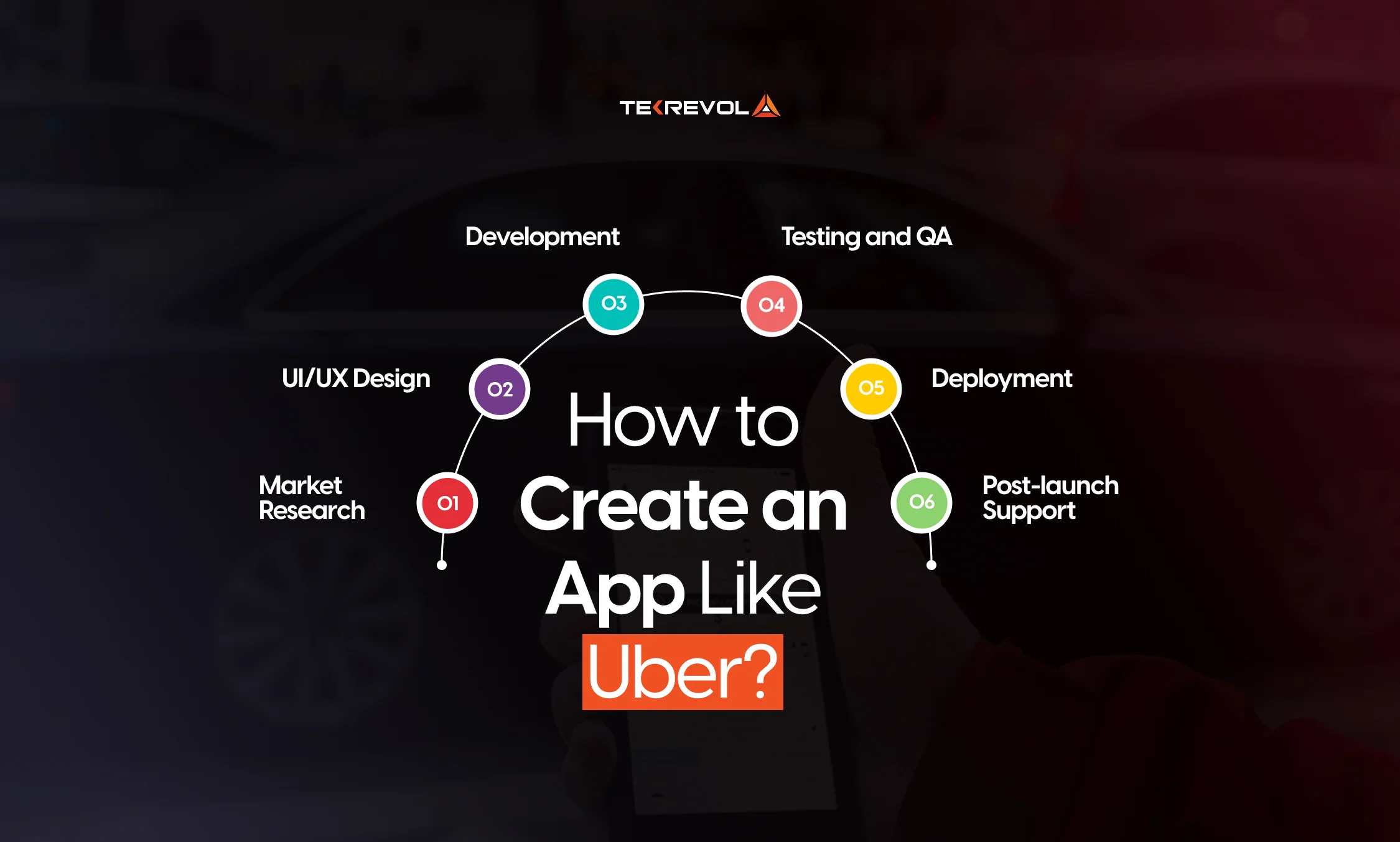
The cost to build an app like Uber can vary from $80,000 to $950,000, depending on complexity and features. This range highlights the importance of planning and selecting features to match your budget and business goals.
Each development stage adds some specific cost. Let’s take a moment to go through every stage and see what goes behind the scenes of taxi app development cost so that you can understand where your investment is going and make wise decisions that meet your objectives.
Step 1: Discovery and market research
This is the initial phase, which involves researching deeply in the market, identifying competitors, looking for your target audience, and documenting all the requirements for your app, making sure you are prioritizing the correct features. This stage helps you to define the goals of your map and validate ideas before you move further to build an app like Uber.
- Cost: $2,000 – $15,000
- Estimated Time: 1 – 3 weeks
Step 2: UI/UX design
Your app ideas are transformed into an attractive experience in the design phase. Here you will be dealing with wireframes, prototyping, screen designs, and changes according to feedback, so your audience can easily navigate through your application from the first tap.
- Cost: $10,000 – $30,000
- Estimated Time: 3 – 6 weeks
Step 3: Development Phase
This stage is where your design turns into a fully functioning app. Creators implement different features, add backend logic, and build the core functionalities to create an app like Uber. They follow all the work processes defined in earlier stages to guarantee a smooth performance.
- Cost: $30,000 – $150,000 (depends on complexity)
- Time: 8 – 20+ weeks
Step 4: Testing and Q/A
Here, the app is continuously tested to identify any bugs or errors to make sure your app functions smoothly across devices. Testing includes functional, performance, and reliability checks for every user.
- Cost: $5,000 – $20,000
- Time: 2 -4 weeks
Step 5: Launch and Deployment
You are done with the process to build an app like Uber; now it’s time to prepare it for a huge launch, where users will interact with your app. It covers submissions to app stores, final server setups, and verification of live functionality.
- Cost: $4,000 – $10,000
- Time: 1 – 2 weeks
Step 6: Post-launch Support
Making your app live for the users is not the end. The process continues in ongoing support to keep your app running smoothly. This part includes monitoring performance, bug fixing, adding new updates, and responding to user feedback to maintain reliability and increase engagement, which keeps adding to the cost to build an app like Uber.
- Cost: $3,000 to $10,000 per month
- Time: Ongoing
Key Challenges to Consider When Building an Uber-Like App
Even though the market potential is enormous, the creation of a ride-sharing application such as Uber involves different kinds of challenges. Knowing these obstacles at the very beginning may assist you in making a better plan and thus, in avoiding mistakes that cost a lot.
1. Regulatory Compliance:
Ride-sharing applications are subject to regulations at both local and national levels. For instance, each city or country can set different requirements for obtaining a license, safety regulations, and data privacy laws. Non-compliance can result in penalties, suspension, or even the closure of your service.
2. Market Competition:
The market for ride-hailing services is fiercely competitive. In addition to major players like Uber and Lyft, local companies are also investing heavily in their growth. Therefore, to create a buzz around your app, it is quite necessary to be able to differentiate it by distinctive features, better UX, or specialized services (for instance, luxury rides, medical transport).
3. Driver & Rider Retention:
On the one hand, you can manage to acquire users. However, on the other hand, retaining them is a completely different story. A constant supply of drivers and the satisfaction of riders, through a convenient booking, pricing that is clear, and support that is prompt, are issues that require a permanent effort.
4. Technology & Scalability:
The app of the Uber type should be capable of simultaneously accommodating a large number of users without performance problems. In fact, among the main issues to be solved are: the optimization of the backend architecture, the assurance of updates in real-time, and taking into account the scalability of the project in the future.
5. Security Concerns:
In order to execute safe measures for security, it is necessary to take into consideration that the information being dealt with is sensitive, personal, and that it involves payments. Users can feel secure when the service has secure payment gateways, encryption, and is always vigilant against fraud or cyberattacks.
Partner with TekRevol to Build an App Like Uber within Your Budget
Uber didn’t win because it had the best idea. It won because it executed fast, fixed problems in real-time, and built a platform that could absorb millions of users without collapsing. That execution starts with who you build with.
And let’s get this straight, the real question is not about whether the market is ready to see another clone Uber app development, it’s about whether you are ready to take a step further and launch your dream or not.
This is where TekRevol takes the lead. As a mobile app development company, we specialize in high-performance on-demand ecosystems. We map the total cost to build an app like Uber to let you see a clear growth path. With years of developing custom mobility and on-demand platforms, we have helped many businesses cut the risks and increase ROI in competitive markets.
If other founders have launched and scaled in this space, there’s no reason you can’t. At TekRevol, we’ve done it before and we’ll do it with you, not just for you.
Stop Waiting for Deployment And Launch Your Taxi App Now
Skip the months of coding and uncertainty. Acquire a high-performance, custom-branded taxi application within days.
Schedule Your Free Discovery Session


