
Online shopping has changed dramatically in the last ten years, but this is one thing you will not want to hear: not all online shopping is equal. In case you have found yourself leaving your laptop to complete your purchases on your mobile phone, you are living the transition between ecommerce to mcommerce.
The misconception between the definition of ecommerce and mcommerce costs business organizations thousands of sales. Most business people spend a lot of money on conventional online stores, only to see potential shoppers skip due to a clunky experience on the mobile platform.
This is the truth, ecommerce is the larger term of everything that is done online to purchase and sell, whereas mcommerce is the process that involves the use of mobile phones.
This difference does not simply involve technical jargon. It dictates the way you build your checkout procedure, payment systems, and the overall user experience. Working with a skilled ecommerce app development company ensures you’re not just mobile-friendly, but mobile-first, capturing customers wherever they are.
Comprehending the difference between ecommerce and mcommerce might be the ticket to unlock the next breakthrough in revenue. We will discuss the peculiar advantages of each platform and why ecommerce and mcommerce for businesses should work hand in hand.
What is E-commerce?
E-commerce is the online marketplace where the transaction occurs via websites and other internet-based platforms, mainly via desktop computers and laptops. What began as simple online shopping, browsing, and clicking items into your cart, purchasing at your desk, is changing rapidly.
The future of ecommerce is far beyond clicking on” buy now”. We are witnessing AI-assisted suggestions, 360-degree shopping experiences, and technologies that make it hard to differentiate between online and brick-and-mortar shopping.
As per the recent market outlook, the sales of global ecommerce are estimated to reach approximately 6.86 trillion dollars by 2025, compared to around 5.82 trillion dollars by 2023, which shows how essentially such a model has redefined retail.
Big players such as Amazon, eBay, and stores powered by Shopify control this market, selling electronics to groceries via web-based platforms.
Pros of Ecommerce
| Advantage | Description | Business Impact |
| Wider Reach | Sell products and services globally, breaking geographical barriers | Access millions of potential customers beyond local markets |
| Cost Efficiency | Lower operating costs without physical storefronts, rent, or utilities | Higher profit margins with reduced overhead expenses |
| 24/7 Availability | The store never closes, customers shop anytime, day or night | Increased sales opportunities and customer convenience |
| Personalized Shopping | Use customer data and analytics to recommend relevant products | Higher conversion rates through tailored experiences |
| Diverse Payment Options | Accept credit/debit cards, digital wallets, bank transfers, and more | Reduced cart abandonment with flexible payment methods |
What is M-commerce?
M-commerce refers to mobile commerce; in simple terms, it is the straight-up purchase of items using your tablet or smartphone. When making an ecommerce and mcommerce comparison, the convenience factor stands out immediately. While eCommerce ties you to a workstation or laptop, mCommerce fits right in your pocket, enabling shopping anywhere, anytime.
This is not a fashion, but it is the new norm. The use of mobile devices has become about 60 percent of all e-commerce transactions worldwide, which is evidence that consumers have significantly changed the nature of their online shopping habits.
Applications such as Uber Eats, Amazon mobile application, PayPal, and mobile banking applications like Venmo are examples of this wireless shopping revolution, where one or two taps take the place of the entire process of making a purchase.
Pros of M-Commerce:
| Advantage | description | Business Impact |
| Greater Accessibility | Shop from anywhere, on the go, during commutes, or while waiting in line | Increased sales opportunities with impulse purchases and higher transaction frequency |
| Enhanced User Experience | Leverages GPS, push notifications, camera, and biometric authentication | Higher customer engagement and retention through personalized, seamless experiences |
| Faster Transactions | One-tap payments with mobile wallets and saved payment methods | Reduced cart abandonment rates and 2-3x higher conversion rates |
| Social Media Integration | Direct shopping within Instagram, TikTok, and Facebook without leaving the apps | Lower customer acquisition costs and viral marketing potential through social sharing |
Don't Let Competitors Capture Your Mobile Audience
Partner with us to launch a mobile commerce platform that puts you ahead of the curve.
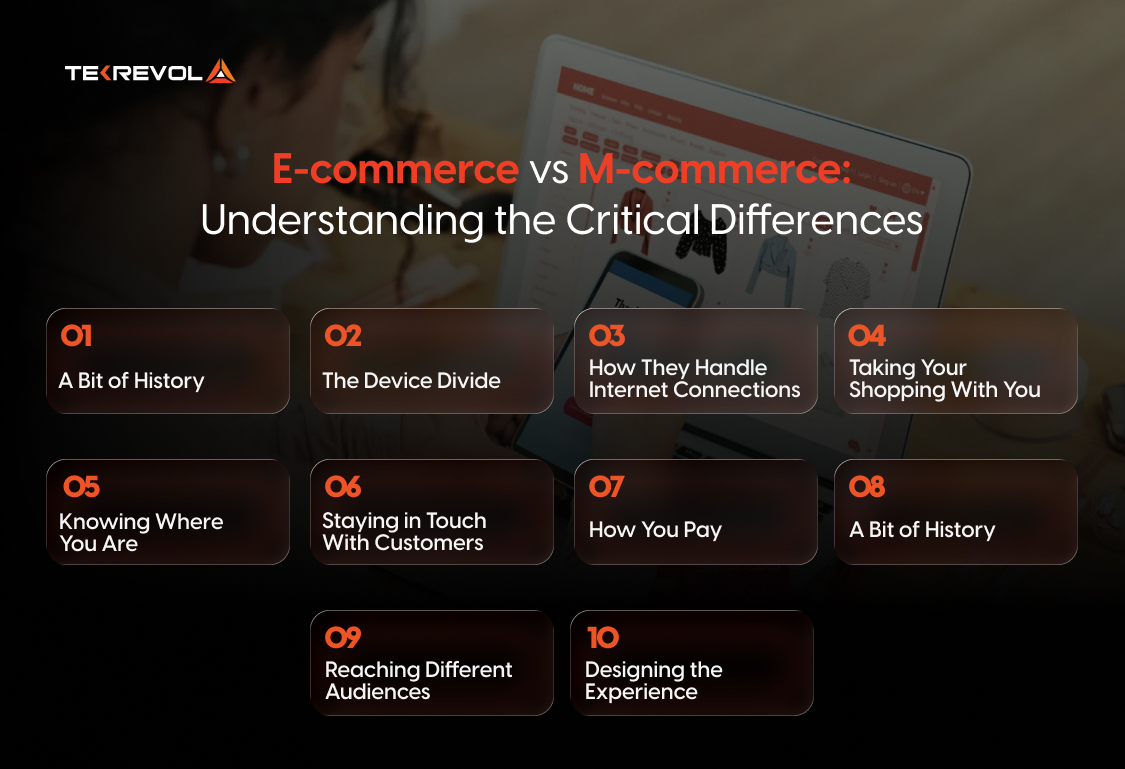
Schedule a Consultation!E-commerce vs M-commerce: Understanding the Critical Differences
The difference between e-commerce and m-commerce is far more than a mere matter of screen size. When you are looking to start a successful ecommerce business or if you are simply looking to enhance what you already have, the knowledge of these differences is important. It is time to explore the actual differences between these two methods of online selling.
A Bit of History
In fact, e-commerce began way back in the 1970s with a few electronic systems of data exchange. However, it did not actually gain momentum until the 1990s when the internet went boom and such businesses as Amazon and eBay were launched.
M-commerce was a late 90s, early 2000s development,t but it did not become big until smartphones had gone mainstream with the release of the iPhone in 2007. It was simply that the technology requires time to keep pace, so that it would be possible to shop on mobile, and it would actually be a good experience.
The Device Divide
E-commerce occurs on desktops and laptops when you are sitting at your desk with a full keyboard and a big screen. This system is ideal for comparing various products and doing proper research before purchase.
M-commerce has a way of being everywhere. Your smartphone transforms any idle time into shopping time. This mobility is altered when individuals make purchases and impulse purchases without any difficulties.
How They Handle Internet Connections
E-commerce fully relies on the internet. When your internet signal drops while shopping on a laptop, the process comes to a stop.
M-commerce is more forgiving. Most features require the internet, but most of the shopping apps allow you to browse products, make wishlists, or prepare orders without being connected to the internet. All this just automatically works when you reconnect to the internet, and certain apps work even with poor connections.
Taking Your Shopping With You
We have to be realistic; no one is going around with their laptop, trying to win a flash sale. Desktop computers are not designed to be portable, and this is the reason why mobile shopping continues to increase at a very rapid rate.
Mobile devices are pocketable and thus m-commerce is everywhere. Companies can also access you during such rush hours when you have a sudden urge to have something. This is where the advantages of a mobile app in ecommerce business will fully manifest themselves: you are providing the customer with an opportunity to shop, an opportunity that is always available.
Knowing Where You Are
Location tracking with e-commerce is not very good, as desktops cannot move. They may recognize your approximate location based on your IP address, but that is all.
M-commerce is different. GPS, Wi-Fi, and cell towers are the methods by which your phone can determine your precise location. The shopping applications will be displaying the stores nearby, giving directions, showing local inventory, and even sending exclusive discounts when walking to the mall.
Staying in Touch With Customers
E-commerce is based on emails, whereby customers may hope to come in and see what is new or on sale. There’s no way to reach them directly in the moment.
M-commerce relies on push notifications, which appear on your lock screen. Your businesses notified you of flash sales, left-behind carts, shipments of your orders, or custom offers. This is immediate communication, and it is much more engaged than email.
How You Pay
The conventional form of e-commerce involves typing credit card details and billing addresses with each checkout.
Mobile wallets such as Apple Pay, Google Pay, and Samsung Pay provided by M-commerce simplify payment procedures and enable a person to leave in several seconds. Use biometric authentication, such as fingerprints or facial recognition, instead of passwords. In-store payments are just as easy with a simple phone tap.
Reaching Different Audiences
E-commerce will only reach individuals who have computers and have good internet at home. While this group is important, it remains limited in size, especially in developing countries.
M-commerce is becoming accessible to a growing audience. When you look at eCommerce statistics for the U.S. and global markets, the desktop-to-mobile transition is massive; mobile purchasing has become the majority of all online purchases in the world.
Designing the Experience
E-commerce websites capitalize on those large screens. You will be able to view close-up product pictures, extensive descriptions, side-by-side comparisons of various products, and multiple products in one view. The navigation is not too complicated.
However, building a successful ecommerce website, the key is finding the right balance: your images should look amazing without making your site load slowly and frustrating visitors.
Ecommerce and Mcommerce Business Models
The type of business model you adopt dictates how you make money and how you relate with the customers. Now we will discuss the key models transforming online commerce.
eCommerce Business Models: The Basics of Selling Online
B2C (Business-to-Consumer)
This is simple: companies are selling to individual customers like you and me. Typical examples are Amazon and Walmart.
Mobile applications are now the centre of B2C success. By downloading your app, customers are placing you permanently on their home screen. The application tracks their preferences, memorizes their payment information, and reordering is absurdly easy. That convenience is a better motivator to purchase repeatedly than any site.
B2B (Business-to-Business)
In this case, businesses sell to businesses, such as a wholesaler supplying restaurants or manufacturers selling to retailers.
B2B was originally referred to as desktop-only shopping due to sophisticated pricing and quantity ordering. Not anymore. The sales reps can now view inventory, make orders, and negotiate deals at the client meetings through the use of mobile applications.
C2C (Consumer-to-Consumer)
Websites such as eBay and Facebook Marketplace allow common citizens to sell to one another.
Mobile totally changed C2C. You can take pictures of something you are selling, post it, and communicate with buyers, as well as finalize the sale in a few minutes, all on your phone. This convenience is why C2C platforms put mobile experiences above all.
D2C (Direct-to-Consumer)
Many successful companies skip physical stores entirely and sell their products directly to customers online.
The mobile applications reinforce these face-to-face relationships by establishing relationships. Special discounts, access to new products, and personal loyalty rewards are offered to app users. This is direct access to the customers, which is among the largest reasons why you should have an eCommerce mobile app.
mCommerce Business Models: Shopping on Your Phone
App-Based Commerce: Shopping Through Brand Apps
This is where you make purchases using a mobile application of a company rather than using the company website. Consider the Starbucks app, the Target app, or the Sephora app.
Applications are preferable to mobile websites since they are faster and more capable. They will be able to notify you of sales, remember your tastes, scan products with your camera, and check out incredibly fast. After downloading an application, the brand is immediately on your phone, making you more willing to shop with them on a regular basis.
Social Commerce: Buying Without Leaving Social Media
Social commerce implies that one can shop without leaving the app directly on Instagram, TikTok, Facebook, or Pinterest. You find a product on the feed of a person and can purchase it directly.
This is effective since individuals already believe in suggestions by influencers and peers. You are browsing the material, you notice something interesting, and you can capture it in an instant.
QR Code & NFC Purchases: Scan and Pay
It is the least complex type of mobile shopping. You scan a QR-code or use your phone to pay or access information. Consider scanning a code in a restaurant to view the menu, or swiping your phone to pay in Apple Pay. It is a trendy thing since it is very quick and simple. One scan and you’re done.
Mobile-Optimized Marketplaces: Apps Built for Shopping
These marketplace apps, such as Amazon, eBay, or DoorDash, are much more comfortable on your phone than on your computer. A majority of people are utilizing these apps rather than the websites.
These applications are thumb-friendly. Everything is simply tap to use; they know where you are, and the nearby options are displayed. You can search by taking a picture, and checkout is blazing fast. They notify about the approaching package or when there is an offer.
Build the Mobile Shopping Experience Your Customers Deserve
Partner with us to build a mobile commerce platform that keeps customers coming back.
Book A FREE Consultation Now!Ecommerce and Mcommerce Trends Shaping the Future
It is imperative to remain ahead of the ecommerce and mcommerce trends in order to have a competitive edge. The digital commercial environment is transforming fast due to technological emergence and shifts in consumer demands.
Mobile Apps Dominance
Millions of people nowadays shop using mobile applications. They are quicker, more convenient, and have better experiences compared to mobile websites. This is nothing but an mCommerce trend as applications are made to fit phones and tablets.
Apps allow push-notifications regarding sales, special offers, and loyalty programs, which make people purchase again. Application users use the application 3 times higher than mobile web visitors, making up 70 percent of the mobile commerce sales.
For detailed insights on app adoption trends, check out our comprehensive guide on mobile app download statistics & usage.
Augmented Reality (AR) and Virtual Reality (VR)
AR and VR are transforming businesses in phones, as well as in computers, affecting both mCommerce and eCommerce. Furniture brands allow you to use your phone camera to virtually put couches in your living room. Makeup companies provide virtual try-ons. VR showrooms can be used by desktop shoppers.
AR and VR in ecommerce addresses the largest issue in online shopping, which is uncertainty. The ability to visualize the products reduces buyer returns and enhances customer satisfaction.
Voice Shopping
Alexa, Google Assistant, and Siri voice assistants allow people to shop without raising a finger. Consumers place grocery orders, reorder household goods, and shop by speaking to smartphones, smart speakers, or personal computers.
Artificial Intelligence (AI) and Machine Learning
Artificial Intelligence enables a personalized feeling of shopping on all platforms, which affects both traditional eCommerce sites and apps. These technologies predict with the help of browsing history and behavior, propose any relevant products, enable instant-response chatbots, and guide customers to what they need.
In the background, AI forecasts inventory requirements, prices, and scams. The sales of AI personalization are likely to go up, and 80 percent of the retail executives intend to implement AI automation by 2026.
Social Commerce
Social media has turned into a significant mobile shopping destination. In-app purchases are now available on Instagram, TikTok, Facebook, and Pinterest without the need to move out of your phone.
This is mainly an mCommerce trend, as the majority of social browsing is done via mobile, and the statistics support this. According to the social media platforms by user statistics 2026, the mobile users are not simply scrolling, but they are buyingg and social commerce is one of the fastest-growing channels of sales.
Mobile Wallet Adoption
Mobile wallets such as Apple Pay, Google Pay, and Samsung Pay are becoming the standard mobile payment system, one of the primary trends in mCommerce. They are safe, easy, and quicker than typing credit card information.
Mobile wallets minimize cart abandonment for businesses. By the year 2028, mobile wallet transactions will be above 16 trillion worldwide, and half of all smartphone users are using them now.
Chatbots
Building chatbots has become essential across all platforms, benefiting both eCommerce and mCommerce. They answer questions instantly, help find products, and guide checkout, without human intervention on desktop or mobile.
Common problems, order tracking, returns, and personalized recommendations are handled using good chatbots. They will allow them to support 24/7 without having to justify a full-time call center. This is particularly useful to mobile shoppers, as chatbots help them to access help fast and conveniently.
Progressive Web Apps (PWAs)
Progressive Web Apps are a type of website that’s like a mobile application, an mCommerce-oriented innovation. They open quickly, are offline, and also send out push notifications, and they feel just like native applications, but do not need to be downloaded through an app store.
PWAs are ideal for companies that would like to have app-like features without creating individual iOS and Android apps.
Subscription Commerce
The subscription models are not just limited to streaming services but have also affected the eCommerce and mCommerce platform. Today, people are subscribing to razors, meal kits, clothing boxes, among other things, and manage the subscription via mobile apps or desktop dashboards.
The trick is to bring actual value, to save money, time, or provide curated products. Subscriptions establish a strong customer relationship with frequent customer engagement with the brand, and not a one-off purchase.
How to Integrate Mobile Commerce Into Your Ecommerce Business Strategy
Today, the most successful online businesses do not have to make a choice between mobile and web; they develop seamless experiences in both directions. In case you are already selling online, but you have not done so well to cater to mobile customers, this is how you can effectively take mobile commerce as a part of your current plan.
Evaluate Your Current eCommerce Platform.
Start by determining if your current setup can handle mobile commerce functionality. Not all ecommerce and mcommerce platforms are created equal; older systems often lack mobile optimization and may need substantial upgrades or a complete platform switch to deliver the seamless mobile experience customers expect.
Today’s platforms must support responsive design, mobile-optimized checkout, app integration, and comprehensive CRM for ecommerce to track customer behavior across devices. If your current solution is limiting your growth, it’s time to switch to a platform that delivers true flexibility for both web and mobile experiences.
In case your platform requires significant work or you do not have technical know-how in-house, then it may be a good idea to hire an ecommerce development company specializing in mobile optimization and platform migration.
Optimize Your Website for Mobile Devices
Your website must deliver a smooth experience on smartphones and tablets. This means more than just making things smaller; it requires rethinking navigation, button sizes, image loading speeds, and form inputs for touch screens.
Test your site thoroughly on actual mobile devices. Check page load times, complete test purchases, and ensure every feature works properly.
Develop a Mobile Application
While not essential for every business, a dedicated mobile app development can significantly boost customer engagement and sales. Apps provide faster performance, push notifications, offline access, and features that mobile websites simply can’t match.
Before investing in app development, identify what unique value it would offer your customers. You have two main options: turn your website into a mobile app using conversion platforms, or build a custom app from scratch. Whether it’s easier reordering, exclusive promotions, loyalty rewards, or advanced features like augmented reality, ensure your app solves real customer needs.
Implement Mobile Payment Solutions
Simplify the checkout process by integrating mobile wallet options like Apple Pay, Google Pay, and Samsung Pay. These payment methods allow customers to complete purchases in seconds with just a fingerprint or face scan. The easier you make payment, the higher your conversion rates will be.
Leverage Location-Based Marketing
Take advantage of your customers’ mobility by implementing location-based features. Send targeted notifications when shoppers are near your physical store, offer location-specific promotions, or display local inventory availability.
Monitor Performance and Continuously Improve
After implementing mobile commerce features, track key metrics like mobile conversion rates, average order values, app engagement, and customer feedback. Use this data to identify areas for improvement and optimization.
Mobile commerce is an ongoing process, not a one-time project. Stay updated on new technologies and changing customer expectations, and be ready to adapt your strategy accordingly.
Wrapping Up
As we have discussed the difference between ecommerce vs mcommerce, it’s clear that both play crucial roles in today’s digital economy. E-commerce provides a large platform with extensive reach, ideal for desktop users, while M-commerce meets the needs of mobile users with flexibility, speed, and personalized experiences.
At Tekrevol, we help businesses leverage both channels effectively, guiding the implementation of robust ecommerce platforms and intuitive mcommerce applications that align with your audience and business goals.
For ecommerce, Tekrevol has delivered powerful solutions like “Al Hussaini”, an omnichannel retail platform that boosted online sales and unified digital and physical experiences for a major retailer.
On the mobile side, the “Mdrouz” multi‑vendor ecommerce app showcases our mcommerce expertise, providing users in the GCC region a seamless shopping experience with local payment integration and engaging UI.
These projects highlight our ability as a leading ecommerce website design and development services to build solutions that perform and scale.
Tekrevol’s team provides end-to-end solutions customized to your business needs. Let us help you create seamless and engaging digital experiences that turn visitors into loyal customers.
Don’t let your competitors outpace you.
Partner with Tekrevol to launch impactful digital solutions fast.
Book a Consultation Now!



![How Much Would It Truly Cost to Develop a Food Ordering Website? [2026 Analysis]](https://d3r5yd0374231.cloudfront.net/images-tek/uploads/2026/03/Tek-Feature-7-1.jpg)