AR/VR apps in the USA hit different price points from $30,000 to $300,000 based on depth. An entry-level augmented reality app development costs with off-the-shelf elements zip by at $15K. However, VR apps with photorealistic 3D models and multi-user support go over $500,000, as they need more design time and testing skills.
The investment fluctuation in AR/VR app development cost is still the main roadblock for the 91% of USA companies planning to integrate spatial computing into their operations. The global market, however, projects $123 billion by 2032, accelerating the need to invest as only early movers gain the advantages of engagement and efficiency in 2026.
Therefore, we prepared this guide to equip you with stage-by-stage breakdowns, industry-specific estimates, and key cost drivers like team location and asset quality. Plus, we list the coming trends that affect your budgets and maximize ROI on costs to develop AR/VR apps.
How Much Does It Cost to Develop an AR App?
Custom AR app development in the USA begins at $30,000 for basic marketing applications. It can scale up to $300,000 or above for top-grade solutions developed by an expert enterprise app development company by integrating AI and real-time IoT data.
| AR App Complexity | Estimated Cost (USA) | Average Timeline |
| Basic (Markers/Filters) | $30,000–$50,000 | 4–6 Months |
| Medium (SLAM/Navigation) | $50,000–$120,000 | 4–9 Months |
| Advanced (Enterprise AI/IoT) | $120,000–$300,000+ | 9–12+ Months |
The augmented reality app development cost is a direct reflection of how much “brainpower” the application needs to interpret and interact with the physical world. Statista predicts that mobile AR users are projected to exceed 1.19 billion by 2028, and companies are budgeting across these distinct tiers of complexity.
Simple AR Apps (Marker-based)
These applications use specific triggers like QR codes or images to launch digital overlays. Because they don’t require the app to map a 3D environment, they are the most budget-friendly entry point for retail demos or simple games with a budget of $30,000–$50,000.
Mid-level AR Apps (SLAM and Geolocation)
Budgets for these projects usually sit between $50,000 and $120,000. Mid-tier apps use Simultaneous Localization and Mapping (SLAM) to “see” surfaces like floors or walls. This technology is the backbone of “View in Room” features that have led to a 94% conversion lift for retailers like Shopify.
Enterprise-grade AR Apps (AI and Real-time Data)
These tools use AI for complex object recognition and pull live data from industrial machinery. AR app pricing USA for these enterprise tools starts around $150,000 and can scale indefinitely. If you want to build an AR app for a factory floor, this is your bracket.
For companies weighing marker-based vs markerless AR cost, the latter offers a more seamless user experience that 73% of AR users claim leaves them satisfied with their brand interaction.
High pricing stalling your vision?
Tekrevol optimizes your augmented reality development cost.
Contact us todayHow Much Does It Cost to Develop a VR App?
Virtual reality app development cost in the USA typically ranges from $20,000 for a lean MVP to over $500,000 for complex enterprise simulations that include AI and real-time processing.
VR development cost is often higher than AR because you aren’t just adding to a room; you are building the entire world from scratch, which influences the pricing tiers below:
| Complexity | Average Timeline | Estimated Cost | Key Features |
| Simple VR | 3–5 Weeks | $3,000 – $9,000 | Basic navigation and limited 3D models. |
| Basic MVP | 2–3 Months | $20,000 – $50,000 | Primary interactions, standard UI. |
| Medium Core | 4–6 Months | $50,000 – $80,000 | Interactive environments, 3D viewing. |
| Advanced AAA | 12+ Months | $150,000 – $500,000+ | High-end graphics, multi-user, complex AI. |
VR MVPs and Prototypes
A VR MVP is a focused “proof of concept” used to test a core mechanic or environment. It is a strategic starting point for startups using MVP development services to secure funding or internal buy-in.
High-End Immersive VR
These environments feature photorealistic 3D assets and multi-user collaboration. They are frequently used for high-level sales meetings or detailed training where “presence” is non-negotiable for success.
Advanced VR Simulations
Advanced simulations are the gold standard for high-stakes industries like aerospace and medicine. A VR-trained worker is 4x more focused than an e-learning student, which justifies the high VR simulation pricing for these complex builds.
What Factors Affect AR/VR App Development Cost?
The primary drivers for AR/VR app development cost include the level of 3D interactivity, the choice of hardware (such as Apple Vision Pro vs Meta Quest), and the geographical location of the development team.
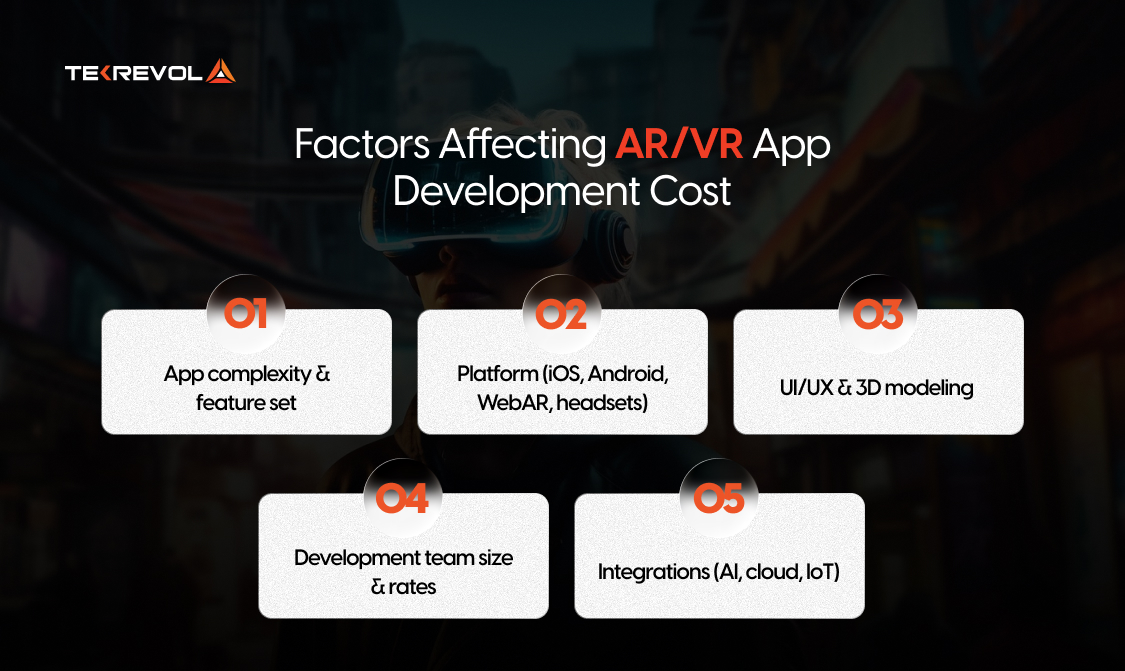
Budgeting for spatial computing is closer to movie production than traditional coding. Our AR/VR development company will prioritize the following variables to keep costs predictable.
App Complexity and Interaction Levels
Complexity is the biggest budget eater. Every interactive button, every physics-based object, and every custom animation adds hours to the build. If you want “basic,” the cost stays low. If you want “cinematic,” the virtual or augmented reality app development cost climbs accordingly.
Hardware Platform
Each platform has its own rules and development kits. Developing for multiple platforms at once can save money in the long run, but requires a larger initial investment. Standalone headsets (like Quest 3) are generally less expensive to develop for than high-end mixed reality devices.
UI/UX and 3D Asset Quality
3D model quality ramps up the cost to develop an AR/VR app fast. Photorealistic textures and intricate animations demand far more effort than low-poly or stylized designs. Custom modeling invests $5K–$30K in standout branding and deeper user engagement.
Team Skill and Location
In the US, developers’ hourly rates typically range from $100 to $250 per hour. While you can hire app developers at lower rates in other regions, local teams offer better alignment with regional business standards and faster communication. A smaller team is cheaper but will take longer to hit your launch date.
Backend and Integrations
You’ll likely need API integration services to connect your 3D world to real-world data like inventory or user accounts. System integration with legacy CRM or ERP software adds significant time and $30,000+ to the backend budget.
Estimated AR/VR App Development Cost by Industry
The cost to develop an AR/VR application varies widely by industry due to unique demands for quality, security, and realism. For example, a retail AR app for try-ons is around $40K–$80. However, when it comes to healthcare, a VR training tool for surgical precision soars past $ 100,000.
Why? Hyper-real anatomical models, HIPAA-grade security, and fail-proof interactions demand custom 3D scans and endless testing to save real lives.
Retail & eCommerce
Custom Market Insights forecasts that the use of AR in retail is projected to reach a $105 billion market size by 2033. Retailers implementing virtual reality in shopping have reported a 25% reduction in product returns, justifying the initial augmented reality app development cost.
Healthcare
The cost of virtual reality in healthcare often starts high because it requires extreme accuracy for diagnostics or surgical prep. With the market for VR in healthcare projected to grow at a CAGR of 35.1%, more hospitals are piloting these tools. You should consult a healthcare app development company to ensure all regulatory standards are met.
Manufacturing & Automotive
These industries use XR for assembly line training and safety protocol visualization. A combination of marker-based and projection AR is common here to provide maximum precision. Marketing Biz confirms that firms saw 43% drop in workplace injuries after implementing VR safety drills, proving that the VR development costs are often recouped through improved safety and efficiency.
Education & Training
The augmented reality app development cost for educational tools is increasingly justified by a 76% increase in learning effectiveness compared to traditional methods. The spend of virtual reality in education is projected to reach $86.96 billion by 2029, according to Research and Markets. It highlights that institutions are rapidly adopting immersive simulations for STEM and vocational training.
Real Estate
A skilled real estate app development company integrates VR for virtual property tours, which can be built relatively quickly. This allows buyers to walk through a home before it’s even built. It’s a powerful sales tool that often pays for itself within a few closings.
Entertainment
Entertainment remains a primary driver for immersive tech. As per the Market Growth Reports on AR/VR &XR stats, over 150 million users engage with AR or VR monthly. High-fidelity social VR worlds and multiplayer arenas are seeing massive growth, often requiring significant investment to maintain the 90+ FPS needed for a seamless user experience.
| Industry/Sector | Primary Use Case | AR Development Cost | VR Development Cost |
| Retail | Virtual Try-Ons / Showrooms | $30k – $150k | $50k – $250k |
| Healthcare | Surgical Training / Diagnostics | $100k – $300k+ | $150k – $500k+ |
| Real Estate | Virtual Tours / Staging | $40k – $180k | $20k – $70k* |
| Manufacturing | Maintenance / Digital Twins | $80k – $250k | $100k – $400k |
| Education | Immersive Classrooms | $25k – $120k | $40k – $180k |
| Entertainment | Social VR / Mobile Games | $20k – $200k | $60k – $500k+ |
AR/VR App Development Cost Breakdown by Stage
Most projects span discovery, design, development, and testing. Each of these phases carries a specific weight that dictates your final augmented reality app development cost.
At our mobile app development company, the actual development phase usually gobbles up about 40–50% of the total budget. Because it’s the groundwork that determines if that money is well-spent.
- Pre-Production and Discovery (10–15%): This is your “measure twice, cut once” phase. Invest in deep-dive market research and rapid prototyping to prove that your idea actually works in 3D. Skipping this is the fastest way to bloat your augmented reality app development cost with unnecessary features.
- UI/UX and Asset Creation (15–20%): In spatial computing, the “vibe” is everything. Designers map out the visual journey while 3D artists make it immersive, from lightweight low-poly backgrounds for mobile to the hyper-realistic avatars that make enterprise VR feel real.
- Production and Coding (40–50%): The engine room is where developers perform the heavy lifting, implementing SLAM (Simultaneous Localization and Mapping), complex gesture recognition, and API integration to keep your app connected to the cloud.
- Testing and QA (10–15%): This stage is your safety net. Beyond just hunting for bugs, it’s about comfort testing to eliminate “simulator sickness because a laggy experience is a failed experience.
- Deployment and Launch (5–10%): The final sprint, which covers the technical heavy lifting of releasing on the App Store, Google Play, or specific enterprise headsets like the Meta Quest 3 or Vision Pro.
Don’t forget that “software rot” is real. VR app maintenance cost is an ongoing reality, typically requiring 15–20% of your initial investment annually to keep your app compatible with the latest OS updates and hardware firmware. Following a strict AR app development lifecycle is the only way to keep these percentages in check.
Stop overspending on immersive tech
Optimize Your Investment for AR/VR development cost with Tekrevol.
Request your quoteHow Long Does It Take to Make an AR/VR App?
Most AR/VR projects take between 4 and 10 months to move from an idea to a finished product. The AR/VR app development cost per hour is the price you pay for this intensive, multi-disciplinary work.
| Project Complexity | Average Timeline | Typical Focus |
| Simple (MVP) | 2–4 Months | Basic 3D overlays with simple interactions and 1-2 key features. |
| Medium | 4–9 Months | Multi-user support, SLAM navigation, and custom 3D assets. |
| Enterprise / AAA | 10–24 Months | High-fidelity physics, AI integration, and complex backend data sync. |
The AR app development timeline is usually a bit shorter for mobile-based projects. VR projects take longer because the developers are essentially building a small video game. If you want to make VR game content, you have to account for level design and balance.
Tech Stack and Tools That Impact AR/VR Cost
Selecting the right tech stack can significantly swing your AR/VR development costs, ranging from budget-friendly to sky-high.
Start with engines. Unity AR development cost kicks off free for starters, with its huge asset store speeding mobile AR builds at $2,000/year per dev. Switch to Unreal Engine VR pricing, and you get pro-grade visuals for immersive VR, but brace for a tougher learning curve plus 5% royalties after $1M revenue (or $1,850/seat/year subs for non-games).
Next, layer in AR SDKs to track the progress. ARKit (free for iOS) and ARCore (free for Android) keep AR SDK licensing cost near zero for basics, while Vuforia ramps it up to $500–$10K/year for advanced model/area targets. For seamless cross-device work, OpenXR delivers royalty-free runtime unity at no upfront cost.
WebAR frameworks like 8th Wall ($95+/month starter) or Zappar enable quick browser deploys without app stores, trimming distribution overhead.
Finally, cloud and analytics tools like AWS Sumerian or Google ARCore Cloud Anchors handle rendering remotely (pay-per-use for $0.01–$0.10/GB). If you paired them with Unity Analytics/Firebase for data-driven tweaks, that slashes iteration costs by 15–30%.
Emerging Technologies & Trends Affecting AR/VR Development Cost
New trends like spatial computing and AI-driven realism are changing how we calculate augmented reality app development cost. As per the Bis Research, we are moving toward a $2.8 trillion AR market by 2034, where these XR development trends likely increase the future cost of AR VR.
- Mixed Reality (MR): Headsets like the Apple Vision Pro roll out a “VisionOS Premium” tier, increasing resolution demands that drive up the price tag on those fancy 3D assets.
- AI-Generated Environments: AI’s jumping in to whip up 3D characters and scenes on the fly through procedural magic, slashing manual artist hours by as much as 20% on epic, drawn-out projects.
- Low-Latency 5G: It unlocks “cloud-powered” AR, offloading the grunt-work rendering to remote servers and letting you ditch the beastly high-end gear right in your pocket.
How Does TekRevol Optimize AR/VR App Development Cost Without Compromising Quality?
As a leading company, we focus on cross-platform app development services to deliver value in increments and prevent budget overrun. Our approach includes:
- Reusable Asset Libraries: We maintain a catalog of base 3D models and UI components to reduce design time, thereby, total augmented reality app development cost.
- Offshore-Onshore Hybrid Models: By leveraging global talent, our experts can reduce total development costs by 40-55% while maintaining quality.
- Agile Prototyping: We build and test core mechanics within weeks, ensuring your budget is spent on features that users actually want.
This approach ensures you get the best AR/VR app cost savings without sacrificing technical excellence. We act as a true partner to help you scale your digital vision.
Ready to maximize your returns?
We create lean AR/VR development cost strategies for long-term profit.
Start your project