SRE vs DevOps comes down to scope. DevOps is a culture and a set of practices for building and shipping software, and site reliability engineering (SRE) is an engineering discipline that runs a service against a reliability target. Google’s SRE workbook treats SRE as one concrete way to practice DevOps. The real question is which one your team needs first. This guide compares them side by side and works through SLOs and error budgets with real arithmetic. It ends with the TekRevol Reliability Ownership Map, a three-question way to choose a model for a team running a custom software development project.
What is the difference between SRE and DevOps?
DevOps covers how a team builds and ships software, and SRE covers how reliably that software runs once it is live. Google’s SRE workbook describes DevOps as the broader, more cultural idea, and SRE as narrower, centered on a service and more prescriptive about how to run it.
| Dimension | DevOps | SRE |
| Core idea | A culture of shared ownership between development and operations | An engineering discipline that treats operations as a software problem |
| Main goal | Deliver software faster and more safely | Keep a service reliable enough for its users |
| Success measure | Delivery metrics, such as DORA’s change lead time and change fail rate | A service level objective and the error budget that remains |
| Who does it | Everyone who builds and runs the product | Engineers, often a dedicated team, who own the reliability target |
| Team shape | Cross-functional teams, with roles that vary | Software engineers who also do operations work, often on call |
| Attitude to change | Ship small changes often | Ship while the error budget lasts, and slow down when it runs out |
This table is TekRevol’s summary of the pattern that Google’s workbook and vendor guides describe.
What is DevOps?
DevOps is a way of working that removes the wall between the people who write software and the people who run it. Google’s workbook summarizes it with five ideas: culture, automation, lean practices, measurement, and sharing. Its core beliefs are that teams should not work in silos, that accidents are normal, and that small and frequent changes are safer. The workbook says tooling and culture are interrelated.
What is SRE in DevOps?
Google’s SRE workbook chapter on how SRE relates to DevOps sums up the relationship in one line: “class SRE implements interface DevOps”. The workbook lists these principles. Operations is a software problem. Teams manage by service level objectives. They minimize toil, which is repetitive manual work that automation could do. They learn from production, apply “Automate This Year’s Job Away”, reduce the cost of failure, share ownership with developers, and use the same tools as everyone else. The workbook caps toil at 50 percent of an SRE’s time.
How do SLOs and error budgets work?
An SLO is a reliability target, and the error budget is the amount of failure that the target still allows. Google’s SRE book defines three terms. A service level indicator (SLI) is a precisely defined measure of how a service performs, such as the share of requests that succeed. A service level objective (SLO) is the target that the SLI should meet. A service level agreement (SLA) is a contract with users that attaches consequences, usually financial, to missing an SLO. The book treats 100 percent compliance as unrealistic, so a team allows a rate at which the SLO can be missed. That allowance is the error budget.
The table shows what each target allows over 30 days, which is 43,200 minutes. Each figure is plain arithmetic: multiply the share of time the service may fail by 43,200.
| SLO target | Failure allowed | Downtime allowed in 30 days |
| 99% | 1% | 432 minutes (7.2 hours) |
| 99.9% | 0.1% | 43.2 minutes |
| 99.99% | 0.01% | 4.32 minutes |
A request-based SLI works the same way. A 99.9% target on 1,000,000 requests allows 1,000 failed requests.
The error budget also guides release decisions. While budget remains, releases can ship. If the team spends the budget, it pauses releases and invests in testing and resilience, and the book also describes gentler options, such as slowing or rolling back releases as the budget runs low. The book adds that this works only when the SRE team has the authority to halt launches once the SLO is breached. In TekRevol’s judgment, the budget works best as a rule that the team agrees on before an incident.
Which metrics does each use?
DevOps teams track how fast and how safely they deliver, and SRE teams track how well the live service performs against its SLO. DORA’s software delivery metrics guide defines five delivery metrics in two groups, throughput and instability, and notes that the set evolved from an earlier four.
| Measure | Group | What it tells you | Used by (TekRevol’s judgment) |
| Change lead time | Throughput | Time from a commit to running in production | DevOps |
| Deployment frequency | Throughput | How often deployments happen | DevOps |
| Failed deployment recovery time | Throughput | Time to recover from a failed deployment | Both |
| Change fail rate | Instability | Share of deployments that need immediate intervention, such as a rollback or hotfix | DevOps |
| Deployment rework rate | Instability | Share of deployments that are unplanned and triggered by an incident in production | DevOps |
| SLI | Service health | Measured performance of the live service | SRE |
| SLO and error budget | Service health | The target, and how much failure it still allows | SRE |
The two sets meet at recovery time, because how fast a team restores a service after a failed release affects both the DORA metric and the error budget. This link is TekRevol’s reading.
The SLI needs signals from the running service, and TekRevol’s guide to monitoring microservices covers what to track and alert on.
Where do SRE and DevOps overlap, and how do they work together?
DevOps and SRE overlap because both exist to ship change safely. Google’s workbook names the shared ground: both favor small and frequent changes, and both rely on measurement. DevOps rejects silos between development and operations and treats accidents as normal. Both also automate repetitive work. TekRevol’s DevOps automation guide is a related read.
In TekRevol’s judgment, the cleanest working split is that the DevOps side owns the delivery path and the SRE side owns the reliability target. Both sides run blameless postmortems, so every incident improves the delivery path and the target together. The workbook adds two cautions. Narrow metrics get gamed, and reliability work needs the same standing as feature work.
Platform engineering vs SRE: where does each fit?
A platform team builds the internal tools that developers use every day, and an SRE team protects the reliability of the services that run on them. Google Cloud’s platform engineering guide, last updated in October 2026, describes platform engineering as designing, building and maintaining an internal developer platform that offers standard, self-service paths for developers. It says the platform team treats those tools as a product. It calls platform engineering and DevOps complementary, with DevOps as the cultural goal and platform engineering as the way to reach that goal at scale. It does not compare platform engineering with SRE.
TekRevol’s reading is that the two protect different things. A platform engineer protects developer time, and an SRE protects the user’s experience of the service. A platform engineer vs SRE choice therefore depends on whether your main problem is slow delivery or an unreliable service. Google Cloud also notes that smaller teams may need only DevOps practices and simple automation, which matches TekRevol’s judgment that platform work pays off as a company grows.
What does an SRE team do?
An SRE team sets reliability targets with the product team, runs on-call and incident response, and automates repeated manual work. A site reliability engineer vs DevOps engineer comparison therefore comes down to focus: the SRE spends more time on how the service behaves in production, including SLOs, alerts, capacity and incident review.
The difference between an SRE and a software engineer is the target. Both write code, but an SRE writes it to keep a service inside its reliability target. That distinction is TekRevol’s judgment, and job titles vary by company.
Which model fits your team? The TekRevol Reliability Ownership Map
Most teams should add SRE practices before they add an SRE team. The TekRevol Reliability Ownership Map is TekRevol’s judgment, built on Google’s SRE workbook and DORA’s metrics. It asks three questions in an order that is also TekRevol’s judgment.
- Do users feel outages enough to justify a reliability target?
- Do you have an agreed target, an SLO, and a way to measure it?
- Can you staff an on-call rotation without starving delivery work?
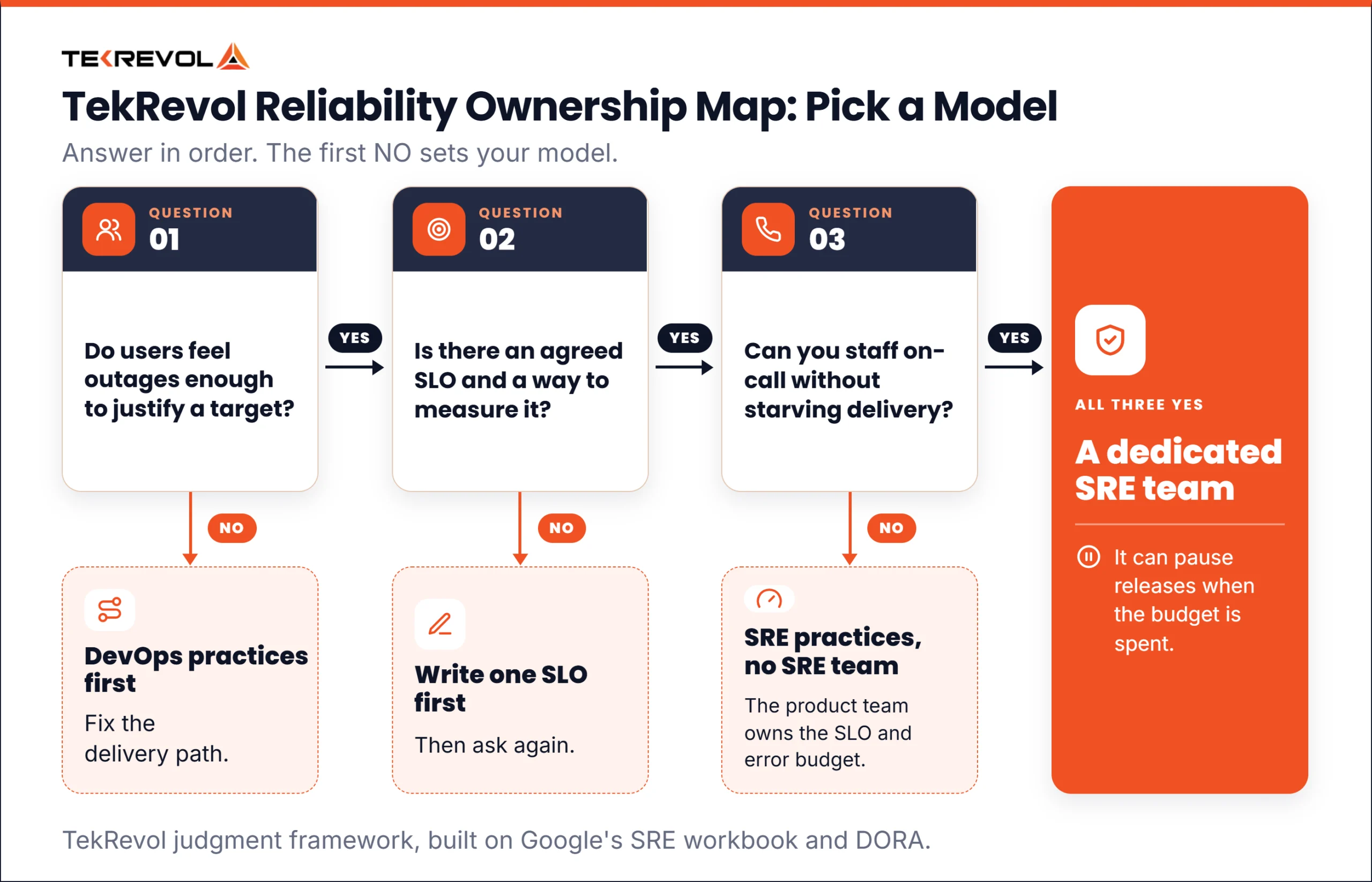
| Your answers | Model | Do this first |
| No target yet | DevOps practices first | Fix the delivery path, then write one SLO for your most important user journey |
| Target justified, but no SLO or way to measure it | Write one SLO first | Write the SLO and a way to measure it, then ask again |
| Target, but no spare engineers | SRE practices without an SRE team | The product team owns the SLO, the error budget and the blameless postmortems |
| Target and spare engineers | A dedicated SRE team | Give the team authority to pause releases when the budget is spent, as the SRE book describes |
Is SRE better than DevOps?
No. A DevOps vs SRE ranking makes little sense, because the two answer different questions and neither is better in general. In TekRevol’s judgment, a team with slow, painful releases should start with DevOps practices, and a team with frequent outages and a fast release pace should start with SLOs. That is a judgment call.
Get help with reliability ownership
TekRevol offers DevOps consultancy. If you want a second opinion on where your team sits on the Ownership Map, bring your current release process and your most recent serious outage. Start with a Free Consultation.