
POC, MVP, and Prototype are three terms that are used all the time interchangeably. And this misunderstanding is not only semantic, but it is also expensive. Picking an incorrect point of origin may lead to the allocation of resources in the wrong direction, skew the teams, and hinder innovation before it even starts.
- A Proof of Concept responds: “Is it possible to make this? It’s a technical risk check.
- A Prototype answers: “Should we build it this way?” It’s a design and usability test.
- A Minimum Viable Product answers: “Should we build this at all?” It’s a market reality check.
Making the wrong choice of tool makes everything slow. This is not a theory but a strategy. Knowledge of the appropriate time to apply a POC, Prototype, or MVP can be the difference between spinning your wheels and building effectively.
Before engaging a mobile app development company or assembling your own team, understanding these distinctions ensures you invest resources wisely and align development phases with your business validation needs.
This guide gives you practical insights to align your team and validate your next big idea with confidence. So, let’s get started!
What Is POC (Proof of Concept) in Software Development?
POC in Software development is the concept of the first phase in technical validation. It is an experiment that aims to provide the answer to one important question:
Can this idea work at all?
A proof of concept (POC) demonstrates the viability of the technology, architecture, algorithm, or innovation. Does it work? It is a technical user experience deliverable, not a user experience one.
The POC is necessary when you are dealing with unknowns, new algorithms, new third-party integrations, complex data flows, or architectural risk. Essentially, it establishes the existence of the main assumption that a product is technically feasible.
Why Do We Need a POC in Software Projects?
To see why we need a POC in a software project, it’s important to recognize its key functions in software development. Here are the benefits of proof of concept in software:
- Risk Reduction: It is better to test technical feasibility prior to investing significant resources to act early enough before the roadblock. Research has shown that a POC can help to cut project failure by as much as 40%.
- Technical Validation: POC helps identify the extent to which the selected technology stack, architecture, or approach can resolve the problem you are going to.
- Investor Confidence: Albeit an internal tool, a successful POC will give concrete results in the case of seed funding or stakeholder buy-in.
- Resource Planning: POC development life cycle assists in estimating the budgets, timelines, and technical requirements of complete development by the teams.
- Direction Setting: The outcomes of a POC inform the decision-making regarding the features that need to be focused on and the technical strategies that should be followed.
What Is a Prototype in Software Development?
A prototype during custom software development is the next step after feasibility validation. A POC will answer the question of whether or not something can be built, whereas a prototype will address the way it is supposed to behave as a user would use it.
A prototype is a representation in visual or interactive form that illustrates workflows and display layouts, and feature interactions. It is not a complete functioning software, yet it gets close to the user experience to test the usability and design decision.
Prototypes can be particularly useful when a team has to explain product behavior or test assumptions regarding user flows, or stabilize the stakeholders before development.
Concisely, a prototype is used to address the following question: Does this solution make sense to users?
Why Do We Need a Prototype in Software Projects?
The prototype is an important step in the process of developing the product prior to the commitment of engineering resources.
- User Experience Check: Prototypes enable the teams to identify early navigation, interactions, and usability. This assists in the identification of areas of friction that might otherwise be detected towards the end of development.
- Design Alignment: Early visualization of the product guarantees that the designers, developers, and stakeholders have a good idea of what is being created through prototypes.
- Quick Feedback: Teams are able to receive feedback, make modifications, and repeat their process faster because it is possible to develop prototypes very quickly.
- Less Development Waste: Requirement validation at the beginning of the design reduces the chances of creating new functionality that the user finds confusing or hardly needed.
- Better Product Direction: Prototyping offers insights into what is desired in the product, which are used to prioritize features and make better decisions before the entire product process is delivered.
What Is an MVP (Minimum Viable Product)?
Minimum viable product refers to the first form of the actual product that can be launched among the customers. It also has limited functionality or includes only the essential functionality to provide value and to collect verified user feedback.
So, unlike a prototype or pilot project or POC, an MVP is put on the market and utilized to get to know what the users actually want. MVPs assist startups in creating lean, preventing unnecessary efforts, and pivoting in the shortest time possible. For founders without technical backgrounds, MVP development services provide the expertise needed to transform ideas into testable products quickly while maintaining focus on core business validation.
Why Do We Need an MVP in Software Projects?
The MVP provides a way to bridge the internal validation and reality.
- Market Validation: With only basic features, a team can perform market validation by verifying that the product is a solution to a real problem of users.
- Actual User Feedback: MVPs are created to be mindful of actual usage, and not on assumptions or opinions within the company.
- Cost Effectiveness: By making sure that the features included are must-haves, you can avoid overbuilding and cut down on non-obligatory features development costs.
- Shorter Time to Market: The MVP enables teams to get into the market as fast as possible and respond to actual feedback instead of prolonged planning processes.
- Scalable Product Growth: The information used with MVP usage is used to make future improvements to the product, and the team is able to make correct choices to scale the product.
POC vs MVP vs Prototype? Key Differences
When launching a new product idea, three important steps can be used to reduce the risk and maximize success. Answering the question as to whether you require a PoC, prototype, or MVP is based on the question you are aiming to answer and the stage of product development you are at.
| Aspect | Proof of Concept (POC) | Prototype | MVP |
| Purpose | Prove the idea is technically possible | Show how the product will work and look | Deliver core value to early users |
| Audience | Internal stakeholders, investors | Internal team, potential investors | Real customers/end users |
| Functionality | Minimal, just enough to test feasibility | Limited, focuses on key features and UX | Functional with essential features only |
| Quality | Rough, experimental | Polished visually but may not be fully functional | Production-ready but basic |
| Development Effort | Minimal – backend, API, logic focus | Medium – UI design, interactions, mock data | High – production-ready development with real data & security |
| Timeline | Days to weeks | Weeks to months | Months |
| Cost | Lowest | Moderate | highest |
| Goal | Answer: “Can we build this?” | Answer: “How will this work?” | Answer: “Will users pay for this?” |
| Use cases | Testing if AI can accurately detect objects in images | Interactive mockup showing app screens and user flow | Basic app with 3-5 core features available on the app store |
Confused About Which Stage Your Product Needs First?
With TekRevol, you get guidance on the optimal development stage for your idea to maximize your ROI.
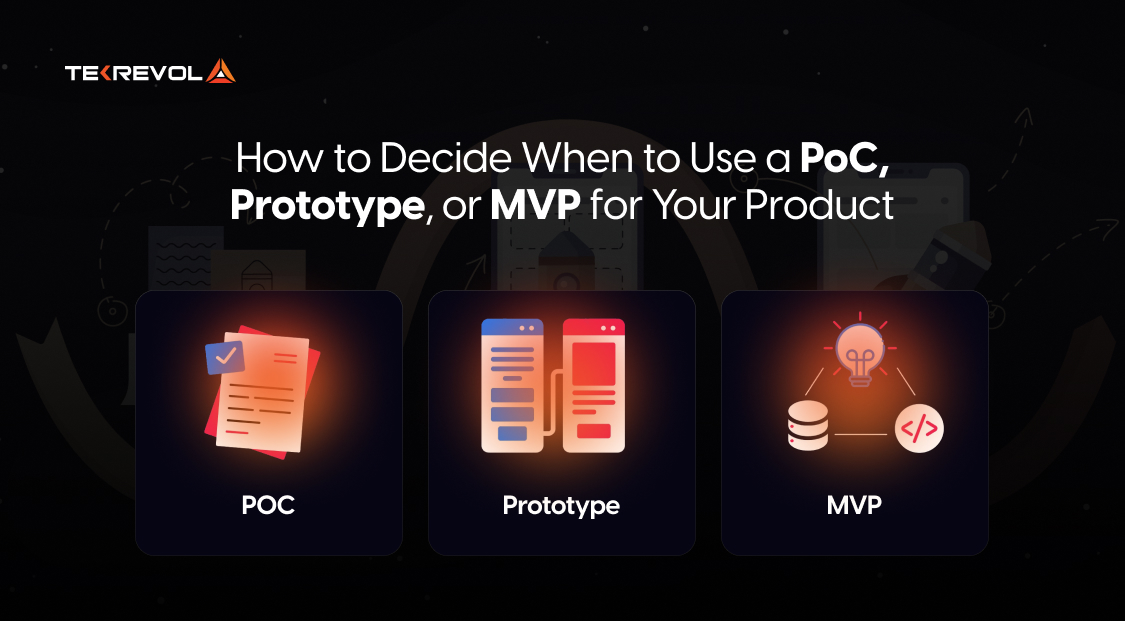
Book A FREE Call Now!How to Decide When to Use a PoC, Prototype, or MVP for Your Product
Not all products have to pass through all three stages. The correct strategy would be based on your situation, resources, and aims. This is the way you can find out when to use a poc, MVP, or prototype.
Key Questions to Guide Your Decision
The following are the basic questions to be used before choosing a development approach:
- What is your major area of doubt? When you are not sure of technical feasibility, begin with a PoC. Should user experience be validated, then a prototype development becomes the choice. When demand in the market is your concern, create an MVP.
- How complex is your concept? Basic concepts that have been tested technologically may go directly to MVP, and creative or technically demanding ones may start with a PoC.
- What resources do you have? With limited budgets, teams usually start with prototypes for early validation, whereas bigger budgets enable faster MVP development.
- Who needs convincing? PoCs are required by internal teams, prototypes by investors, and MVPs by customers.
When Does a Proof of Concept (PoC) Make Sense?
When the technical feasibility is not clear, a PoC is the correct step to take. It is concerned with one critical question: Can this idea really work?
Use a PoC when:
- You have to subject the idea to testing to see if it is technically feasible under real-life conditions.
- You would like to find out the dangers before entering full-scale development.
- You should have facts to back up the discussions with investors or inside decision-makers.
A PoC is not concerned with design or user experience, but it is simply about demonstrating that the idea is workable.
When Should You Build a Prototype?
A prototype would work well when the idea is viable, but you must see and develop the experience first, then construct the actual product.
Choose prototyping when:
- You desire to show some stakeholders or investors the product flow and interface.
- You must have an actual means of expressing your concept without developing complete functionality.
- You have a limited budget, but you require something interactive and persuasive.
Prototypes aid in matching expectations and making everyone aware of how the product is going to appear and how it will act.
When Is an MVP the Right Choice?
An MVP is a proper move when you are ready to get into the market and get to know the real users. It is a working product which is intended to add value, not only test assumptions. This is why most MVP development companies for startups emphasize launch-ready functionality over perfection, helping founders enter the market quickly with products that solve real problems for early adopters.
Go with an MVP when:
- You wish to introduce a product that can be used by customers.
- You are about to begin generating revenue or monetizing.
- You must have the real-world usage information to inform your development.
- You are ready to iterate based on feedback rather than guesswork.
MVP is the point at which the idea is validated, and market validation is carried out.
PoC vs Prototype vs MVP: Which One Should You Build First?
The prospect of creating a new product is thrilling; however, it is dangerous to plunge directly into the development. And that is where the knowledge of stages of startup product development and the appropriate approach comes in.
Proof of Concept (PoC), Prototype, and Minimum Viable Product (MVP) are all designed with their own purpose, as they assist you in proving your idea most efficiently and bringing real business value. Understanding PoC vs MVP vs Prototype differences helps you select the right validation tool at each stage, preventing wasted effort on premature development or incomplete technical validation.
PoC: Validating Your Idea Before You Build
Software PoC has a huge business potential. A PoC makes you find out the question that is burning: Can this work? A Proof of Concept is a targeted experiment, which might involve an algorithm, a backend integration, or new technology. Its purpose is to assess feasibility rather than deliver a finished product. The decision to create a POC in software development should come early, especially when dealing with unproven technologies, complex integrations, or innovative features where technical risk is high.
PoCs minimize risk in software development, save time, and eliminate costly mistakes. In startups, this step is very important, particularly where the idea is based on new technology or sophisticated features. Imagine it as your initial validation gate in your plans for tech product validation. When investor funding or strategic decisions hinge on proving technical viability, bringing in a custom PoC development company provides third-party credibility and accelerates the validation timeline with dedicated resources.
Prototype: Exploring User Experience
After you have found out that your idea is technically viable, the next step is to build a Prototype. In this case, it is no longer about feasibility but experience: “How will it feel to the users?
Prototypes are either a visual or interactive model, low-code, no-code tools, or design-oriented. They assist you in improving UI/UX, collecting opinions of the stakeholders, and identifying problems in time.
Though prototypes are not market-ready yet, they are an obligatory stage in the product development stages of startups, and they are important to make sure that your final product is user-friendly and intuitive. A startup prototype development company brings objectivity to the design process, challenging assumptions and identifying usability issues that internal teams might overlook due to proximity to the project.
MVP: Testing the Market
Once the feasibility and design have been correct, the next step would be to develop a Minimum Viable Product (MVP). An MVP is also a real-world product and not a prototype like one.
The MVP will answer the final question: Will people use this? It is minimal but provides value to make sure that you can get feedback, gauge engagement, and verify your assumptions.
In software development, understanding PoC vs MVP is key: PoC tests feasibility, while MVP tests market demand. Skipping the PoC may be tempting, but doing both strategically can maximize the chances of success.
POC vs MVP vs Prototype: Time, Cost, and Investment Comparison
When planning a new product, it’s important to understand how each stage, PoC, Prototype, and MVP, differs in terms of time, cost, and required investment. Understanding how long a PoC, MVP, and prototype take is crucial for effective resource and timeline planning.
Being aware of the approximate cost of a software PoC, MVP, and prototype will help teams to be smarter, budget efficiently, and minimize the risks.
| Stage | Timeframe | Typical Investment | Key Outcome |
| PoC (Proof of Concept) | 1–4 weeks | Low: average cost of a software PoC is relatively small, ideal for testing high-risk ideas | Go/No-Go decision on technical viability |
| Prototype | 2–6 weeks | Moderate: requires more resources for UI/UX design and interaction testing | Stakeholder and user feedback to refine product flow |
| MVP | 4–12 weeks (or longer) | Higher: includes core functionality and scalability | Market validation, user engagement, and real-world insights |
Best Practices to Decide the Best Product Strategy for Your Startup
Creating a successful product is not a straight road. Ideas move in their own way, and choosing the option would depend on the objectives, available resources, and the stage of your product development. Choosing the wrong direction may mean the wastage of time, money, or effort.
Here’s a guide to help you navigate the POC vs MVP vs Prototype decision-making process, clarifying which approach aligns with your current uncertainties, available resources, and business objectives.
Stage 1: Before Validation: Testing the Core Idea
Your idea is an exciting one that has yet to be tried at the earliest stage. You may even have sketches, notes, or rough ideas, but there is no evidence that they will be technically effective or will be accepted by the users.
Start with a PoC if:
- You are trying out new or untested technology.
- You are interested in checking the technical feasibility of your idea prior to investing heavily.
- You must be able to get some physical outcome to prove to the investors or stakeholders that the idea is worth pursuing.
Move to a Prototype if:
- The idea is technically feasible, but the user experience, flow, or interface is not clear.
- You want to conceptualize stakeholder or initial team alignment interactions.
- You have to show the product to the point of full development.
Go straight to an MVP if:
- You already have market validation or insights from similar products.
- There’s urgency to enter the market and learn from real users.
- You aim to generate early revenue while refining your product.
Stage 2: During Validation: Building on Early Insights
After testing your idea both technically and conceptually, you’re ready to decide on the next steps. The way you go is determined by what you have already achieved.
If you have a PoC:
- You have already made feasibility, but the experience is abstract.
- Next: Develop a prototype to perfect the interface and interactions, or go to an MVP when it is obvious what will be used and in what way.
- Scenario: A test application of an AI engine is a success. Now, you make a prototype dashboard to display the appearance of predictions to the audience.
At the prototype stage:
- You have tested user flows, interactions, or design concepts.
- The next step: Introduce an MVP to get real user feedback and to test your product in the market.
- E.g,. You launch an MVP that provides only the necessary features to book trips after your prototype of a travel booking app has been tested by users.
If you have an MVP:
- You have now gone to actual users and received the first feedback.
- Second stage: Add functionality, put on UX, and scale your product according to the usage insights.
- Sample: Your MVP has 1,000 early adopters. Now you enhance onboarding, introduce integrations, and get ready to expand market launch or investor presentations.
Validate your technology before you build.
Partner with TekRevol for smart product development strategies.
Schedule a DemoAvoiding Common Pitfalls in Early Product Development
The following are some of the most common missteps and mistakes that teams fail to avoid when going through PoC, prototype, and MVP development, and how to prevent them.
1. Confusing Prototypes with MVPs
A prototype mainly refers to an image or interactive sketch employed to test design, layout, or workflow ideas. It is not intended to be used or even validated in the market.
MVP, on the other hand, is a product that is in operation and that provides core value to real users. Considering a prototype to be an MVP may result in:
- False motivation by non-functional demos.
- Wrong suppositions regarding the market demand.
- Wasted time and resources building features users don’t need
Insight: 35% of startups fail due to a lack of market need, often caused by relying on prototypes instead of validating with a functional MVP.
2. Skipping PoC in Advanced Technology Projects
In the case of products based on complicated technologies, like AI, blockchain, IoT, or quantum computing, market adoption is not the greatest threat but rather technical feasibility.
Leaping directly to MVP creation without justifying the existence of the basic technology can mean that development cycles are wasted, and the costs are increased.
Recommended sequence:
PoC → Prototype (optional) → MVP
Skipping the PoC stage is like flying blind; you may discover too late that your idea isn’t technically feasible.
3. Overbuilding Your MVP
The reason behind an MVP is to put your value proposition to the test within a short time frame and with great effectiveness. Prematurely adding features may:
- Slow complexity and development time.
- Overcharge expenses needlessly.
- Delay market entry and reduce feedback gathering.
Important observation: MVP should not be constructed in months, but in weeks. By the time your MVP requires a few months, most likely you are creating a full version 1.0 and not a lean product that can be used to validate your idea.
Wrapping Up
Not all ideas are fit to undergo a full product launch, so there are PoC vs Prototype vs MVP. A PoC will demonstrate that your technology is working, a prototype will demonstrate how it will feel, and an MVP will demonstrate whether the market wants it. Every step eliminates risk and keeps your project on schedule.
At TekRevol, there is no need to guess what stage you should begin with. We use our knowledge to guide companies and startups to the right direction, develop fast, and iterate.
We can assist you throughout the product development process. Your ideas are put to the market in a ready-to-go form, and our team will make sure that they bring real outcomes and quantifiable growth.
Turn your idea into a market-ready product.
Let TekRevol identify the stage that saves you time and money.
Schedule a Consultation!

![How Much Would It Truly Cost to Develop a Food Ordering Website? [2026 Analysis]](https://d3r5yd0374231.cloudfront.net/images-tek/uploads/2026/03/Tek-Feature-7-1.jpg)