



- Logistics app development cost runs $30,000 to $250,000+, driven mostly by integrations, not by screen count.
- Most logistics budgets break down by user role: driver app, dispatcher console, customer portal, admin panel.
- Third-party integrations with TMS, ELD, and telematics systems often eat 25 to 40 percent of a budget.
- Annual maintenance adds 15 to 20 percent of build cost, so plan three-year ownership, not just launch.
- An MVP with tracking and dispatch ships in about four months and validates demand before enterprise spending.
- Cutting scope beats cutting rates: fewer integrations at launch saves more than cheaper offshore developers.
A delayed shipment is expensive. A driver sitting idle is expensive. A dispatcher manually fixing routes all day is expensive. And building the wrong logistics app? That can cost even more. The tricky part is that there’s no single price tag for logistics software, because a simple delivery tracking app and a platform managing thousands of shipments are completely different products.
In 2026, logistics app development costs can range from $30,000 to $250,000+, depending on how deeply the software sits inside your operations. A basic MVP may only handle orders, drivers, and tracking. But a larger platform includes dispatch automation, live fleet visibility, route optimization, multiple user roles, and integrations with ERP, TMS, WMS, or other business systems. That operational complexity, not just design or screen count, is where the budget climbs.
This guide breaks down what you can realistically spend on logistics app development, what features push a logistics app into a higher price tier, and where businesses often underestimate the cost.
If you’re planning a logistics platform and want numbers based on your actual workflows, TekRevol can help scope the project as a logistics app development company working with fleets, carriers, and logistics businesses.
How Much Does Logistics App Development Cost by Complexity Tier?
Logistics app development cost ranges from $30,000 for a basic MVP to $250,000+ for an enterprise platform. Mid-tier builds with route optimization and system integrations typically run $70,000 to $130,000, with timelines stretching from three months to a year.
Complexity here isn’t about polish. It’s about how much of your operation the software is expected to run. A basic app watches trucks. An enterprise platform decides where the trucks go, bills the customer, and reconciles the paperwork. Here’s how we tier our own estimates:
| Tier | Cost range | Timeline | What you actually get |
| Basic / MVP | $30,000 – $60,000 | 3 – 4 months | Driver app, live GPS tracking, manual dispatch, basic admin panel, one platform |
| Growth build | $60,000 – $120,000 | 4 – 7 months | Everything above plus route optimization, customer tracking portal, payments, one or two integrations, both platforms |
| Full platform | $120,000 – $200,000 | 7 – 10 months | Multi-role access, TMS or WMS integration, analytics dashboards, offline mode, proof of delivery, compliance workflows |
| Enterprise | $200,000 – $250,000+ | 10 – 14 months | AI dispatch and forecasting, IoT and telematics feeds, EDI, multi-region, custom SLAs, dedicated infrastructure |
Timelines and cost move together, because the meter runs on a team, not a product. And the jump from growth build to full platform is the expensive one, almost always triggered by integrations rather than features.
Wondering which cost tier your logistics app actually falls into?
We'll map your features, your integrations, and a realistic budget range in about 30 minutes, with no obligation on your side.
Book Your Free Logistics App Scoping Session →What Do the Logistics Market Say in 2026?
Logistics technology is growing steadily in 2026, with businesses focusing more on connected systems, real-time visibility, and practical AI adoption than complete operational overhauls.
- $41.5B by 2030: The global connected logistics market is projected to grow from $21.4 billion in 2019 to over $41.5 billion by 2030.
- 56% face integration challenges: Supply chain leaders identify connecting AI with legacy systems as a major roadblock.
- Only 17% are transforming immediately: Most organizations are taking an incremental approach to AI adoption rather than rebuilding their entire supply chain.
- Real-time visibility is becoming standard: Tracking shipments, fleets, and operations is increasingly a baseline expectation according to Forbes.
What this means for your budget: You don’t necessarily need a massive AI-powered logistics ecosystem. For many businesses, the biggest value comes from connecting existing operations, automating key workflows, and adding real-time visibility, typically placing the build in the $60,000 to $130,000 range.
What Does Logistics App Development Cost at Each Build Stage?
Stage-by-stage pricing gives you a clearer picture of where your logistics app budget actually goes. Most of the investment goes into core development, but discovery, design, testing, and deployment each play a critical role in avoiding costly changes later. For a representative $100,000 logistics app, here’s how the budget typically breaks down:
| Stage | Share of budget | Cost on a $100K build | Duration |
| Discovery and requirements | 5 – 10% | $5,000 – $10,000 | 2 – 4 weeks |
| UX/UI design | 10 – 15% | $10,000 – $15,000 | 3 – 6 weeks |
| Core development | 50 – 60% | $50,000 – $60,000 | 12 – 24 weeks |
| QA and testing | 10 – 15% | $10,000 – $15,000 | Runs parallel, 3 – 5 weeks solo |
| Deployment and handover | 5 – 10% | $5,000 – $10,000 | 2 – 3 weeks |
Discovery is the stage hardest to skip, and the worst one to cut. It catches the integration you forgot to mention, and that catch is often worth more than the entire discovery fee. We’ve seen a two-week workshop reshape a scope by $40,000 in either direction.
QA deserves special mention in logistics. Your app runs on phones in dead zones, on cracked screens, in cabs at 2am. Testing offline sync and GPS drift is harder than testing a shopping cart, and underfunding it is how you pay twice.
What Does Each User Role Cost to Build in a Logistics App?
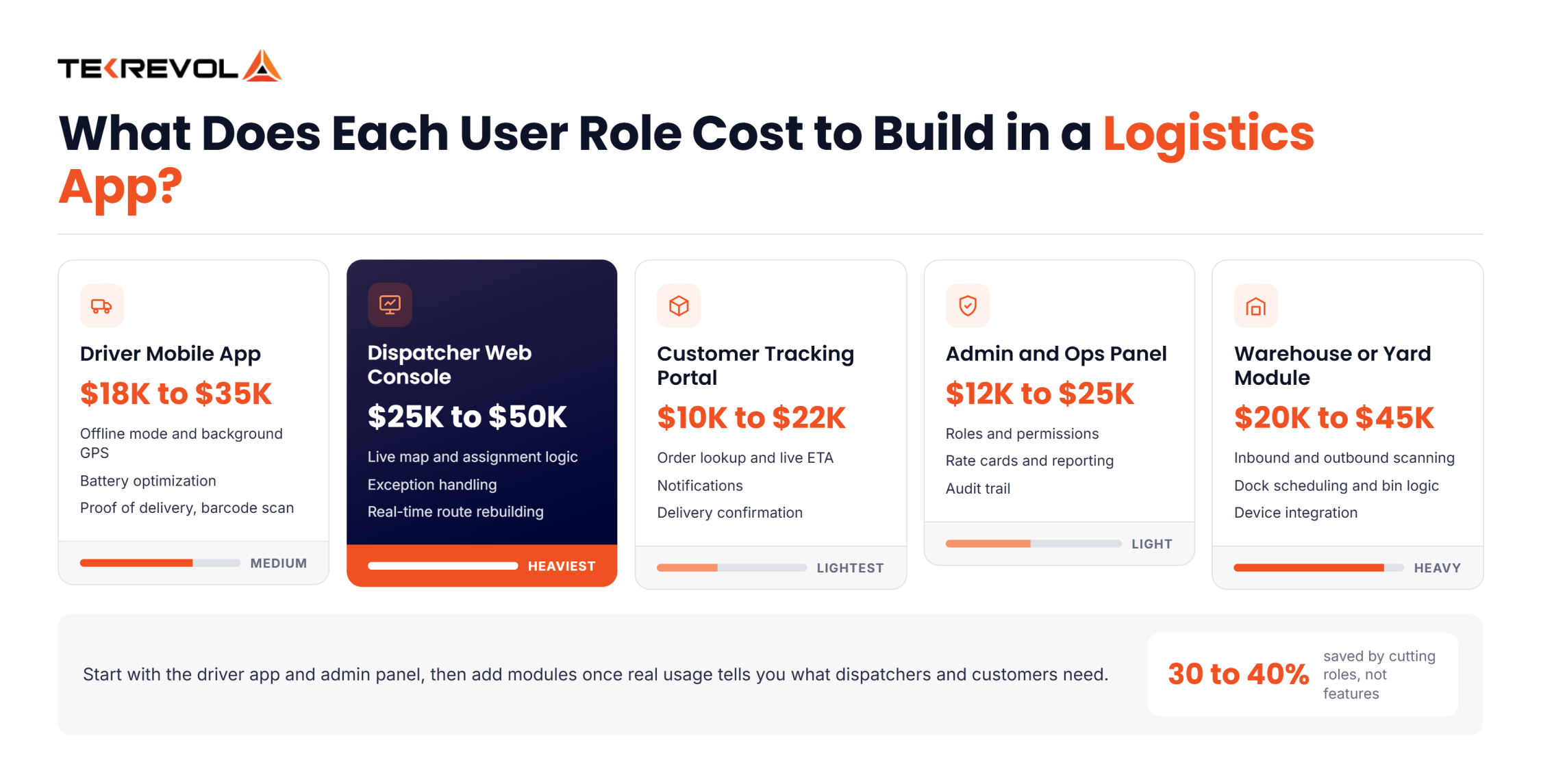
A logistics platform is rarely just one app. Drivers, dispatchers, customers, warehouse teams, and administrators often need separate interfaces, workflows, and permissions. The more user roles you launch with, the higher your development cost.
| Role surface | Cost range | Why it costs what it does |
| Driver mobile app | $18,000 – $35,000 | Offline mode, background GPS, battery optimization, proof of delivery, barcode scan |
| Dispatcher web console | $25,000 – $50,000 | The heaviest surface: live map, assignment logic, exception handling, route rebuilding |
| Customer tracking portal | $10,000 – $22,000 | Lightest surface: order lookup, live ETA, notifications, delivery confirmation |
| Admin and ops panel | $12,000 – $25,000 | Roles and permissions, rate cards, reporting, user management, audit trail |
| Warehouse or yard module | $20,000 – $45,000 | Inbound/outbound scanning, dock scheduling, bin logic, device integration |
The dispatcher console is often the biggest cost driver because it handles complex, real-time decision-making. A practical way to reduce the initial budget is to launch only the essential user surfaces first and add more advanced modules once the core operation is running.
What Factors Affect the Logistics App Development Cost?
Logistics app development cost depends on more than the number of features you want. Integrations, platform choice, compliance, AI requirements, design complexity, and post-launch needs can all shift the budget significantly.
In most projects, the biggest cost drivers are the systems your app needs to connect with and the complexity behind each workflow.
Below are the nine factors we see move quotes most, roughly in order of impact.
1. Third-party integrations
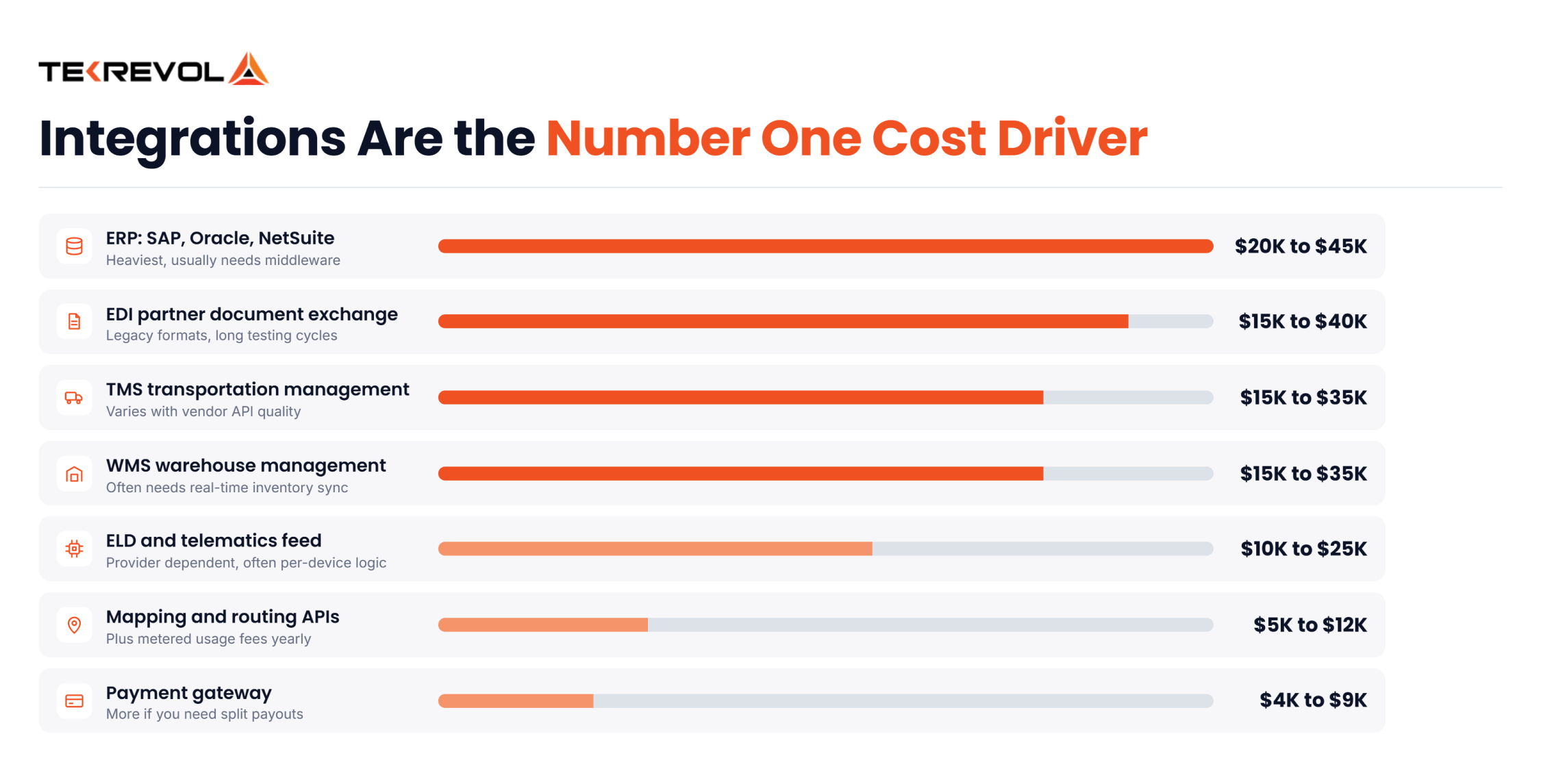
Integrations are the number one cost driver in custom logistics software development, and they’re invisible in a wireframe. Every outside system your app touches needs auth, data mapping, error handling, and its own testing cycle. Here’s what each adds:
| Integration | Added cost | Notes |
| TMS (transportation management) | $15,000 – $35,000 | Varies wildly by vendor API quality |
| WMS (warehouse management) | $15,000 – $35,000 | Often needs real-time inventory sync |
| ERP (SAP, Oracle, NetSuite) | $20,000 – $45,000 | The heaviest; usually needs middleware |
| ELD/telematics feed | $10,000 – $25,000 | Provider-dependent, often per-device logic |
| Mapping and routing APIs | $5,000 – $12,000 | Plus ongoing usage fees, covered below |
| Payment gateway | $4,000 – $9,000 | More if you need split payouts |
| EDI (partner document exchange) | $15,000 – $40,000 | Legacy formats, long testing cycles |
Add three of those, and you’ve added the price of an entire MVP.
2. Feature complexity
Feature complexity is what everyone budgets for. Real-time GPS tracking adds $8,000 to $15,000. AI-based route optimization adds $15,000 to $40,000, depending on how much of your own data it learns from. Offline mode with conflict-safe sync adds $8,000 to $18,000 and is non-negotiable for most trucking operations.
3. Platform choice
Platform choice can save or cost you a third of the mobile budget. Building native iOS and Android separately roughly doubles mobile engineering. A cross-platform app development company uses React Native or Flutter to cuts 25 to 40 percent off that line while covering both, which is why most driver apps we build are cross-platform.
4. Compliance and security
Compliance and security are the quiet budget killers. DOT and HOS compliance workflows add $10,000 to $25,000. SOC 2 readiness, encrypted audit trails, and role-based access control add another $8,000 to $20,000. Moving pharma, food, or hazmat means chain-of-custody logging on top of that.
5. AI and predictive capability
AI and predictive capability is the fastest-growing line item in logistics quotes. Demand forecasting, ETA prediction, and automated dispatch add 20 to 40 percent to a build. The cost isn’t the model. It’s the data pipeline and validation loop behind it, which is why AI development services need a data audit before anyone quotes a number.
6. Design depth
Design depth costs less than people fear here. A driver using an app in a cab needs large tap targets and high contrast, not animation. Functional, accessible design runs $10,000 to $18,000. Elaborate custom design systems push toward $25,000 and rarely earn it back in this category.
7. Backend architecture and scale
Backend architecture scales with vehicles and events, not users. Tracking 50 trucks and tracking 5,000 are different engineering problems, because location pings compound fast. Building for real scale from day one adds $10,000 to $30,000. Skipping it means a rewrite later.
8. Team location and seniority
Team location shifts hourly rates by a factor of four or more. US and Canadian teams bill $100 to $200 per hour, Western Europe $80 to $150, Eastern Europe $40 to $80, and South Asia $25 to $50. Rate alone is a poor predictor of total cost, because a cheaper team that misunderstands freight operations rebuilds more.
9. Post-launch scope
Post-launch scope is a factor, not an afterthought. Every logistics app we’ve shipped generated change requests within 60 days, because real drivers and dispatchers always want things nobody predicted in a workshop. Budgeting 10 to 15 percent for early iteration is realistic, not pessimistic.
Worried your integration list is quietly doubling the quote?
Send us the systems you already run, and we'll audit what each connection realistically costs to build and maintain.
Request Your Free Integration Audit →What Are the Hidden Logistics App Development Costs?
Hidden costs can push your logistics app budget well beyond the initial development quote.
Beyond the build itself, businesses should account for maintenance, cloud hosting, mapping API fees, security audits, compliance renewals, driver training, and legacy data migration. Annual maintenance alone can typically add 15–20% of the original development cost.
The build quote is what everyone compares. The running costs decide whether the project stays affordable.
| Hidden cost | Typical amount | Frequency |
| Maintenance and support | 15 – 20% of build cost | Annual |
| Cloud hosting and infrastructure | $6,000 – $30,000 | Annual, scales with fleet size |
| Mapping and routing API usage | $2,000 – $25,000 | Annual, usage-based, easy to underestimate |
| Third-party licenses and SDKs | $1,500 – $8,000 | Annual |
| Security audits and pen testing | $5,000 – $25,000 | Annual for regulated freight |
| Compliance certification | $10,000 – $60,000 | One-time, then periodic renewal |
| Data migration from legacy systems | $8,000 – $30,000 | One-time |
| Driver and dispatcher training | 5 – 10% of project cost | One-time, sometimes recurring |
| App store and developer accounts | $200 – $500 | Annual |
Two deserve extra attention. Mapping API fees are metered per request, so a fleet that triples its route recalculations triples that bill without anyone changing a line of code. And driver training is the cost operators dismiss most often, right up until adoption stalls because nobody showed the night shift how proof of delivery works.
What Does a Logistics App Cost to Own Over Three Years?
A logistics app costs roughly 1.5 to 1.8 times its build price over three years once maintenance, hosting, API usage, and iteration are counted. A $100,000 build typically reaches $155,000 to $180,000 in total ownership cost by the end of year three.
Comparing a custom build to a subscription on day one is the most common budgeting mistake in this category. Custom looks expensive, and SaaS looks cheap, right up until year two. Here’s a realistic three-year view for a mid-sized operation:
| Cost line | Custom build | Off-the-shelf TMS/SaaS |
| Year 1 | $100,000 build + $12,000 running | $24,000 – $60,000 subscription + $15,000 setup |
| Year 2 | $18,000 maintenance and hosting | $24,000 – $60,000 subscription |
| Year 3 | $20,000 maintenance and iteration | $26,000 – $66,000 (typical uplift) |
| 3-year total | $150,000 – $180,000 | $89,000 – $201,000 |
| You own the code | Yes | No |
| Per-seat cost as you grow | Flat | Rises with headcount |
SaaS wins if you’re small and your workflow is standard. Custom wins past roughly 40 to 50 seats, or when you have a workflow competitors don’t share, or a plan to sell access to your shippers. Our blog on why logistics businesses need custom software walks through that decision in detail.
How Do You Develop a Logistics App?
A logistics app should be built around real operational workflows, not just a list of features. The process typically covers requirements and technical discovery, role-specific UX/UI design, backend and integration development, app development, field testing, and deployment, followed by training and continuous improvements.
Here’s how the process runs on a typical build:
- Map the operation, not the app. We shadow how dispatch, drivers, and customers work today, spreadsheets and phone calls included. This is where scope gets real.
- Run technical discovery. Every integration gets checked against its live API before anything is quoted firmly. Vendor docs and vendor reality often differ.
- Design by role. Driver screens optimize for one-handed use in a cab. Dispatcher screens optimize for density and speed.
- Build the backend first. Data models, permissions, and the event pipeline come before pixels, because everything else depends on them.
- Develop the client surfaces. Mobile and web get built in parallel against the same API, in two-week sprints with demos you can click.
- Test in the field. Offline sync, GPS drift, poor connectivity, and low battery get tested on real routes, not in a simulator.
- Launch, train, iterate. Pilot one depot or route, train the crews, gather feedback for 30 days, then roll out wider.
Most mid-tier builds run four to seven months on this path. For the broader picture of how these apps change day-to-day operations, our piece on how logistics apps are revolutionizing the industry covers the operational side.
How Can You Optimize On-Demand Logistics App Development Cost?
Optimizing on-demand logistics app development cost comes down to sequencing rather than discounting. Ship fewer role surfaces first, defer integrations, build cross-platform, run a paid discovery phase, and reuse proven infrastructure instead of building custom where standards already work.
Here are the seven levers that actually move the number, ranked by how much they save:
- Cut roles, not features. Launching with a driver app and admin panel instead of all four surfaces saves 30 to 40 percent. You add the rest once real usage tells you what they need.
- Defer integrations past launch. Running dispatch through a CSV export for one quarter can push $30,000 of integration work into next year’s budget.
- Build cross-platform. React Native or Flutter for the driver app saves 25 to 40 percent versus two native codebases, with no meaningful performance cost here.
- Pay for a real discovery phase. It looks like added cost. It prevents the mid-build scope change, which is the most expensive event in any project.
- Use managed cloud services. Managed databases, queues, and auth cut DevOps hours sharply, and a solid cloud consulting service setup keeps hosting predictable as your fleet grows.
- Buy commodity capability, build differentiation. Payments, notifications, mapping, and auth should be bought. Your dispatch logic is the part worth building.
- Hire senior, not cheap. A smaller senior team beats a larger junior one on total cost, because rework is invisible in the quote and brutal in the invoice.
One thing we don’t recommend: cutting QA or discovery to hit a number. Those are the two stages where saved dollars always come back with interest.
How Do Logistics Apps Make Money?
Logistics apps can generate revenue through per-delivery charges, SaaS subscriptions, freight-matching commissions, premium features, analytics services, and white-label solutions. The right model depends on whether you’re serving carriers, shippers, drivers, or multiple sides of the logistics network.
Your revenue model matters to the budget because it changes what you build first. Here’s how the main models compare:
| Model | How it earns | Best fit | Build impact |
| Per-delivery fee | Flat or percentage charge per completed job | On-demand and last-mile | Needs solid payments and payouts early |
| Subscription (SaaS) | Monthly per seat, vehicle, or location | 3PLs selling to shippers | Needs billing, tenancy, and role management |
| Freight matching commission | Percentage of each matched load | Marketplaces and brokers | Needs matching logic and escrow |
| Premium feature tiers | Advanced analytics or API access as an upsell | Established platforms | Needs feature gating built in from day one |
| Data and benchmarking | Anonymized lane and performance insights | Networks with volume | Needs clean data pipeline and consent handling |
| White-label licensing | Licensing your platform to partner carriers | Mature operations | Needs theming and multi-tenant architecture |
The takeaway: multi-tenancy and billing are architectural decisions, not features. Retrofitting them costs several times what building them in costs. If you plan to sell access to your platform later, say so in discovery even if it’s two years out.
Future Trends in Logistics App Development
Logistics apps are moving beyond basic tracking toward AI-powered dispatch, IoT-connected operations, predictive analytics, and automated decision-making. Agentic AI can help optimize routes and assignments, while specialized AI models and governance tools can make logistics decisions faster, smarter, and easier to audit.
Gartner’s 2026 trend list points somewhere specific: from software that reports to software that decides.
Agentic AI in Dispatch
It is the near-term shift. Instead of surfacing an exception for a human, the system reassigns the load, notifies the customer, and logs the reasoning. Expect it to add 20 to 40 percent to a build today and to become table stakes within a few years.
Physical AI and IoT
It connects models directly to sensors on trailers, containers, and dock equipment. Cold chain monitoring and predictive maintenance come first, and they carry hardware costs your software quote won’t include.
Domain-specific language models
Trained on freight documents beat general-purpose AI at reading a bill of lading or rate confirmation. This is where document-heavy workflows finally get cheap to automate.
Decision Governance
It is the one nobody markets, and everyone will need. Once software decides, you need an audit trail explaining why. Building that in later is expensive. Building it in now costs almost nothing.
Our broader mobile app development practice sees this pattern everywhere, but logistics feels it first because the margin pressure is sharper here.
Why Choose TekRevol for Logistics App Development?
TekRevol approaches logistics app development from the operational side first. With 60+ engineers, 12+ business analysts, 200+ delivered projects, and a 4.8 Clutch rating, we focus on the workflows, integrations, and business logic that make logistics platforms work.
- 60+ engineers and 12+ business analysts for complex software projects
- 200+ projects delivered across multiple industries
- 4.8 Clutch rating based on client feedback
- Workflow-led scoping that accounts for roles, integrations, and operational complexity
- Real-world logistics experience with live data, dispatch, tracking, and multi-role platforms
The goal is simple: give you a realistic scope, a clear budget, and a development plan built around how your logistics operation actually works.
Ready to put a real number on your logistics app?
Talk to a senior logistics product engineer, walk through how your operation actually runs today, and leave with a feature-level cost estimate you can take to your board.
Schedule Your Free Consultation →


