



- VR app development costs $20,000 to $500,000+ depending on complexity, platform, and content volume required.
- The choice between 360° video and real-time CG has a much bigger impact on cost than the headset you use.
- 3D asset production consumes 80–90% of most VR budgets, far outweighing coding and backend development work.
- Healthcare and manufacturing VR cost more due to compliance, validation, and CAD-to-VR data conversion requirements.
- Post-launch costs for support, updates, localization, and hardware can make up more than 50% of your total VR spending.
- Choosing custom development versus off-the-shelf platforms depends on whether training must mirror your specific operation.
If you’re mapping out a VR project, chances are the budget question is on your mind before anything else. But the real number depends on the experience you’re trying to build.
On average, Virtual reality app development costs $20,000 to $500,000+ in the US. A pilot starts near $20,000. A 360° video experience runs $25,000 to $60,000. Most business applications land between $50,000 and $200,000, and advanced simulations with multiplayer, AI scenarios, or regulated validation pass $200,000.
Before locking one in, you need to decide which platform fits your audience- Oculus, Vive, or mobile VR, and how immersive the experience needs to be. You’ll also have to choose between native development and engines like Unity or Unreal. Each of these choices shapes your timeline, team size, and final development cost.
Working with an AR & VR development company can make the process more predictable, as experienced teams can use proven frameworks and existing hardware expertise instead of building everything from scratch.
In this blog, we’ll break down the key factors that influence VR app development costs, from features and platforms to development time and team requirements.
How Much Does Virtual Reality App Development Cost in 2026?
The cost to develop a VR app in the US ranges from about $20,000 for a focused pilot to $500,000+ for an advanced enterprise solution. Simple 360° experiences sit toward the lower end, while interactive training and business applications commonly reach $50,000–$200,000. Complex simulations can exceed $200,000 when they require multiplayer, AI, or extensive custom 3D content.
| Project tier | US cost range | Timeline | What you actually get |
| Pilot / MVP | $20,000–$50,000 | 6–10 weeks | One scenario, one headset, mostly stock assets, no integrations |
| 360° video experience | $25,000–$60,000 | 6–10 weeks | Filmed environment, hotspot navigation, roughly $8K–$15K per finished minute |
| Single interactive CG module | $50,000–$100,000 | 10–16 weeks | Custom 3D environment, hand interactions, single platform |
| Standard multi-module app | $100,000–$200,000 | 12–24 weeks | Several modules, branded assets, LMS or backend integration, and analytics |
| Advanced / simulation grade | $200,000–$500,000+ | 6–12 months | Multiplayer, AI-driven scenarios, haptics, physics fidelity, regulated environments |
VR app costs are driven mostly by 3D content, not coding. Around 80%–90% of the cost can go toward environments, characters, animation, lighting, and audio. The more 3D assets you need, the higher the cost.
Know Your VR App Budget Before You Build
Tell us what you want to build. We'll break down the scope, development cost, and timeline so you know what to expect.
Get Your VR Cost Breakdown!What Is the Most Expensive Decision in a VR Project?
The most expensive decision in a VR project is content format, not hardware. Choosing real-time computer-generated environments over 360° video typically multiplies cost by three to five times. Teams usually make this call in week one, before anyone reviews the budget.
Everybody obsesses over headsets. Meanwhile, the format question decides the number.
| 360° video VR | Real-time CG VR | |
| Typical cost | $25,000–$60,000 | $60,000–$200,000+ |
| Per-unit pricing | $8,000–$15,000 per finished minute | Priced per environment and interaction |
| Best for | Site walkthroughs, soft skills, orientation, empathy training | Procedural tasks, equipment operation, anything with failure states |
| Can the user do things? | Look and select only | Yes, with hands and tools |
| Changing content later | Reshoot required | Edit the scene |
| Production risk | Location access, scheduling, weather | Scope creep on assets |
Our rule is simple: Use CG when users need to interact and make decisions. Use 360° video when they only need to explore or observe.
Industry-Specific VR App Development Costs
VR app development costs vary by industry due to compliance and content fidelity. Real estate and retail VR start around $20,000. Healthcare and manufacturing simulations run $100,000 to $500,000+, because regulated environments demand accuracy, documentation, and validation that consumer apps never need.
Here’s how that plays out sector by sector, from the cheapest entry point to the most expensive.
Real Estate VR: $20,000 to $70,000
Real estate is the cheapest place to start, because the environment already exists and you can film it. A 360° tour of a finished property sits at the bottom of that range. Costs increase when you need CG visuals for properties that haven’t been built yet or a configurator that lets buyers change finishes and layouts. If you create these for multiple properties, the cost per property usually drops because the assets can be reused.
Retail and eCommerce VR: $30,000 to $150,000
Retail VR pricing tracks SKU count and asset quality more than anything else. A single virtual showroom with twenty modeled products is a different job from a configurator covering three hundred. Photorealistic product assets are where the money goes, since shoppers notice when a fabric or a finish looks wrong. Our piece on virtual reality in ecommerce walks through where the conversion lift actually shows up.
Education and Training VR: $40,000 to $500,000+
Education and corporate training budgets are driven by module count, integration depth, and how far into custom logic the scenarios go.
- Entry-level (pilot): $50,000–$100,000: one or two modules, built mostly from pre-existing assets, enough to prove the concept before committing further.
- Standard custom: $100,000–$200,000: several branded modules with custom 3D assets and LMS integration. This is where most enterprise training programs land.
- Advanced: $200,000–$500,000+: AI-driven scenarios, branching logic tied to learner decisions, haptic feedback, or multi-environment simulations for high-stakes procedures.
Connecting modules to a platform like Cornerstone or Workday through xAPI or SCORM typically adds $15,000–$40,000, and this is the line item buyers most often forget to budget for.
Accessibility is the other one: captioning, seated-mode alternatives, and Section 508 compliance usually add another 10–15% to public-sector or education builds. Our education software development services ensure accessibility from the start rather than bolting it on later.
Manufacturing and Automotive VR: $100,000 to $400,000
Manufacturing VR gets expensive at the data layer, not the headset. Teams often assume their CAD files are ready to use, but they usually are not. Engineering CAD contains too much geometry for a headset to render at 72 frames per second, so the files need to be optimized and retopologized. Budget $15,000 to $50,000 for this conversion and ask about it before you sign.
Healthcare VR: $150,000 to $500,000+
Healthcare is the most expensive band, though not for the reason most buyers expect. Clinical teams underestimate review cycles, not development. Reviewing and approving procedural accuracy can add weeks or even months, increasing the total project cost. Adding HIPAA compliance to the app also increases development costs.
Entertainment and Games VR: $60,000 to $500,000+
Entertainment has the widest range on this list because content volume has no natural ceiling. A focused single-player title lands near the bottom. Multiplayer, live ops, and a content roadmap push it past half a million fast, and unlike enterprise VR, there’s no internal budget holder to justify it to.
Our game development team treats live-ops cost as part of the build estimate, and our guide on how to make a VR game covers the production side.
Location-Based VR (Arcades and Attractions): $150,000 to $1,000,000+
Location-based VR is priced differently from a single-user app because the cost isn’t just software; it’s outfitting a physical venue. Multi-station setups need synchronized hardware, venue-grade networking, and equipment built to survive hundreds of sessions a week instead of one careful home user. Budget scales with station count and how much the experience needs to differ from station to station.
Factors That Actually Drive VR App Development Cost
Several factors shape the cost of a VR app, but some have a much bigger impact than others. Complexity, content, platform, 3D assets, and interaction depth usually account for the largest share of the budget, while tooling and localization tend to have a smaller impact.
1. App Complexity
The cost of developing a VR app depends largely on its complexity. Basic experiences range from $20,000–$50,000, medium-complexity apps from $50,000–$200,000, and advanced multiplayer or AI-driven builds from $200,000–$500,000+.
| Complexity Tier | What’s Included | Typical Cost | Timeline |
| Basic | 360° video, static navigation, single scene, pre-built templates | $20,000 – $50,000 | 2–3 months |
| Medium | Interactive training modules, product demos, single-user simulations. | $50,000 – $200,000 | 4–6 months |
| Advanced | Multiplayer environments, AI-driven NPCs, enterprise simulators, custom logic | $200,000 – $500,000+ | 8–12+ months |
We’ve shipped across all three tiers, and honestly, most first-time VR buyers think they need the advanced tier when a well-scoped medium build would prove the concept just fine. Our game development studio has built AR/VR interactive experiences at exactly this stage, where the goal is to validate the idea before scaling it up.
2. VR Content and Interaction
The type of experience you want users to have directly affects development effort. A simple 360° tour needs far less work than a fully interactive environment where users can pick up objects, trigger events, move through different scenes, or make decisions that change the outcome.
The main cost differences come from:
- 360° video experiences: Lower development effort and limited interaction.
- Interactive 3D environments: More modeling, programming, animation, and testing.
- Simulation-based apps: Complex rules, scenarios, physics, and user interactions.
- AI-powered experiences: LLM-driven characters or adaptive scenarios add $25,000 to $75,000; see below for how AI can also offset that cost elsewhere in production
3. 3D Modeling and Animation
3D content is usually the single largest line on a VR invoice. Custom assets add $20,000 to $80,000 over a stock library, and photogrammetry of a real facility costs more again.
| Asset Type | Cost Impact |
| Stock 3D assets | Low |
| Customized existing assets | Moderate |
| Custom 3D environments | High |
| Realistic characters and animations | High |
| Photogrammetry / digital twins | Very High |
The question isn’t how many assets you need. It’s how detailed and unique each one has to be, and which ones you can reuse in module two. On TruthGPT, adding 3D features tripled user engagement, and Flutter animations lifted interactions by 40%, which is a useful reminder that detailed 3D work earns its cost when users actually engage with it and wastes it when it’s decoration.
4. Platform and Device Support
The platform you build affects both development effort and the hardware your users need. Meta Quest is usually the more affordable option for standalone VR. Apple Vision Pro and enterprise headsets can cost more because they require different controls, advanced hardware support, and additional development work.
| Platform | Typical Development Cost | Best For | Cost Considerations |
| Meta Quest 3/3S | $15,000–$80,000 | Training, games, simulations | Mobile-class GPU, heavy optimization, largest install base |
| PC VR | $20,000–$100,000 | High-fidelity games and simulations | More GPU headroom, but PC hardware variability |
| Apple Vision Pro | $50,000–$200,000+ | Premium spatial experiences | Separate visionOS and RealityKit stack, eye and pinch interaction rebuilt |
| Enterprise XR | $80,000–$250,000+ | Industrial and specialized simulations | Simulation fidelity, small deployments, specialist integration |
| Mobile/WebXR | $20,000–$50,000 | Broad-reach experiences | Cheapest entry, weakest immersion, widest reach |
Each additional platform adds 25% to 40%, since the team optimizes twice for different GPUs, control schemes, and storage requirements. Apple Vision Pro is the outlier at roughly three to four times a Quest build. Launch on one platform, then port once adoption data justifies it.
5. Multiplayer and Real-Time Features
A single-user VR application is considerably simpler than one where several users share the same virtual environment. Multiplayer requires real-time communication, synchronization of player movements and objects, session management, networking logic, and backend infrastructure.
For training, education, or product visualization, a single-user experience may be enough. Multiplayer becomes worthwhile when collaboration is part of the core use case.
6. Backend and Third-Party Integrations
Not every VR app needs a complex backend, but enterprise and connected experiences often do. Integrating your VR application with an LMS, CRM, ERP, IoT platform, payment system, or custom API adds development and testing work.
For enterprise VR, these integrations can add $15,000–$40,000+ depending on the number and complexity of systems involved.
Confirm in writing whether your quote includes it. Our API integration services handle this boundary on most enterprise builds.
7. VR UI/UX Design
VR interfaces work through controllers, hand tracking, gaze, and head movement, so nothing carries over cleanly from mobile or web. Design cost scales with the number of environments, interactive elements, custom 3D interfaces, and platform-specific requirements.
A simple VR interface runs $5,000 to $15,000. Highly customized spatial interfaces reach $30,000 or more, which, on a mid-size build, sits inside the discovery-and-design stage covered below.
8. Performance Optimization
VR applications have much less room for performance problems than ordinary mobile apps. Frame drops, lag, poor tracking, or excessive loading can quickly make an experience uncomfortable or unusable. The more visually detailed your VR environment is, the more optimization work your development team will need.
9. Development Team and Expertise
VR development requires a combination of skills that are less common than those in standard mobile or web development. Your team may need VR developers, 3D artists, Unity or Unreal specialists, UI/UX designers, backend engineers, and QA specialists.
The team’s location also affects hourly rates:
| Region | Typical Developer Rate |
| United States | $100–$149/hour |
| Canada / Australia | $100–$149/hour |
| Western Europe | $80–$150/hour |
| Central & Eastern Europe | $40–$100/hour |
| South Asia | $25–$49/hour |
A 4x difference in hourly rates does not mean a 4x difference in total cost. Rework, reviews, and communication can narrow the gap to around 1.5x–2.5x. If you want more control over the team, IT staff augmentation can be a middle-ground option between hiring internally and outsourcing the full project.
10. Industry Regulation and Validation
Regulated VR applications cost more because they require additional security, documentation, testing, and approval before launch. A healthcare training app, for example, may need HIPAA-compliant data handling, while a medical VR product may require additional validation and documentation.
The cost impact usually comes from:
- Compliance requirements: HIPAA, GDPR, SOC 2, or industry-specific standards.
- Security controls: Encryption, access controls, audit logs, and secure data storage.
- Validation and testing: Additional technical, clinical, or safety testing.
- Documentation: Compliance records, risk assessments, and technical documentation.
- Expert review: Clinical, legal, safety, or regulatory specialists.
For regulated VR projects, these requirements can add 15%–30% or more to the development budget, depending on the industry and level of regulatory scrutiny.
11. Engine and Tooling Licenses
Engine licensing is small relative to labor, though it surprises finance teams who weren’t expecting a recurring line.
| Tool | Cost | When it applies |
| Unity Personal | Free | Under $200,000 in revenue or funding |
| Unity Pro | $2,310/seat/year (or $210/month) | Above $200,000 in revenue or funding |
| Unity Enterprise | Custom pricing | Above $25M annual revenue |
| Unreal Engine (games) | Free, then 5% royalty | Royalty on lifetime gross revenue above $1M |
| Unreal Engine (non-game) | $1,850 per seat per year | Commercial non-game use above $1M revenue |
According to Unity and Epic Games, Unity increased Pro and Enterprise pricing by 5% on January 12, 2026.
12. VR-Specific QA and Comfort Testing
VR testing requires more than checking whether features work. Developers must test motion comfort, frame rates, tracking, controllers, and headset compatibility in real-world conditions.
- Basic QA: $5,000–$10,000
- Multi-device VR testing: $10,000–$25,000
- Advanced comfort and usability testing: $20,000–$40,000+
13. Accessibility and Localization
Accessibility and localization increase costs when your VR app needs captions, seated modes, alternative controls, or multiple languages. The final cost depends mainly on the number of platforms, languages, and accessibility requirements.
- Accessibility: $5,000–$15,000
- Localization: $2,000–$8,000 per language
- Accessibility + multiple languages: $15,000–$30,000+
14. Team Structure
Who builds your VR app matters as much as where they’re located. The three common team structures carry different cost profiles and different risks.
| Team Type | Cost | Pros | Cons |
| Freelancers | Lowest | Affordable, flexible hiring | Limited scalability, inconsistent quality, and coordination fall on the client |
| In-House Team | High | Full control, deep product alignment | Expensive salaries, long-term overhead |
| Agency | Moderate–High | Specialized expertise, faster delivery | Higher upfront investment than freelance |
15. AI-Assisted Production
AI affects VR development costs in two ways: it can add new AI-powered features, but it can also reduce production effort. Adding features such as adaptive difficulty or an AI-driven coach can increase project costs by around 10%–15%.
At the same time, AI can reduce costs in other areas. Procedural scenario generation can lower manual authoring costs by 30%–60%, while generative tools can speed up 3D asset creation and AI voiceovers can reduce localization costs by up to half.
The savings can offset the added AI costs, but the results depend on having a team experienced in AI-integrated VR development. Without that expertise, rework and testing can quickly reduce the expected savings.
How Does VR App Development Cost Break Down by Stage?
VR app development typically moves through five stages: discovery and design, 3D asset production, development, testing, and deployment. Each stage takes a different share of the budget, with 3D production often becoming the highest cost for highly visual VR experiences.
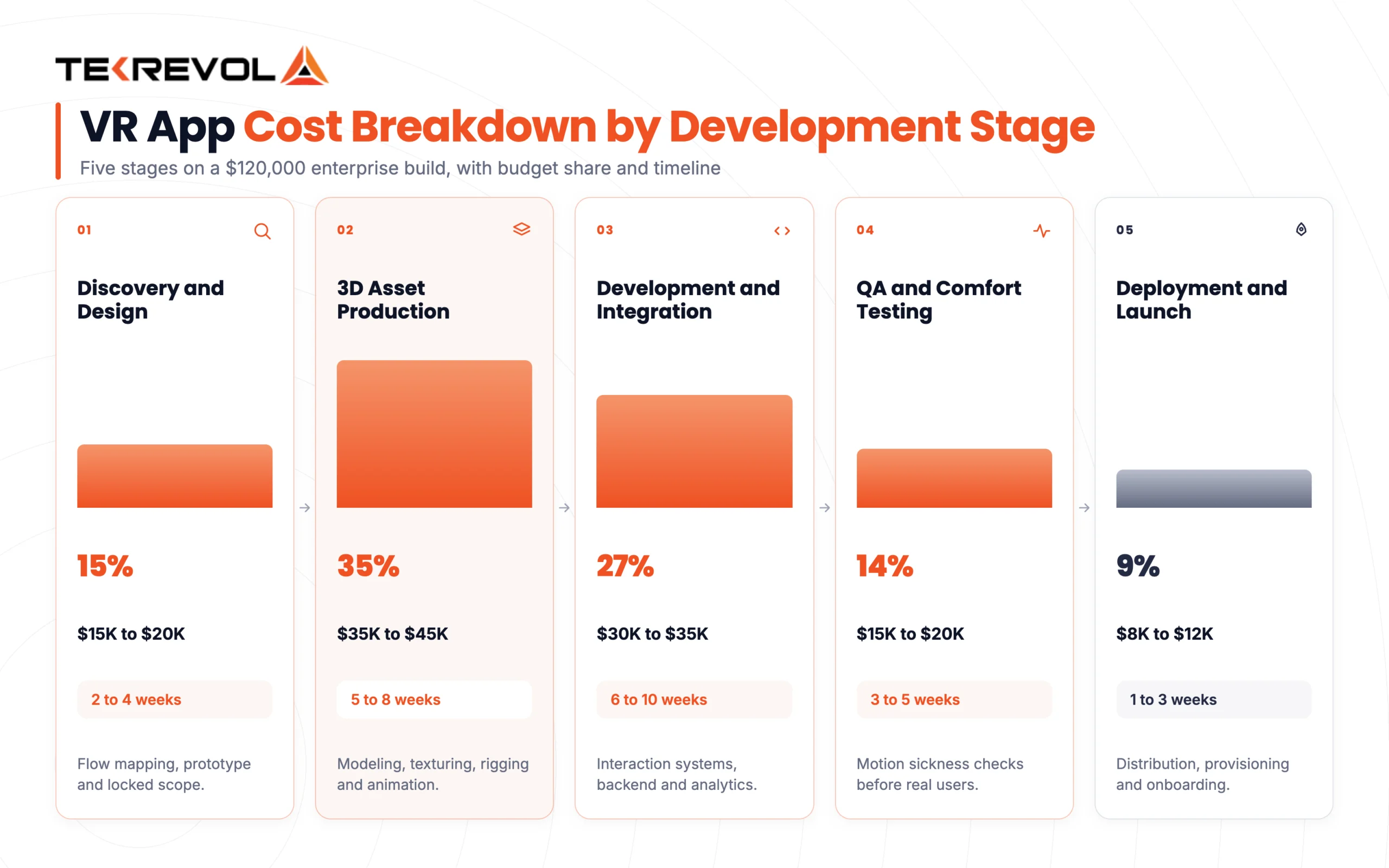
For a $120,000 enterprise VR app, a typical budget can look like this:
Discovery and Design: 15%
Estimated cost: $15,000–$20,000
Estimated timeline: 2–4 weeks
Before any building starts, the team turns the VR concept into a concrete, buildable plan, mapping how users move through the experience and locking scope so nothing drifts later.
- Discovery and technical feasibility
- User flow and interaction mapping
- Wireframes and clickable prototype
- Locked feature scope and architecture
Documentation is included in this stage. If your concept involves an untested interaction, a new input method, haptic response, or AI-driven scenario, expect Discovery to run toward the higher end, since it may need extra feasibility testing before scope can be locked.
3D Asset Production: 35%
Estimated cost: $35,000–$45,000
Estimated timeline: 5–8 weeks
The most resource-heavy stage, since everything a user sees or touches has to be modeled from scratch. This is where reusing existing assets saves the most money.
- Environment and prop modeling
- Character design and texturing
- Rigging and animation
- Photogrammetry / digital-twin capture (for real-world replicas)
Development and Integration: 27%
Estimated cost: $30,000–$35,000
Estimated timeline: 6–10 weeks
Design and assets are turned into a working VR build during this stage. Interaction systems, application logic, and backend connections are developed and integrated here, making it one of the longest stages of the project.
- Interaction and control systems
- Simulation/game logic
- Backend, API, and account integration
- Analytics and tracking setup
QA and Comfort Testing: 14%
Estimated cost: $15,000–$20,000
Estimated timeline: 3–5 weeks
Testing here covers more than bugs; it has to catch comfort issues like motion sickness before real users ever put on a headset.
- Device and performance testing
- Locomotion and motion-sickness checks
- Controller/hand-tracking accuracy
- Usability testing with outside users
Deployment and Launch: 9%
Estimated cost: $8,000–$12,000
Estimated timeline: 1–3 weeks
The shortest stage is the payoff of everything done earlier, focused on getting the build live and users comfortable with it.
- Store or enterprise distribution
- Headset provisioning and final config
- Post-launch monitoring
- Onboarding/training
Real-World VR App Examples and What They Cost to Build
Real-world VR projects show that higher spending does not always mean better results. Beat Saber and Gorilla Tag achieved major success with focused mechanics, while Half-Life: Alyx represents the high end of VR production. The examples below use publicly reported facts, while the cost ranges are estimates for comparable projects today.
Beat Saber: Simple Mechanics, Major Revenue
Beat Saber was developed by a small team and had sold more than 4 million copies by February 2021. It reportedly generated around $255 million in sales by October 2022.
Its focused gameplay and limited environments kept the experience relatively streamlined. A comparable interactive VR game could cost around $50,000–$100,000 today. This is a comparable-project estimate, not Beat Saber’s actual development cost.
Gorilla Tag: Simple Art, Strong Engagement
Gorilla Tag used low-detail visuals and a distinctive arm-based locomotion system. Another Axiom reported more than $100 million in revenue and 10 million lifetime players by 2024.
By keeping the art simple, development could focus on movement and multiplayer gameplay. A comparable VR multiplayer project could cost around $50,000–$120,000+, depending on networking and content.
Half-Life: Alyx: The High-End Benchmark
Valve confirmed that around 80 people worked on Half-Life: Alyx, making it one of the company’s largest development efforts.
Its detailed environments, physics, voice acting, and campaign put it far beyond a typical business VR application. A comparable production would require millions of dollars, although Valve has not publicly disclosed the actual budget.
Walmart and Strivr: VR Training at Scale
Walmart used Strivr to train more than 2.2 million associates across 4,700+ locations. One VR module reportedly reduced training time from 8 hours to 15 minutes, and 70% of VR-trained associates scored higher on post-training assessments than those trained without VR.
Strivr does not disclose Walmart’s development costs. A comparable custom enterprise VR training module could cost around $100,000–$200,000, depending on assets, integrations, and scenario complexity.
Osso VR: Why Healthcare VR Costs More
Osso VR focuses on surgical training, where clinical accuracy and realistic interactions are critical. A peer-reviewed study found that VR trainees completed more procedural steps correctly (33 vs. 27) and finished faster (26.7 vs. 35.4 minutes).
A comparable healthcare VR platform could cost $150,000–$500,000+, depending on simulation depth, clinical validation, integrations, and compliance requirements. The higher cost comes from medical accuracy as well as VR development.
See Where Your Idea Lands
You've seen what similar apps cost to build. Tell us your concept, and we'll tell you where it realistically fits and what it would take to get there.
Review My VR Concept!Should You Build Custom VR or Buy Off-the-Shelf?
Before budgeting a custom VR app, decide whether you actually need one. Off-the-shelf platforms can cover generic training at a much lower upfront cost, while custom development becomes worthwhile when the experience needs to mirror your equipment, workflows, facilities, or compliance requirements.
Choose Off-the-Shelf for Generic Training
Platforms such as Strivr and EON Reality can make sense when you need standardized training that does not depend on your specific operation. You can deploy existing scenarios without paying to build environments, interactions, and training logic from scratch. The downside is that pre-built scenarios may not fit your specific equipment, facility layout, or procedures.
Choose Custom VR for Specialized Workflows
Custom development earns its higher cost when the training experience must replicate your real-world operation. That could mean simulating specific machinery, recreating your facility, following proprietary procedures, or building workflows around your compliance requirements. You can also update the experience whenever needed instead of waiting for a platform vendor.
Use a Hybrid Approach When Possible
You do not always have to choose one or the other. Use an off-the-shelf platform for generic onboarding and soft-skills training, then invest in custom VR only for the procedures where realism directly affects safety, performance, or compliance. This can keep the initial budget lower without sacrificing the parts of the training that actually need customization.
How Long Does VR App Development Take?
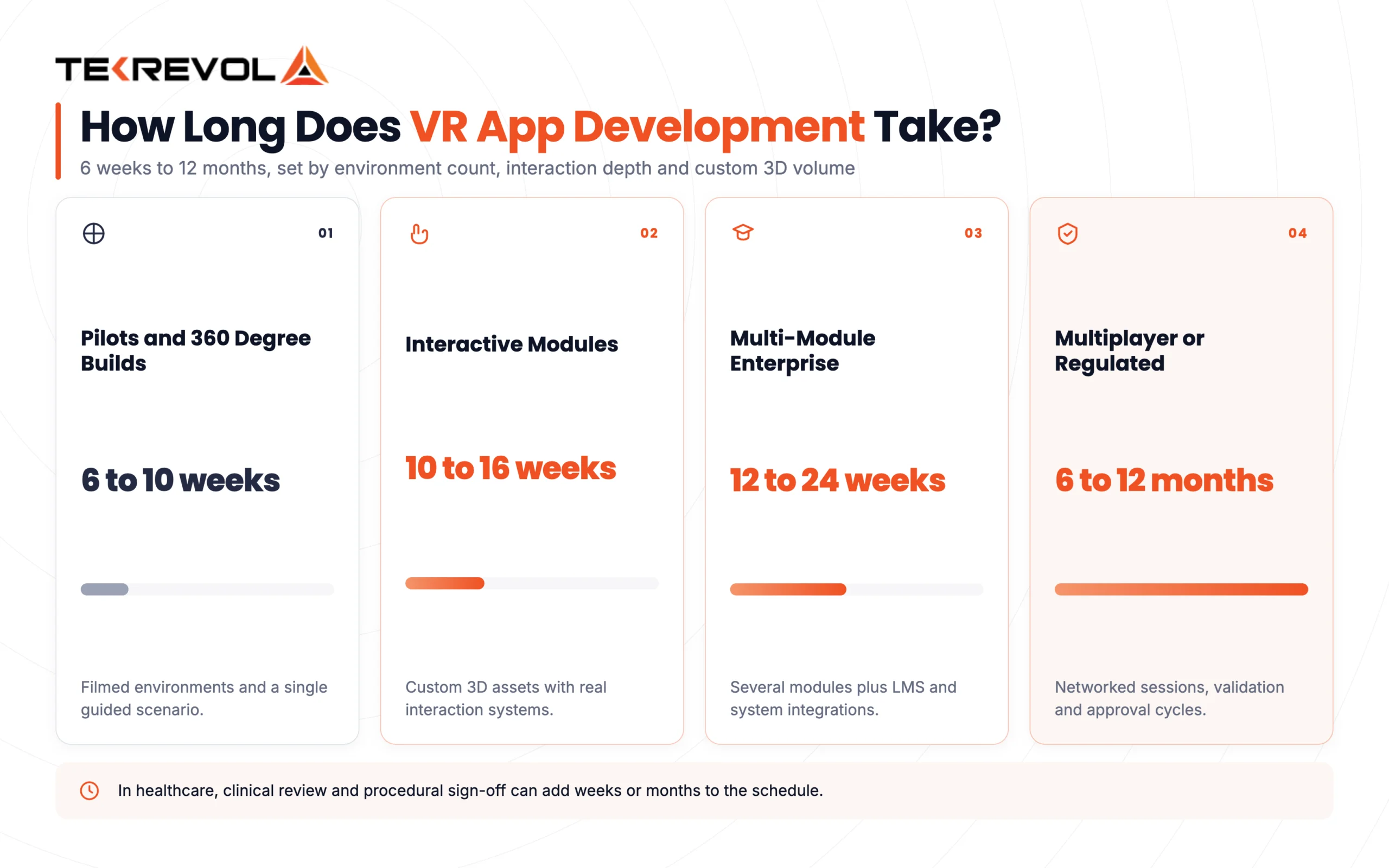
VR app development can take 6 weeks to 12 months, depending on the experience, number of environments, level of interaction, and amount of custom 3D content. Simple pilots can launch in weeks, while enterprise simulations with multiple modules and integrations can take several months.
| VR App Type | Typical Timeline | What It Usually Includes |
| Pilot / 360° Experience | 6–10 weeks | 360° video, basic navigation, limited interaction |
| Interactive VR Module | 10–16 weeks | Custom interactions, 3D assets, animations, single-user experience |
| Multi-Module Enterprise App | 12–24 weeks | Multiple environments, user management, analytics, integrations |
| Advanced VR Simulation | 6–12 months | Multiplayer, AI, complex physics, custom environments, enterprise systems |
Real Cost of Running a VR App After Launch
The initial build is only part of the total VR investment. Maintenance, content updates, integrations, hosting, localization, training, and hardware replacement can add high costs after launch.
Year-One Support and Content Updates
Estimated cost: 15–25% of build cost
Ongoing support covers bug fixes, headset and SDK updates, performance issues, and minor content changes. Regular maintenance also helps prevent small compatibility issues from becoming expensive fixes later.
Year 2+ Major Refresh
Estimated cost: 30–50% of build cost
Larger updates may be needed when hardware changes, training content becomes outdated, or the app needs new features. Planning for these upgrades early makes long-term VR costs easier to manage.
LMS / xAPI Integration
Estimated cost: $15,000–$40,000 one-time
Connecting VR training data to platforms such as Cornerstone, Workday, SAP SuccessFactors, or Moodle requires additional development. The cost depends on the number of systems and the type of data the VR app needs to send.
Multiplayer Hosting
Estimated cost: $500–$5,000 per month
Multiplayer VR requires servers to synchronize users and sessions in real time. As concurrent users and session activity increase, monthly infrastructure costs increase as well.
Localization
Estimated cost: +8–15% per language
Localization can include translated text, voiceovers, subtitles, and UI adjustments. Experiences with extensive dialogue or voice instructions usually cost more to localize.
Train-the-Trainer and Change Management
Estimated cost: $10,000–$30,000
Enterprise VR often requires staff training so teams can manage and deliver the experience themselves. This can include onboarding sessions, training materials, and rollout support.
Headset Replacement
Estimated cost: $299+ per unit
VR hardware eventually needs replacement due to damage, wear, or newer devices. Large deployments should include a replacement budget to avoid disruptions when devices need to be retired.
2026 Meta Quest Changes That Affect VR Budgets
Meta’s 2026 changes to its Quest business offering can affect the ongoing cost of enterprise VR deployments. The biggest changes involve device management, headset purchasing, and warranty coverage, so they should be considered when preparing a fleet budget.
1. Device Management Costs Are Lower
Meta made Horizon Managed Services free, removing a recurring software cost that some older VR budgets still include. For a 200-headset fleet, this can eliminate thousands of dollars in annual device-management expenses.
2. Enterprise Buyers Now Use Standard Quest Headsets
Meta stopped selling its dedicated Work and Education headset SKUs, so organizations now use standard Quest devices and manage them through Meta’s platform. This can simplify hardware purchasing, but the budget should still account for device setup and management.
3. Budget for Hardware Replacement
With the move away from the previous three-year business warranty, organizations should plan for hardware replacement beyond the standard warranty period. For large or heavily used fleets, setting aside 5%–10% of annual hardware spend as a replacement reserve can help cover damaged or aging devices.
How Do VR and AR Development Costs Compare?
VR costs more than AR at every tier. Entry-level AR starts around $5,000; entry-level VR starts around $20,000. At the top end, enterprise AR tops out near $300,000, while advanced VR simulations can pass $500,000.
| AR | VR | |
| Entry level | $5,000–$30,000 (marker-based, filters) | $20,000–$50,000 (single scenario, stock assets) |
| Mid-range | $50,000–$120,000 (SLAM, plane detection) | $50,000–$200,000 (custom CG modules) |
| Advanced | $120,000–$300,000+ (enterprise AI, IoT) | $200,000–$500,000+ (multiplayer, physics, haptics) |
| Hardware | Phones people already own | Headsets you buy and manage |
| Biggest cost driver | Tracking accuracy in the real world | Volume and fidelity of 3D content |
The core difference is distribution. AR runs on devices people already carry. VR requires deploying headsets, which adds a logistics and change-management cost that never shows up on a development quote.
That’s why the choice usually comes down to audience, not budget:
- Consumer-facing or scale-driven → AR
- Focused, repeatable, high-stakes training → VR
For more details, see our AR & VR app development cost guide.
How Can You Reduce VR App Development Cost Without Gutting the Product?
Reducing VR app development cost is less about cutting features and more about sequencing them intelligently. Start with a focused pilot, validate the experience, and expand only after you know what users actually need.
Start With One Core Module
Build the first module around the most important user outcome instead of developing the entire VR program upfront. Your first build establishes the environment, interaction framework, reusable assets, analytics, and technical foundation that later modules can share.
Use 360° Video When It Fits
Not every VR experience needs fully interactive 3D environments. If the objective is guided learning, virtual tours, demonstrations, or observational training, 360° video can deliver the experience at a significantly lower production cost than a fully interactive 3D build.
Launch on One Platform First
Supporting multiple headsets from day one increases testing, optimization, and compatibility work. Launching on one target platform lets you validate the product before extending it to additional devices.
Reuse Your VR Assets
Design environments, characters, props, animations, and interaction components for reuse. A well-planned asset library can reduce the cost of future modules because you are extending an existing system instead of rebuilding core elements.
Finalize the Experience Before Development
Lock the user flow, branching logic, interactions, and learning objectives before production begins. Late changes to VR interactions can affect 3D assets, programming, testing, and performance optimization at the same time.
Localize After You Validate Demand
If your first users are concentrated in one market, launch in one language and measure adoption first. Add additional languages when the data shows enough demand to justify the localization and testing cost.
Own Your Assets and Source Files
When negotiating with a VR development partner, look beyond the hourly rate. Make sure your agreement covers ownership of source code, 3D assets, environments, animations, and other reusable project files. A small discount today matters less than avoiding redevelopment costs when you expand the product later.
Don’t Cut Discovery to Save Money
Discovery is one area where reducing spend can create a much larger bill later. A clear technical scope, interaction map, platform strategy, and prototype can prevent major changes after development has already started.
A focused MVP approach can help you validate the core VR experience before committing to a larger product. TekRevol’s MVP development approach follows this same principle: build what is essential, validate it, and expand based on evidence.
Partner With TekRevol for Virtual Reality App Development
Building VR well means treating it as its own discipline, not simply adding a headset to a mobile app. Every project starts with real discovery, mapping the user journey, locking scope, and pricing out the 3D work honestly before development ever begins, so the budget you approve is the one you actually pay.
As a leading mobile app development company, we bring that same rigor into immersive work: one team handling 3D art, engineering, and QA together, rather than a project stitched across freelancers.
- Transparent, phased cost estimates with no hidden fees
- In-house 3D artists, VR engineers, and QA specialists working as one team
- Proven experience across training, healthcare, retail, and enterprise VR.
- A discovery-first process that locks scope before development begins
Ready to Bring Your VR Experience to Life?
From the first concept to a launch-ready experience, our VR team can help you plan, design, and build the product.
Discuss Your VR Project!


