



- Strategy games generate $8–$45 LTV per paying user; the highest of any mobile genre worth building today.
- Strategy game development starts with defining core mechanics, followed by a strong gameplay loop that drives long-term engagement and retention.
- A Game Design Document is required before production begins, it prevents mid-build pivots that cost 3–5x more to fix.
- Unity is the industry-standard engine for building a mobile strategy game app, powering 71% of top titles.
- The best strategy game monetization model combines IAP and battle pass with rewarded ads to maximize revenue per user.
- Development cost range from $10K for a prototype to $300K+ for a full commercial release with multiplayer.
- Strategy games without live-ops content updates flatline within 60–90 days of launch, so plan for it before you ship.
To build a mobile strategy game app from scratch, you need four things: a defined sub-genre, a Game Design Document written before production begins, a game engine (Unity for most mobile builds), and a monetization model designed into the progression system from day one.
Strategy games are one of the most rewarding and technically demanding genres in mobile gaming. Players spend longer per session, and the genre has a churn rate far slower than casual game audiences. That makes strategy a commercially viable game genre to build.
If you are a game entrepreneur or an IP holder looking to digitize a board game and seeking a development partner, TekRevol has worked through this process as a hands-on game development company. We know how to build a mobile strategy game like Clash of Clans, Rise of Kingdoms, that actually makes money.
This guide walks you through every phase of building a mobile strategy game, from core loop design and AI balancing to realistic cost estimates. We also cover monetization models and common mistakes that kill most strategy launches before they find traction.
What Are Mobile Strategy Games?
Mobile strategy games are games where players win through planning, resource management, and tactical decisions, not reflexes. The player controls units, buildings, or systems and must out-think either an AI opponent or other players to achieve an objective such as capturing territory, building an empire, or defending a position.
What separates strategy from other mobile genres is depth. A real-time match might last 20 minutes. A 4X campaign can run for weeks. That depth drives the high retention, long sessions, and strong LTV that make the genre commercially attractive to developers and publishers.
Got a Strategy Game Concept?
TekRevol builds mobile strategy games from GDD to global launch—helping you turn your idea into a scalable, high-performance product with a clear cost estimate within 48 hours.
Start the Conversation →Strategy Games Dominate Mobile Gaming in 2026
- $15B+ Revenue Mobile strategy games generated over $15 billion in global revenue in 2023
- 12–18% Day 30 Retention Strategy games hold players at Day 30 at 2–4x the rate of casual titles
- 12–20 Min Session Length Average session in a strategy game runs 12–20 minutes versus 3–5 for casual games
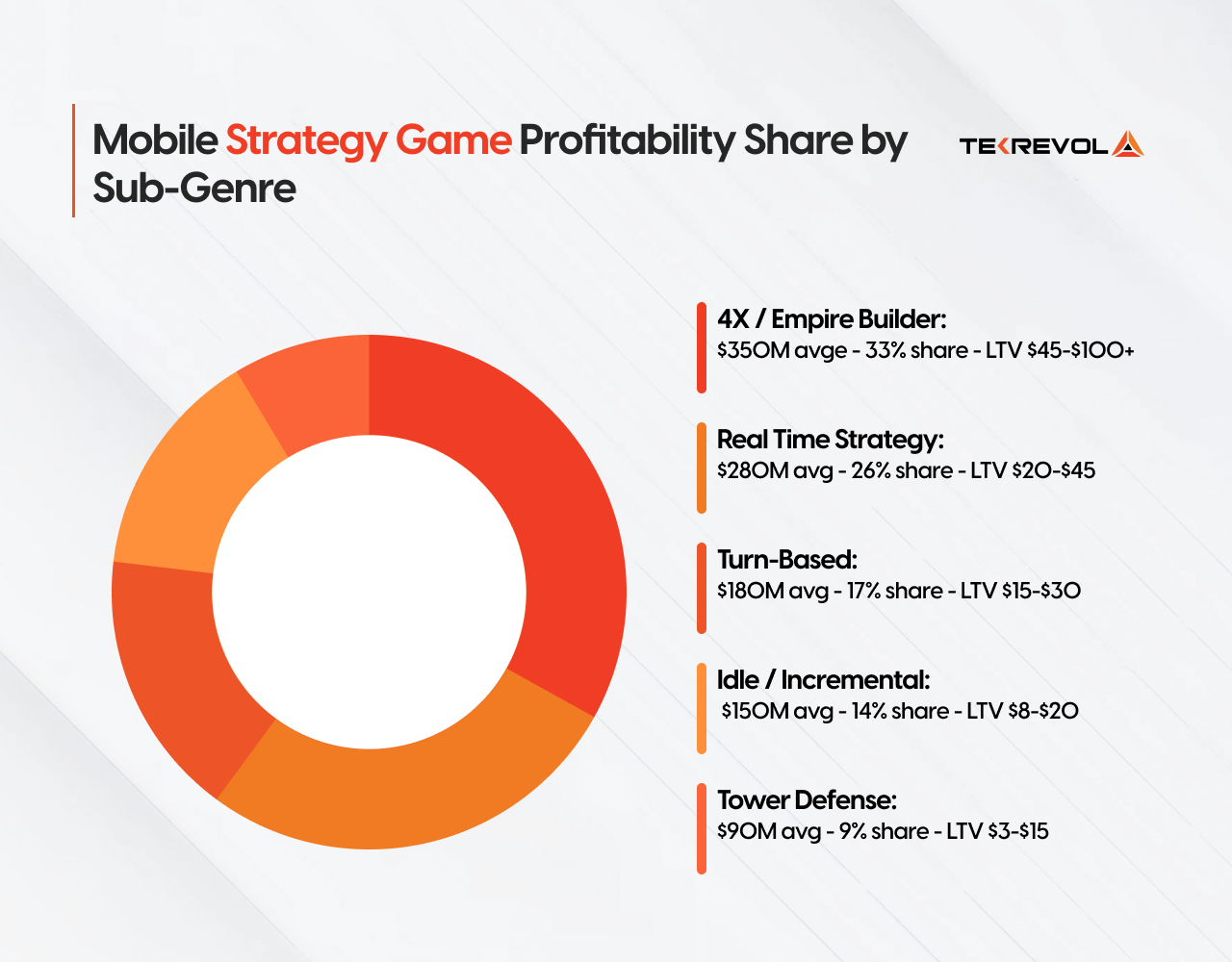
- $8–$45 Player LTV Mid-core strategy players average $8–$45 lifetime value — top 4X titles exceed $100
- Top 3 Genre by Revenue Strategy consistently ranks top #by revenue in both the US and the Asia-Pacific mobile market
Types of Mobile Strategy Games to Build in 2026
Strategy games are divided into five sub-genres: Real-Time Strategy (RTS), Turn-Based Strategy (TBS), 4X, Tower Defense, and Idle/Incremental.
Each has different technical requirements, target audiences, and monetization potential, which we discussed below:
Real-Time Strategy (RTS)
In RTS games, all players act simultaneously in real time. The core tension is fast decision-making under pressure.
Real-time strategy mechanics require solid server infrastructure for multiplayer and precise mobile input design, so the dragging, tapping, and pinching on a 6-inch screen must feel natural.
- Popular Examples: Clash of Clans, Boom Beach
Turn-Based Strategy (TBS)
Here, players act in discrete turns, which dramatically reduces server complexity and suits asynchronous multiplayer (play-by-email style).
Turn-based mechanics are highly accessible on mobile because players can pause between decisions.
- Examples: XCOM 2 Collection, Into the Breach, Civilization VI
4X Strategy (Explore, Expand, Exploit, Exterminate)
4X is the most complex and most lucrative strategy sub-genre. They require AI-driven opponent empires, technology trees, diplomacy systems, and large-map rendering.
AI opponent development is the biggest technical challenge. It must behave like a credible opponent across dozens of possible strategic states.
- Examples: Rise of Kingdoms, Forge of Empires
Tower Defense
Players place defensive units along a path to stop waves of enemies. Tower defense is the easiest sub-genre to prototype.
Monetization typically leans on IAP for premium towers or rewarded video ads, making it ideal for indie teams or first-time mobile game developers.
- Examples: Plants vs. Zombies, Bloons TD 6
Idle / Incremental Strategy
These are strong, long-term mobile games where players set up production chains or armies that generate resources over time, even offline.
Idle mechanics pair naturally with battle pass monetization and rewarded ads. Though it has lower engagement per session, the genre has exceptional long-term retention through compounding progression.
- Examples: Idle Heroes, Tap Titans 2
What Can You Learn From the Top-Grossing Mobile Strategy Games?
The top mobile strategy games share four design principles worth applying to any new project. Study what they do before writing a single line of code:
| Game | Core Mechanic | Monetization Model | Key Retention Driver |
| Clash of Clans | Base-building + RTS | IAP (gems), Battle Pass | Clan social loops |
| Clash Royale | Real-time card battles | Battle Pass + card IAP | Seasonal content |
| Rise of Kingdoms | 4X empire building | IAP + VIP subscription | Alliance warfare |
| Plants vs. Zombies 3 | Tower Defense | Energy + IAP | Level progression |
| Into the Breach | Turn-based tactics | Premium ($2.99) | Puzzle-like depth |
Lessons
- Social systems (clans, alliances, guilds) extend retention far beyond any single-player campaign.
- Battle passes create reliable recurring revenue without alienating free-to-play users.
- Premium pricing works for critically acclaimed, PC-ported titles.
- Seasonal content refreshes player interest without requiring a full sequel.
What Does Strategy Game Development Actually Involve? [Key Aspects]
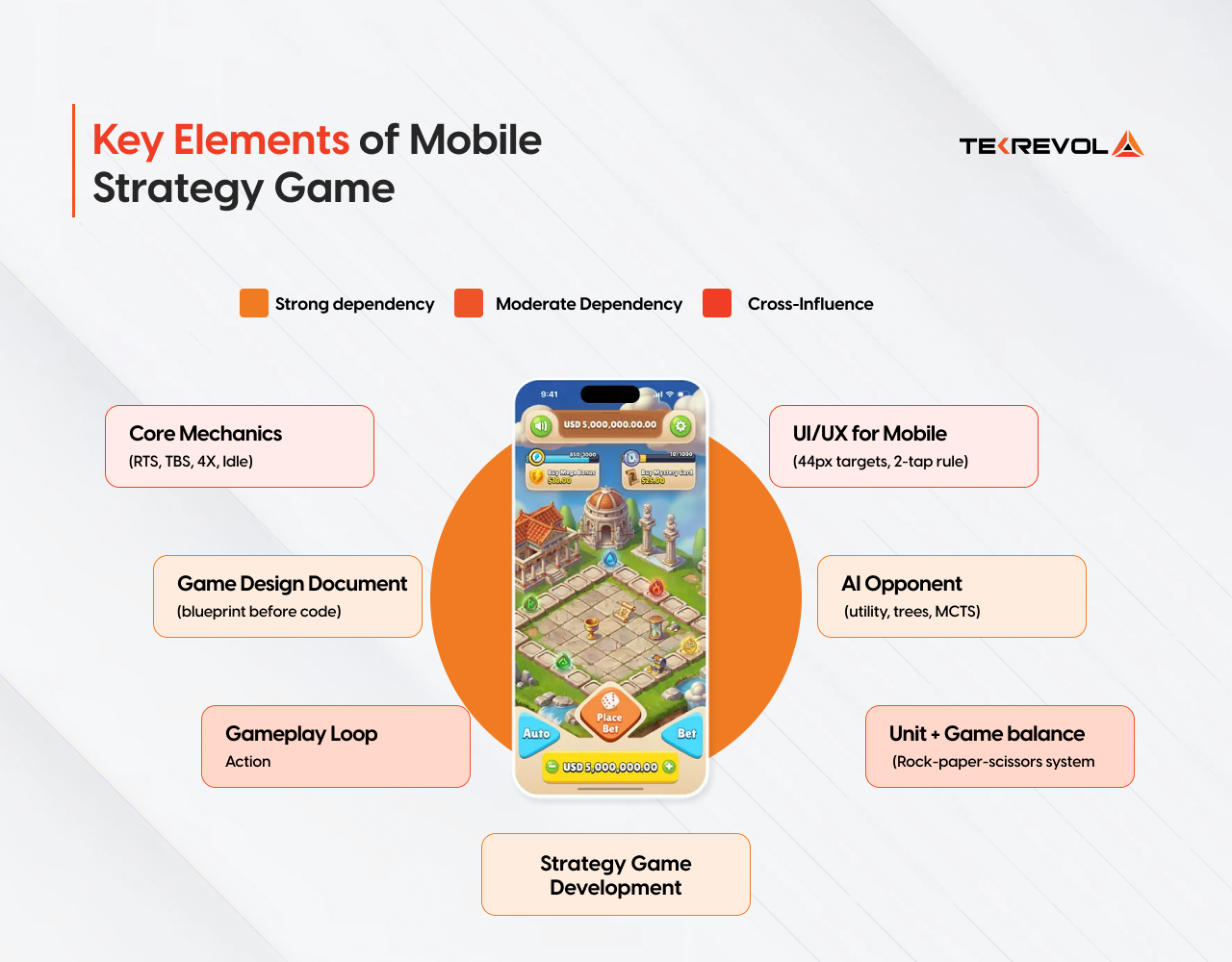
Building a strategy game that retains players and generates revenue comes down to 7 interconnected elements:
Core Mechanics, the Game Design Document, Gameplay Loop, Unit and Game Design Balance, AI Opponent, and Mobile-specific UI/UX.
Miss any one of them, and the game will feel incomplete, regardless of how polished the others are.
Core Mechanics
The core mechanics define the player’s primary interaction with the game. You must decide between Real-Time Strategy (RTS) for fast-paced action or Turn-Based Strategy (TBS) for tactical planning.
Real-time mechanics demand persistent servers and precision input design. Turn-based mechanics open the door to async multiplayer at a fraction of the infrastructure cost. Lock your core mechanic before anything else gets designed.
Game Design Document (GDD)
The GDD acts as your project’s constitution. It details every unit stat, story beat, and monetization trigger. A professional GDD prevents “feature creep” and ensures that the art and engineering teams remain perfectly aligned throughout the development lifecycle.
Gameplay Loop Design
Every successful strategy game is built on a tight, repeatable gameplay loop. The loop is the sequence of actions a player takes repeatedly:
- Collect resources
- Upgrade units or base
- Engage in battles
- Earn rewards
AI Opponent Development
AI opponent development determines whether the single-player feels alive or hollow. The right AI architecture depends on your sub-genre and available compute budget on mobile hardware. Here is a practical guide:
| AI Type | Best For | Relative Cost | Timeline Add |
| Rule-Based | Tutorial / easy mode | Low | +1–2 weeks |
| Utility-Based | Mid-core single-player | Medium | +4–8 weeks |
| Behavior Trees | RTS unit squads | Medium-High | +6–10 weeks |
| MCTS | Deep TBS / 4X | High | +10–16 weeks |
Unit Balance
Unit balance is critical to competitive fairness and long-term engagement. The simplest proven framework is “Rock-Paper-Scissors”. This model (used in everything from Starcraft to Clash Royale) ensures no single strategy dominates and encourages players to diversify their rosters.
Game Balance
Game balance design is the broader system that determines how resources, progression speed, upgrade costs, matchmaking, and monetization interact to keep the overall experience fair for both free and paying players across all stages of progression.
A game can have perfectly balanced units and still feel broken if a paying player can rush upgrades that take a free player three weeks to earn.
UI/UX for Mobile
Complex strategy interfaces for desktops require complete rethinking for 5–6-inch touchscreens. Every HUD element, unit selection indicator, and menu must be accessible with a thumb. Touch targets should be a minimum of 44×44 pixels. Critical actions should never be more than two taps from any game state.
How to Build a Mobile Strategy Game [7 Phases Explained]
To build a mobile strategy game, follow seven phases: Research and GDD, Prototype, Pre-Production, Production, Soft Launch, and Global Launch with Live-Ops.
Each phase in this game development process has one defined output. Skipping any phase increases the cost and timeline in the next phase.
| Stage | Work Scope | Cost Range | Timeline |
| Research & GDD | Market analysis, GDD, wireframes, balance spreadsheet | $5,000 – $15,000 | 3–5 weeks |
| Prototype | Core loop, placeholder art, basic AI, single map | $10,000 – $25,000 | 4–8 weeks |
| Pre-Production | Art style locked, backend architecture, engine config | $15,000 – $30,000 | 3–5 weeks |
| MVP Development | 3–5 levels, polished UI, 1 monetization layer, iOS + Android | $40,000 – $90,000 | 3–5 months |
| Soft Launch & QA | Closed beta, crash fixes, balance tuning, server load tests | $10,000 – $25,000 | 4–8 weeks |
| Full Commercial | Full campaign, PvP/multiplayer, live-ops backend, store optimization | $120,000 – $300,000+ | 8–18 months |
1st Phase: Research and Concept
Phase one of strategy game app development is about answering “what you are building” and “why players would choose it over what already exists” before they cost you six figures to answer later. Phase one produces three things:
- Sub-genre decision with a documented rationale,
- Competitive gap analysis of the three closest titles in your category, and
- One-page value proposition that answers why a player would choose your game over Clash of Clans.
Everything else in this phase feeds those three outputs.
2nd Phase: Game Design Document
Before entering production, make a Game Design Document. A solid GDD for a commercial mobile strategy game covers:
- Core rules and win/loss conditions
- Unit roster, stats, and balance framework
- Technology tree or upgrade paths
- Map design and procedural generation rules (if applicable)
- UI/UX wireframes for key screens
- Monetization triggers and IAP item catalog
- Narrative/lore overview (if story-driven)
- Live-ops roadmap for post-launch content
3rd Phase: Prototyping
Prototyping is about proving that your core gameplay loop design is actually fun before creating assets. Designers use basic shapes to simulate the game’s “feel” and mechanical depth.
Key focus areas include:
- Building the minimum playable loop (Build, Fight, Collect)
- Testing unit movement and pathfinding logic
- Verifying the “Rock-Paper-Scissors” combat balance
- Adjusting the speed of resource generation and construction
- Identifying “boring” mechanics that need to be cut or simplified
- Testing the basic touch-interface responsiveness
- Running internal playtests to gather raw feedback on difficulty
4th Phase: Pre-Production
Pre-production establishes the technical and visual foundation for the entire project. This phase ensures the team has a clear workflow for asset integration.
Essential activities involve:
- Setting up the server-side architecture for multiplayer
- Creating the “Vertical Slice” (one perfectly polished level)
- Finalizing the tech stack (Unity vs. Unreal Engine)
- Creating the master asset list and naming conventions
- Developing the AI opponent framework
- Establishing performance budgets for mobile hardware (RAM/CPU)
- Setting up version control and CI/CD pipelines for the dev team
5th Phase: Production
Production is the execution phase where the bulk of 2D or 3D game assets are created and integrated. This is the most resource-intensive stage of the project.
During this period, the team works on:
- Modeling, texturing, and animating all unit types
- Coding complex real-time strategy mechanics and UI systems
- Recording and integrating sound effects and orchestral scores
- Implementing the full economy and progression system
- Writing and localized narrative dialogue for global markets
- Building out the full campaign or world map levels
- Conducting daily “smoke tests” to ensure build stability
6th Phase: Soft Launch
A soft launch is a controlled release in a small territory to gather data and optimize the in-app purchase strategy. This phase includes:
- Measuring Day 1, Day 7, and Day 30 player retention
- Identifying specific levels where players “churn” or get stuck
- A/B testing different tutorial flows to improve onboarding
- Testing server load and matchmaking latency with real users
- Gathering feedback on the fairness of the monetization
- Adjusting unit stats based on community exploits
- Scaling the customer support and bug-reporting systems
7th Phase: Global Launch & Live-Ops
Launch day is not the finish line; it is the start of a different kind of work. The strategy games that stay in the top charts for years are not better at launching. They are better at not going stale.
Live-ops activities:
- Launching the first seasonal battle pass monetization cycle
- Deploying monthly content updates, hosting limited-time events
- Tracking high-spending players who generate 50–70% of IAP revenue to understand what triggers their purchases, and
- Constant server maintenance and anti-cheat updates
TekRevol in Action: Ether Legends
Strategy game app development at this level requires a team that has solved these problems on a real project before.
TekRevol developed Ether Legends — a blockchain-based collectible card strategy game. The project combined turn-based strategy mechanics with a Web3 asset ownership model, requiring TekRevol’s team to balance competitive card gameplay, an on-chain economy, and mobile performance constraints simultaneously.
For studios exploring where mobile strategy and blockchain intersect, this case study is worth reviewing in full. Read the Ether Legends Case Study →
How Much Does It Cost to Build a Strategy Game? [Breakdown by Type]
Strategy game app development costs $30,000 for casual tower defense titles and exceeds $1,000,000 for complex multiplayer 4X games. The following table outlines estimated ranges based on sub-genre and technical scope.
| Game Type | Description | Estimated Cost | Timeline |
| Prototype / POC | Core loop, placeholder art, 1 map, basic AI, no multiplayer | $10,000 – $25,000 | 4 – 8 weeks |
| Casual Tower Defense | 5–10 levels, 2D art, rewarded ads, single-player only | $30,000 – $60,000 | 2 – 4 months |
| Turn-Based Strategy MVP | 10–20 levels, 2D art, async multiplayer, IAP, battle pass | $60,000 – $120,000 | 4 – 7 months |
| Mid-Core RTS / 4X | Full campaign, real-time PvP, 3D art, clan system, live-ops backend | $150,000 – $350,000 | 9 – 18 months |
| AAA Strategy Title | 4X / cross-platform, full 3D, custom AI, cloud saves, live-ops team | $500,000 – $2M+ | 18 – 36 months |
Top Factors Influencing Your Budget
- Scope (how many features)
- Art quality (2D vs. 3D, style complexity)
- AI complexity
- Backend infrastructure
Recommended Tech Stack for Strategy Game Development
The tech stack for Strategy game app development typically includes: game engine, backend infrastructure, and supporting tools. Here is what professional studios use across every layer of the build.
Game Engine
Choosing the right game engine for strategy games depends on your game scope and team experience. For most mobile strategy projects, the choice comes down to Unity vs Unreal vs Godot.
| Engine | Cost | Learning Curve | Mobile Performance | Best For |
| Unity | Free – $2,040/yr | Moderate | Excellent | 2D & 3D RTS, TBS, tower defense |
| Unreal Engine 5 | Free (5% rev share >$1M) | Steep | Good (heavier builds) | High-fidelity 3D 4X or cross-platform titles |
| Godot 4 | Free / Open Source | Moderate | Good (lightweight) | Indie 2D turn-based and tower defense |
Unity game development is the default for most mobile strategy builds. One codebase ships to iOS and Android, the 2D and 3D toolsets are both mature, and the talent pool is the deepest of any mobile engine.
Backend Infrastructure
To build a professional strategy game, you need a robust backend that handles everything from global matchmaking to real-time data tracking. Strategy games cannot afford to lose player data between sessions. That requires a backend built for persistence from day one, not patched in after launch.
| Category | Recommended Tools | Purpose |
| Multiplayer | Unity Gaming Services, Photon | Connects players for real-time battles. |
| Cloud Storage | Firebase, AWS | Saves player progress and base data safely. |
| Analytics | Unity Analytics, Adjust | Shows how players spend money and where they quit. |
| Notifications | Firebase Cloud Messaging | Alerts players when a building is finished or under attack. |
| Live Updates | PlayFab, Custom CMS | Changes game balance or events without a new download. |
Supporting Tools
- 2D strategy games: Adobe Photoshop and Illustrator for static assets and UI, Spine (the industry standard for mobile unit animation by Esoteric Software) for skeletal animation, and Aseprite for pixel art styles.
- 3D strategy games: Maya for studios with senior 3D artists who need robust rigging and animation tooling at scale, or Blender for lean indie teams who need professional-quality 3D output without the per-seat licensing cost. Substance Painter is the standard for texturing regardless of which modeler you choose.
- Version Control: Git with GitHub or Bitbucket; Unity Plastic SCM for large binary asset management.
- Project Management: Jira or Linear for sprint tracking; Confluence for GDD and documentation.
Monetization Strategies for Mobile Strategy Games
The most effective monetization model for strategy games is a hybrid of IAP and battle pass. It balances player fairness with high-value revenue streams.
Here are the top mobile game monetization strategies that work in the strategy genre, with real LTV data.
| Model | Avg. Player LTV | Best For | Key Risk |
| In-App Purchases (IAP) | $8 – $45 (mid-core) | All strategy sub-genres | Pay-to-win perception if selling raw power |
| Battle Pass | $15 – $30 per season | Games with seasonal content cycles | Requires consistent live-ops content delivery |
| Subscription | $5 – $15/month | Deep 4X and strategy-RPG hybrids | Players expect regular content updates to justify the cost |
| Rewarded Video Ads | $0.50 – $3 (casual) | Casual tower defense and idle strategy | Low ceiling; best as a supplement, not primary revenue |
| Premium (Paid Download) | $1 – $5 one-time | PC-ported indie titles with proven audiences | High risk on mobile; limited organic discovery |
In-App Purchases (IAP)
IAP remains the dominant revenue model in strategy games. Selling resources that shorten wait timers (energy, speed-ups) is a great example of how to monetize a game by targeting impatience without breaking competitive balance. Selling cosmetic skins or unit variants also monetizes player identity effectively.
Battle Pass
Battle passes, popularized by Fortnite and Clash Royale, are ideal for strategy games with seasonal content cycles. A typical pass offers a free tier and a premium tier that unlocks exclusive units.
Subscription
Monthly subscriptions ($4.99–$14.99/month) work best for deep 4X and strategy-RPG hybrid games. Subscriptions deliver more predictable revenue than IAP spikes but require regular updates to justify the recurring cost.
Rewarded Video Ads
In casual and idle strategy games, you can use ads where players choose to watch a 15–30 second video in exchange for bonus resources. This can generate $0.50–$3 per user in markets where IAP conversion rates are low.
Expert Tip! To maximize your returns, do not pick one monetization model. Layer IAP for spenders, battle pass for engaged mid-tier players, and rewarded ads for everyone else. Each layer earns from a different player type.
Why Most Mobile Strategy Games Fail (And How to Avoid It)
In TekRevol’s experience across 12+ game builds, the following mistakes appear repeatedly. Every one is avoidable with proper pre-production planning.
- Skipping the GDD. Teams that design as they go rebuild core systems mid-production at 3–5x the cost of getting design right in week two.
- Over-scoping the MVP. Test the core loop first. Launching with 50 maps and 12 factions before validating that the mechanic is fun burns the budget on the wrong problem.
- Pay-to-win mechanics. Selling raw power creates a toxic competitive environment, drives free players out, and generates negative App Store reviews.
- Ignoring mobile UX. PC strategy UI on a 6-inch touchscreen is illegible. Every HUD element and touch target must be redesigned for mobile.
- No soft launch. A limited geographic beta on Google Play before global release catches balance failures, server load problems, and monetization friction at low cost.
- No live-ops plan. Strategy games without content updates stagnate within 60–90 days. New units, seasonal events, and balance patches must be planned and budgeted before launch.
Why TekRevol Is Your Best Partner to Build a Mobile Strategy Game
If you are evaluating strategy game app development as your next move, you need a team that has done it before, not one learning on your budget.
TekRevol is a full-service mobile game development company with dedicated teams for game design, Unity engineering, 2D and 3D art, backend infrastructure, and QA. We have shipped strategy titles across iOS and Android for indie studios, IP holders, and established publishers.
We also offer Web3 game development services for studios exploring blockchain-based asset ownership or play-to-earn mechanics within the strategy genre. Every project starts with a GDD-first process, meaning design is locked before production begins. That single discipline is what keeps timelines clean and budgets predictable.
Ready to Scope Your Strategy Game?
Book a 60-minute discovery session with TekRevol to define your concept, estimate costs, and map a clear, scalable development roadmap for your game.
Contact Us Now


