



- AI EdTech apps combine education science with AI like LLMs, personalization, and computer vision
- Global AI in education market projected to reach $34.6B by 2030
- Effective platforms use AI for learning paths, quiz generation, and real-time analytics
- Compliance with FERPA, COPPA, and data privacy laws is essential from day one
- Development costs range from $25K (MVP) to $200K+ (enterprise)
- TekRevol’s dedicated EdTech practice delivers AI-powered learning platforms with full compliance and scalable architecture.
The education technology sector is undergoing a profound transformation. Students, institutions, and corporate training teams are no longer satisfied with static e-learning modules or one-size-fits-all curricula.
They want learning experiences that adapt, respond, and improve over time. This is exactly what an AI app development company makes possible.
Aimed primarily at EdTech startup entrepreneurs, university IT departments, corporate L&D directors, and tutoring agencies, this handbook is a handy companion for anyone wishing to create AI-driven educational platforms that are both intelligent and scalable, as well as aligned with compliance requirements.
If you plan to develop a new system or merely improve the one you have, this in-depth analysis is your go-to guide for everything from examining the potential of the market to determining the tech stack and estimating development cost.
EdTech Sector Potential for 2026
The present moment could hardly be more favorable for developing an AI-powered EdTech application. Factors that are contributing to global demand for educational technology capable of personalization at scale include increasing remote learning, workforce skill development requirements, and the rising expectation for smart digital experiences.
Below are the statistics that are important for manufacturers and financiers:
- $34.6 billion: The estimated value of the worldwide AI in education market in 2030, with an expected annual growth rate of 36.5% (Global Industry Analysts).
- More than 90% of learners worldwide are currently making use of AI study aids or tools for writing and research purposes (Statista, 2025).
- Educational retention rates increased by 35% significantly when students were using AI personalized learning platforms as compared with traditional teaching methods.
- Featuring $7.3 billion in global EdTech venture funding just in 2024, funding has still remained quite active in this segment.
- Corporate driving forces behind demand: Recently, more than 70% of Fortune 500 enterprises have bought into AI-powered LMS for staff skill enhancement and regulatory training.
The market is not just large, it is structurally shifting. Academic institutions are replacing legacy LMS platforms. Tutoring businesses are building proprietary AI assistants. Corporate L&D teams are demanding personalized learning paths that integrate with HR systems.
Across all these segments, the core requirement is the same: intelligent, data-driven learning that adapts to the individual.
Build Your AI EdTech Platform the Right Way
Partner with TekRevol for expert strategy, end-to-end development, and scalable architecture to create a high-performing AI-powered education platform.
Get Free Consultation!Top AI Study Apps: What Builders Can Learn?
The most successful AI study apps share a set of product decisions that translate directly into development priorities. Here are five platforms worth analyzing as product case studies:
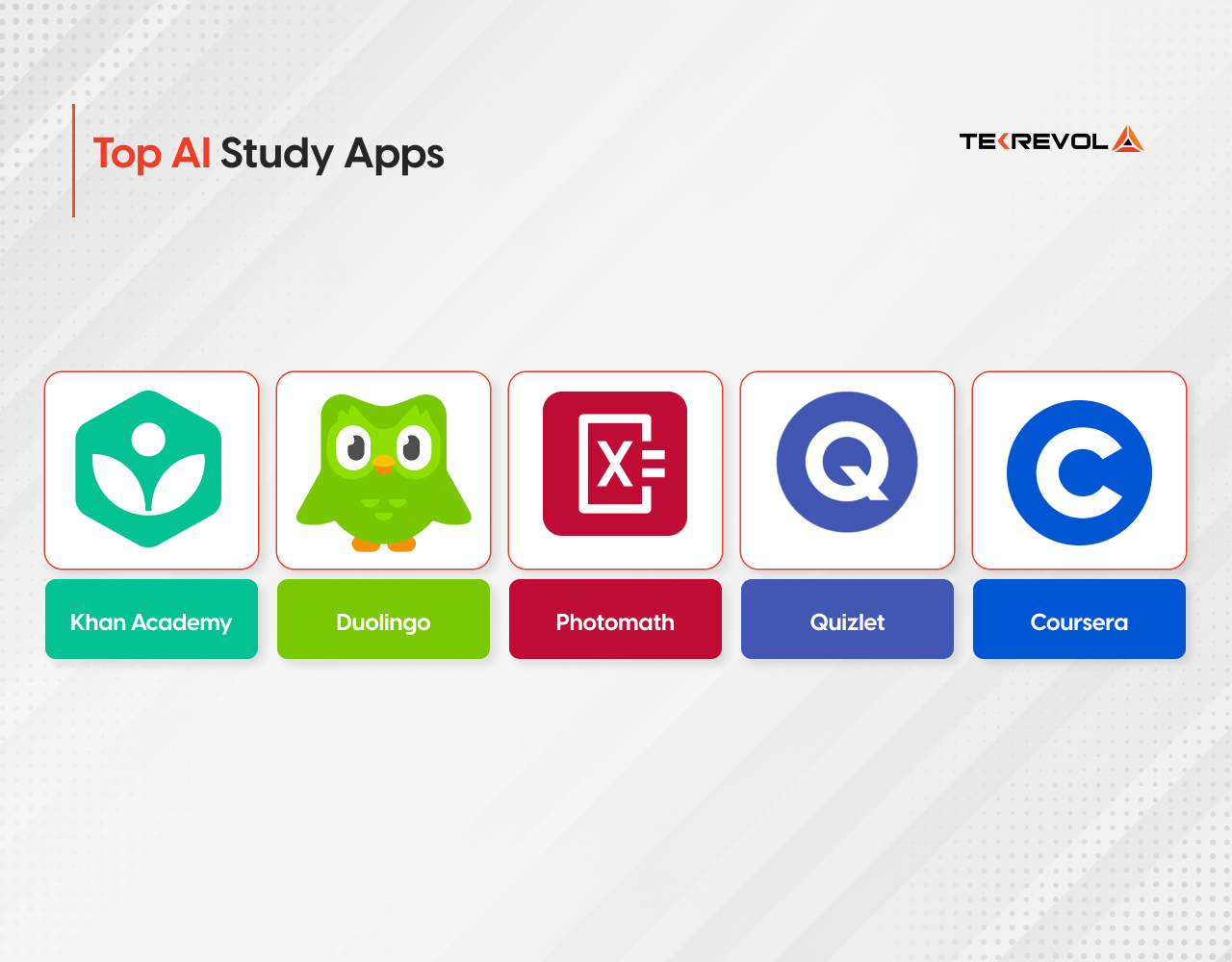
1. Khan Academy (Khanmigo AI Tutor)
What it does: Delivers Socratic tutoring, guiding students through problems with questions rather than giving direct answers. Built on large language model integration within an existing content ecosystem.
The key product insight here is dialogue-based scaffolding, a model that requires robust NLP infrastructure and careful prompt engineering.
Builders should note how Khan Academy separates AI interaction from static content, making the AI layer a service on top of existing assets.
2. Duolingo
Duolingo is designed to keep learners returning every day by means of spaced repetition algorithms, adaptive difficulty scoring, and gamification.
The streak system on Duolingo has become a highly researched case of behavioral design in educational technology.
The takeaway for developers: gamification must be linked to learning outcomes, not just engagement metrics. Badge systems and leaderboards should promote correct practice behavior only, not just time-on-app.
3. Photomath
Computer vision in real-time for helping solve math with detailed explanations.
The technical highlight was the decision to create a pipeline OCR + ML specially made for mathematical symbols, which is a much more difficult problem than regular text recognition.
Builders who focus on STEM education should know that the subject-specific AI models tend to have better performance than general-purpose ones.
4. Quizlet
Flashcards and quiz sets are created by AI from the study materials that the user has uploaded.
The content ingestion pipeline is what sets the product apart, with the capability to convert PDFs, notes, and textbook pages into structured learning objects.
This should be the main focus of any EdTech platform offering exam preparation or corporate compliance training.
5. Coursera / Skill Assessment Platforms
Learning paths are tailored to individuals based on their skill gap, assessment, and job market data.
The main product feature is outcome-driven sequencing, that is, the platform is able to suggest content based on the learner’s goal, not just their current level.
This requires integrating learning goal frameworks into the recommendation engine from day one.
Build the AI infrastructure around that. TekRevol’s educational app development practice uses this case study methodology during product discovery to help clients define their AI differentiation strategy before development begins.
Which Types of EdTech Applications are Worth Investing in
Education Technology (EdTech) is a huge category that involves various types of products, which differ significantly from each other by technical features, target users, and revenue models. Knowing what exactly you are going to develop will help you make the right decisions regarding system design from the very beginning.
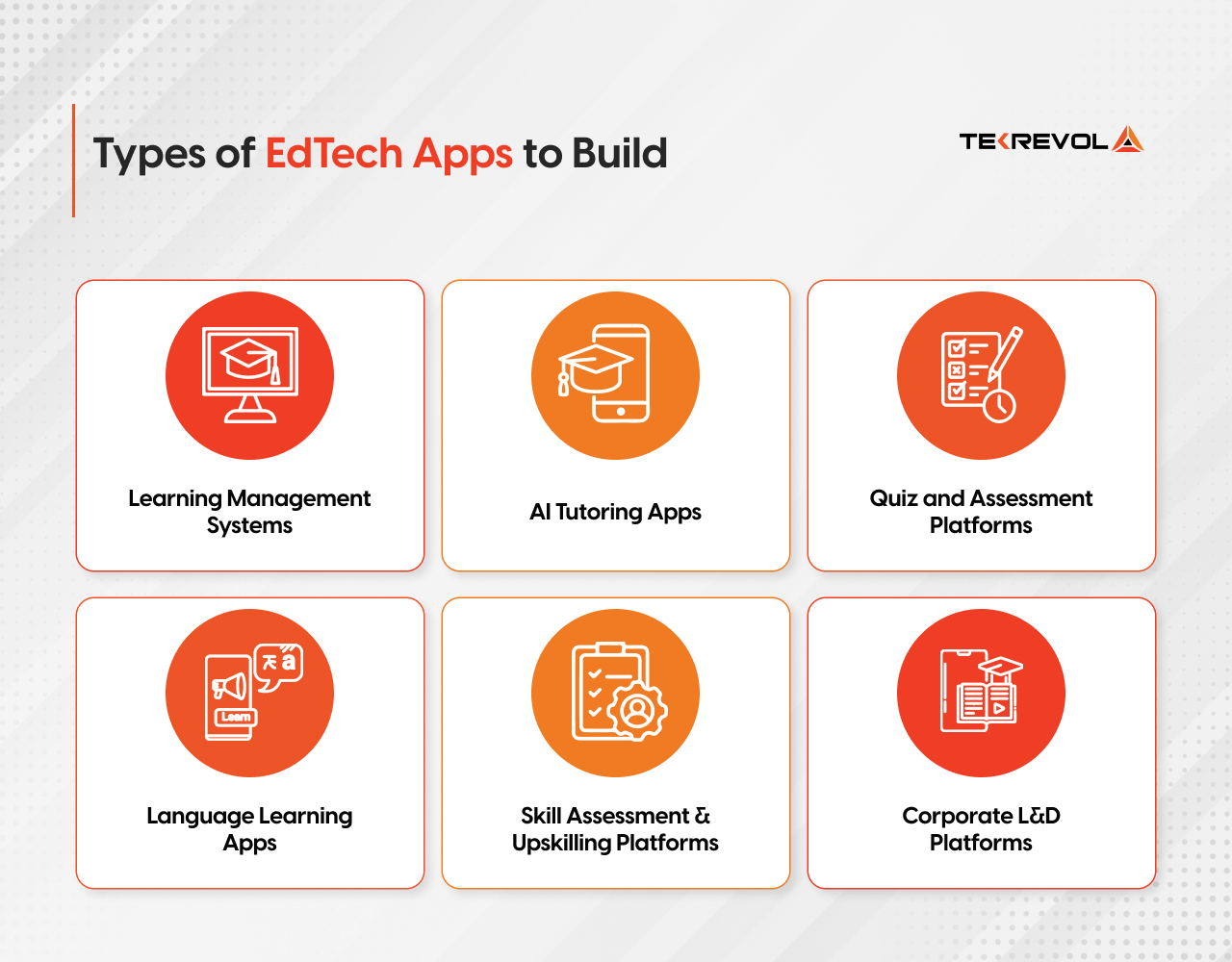
Learning Management Systems (LMS)
These types of platforms are mainly used by enterprises or institutions that wish to monitor course delivery, registration, exams, and performance.
Typical clients are: educational institutions, corporations, and governmental bodies.
Major functionalities: support for multiple tenants, compliance with SCORM standards, and different access rights for different user roles.
TekRevol focused on building a scalable architecture that manages diverse content libraries while tracking detailed student performance. It serves as the perfect blueprint for an AI-powered LMS where data integrity and structured learning paths are critical for institutional success.
Read the complete case study here.
AI Tutoring Apps
1-on-1 adaptive learning usually covers only a single subject.
Intended users: students of kindergarten through grade 12, those taking professional exams, and people learning languages.
Major characteristics: conversational NLP, on-the-spot offering of clues, spaced repetition.
Quiz and Assessment Platforms
They assist in generating quizzes automatically, marking them, and examining students’ results.
Intended users: Educational institutes, HR, and learning & development departments.
Main features: AI-created question generation, anti-cheating methods, and detailed score reports.
Language Learning Apps
Vocabulary expansion, pronunciation learning, and simulating real-life discussions with a virtual human.
Intended users: solo learners, companies that offer language learning to their employees.
Main features: speech recognition, adaptively ordering vocabulary, and inclusion of audio from native speakers.
Skill Assessment and Upskilling Platforms
Identifying shortcomings, offering role-specific learning paths, and competency tracking.
Target users: HR departments, platforms for continuing professional development.
Major features: skills taxonomy integration, job market data APIs, certificate generation.
Corporate L&D Platforms
At scale, handling compliance training, onboarding, and leadership development. Target users: enterprise HR and L&D managers.
Key features: HRIS integration, mandatory completion tracking, and reporting dashboards for regulators.
How to Build an AI EdTech App: Step-by-Step Guide
Building an AI EdTech app is not a linear process, but it does follow a clear sequence of decisions. Here is the development framework TekRevol uses for educational app development:
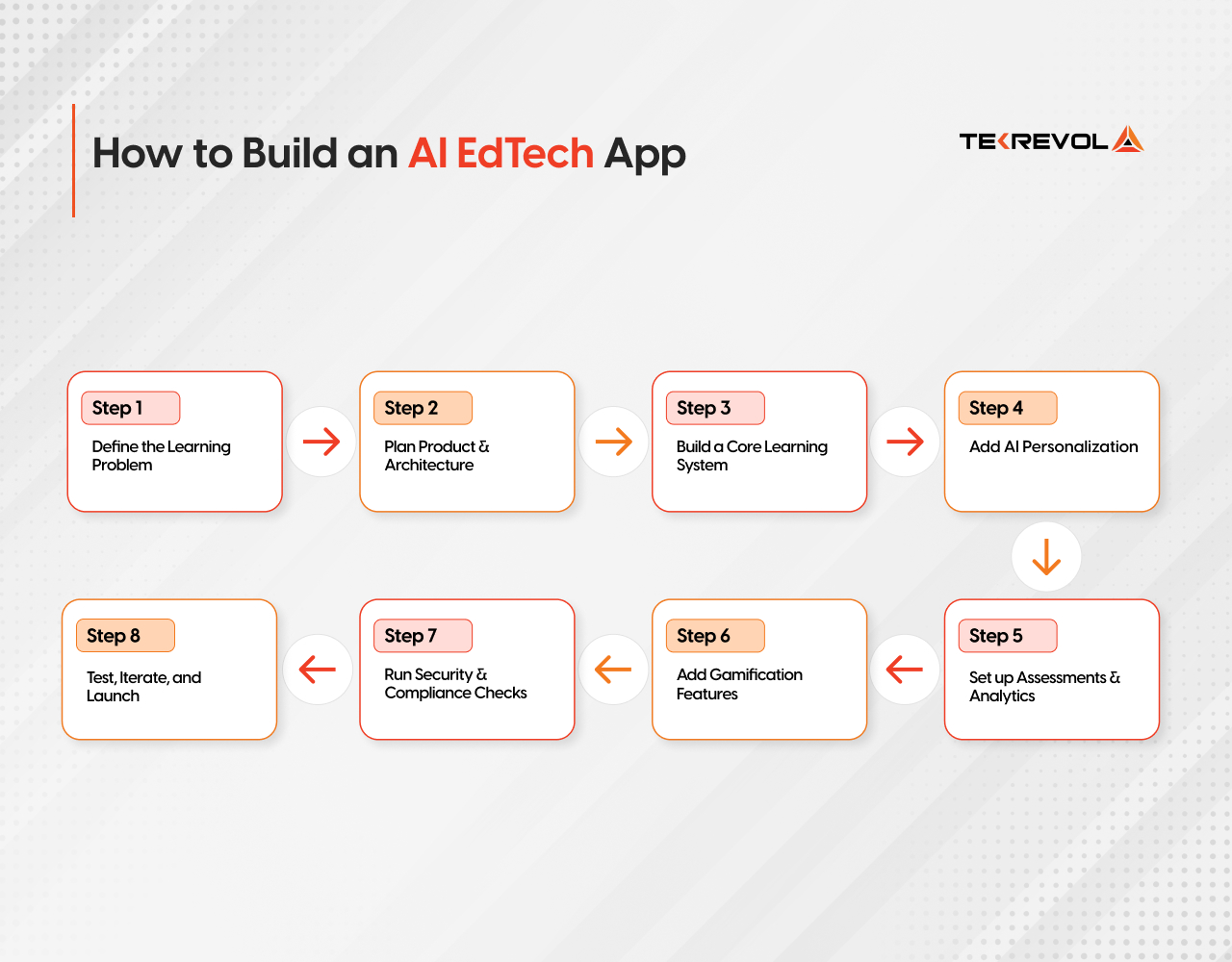
Step 1: Define the Learning Problem
Start with the pedagogical challenge before the technical one.
- What specific learning outcome does your platform improve?
- Who is the learner?
- What is their existing journey?
These questions’ answers will determine your data model, AI training requirements, and feature prioritization. Develop a user journey map that unfolds the full learning life cycle from the point of onboarding and assessment up to content delivery, practice, and performance review.
Step 2: Perform Product Discovery and Architecture Planning
In this step, we do a competitive analysis, a selection of a technology stack, mapping of compliance requirements (FERPA, COPPA, GDPR, depending on market), and an AI capability assessment.
Output: a product requirements document (PRD), a data architecture diagram, and a set of MVP features. For AI features, specify what data you will require to train or fine-tune the models and how you will collect this data in an ethical way.
Step 3: Develop the Main Learning Infrastructure
Without AI features, you should first set up the groundwork, user authentication, content management, course/module layout, and simple progress tracking. This forms the basis on which AI layers are applied.
Skipping or hurrying this phase will result in technical debt, making AI personalization very challenging to implement correctly later.
Step 4: Bring AI Personalization Engine on Board
This is where adaptive learning software development gets complex. The three elements that make up the personalization engine are usually: a learner profile model that keeps a track of the knowledge state and learning velocity, a content recommendation model that pairs content with the learner profile, and an adaptive difficulty engine that modifies the level of challenge based on performance signals.
These components are in a feedback loop, with each learning interaction updating the learner model, then updating recommendations, and eventually leading to new interaction data.
Step 5: Build the Assessment and Analytics Layer
AI quiz generation, auto-grading, performance monitoring dashboards, and predictive analytics are a few features that rely on the underlying assessment infrastructure. Prepare your data schema back in Step 3 for this layer, where every interaction event is logged in a format suitable for further analytics and model retraining.
Step 6: Add Engagement and Gamification Features
Continuous learning, reward systems, leaderboards, and progress tracking are examples of features that will drastically enhance the retention rate. Besides that, these features should be linked to meaningful learning behaviors, such as finishing a module, reaching a certain score, keeping up a study streak, not merely just time-on-platform.
Step 7: Compliance Audit and Security Review
In order to go live, you must first execute a complete FERPA/COPPA/GDPR compliance audit, penetration testing, and a data encryption examination. See the compliance section below for details.
Step 8: Beta Testing and Model Iteration
Launch with a controlled beta cohort. Use real learning data to evaluate model performance, fix content gaps, and improve the recommendation engine. Plan for at least two to three iteration cycles before a full public launch.
Core Features of an AI EdTech App
The features below represent the functional backbone of a competitive AI-powered learning platform. Not all are required for an MVP, but all should be on your product roadmap.
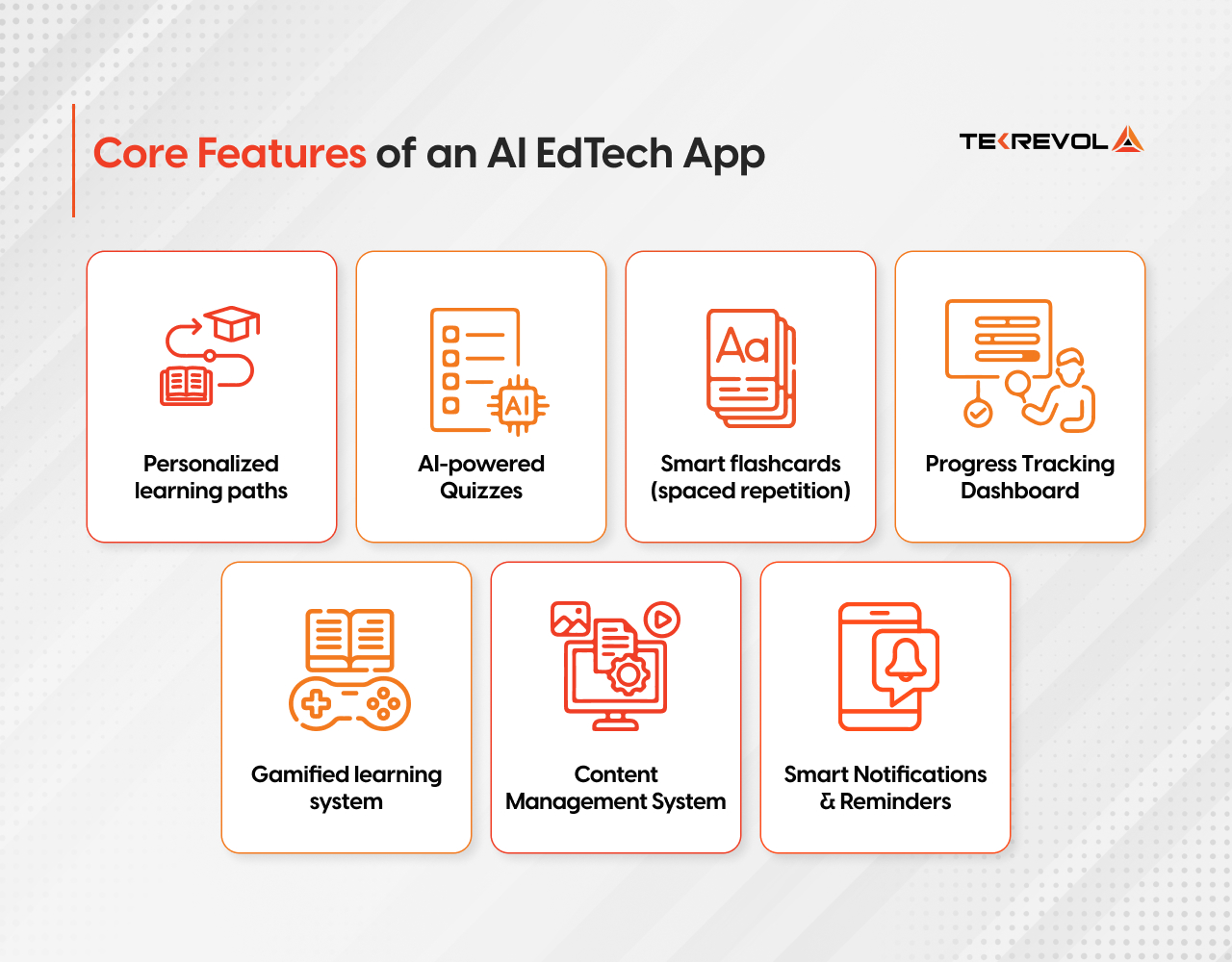
Personalized Learning Path Engine
The platform generates unique content sequences for each learner based on their prior knowledge, learning pace, stated goals, and performance history.
This is the most complex feature to build correctly, but also the most differentiating. Implementation requires a learner knowledge graph, a content tagging taxonomy, and a recommendation algorithm, typically a collaborative filtering or knowledge-tracing model.
AI Quiz and Assessment Generator
Automatically generates quiz questions from uploaded content, textbooks, lecture slides, PDFs, and video transcripts. Uses a natural language processing guide to extract key concepts and formulate questions of varying difficulty. Also handles automated grading for open-ended responses using semantic similarity scoring.
Spaced Repetition and Flashcard System
Implements the spaced repetition algorithm (SRS) to schedule review sessions at optimal intervals based on forgetting curve science. Significantly improves long-term retention compared to massed practice. Widely used in language learning apps and professional certification prep platforms.
Progress Dashboard and Analytics
Provides learners with real-time visibility into their performance, time spent, topics mastered, weak areas, and projected completion timelines. For institutional clients, it provides instructor and administrator dashboards with cohort-level analytics, completion rates, and learning outcome tracking.
Gamification Engine
Points, badges, streaks, and leaderboards drive behavioral reinforcement. Effective gamification design ties rewards to learning outcomes. Examples: a badge for completing a difficult topic that the learner had previously failed multiple times; a streak system that rewards consistent daily practice rather than just time logged.
Content Ingestion and Management System
Allows instructors or administrators to upload and manage learning content in multiple formats, such as video, PDF, SCORM packages, and interactive HTML5. The AI layer processes this content for tagging, indexing, and quiz generation.
Notification and Nudge System
AI-triggered notifications remind learners to resume incomplete modules, maintain streaks, or review flagged weak areas. Notification timing is optimized based on learner behavior patterns, sending reminders when the learner is most likely to be receptive.
Want to Disrupt the EdTech Space with AI?
Partner with TekRevol to transform your concept into a scalable, high-performing AI-powered education platform built for growth and user engagement.
Let’s TalkAI/ML Features That Differentiate EdTech Apps
Standard EdTech apps offer content libraries and basic quizzes. AI-differentiated platforms use machine learning to make the experience fundamentally different for every user. Here is a comparison of basic ML versus advanced AI features, along with their cost implications:
| Feature | Basic ML | Advanced AI | Cost Impact |
| Content Recommendation | Rule-based filtering | Collaborative filtering + NLP | +$8K–$15K |
| Quiz Generation | Static question bank | AI-generated adaptive quizzes | +$12K–$20K |
| Difficulty Adjustment | Manual level setting | Spaced repetition + performance ML | +$15K–$25K |
| Progress Analytics | Basic dashboards | Predictive performance modeling | +$10K–$18K |
| Language Understanding | Keyword search | Full NLP-based semantic analysis | +$20K–$35K |
| Feedback Engine | Score display | Intelligent hint generation | +$8K–$12K |
The most commercially successful EdTech platforms in 2026 combine at least three of these advanced AI features into a cohesive experience. Adaptive difficulty without strong analytics, or NLP-based content analysis without a personalization engine, delivers fragmented value.
The real moat is in how these features work together. TekRevol’s AI development team specializes in designing integrated AI architectures where each component feeds and improves the others.
Adaptive Difficulty Engine
Continuously adjusts content complexity based on learner performance signals. Uses item response theory (IRT) or knowledge tracing models to estimate learner ability in real time and select appropriately challenging content. Critical for maintaining engagement — content that is too easy produces boredom; content that is too hard produces frustration and dropout.
NLP-Based Content Analysis
Applies natural language processing to understand the semantic content of learning materials, not just keywords, but meaning, context, and the relationship between concepts. Enables automatic topic tagging, prerequisite mapping, and question generation. Also powers semantic search, which allows learners to find relevant content using natural language queries rather than exact keyword matching.
Predictive Performance Modeling
Uses historical learner data to predict future performance, which students are at risk of failing an assessment, which topics are likely to cause difficulty for a specific learner profile, and when a learner is likely to disengage. These predictions enable proactive interventions: early warnings for instructors, targeted remediation content for learners, and personalized encouragement messages.
Tech Stack for an AI Education App
Technology selection should be driven by your platform’s AI powered app development requirements, target device coverage, and compliance obligations. The following stack represents what TekRevol recommends for scalable, compliant AI EdTech development:
| Layer | Recommended Technologies |
| Frontend (Mobile) | React Native, Flutter |
| Frontend (Web) | React.js, Next.js |
| Backend | Node.js, Python (Django/FastAPI) |
| AI/ML Framework | TensorFlow, PyTorch, scikit-learn, Hugging Face Transformers |
| NLP Services | spaCy, OpenAI API, Google NLP |
| Database | PostgreSQL, MongoDB, Redis (caching) |
| Cloud Infrastructure | AWS, Google Cloud, Azure |
| Storage | AWS S3, Cloudinary (media assets) |
| Analytics | Mixpanel, Amplitude, custom dashboards |
| Compliance Tools | AWS Macie, OneTrust, in-app consent management |
For platforms requiring deep mobile app development, particularly those targeting K-12 students or consumer language learning, React Native provides the best balance of development speed and native performance across iOS and Android. For enterprise LMS platforms where web delivery dominates, Next.js with a Python backend is our recommended combination.
Development Cost for an AI EdTech App
Development costs vary significantly based on feature complexity, AI sophistication, compliance requirements, and team composition. The table below provides realistic cost estimates by feature tier:
| Feature Tier | Features Included | Estimated Cost Range |
| Basic MVP | User auth, content library, quiz module, progress tracking | $25,000 – $45,000 |
| Standard | AI quiz generation, personalized paths, NLP content tagging, gamification | $50,000 – $90,000 |
| Advanced | Adaptive difficulty engine, predictive analytics, LMS integration, FERPA/COPPA compliance layer | $100,000 – $180,000 |
| Enterprise | Custom AI model training, white-label LMS, multi-tenant architecture, dedicated support | $200,000+ |
These estimates assume a dedicated development team including a project manager, UI/UX designer, frontend and backend developers, an ML engineer, a QA engineer, and a compliance consultant. Costs are higher for platforms targeting K-12 students due to COPPA compliance requirements and lower for corporate L&D platforms where content governance is simpler.
Ongoing costs post-launch — model retraining, infrastructure scaling, content updates, and compliance monitoring, typically run 15–25% of initial development cost annually. TekRevol’s custom software development engagements include a post-launch support roadmap to ensure these costs are planned for rather than discovered.
Compliance: FERPA, COPPA, and Student Data Privacy
Student data privacy is one of the most critical and most frequently overlooked aspects of EdTech development. Getting it wrong creates legal liability, destroys institutional trust, and can result in platform bans from schools and universities. Here is what every EdTech builder must understand:
FERPA — Family Educational Rights and Privacy Act
FERPA applies to any educational institution that receives federal funding in the US, and by extension to any EdTech platform that those institutions use.
Key requirements: student education records must be kept confidential; parents (or students over 18) have rights to access, review, and correct their records; personally identifiable information (PII) cannot be shared with third parties without consent.
For EdTech platforms, this means strict data governance for student performance records, assessment results, and any data that could identify a student.
COPPA — Children’s Online Privacy Protection Act
COPPA applies to any digital service that collects personal data from children under 13. For K-12 EdTech platforms, this means verifiable parental consent is required before data collection, data retention must be minimized, and marketing or behavioral profiling of children is prohibited.
COPPA compliance must be designed into the data collection architecture; it cannot be retrofitted with policy changes alone.
GDPR — General Data Protection Regulation
For EdTech platforms serving users in the European Union, GDPR requires explicit consent for data processing, the right to data deletion (‘right to be forgotten’), data portability, and mandatory breach notification within 72 hours. GDPR also applies to platforms outside the EU if they collect data from EU residents.
PDPA and Regional Regulations
Markets in Southeast Asia, India, and the Middle East have their own data protection frameworks, Thailand’s PDPA, India’s DPDP Act, and Saudi Arabia’s PDPL.
If your platform has international ambitions, build a flexible consent and data governance architecture that can be configured per jurisdiction rather than hardcoding a single compliance approach.
Technical Implementation of Compliance
- Data encryption at rest (AES-256) and in transit (TLS 1.3) for all student records.
- Role-based access control (RBAC) with audit logs for all data access events.
- Data residency controls — the ability to store data in specific geographic regions.
- Automated data retention and deletion policies.
- Consent management platform (CMP) integrated into the onboarding flow.
- Privacy-preserving analytics — use aggregated, anonymized data for AI training wherever possible.
TekRevol builds compliance into the architecture from day one, not as a bolt-on after development. Our EdTech practice includes a compliance specialist on every engagement who works alongside the engineering team to ensure that FERPA, COPPA, and applicable regional regulations are addressed at the data model level, not just in the privacy policy document.
How TekRevol Builds EdTech Solutions
Our practice as an educational software company has delivered AI-powered learning platforms for academic institutions, EdTech startups, and corporate training divisions. Our approach to EdTech development is defined by three principles: intelligence by design, compliance by default, and scalability from day one.
Our EdTech Development Process
- Discovery and Strategy: A 2-week discovery sprint covering user research, competitive analysis, compliance mapping, and AI capability assessment. Output: PRD, architecture blueprint, and a phased development roadmap.
- MVP Development: We build lean, functional MVPs that validate the core AI value proposition — typically in 12–16 weeks. The MVP is not a stripped-down version; it is a focused version that does one thing very well.
- AI Integration: Our ML engineers work alongside product developers to integrate the personalization engine, recommendation models, and assessment AI in iterative sprints. Each AI feature is tested with real learner data before the next is built.
- Compliance and Security: Every EdTech engagement includes a dedicated compliance review, penetration testing, and a privacy impact assessment before launch.
- Post-Launch Optimization: We provide ongoing model retraining, A/B testing of recommendation algorithms, and performance monitoring as the platform scales.
What Sets TekRevol Apart
Most mobile app development agencies treat EdTech like any other app category. TekRevol’s team includes former educators, instructional designers, and AI engineers who understand the pedagogy behind the product. This means we do not just build what you ask for — we challenge assumptions, suggest better learning architectures, and bring research-backed best practices into every product decision.
Whether you are building a language learning app, a corporate LMS, or an AI tutoring platform, TekRevol’s custom software development team has the domain expertise and technical depth to deliver a platform that genuinely improves learning outcomes and scales with your business.
Build an EdTech App That Personalizes Learning at Scale
TekRevol builds compliant AI EdTech platforms from MVP to enterprise LMS, with FERPA, COPPA, and scalability designed in from day one.
Get a Free EdTech Consultation


