- Generative AI drives efficiency, cuts corporate operational costs by 40%, and speeds up production timelines.
- Enterprise leaders get maximum ROI by deploying AI for automated coding, support agents, and rapid data extraction.
- Off-the-shelf foundation models work for basic text tasks, while custom models protect sensitive data.
- Advanced AI models use Retrieval-Augmented Generation to stop hallucinations and secure corporate data.
- TekRevol builds secure, scalable, and custom AI applications designed to drive immediate business revenue.
Choosing generative AI for business lets machines create new text, code, images, and designs based on your data patterns. Organizations using these tools boost profits and cut expenses by automating tasks, personalizing customer care, and speeding up innovation.
A clear deployment roadmap helps transform your everyday workflows while keeping your strict data security and ethical standards completely intact.
This tech shift is no longer just hype; it is a critical competitive necessity for modern companies. Recent data shows that 71% of American CEOs now rank generative AI as a top investment priority. Because of this massive surge in adoption, global analysts confirm the market has already blasted past its previous $71.36 billion benchmarks.
TekRevol builds high-ROI digital infrastructure. By integrating advanced machine learning models into your daily operations, we help your business automate complex workflows. Partnering with an expert mobile app development company lets organizations turn vague AI potential into specialized software assets that scale.
How Generative AI Matters For Business?
Do you know that surveys indicate that 83% of companies are already experimenting with generative AI tools and 60% of companies have already handled some kind of AI within their operations.
Generative AI for business creates measurable economic value by automating specialized cognitive tasks, reducing product time-to-market, and optimizing complex workflows across data-heavy departments.
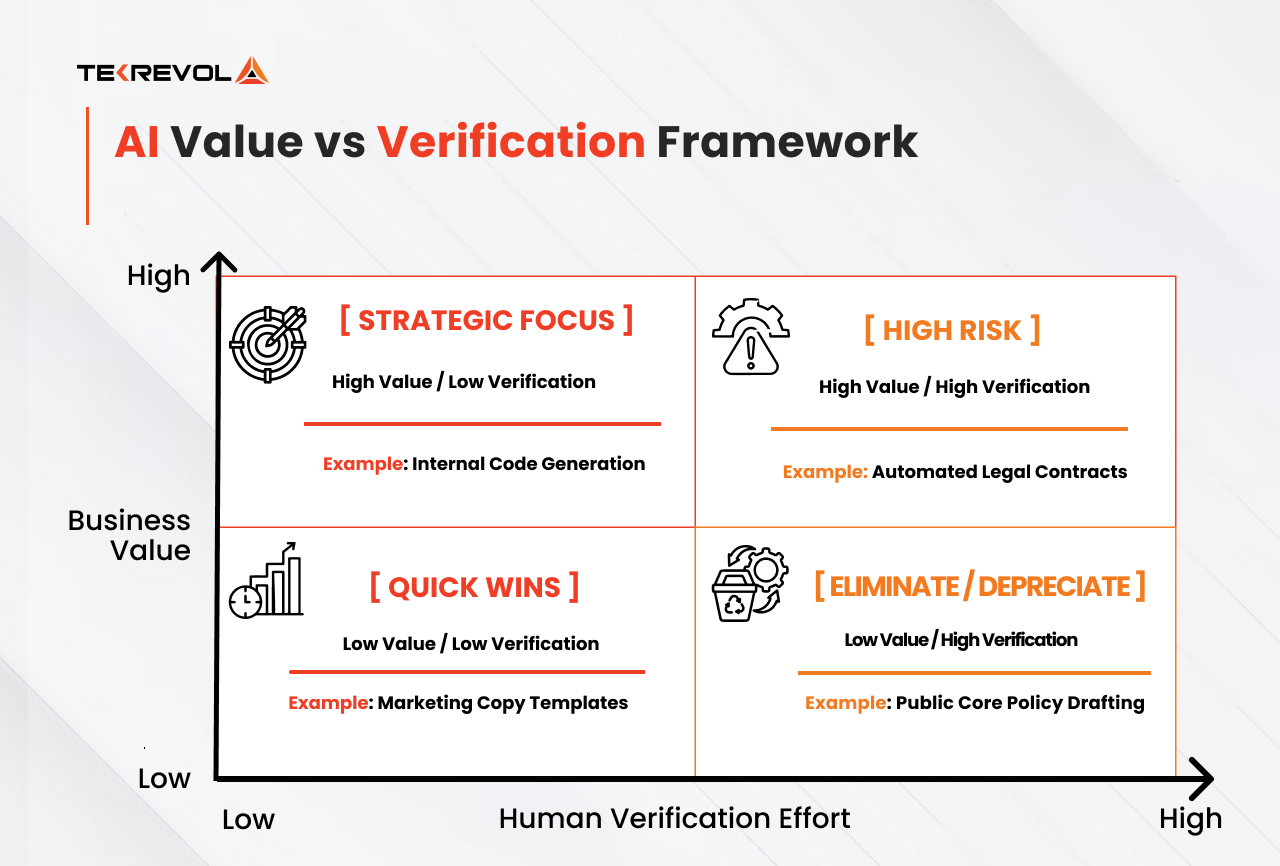
Unlike traditional analytics software, generative systems do not just parse old metrics. Instead, they synthesize new, highly contextual assets including code, text, legal documents, and structured data tables.
The Market Shift: Real Economic Impact
The current shift toward generative tools represents a massive structural change in corporate productivity. Enterprise investments have moved from speculative research budgets to core operational funding.
- Trillion-Dollar Growth: Corporate investments are now directly tied to fundamental profit and loss statements.
- Asset Creation: Growth is driven by automated asset creation, lower development costs, and smarter data accessibility across legacy platforms.
- Operational Scale: Businesses use these models to scale output without linearly increasing their operational headcount.
The Evolution: From Simple Prompts to Autonomous AI Agents
The enterprise landscape is moving rapidly beyond standard text-prompting interfaces. The modern operational standard relies on autonomous AI agents that handle multi-step workflows.
- Beyond Standard Prompts: Modern systems do not wait for line-by-line human direction to execute corporate tasks.
- Proactive Workforce: Systems receive a high-level operational goal, break it down into sequential tasks, call external APIs, and cross-reference internal databases.
- System Integration: These agents securely log into legacy enterprise systems to update records and complete processes independently.
TekRevol built an AI Project Analysis Agent that simulates CEO, CTO, and Project Manager decision-making to eliminate app development bottlenecks. The agent unified planning, risk analysis, and resource allocation into a single automated workflow, reducing project scoping time by 60% and improving estimation accuracy across more than 100 live projects. View the Full Case Study →
10 High-Impact Generative AI for Businesses Use Cases With Provable ROI
Enterprise generative AI use cases deliver maximum financial return when applied to data bottlenecks, high-volume customer touchpoints, and repetitive software development workflows.
| Use Case Category | Core Enterprise Application | Primary Benchmark ROI Metric |
| Customer Service Automation (Klarna) | AI-powered customer support assistant for multilingual customer inquiries and knowledge retrieval | Reduced customer service costs and increased support capacity without proportional hiring |
| Marketing Content Generation (Coca-Cola) | Automated creation of marketing campaigns, ad creatives, and localized content | Lower content production costs and faster campaign deployment |
| Software Development Acceleration (GitHub Copilot) | AI-assisted coding, testing, documentation, and debugging | Faster software release cycles and improved engineering productivity |
| Financial Research & Advisory (Morgan Stanley) | Natural-language search and summarization of investment research and financial documents | Reduced research time and increased advisor productivity |
| Strategic Planning & Market Intelligence | AI-generated growth roadmaps, market intelligence, and predictive risk analysis | Faster strategic decision-making and improved KPI alignment |
| Industrial Maintenance Optimization (Siemens) | Analysis of maintenance logs, technical records, and predictive maintenance planning | Lower downtime and reduced maintenance costs |
| Fraud Detection & Risk Management (Mastercard) | Real-time transaction monitoring and anomaly detection | Reduced fraud-related losses and stronger payment security |
| Drug Discovery & R&D (Insilico Medicine) | AI-driven molecular design and candidate prioritization | Shorter drug development timelines and lower R&D costs |
| Consumer Insights & Market Research (Nestlé) | Analysis of customer feedback, reviews, and market trends | Improved product-market fit and reduced product development risk |
| Talent Acquisition & Recruitment (Unilever) | AI-assisted applicant screening and recruitment workflow automation | Lower hiring costs and shorter recruitment cycles |
Your Highest-ROI Use Case Is Already in This List.
TekRevol has built production AI systems across every category: scoped, secured, and delivering measurable results.
Find My Highest-ROI AI Use Case1. Klarna’s AI Customer Service Assistant
In 2024, Klarna deployed an OpenAI-powered customer service assistant that handled the equivalent workload of hundreds of support agents. The assistant manages customer inquiries across multiple markets and languages while maintaining customer satisfaction levels comparable to human agents.
Key Applications:
- Answers customer questions 24/7 without agent intervention.
- Retrieves information from internal knowledge bases in real time.
- Supports multiple languages across international markets.
Business Impact:
- Faster response times for customers.
- Increased support capacity without proportional hiring.
- Allows human agents to focus on complex issues.
ROI: Reduced customer service costs while significantly increasing support capacity.
2. Coca-Cola’s AI-Generated Marketing Campaigns
Coca-Cola has used generative AI to create marketing content, campaign concepts, and creative assets for global advertising initiatives. The company leverages AI to accelerate content production while maintaining brand consistency across regions.
Key Applications:
- Generates campaign concepts and creative variations.
- Produces localized content for different markets.
- Accelerates content creation for large-scale campaigns.
Business Impact:
- Faster campaign deployment.
- More creative testing opportunities.
- Reduced dependency on lengthy production cycles.
ROI: Lower content production costs and shorter campaign development timelines.
3. GitHub Copilot for Enterprise Software Development
GitHub Copilot is being used by enterprises worldwide to assist developers with coding, documentation, debugging, and test creation. The tool acts as an AI coding assistant directly within development environments.
Key Applications:
- Generates boilerplate code and functions.
- Creates test cases and technical documentation.
- Assists with code reviews and debugging.
Business Impact:
- Reduces repetitive development work.
- Accelerates software delivery.
- Improves developer productivity.
ROI: Faster release cycles and measurable engineering efficiency gains.
4. Morgan Stanley’s AI Financial Advisor Assistant
Morgan Stanley implemented a generative AI assistant that enables financial advisors to search extensive internal research libraries using natural language queries. The system helps advisors quickly access insights from thousands of reports, investment analyses, and market research documents that would otherwise require extensive manual review.
For wealth management firms, speed and accuracy are critical when responding to client inquiries. By integrating generative AI into advisor workflows, Morgan Stanley has made institutional knowledge more accessible across its organization. Instead of spending valuable hours searching for information, advisors can retrieve relevant insights within seconds and focus more on client relationships and strategic planning.
Key Applications:
- Searches investment research instantly.
- Summarizes complex financial documents.
- Retrieves relevant client-facing information.
- Supports faster client decision-making.
Business Impact:
- Reduced manual research time.
- Increased advisor productivity.
- Improved access to institutional knowledge.
ROI: More advisor time devoted to revenue-generating client activities and client engagement.
TekRevol built an AI Strategy Advisor that gives real estate firms hyper-personalized growth roadmaps, real-time market intelligence, and predictive risk analysis on demand. By automating strategic planning, the agent eliminates decision delays, uncovers new opportunities, and aligns teams around data-driven KPIs. View the Full Case Study →
5. Siemens’ AI-Powered Industrial Maintenance
Siemens uses AI technologies to analyze maintenance logs, operational reports, and technical documentation to improve industrial maintenance processes. The system helps maintenance teams identify recurring equipment issues and uncover insights hidden within large volumes of operational data.
Industrial facilities generate enormous amounts of unstructured information every day, much of which remains underutilized. Generative AI helps transform maintenance records and technician notes into actionable intelligence, allowing teams to predict issues earlier and optimize maintenance schedules before costly breakdowns occur.
Key Applications:
- Reviews equipment maintenance records.
- Identifies recurring failure patterns.
- Summarizes technical documentation.
- Supports predictive maintenance planning.
Business Impact:
- Earlier detection of equipment issues.
- Improved maintenance planning.
- Reduced operational disruptions.
ROI: Lower downtime, reduced maintenance costs, and improved equipment utilization.
6. Mastercard’s AI Fraud Detection Systems
Mastercard uses AI-powered technologies to monitor transaction activity and identify suspicious patterns across its global payment network. The company processes billions of transactions annually, making AI essential for detecting anomalies that would be impossible to identify manually.
Modern fraud schemes evolve rapidly, requiring financial institutions to adapt in real time. Generative AI enhances fraud detection by analyzing transaction context, identifying unusual behaviors, and helping investigators understand potential risks more efficiently. This allows security teams to respond faster while maintaining a seamless customer experience.
Key Applications:
- Detects unusual transaction behavior.
- Supports fraud investigation teams.
- Monitors large transaction volumes in real time.
- Flags suspicious activities for review.
Business Impact:
- Faster fraud identification.
- Reduced financial losses.
- Improved payment security.
ROI: Lower fraud-related costs and stronger protection for customers and financial institutions.
7. Insilico Medicine’s AI-Driven Drug Discovery
Insilico Medicine has become one of the most recognized examples of generative AI in pharmaceutical research. The company uses AI to identify potential drug candidates, design molecular structures, and accelerate early-stage discovery processes that traditionally take years to complete.
Drug discovery has historically been expensive, slow, and highly uncertain. Generative AI enables researchers to evaluate significantly more molecular possibilities than conventional approaches, helping teams prioritize promising candidates faster. This allows pharmaceutical companies to reduce development timelines and allocate research resources more effectively.
Key Applications:
- Generates novel molecular structures.
- Evaluates potential drug compounds.
- Prioritizes candidates for testing.
- Accelerates early-stage research.
Business Impact:
- Faster research workflows.
- Expanded candidate discovery.
- Improved research efficiency.
ROI: Shorter drug development timelines and lower R&D costs.
8. Nestlé’s AI Consumer Insight Analysis
Nestlé uses AI technologies to analyze consumer feedback, online reviews, social media conversations, and market trends. The company leverages these insights to better understand changing consumer preferences and identify opportunities for product innovation.
Consumer behavior can shift rapidly, making traditional market research methods too slow for many business decisions. Generative AI allows Nestlé to process vast amounts of customer feedback at scale, uncovering patterns and trends that help product teams make more informed decisions about product development and marketing strategies.
Key Applications:
- Monitors social and consumer sentiment.
- Identifies product improvement opportunities.
- Detects emerging market trends.
- Analyzes customer feedback at scale.
Business Impact:
- Better-informed product decisions.
- Faster response to consumer demand.
- Reduced development risk.
ROI: Improved product-market alignment and stronger innovation outcomes.
9. Unilever’s AI-Powered Recruitment Process
Unilever has incorporated AI into parts of its recruitment workflow to streamline candidate screening and improve hiring efficiency. The company receives large volumes of applications annually, making automation valuable for managing recruitment at scale.
Recruiters often spend significant time reviewing applications and performing repetitive administrative tasks. AI helps automate portions of the hiring process, allowing talent acquisition teams to focus on engaging qualified candidates and making strategic hiring decisions. This approach improves both efficiency and candidate experience.
Key Applications:
- Assists with applicant screening.
- Supports candidate assessment processes.
- Streamlines recruitment workflows.
- Reduces administrative workload.
Business Impact:
- Faster hiring decisions.
- Improved recruiter productivity.
- Enhanced candidate management.
ROI: Lower hiring costs and shorter recruitment cycles.
10. Allen & Overy’s Contract Review With Harvey AI
Global law firm Allen & Overy adopted Harvey AI to support legal professionals with contract review, legal research, document analysis, and drafting assistance. The implementation is one of the most widely cited examples of generative AI adoption in the legal sector.
Legal teams spend substantial time reviewing contracts and searching through extensive documentation. By incorporating generative AI into routine legal workflows, the firm enables lawyers to complete repetitive tasks more efficiently while maintaining human oversight for complex legal judgments. This allows legal professionals to focus on higher-value advisory work.
Key Applications:
- Reviews contracts and legal documents.
- Summarizes lengthy agreements.
- Assists with legal research tasks.
- Supports document drafting.
Business Impact:
- Faster legal workflows.
- Reduced time spent on repetitive tasks.
- Increased operational efficiency.
ROI: Shorter contract review cycles, reduced administrative workload, and improved lawyer productivity.
Measuring Real ROI and Proving Business Value
An investment in generative AI is a cost unless you can prove it is paying for itself. To get buy-in from leadership, you must move past technical jargon and focus on the business KPIs that matter to the C-suite.
- Data-Backed Proof: The goal is to draw a data-backed line from your AI project to cost savings, productivity boosts, or new revenue.
- The Bottom Line: Success is measured in dollars saved and hours your team gets back.
- Baseline Frameworks: The key is to establish a clear, quantitative baseline before you deploy anything because without a “before” picture, you cannot measure the “after.”
Establishing Your Baseline for Success
Before you start a project, you need to define what success looks like in operational terms. This baseline is your control group, the fixed point you’ll measure against to see if your generative AI solution is making a difference.
- Pain Point Integration: Think back to the specific, measurable pain points you found during your discovery phase. What are the numbers that define that problem today?
- Customer Service Baselines: What is the average time a customer waits for a response (e.g., 4 minutes and 30 seconds based on Q1 data)? What percentage of issues are resolved on the first contact (e.g., 78% based on Q1 data)?
- Manufacturing Baselines: What was your scrap rate last quarter (e.g., 5.2% in Q1)? How many machine-hours were lost to unexpected downtime last month (e.g., 22 hours in March)?
- Logistics Baselines: How many team hours are spent each week manually sorting emails (e.g., 150 hours based on a 4-week average)? What is the average cost of a misrouted shipment (e.g., $450 per incident in Q1)?
Getting these baseline metrics is non-negotiable. They are the bedrock of a credible business case and the only way to show a clear, quantifiable return on investment.
No AI ROI Without a Baseline. We'll Help You Create It.
TekRevol defines KPIs before development begins, ensuring clear, measurable AI outcomes after launch.
Get My AI ROI Baseline SessionThe Enterprise Strategy: How to Select and Scale Your GenAI Use Cases
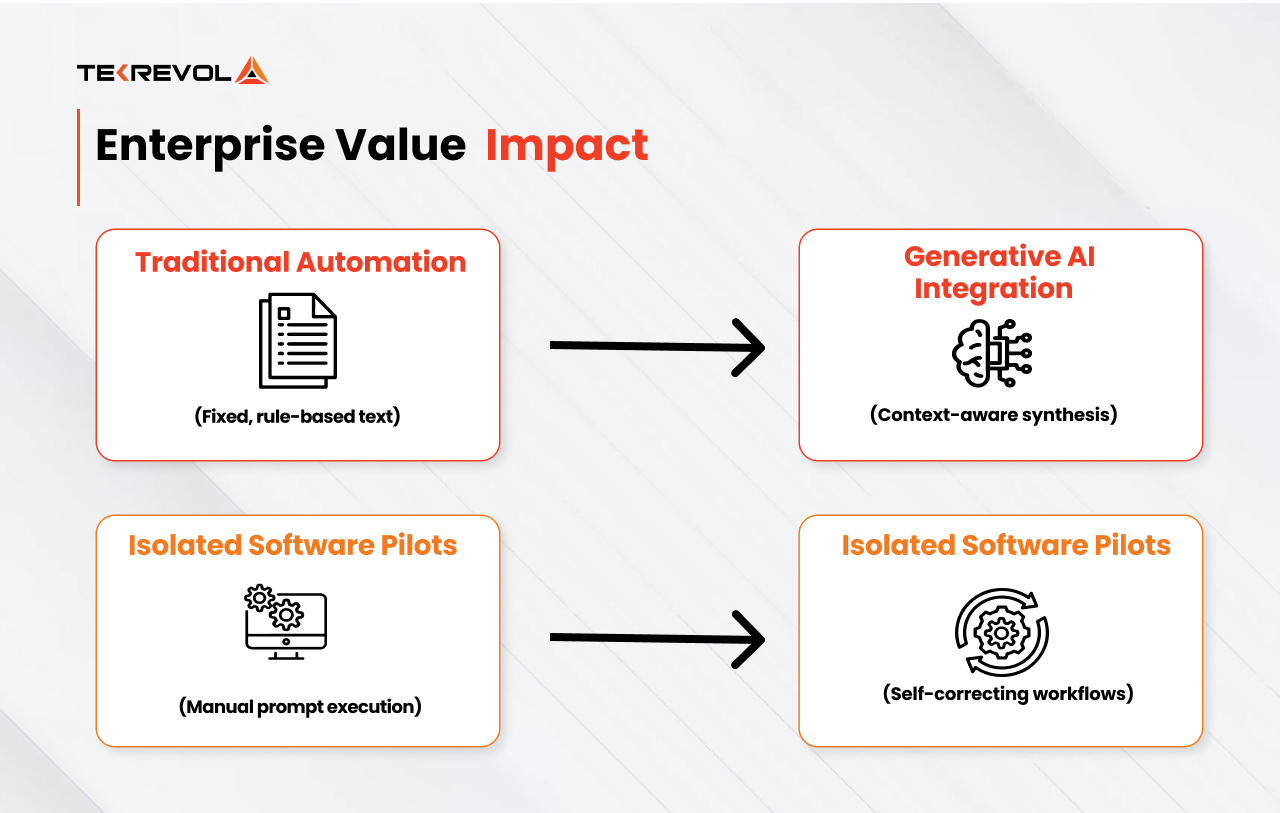
Enterprises must select generative AI use cases by balancing the operational value of an automated output against the human verification effort needed to ensure its accuracy.
The Artifact Validation Framework: Balancing Value and Verification
Before spending capital on development, leadership needs a clear framework to measure process efficiency. You must balance the speed of generation against the time required for a human expert to verify the results.
- Quadrant Framework: To build a sustainable strategy, leaders should evaluate processes using a simple quadrant framework.
- Key Metrics: Rank target workflows by two clear metrics: the business value of the completed task and the time required for an expert to verify the AI’s work.
- The Sweet Spot: Target high-value, low-verification tasks first. If an AI engine generates software code, automated software testing suites can verify its functionality in seconds.
- What to Avoid: Move high-risk tasks that require meticulous, line-by-line human review—such as drafting binding customer contracts—down your priority list.
Fine-Tuning vs. Foundation Models: What Does Your Enterprise Need?
Selecting your model architecture depends on your data privacy mandates and industry specificity. Off-the-shelf foundation models work well for general knowledge tasks with API integration services but fail at specialized corporate operations.
- Technical Selection: Choosing the right technical path depends entirely on your data privacy demands and industry specificity.
- Public APIs: Third-party cloud models accessible via standard APIs work perfectly for generic copywriting and basic data summaries.
- Private Cloud Deployments: If your workflows require deep knowledge of proprietary product code, unique customer history, or confidential financial metrics, you need specialized AI development services.
- Data Control: Engineers take an open-source model and fine-tune it within a secure cloud environment using your own corporate data. This approach keeps your data private while delivering highly accurate, tailored results.
Mitigating the Risks of Enterprise Generative AI
Enterprises mitigate generative AI risks by installing real-time output validation layers, setting up strict data privacy firewalls, and using advanced validation models.
Hallucinations, Bias, and Toxicity Control
A major roadblock to deploying business applications of generative AI is the tendency of large models to state inaccurate information with absolute confidence. To fix this, engineering teams implement strict architectural guardrails.
- Retrieval-Augmented Generation (RAG): To fix accuracy issues, engineering teams implement RAG architectures.
- Closed Index Searching: RAG restricts the AI’s search area to a verified, closed index of your secure corporate documents.
- Preventing Inventions: If the answer does not exist in the approved files, the system states that it cannot find the information, preventing it from inventing facts.
- Validation Filters: Running automated validation filters catches biased or toxic language before an asset ever goes live.
Data Leakage and Intellectual Property Guardrails
When employees paste sensitive corporate data into public consumer AI tools, that information can be stored and used to train future public models. This creates a massive corporate security risk.
- Data Boundary Implementation: Enterprises prevent data leakage by establishing strict data boundaries through enterprise-grade generative AI development agreements.
- Secure Routing: All corporate data routes through secure APIs that explicitly prohibit data retention or vendor training.
- Ownership Maintenance: This ensures your proprietary insights, codebases, and customer files remain entirely yours and are never exposed to the public.
TekRevol built TruthGPT to combat the core risk enterprise AI teams fear most: confident, inaccurate output. The app delivers verified, unbiased information through an advanced chatbot interface, with blockchain integration ensuring full data transparency and tamper-proof content records. View the Full Case Study →
How TekRevol Helps Your Business Scale With Generative AI
Implementing high-return AI solutions for businesses requires a development partner who understands legacy enterprise software, data compliance, and modern machine learning architectures.
TekRevol builds tailored AI applications designed to integrate smoothly with your existing systems, eliminate operational bottlenecks, and drive measurable revenue growth.
- Outcome-Driven Approach: We focus entirely on your business outcomes. Our teams audit your current workflows, find your highest-return automation opportunities, and deploy secure, scalable AI tools that keep you ahead of the competition.
- Tailored Infrastructure: We build customized generative AI development models that respect your corporate data boundaries while maxing out operational speed.
- End-to-End Execution: From initial data structuring to final private cloud integration, we manage the entire lifecycle of your custom corporate applications.
- Let’s Connect: Ready to transform your corporate data into a powerful competitive advantage? Contact TekRevol today to plan your enterprise AI roadmap.
Ready to Unlock Real ROI With Generative AI?
TekRevol builds secure, scalable, and custom AI applications designed to drive immediate business revenue
Contact TekRevol and Start Your Enterprise AI Project