Rapid application development (RAD) is a way of building software through repeated working prototypes and user feedback, instead of one long plan-first build. The RAD model fits systems that need to become usable quickly and can change as users react to them.
This guide explains how the rapid application development model works, walks through an example, and gives a test for when it fits a custom software development project.
What is RAD in software development?
Rapid application development (RAD) is a software development approach that builds a working system through short cycles of prototyping, user feedback, and revision. The RAD model is a process rather than a tool.
The aim is a workable information system in a short time, with users shaping it along the way. In TekRevol’s reading, the defining trait is that users test something real in every cycle.
Where RAD came from
RAD grew in the 1980s as a reaction to plan-driven methods, and James Martin, working at IBM, formalized his version in a 1991 book. Wikipedia describes the approach as a response to methods that defined everything before building anything. James Kerr and Richard Hunter’s 1993 book Inside RAD later popularized it, and Wikipedia links its peak to business process re-engineering, when prototypes helped users rethink how work was done.
Barry Boehm’s 1988 paper in IEEE Computer published the spiral model, which Wikipedia names as an early alternative that also leaned on prototypes.
The phases of the RAD model
Martin’s version has four phases: requirements planning, user design, construction, and cutover. The table shows what happens in each phase and what users see.
| Phase | What happens | What users see |
| 1. Requirements planning | Users and analysts agree the problem, the key features, the limits and who approves the work | An agreed scope |
| 2. User design | Users and analysts build and test prototypes together | A clickable prototype |
| 3. Construction | Developers build and integrate the system, often from reusable components, while users keep suggesting changes | Working modules |
| 4. Cutover | The team converts data, tests the system, trains users and goes live | The live system |
Some sources, including IBM, list a fifth phase called testing and feedback. In TekRevol’s reading, it is the same work, because testing runs through user design and construction instead of waiting for the end. That is why you will see both four-phase and five-phase versions of the RAD phases.
RAD diagram: how one cycle runs
In the diagram, user design and construction repeat in a loop, and the loop ends when users accept the system. Requirements planning happens once at the start, and cutover happens once at the end.
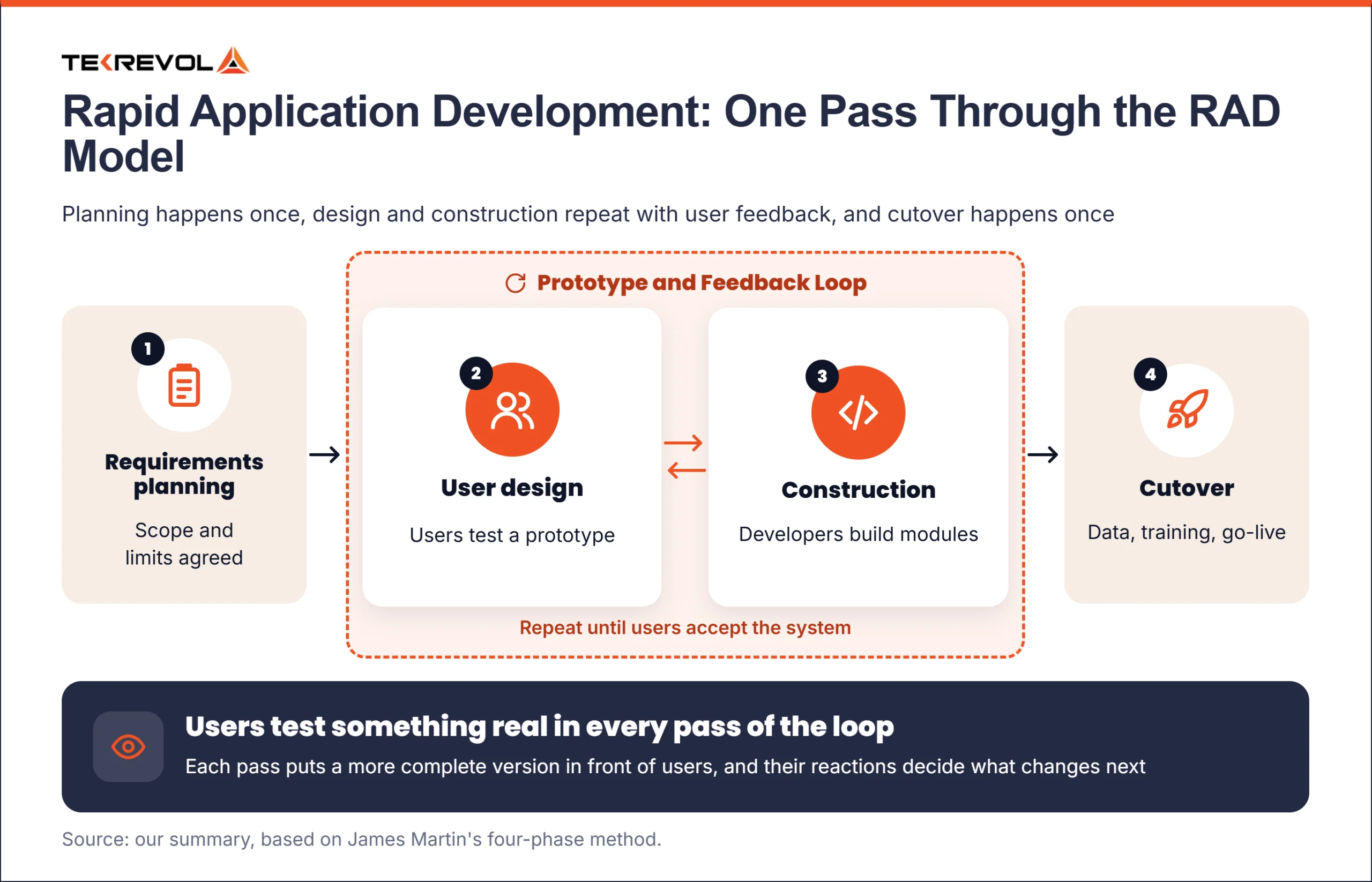
Each pass through the prototype loop puts a more complete version in front of users. Their reactions decide what the next pass changes, so the plan stays flexible. In TekRevol’s reading, the loop is also where the speed comes from: a wrong idea dies in a prototype.
A RAD team typically stays small to medium in size and relies on committed users, and Wikipedia lists those two conditions as where RAD works well.
A RAD example: an expense approval tool
Each cycle in this example puts something new in front of users and changes the next cycle. The example is TekRevol’s illustration: a finance team needs an internal tool to approve employee expense claims.
| Cycle | What users see | What they say | What changes |
| 1 | A clickable mockup of the claim form | Managers want to approve from their phone | The design adds a mobile approval screen |
| 2 | A working form with one approval path | Staff want to attach receipt photos | Construction adds file upload |
| 3 | A reporting view for finance | Finance needs claims grouped by department | The report is regrouped |
| 4 | The full system with test data | Staff are ready, but old claims need importing | Cutover adds data conversion and training |
The receipt upload surfaced in a working form. That is the point of the method. A real project may run more cycles or fewer.
Advantages of RAD
The main advantage of RAD is that users correct the product while it is still cheap to change. These are the benefits most often cited. In TekRevol’s reading, published pages rarely back them with measurements:
- Faster feedback. Users react to early prototypes.
- Early risk discovery. Wrong assumptions surface in prototypes.
- Better usability. Real users shape the interface.
- Visible progress. Each cycle shows working results.
- Easier change. Short cycles absorb new requirements.
Disadvantages of RAD and how to fix them
The main disadvantage of RAD is that it depends on users who have time to give feedback. Sources also warn about thin documentation and scope creep. The fixes below are TekRevol’s judgment.
- Heavy demand on users. Busy stakeholders slow every cycle. Name one product owner and agree on fixed feedback hours before the prototype.
- Prototype code reaching production. A quick prototype can become the real system by accident. Decide in advance which prototype code will be thrown away.
- Scope creep. Each demo invites new requests. Timebox every cycle and keep a visible change list.
- Thin documentation and weak architecture. Speed can skip both, which hurts maintenance and scaling. Write short architecture notes before construction and document the system at cutover.
Challenges of RAD software development
The biggest challenge in rapid development methodology is keeping expectations realistic, because a polished prototype can look finished long before the system is ready. The challenges below come up when a team runs the method, and the fixes are TekRevol’s judgment.
- Expectations set by prototypes. Users may read a good-looking prototype as nearly done. Label what each prototype is, and show what is still to be built, such as data, integrations, and security.
- Security and compliance. Wikipedia notes that RAD pays little attention to non-functional requirements such as security and portability. List them in requirements planning and test them in every cycle.
- RAD suits small to medium systems, and very large ones strain it. Set the architecture first, then run the RAD loop inside each module.
- Skills and the big picture. The team needs people fluent in the chosen tools, and short cycles can hide the view of the whole system. Keep one architect who owns the overall design.
RAD vs Agile, Scrum and Waterfall
Rapid development optimizes for fast, user-validated delivery. Agile sets a broader set of values, and Scrum adds a fixed cadence of sprints. Waterfall sits at the other end, with requirements and design fixed before the build, and the table is TekRevol’s reading of the four approaches.
| Aspect | RAD | Agile and Scrum | Waterfall |
| What it optimizes for | Fast, user-validated delivery | Steady delivery of value on a fixed cadence | A predictable plan |
| User involvement | Throughout the prototype loop | Throughout, through a product owner | Mostly at the start and at acceptance |
| Cycle | Prototype and feedback loop | Fixed-length sprints | One pass through the phases |
| Documentation | Light until cutover | Light but ongoing | Heavy and signed off |
| Best fit | Interface-heavy systems with engaged users | Products that keep evolving | Stable scope and a fixed contract |
In RAD vs agile, both reject a long plan-first build, and many teams combine them by running RAD-style prototyping inside agile sprints. RAD vs Scrum comes down to cadence: Scrum fixes the sprint length, and RAD fixes only the loop between prototype and feedback. Our guide to SDLC models covers them in depth.
The spiral model is the closest relative. In TekRevol’s reading, it picks its next step by the biggest open risk, and RAD picks it by what users say about the last prototype.
When to use RAD
Use the rapid application development model when users can give regular feedback and the work splits into small modules. The TekRevol RAD Fit Check turns that into five questions. The check is TekRevol’s judgment.
| Question | Points toward RAD | Points away from RAD |
| Can users give regular feedback? | Yes, a named user group has set hours | No, users are scarce or hard to reach |
| Is the system driven by its interface? | Yes, such as forms and workflows | No, the hard part is deep back-end logic |
| Can the work split into modules? | Yes, each module can be built and shown alone | No, the parts depend on each other |
| How costly is a failure? | Low, and easy to fix after release | High, such as a safety or compliance risk |
| How large are the system and the team? | Small to medium | Large, with many teams |
Four or five answers in the middle column point to RAD, and four or five in the last column point to a more planned approach. Anything in between suggests a hybrid, such as a prototype loop first and a planned build after.
Wondering if your project suits a prototype-first build?
If your users can react to working software every cycle, a prototype-first build can save you from building the wrong thing. Bring your project and your user group to a conversation, and we will help you decide whether it fits.
TekRevol is a software development company that builds this way within its development process. It validates the idea with an MVP before the main build, then builds in two-week agile sprints with a working software demo at the end of each iteration.
Choose the model after you test the fit, not before. Start with a 30-minute Free Consultation.