Microservices security is the set of controls that protect each service and the traffic between services, along with the data and credentials the services use. A single request crosses many network hops in this style of system, so each hop needs its own control. Every control also has a limit, and this guide names the limit for each one.
This guide follows one request through five hops and names the main control and the main gap at each. The gaps come from primary sources, and the map that organizes them is TekRevol’s judgment.
What is microservice security?
Securing a microservices system means protecting each service and the calls between them, together with the credentials and delivery pipeline behind them. NIST SP 800-204, published in August 2019, lists the supporting features, from access control and secure communication to security monitoring, and analyzes configuration options for architectural frameworks such as API gateways and service mesh. TekRevol’s guide to microservices architecture explains the style itself, and this article covers only security for microservices.
Why is security in microservices architecture harder?
Microservices make security harder because one request crosses many network hops, and each hop needs its own check. A monolith keeps most calls inside one process, which leaves one boundary to defend, and TekRevol’s comparison of monoliths and microservices covers the other trade-offs. Each service adds an endpoint, and each internal call becomes traffic that needs authentication and encryption.
Vendor pages from Tigera and CrowdStrike describe each service as another entry point. Neither measures it, so this guide gives no figure for it. The security challenges in microservices therefore come down to coverage: a team must put the right control on every hop and know what that control leaves open.
How to secure microservices: the TekRevol Control Gap Map
To secure microservices, put one control on each hop of the request path and name the gap that control leaves. The TekRevol Control Gap Map does this for five hops. This is TekRevol’s judgment. The gaps in the table come from the OWASP Microservices Security Cheat Sheet, NIST SP 800-204C, and from the Kubernetes documentation. Teams can reuse the five rows as the security section of the architecture brief for any custom software project.
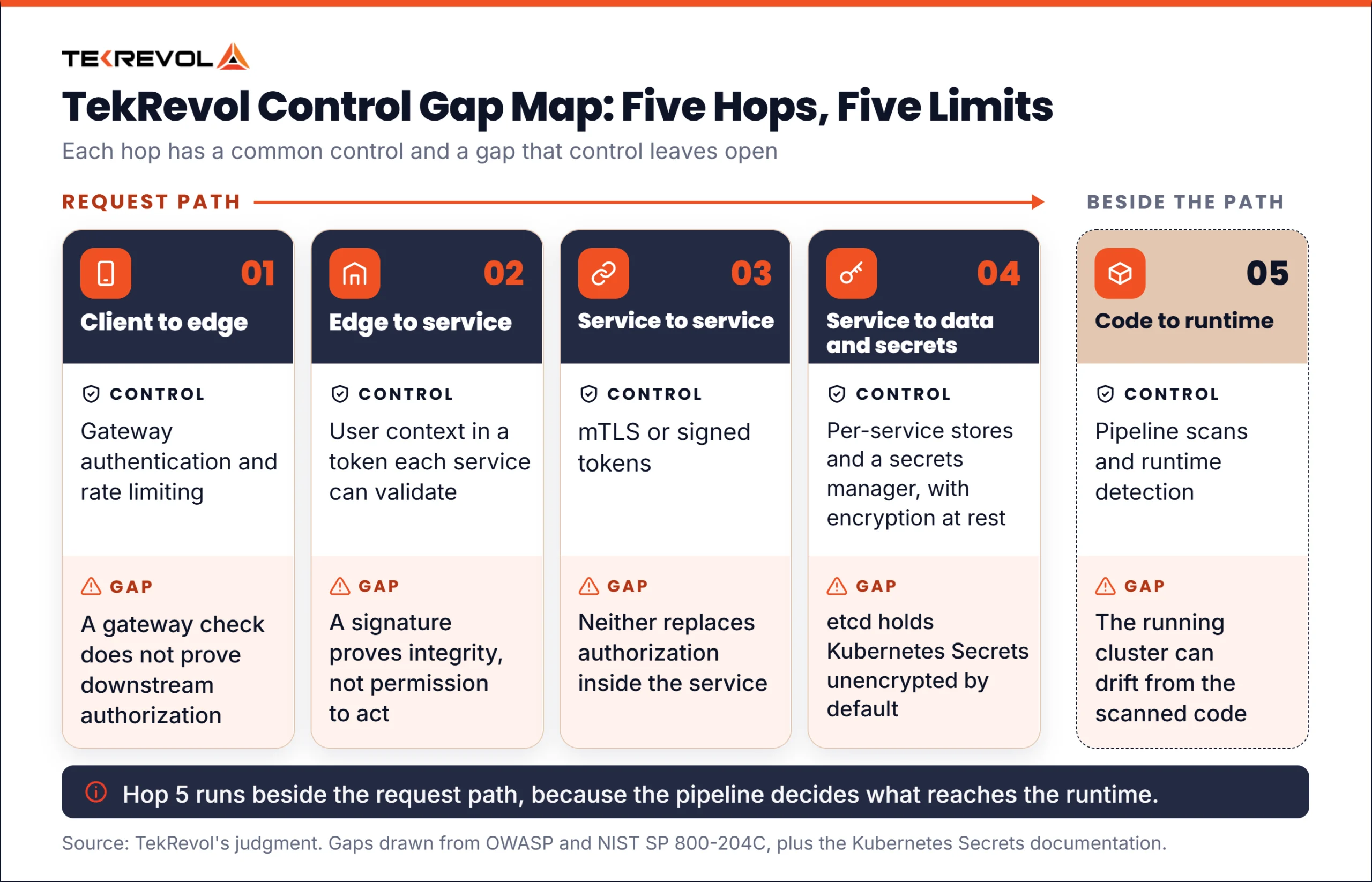
| Hop | Common control | What it proves | Where it stops |
| Client to edge | API gateway authentication and rate limiting | The caller authenticates before the request reaches a service | A gateway check does not prove the downstream operation has permission (OWASP) |
| Edge to service | User context passed as a token each service can validate | The service can see who the end user is | A signature proves integrity only (OWASP) |
| Service to service | Mutual TLS (mTLS) or signed tokens | The calling service is who it claims to be | Neither replaces authorization inside the receiving service (OWASP) |
| Service to data and secrets | Per-service data stores and a secrets manager, with encryption at rest | Each service reads and writes only its own data and credentials | etcd holds Kubernetes Secrets unencrypted by default, and list or watch access reads every Secret in a namespace (Kubernetes docs) |
| Code to runtime | CI/CD scanning and runtime detection | Tests ran on the code before release | The running cluster can drift from the scanned code. NIST SP 800-204C says assurance holds only if the architecture defined in infrastructure as code matches the deployed environment, and it calls for a drift management process. |
The first three hops share one theme. Authentication tells a service who is calling, and authorization decides what the caller may do. The next two sections cover authentication and authorization patterns, then service-to-service communication.
Microservices security patterns for authentication and authorization
Authenticate the caller at the edge, and authorize each sensitive action inside the service that owns the data. This is the core pattern for microservices authentication and authorization in the OWASP cheat sheet. Gateways should reject unauthorized incoming requests and block direct access that skips the gateway. Checks that need resource or business context, such as which tenant owns an object, belong inside the service. Every service should also enforce access to its protected operations on internal calls.
Identity travels with the request. OWASP advises passing authenticated user context in a form each receiving service can validate, and authenticating the calling service separately. Tigera and JFrog both name OAuth 2.0 and OpenID Connect, with JSON Web Tokens (JWTs) as the token format. TekRevol’s microservices best practices guide covers where these checks sit in its adoption order.
How a service validates a token changes what it can see.
| Validation | How it works | What it can see | Where it stops |
| Online introspection | The service asks the token issuer whether the token is valid | Revocation, within the cache lifetime | Revocation needs and token expiry set the cache lifetime |
| Local validation | The service checks the signature and token profile itself | Integrity and expiry | Cannot see revocation before expiry without extra mechanisms |
If validation cannot finish, the service rejects the request, according to OWASP. Short token lifetimes shrink the revocation window. This is TekRevol’s judgment.
How do you secure communication between microservices?
Encrypt the traffic and prove identity at both ends, then handle authorization as a separate step. Security between microservices has two established approaches in the OWASP cheat sheet: mTLS and tokens. With mTLS, each service holds a key pair and authenticates to its peers, which gives caller identity plus confidentiality and integrity.
A service mesh packages mTLS and policy enforcement outside the application code, and NIST SP 800-204A gives deployment guidance for security services on a mesh. Tigera names Istio and Linkerd as meshes that can automate mTLS. In TekRevol’s judgment, a mesh pays off when many services need the same mTLS and policy settings, and a team with a handful of services can often start with library-level TLS and tokens.
| Approach | What it proves | Main burden | Where it stops |
| mTLS | The caller’s identity, with confidentiality and integrity | Key provisioning and trust bootstrap, plus revocation and rotation | Does not say what the caller may do |
| Signed tokens | The caller’s identity and scopes | Choosing online or local validation | Local checks cannot see revocation before expiry |
| Service mesh | mTLS and policy outside application code | Running and operating the mesh | Does not replace the service’s own authorization rules (TekRevol’s reading of OWASP) |
Microservices API security: what the gateway should handle
An API gateway is the single entry point where authentication and rate limiting happen, and it must never be the only check. Tigera places authentication and rate limiting at the gateway, and CrowdStrike places both on API servers.
CrowdStrike ties rate limiting to brute-force and denial-of-service attempts. Solo.io routes traffic through a gateway for token-based authentication. OWASP sets two limits: block direct access that skips the gateway, and keep fine-grained checks in the service. OWASP says neither a gateway check nor a signature replaces service-level authorization.
In TekRevol’s judgment, business rules stay in the services, because a gateway that holds them becomes one more shared component to defend.
How do you protect secrets, containers and the pipeline?
Keep secrets out of code and images and encrypt them at rest, then limit who can read them and test what you ship. The Kubernetes documentation says etcd holds Secrets unencrypted by default, and base64 encoding obscures a value without protecting it. Its minimum steps start with encryption at rest and least-privilege role-based access control (RBAC). They continue with restricting Secret access to specific containers and considering an external secret store. Granting list or watch lets a subject read every Secret in the namespace, and a privileged container can read every Secret used on its node. Tigera names HashiCorp Vault and AWS Secrets Manager as secrets managers.
NIST SP 800-204C, published in March 2022, treats five kinds of code, from application code to observability as code, as separate pipelines. It recommends a pull-based GitOps model so cluster credentials stay inside the cluster. It also recommends security testing (SAST, DAST, IAST and SCA) and container image scanning, and it describes runtime threat detection. On drift, it says assurance holds only if the architecture defined in infrastructure as code matches the deployed environment, and it calls for a drift management process. That explains the last row of the Map.
What should you log and monitor?
Start by logging every authentication decision and every cross-service call, each with a correlation ID, and send the logs to one central place. That starting point is TekRevol’s judgment. The pattern comes from OWASP: services write to standard output or local files, an agent forwards the logs through a message broker, and a central service processes them. OWASP recommends mutual TLS and access control on the broker. It also recommends buffering and structured formats, and it says to remove secrets before logging. OWASP warns that a broker alone does not prevent log loss or denial of service.
What do OWASP and NIST say about securing a microservices system?
OWASP covers authentication and authorization patterns. The NIST SP 800-204 series covers strategies and service mesh deployment, then access control and DevSecOps. The series descriptions come from the abstracts and from NIST’s own summary in SP 800-204C.
| Source | What it covers | Use it for |
| OWASP Microservices Security Cheat Sheet | Edge and service-level authorization and identity propagation, plus mTLS and token patterns and logging | Designing authentication and authorization |
| NIST SP 800-204 (August 2019) | Supporting features and their implementation options in gateways and meshes, plus strategies against microservice-specific threats | Choosing and configuring a gateway or mesh |
| NIST SP 800-204A and 800-204B | Deploying security services on a service mesh, and attribute-based access control on a mesh | Mesh-based enforcement |
| NIST SP 800-204C (March 2022) | DevSecOps pipelines for a microservices application with a service mesh, including GitOps and drift | Pipeline design |
Where should you start?
Start with authorization inside each service, then service-to-service identity, then secrets, then central logging. This order is TekRevol’s judgment: it ranks the four moves by how much damage the matching gap allows.
- Authorize inside each service. A gateway check alone leaves every internal call open (OWASP).
- Give each service an identity. Use mTLS or tokens so a service can tell its callers apart.
- Lock down secrets. Turn on encryption at rest and restrict read access.
- Centralize logs. Add correlation IDs so you can trace one request across services.
Pipeline scanning and a service mesh come next.
Securing microservices on a real project
A secure microservices system starts with the Control Gap Map in the architecture brief, before any team builds a service. As a software development company, TekRevol understands cloud security work, including identity and access control and vulnerability scans, alongside containerized microservices. If you are planning or hardening a microservices system, bring your answers for each hop to a conversation with our team. Start with a Free Consultation.