- Look for baseline rankings, realistic timelines, and no-guarantee language when evaluating any app store optimization company.
- The best ASO agencies score high on transparency, methodology, and verifiable portfolio claims, not just pitch quality.
- Guaranteed rankings, bought reviews, and generic keyword templates are immediate walk-away signals during any evaluation.
- Pricing runs from $150–$350/month for basic retainers up to $10,000+/month for full multi-app agency management.
- A solid contract always includes reporting cadence, asset ownership, and clear cancellation terms in writing.
- TekRevol runs audit-first ASO engagements with real, checkable client outcomes across fitness, education, and retail apps.
Every ASO agency’s homepage says the same thing: “We’ll get you to the top of the App Store.” Almost none of them can actually promise that, because no outside company controls Apple’s or Google’s algorithm. Both platforms change their ranking signals without notice, and any agency claiming otherwise is telling you something important before you’ve spent a dollar.
Most founders vet an app store optimization company the way they’d vet any vendor. Check the portfolio, ask for a price, and sign. That approach misses the specific ways this industry gets gamed: fabricated case studies, review manipulation that risks your app getting suspended, and contracts with no real accountability built in. By the time the damage shows up, you’re locked into a retainer and down a few months of runway.
This guide covers what a legitimate app store optimization company actually does, how to score one against another, pricing models and their hidden risks, and the red flags that should end a conversation immediately. By the end, you’ll have a real framework instead of a gut feeling, and a way to compare two competing proposals side by side instead of picking the one with the nicer slide deck.
What Does an App Store Optimization Company Actually Do?
An app store optimization company improves an app’s visibility and conversion rate inside the Apple App Store and Google Play through keyword research, metadata optimization, visual asset testing, ratings management, and ongoing performance tracking.
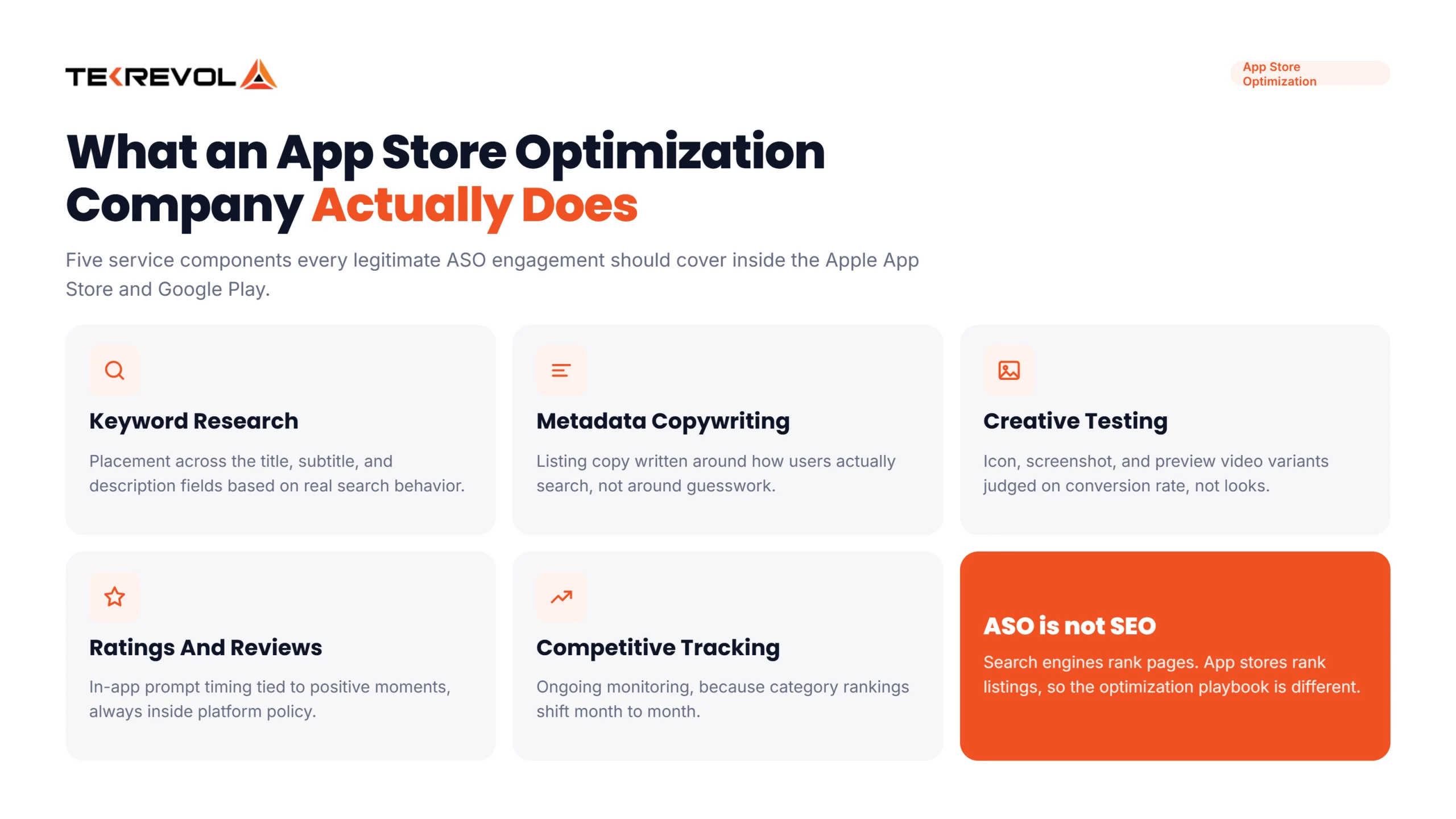
Unlike traditional SEO, which focuses on search engines, ASO focuses on app stores. Understanding ASO vs SEO helps clarify why app listings need a different optimization strategy.
The core service components most agencies should cover:
- Keyword research and placement across the title, subtitle, and description fields
- Metadata copywriting built around real search behavior, not guesswork
- Icon, screenshot, and preview video testing tied to conversion rate, not just looks
- Ratings and review strategy, including in-app prompt timing
- Ongoing competitive tracking, since rankings shift month to month
Not Sure If Your Current ASO Setup Is Actually Working?
Get a free audit showing exactly where your keywords rank today and what's holding your conversion rate back.
Get My Free ASO AuditHow Do You Score an App Store Optimization Company Before Hiring One?
Score a prospective app store optimization company across five categories: transparency, methodology, portfolio verification, reporting structure, and contract terms, using a simple point system. This turns comparing two or three agencies into an objective exercise instead of a gut call.
| Category | What to check | Points (0–2 each) |
| Transparency | Do they show current baseline rankings before proposing work? | 2 = Yes, 1 = Partial, 0 = No |
| Methodology | Can they explain their keyword research process in plain language? | 2 = Clear, 1 = Somewhat clear, 0 = Vague |
| Portfolio proof | Can their claims actually be verified? | 2 = Fully verifiable, 1 = Limited proof, 0 = No proof |
| Reporting | Is a reporting cadence defined in writing? | 2 = Clearly defined, 1 = Partially defined, 0 = Not defined |
| Contract terms | Do cancellation and no-guarantee clauses exist? | 2 = Both included, 1 = One included, 0 = Neither included |
A score of 8–10 signals a strong candidate. 5–7 means ask follow-up questions before committing to anything. Below 5 means the risk is real enough to keep looking elsewhere.
What Interview Questions Should You Ask an ASO Company?
Ask an app store optimization company to walk through their keyword research method, show a redacted client report, explain their review-prompt strategy, and describe exactly what happens if rankings don’t move. Their answers reveal far more than any pitch deck ever will.
Five questions worth asking directly:
- “How do you build a keyword list for a new client?” A good answer mentions autocomplete data, competitor analysis, and search volume research. A bad answer is “we have a proprietary database” with nothing further offered.
- “Can I see a redacted example report?” A good agency shares one immediately. A bad one hesitates or claims reports are “custom every time” as a dodge.
- “What’s your review and rating strategy?” A good answer describes in-app prompt timing tied to positive moments. A bad answer mentions review “boosting” services in any form.
- “What happens if my rankings don’t improve in 90 days?” A good answer explains their iteration process with realistic timelines. A bad one offers vague reassurance with no specifics attached.
- “Do you work with competitors in my exact category?” A good agency is upfront about conflicts and how they’re managed. A bad one dismisses the question entirely.
What Pricing Models Do ASO Companies Use, and What’s the Risk in Each?
ASO companies typically price through hourly or project-based work, flat monthly retainers, or performance-based revenue share. Each model carries a different incentive risk, and knowing which one you’re being offered changes what to watch for.
Hourly or Project-Based Pricing
A one-time audit and metadata rewrite typically runs $300–$2,500. The main risk here is scope creep without clear boundaries on what’s included; “one-time” projects can quietly expand into ongoing bills.
Flat Monthly Retainer
A single-app retainer usually runs $150–$350 a month, while multi-app or enterprise management climbs to $2,000–$10,000+ a month. Without defined deliverables attached, a retainer can quietly become “we’ll check in occasionally” instead of real active work.
Performance-Based or Revenue Share
This model typically runs 10–30% of incremental revenue attributed to ASO. It sounds appealing because cost aligns with results, but attribution is genuinely difficult to prove cleanly — and it’s also the model most likely to tempt an agency toward short-term tactics that risk your account’s long-term standing.
Performance-based ASO pricing looks great on paper because it ties cost to results directly. In practice, it’s also the pricing structure most associated with agencies leaning on gray-hat tactics to hit numbers fast, since their own paycheck depends on speed over sustainability.
Once your listing is optimized, the keyword side of the equation still needs real research behind it. This breakdown of the best app store keyword research tools covers what a legitimate agency should actually be using, not guessing at.
What Shady ASO Tactics Should You Watch a Company Use on Your Behalf?
Some ASO companies quietly lean on tactics that boost short-term numbers while putting your entire app at risk of removal: keyword stuffing, install farms, incentivized downloads, and coordinated fake reviews are the four worth specifically screening for before you hand over access to your developer account.
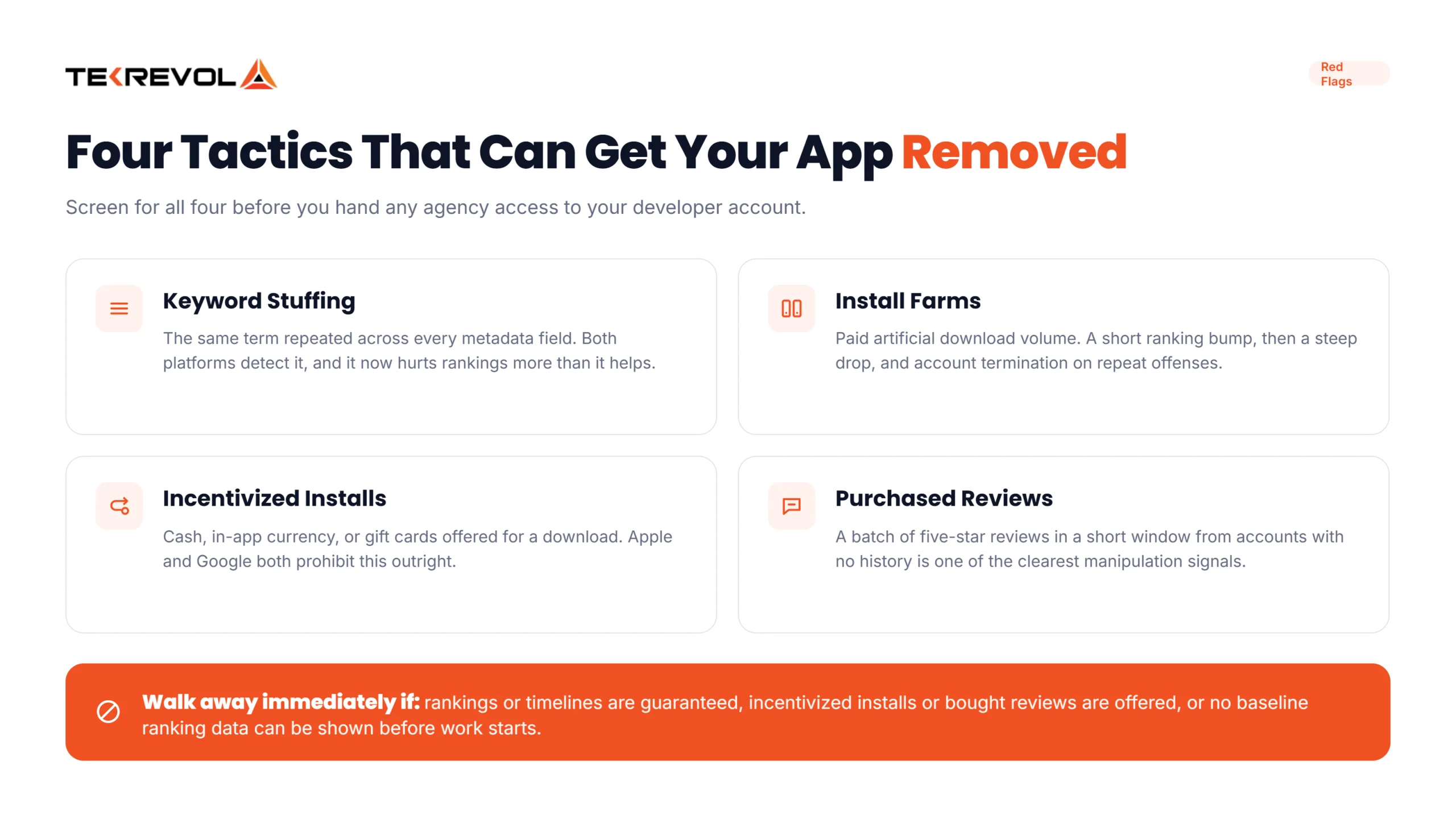
- Keyword stuffing: repeating the same term across every metadata field until it reads like spam rather than a real product description. Both platforms have gotten better at detecting this, and it increasingly hurts rankings instead of helping them.
- Install farms: paying for artificial download volume from device farms or click-farm networks to fake a download velocity spike. This can trigger a temporary ranking bump followed by a steep drop once the platform detects the unnatural pattern, and repeated offenses risk account termination.
- Incentivized installs: offering users a reward (cash, in-app currency, gift cards) specifically for downloading, which both Apple and Google explicitly prohibit under their developer guidelines.
- Coordinated or purchased reviews: a batch of five-star reviews appearing in a short window, often from accounts with no other review history, is one of the clearest signals platforms use to flag manipulation.
In-House ASO or a Dedicated Company: Which Actually Makes Sense?
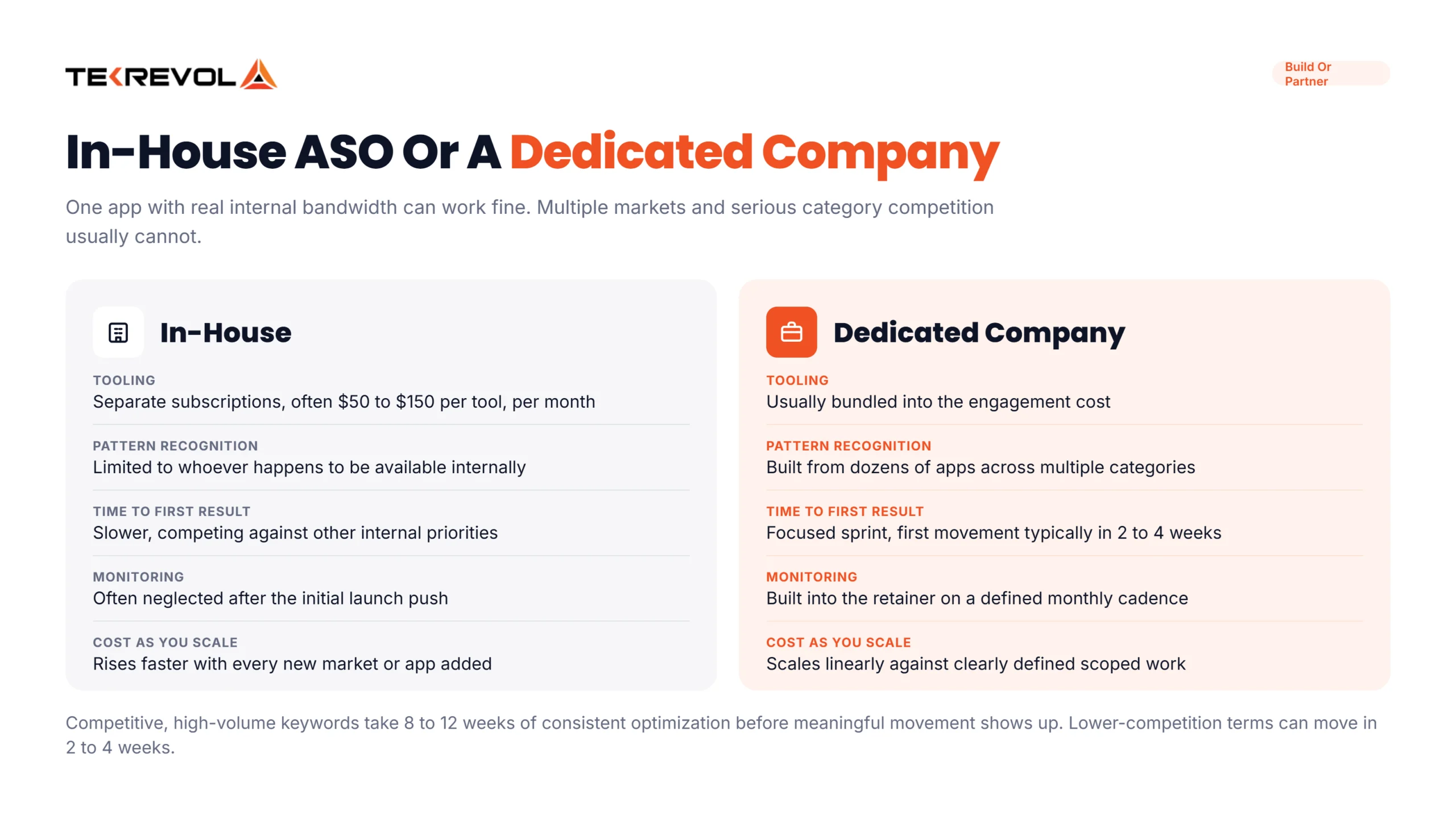
When choosing between in-house ASO or a dedicated company, in-house can work for a single app with one person managing it part-time, but it often gets deprioritized once other work competes for attention.
| Factor | In-House ASO | Dedicated ASO Company |
| Keyword tooling access | Requires a separate subscription, often $50–$150/month per tool | Usually bundled into the engagement |
| Cross-app pattern recognition | Limited to whoever’s available internally | Built from patterns seen across dozens of apps and categories |
| Time to first result | Slower, competes with other internal priorities | Focused sprint, typical first movement in 2–4 weeks |
| Ongoing monitoring | Often quietly neglected after the initial launch push | Built into the retainer on a defined monthly cadence |
| Cost at a small scale | Cheaper if someone already has spare bandwidth | More predictable, scoped cost from day one |
| Cost of growing scale | Increases faster as you add markets or apps | Scales more linearly with clearly defined hourly work |
For a single app with one person managing it part-time, in-house can genuinely work fine for the first few months. Once a business is managing multiple markets or facing real category competition, a dedicated company usually pays for itself through better ranking stability alone.
What Are the Biggest Red Flags When Evaluating an ASO Company?
The clearest red flags are guaranteed rankings, incentivized or purchased reviews, no baseline reporting, generic keyword templates, and vague answers to methodology questions. If you’re also evaluating mobile app development services, make sure the agency clearly separates development deliverables from ongoing ASO work.
Walk Away Immediately
- Guarantees a specific ranking position or timeline; no outside party has that level of control over either platform’s algorithm
- Recommends or offers incentivized installs, bought reviews, or review-gating, all of which violate both platforms’ policies and risk app suspension
- Cannot show any baseline ranking data before starting work
Ask More Questions First
- Pricing is unusually low compared to the market range. Find out exactly what’s being excluded
- Portfolio results aren’t tied to specific, checkable timeframes
- No mention of localization for an app with a real international audience potential
- Reporting cadence isn’t specified anywhere in writing before signing
Not Sure If the Proposal You're Weighing Is Actually Solid?
Send us the ASO proposals you're comparing, and we'll give you an honest assessment of what's realistic and what's overpromising.
Get a Free Proposal ReviewHow Do You Verify an ASO Company’s Portfolio Claims?
Verify a portfolio claim by asking for the specific app name, checking its current ranking and rating history independently, and requesting the exact timeframe over which the improvement happened. A real result holds up to that scrutiny without hesitation.
- Ask for the exact app name, not a vague category description
- Search the app yourself and check its current ranking, rating, and review recency
- Ask what specifically changed and over what timeframe. A real case study has specifics; a fabricated one stays vague
- Request a direct reference conversation with the actual client, not just a written testimonial
What Should Be in Your ASO Company Contract?
A solid app store optimization services contract includes a defined reporting cadence, explicit no-guarantee language around rankings, clear ownership of creative assets after the engagement ends, and a reasonable cancellation clause. Vague or missing versions of any of these are worth negotiating before signing anything.
| Clause | What to look for | Why it matters |
| Reporting cadence | Weekly or monthly, specified in writing | Prevents “we’ll update you occasionally” drift |
| No-guarantee language | Explicit acknowledgment that rankings aren’t guaranteed | A contract promising rankings is a legal red flag, not reassurance |
| Creative asset ownership | You retain icons, screenshots, and copy after the contract ends | Without this, switching agencies means starting over from zero |
| Cancellation terms | Reasonable notice period, no excessive lock-in | Long lock-ins with vague metrics favor the agency, not you |
Apple prohibits attempts to manipulate ratings or App Store discovery through paid, incentivized, filtered, or fake feedback. For businesses investing in iOS app development, ASO activities should follow Apple’s platform policies to avoid putting the app at risk.
Google Play also provides Store Listing Experiments and performance reporting tools that let developers measure and improve listing performance over time. This reinforces an important point when evaluating an ASO company: optimization should be treated as an ongoing process of testing, measurement, and refinement rather than a one-time listing update.
The same principle applies to your agency contract. Clearly defined reporting requirements make it easier to evaluate what the agency is doing, identify problems early, and determine whether the engagement is delivering value.
To understand why these compliance and performance considerations matter, it also helps to understand how app store ranking algorithms influence visibility and discoverability.
How Does ASO Actually Fit Alongside Your Broader Marketing Strategy?
ASO works best as one piece of a broader growth plan, not a standalone fix. An app with a perfectly optimized listing still needs a real marketing push behind it, and a listing alone rarely carries a launch on its own.
Organic app store search remains one of the largest sources of app discovery worldwide, and research from Statista consistently shows that search inside the app stores drives a majority of installs across most categories, ahead of social referrals or paid campaigns alone.
That’s exactly why a weak listing quietly wastes every dollar spent on paid acquisition elsewhere; a strong ad campaign still has to convert on a store page that hasn’t been optimized to hold up its end of the funnel.
For founders thinking beyond the store listing itself, this guide on top app marketing strategies covers the acquisition channels that work alongside strong organic ASO rather than instead of it.
And if the product itself still needs work before a marketing push makes sense, these mobile app development tips cover the fundamentals worth getting right first.
How TekRevol Helps You Choose and Run the Right ASO Strategy
The right ASO strategy starts with knowing where your app stands before making changes. TekRevol begins with a detailed audit of your app’s current visibility, keyword performance, conversion rate, ratings, and competitive position. This baseline creates a clear starting point, so every optimization has a measurable purpose.
From there, the strategy is built around how your audience actually searches, compares, and chooses apps. Keyword research, listing optimization, creative testing, localization, and performance tracking work together rather than as disconnected tasks. As market conditions and competitor strategies change, the approach evolves too, allowing teams to identify new opportunities, address weak points, and focus resources on the changes most likely to improve organic visibility and conversions.
Most importantly, TekRevol treats ASO as an ongoing growth process rather than a one-time launch task. You get clear reporting, transparent recommendations, measurable benchmarks, and a strategy that can be refined as real performance data comes in.
Our goal isn’t simply to make an app rank higher; it’s to build sustainable visibility that brings the right users to the listing and gives them a stronger reason to install.
Ready to See Where Your App Stands and What Can Be Improved?
TekRevol will show you a real baseline audit of your app before you commit to anything.
Book My Free ASO Audit →