



- eCommerce app development in Qatar requires QPay, since it’s the payment method Qatari nationals expect and trust at checkout.
- eCommerce app development in Qatar demands true Arabic RTL design, rebuilding layouts from scratch instead of translating English ones.
- A Qatar eCommerce app costs QAR 50,000 for an MVP, scaling past QAR 250,000+ for enterprise marketplace builds.
- Qatar has over 4,000 live eCommerce apps, making loyalty programs and Arabic App Store optimization essential for differentiation.
- PayPal and Stripe can’t process payments legally in Qatar as standalone accounts, requiring a QCB-licensed local processor instead.
- Qatar’s eCommerce market is worth $4.54 billion in 2025, with shoppers averaging $3,960 per transaction, among MENA’s highest.
- BNPL is Qatar’s fastest-growing payment category, forecast at an 11.46% CAGR through 2031 for higher-ticket purchases.
Building an e-commerce app in Qatar and wondering why it’s harder than it looks?
Most e-commerce apps here lose customers in the first few taps. Not because the product is bad, but because the experience doesn’t feel local. Qatar isn’t a generic market. And generic apps don’t survive here.
eCommerce app development in Qatar means getting three things right simultaneously: a truly native Arabic UX that’s built RTL from the ground up, not just translated. QPay and local payment gateways integrated from day one. And a product distinct enough to stand out among 4,000+ apps already competing for the same shoppers.
Most businesses figure this out the expensive way, after launch. The smarter move is working with a mobile app development company in Qatar that already understands these dynamics before a single line of code is written. One that’s built for this market, not just in it.
This guide breaks down what it takes to build (or fix) an e-commerce app that works in Qatar, from RTL design decisions to payment infrastructure to shipping an app that actually competes.
Quick Answer: What It Takes to Build a Competitive eCommerce App in Qatar
A competitive eCommerce app in Qatar needs four things: true RTL Arabic UX (not a translated English layout), QPay as a first-class payment option alongside international cards, sub-3-second checkout performance, and a differentiation strategy. Loyalty, ASO, or category focus, strong enough to stand out among 4,000+ apps already live in the market. Budget for QAR 50,000+ and 3+ months. For even a basic version done right.
The State of eCommerce App Development in Qatar: What the Numbers Actually Say
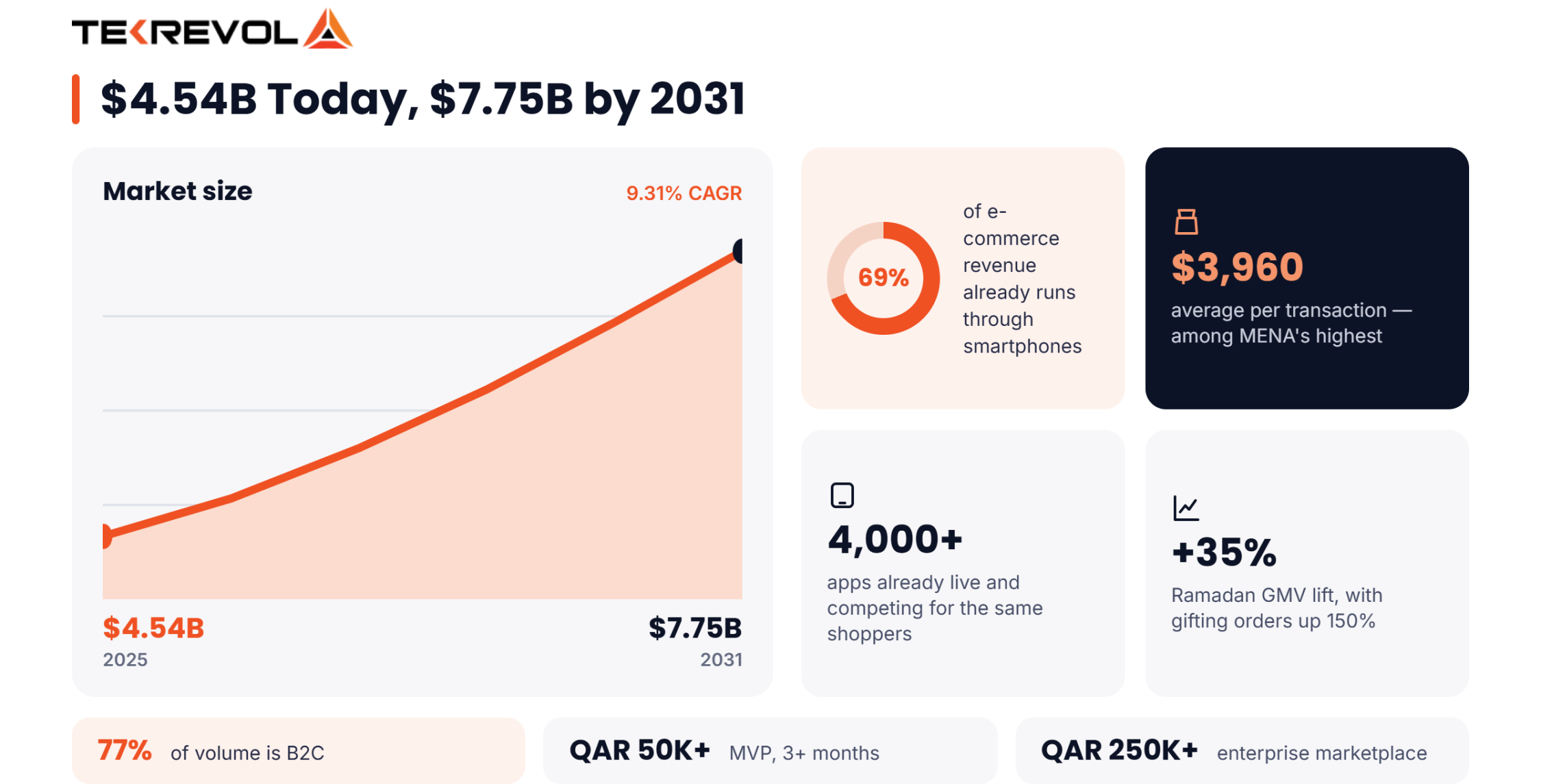
Qatar’s e-commerce market is worth $4.54 billion in 2025, growing at a 9.31% CAGR, and projected to reach $7.75 billion by 2031.
That’s not a market still warming up to online shopping. The average Qatari online shopper spent $3,960 per transaction in 2024, one of the highest averages anywhere in the MENA region.
69% of all e-commerce revenue already flows through smartphones, backed by 95% smartphone penetration and near-universal 5G and fiber coverage. Mobile isn’t the future here; it’s the present. If your app isn’t mobile-first, it isn’t market-ready.
And yet, most e-commerce apps built for Qatar underperform. Not because the market is wrong. Because the product doesn’t fit it.
We’ve tracked this pattern closely at TekRevol, both in our GCC project work and in our analysis of how Qatari users actually adopt and rank apps. The takeaway we keep coming back to: founders who treat the Gulf as one market lose to founders who design for its actual fault lines.
Who Shops on eCommerce Apps in Qatar?
Qatar’s e-commerce buyers really split into two camps. Arabic-first nationals who trust QPay because it’s familiar and government-backed. And convenience-first expats who default to English UX and international payment methods. Both groups spend heavily and live on their phones, but that’s about where the similarity ends.
Qatari nationals expect Arabic-first interfaces, not an afterthought translation. They lean into seasonal moments hard; Ramadan drove a 35% GMV lift and a 150% spike in gifting orders in 2025, and a checkout flow that feels imported loses them fast.
Expats want English and international payments, sure. But they still live here. They expect fast local delivery and merchant trust signals that feel native, not bolted on.
The apps that win serve both audiences without making either feel like an afterthought. It’s a problem TekRevol has hit firsthand; our co-founders launched ServeEasy, a restaurant-tech venture showcased at Web Summit Qatar 2024. Building it, we saw firsthand how differently nationals and expats use an app to order and pay. That’s the experience we bring to every app build in this region, not just research.
How Many eCommerce Apps Are Competing in Qatar?
Over 4,000 e-commerce apps are already live on Qatar’s App Store. That includes regional giants like Talabat, Snoonu, Carrefour Qatar, and Amazon.qa, apps with years of user data, brand recognition, and logistics infrastructure that took years to build.
A generic app won’t cut it here. What works is local UX, payment methods people already trust, and features built around how this market shops.
It’s the same conclusion we keep landing on at TekRevol with clients building across the GCC: differentiation isn’t a marketing layer added at the end; it’s a product decision made on day one.
That’s what the rest of this guide covers.
Mobile App Development in Qatar: The Full Landscape
eCommerce app development doesn’t happen in isolation. It sits within a broader mobile app ecosystem that has matured significantly in Qatar over the last five years.
Qatar’s mobile-first reality means the standards are high. Users compare your app not just to local competitors, but to the global apps they use daily: Careem, Talabat, Amazon. If your product feels slower, harder to navigate, or less trustworthy than those, you lose.
This is why the right mobile app development approach matters as much as what you build. The strategic decisions, platform, tech stack, design philosophy, and payment infrastructure made before development begins determine almost everything about how the product performs once it’s live.
Types of eCommerce Apps for the Qatar Market
The four models that perform in Qatar are B2C, multi-vendor marketplace, on-demand/hyperlocal, and B2B procurement. B2C alone accounts for 77% of Qatar’s e-commerce volume in 2025.
B2C eCommerce App
B2C apps dominate the market, accounting for 77% of Qatar’s e-commerce volume in 2025. Fashion, electronics, groceries, and luxury goods are the highest-performing categories. These apps win on product discovery, checkout speed, and loyalty mechanics.
Multi-Brand / Multi-Entity Marketplace Apps
Multi-vendor marketplaces are the most complex to build, but they have the highest ceiling in Qatar. Shoppers here want variety in one place; the Talabat and Amazon model isn’t just a feature preference; it’s an ingrained shopping habit. These marketplaces need sophisticated vendor management, commission logic, and distinct buyer, seller, and admin experiences.
On-demand Apps
On-demand apps are growing fast. Snoonu and Baqaala have trained Qatari shoppers to expect 15-30 minute delivery for groceries. Any app in this category is competing on speed of fulfillment more than anything else, which means it needs to surface real-time inventory and live delivery tracking without lag.
B2B procurement apps
B2B procurement apps serve Qatar’s construction, hospitality, and supply chain sectors, industries with significant spend. These require different UX patterns: bulk ordering, account-based pricing, approval workflows, and ERP integration. TekRevol’s C-More build for a construction procurement client cut material delivery times by 30% through this exact approach.
Must-Have Features for an eCommerce App in Qatar
Every competitive eCommerce app in Qatar needs bilingual Arabic/English UX, QPay integration, real-time order tracking, and secure 3D Secure payments as baseline; loyalty programs, AI recommendations, and BNPL are what separate apps that win from apps that merely launch.
The Non-Negotiables
Arabic and English bilingual support: Not a toggle. Both languages should feel native, with proper RTL layout for Arabic and clean LTR for English. Language preference should persist across sessions.
QPay at checkout: Qatar’s national payment method. Covered in full detail below, but its absence in a checkout flow is a direct conversion killer for Qatari national users.
Guest checkout: Expat shoppers buying once shouldn’t be forced into account creation before purchase. Prompt sign-up after the order confirms, not before.
Secure payment gateway with 3D Secure: Visa and Mastercard with 3D Secure is the expected standard, alongside Apple Pay and Google Pay for one-tap checkout. Trust signals at checkout, security badges, and clear encryption messaging reduce abandonment across all user segments.
Real-time order tracking: Qatar’s same-day delivery culture has raised user expectations significantly. Static “your order is on the way” messaging isn’t enough. Live map tracking, ETA updates, and driver contact options are now baseline.
Push notifications: One of the highest ROI features in e-commerce. Cart abandonment recovery, flash sale alerts, order status updates, and loyalty reward notifications all drive measurable revenue impact. Arabic-language push notifications perform significantly better with Qatari users than English-only.
Wishlist and product saving: Qatari shoppers often browse before they buy, especially in fashion and electronics. Saving functionality keeps them in the product and drives return visits.
Reviews and ratings: Trust-building features that reduce purchase hesitation, especially for products customers can’t inspect in person.
Easy returns and refund flow: The Ministry of Commerce enforces consumer protection mandates in Qatar. Clear, in-app return initiation and refund status tracking reduce support volume and build trust.
WhatsApp order updates: In Qatar and the wider GCC, WhatsApp gets opened faster than in-app push or email. Order confirmations, delivery ETAs, and support handoff should route through WhatsApp Business API alongside push notifications, not instead of them.
The Differentiators
Seasonal UX flows: Ramadan-specific product surfacing, gift wrapping options, adjusted delivery windows during Iftar hours. National Day promotions, Eid collections, Apps with these built-in feel local. Apps without them miss the highest GMV moments of the year.
Loyalty programs: Points, tiers, and early access- the specifics are worth their own section below, but the short version is: Qatar’s spend-per-transaction makes this one of the highest-ROI features you can build.
AI-powered product recommendations: Behavior-based recommendations increase average order value by 10-30%. TekRevol builds AI personalization directly into ecommerce app development engagements; it’s not a premium add-on; it’s built into the architecture.
Buy Now Pay Later (BNPL): Sharia-compliant installment options are one of Qatar’s fastest-growing payment categories, with BNPL forecast to grow at an 11.46% CAGR through 2031, the fastest of any payment method tracked. For higher-ticket categories (electronics, furniture, luxury), BNPL increases conversion by removing the barrier of the full upfront payment.
One-touch reorder: For grocery and everyday essentials, letting customers reorder a previous purchase in just a few taps makes repeat shopping much easier. Qatar’s grocery apps that built this feature will see significantly higher weekly active user rates.
Arabic UX & RTL Design: A Key to Success in Qatar
Real Arabic UX means rebuilding the interface from the wireframe stage, right-to-left navigation, right-to-left CTA placement, RTL-native fonts like Cairo, Rubik, or Tajawal, and 1.6+ line height. Not flipping a translated English layout.
RTL Is Not a Mirror, It’s a Rebuild
The most common mistake in Arabic UX: build the English version, translate the copy, flip the direction attribute. The result is an app that technically reads right-to-left but feels like a translated product, because structurally, it still thinks left-to-right.
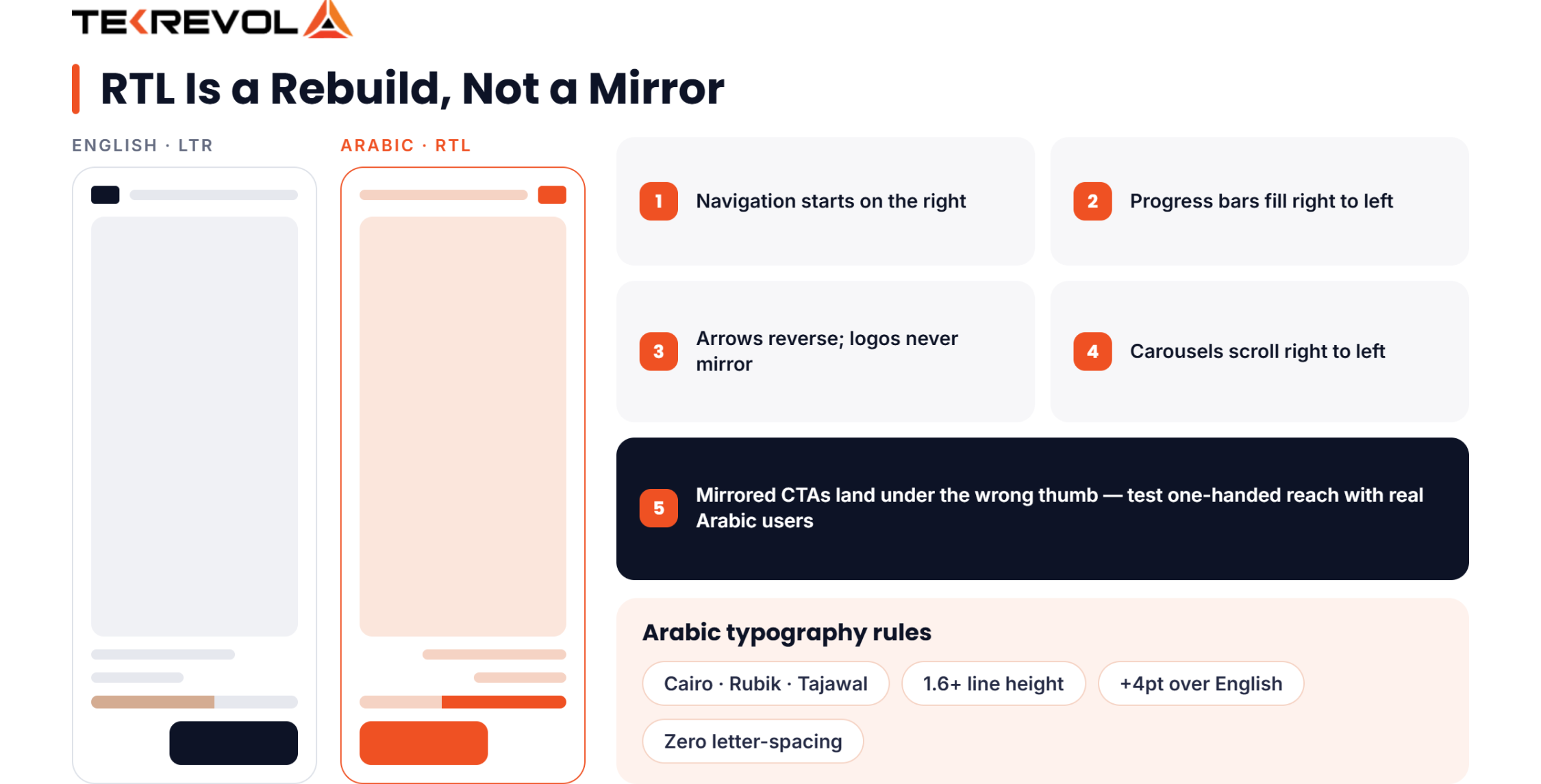
Real RTL design means rebuilding the interface from the wireframe stage with Arabic users as the primary design target. Here’s what actually changes:
- Navigation menus begin on the right side of the screen, not the left
- Primary CTAs (Add to Cart, Buy Now) sit on the right, the side where Arabic readers naturally look first
- Progress bars fill right to left
- Image carousels and product sliders scroll from right to left
- Back and forward arrows are reversed; forward points left, backward points right
- Checkout flow direction moves from right to left across all steps
We’ve seen the same pattern hold across the Gulf; our breakdown of Arabic RTL app development covers the same rebuild-not-mirror principle for the UAE market, including the common mistake of mirroring things that shouldn’t mirror (logos, product photos) alongside the things that should (arrows, progress bars).
Arabic Typography: Where Apps Visibly Break
Typography is where Arabic UX decisions are most visibly wrong to native readers. The rules are specific:
- Font choice: Arabic script has structural requirements that most Latin fonts don’t satisfy. The three fonts that consistently perform in Arabic mobile e-commerce are Cairo, Rubik, and Tajawal. They render cleanly at small sizes and hold up across screen resolutions. Using generic system fonts for Arabic is an immediately visible sign of an app that wasn’t designed for this audience.
- Line height: Standard English line height (1.2) applied to Arabic text causes lines to visually collide. Arabic body text requires a minimum line height of 1.6. Skip this, and your product descriptions and checkout copy look broken.
- No artificial letter-spacing: Arabic is a cursive script; characters connect. Adding letter-spacing breaks those connections and makes text illegible. This is one of the most common Arabic UX mistakes made by developers who’ve only built for Latin-script languages.
- Point size: Arabic at the same point size as English is noticeably harder to read. Arabic body text should be approximately 4 points larger than its English equivalent to achieve equivalent legibility.
The CTA Button Problem Nobody Talks About
Here’s an RTL UX issue that almost no design guide covers: the ergonomic paradox of mirrored CTA placement.
When an interface is properly mirrored to RTL, the primary action button, Add to Cart, Checkout, Confirm Order, moves from the bottom right to the bottom left. Structurally correct. Ergonomically terrible.
Most people in Qatar use their phones with one hand. If important buttons are placed in hard-to-reach areas, users are more likely to hesitate or leave before completing a purchase.
The solution isn’t just switching the layout to RTL. It’s testing the app with real Arabic-speaking users to make sure buttons, menus, and key actions are both easy to reach and feel natural. Apps that skip real usability testing often miss these small details, which can affect the overall user experience.
Cultural UX Beyond Layout
Supporting RTL is only the starting point. A truly localized experience is what helps users feel comfortable and keeps them coming back.
- Visual imagery: Product photography featuring Western models in a Qatari app creates distance. Using images that reflect local users or are culturally appropriate helps customers connect with your brand, especially in fashion and beauty.
- Color and tone: Gold, green, and deep blue carry positive cultural resonance in Qatar. Color combinations that are neutral in Western design can read differently in Arab markets. It’s worth a cultural design review with someone who knows the market.
- Arabic copy quality: Word-for-word translation of English marketing copy produces Arabic that reads strangely to native speakers. Product descriptions, CTA text, push notification copy, and error messages all need to be written in natural Arabic by someone who writes it fluently, not translated by a tool. Qatari users will tell the difference in seconds.
- Ramadan-specific UI: During Ramadan, shopping behavior shifts significantly. Peak activity moves to late evening and early morning. Gift-giving spikes. App interfaces that acknowledge this, with seasonal design elements, gift-specific product surfacing, and delivery messaging calibrated to Iftar, feel respectful of the culture. Apps that ignore it feel foreign.
What QPay Is and Why It’s Non-Negotiable
QPay is Qatar’s national payment gateway, backed by the Qatar Central Bank and operated through the National Payments System (NAPS). It’s the payment method Qatari nationals expect at checkout, and skipping it can cost apps up to 23% in cart abandonment.
For a Qatar-focused e-commerce app, skipping QPay is like building a US app without Visa/Mastercard support. It’s not a nice-to-have; it’s infrastructure customers expect, the way they’d expect a store to accept cash.
A checkout may seem complete, but it can still miss the payment methods local customers expect. Having worked on projects for the Qatari market, TekRevol understands the importance of building checkout experiences around local payment preferences.
QPay vs. International Gateways
International gateways like Stripe, PayPal, and Checkout.com serve expats and international cardholders well, but they aren’t independently licensed as merchant acquirers in Qatar.
To accept cards compliantly, businesses need to route through a QCB-licensed local processor such as QPay/NAPS, Dibsy, or Tap Payments, rather than a direct Stripe or PayPal account. The mistake many businesses make is treating these international brands as plug-and-play, without setting up the right local licensing behind them.
| QPay | Dibsy | International Gateways | |
| Target user | Qatari nationals, local debit cards | Local + international cardholders, one QCB-licensed account | Expats, international cards |
| Local trust | High government-backed | High — QCB-licensed | Moderate — recognized but foreign |
| Settlement speed | Fast, local clearing | Fast, local clearing | 3–5 days international |
| Abandonment risk | Low when present, high when absent | Low — covers both audiences in one integration | Moderate |
| Integration complexity | Moderate (redirect + NAPS) | Moderate (single API, no need for separate NAPS + Stripe stack) | Low (well-documented APIs), but not independently licensed to settle locally |
Apps serving the full Qatar market need both, QPay as a primary option, alongside Visa/Mastercard for complete coverage. This is how TekRevol scopes payments for Qatari clients from the start: QPay and international options designed in together, not bolted on afterward.
How the Integration Works
QPay uses a secure redirect-based checkout. Customers are redirected to QPay to verify their payment using a PIN and SMS OTP before the transaction is completed. The merchant then receives the payment status through a webhook.
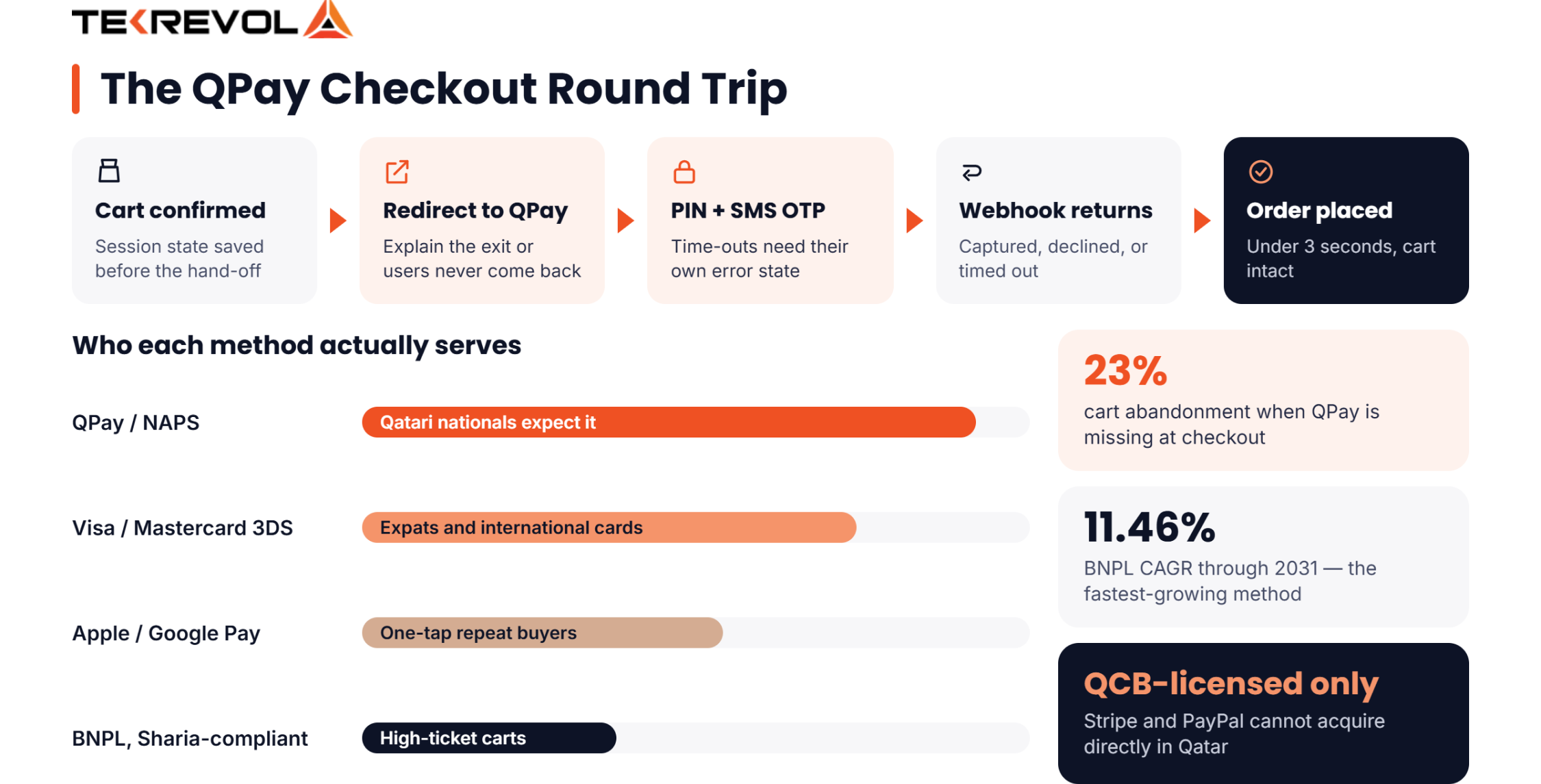
This requires:
- A backend that maintains session state through the redirect
- Webhook handling for captured/declined / timed-out states
- Clear error UX for OTP timeouts or failed authentication
- Session persistence so cart and context survive the round trip
It’s not complex engineering, but developers who haven’t done it before tend to underestimate the redirect’s UX impact: users who don’t understand why they’ve left the app, and don’t come back. TekRevol’s engineers have built this flow enough times to know exactly where that drop-off happens, and design the return path so it doesn’t.
Integrating at Enterprise Scale
A basic checkout integration works for one store, not a multi-brand or multi-entity operation. Enterprise QPay integration means handling multi-entity transactions, centralized reconciliation, and QCB compliance across business units. Most vendor pitches fall apart here, since they’ve only ever integrated QPay for a single small store, not an organization with real reconciliation demands.
Architecture: Route through a licensed local processor with API-level access, not a hosted checkout page. This supports multiple merchant accounts, per-unit settlement rules, and a single audit trail, designed alongside your ERP from the start, not bolted on later.
Reconciliation: International gateways still matter for expat and cross-border transactions. The real challenge is rolling up QPay, NAPS, and international card settlements into one clean report, instead of reconciling three separately by hand. This is the layer TekRevol built for a leading Qatari bank’s wealth management platform, reconciling multiple data sources into a single trustworthy view and cutting transactional errors by 82%.
Compliance & Security
PCI-DSS is the floor, not the ceiling. A vendor should give you clear, written answers on tokenized card storage, encryption at rest and in transit, and data residency- where your data lives, who can access it, and how long it’s retained. TekRevol has built and shipped inside a regulated Qatari bank’s compliance framework, not just an e-commerce sandbox, so these aren’t answers we’re guessing at.
The Broader Qatar Payment Landscape
Beyond QPay, a few other payment considerations worth building for:
- Dibsy: A QCB-licensed payment platform built specifically for the Qatar market, supporting card payments and payment links without requiring a full website. A practical alternative or complement to QPay for businesses that want one licensed local processor handling multiple payment types.
- SADAD: Qatar Central Bank-licensed full-stack payment platform with direct NAPS integration. Good option for businesses that also need POS and invoice capabilities alongside the app.
- Tap Payments: Tap is a practical choice among GCC payment gateways, supporting QPay/NAPS, Visa, Mastercard, and Apple Pay for businesses operating across multiple Gulf markets. Since most TekRevol clients operate across Qatar, the UAE, Bahrain, and Saudi Arabia, we often recommend Tap from day one, so the payment layer doesn’t need rebuilding as clients expand.
- BNPL: Sharia-compliant installment options via Qatar Islamic Bank and similar providers. Worth integrating for electronics, furniture, and fashion categories where order values are high.
- Fawran: QCB’s instant payment network completes transactions in seconds, making it a fast and convenient checkout option for customers in Qatar.
What Actually Helps an eCommerce App Stand Out in Qatar?
In a competitive market, success often comes down to three things: a fast checkout, Arabic-first App Store optimization, and features like loyalty programs and quick reordering that keep customers coming back.
Performance Is a Differentiator, Not a Baseline
Qatar’s users have fast phones and fast internet. Users expect apps to be fast. Slow loading screens, delayed payments, or a lengthy checkout can lead customers to leave and buy from a competitor instead.
Performance optimization for the Qatar market means:
- Image optimization for mobile connections (even on 5G, lazy loading and compression reduce perceived load time)
- Checkout flows that complete in under 3 seconds from “confirm” to “order placed”
- Backend infrastructure that auto-scales for Ramadan traffic, which can run 2-3x normal volume
- App startup time under 2 seconds cold, under 1 second warm
These aren’t premium features. They’re the minimum viable development standard for a market where competing apps are already fast. TekRevol plans for high traffic from day one. The backend development is designed to handle peak shopping periods like Ramadan without compromising performance.
Post-Launch: ASO Strategy for the Qatar Market
Most e-commerce apps launch and rely on paid acquisition for downloads. App Store Optimization is the channel that almost every competing app in Qatar is underutilizing.
Arabic keyword optimization is the clearest opportunity. Most apps competing in Qatar are optimized for English search terms. Arabic keyword research for Qatari search patterns- how users in Qatar actually search for “online shopping” or “grocery delivery” in Arabic- is underexplored and delivers measurable ranking improvements.
Localized App Store assets such as screenshots and preview videos showing Arabic UI and Qatari context convert significantly better with Arabic-speaking users than English screenshots with Arabic copy overlaid. The App Store is a product experience before the product is even downloaded.
Regular positive reviews help improve your app’s visibility over time. Asking customers for feedback after a successful delivery or a smooth purchase can encourage more genuine ratings.
TekRevol’s ASO services aren’t an add-on we tack onto the invoice; they’re part of how we deliver every mobile app development engagement, alongside App Store submission support and post-launch performance monitoring. Arabic-language ASO specifically grew out of necessity on our own GCC builds, where relying on English-only keywords was quietly leaving organic traffic on the table.
The Role of Customer Retention in eCommerce App Success
Downloads are a vanity metric. Revenue comes from repeat users. Qatar’s e-commerce market has a structural advantage for retention; customers who come back are worth a lot, which makes the retention mechanics below worth building from day one:
Loyalty programs: Points, tiered benefits, early access. Qatar’s affluent consumer base responds well to being treated as a VIP. Loyalty programs built into the core app, not bolted on post-launch, have significantly higher adoption.
Personalized push notifications: “You left something in your cart” works. “Your favorite brand just dropped new abayas” works better. Push notifications calibrated to individual behavior and sent at appropriate local times (not 3 am Doha time) are one of the highest-ROI retention levers available.
This is a near-identical pattern to what we built into Mdrouz’s notification logic: category-specific alerts (new abaya drops, restock notices) tied to a user’s actual browsing history rather than generic blasts.
Seasonal engagement: Ramadan, Eid, and National Day are more than seasonal campaigns. Updating your app with relevant offers, messaging, and experiences during these occasions helps customers feel understood and keeps them engaged.
What Tech Stack Supports Enterprise eCommerce Apps in Qatar?
Enterprise eCommerce app development in Qatar typically needs an API-first, microservices-based architecture that can integrate with existing enterprise systems and scale under high traffic; the framework choice (Flutter, React Native, native) matters less than the architecture underneath it.
| Architecture Layer | What Enterprise Buyers Need | Why It Matters |
| API-First, Microservices | Independent services for catalog, checkout, payments, inventory, not one monolith | One area spikes (flash sale), the rest keeps running |
| Native vs Cross-Platform | Flutter/React Native for most apps; native only for heavy hardware use or high-volume B2B orders | Cross-platform is faster and cheaper; PWA is faster still but loses offline/App Store presence; native only when it’s actually needed. |
| Cloud Infrastructure & SLAs | AWS, Azure, or GCP with defined SLAs, auto-scaling, disaster recovery | Get the uptime number in writing before signing |
| Security & Compliance | Role-based access, audit logging, penetration testing, built in, not bolted on | Retrofitting security later costs way more than designing it in. |
These aren’t abstract trade-offs; they’re the same set of decisions TekRevol works through on every GCC build, including ecommerce website development projects where the web and app share one backend. Get this layer right early, and everything downstream- performance, payments, retention has a foundation that holds up past launch.
Process for Building an eCommerce App in Qatar
A Qatar eCommerce app build runs through five phases: discovery and market mapping, RTL-first design, development with QPay integration in parallel (not bolted on at the end), QA against real Qatari devices and networks, and App Store submission with Arabic ASO assets.
| phase | What Happens | Typical Duration |
| Discovery | Market mapping, competitor teardown, feature scoping | 1–2 weeks |
| Design | RTL wireframes, Arabic typography, usability testing | 2–4 weeks |
| Development | Core build + QPay/NAPS integration in parallel | 8–20 weeks |
| QA | Device testing, payment redirect testing, load testing | 2–3 weeks |
| Launch | App Store submission, Arabic ASO, monitoring | 1–2 weeks |
Have a Qatar eCommerce App in Mind?
Let's scope your timeline, budget, and QPay integration with a free consultation tailored to your business goals.
Book a Free Consultation!How Much Does It Cost to Build an eCommerce App in Qatar?
The cost of app development in Qatar ranges from QAR 50,000 to QAR 250,000+, depending on the features and complexity. A basic MVP starts around QAR 50,000, while a full enterprise marketplace with ERP integration can run past QAR 1.8 million.
| Tier | What’s Included | Cost Range (QAR) | Timeline |
| MVP | Product catalog, cart, QPay + card payments, order tracking, bilingual Arabic/English, user accounts | QAR
50,000–110,000 |
3–4 months |
| Growth | Everything above + loyalty program, AI recommendations, push notifications, analytics dashboard, admin panel, Ramadan/seasonal UX flows | QAR 110,000–170,000 | 4–7 months |
| Enterprise | Multi-vendor marketplace, ERP integration, custom AI personalization, advanced analytics, B2B procurement features | QAR 170,000–250,000+ | 7–12 months |
Post-launch, budget 15-20% of your initial build cost annually for maintenance, OS compatibility updates, security patches, and feature iterations based on real user data.
These ranges reflect cross-platform development. Native development for both platforms adds 30-40%.
Curious What Your Specific App Would Actually Cost?
Share your project details to receive a custom quote, or use our app cost calculator for a fast, personalized estimate.
Calculate Now!What Legal Requirements Apply to eCommerce Apps in Qatar?
eCommerce apps operating in Qatar must comply with MOCI consumer-protection rules, Qatar’s Personal Data Privacy Protection Law (Law No. 13 of 2016), QCB-licensed payment processing, and a new 2026 licensing decision specifically covering e-commerce websites and apps.
- Consumer protection: Governed by Law No. 8 of 2008 and Decree-Law No. 16 of 2010 (the e-Commerce Law), enforced by MOCI. Articles 51–59 specifically cover delivery delays, refunds, and disclosure for online purchases. Your return and refund flow needs to be compliant, in Arabic, and actually functional, not just written into a terms page.
- 2026 update to know: Ministerial Decision No. 25 of 2026 introduces licensing requirements for e-commerce sites and apps without a physical Qatar presence, plus mandatory disclosure of return policies and complaint-handling. If you’re a pure e-commerce play, this is the newer, more specific rule to check first.
- Payment processing: You need a merchant account through a QCB-licensed bank or PSP to accept cards, and QPay and NAPS are the national infrastructure your acquirer connects to, not something most merchants integrate with directly. Factor merchant account setup into your timeline; it takes time.
- Data protection: Law No. 13 of 2016 governs consent, data subject rights, breach notification, and cross-border transfers, enforced by the National Cyber Security Agency. Build for this at the architecture stage, not after the fact.
- App Store localization: Not a legal requirement, but functions like one; apps without Arabic-first App Store presence don’t get found by Arabic-speaking search traffic. We fold this into ASO delivery rather than treat it separately.
- QID integration: Optional, not required. Worth it for higher-trust categories (fintech-adjacent, luxury, BNPL) where verified-identity onboarding cuts fraud.
Most of this is where clients get blindsided mid-build, not because the rules are hidden, but because they sit outside a typical dev-only scope. It’s cheaper to map these at the architecture stage than retrofit after a Ministry review flags something post-launch.
How Do You Choose an Enterprise eCommerce App Development Vendor in Qatar?
Look for GCC market experience, end-to-end ownership, and credentials you can independently verify, not just claimed expertise. It’s the gap between the strongest mobile app development companies in Qatar and the rest of the field: plenty show a portfolio, few can show an Arabic RTL app they actually shipped or a QPay integration they’ve handled before.
Here’s what actually separates vendors worth talking to from the ones who just know how to write a proposal:
GCC market experience is non-negotiable
Don’t rely on claims alone. Ask to see Arabic RTL apps they’ve shipped, not mockups. Ask whether they’ve integrated QPay before and how they handled the redirect flow. If they pause on that question, you have your answer.
End-to-end Ownership Matters
Discovery, design, development, payment integration, launch, and post-launch support should sit under one team. The moment you’re coordinating between a design agency, a dev shop, and a payment integration contractor, things fall through the gaps, and they always fall through at the worst time.
Match the Engagement Model to Your Stage
A fixed-scope project works well for an MVP, while a dedicated team is better for ongoing updates and new features after launch. Choose a partner that offers both, so the engagement fits your business needs.
Scalability isn’t a Phase 2 conversation.
Qatar’s Ramadan traffic alone can run 2-3x normal volume. Infrastructure decisions made at the build stage determine whether your app performs or crashes exactly when it matters most.
Verify Before You Commit
Look for ISO certification, independently verified client reviews, and case studies you can trace to real products.
TekRevol holds itself to that same standard: ISO 27001-certified, verified as a Clutch Top B2B Company, with GCC-built products and 800+ successful projects that speak for themselves.
How Does TekRevol Help You Build eCommerce Apps in Qatar?
You now have a clear picture of what it actually takes to build a competitive eCommerce app in Qatar, grounded in real cost ranges and a real process, not a generic estimate.
TekRevol is a mobile app development company with experience building bilingual, QPay-integrated eCommerce platforms for the Qatari market. From single-brand stores to multi-vendor marketplaces and B2B procurement apps, the team understands the RTL design and local payment architecture these projects require.
This isn’t theoretical for us. When we rebuilt the e-commerce experience for Al Hussaini Trading, a GCC-based trading business, the result was a 5x increase in e-commerce revenue, real proof that getting the fundamentals right (checkout, payments, UX) translates directly into sales, not just better reviews.
You can see more of that work across our portfolio, including apps built for retail, marketplace, and on-demand operators across the GCC.
Our engagements start with scoping your specific category, your MVP feature list, and your realistic budget, before any code gets written.
Not Sure Yet Whether You Need an MVP or a Full Marketplace Build?
Share your idea with our team, and we'll honestly assess what it will take to bring it to market—no pressure, just practical guidance.
Talk to Our Team!


