



- EdTech app development in Austin usually runs from $25,000 for an MVP to $200,000+ for full platforms.
- Compliance shapes the build early: FERPA, COPPA, and WCAG accessibility rules affect features before design starts.
- Winning education apps compete on engagement and retention, not feature count.
- Adaptive learning, LMS integration, and offline access separate serious platforms from basic content apps today.
- A local Austin partner shortens feedback loops and keeps education product decisions close to your team.
Here’s the problem we watch Austin education founders run into. They fall in love with a feature list, build fast, and only discover FERPA, COPPA, or accessibility rules after the first institute says no.
EdTech app development in Austin is the work of turning a teaching idea into real software. That software has to be engaging, measurable, and legal to run in a classroom. Cost usually lands between $25,000 for a lean MVP and $200,000+ for a full learning platform. And compliance moves that number as much as any feature does.
At TekRevol, we build educational software solutions out of a downtown Austin office. So this guide is the version we’d give you over coffee: what these apps actually cost here, which features matter, the compliance you can’t skip, how long it takes, and the results a good build can deliver.
What Is EdTech App Development, and What Does It Cover?
EdTech app development is the process of building software that delivers, manages, or improves learning. It covers everything from a kids’ phonics app to a university LMS, corporate training tools, tutoring marketplaces, and AI-driven adaptive platforms that adjust to each learner in real time.
The category is wider than most people think, and the type you’re building changes almost every downstream decision: budget, timeline, compliance, and tech stack.
We group most edtech projects into four buckets, and it’s worth knowing which one you’re in before you talk price.
| EdTech app type | What it does | Typical complexity |
| Content/practice app | Lessons, flashcards, quizzes, language drills | Low |
| Tutoring/marketplace app | Connects learners and instructors, scheduling, payments | Medium |
| Learning management system (LMS) | Course delivery, grading, analytics, admin roles | High |
| AI / adaptive learning platform | Personalized paths, real-time difficulty tuning | High |
Scoping an Education App for Austin?
Talk to TekRevol's education team and get an itemized project estimate within 48 hours.
Get a Free EdTech ConsultationWhy Build an EdTech App in Austin?
Austin pairs a fast-growing tech workforce with a dense base of schools, universities, and training startups.
The region has nearly 95,000 IT professionals, providing a strong talent pool for building education platforms, as reported by Opportunity Austin and Workforce Solutions Capital Area.
Austin ISD serves 69,251 students across 114 schools, while UT Austin enrolled 55,000 students in fall 2025. Together, these institutions create opportunities to test products with K-12 schools, universities, teachers, and learners.
Education software isn’t a build-it-and-walk-away product. It needs real teachers and learners testing it, complaining about it, and shaping the next version.
That’s the quiet advantage of a local build. When you work with a mobile app development company in Austin, as we do at 701 Brazos St, a pilot becomes a short drive and a shared calendar.
Proximity also helps with the unglamorous parts: compliance reviews, procurement conversations, and the back-and-forth of matching a real curriculum to real screens.
How Much Does EdTech App Development Cost in Austin?
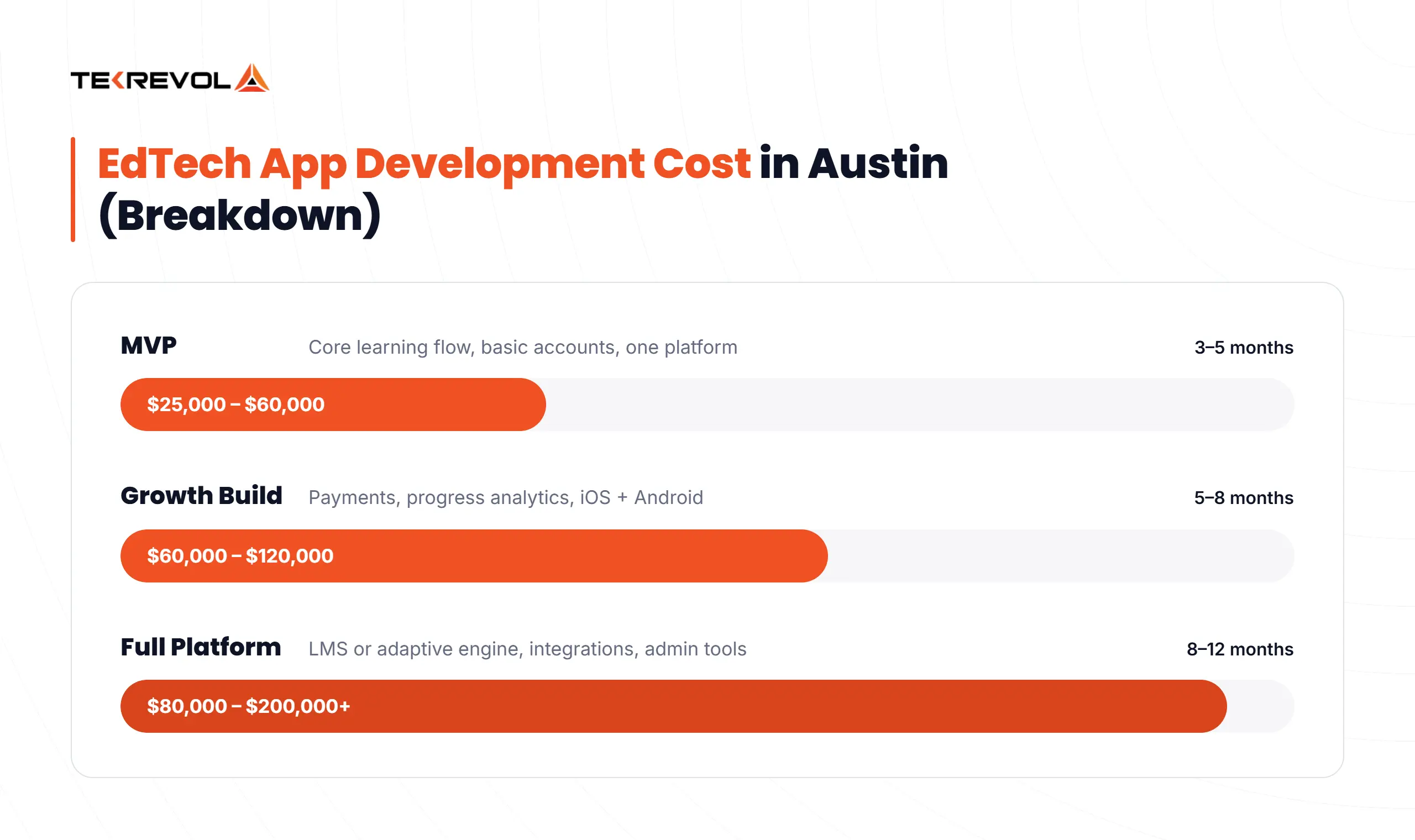
Most EdTech projects in Austin run between $25,000 for a focused MVP and $80,000–$200,000+ for a full platform, based on TekRevol’s Austin pricing. What moves you along that range isn’t the number of features. It’s data sensitivity, integrations, and how much personalization you need.
| Project stage | What you get | Planning range |
| MVP | Core learning flow, basic accounts, one platform | $25,000–$60,000 |
| Growth build | Payments, progress analytics, iOS + Android | $60,000–$120,000 |
| Full platform | LMS or adaptive engine, integrations, admin tools | $80,000–$200,000+ |
Let’s break it down. A single-purpose practice app with no student accounts is inexpensive to build and run. The cost climbs the moment you store learner data, connect to a school system, or add adaptive logic.
Three drivers push an EdTech budget upward more than anything else.
- First, compliance work like FERPA and COPPA readiness.
- Second, integrations with existing LMS, single sign-on, or school information systems.
- Third, AI and adaptive features that need data pipelines behind them.
Not Sure Which Stage Your Idea Sits In?
Get a scoped EdTech project estimate based on your actual feature list and business goals, not a generic template.
Claim Your Free Project EstimateWhat Features Does a Successful EdTech App Need?
The features that matter most are the ones that keep learners coming back. Reliable progress tracking, personalized content, offline access, and clean analytics for teachers or admins do more for retention than any single gimmick. Engagement mechanics come next, not first.
We tell founders to separate table-stakes features from differentiators. Accounts, content delivery, and basic progress tracking just keep you in the game. Here’s the core set a serious education app needs, with the payoff each one earns:
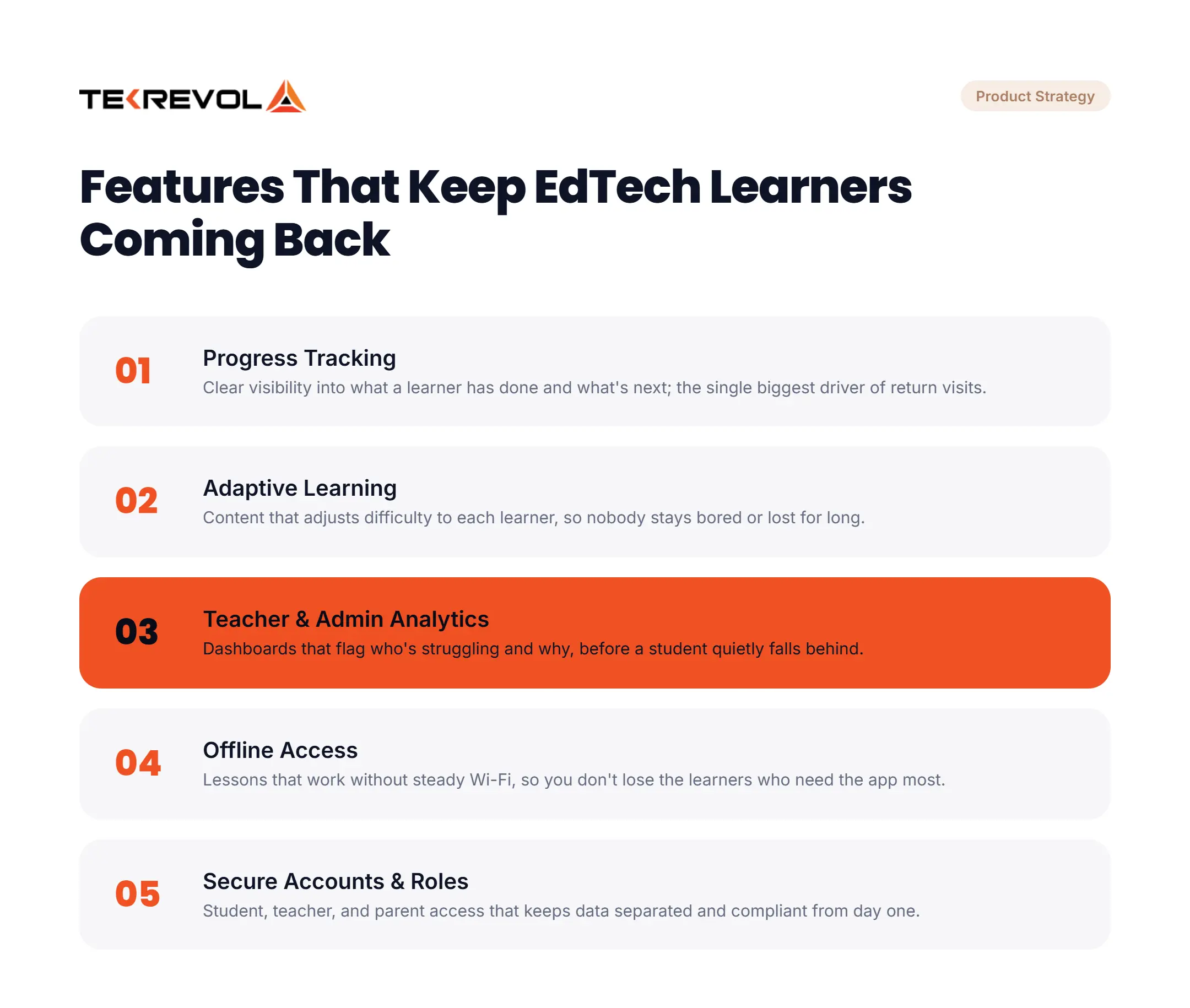
- Progress tracking: clear visibility into what a learner has done and what’s next. It is the single biggest driver of return visits.
- Adaptive learning: content that adjusts difficulty to each learner, so nobody stays bored or lost for long.
- Teacher and admin analytics: dashboards that flag who’s struggling and why, before a student quietly falls behind.
- Offline access: lessons that work without steady Wi-Fi, so you don’t lose the learners who need the app most.
- Engagement design: streaks, feedback, and small wins that respect the learner instead of nagging them.
- Secure accounts and roles: student, teacher, and parent access that keeps data separated and compliant from day one.
Offline access deserves a second mention, because plenty of Austin learners don’t have reliable connectivity. AI is moving fast here too, and our take on AI in education covers where it genuinely helps versus where it’s hype.
Compliance Rules Apply to Education Apps
If your app touches students, three rules dominate.
- FERPA (Family Educational Rights and Privacy Act) governs student education records
- COPPA (Children’s Online Privacy Protection Act) protects children under 13
- WCAG (Web Content Accessibility Guidelines) ensures learners with disabilities can use it.
FERPA, enforced by the US Department of Education, controls how student records are stored and shared. COPPA, enforced by the FTC, sets strict rules for collecting data from kids under 13. That includes verifiable parental consent. And accessibility isn’t optional politeness. Public schools expect WCAG support, and ADA risk is real.
Ignoring any one of them can block a school deal or trigger penalties.
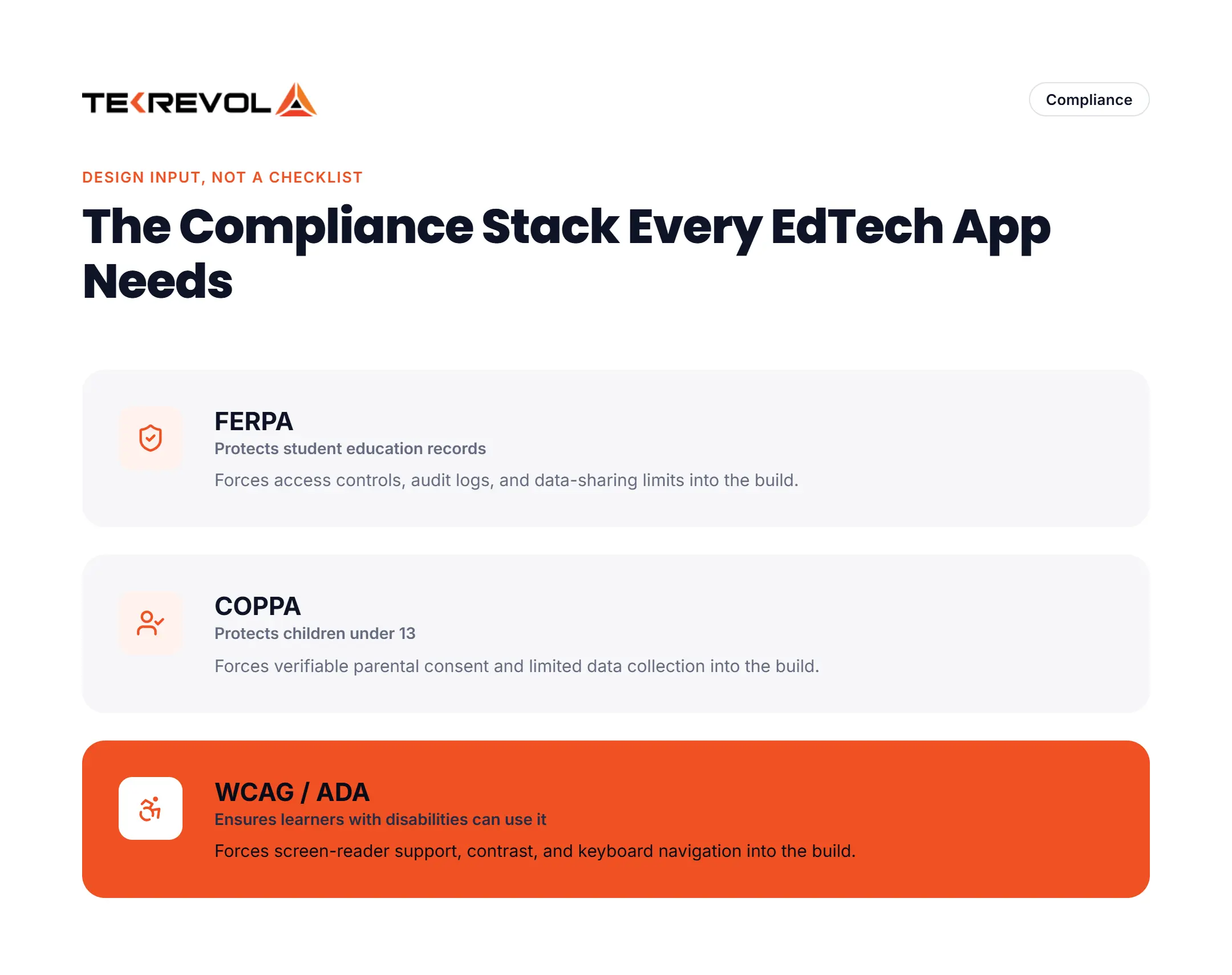
This is the part founders skip, and it’s the part that quietly determines whether a district will ever sign. Here’s the compliance stack we map before writing much code.
| Rule | Who it protects | What it forces into the build |
| FERPA | Student education records | Access controls, audit logs, data-sharing limits |
| COPPA | Children under 13 | Verifiable parental consent, limited data collection |
| WCAG / ADA | Learners with disabilities | Screen-reader support, contrast, keyboard navigation |
The same dynamic governs HIPAA-compliant app development in Austin; the regulator differs, but in both categories compliance is what decides whether an institution can buy at all.
Building an EdTech Solution and Worried About FERPA or COPPA?
Get your compliance questions answered by TekRevol's Austin team. We help you build privacy and regulatory requirements into your app from day one.
Talk to Our Austin TeamShould You Build a Custom LMS or Integrate an Existing One?
Build custom when your teaching model is your competitive edge and off-the-shelf tools force you to compromise it. Integrate an existing LMS when you need standard course delivery fast and cheap. Most Austin institutions land somewhere in between: a custom layer over proven infrastructure.
We push back on both extremes. Building a full LMS from scratch when Canvas or Moodle would do is burning budget on solved problems. But forcing a genuinely new learning model into rigid third-party software is how good ideas get flattened.
The honest framework is about where your value actually lives.
| Approach | Best when | Trade-off |
| Custom LMS | Your pedagogy or workflow is the product | Higher cost, longer build |
| Integrate existing LMS | You need standard delivery quickly | Less control, potential lock-in |
| Custom layer + proven base | You want a unique experience on stable rails | Requires careful architecture |
For teams that do need something bespoke, our custom LMS development work is built around exactly this “unique layer, stable base” approach.
How Do EdTech Apps Make Money?
The strongest EdTech revenue models are subscriptions, institutional licensing, and freemium upgrades. Consumer apps lean on subscriptions and in-app purchases; B2B and school-focused products usually license per seat or per campus.
The right model depends on who pays: the learner, the parent, or the institution.
| Model | Who pays | Fits best |
| Subscription | Learner or parent | Consumer learning, tutoring, language apps |
| Institutional licensing | School, university, employer | LMS, training, campus-wide tools |
| Freemium + upgrades | Learner, later | Content apps building an audience first |
| In-app purchases | Learner or parent | Kids’ apps, gamified practice |
Monetization should be decided early, because it shapes features and compliance. An app billed to parents needs different flows than one licensed to a school district.
Pick the model that matches your buyer, then build the billing and consent flows to match. Mixing consumer subscriptions with under-13 users, for example, drags COPPA straight into your payment design.
How Long Does It Take to Build an EdTech App in Austin?
A focused EdTech MVP usually takes three to five months, and what an MVP costs to build in Austin tracks that timeline closely across categories. A full platform with an LMS, integrations, and adaptive features more often runs eight months to a year.
| Build type | Typical timeline | What drives the range |
| MVP | 3–5 months | Single platform, core learning flow |
| Growth build | 5–8 months | Payments, analytics, iOS + Android |
| Full platform / LMS | 8–12 months | Integrations, adaptive engine, compliance, pilot cycles |
Timelines slip in education for predictable reasons, and most of them aren’t engineering.
The build itself is fairly measurable. What’s less predictable is content. Getting a real curriculum structured, reviewed, and loaded takes longer than teams expect. Pilot cycles add time too, and that’s healthy. A semester-long test with real learners tells you more than months of internal QA.
Our development process runs sketch, design, develop, test, then rollout and upscale. We deliberately build the pilot into “test,” so the app meets real students before it meets the market. If you want the fuller picture, our educational app development guide breaks the stages down further.
What Results Can a Well-Built EdTech App Deliver?
Done right, education apps move real numbers: retention, completion, and outcomes. Across TekRevol’s education portfolio, three named projects show the pattern of engagement engineering, not feature stuffing.
| Project | Category | Result | What drove it |
| Schology | Learning platform | 150% higher student retention | Progress made visible and rewarding |
| Gear Up | Education platform | 70% higher student success | Secure, genuinely engaging learning experience |
| Project Impact | Education app | 30% more enrollment and emotional intelligence | Motivation treated as a core feature |
There’s a common thread across all of them. Each project picked one number to move, then let that number drive the feature decisions. Name the metric that has to change, then build toward it. That habit is the difference between an app that ships and one that works.
How Do You Choose an EdTech App Development Company in Austin?
Pick a partner who’s shipped education software, not just apps in general. Ask for named results, confirm they understand FERPA and COPPA, and check for a real local presence.
Education is a domain where compliance fluency and classroom empathy matter as much as clean code. Run every candidate through the same short test. It saves months.
- Ask for the number. A real education case study names a retention, completion, or enrollment gain, not just “a great UX.”
- Check compliance fluency. If a team can’t explain FERPA and COPPA in plain English, they’ll learn on your budget.
- Look for an education range. Experience across LMS, tutoring, language, and AI learning means the hard problems are already solved.
- Confirm a local footprint. Austin founders partner with TekRevol because we build from downtown Austin (701 Brazos St) and hold a 4.8 rating across 83+ Clutch reviews.
The Bottom Line
EdTech in Austin rewards teams that treat compliance and engagement as design inputs from day one, not problems to fix after a pilot falls through. Get the cost drivers, the rules, and the retention mechanics right early, and the build becomes far more predictable.
We’d rather help you scope it correctly than watch you rebuild it later.
Turn Your Education Idea into an App Austin Classrooms Will Use
Talk to TekRevol's education specialists and get a scoped, itemized project estimate within 48 hours.
Schedule Your Free Consultation


