



- Retail app development in Austin usually runs $30,000 for an MVP to $150,000+ for a full build.
- Mobile now drives the majority of US retail e-commerce sales, so an app is a core sales channel.
- Roughly 70% of shopping carts get abandoned, and a fast app is one of the best fixes.
- Loyalty, inventory sync, and easy checkout matter more to retail revenue than any flashy feature.
- Custom builds win on control and omnichannel; platforms like Shopify win on speed and cost.
- A local Austin partner makes launches, peak-season fixes, and in-store integration far easier to manage.
Walk down South Congress and nearly every shopper you come across is carrying a smartphone. Mobile now drives the majority of US retail e-commerce sales, and in a city that shops as fast as Austin, brands without a solid app quietly hand their repeat customers to the ones that have one.
Retail app development in Austin turns your store into an app people keep on their phone and buy from repeatedly. Most builds run between $30,000 for a lean MVP and $150,000+ for a full platform, depending on features and integrations.
As an experienced mobile app development company in Austin, TekRevol builds retail and e-commerce apps. So here we share what retail app development costs, the features that move sales, custom versus platform builds, how an app connects to your store, and criteria to pick the right partner.
What Is Retail App Development, and What Does It Cover?
Retail app development is the process of designing, building, and maintaining the mobile app your customers use to browse, buy, and stay loyal. It spans classic shopping apps, omnichannel apps that tie into your physical store, grocery and on-demand delivery, and multi-vendor marketplaces.
The type you build shapes everything downstream: features, integrations, cost, and timeline. So it’s worth naming your model before you talk budget.
Retail App Categories
At the simple end sits a branded shopping app: catalog, cart, checkout.
In the middle are omnichannel apps that connect to your point-of-sale, inventory, and in-store pickup.
At the complex end are grocery, on-demand, and marketplace apps with real-time logistics and many sellers; once couriers and contractors enter the picture, you’re into gig economy app development in Austin rather than retail alone.
We group most Austin retail projects into four buckets.
| Retail app type | What it does | Typical complexity |
| Branded shopping app | Catalog, cart, secure checkout for one brand | Low–medium |
| Omnichannel / BOPIS app | Ties app to POS, inventory, and in-store pickup | Medium–high |
| Grocery / on-demand app | Real-time ordering, delivery, and routing | High |
| Marketplace app | Many sellers, split payments, vendor tools | High |
If your app needs to know what’s on the shelf in real time, you’re in omnichannel territory, and our retail app development page walks through what that scope looks like.
Scoping a Retail App and Want a Real Austin Budget?
Talk to TekRevol's eCommerce team and get an itemized retail app estimate within 48 hours.
Get a Free Retail App ConsultationWhy Are Austin Retailers Investing in Apps Right Now?
Because that’s where the buying happens. Mobile devices now drive the majority of US retail e-commerce sales, according to Statista. A well-built app converts high-intent, returning shoppers far better than a mobile website does. In a competitive market, that gap shows up in revenue.
Austin is one of the fastest-growing metros in the country, packed with DTC brands, specialty retailers, and shoppers who’ve come to expect a polished mobile experience wherever they shop.
That raises the floor for everyone. When a nearby competitor offers a smooth app with saved payments and one-tap reorder, a clunky checkout starts bleeding orders. The Baymard Institute puts average cart abandonment near 70%, much of it caused by slow or untrustworthy checkout.
An app is the most direct fix for that leak. It’s the highest-intent channel you own, and small friction improvements compound into real money over a year.
How Much Does Retail App Development Cost in Austin?
Most retail apps in Austin cost between $30,000 and $150,000, based on TekRevol’s Austin pricing, with complex builds running past $200,000. A lean MVP with core shopping features sits at the low end. Deep integrations, loyalty engines, and multi-platform delivery push you higher.
| Project stage | What you get | Planning range |
| MVP | Catalog, cart, secure checkout, one platform | $30,000–$60,000 |
| Growth build | Loyalty, push, analytics, iOS + Android | $60,000–$120,000 |
| Full platform | POS/inventory integration, omnichannel, marketplace | $120,000–$200,000+ |
Let’s be honest about what moves the number. It isn’t the length of your feature wishlist; it’s complexity underneath the surface.
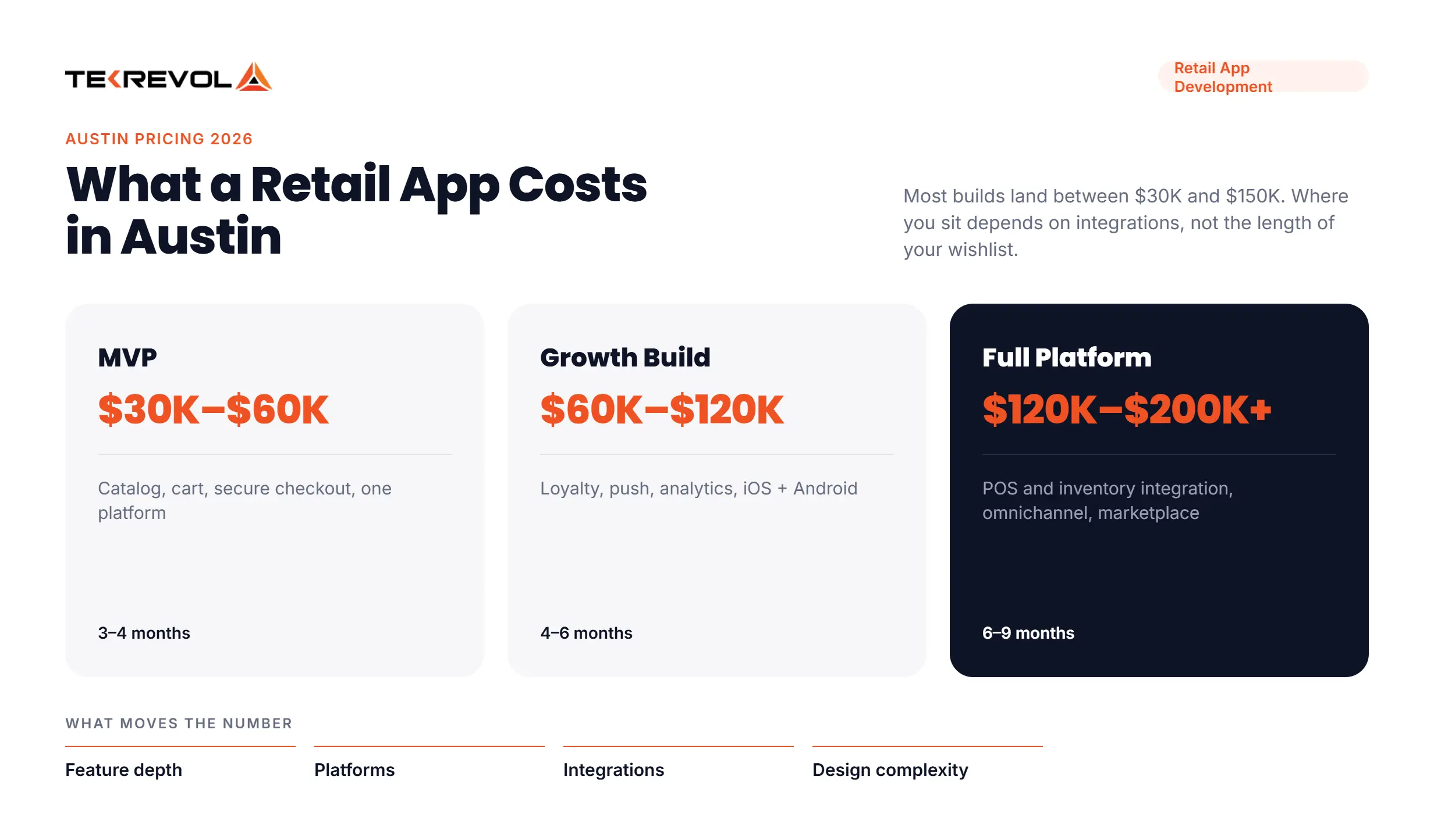
Four drivers matter most. Feature depth, like subscriptions or AR try-on. Platforms, since one cross-platform build usually beats two native apps on cost. Integrations with your POS, inventory, and payment systems. And design complexity, since custom, brand-heavy interfaces take more work than templates.
Not Sure Which Stage Your Store Needs?
Get a scoped retail app estimate tailored to your existing systems and business goals, not a generic template.
Get a Free Project EstimateWhat Features Does a Retail App Need?
The features that move retail revenue are the ones that make buying and re-buying easy. Fast checkout, saved payments, loyalty rewards, real-time inventory, and smart push notifications do more for sales than any single gimmick. Discovery and personalization come next.
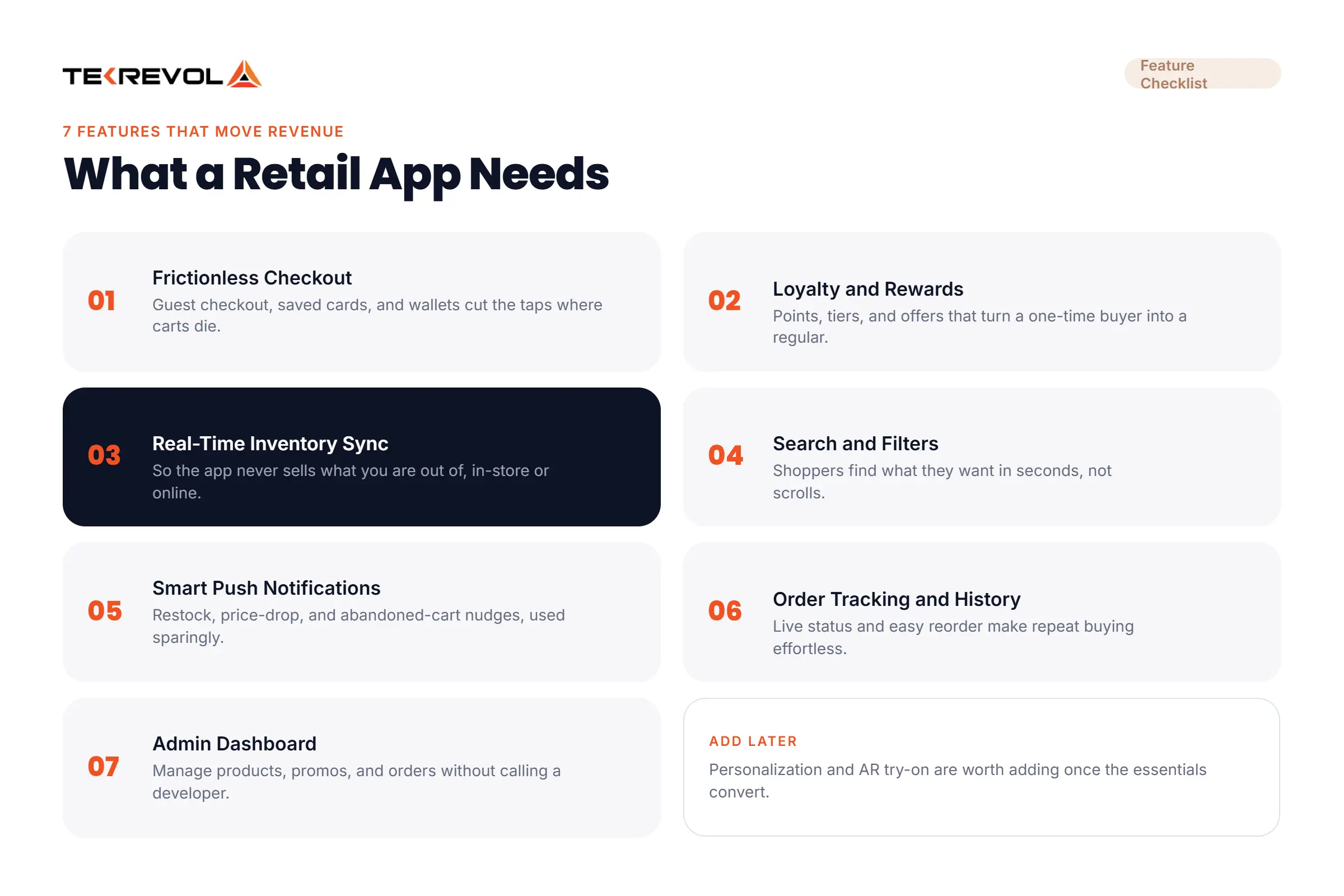
We tell founders to separate table-stakes from differentiators. Here’s the core set for a serious retail project, including food ordering app development, with the payoff each one earns:
- Frictionless checkout: guest checkout, saved cards, and digital wallets that cut the taps where carts die.
- Loyalty and rewards: points, tiers, and offers that turn a one-time buyer into a regular.
- Real-time inventory sync: so the app never sells something you’re out of, in-store or online.
- Product search and filters: so shoppers find what they want in seconds, not scrolls.
- Smart push notifications: restock, price-drop, and abandoned-cart nudges that convert when used sparingly.
- Order tracking and history: live status and easy reorder that make repeat buying effortless.
- Admin dashboard: so your team manages products, promos, and orders without calling a developer.
Notice each feature names the payoff, not just the label. That’s how you brief a developer and know nothing important got skipped. Personalization and AR try-on are worth adding later, once the essentials convert.
Should You Build a Custom App or Use a Platform Like Shopify?
Use a platform app when you need standard shopping fast and cheap. Build custom when your brand experience, loyalty model, or store integration is your edge, and templates get in the way. Many Austin retailers start on a platform, then move to custom as they scale.
We push back on both extremes. Building everything from scratch when a Shopify or BigCommerce app would do is burning budget on solved problems. But forcing a genuinely unique retail experience into a rigid template is how brands end up looking like everyone else.
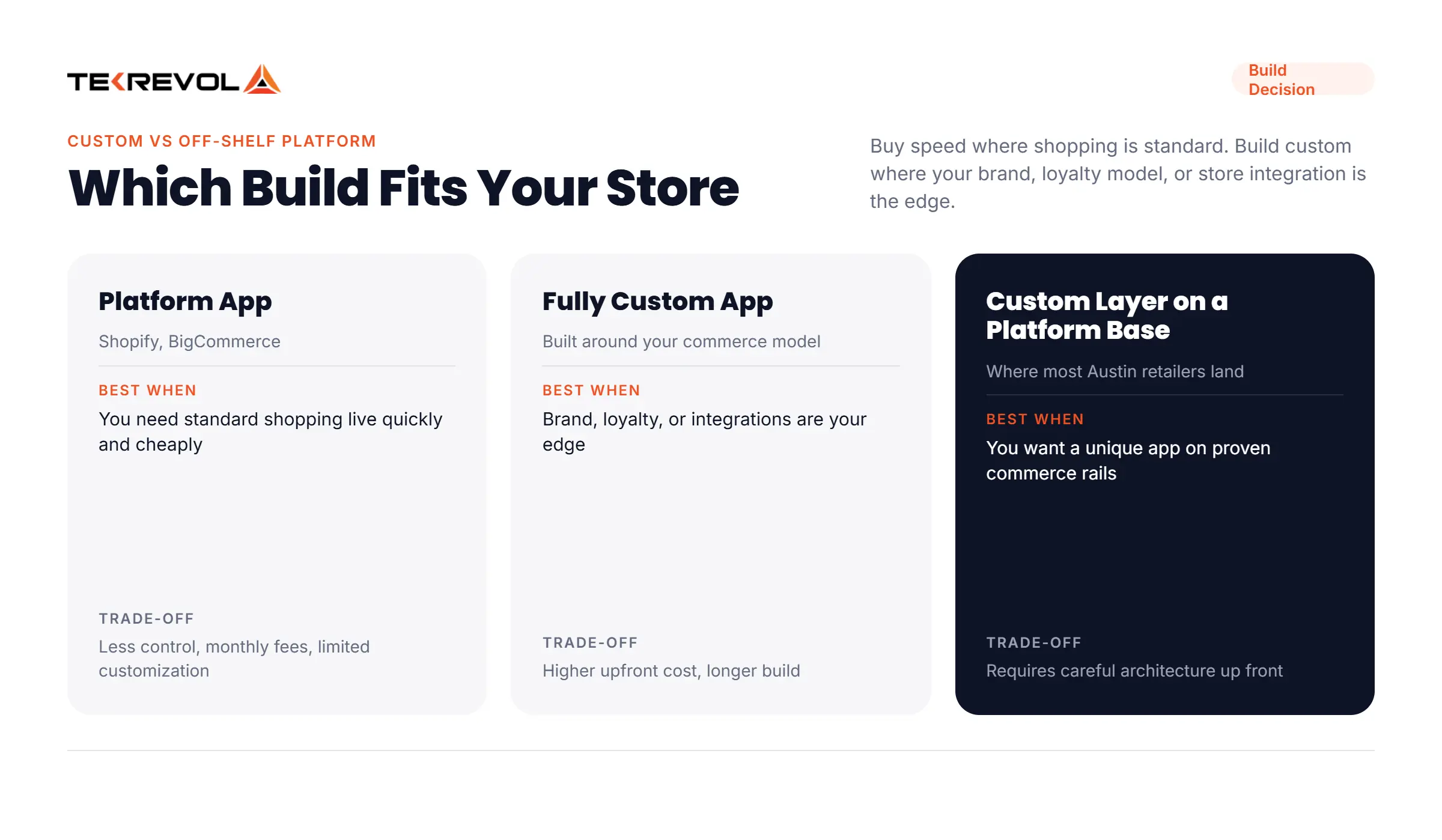
The honest framework is about where your value actually lives.
| Approach | Best when | Trade-off |
| Platform app (Shopify, BigCommerce) | You need standard shopping live quickly | Less control, monthly fees, limited customization |
| Fully custom app | Brand, loyalty, or integrations are your edge | Higher upfront cost, longer build |
| Custom layer on a platform base | You want a unique app on proven commerce rails | Requires careful architecture |
For brands that also need the web side handled, our e-commerce website development work is built to connect cleanly with the app.
How Long Does It Take to Build a Retail App in Austin?
Most retail apps take three to six months from kickoff to launch. A lean MVP can ship faster; a full omnichannel build with POS and inventory integration runs longer. The biggest timeline variable isn’t code but how many existing systems need connecting.
Timelines slip for predictable reasons, and integrations top the list.
The build itself is measurable, but what stretches a schedule is connecting to the systems you already run: a legacy POS, a picky inventory tool, a payment setup with its own quirks. Clear scope up front remains the single biggest factor in hitting the target date.
| Build type | Typical timeline | What drives the range |
| MVP | 3–4 months | Single platform, core shopping flow |
| Growth build | 4–6 months | Loyalty, push, analytics, iOS + Android |
| Full omnichannel | 6–9 months | POS, inventory, in-store pickup, integrations |
We run a clear path: sketch, design, develop, test, then rollout and upscale, so you approve the flow before code, and starting with an MVP lets you validate demand before adding the expensive extras.
How Does a Retail App Connect to Your Store?
Through integrations. A retail app links to your point-of-sale, inventory system, payment gateways, and often your existing website or platform. Those connections are what make features like buy-online-pickup-in-store, real-time stock, and unified customer profiles possible. They’re also where weaker teams struggle.
This is the part that separates a real omnichannel app from a pretty catalog. The integrations that matter most are:
- POS (so online and in-store share one truth),
- Inventory (so stock is accurate everywhere), and
- Payments (secure, PCI-compliant, wallet-ready)
Add a CRM connection, and you get one customer profile across every channel.
Get these right, and the payoff is concrete: a shopper reserves online, picks up in-store, and your inventory updates in real time. Get them wrong, and you’re back to overselling and disappointed customers. This is exactly why “my cousin can build an app” tends to end in a rebuild.
Worried About Connecting an App to Your POS and Inventory?
Talk to TekRevol's Austin team and get your POS and inventory integration questions answered in a free consultation.
Book Your Free ConsultationHow Do Retail Apps Drive Loyalty and Repeat Sales?
Apps win on retention, not just the first sale. Push notifications, saved carts, loyalty points, and one-tap reorder pull shoppers back without paid ads. That’s the real economic case for a retail app: it lowers the cost of the second, third, and tenth purchase.
The first sale is the expensive one, because you paid for it with ads, discounts, or foot traffic, and everything after that acquisition cost is where your actual margin lives.
A good app makes returning easy and rewarding. Loyalty tiers give a reason to consolidate spending with you. Push notifications bring people back at the right moment maybe a restock, a sale, a forgotten cart. Saved payment and reorder remove the friction that sends shoppers elsewhere.
Retail apps also unlock first-party data, which matters more every year as third-party tracking fades. Knowing what your customers actually buy lets you personalize offers instead of guessing, and that’s a durable advantage.
What Results Can a Well-Built Retail App Deliver?
Done right, retail apps move sales, order value, and repeat rate.
Across TekRevol’s retail and e-commerce portfolio, Mdrouz drove 40% more sales, and Al Hussaini grew its e-commerce 5x. The pattern is friction removal, not feature stuffing.
| Project | Category | Result | What drove it |
| Mdrouz | E-commerce | 40% more sales | Seamless, low-friction shopping flow |
| Al Hussaini | Retail/trading | 5x e-commerce growth | Rebuilt online buying experience |
TekRevol also runs a dedicated e-commerce practice with 50+ e-commerce developers and 150+ apps delivered across 11+ industries, so payments and inventory aren’t new territory.
How Do You Choose a Retail App Development Company in Austin?
Pick a partner who’s shipped real stores, not just generic apps. Run every candidate through the same short test. It saves months.
- Ask for the number. A real retail case study names a sales, order-value, or retention gain, not just “a nice UI.”
- Check integration depth. Payments, POS, and inventory are where inexperienced teams break. Ask to see live shopping apps.
- Confirm a local footprint. TekRevol builds from downtown Austin (701 Brazos St), holds a 4.8 rating across 83+ Clutch reviews, and has shipped 150+ apps.
- Nail down post-launch support. Who fixes the checkout bug on Black Friday? Confirm maintenance and SLAs before signing.
Local matters more in retail than most categories, because launches and peak-season traffic are exactly when you need a real person you can reach.
Why Choose TekRevol for Retail App Development in Austin
We build retail apps with a dedicated e-commerce practice, a downtown Austin presence, and a track record you can verify. That mix of deep commerce engineering plus a local team you can actually meet is what keeps a retail build from turning into an expensive rebuild.
A few things that matter for a retail app specifically:
- A dedicated e-commerce practice: 50+ e-commerce developers and 150+ apps delivered across 11+ industries, so payments and inventory aren’t new territory.
- Full-stack retail capability: from the app to a connected e-commerce website, built to work together instead of fighting each other.
- Real local presence: an app development team in downtown Austin at 701 Brazos St you can meet, not a distant vendor.
- Verified track record: a 4.8 rating across 83+ Clutch reviews, with named results like Mdrouz’s 40% sales lift, not vague promises.
Retail rewards apps that make the second purchase easy, and the right partner gets the integrations and loyalty mechanics correct the first time. We’d rather help you scope it that way than watch you rebuild it after a rough launch.
Turn Your Store into an App Austin Shoppers Keep Coming Back to
Talk to TekRevol's retail app specialists and get a scoped, itemized project estimate within 48 hours.
Schedule Your Free Consultation


