



- Cross-platform apps (Flutter/React Native) cost ~30–40% less in Dubai, with MVPs from AED 45,000 vs AED 147,000+ native.
- Android holds ~79.85% UAE market share, making cross-platform the most efficient way to reach all users.
- Flutter leads in 2026 for pixel-perfect UI, Arabic RTL support, and near-native performance.
- React Native is the better choice for teams already working in JavaScript or sharing logic with an existing web platform.
- Only 5–10% of apps need native, mainly for AR/VR, regulated fintech, or deep hardware features.
- React Native MVPs take 4–8 weeks; Flutter MVPs typically take 6–10 weeks.
- Plan UAE compliance early; adding TDRA, PDPL, DFSA, and RTL later is significantly more expensive.
Dubai’s app development market has matured. Founders in 2026 aren’t debating whether to build, they’re debating how. And that decision carries real consequences for budget, timeline, and long-term product trajectory.
The native vs cross-platform conversation is one of the most misrepresented in the region’s tech ecosystem. Agency blogs frame it as settled. Developers argue from whichever stack they know best. The result is a lot of confident advice with a lot of hidden agendas behind it.
This guide has none of that. What follows is a straight, industry-specific breakdown of both approaches, what each actually costs in the UAE market, where each genuinely wins, and how to make the right call for your business without being sold to in the process.
Read this before you budget a single dirham.
What Is Native App Development? (And When Dubai Businesses Choose It)
Native app development in Dubai focuses on building applications specifically for a single platform, such as iOS or Android, using languages like Swift, Objective-C, Kotlin, or Java. Native apps offer a performance advantage and are highly reliable for complex localization needs like Arabic RTL support, local date formats, and UAE-specific payment gateways.
Businesses that approach a reliable mobile app development company in Dubai typically prioritize native solutions for government, fintech, healthcare, and enterprise use cases, where security, compliance, and performance are non-negotiable.
If your project falls into any of these categories, working with a team that understands both the technical depth and the regional landscape makes all the difference.
Core Advantages of Native App Development
- Peak performance: Animations, graphics, and real-time processing run at maximum efficiency, even across multilingual interfaces.
- Full hardware access: Face ID, GPS, ARKit, NFC, and every sensor your device carries.
- Built-in localization depth: iOS and Android each have mature, battle-tested localization frameworks. Arabic RTL layouts, dynamic font scaling, and locale-aware content render natively without workarounds.
- Platform-specific security: Critical for UAE fintech apps under CBUAE regulation and healthcare apps governed by the Dubai Health Authority (DHA), where data handling must meet strict regional compliance standards.
- Day-one SDK access: when Apple or Google drops a new feature, native apps get it immediately. No waiting for a framework to catch up.
- Platform-native UI: Apps feel exactly right on each device, in every language. Dubai users notice. They trust it more.
When TekRevol built the Tamreeni App, the goal was simple: create a fitness app that truly understood its UAE users. The result spoke for itself: 3M+ downloads, a 40% increase in user engagement, and a 60% lift in retention rate. This is what happens when the right architecture is matched to the right market.
Drawbacks of Going Native in Dubai
The tradeoffs are real, and they hit your bottom line directly.
- Two separate codebases mean two dev teams, two QA cycles, two deployment pipelines. For Dubai businesses managing both Arabic and English versions, that complexity multiplies further; every UI change, every RTL adjustment, every localized string gets reviewed and tested twice across both platforms.
- Longer time-to-market: In Dubai’s fast-moving startup scene, that delay has a price. If your launch window is tied to a season, a regulatory deadline, or a market moment, building native on both platforms can cost you it.
- Zero code reuse between platforms: Every feature gets built twice, and so does every localization update. New Arabic copy, updated currency formatting, region-specific onboarding flows, all of it gets implemented separately for iOS and Android.
- Post-launch maintenance doubles: Bug fixes and updates can become expensive over time, especially for UAE businesses serving diverse users with changing compliance and content needs.
UAE Use Cases Where Native is the Right Call
Industry analysis suggests fewer than 10% of commercial apps genuinely require native-only development; the vast majority fall comfortably within cross-platform capability. In Dubai specifically, native development makes sense for:
- Dubai International Financial Centre (DIFC)-regulated fintech platforms, where real-time transaction performance and CBUAE compliance are non-negotiable
- UAE government apps requiring deep device integration with UAE PASS and biometric authentication
- AR-powered PropTech apps are doing real-time 3D rendering of off-plan properties in Dubai Marina or Downtown
- Healthcare apps syncing with wearable health technology under DHA jurisdiction
- High-end gaming and metaverse experiences targeting the UAE’s fast-growing gaming market.
What Is Cross-Platform App Development?
Cross-platform development lets you write one codebase that runs on both iOS and Android. This isn’t a website in an app shell. It’s compiled code that renders near-native components.
In 2026, the gap between cross-platform and native has closed to a point where it’s no longer the dealbreaker it used to be. The three cross-platform frameworks dominating Dubai app development right now: Flutter, React Native, and the rising Kotlin Multiplatform.
Flutter App Development in Dubai
Flutter is Google’s open-source framework, built on the Dart language. It doesn’t rely on the platform’s native UI components; it draws everything itself. That gives you pixel-perfect control over every screen, on every device, in every language.
Flutter app development in Dubai has become the go-to choice for startups that need a uniform experience across iOS, Android, and web, without having to build twice. It also handles Arabic RTL, locale-aware design, and cultural UI needs through a single codebase.
Flutter works best for an MVP app development in Dubai, as its shared codebase delivers the fastest path from scope to launch. It is also a recommended choice for:
- Consumer apps: where brand consistency across platforms and languages is non-negotiable
- E-commerce platforms, loyalty apps, and fintech dashboards serving Dubai’s multicultural, multilingual user base
- Projects with tight timelines, where shipping localized builds efficiently is as important as the budget
For most UAE startups building their first product, the cross-platform route pairs naturally with an MVP approach. Rather than building full native apps for both platforms, an MVP app development strategy in Dubai lets you validate your idea on a shared codebase, then invest in native performance once you’ve proven market fit.
React Native App Development in Dubai
React Native app development in Dubai is not slowing down. It powers Facebook, Instagram, Shopify, and Discord, and in 2026, its New Architecture has made it more competitive than ever.
The New Architecture, Fabric renderer, JSI bridge, and TurboModules delivered measurable improvements:
- App startup time improved by 43%
- JavaScript-to-native communication is 40x faster than the old bridge
- Memory usage dropped by 26%
- Rendering speed improved by 39%
For Dubai businesses, React Native’s biggest practical advantage is the developer pool.JavaScript is the most widely used programming language in the world.
React Native has a strong track record for supporting Arabic RTL. Its component-based structure works well with bidirectional text, and the ecosystem includes solid localization libraries for Arabic.
When Kinder Morgan needed a mobile platform for real-time data access across its oil and gas operations, TekRevol built Kinterex Energy on React Native with RBAC security and role-specific access controls. The result: fast performance, intuitive UX, and enterprise-grade security from a single cross-platform codebase. This is the React Native New Architecture story in practice, not theory.
Other Frameworks Worth Knowing in 2026
- Kotlin Multiplatform: shares business logic across Android and iOS while keeping native UI on each platform. Rising fast for Dubai enterprise apps that need long-term scalability and tight control over region-specific compliance logic.
- .NET MAUI: Microsoft’s framework for enterprise teams already operating in a Windows ecosystem, with solid internationalization support for Arabic and other RTL languages.
- Hybrid apps (Ionic, Cordova): A web view wrapped in a native shell is cheap but slow, with poor UX and inconsistent Arabic RTL support, usually not suitable for Dubai’s market demands.
Not sure which cross-platform framework to pick? Read our full Flutter vs React Native breakdown.
Not Sure Which Framework Fits Your Business?
We’ve delivered native and cross-platform apps across key UAE industries. Tell us your idea, and we’ll map the best way to build it.
Get Your Free Technical ConsultationDubai’s Mobile Market Context: The Data Behind The Decision
According to Statcounter, Android commands 79.85% of the UAE mobile market as of April 2026. iOS sits at 20.1%. That is a nearly 4:1 ratio in Android’s favor.
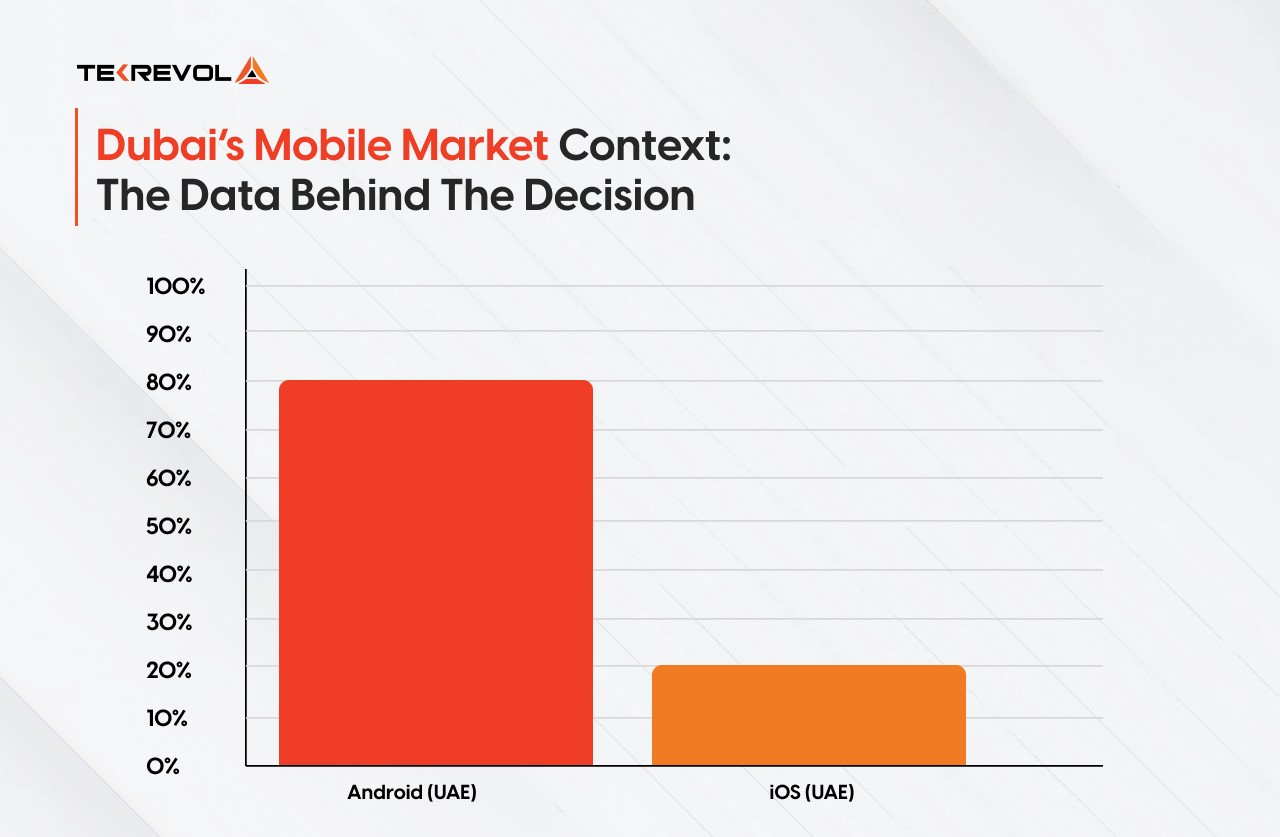
The nuance is worth understanding: in premium urban demographics, DIFC professionals, high-income Emirati households, and Downtown Dubai residents, iOS adoption trends are meaningfully higher than the national average.
iOS is the fastest-growing OS segment in the UAE by revenue, because iPhone average selling prices are high. But revenue growth is not the same as market share. If you are building a mass-market consumer app in the UAE, ignoring Android means ignoring 80% of your potential users.
If you are building a premium fintech or luxury retail app targeting DIFC-adjacent demographics, your iOS/Android split will look more balanced, but Android still matters significantly.
This single data point is the strongest argument for cross-platform development in the UAE. Building native for iOS only caps your reach at roughly 1 in 5 UAE users. Cross-platform saves roughly 30–40% compared to building native for both platforms separately. Cross-platform solves that problem with one codebase.
Additional market context:
- UAE smartphone penetration is at 99% according to Khaleej Times.
- Mobile traffic share of total UAE web visits: 64%
- Xiaomi leads the UAE device market at 20.9% vendor share, followed by Samsung at 17.71%, Apple at 13.82%
Note: vendor share measures which manufacturer made the device; OS share measures which operating system it runs; they are different metrics and will show different percentages for the same brand.
The native vs cross-platform question assumes you’ve decided which platforms to target. If you’re still working through whether your audience skews iOS or Android, our detailed comparison of Android vs iOS app development in Dubai covers UAE device demographics, App Store differences, and the purchase behaviour data that should drive that decision.
Native vs Cross-Platform App Development in Dubai: Head-to-Head Comparison
The right framework depends entirely on what your app needs to do and how fast you need to ship it.
| Factor | Native iOS/Android | Flutter | React Native |
| Performance | Exceptional | Near-native | Near-native |
| Dev Cost (Dubai) | AED 147,000–1,100,000+ | AED 45,000–250,000+ | AED 45,000–250,000+ |
| Time to Market | Slower (2 codebases) | Fast | Fast |
| Code Reuse | 0% | ~80% | ~70% |
| UI Quality | Platform-perfect | Custom & consistent | Near-native |
| Security | Highest | High | High |
| Maintenance | Complex (2 teams) | Simple (1 codebase) | Simple (1 codebase) |
| Best For | Fintech, gaming, AR | Startups, MVPs, UX-heavy apps | JS teams, web+mobile products |
Note: Arabic RTL support is handled differently across frameworks. Flutter’s layout engine has native RTL support; React Native requires more manual configuration; native Swift and Kotlin offer the most control. Our guide to Arabic mobile app development in Dubai covers framework-by-framework Arabic implementation in detail.
Cost of Native vs Cross-Platform App Development in Dubai (2026 Breakdown)
Mobile app development cost in Dubai typically ranges from AED 147,000 to over AED 1,100,000, depending on the complexity and scope of your project.
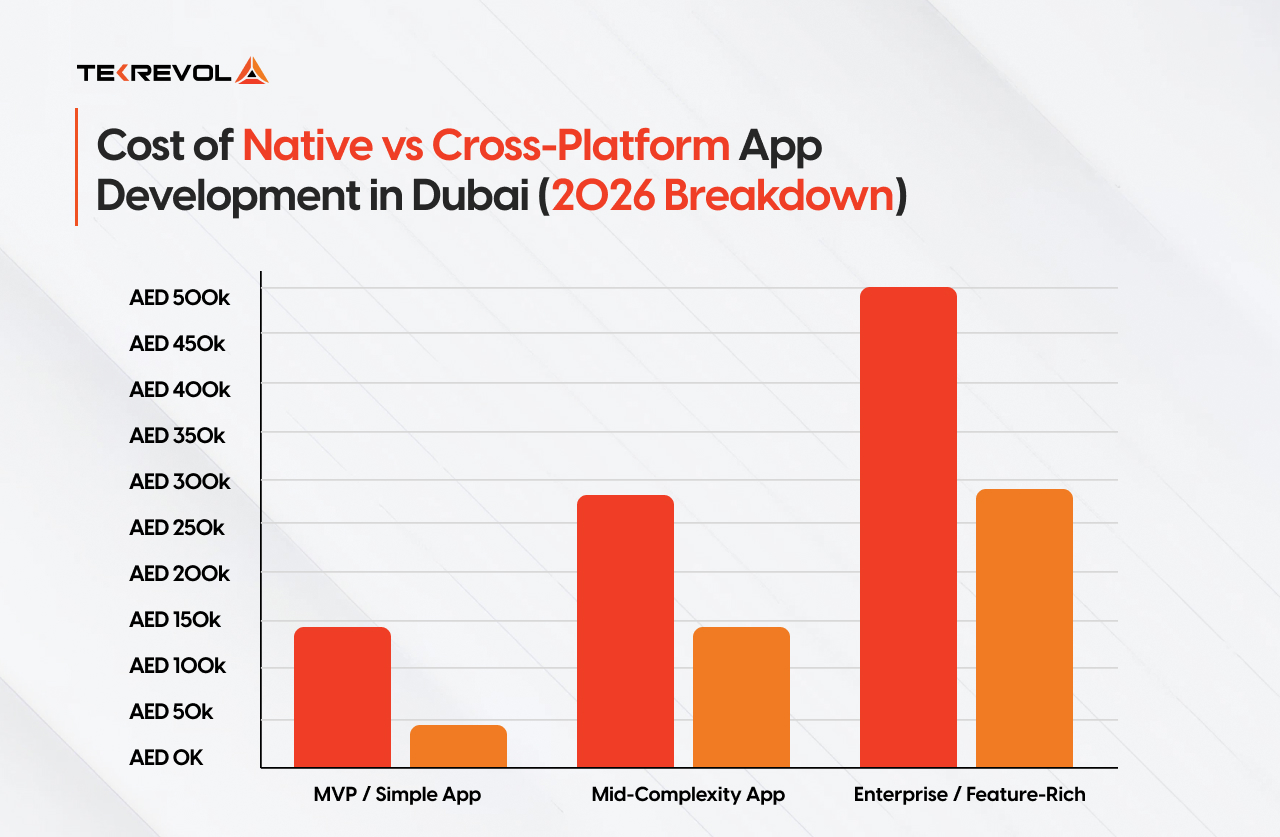
On average, most Dubai businesses invest between AED 350,000 and AED 550,000 for a well-built, fully functional mobile application.
| App Type | Native (Both Platforms) | Flutter/React Native |
| MVP / Simple App | AED 147,000–250,000 | AED 45,000–75,000 |
| Mid-Complexity App | AED 300,000–600,000 | AED 80,000–180,000 |
| Enterprise / Feature-Rich | AED 800,000–1,100,000+ | AED 200,000–250,000+ |
| Annual Maintenance | High — 2x effort | Lower — shared codebase |
Know Exactly What Your App Will Cost, Before You Build
Discuss your project with our Dubai team for a detailed cost breakdown, or jump straight into our cost calculator and get your estimate in under a minute.
Calculate Now!Hidden Costs to Watch Out For
The launch price isn’t the whole story. Budget for:
- Post-launch maintenance: Native apps require updates across two codebases, doubling effort and engineering cost.
- UAE-specific integrations: UAE PASS, local payment gateways, and government APIs add complexity on either path.
- Platform update cycles: Apple and Google release major OS updates annually. Native apps get them immediately. Cross-platform frameworks need time to catch up.
- Compliance overhead: UAE PDPL (Personal Data Protection Law), DIFC regulations, and DHA requirements add development and legal review costs regardless of your framework choice.
App Development Timelines: A Major Competitive Edge in Dubai’s Market
Timeline is one of the most significant practical advantages of cross-platform. A Flutter or React Native app can reduce your build time by 20–30% compared to two separate native codebases.
Typical Dubai timelines in 2026:
- React Native MVP: 4–8 weeks
- Mid-level Flutter app: 10–16 weeks
- Dual native iOS + Android: add 40–60% to those timelines
If you’re working against a hard launch deadline, our mobile app timeline guide for Dubai shows how platform choice sits within the broader development phases — and where the real delays happen.
Performance: Native vs Cross-Platform in 2026
For 90% of apps built for the UAE market, your users won’t notice any performance difference between native and cross-platform. In 2026, Flutter and React Native have closed the gap so well that only the most demanding applications still need fully native development.
Where Native Still Wins on Performance
There are specific scenarios where native is genuinely the better technical call for Dubai businesses:
- Heavy gaming and real-time 3D: Apps pushing GPU limits for gaming or immersive experiences.
- Complex fintech computation: Real-time trading platforms serving DIFC traders, fraud detection engines for UAE banks, high-frequency transaction processing for payment gateways handling thousands of AED transactions per second.
- Deep hardware integration: Medical devices for Dubai Healthcare City facilities, IoT sensors for smart city projects, and industrial systems in Jebel Ali Free Zone.
- Cutting-edge AR/VR: ARKit on iOS and ARCore on Android are still best accessed natively when microseconds matter, especially for AR shopping experiences during the Dubai Shopping Festival or virtual property tours in Dubai Marina.
Where Flutter and React Native Close the Gap
For standard business applications, which cover most of Dubai’s app market, the performance story has completely changed:
- E-commerce platforms, Noon-style marketplace apps, Talabat-like food delivery services, on-demand apps in Dubai, and loyalty programs for UAE retailers — cross-platform performance is indistinguishable from native.
- Flutter’s Impeller engine delivers consistent 60fps animations even during peak shopping events like the Dubai Shopping Festival, when traffic surges hit apps hard.
- React Native’s New Architecture (JSI + Fabric) eliminates the old JavaScript bridge bottleneck. The performance story has changed dramatically since 2019, when many Dubai companies first explored cross-platform.
- Government service apps integrating with UAE PASS, Smart Dubai platforms, and TDRA-compliant solutions run smoothly on cross-platform frameworks.
- Arabic RTL support is now first-class in both Flutter and React Native, crucial for apps serving the UAE’s diverse population.
One area where native consistently outperforms cross-platform is on-device AI. CoreML on iOS and TensorFlow Lite on Android provide tighter hardware integration than what’s achievable through Flutter or React Native bridges. If your app relies on real-time inference, image processing, or intelligent personalization, AI-powered app development in Dubai covers when that performance gap matters and when it doesn’t.
Real-World UAE Examples
Apps like Noon, Talabat, and Careem handle millions of daily transactions across the GCC. Many successful UAE marketplace apps, loyalty platforms, and service booking systems run on cross-platform frameworks without performance issues.
During high-traffic events like:
- Dubai Shopping Festival peak hours
- GITEX Technology Week app launches
- Ramadan evening shopping surges
- Expo-style mass gatherings
Well-built cross-platform apps handle the load just as smoothly as native ones.
Yeppy is a UAE-based super app covering financial services, retail, and bookings for users across the GCC. TekRevol led the development with a focus on secure payments, scalable architecture, and a multilingual interface. This is what cross-platform development looks like at the enterprise level in the UAE.
Hybrid vs Native App Development in Dubai: Is Hybrid Still Relevant in 2026?
Cross-platform apps and hybrid apps are not the same thing; confusing them is one of the most expensive mistakes a Dubai founder can make.
Hybrid (Ionic, Cordova) = web technologies wrapped in a native shell. It’s a website in a box.
Cross-platform (Flutter, React Native) = compiled near-native code. Fundamentally different performance and UX.
When Hybrid Apps Still Make Sense in 2026
- Internal employee portals where staff have no choice but to use the tool
- Proof-of-concept builds for investor demos at in5 Dubai or Hub71 Abu Dhabi
- Basic content directories or corporate event apps where speed of deployment beats experience quality
Why Most Dubai Businesses Are Moving Away from Hybrid
Dubai and UAE app users are among the most sophisticated in the world. They use Careem for rides, Noon for shopping, Talabat for food delivery, Emirates NBD and ADCB for banking, all fast, polished, and smooth.
When weighing hybrid vs native app development in Dubai, the user experience gap is the deciding factor. UAE users notice the difference immediately, in feel, in polish, in trust.
App Store algorithms penalize high crash rates and slow load times, both hybrid weaknesses. This hurts your visibility when targeting customers across the Emirates.
The UAE’s mobile-first market means your app competes with global-quality products. Dubai Shopping Festival shoppers won’t tolerate lag. DIFC traders demand instant performance. Healthcare apps serving Dubai Healthcare City demand reliability.
Flutter’s rise makes cross-platform the better choice at a similar price point to hybrid. You get near-native performance with Arabic RTL support, UAE PASS integration, and the smooth experience UAE users expect.
Government compliance: TDRA regulations and Smart Dubai standards favor robust, performant apps. Hybrid often struggles here.
Industry-Specific App Development Recommendations for Dubai Businesses
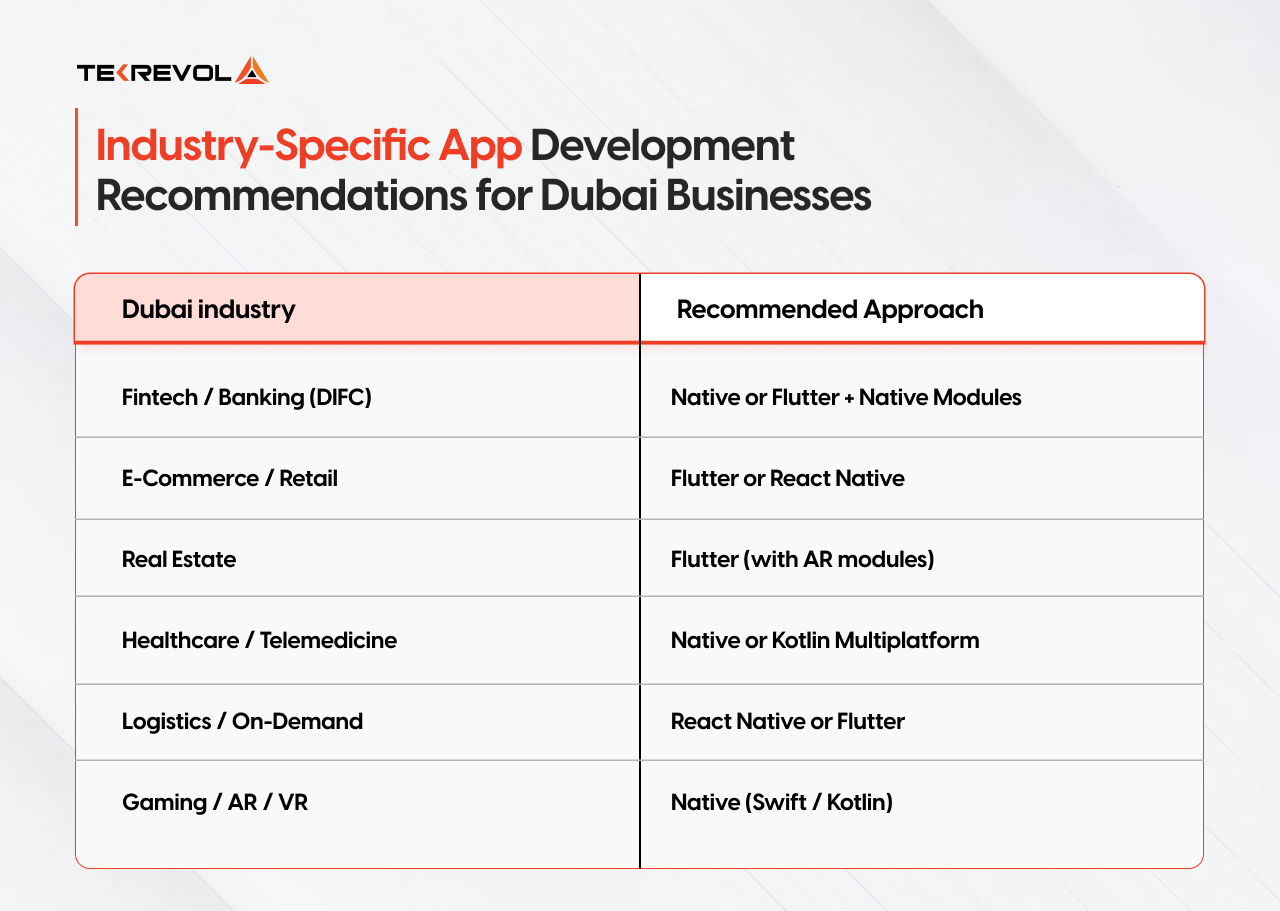
The right framework isn’t just about benchmarks; it’s about your regulatory environment, your users, and how your business scales. Here’s the breakdown by Dubai’s key sectors.
| Dubai industry | Recommended Approach | Why |
| Fintech / Banking (DIFC) | Native or Flutter + Native Modules | UAE PASS integration, biometric auth, DIFC compliance |
| E-Commerce / Retail | Flutter or React Native | Speed to market, consistent UX, cost efficiency |
| Real Estate | Flutter (with AR modules) | Rich UI, 3D tours, location features, fast prototyping |
| Healthcare / Telemedicine | Native or Kotlin Multiplatform | DHA compliance, UAE PDPL, secure data handling |
| Logistics / On-Demand | React Native or Flutter | Real-time GPS, push notifications, cross-platform reach |
| Gaming / AR / VR | Native (Swift / Kotlin) | Hardware-level GPU access, maximum performance |
How to Choose: The 5-Factor Decision Framework for Dubai Founders
Choosing the right app development approach in Dubai has no universal answer, but there is a right answer for your specific business. Work through these 5 factors, and the decision usually makes itself.
Factor 1 — What’s Your Budget and Timeline?
If your budget is under AED 150,000 or you need to launch in under 6 months, cross-platform is your path. Flutter and React Native were built precisely for this scenario: quality apps, fast timelines, realistic budgets.
If you have a runway and you’re building a complex product for the long term, native is worth the investment.
Factor 2 — How Performance-Intensive Is Your App?
Take a clear-eyed look at what your app actually needs to do. Most business apps, even complex ones, don’t push device hardware anywhere near its limits. If yours does (real-time 3D, AR, biometric-heavy security flows), go native. If it doesn’t, cross-platform performs fine.
Factor 3 — What Does Long-Term Scalability Look Like?
Think 3 years ahead. Will your app grow into a platform? Will it need deep OS integrations as Apple and Google introduce new features? Native gives you the most headroom. Cross-platform frameworks are catching up, but they still lag on day-one support for bleeding-edge OS capabilities.
Factor 4 — What Are Your Compliance and Security Requirements?
Operating under DIFC regulation? Building under DHA jurisdiction? Handling financial data under CBUAE oversight? Processing payments that require PCI-DSS compliance?
Native apps have a traditional advantage in meeting the most demanding platform-specific compliance requirements, particularly around hardware-level encryption, biometric authentication architecture, and direct OS-level security APIs.
In practice, Flutter with properly architected native security modules meets UAE compliance requirements across most regulated sectors. But for the most stringent DIFC-regulated financial infrastructure, a native or a Flutter-plus-native-modules hybrid is the safer architectural choice.
Factor 5 — What’s Your Target Platform Split in the UAE?
Platform choice in the UAE isn’t a coin flip. Android commands roughly 80% of the UAE smartphone market. However, in premium urban demographics, DIFC professionals, and high-income Emirati households, iOS adoption trends are significantly higher than the national average.
If your product targets a broad demographic, cross-platform is the logical answer. You cover both platforms, one build, zero compromise.
What to Look For When Hiring a Dubai App Development Company
Not every React Native app development company or Flutter agency that lists these frameworks on its website has the UAE-specific expertise your project needs. Here is exactly what to check before you sign anything.
- Can they show you a live bilingual Arabic/English app they have shipped — not a mockup, a live app store listing?
- Do they understand PDPL compliance, TDRA NOC requirements, and your sector’s specific regulatory framework?
- Have they integrated local payment gateways — Tabby, Tamara, Network International — in previous projects?
- Do they have sector experience in your vertical, not just generic mobile development experience?
- Is their pricing in AED with clearly defined deliverables and no ambiguous scope items?
- What is their post-launch maintenance SLA, and how do they handle OS update cycles?
A competent Dubai app development agency can answer all six questions with live examples. If they can’t answer these confidently, treat that as a meaningful signal
How TekRevol Can Help You Build Your App in Dubai
TekRevol is a Dubai-based mobile app development company specializing in native and cross-platform app development across the UAE market, with hands-on experience across fintech, PropTech, e-commerce, and healthcare. Every recommendation in this guide comes from that ground-level experience, not theory.
As a Flutter app development company with a dedicated Dubai team, we know exactly when Flutter is the right call and when it isn’t, and we build accordingly, with Arabic RTL architecture that actually works and UAE compliance baked in from day one.
What you get when you hire mobile app developers in Dubai from TekRevol:
- End-to-end native and cross-platform development: Swift, Kotlin, Flutter, and React Native, with a team that has shipped bilingual Arabic/English apps across both app stores
- UAE compliance architecture: PDPL, TDRA NOC, DFSA, RERA, and sector-specific regulatory frameworks built into your app from the wireframe stage, not retrofitted before launch
- Dubai market expertise: local payment gateways, UAE PASS integration, Arabic ASO for App Store and Google Play, and a team that understands how UAE consumers actually use apps
- Transparent AED pricing with defined deliverables: Everything is clearly defined, costs are upfront, and your app stays supported across all updates.
Get Your Free App Strategy Session — Worth AED 1,500
Talk to our Dubai experts and know exactly what to build, how much it costs, and when you can launch.
Book Your Free Session now!


![MVP App Development in Dubai [2026 Guide For UAE Startups]](https://tekrevol-stage.s3.us-east-1.amazonaws.com/images-tek/uploads/2026/05/imgi_1_Tek-Feature-29-400x204.webp)
![Fintech App Development in Austin: Cost, Compliance & Build Strategy [2026]](https://tekrevol-stage.s3.us-east-1.amazonaws.com/images-tek/uploads/2026/07/TekRevol-Fintech-Feature-Image-selection-400x208.jpg)


