



If you’ve ever worked on a business idea, pitch deck, or growth plan, you’ve probably come across three terms that sound more complicated than they actually are: TAM, SAM, and SOM.
At first glance, they feel like investor jargon. But once you understand them, they become one of the most useful tools for answering a simple question:
Is your business opportunity actually worth pursuing?
This guide breaks down the TAM SAM SOM meaning in plain language, shows the difference in TAM vs SAM vs SOM, and explains how to calculate TAM step by step. No complicated theory, just practical thinking you can actually use.
And here’s the part most founders overlook: knowing your market size is only half the battle. The real advantage comes when you combine clear market validation with smart execution. That’s where working with an experienced digital marketing agency can help you translate numbers into traction.
Many growing startups also partner with product-focused teams like Tekrevol to turn validated opportunities into scalable digital platforms built for long-term growth.
What Is TAM, SAM, and SOM?
When people search what is TAM SAM SOM, they’re usually trying to understand how businesses measure real opportunity — not just big numbers on a slide.
Here’s the simple version:
- TAM (Total Addressable Market) – The total revenue opportunity if you captured 100% of the market.
- SAM (Serviceable Available Market) – The portion of the total addressable market your business can realistically serve.
- SOM (Serviceable Obtainable Market) – The realistic share of SAM you can capture in the near term.
Think of it like this:
Big ocean → Your fishing zone → Your actual catch
That’s the core TAM SAM SOM meaning.
But this framework isn’t just theory. The numbers behind it explain why market sizing matters so much.
Global business data shows that companies operating in high-growth markets scale significantly faster than those entering stagnant ones.
For example, the global SaaS market alone is projected to exceed $700 billion by 2030, while digital transformation spending worldwide is expected to cross $3.9 trillion by 2027. At the SAMe time, studies consistently show that nearly 35–40% of startups fail because there is no real market need.
What this means is simple:
The biggest risk isn’t competition, it’s building for a market that’s too small, too crowded, or not ready.
This is exactly where TAM vs SAM vs SOM becomes critical. It helps founders avoid overestimating demand, investors evaluate scalability, and businesses align their product, pricing, and growth strategy with real market potential.
In practical terms:
- TAM shows whether the opportunity is big enough to matter.
- SAM proves you understand your ideal customer segment.
- SOM demonstrates realistic execution based on your resources.
If your SOM doesn’t match your sales capacity or marketing reach, the numbers don’t hold up.
And once your market size is clear, the next step is execution. Many product teams follow structured frameworks like this guide on how to build an app in 10 easy steps to turn validated opportunities into working products.
Businesses targeting larger SAM and SOM opportunities also invest in scalable solutions through custom software development company, ensuring their technology can grow alongside their market.
Because at the end of the day, TAM SAM SOM isn’t just about estimating opportunity, it’s about making sure your product, technology, and growth strategy are built for the size of the market you’re actually entering.
Upgrade Healthcare Logistics With Smart Tech
TekRevol helps you build secure and scalable delivery solutions.
Get a Free Project Estimate!Understanding TAM vs SAM vs SOM Clearly
The difference in TAM vs SAM vs SOM becomes easier to understand with a practical example.
Imagine you’re building a SaaS payroll tool:
- TAM: All small and medium businesses globally
- SAM: Businesses in North America that use cloud-based payroll solutions
- SOM: The percentage you can realistically acquire within your first three years
Each layer answers a different business question:
| Metric | What It Proves |
| TAM | Is the opportunity large enough? |
| SAM | Are we targeting the right segment? |
| SOM | Can we realistically win? |
When discussing TAM vs SAM vs SOM, investors don’t get excited by massive TAM numbers alone. What they really want to see is whether your SOM aligns with your actual go-to-market capacity, your sales team size, marketing budget, distribution channels, and timeline.
This becomes even more important in product-based businesses. For example, if you’re planning a mobile product, your SAM may depend on platform choice. Businesses often narrow their market by deciding whether to target Android users first or focus on Apple’s ecosystem.
Strategic decisions like these are often guided by resources such as this overview of Android app development or a beginner-friendly guide to iOS app development, since platform selection directly affects reachable audience size and, ultimately, your SAM.
What Does SAM Mean in Business?
Many founders spend time estimating TAM but overlook segmentation. So let’s clarify: what does SAM mean in business?
SAM is the portion of the total addressable market that realistically fits your:
- Product capabilities
- Pricing model
- Geographic focus
- Regulatory environment
- Target customer profile
For example, if the global fintech market is valued at hundreds of billions (TAM), but your solution serves only UK-based small businesses, your SAM becomes much smaller, but far more actionable.
And this narrowing isn’t just strategic, it reflects real market structure. According to data from the U.S. Census Bureau, there are over 33 million small businesses in the United States, but only a fraction operate in specific industries, revenue brackets, or technology adoption levels. That means your true SAM is always a targeted slice of the broader market, not the entire business population.
This is why strong TAM SAM SOM meaning isn’t about chasing the biggest number, it’s about identifying the segment where your product fits best and where you can reach customers efficiently.
Businesses that define a focused SAM typically achieve faster product-market fit, lower acquisition costs, and more predictable growth compared to those targeting broad, undefined markets.
How to Calculate TAM (Step-by-Step)
Let’s talk practically.
When people ask how to calculate TAM, they usually overcomplicate it. They think they need a 60-page industry report or a consulting firm.
You don’t.
The most reliable way to calculate Total Addressable Market is surprisingly simple. It’s called the bottom-up method, and it starts with SOMething very basic:
How many real customers exist and how much would each pay you?
Let’s walk through it.
Step 1: Estimate Your Total Potential Customers
Start with a clearly defined group.
Not “all businesses in the world.”
Not “everyone with a smartphone.”
Be specific.
Let’s say you’re building payroll software for small businesses in the U.S. After researching market data, you identify 250,000 businesses that match your ideal customer profile.
That’s your potential customer base.
Step 2: Estimate Average Annual Revenue per Customer
Now ask:
What would each customer realistically pay per year?
Let’s say your subscription costs $500 annually.
That’s your average revenue per customer.
Step 3: Multiply
Now the math becomes simple:
250,000 customers × $500 per year
= $125,000,000
That’s your total addressable market.
- No guessing.
- No inflated global projections.
- Just clean math based on real inputs.
Why This Method Works?
Big consulting firms and market research organizations consistently support bottom-up modeling because it forces discipline.
Instead of saying, “The global HR software market is worth billions,” you’re saying:
“There are 250,000 businesses I can target, and each pays $500.”
That’s believable.
And credibility matters more than big numbers.
Quick Reality Check Before You Present TAM
Before you put your TAM in a pitch deck, ask yourself:
- Does my customer count come from reliable data?
- Is my pricing realistic for this audience?
- Can I explain my math in under 30 seconds?
If the answer is yes, you’re on the right track.
If not, revisit your assumptions.
Because here’s the truth:
A realistic $125M opportunity is far more impressive than an imaginary $5B one.
If you want a simple visual explanation that walks through the math clearly, this video breaks it down well:
It explains the calculation in a straightforward way without overcomplicating the concept.
That’s how you calculate TAM, clearly, practically, and in a way investors actually trust.
Build Products That Scale With Your Market
We turn validated market opportunities into high-performing apps.
Get a Free Project Estimate!Common Mistakes Founders Make with TAM, SAM, and SOM
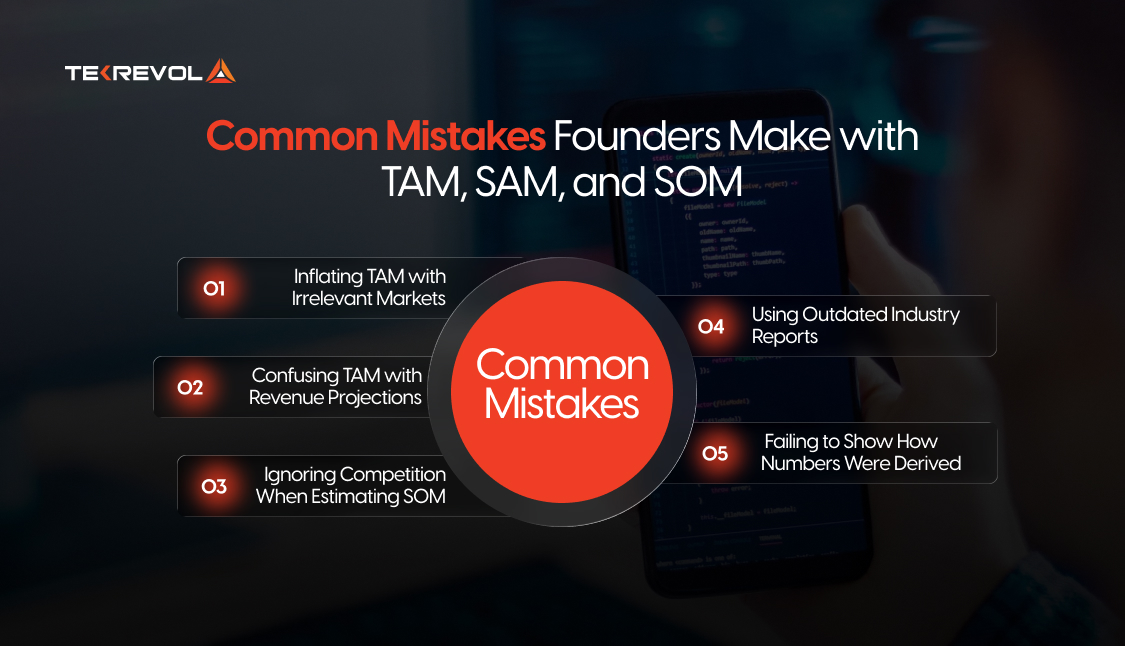
Even when founders understand what is TAM SAM SOM, many stumble when putting numbers on paper. Let’s go through the most frequent errors and how to avoid them.
Image 1:
1. Inflating TAM with Irrelevant Markets
A classic mistake is claiming, “The global SaaS market is worth $700 billion, so my tiny payroll tool can tap into it all.” Investors see through this immediately. If you’re targeting a specific segment, your TAM must reflect realistic, reachable users, not the entire global industry.
For example, Grand View Research reports the SaaS market is projected to reach $716.52 billion by 2030, but your true SAM is just a fraction, the small and medium businesses that use cloud payroll tools in your target geography.
2. Confusing TAM with Revenue Projections
TAM is potential, not guaranteed income. Your TAM may be $125M (based on actual customer counts and pricing), but you won’t earn all of it in Year 1. Mixing up these numbers can mislead investors or internal teams.
3. Ignoring Competition When Estimating SOM
SOM is the slice of SAM you can realistically capture. Many founders overestimate market share by ignoring competitors.
For instance, even if your SAM is $50M, claiming you’ll capture 50% in the first year is often unrealistic. Realistic early-stage market share usually ranges 0.5%–2% depending on the industry and resources.
4. Using Outdated Industry Reports
Markets change fast. Using reports from 2018 or older undermines credibility. Always reference current data sources like Forbes, CB Insights, or Grand View Research to validate TAM, SAM, and SOM assumptions.
5. Failing to Show How Numbers Were Derived
Investors and stakeholders want transparency. Don’t just drop a $50M TAM on a slide, explain how you calculated it, using your customer count × pricing × geography. Even a small table works wonders:
| Market Layer | Calculation Example | Result |
| TAM | 250,000 businesses × $500/year | $125,000,000 |
| SAM | 20% reachable segment | $25,000,000 |
| SOM | 2% realistic market share | $500,000 |
As a rule of thumb: a believable $50M opportunity beats an unrealistic $5T claim every time. It builds credibility and makes your projections actionable.
Top-Down vs Bottom-Up Market Sizing
When estimating TAM SAM SOM, there are two main approaches:
1. Top-Down
- Start with industry reports (Forbes, Grand View Research, Statista)
- Narrow down by geography, segment, or industry
- Quick, high-level estimate
Pros: Fast, good for TAM
Cons: Less credible alone, may overestimate market
2. Bottom-Up (Preferred)
- Start with real customer numbers
- Use actual pricing and realistic adoption rates
- Multiply to get TAM, then narrow to SAM and SOM
Pros: Credible, actionable, trusted by investors
Cons: Requires research and careful assumptions
Tip: Many SaaS startups and mobile app businesses rely on bottom-up modeling because it’s rooted in reality, not assumptions.
Guides like SaaS Application Development Guide and Tailored Scalable Solutions show how bottom-up market sizing integrates with real product planning.
Why TAM, SAM, and SOM Matter for Strategy?
Understanding TAM SAM SOM meaning isn’t just for investors, but for building your business with clarity. Here’s why:
Image 2:
- Set realistic revenue targets – Know what you can realistically earn in Year 1, 2, and 3.
- Plan marketing budgets – Focus spend on segments with highest ROI.
- Determine hiring pace – Scale your team according to potential market capture.
- Attract investors – Show you understand the opportunity and how you plan to win it.
- Avoid overbuilding – Prevent wasting resources on features for unreachable audiences.
Essentially, this framework replaces optimism with structure. When you know your TAM, SAM, and SOM, every decision, from product features to launch regions, becomes data-driven.
External research confirms the impact: Forbes reports that startups using structured market sizing frameworks achieve 30–40% higher growth rates than those relying on intuition.
Example: Platform Choice Impacts SAM and SOM
For digital products, your platform choice affects your reachable audience:
| Platform | Potential Users | Notes |
| Android | 72% global market share | Larger reach in emerging markets (Android Guide) |
| iOS | 28% global market share | Higher ARPU, premium users (iOS Guide) |
Knowing these numbers helps define your SAM and SOM realistically.
If you want a step-by-step visual explanation, this video breaks down TAM, SAM, and SOM clearly with examples:
At Its Core: TAM, SAM, SOM is About Clarity
Here’s the key takeaway:
It’s not about showing huge numbers. It’s about answering three essential business questions:
- Is the opportunity large enough?
- Who exactly are we targeting first?
- What can we realistically capture?
When you understand TAM vs SAM vs SOM, you stop guessing. You stop building for a mythical audience. And you start making data-driven decisions about growth, hiring, marketing, and product strategy.
Frameworks like Why Cloud-Native Solutions Are the Future and Cloud Migration Strategy demonstrate how knowing your market feeds directly into scalable technology and product architecture, ensuring your solution grows with your market opportunity.
How TekRevol Helps Businesses Build Scalable Digital Solutions
Tekrevol specializes in building secure and scalable digital platforms designed for long-term growth. The company develops tailored solutions that help businesses enter and expand within their target markets efficiently. Their expertise ensures that products are built with scalability, performance, and future demand in mind.
With a strong focus on innovation and user experience, Tekrevol designs applications that align with real market opportunities identified through strategic planning. These solutions help businesses launch faster, scale confidently, and adapt as their total addressable market expands.
What Tekrevol offers:
- Custom mobile app development company and web development services
- Scalable architecture for growing markets
- Market-focused product strategy support
- Real-time analytics and performance optimization
- Secure data management systems
- Cloud-based consulting for scalability
- Integration with enterprise and third-party systems
Tekrevol works closely with startups and enterprises to build digital products that match their business goals and growth potential. Their team ensures seamless development, testing, and deployment for long-term success.
With deep expertise in product development and digital transformation, Tekrevol empowers organizations to turn market opportunities into scalable, high-performing platforms that drive sustainable growth.
Turn Your Market Potential Into A Scalable Product
TekRevol builds growth-ready digital platforms aligned with real TAM, SAM, and SOM strategies.
Get a Free Project Estimate!


