In the past, healthcare was focused on people, but the ways in which patients local healthcare systems have undergone very big changes. Nowadays, patients do not want to be solely reliant on phone calls, documents, or waiting for a long time to be able to manage their health. They demand digital solutions that are natural, comforting, and dependable. Health applications have turned into one of the main ways through which patients keep getting reports, communicate with doctors, and monitor their health.
Along with the increase in digital adoption, patients are also getting more particular. They look at health apps the same way they do other everyday platforms that they use regularly. If an app is not only slow and impersonal but also confusing, it almost instantly becomes irrelevant. That is why the AI in healthcare app development company has become a pivotal factor in whether patients decide to keep using an app or completely give it up.
Even better, patients want technology not to be an additional source of stress but rather to be a factor that eases their stress. They want to have a clear picture of things instead of dealing with unnecessary complications, and to feel in control rather than being dependent on someone else. Getting an accurate idea of what patients really expect from health applications becomes indispensable if one wants to gain the patient’s trust, increase their involvement, and consequently, get better health outcomes.
Why Do Patient Expectations Matter Most in Digital Health?
Patient expectations have changed significantly over the past few years as they become more familiar with digital technologies in different industries. When customers get used to easy-to-use and engaging applications for shopping or banking, it is only natural that they would expect a similar experience from healthcare systems. This shift has pushed healthcare application features to the forefront of product success.
- Statista reports that the global digital health market will be valued at hundreds of billions of dollars, with mobile health solutions being the main driver.
- Another Statista report reveals that revenue in the Healthcare Providers market is projected to reach US$8.73tn in 2026.
- Moreover, telehealth usage has increased by over 35 percent globally. This has significantly raised the bar for convenience and accessibility in the healthcare sector.
The figures tell a straightforward story. Patients, in fact, have become very aware of and impatient with health care that does not meet their needs. Hence, the healthcare app development company tightly controls the time of app use, data security, and most importantly, the supportive function of the health apps towards their needs.
Turn patient expectations into lasting engagement
Tekrevol designs healthcare application features that drive real results.
Get Your Free App RoadmapWhat Role Does Patient-Centered Design Play in Creating Successful Health Applications?
Patient-centered design is all about focusing on the actual user requirements instead of guessing. It also takes into account the different emotional conditions, limitations brought by disabilities, and the levels of technical skills. When health applications are designed with empathy, patients feel more confident navigating sensitive information.
Successful healthcare application features prioritize clarity and simplicity. They reduce cognitive load by organizing information logically and presenting medical data in understandable formats. This approach improves trust and encourages consistent usage over time. Moreover, android app development companies are also locking their investment into the healthcare sectors to bring new futuristic features to the users.
10 Must-Have Features For Patients in Health Applications
Patients are not expecting health apps to be able to do everything at the same time, rather they expect these apps to perform very well those few tasks that are most essential.
These essential features are the main reason behind patient satisfaction and their continuous engagement. Each of these features aids convenience, trust, and patient-ease of care management.
Easy and Secure Access to Personal Health Records
Patients should be able to get their health data at once without going through many hoops. Patients feel that transparency is a great tool that enables them to be informed and take charge of their care when they have access to lab results, diagnoses, or visit summaries.
Intuitive dashboards and the use of layman’s terms in medical records help users become conversant with their health data. Healthcare application impact on patients is all about security, and therefore, they need to be convinced that their sensitive data is very well guarded.
Key elements patients value include:
- Centralized access to medical history and reports
- Secure sharing of records with providers or caregivers
- Easy download options for personal use
- Clear presentation of health data
Seamless Appointment Booking and Management
Booking appointments should be easy and not difficult. Patients like the idea of self-scheduling because it allows them to have control over their time without having to make several phone calls or wait for a long time.
A good doctor appointment booking app helps in great scheduling tools can also help to lessen the number of patients who forget their appointments, and they can even improve the coordination of different services. This makes appointment management one of the most valued healthcare application features.
Patients expect:
- Real-time visibility into provider availability
- Easy rescheduling and cancellation options
- Automated reminders and confirmations
- Calendar integration for better planning
Secure Messaging and Direct Communication With Providers
Patients want open communication channels that do not require unnecessary visits. Secure messaging allows them to ask questions, share updates, and receive guidance in a timely manner.
This feature strengthens relationships between patients and providers while reducing administrative overhead. It is especially valuable for follow-ups and non-urgent concerns.
Common expectations include:
- Encrypted messaging for privacy
- Ability to share images or documents
- Faster responses compared to phone calls
- Ongoing communication after visits
Telehealth and Virtual Consultation Capabilities
As a result of the pandemic, the rise of virtual care is no longer just a feature but a standard expectation. Patients appreciate that they can access healthcare professionals without the inconvenience of traveling and waiting in busy places.
There needs to be a high standard for video and audio in order to provide an excellent experience. Moreover, a chat feature should also be available for patients who cannot use the video option for their consultations. Telehealth is constantly changing the scalability of a mobile app development company in the healthcare sector offer services to patients.
Patients appreciate:
- Video, audio, and chat consultation options
- Easy access from home or remote areas
- Reduced waiting times
- Post-visit summaries and follow-ups
Medication Management and Refill Reminders
It is often difficult to keep up with medications, particularly if you have a chronic condition. Health apps assist by listing prescriptions and alerting the patient at the right time.
The feature is an excellent aid for compliance, and at the same time, it diminishes the risk of forgetting a dose, thus, the patient is more self-assured and the results are better.
Useful elements include:
- Automated medication reminders
- Clear dosage instructions
- Refill notifications
- Prescription history tracking
Personalized Health Insights and Recommendations
Patients respond better to personalized experiences rather than generic advice. Tailored insights based on medical history, activity, or symptoms make health apps feel more relevant.
Personalization also improves engagement by delivering the right information at the right time. Many healthcare apps’ features now rely on data-driven insights to enhance patient care. Additionally, generative AI in healthcare sector has really advanced the medical field by ensuring the patients’ needs as per their recorded data and predictive analysis.
Personalization may include:
- Condition-specific health tips
- Customized reminders and alerts
- Relevant educational content
- Adaptive recommendations over time
Intuitive User Experience and Simple Navigation
Complex interfaces discourage usage, especially among older adults or less tech-savvy users. Patients want health apps that feel easy from the first interaction.
Clear navigation reduces frustration and builds confidence. A simple experience ensures that patients focus on their health rather than learning how to use the app.
Patient’s value:
- Clean layouts and readable fonts
- Logical menu structures
- Minimal steps to complete tasks
- Fast access to essential features
Accessibility and Inclusivity Features
Healthcare apps must serve diverse populations. Accessibility features ensure that no patient feels excluded due to language, vision, or physical limitations.
Inclusive design reflects respect and understanding of varied patient needs, which strengthens trust and adoption.
Important accessibility elements include:
- Multiple language options
- Adjustable text sizes
- Voice assistance compatibility
- Inclusive visual design
Strong Data Privacy, Security, and Compliance
Trust is foundational in digital healthcare. Patients need assurance that their personal and medical data is handled responsibly.
Clear communication about privacy practices helps patients feel safe using digital platforms. Security-focused healthcare application features directly influence user confidence.
Patients expect:
- Secure authentication methods
- Transparent data usage policies
- Healthcare regulations compliance
- Safeguarding from unauthorized access
Real-Time Notifications and Health Alerts
By sending out less frequent but timely notifications, patients can be guided on the right path without feeling overwhelmed. The alerts notify users about appointments, medication, and the results of their tests.
With the help of cloud computing in healthcare sector alerting with high risk and notification with the help of millions of patients data seems too quick due to the depth of cloud infrastructure.
Effective alerts include:
- Appointment reminders
- Medication notifications
- Test result updates
- Emergency or critical health alerts
Patient-centric apps create better health outcomes
Tekrevol develops digital solutions built for trust and usability.
Get Your Free ConsultationCommon Mistakes Health Apps Make When Addressing Patient Needs
In spite of good intentions, a great number of health apps don’t deliver what patients expect. Making the interface overly complex or including features that patients hardly use can lead to the users’ frustration. Apps that are mainly designed for providers and not for patients tend to lack usability and thus do not engage patients.
Offering the correct onboarding, as well as making changes step by step on the basis of legitimate input, are two things that are often not done, and as a result, the adoption is low.
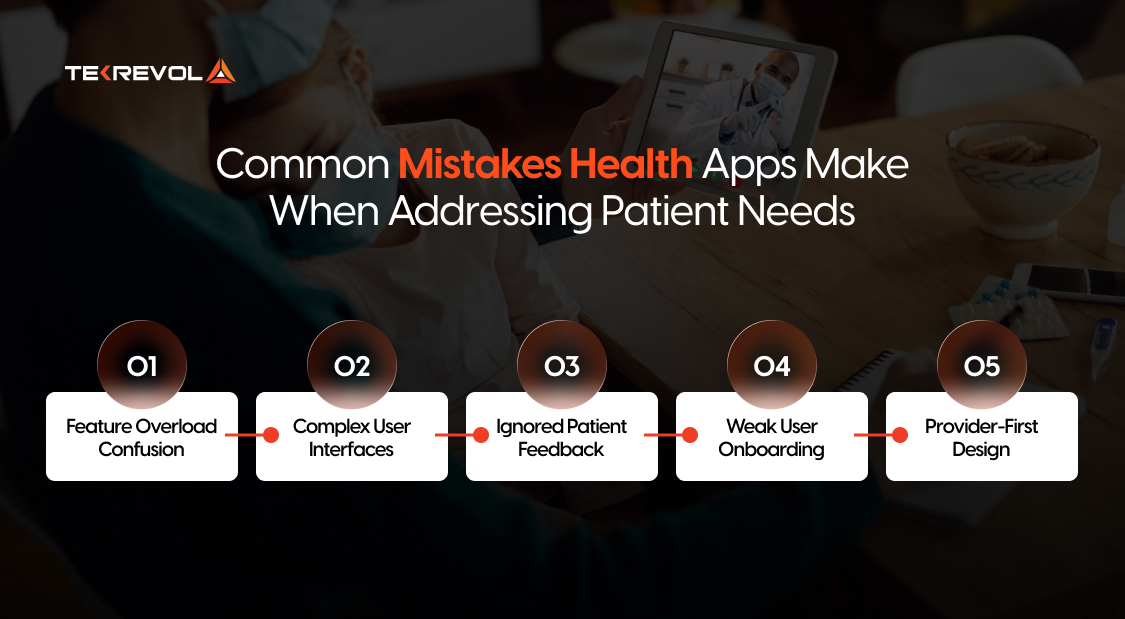
Common mistakes include:
- Overloading the app with too many features that patients rarely use
- Designing complex interfaces that confuse first-time users
- Ignoring real patient feedback during development and updates
- Poor onboarding that fails to explain core functionalities
- Prioritizing internal workflows over patient convenience
How These Features Lead to Better Patient Engagement and Health Outcomes
Allowing patients to access healthcare technology that has features that can meet their needs will highly elevate patient engagement.
Hampering this is the fact that patients hardly ever take the necessary steps to monitor their health, follow treatment regimens, and communicate regularly with their healthcare providers.
But becoming more self-aware and thus taking more control over their health through regular use of monitoring tools like wearable healthcare technology, following the treatment regimes, and contacting the providers more frequently may result in:
- health improvement and
- a stronger patient-provider relationship.
Efficient apps may lower the number of missed appointments, facilitate the correct use of medication, and reinforce the idea of preventive healthcare. Also check out the 21+ healthcare applications that shapes the future of medical niche.
Main advantages are:
- Enhanced patient commitment to their health care
- Improved medication compliance and following of treatment plans
- Reduced missed appointments and delayed care
- Improved communication between patients and providers
- Higher trust and long-term app usage
Future Trends Helping to Shape Patient Expectations in Health Applications
Patient expectations evolve as technology advances. Nowadays, healthcare applications are integrating AI, predictive analytics, and wearable device data to give patients smarter and more personalized care. The features of apps for mental health, wellness, and preventive care are gaining popularity rapidly. AI agents in healthcare are helping patients with apps that can be part of their daily routine and, at the same time, make healthcare easy and accessible.
Some fringes of the future of healthcare applications are:
- More widespread use of AI-based insights and health prediction analytics.
- Deepening of the partnership with wearable devices and remote monitoring gadgets.
- Expansion of mental health and wellness-focused features
- Demand for hyper-personalized care experiences
- Growing emphasis on preventive and proactive healthcare
How Does Tekrevol Support the Development of Patient-Centric Healthcare Apps?
Tekrevol is all about developing healthcare technology that truly considers patients. Through mapping out patient journeys and profiling patient expectations, Tekrevol is able to make various features of healthcare apps so that users find them natural, safe, and really useful. They deploy an approach that marries the top-notch skills of the technical staff with the strategic acumen of the management, thus enabling healthcare providers to come up with apps that users really like.
What Tekrevol can bring to healthcare solutions:
- They have a patient-first mindset and completely immerse themselves in the patient’s world
- Strict adherence to healthcare rules and regulations, with the use of technically secure and compliant development
- Scalable architecture designed for future growth
- Seamless integration of advanced healthcare application features
- End-to-end support from strategy to launch and beyond
Keeping healthcare apps up to date is crucial for meeting patient expectations. Patients nowadays want apps that make their whole experience easier, let them communicate with doctors, and give them personalized information, such as safe access to medical records, telehealth, and medicine reminders.
Working healthcare apps give patients the ability to take care of their health and at the same time, keep in touch with doctors. When apps focus on a patient-centered design and useful features, they can raise the level of both engagement and health results.
Your healthcare app deserves a future-ready approach
Tekrevol integrates innovation with compliance and performance.
Request Your Free Strategy