



- On-demand apps cost $50,000 for single-sided MVPs to $350,000+ for enterprise multi-city marketplace platforms today.
- Most funded US on-demand products cost between $95,000 and $200,000 for three-sided customer-provider-admin systems.
- White-label templates start near $15,000 and launch in 6-10 weeks but limit roadmap control.
- Compliance costs like FCRA checks, PCI DSS, and gig-worker laws can add $138,000 to $415,000 in total.
- Telehealth apps cost $130,000–$350,000, the highest vertical, due to HIPAA compliance and clinical licensing requirements.
- Each additional user role, customer, provider, or admin multiplies development cost by roughly one to three times.
- Annual maintenance typically costs 18%–25% of the original build price, excluding usage-based third-party service fees.
Everyone asks how much an on-demand app costs, but almost nobody asks the right question: costs for what? A grocery delivery app and a home-services platform can both be “on-demand” and still land a hundred thousand dollars apart. The features, the team, and the platform choices tell you everything the label doesn’t.
Custom on-demand app development typically ranges from $50,000 for a single-sided MVP to $350,000+ for an enterprise-grade platform in 2026. A three-sided product- customer app, provider app, and admin console- runs $95,000 to $200,000, while multi-city marketplaces clear $200,000 and keep climbing. If you would rather validate before you build, white-label shortcuts start near $15,000.
The final number depends on complexity, user roles, payment integrations, real-time features, and scalability needs. An experienced on-demand app development company turns these requirements into a practical budget and build plan.
This guide covers on-demand app development costs across delivery, logistics, home services, healthcare, and other industries, so you can see where your idea fits and what to budget at each stage.
How Much Does On-Demand App Development Cost in 2026? A Quick Answer
On-demand app development costs $50,000 for a single-sided MVP and $350,000 or more for a multi-city marketplace. Most funded US products land between $95,000 and $200,000. Your vertical and your launch cities move that number more than your feature list does.
| Tier | Estimated cost | Timeline | What you actually get |
| White-label/template | $15,000 to $50,000 | 6 to 10 weeks | Pre-built core, your branding, limited control over the roadmap |
| Single-sided MVP | $50,000 to $95,000 | 3 to 5 months | One vertical, one city, customer app, manual or simple dispatch |
| Three-sided production app | $95,000 to $200,000 | 5 to 8 months | Customer app, provider app, admin console, automated dispatch, payouts |
| Multi-city marketplace | $200,000 to $350,000 | 8 to 14 months | Multiple markets, zones, surge, support tooling, fraud controls |
| Enterprise multi-vertical | $350,000 to $600,000+ | 14 to 24 months | Several verticals, ML dispatch, enterprise, and ERP integrations |
These estimates cover software only. Licensing, taxes, infrastructure, background checks, and local labor compliance are separate costs and can exceed development expenses.
See where your app fits.
We’ll review your business model, target markets, and features to determine a realistic development budget.
Discuss Your App IdeaWhat Exactly Is An “On-Demand” App?
An on-demand app connects customers who need a service with providers who can deliver it. It manages the entire process, including matching, tracking, booking, and payment, within the app.
Think Uber for rides, Instacart for groceries, TaskRabbit for handyman work, Zocdoc for doctor visits. The category spans transportation, food and grocery delivery, home services, healthcare, beauty, fitness, and logistics. Every vertical shares the same structure: a customer app, a provider app, and an admin system connecting them.
How It Works
Most on-demand apps follow the same four-step flow, regardless of vertical.
- Request: The customer opens the app, picks a service, and submits details like location, service type, schedule, or item.
- Match: The platform routes the request to an available provider based on proximity, availability, or specialty, and the provider accepts or declines.
- Fulfill: The provider completes the job, like a ride, a delivery, a repair, or a consultation, while the customer sees live status updates.
- Pay and rate: The payment is processed automatically, funds are split between the platform and provider, and the customer can rate the experience.
That four-step journey is the backbone of an on-demand app. Everything else, from dispatch and tracking to compliance, is designed to make it faster, safer, and more reliable.
On-Demand App Development Cost by Industry
On-demand app development costs typically range from $55,000 to $350,000+, depending on the industry, workflows, integrations, and compliance requirements.
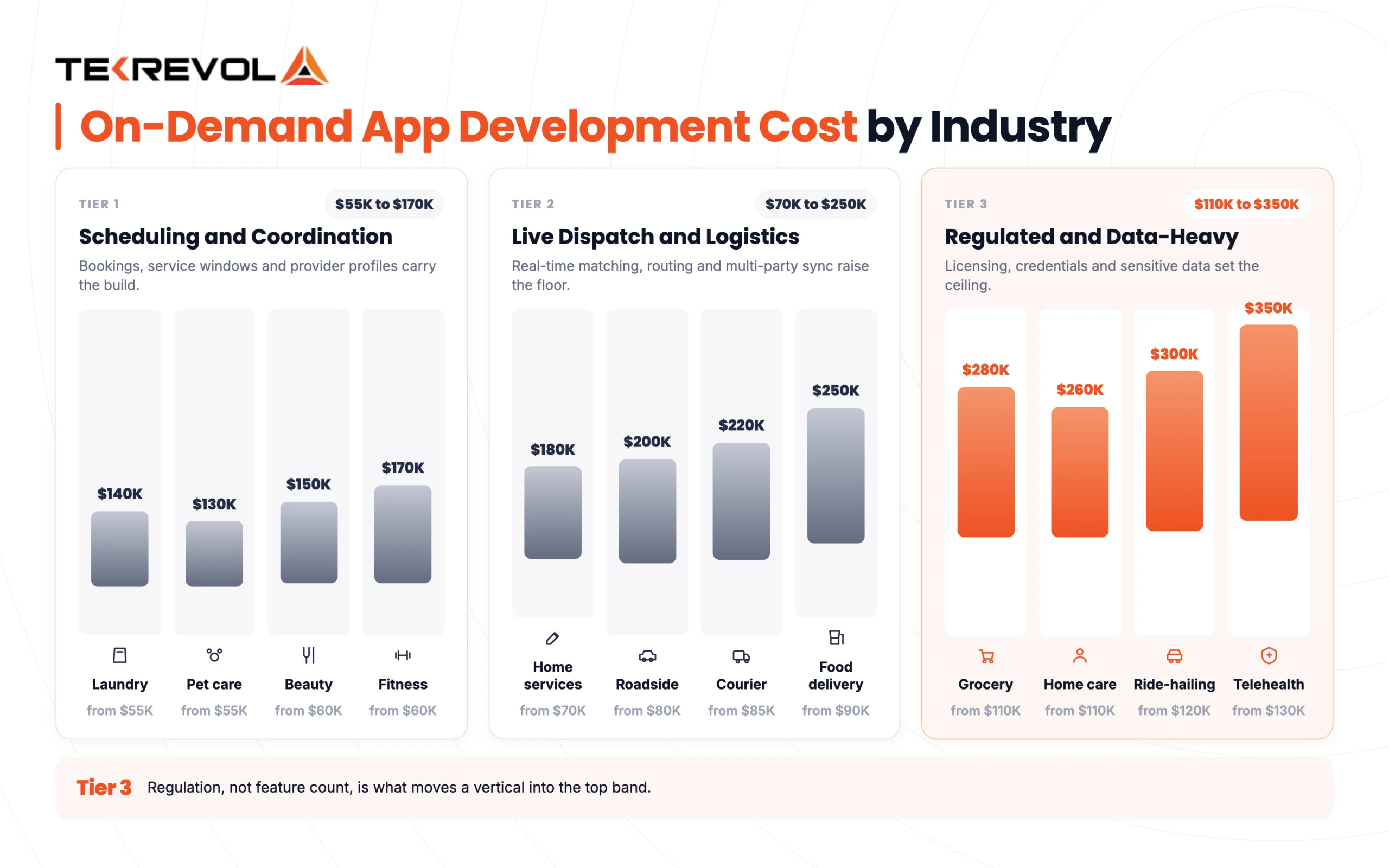
The biggest cost differences usually come from what happens behind the scenes. Each vertical has its own operational requirements, regulations, and failure points that add development complexity.
Laundry & Dry Cleaning App
Estimated cost: $55,000–$140,000
Laundry platforms have a two-stage delivery cycle: the provider picks up the items, processes them, and then returns them to the customer. The app needs to coordinate pickup windows, order status, driver assignment, item tracking, pricing by weight or service, and return delivery. Multi-stop routing and recurring pickup schedules can push the cost toward the upper end.
For a more detailed breakdown, see our guide on how much it costs to create a laundry app in the USA.
Pet Care & Dog Walking App
Estimated cost: $55,000–$130,000
Pet-care apps need to coordinate customers with walkers, sitters, or groomers while keeping track of pets, schedules, and service locations. GPS walk tracking, start-and-end verification, pet profiles, emergency contacts, photo updates, and provider background checks add to the development scope.
Pet care app development costs can vary based on these features and the level of provider management required. More advanced platforms may also support recurring bookings and multiple pets per customer.
Beauty & Grooming App
Estimated cost: $60,000–$150,000
Beauty apps are primarily scheduling platforms, but mobile services introduce another layer of complexity. The system needs to account for appointment duration, provider availability, travel time, service areas, cancellations, and back-to-back bookings. Profiles, portfolios, deposits, tips, reviews, and automated reminders can further increase the build cost.
Scheduling-based apps work differently from dispatch-based apps. On MoCuts, the main challenge was managing appointments, travel time, and cancellations. If your app books time slots instead of assigning the nearest provider, the backend is usually simpler.
Fitness & Wellness App
Estimated cost: $60,000–$170,000
Fitness platforms can support one-to-one sessions, group classes, home visits, or recurring memberships, each requiring different booking rules. Development may include trainer profiles, certifications, availability management, subscriptions, payments, session tracking, and digital waivers. If the app includes workout plans, progress tracking, or wearable integrations, the backend and data requirements become more substantial.
For a deeper look at the fitness app development process, see our guide to creating a fitness app.
Home Services & Handyman App
Estimated cost: $70,000–$180,000
Home-service platforms need to handle different trades, job types, pricing models, and provider qualifications. A customer may request a fixed-price service or describe a problem that requires a quote before work begins. That means the platform may need license verification, insurance records, photo-based estimates, quote approval, scheduling, job tracking, invoices, and dispute management.
This is a category where we’ve built real depth. See how TekRevol is scaling its home-based care infrastructure, including production tools for EVV compliance, caregiver operations, and multi-payer billing.
Roadside Assistance App
Estimated cost: $80,000–$200,000
Roadside assistance is built around speed, location, and accurate dispatch. When a customer requests help, the system needs to identify nearby providers, assign the right service, calculate an ETA, and keep both parties updated. Features such as towing, jump starts, fuel delivery, and emergency support require more complex backend workflows.
Courier & Same-Day Delivery App
Estimated cost: $85,000–$220,000
Courier platforms track packages from pickup to drop-off, often across many stops. The software needs driver routing, delivery windows, and barcode scanning. It also needs proof of delivery, signatures, recipient checks, live status, and a path for failed deliveries. Business platforms add bulk orders, fleet tools, and merchant APIs. Our transportation app development guide covers the routing side in more depth.
Food Delivery App
Estimated cost: $90,000–$250,000
Food delivery involves three active parties: customers, restaurants, and delivery drivers. The platform needs to synchronize menus, order acceptance, preparation status, driver assignment, live tracking, payments, commissions, refunds, and payouts. Multi-restaurant support, scheduled orders, promotions, delivery zones, and restaurant-specific pricing rules can push development toward the higher end.
Statista projects US online food delivery revenue at $473.49 billion in 2026, growing 12.8% year over year.
For inspiration, explore these trending food delivery app ideas.
Grocery Delivery App
Estimated cost: $110,000–$280,000
Grocery has a harder order lifecycle because items go out of stock after the customer has paid. So the platform needs live stock syncing and SKU-level catalogs. It needs shopper flows, substitution rules, customer approvals, partial refunds, and a final price adjustment. Multi-store support adds another layer, as our grocery app development cost breakdown explains.
Cannabis Delivery App
Estimated cost: $100,000–$240,000
Cannabis delivery needs standard marketplace features plus far tighter controls. Depending on the state, that means age and ID checks, purchase limits, and stock tracking. It also means delivery-area limits, compliant receipts, and a link to the state’s seed-to-sale system. Every extra state multiplies that work.
Elderly & Home Care App
Estimated cost: $110,000–$260,000
Home-care platforms connect caregivers, patients, families, and administrators, all while guarding sensitive data. Core flows cover caregiver credentials, care plans, repeat schedules, and visit notes. Add secure messaging, timesheets, and emergency contacts. Medicaid services also require Electronic Visit Verification, which means a logged check-in with location, service type, and duration.
We built DARA, a caregiver-matching app that lets families browse verified profiles and connect directly with caregivers for elderly loved ones, so we know this workflow firsthand.
Ride-Hailing & Taxi App
Estimated cost: $120,000–$300,000
Ride-hailing runs on live location and live matching, so the backend is far more demanding than a booking app. The system tracks who is free, takes rider requests, assigns trips, and handles navigation and ETAs. Then surge pricing, payments, cancellations, ratings, and trip history. State transport permits, insurance rules, and fleet features add more.
Telehealth & Doctor-on-Demand App
Estimated cost: $130,000–$350,000
Telehealth pairs on-demand matching with clinical workflows and strict security. Patients search by specialty, availability, location, and licensing. Clinicians need secure visits, scheduling, notes, and a way to message patients. Video visits, EHR links, ID checks, HIPAA-ready hosting, and state-by-state licensing make this the priciest vertical here.
On-Demand App Development Cost by Feature
On-demand app features cost from $3,000 for basic ratings to $70,000 for machine-learning dispatch. What drives the price is how much live coordination, outside integration, and backend logic a feature needs.
Customer App Features
Customer-facing features cover the complete service journey. Here are the key features:
| Feature | Estimated Cost |
| Onboarding, authentication & profiles | $4,000–$8,000 |
| Service discovery, search & filters | $5,000–$10,000 |
| Live map & GPS tracking | $8,000–$16,000 |
| Booking, scheduling & cancellation | $5,000–$11,000 |
| Payments, split payouts & tipping | $8,000–$16,000 |
| In-app chat & push notifications | $4,000–$9,000 |
| Ratings, reviews & disputes | $3,000–$7,000 |
Provider App Features
Provider-facing features cover the complete service workflow. Here are the key features:
| Feature | Estimated Cost |
| Provider onboarding & document upload | $5,000–$11,000 |
| Background check integration & FCRA flow | $8,000–$18,000 |
| Job offer, accept & decline logic | $6,000–$12,000 |
| Navigation & route guidance | $5,000–$10,000 |
| Earnings dashboard & pay statements | $6,000–$14,000 |
| Availability & shift scheduling | $4,000–$9,000 |
Admin Console Features
The admin console manages the platform behind the scenes. Here are the key features:
| Feature | Estimated Cost |
| User & provider management | $5,000–$11,000 |
| Order & booking monitoring | $5,000–$10,000 |
| Dispute & refund handling | $6,000–$13,000 |
| Payouts & reconciliation | $8,000–$16,000 |
| Analytics & reporting | $5,000–$12,000 |
| Content, zone & pricing configuration | $4,000–$9,000 |
Dispatch Engine Features
The dispatch engine manages how jobs are assigned, tracked, and optimized across the provider network. Here are the key options:
| Approach | Estimated Cost | Best Fit |
| Manual or round-robin assignment | $5,000–$12,000 | Under 50 daily jobs, one city |
| Proximity matching with live ETAs | $12,000–$25,000 | Most initial launches |
| Zones, surge pricing & batching | $15,000–$30,000 | Multi-neighborhood operations |
| ML supply & demand prediction | $30,000–$70,000 | Multi-city, high-volume platforms |
These are standalone estimates, not costs you add together. Features often share the same APIs, UI components, and backend systems, so adding each feature separately can overstate the total development cost.
Why Are On-Demand Apps More Expensive to Build?
On-demand apps cost more because you’re not building a single app. An on-demand platform typically includes three connected products: a customer app, a provider app, and an admin dashboard, supported by backend systems for matching, dispatch, payments, and real-time updates.
This is where many on-demand app budgets get underestimated. The customer-facing app may be the most visible part, but provider features, admin controls, and backend infrastructure add substantial development work.
| Component | Cost | What Drives the Cost |
| Customer app | $30,000–$60,000 | Booking, payments, tracking, ratings |
| Provider app | $25,000–$50,000 | Onboarding, job offers, navigation, earnings |
| Admin dashboard | $20,000–$45,000 | User management, disputes, payouts, reporting |
| Dispatch & matching engine | $20,000–$45,000 | Matching, ETAs, zones, batching, failure handling |
| Total | $95,000–$200,000 |
The dispatch engine is a core part of the product, not just backend infrastructure. Poor matching can lead to longer wait times, lower provider earnings, and higher customer churn.
We saw this architecture in action while building a multi-restaurant food delivery platform. The platform included separate interfaces for customers, restaurant partners, and admins, with GPS tracking and Stripe payments connecting the experience. It delivered 50% higher user engagement, 40% growth in restaurant sales, and $1.2 million in first-quarter revenue.
Factors Affecting On-Demand App Development Costs
On-demand app development costs depend on your business model, features, technology, integrations, and target market. Real-time tracking, payments, multiple user roles, and compliance can further increase the budget. Understanding these factors early helps you set a more realistic development budget.
1. On-Demand App Complexity
Complexity drives cost because more features mean more design, more build, more integration, and more testing. The number of user roles and the workflows each one supports push the budget further still.
| App Complexity | Estimated Cost | Typical Scope |
| Simple | $50,000–$95,000 | Core booking, profiles, payments, basic admin, single platform |
| Medium | $95,000–$200,000 | Multiple user roles, GPS tracking, chat, scheduling, integrations |
| Complex | $200,000–$350,000+ | Advanced dispatch, automation, multi-city support, complex integrations |
2. Number of User Roles you Support
Impact: 1x to 3x on the build.
Each user role adds a product layer with its own screens, permissions, workflows, and alerts. A customer app is one build. Adding provider and admin apps raises both the build cost and the coordination cost.
The clearest way to scope this is to ask who needs to log in:
- One role, customers only: $50,000 to $95,000. Providers receive jobs by SMS or a lightweight web view.
- Two roles, customers and providers: $75,000 to $150,000. This introduces job offers, acceptance logic, and provider earnings.
- Three roles, adding an admin console: $95,000 to $200,000. Disputes, refunds, and payouts now require dedicated tooling.
- Four or more, adding vendors, dispatchers, or finance: $200,000 and upward.
Most founders assume they need three separate roles from day one, but that isn’t always necessary. Launching with fewer roles can reduce development costs by $25,000–$50,000 and shorten the timeline significantly.
3. Industry and Regulatory Requirements
The industry you work in shapes your costs directly. Beyond the core features, your app may need special checks, licensing, compliance controls, and industry-specific links.
| Industry | Typical Requirements | Cost Impact |
| Home Services | Trade license verification, insurance checks, provider background checks, location-based rules | Moderate, $70,000–$180,000 |
| Courier & Logistics | GPS tracking, route optimization, proof of delivery, chain of custody, claims handling | Moderate to high, $85,000–$220,000 |
| Cannabis Delivery | Age and identity verification, purchase limits, delivery-area restrictions, seed-to-sale system integration | High, $100,000–$240,000 |
| Telehealth | Clinical license verification, state-based provider matching, HIPAA compliance, secure health-data handling | Highest, $130,000–$350,000 |
The more specialized or regulated the industry, the more engineering effort is required to support its operational and compliance requirements.
4. Dispatch and Matching Complexity
Impact: $5,000 to $70,000
Dispatch logic decides how jobs get assigned, ranked, priced, and routed. As order volume and complexity grow, you need smarter matching.
| Dispatch Level | Typical Capabilities | Estimated Cost |
| Basic | Manual or round-robin assignment | $5,000–$12,000 |
| Standard | Proximity-based matching, live ETAs | $12,000–$25,000 |
| Advanced | Service zones, surge pricing, job batching | $15,000–$30,000 |
| AI-Powered | Demand forecasting, supply prediction, intelligent matching | $30,000–$70,000 |
5. Number of Launch Markets
Impact: $8,000 to $60,000 per market
Each new market brings fresh tax, licensing, labor, pricing, and compliance work.
Key cost drivers include:
- A second city in your home state usually costs $8,000 to $20,000 for zones, pricing, and local content.
- A first city in a new state costs $15,000 to $45,000 for tax registration, licensing checks, and labor rules.
- A city with its own gig ordinance costs $20,000 to $60,000 for pay formulas, disclosure screens, and reporting exports.
Sequence your cities by regulatory cost rather than by population. Austin, then Dallas is inexpensive. Austin, then New York City is a separate project with its own timeline.
6. Development Team Location
On-demand development costs $100 to $200 per hour in the US and $25 to $55 in South Asia. That 4x rate gap changes your total by more than any feature decision, though it also changes your timezone overlap and your compliance familiarity.
| Region | Hourly Rate |
| US onshore | $100 to $200 |
| US plus nearshore blend | $60 to $120 |
| Western Europe | $80 to $150 |
| Eastern Europe | $50 to $85 |
| Latin America | $45 to $80 |
| South Asia | $25 to $55 |
Most US on-demand companies we work with land on the blended model, and for a specific reason. The compliance work above needs someone who understands US labor and tax rules. The rest of engineering doesn’t need that at all.
Your product and architecture can stay focused on the US market while development happens offshore. If you already have engineers but need marketplace specialists, IT staff augmentation can fill those gaps faster than traditional hiring.
7. Platforms and Technology Approach
Impact: 1× to 1.9× on the build
Platform choice moves costs sharply, above all when an app serves several user roles. Cross-platform frameworks such as Flutter and React Native can reduce duplication. Native earns its cost only for hardware-heavy needs.
| Approach | Best For | Cost Impact |
| Single native app (iOS or Android only) | Validating one market before committing to both | 0.7x |
| Cross-platform (Flutter or React Native) | Maps, payments, notifications, booking, real-time updates | 1x, the baseline |
| Cross-platform plus native modules | Shared code with a few platform-specific features | 1.2x |
| Two native apps (iOS and Android) | Deep background location, CarPlay, hardware features | 1.9x |
8. Real-Time Functionality
Impact: Adds 15%–30% to the overall build
Real-time features can increase development costs significantly. Live location, provider availability, order updates, and dynamic pricing require real-time data syncing and reliable network handling.
| Real-Time Feature | Typical Requirements | Cost Impact |
| Live Order Status | Real-time status updates and notifications | moderate |
| Provider Availability | Live availability and instant status synchronization | Moderate |
| Live Location Tracking | GPS updates, map integration, background tracking | High |
| Dynamic Pricing | Real-time pricing updates and demand-based calculations | High |
Prioritize real-time functionality based on business requirements rather than making every element live. This keeps the architecture more efficient while controlling development and infrastructure costs.
9. Payment and Payout Infrastructure
Impact: $15,000–$45,000 for payout infrastructure
Payment processing is relatively straightforward, but managing marketplace payouts is considerably more complex. On-demand platforms often need to split payments, hold funds, manage refunds and disputes, and maintain accurate financial records.
Key requirements may include:
- Split payments: Distributing funds between the platform, providers, and other parties.
- Payout management: Scheduling payouts and handling failed or closed provider accounts.
- Disputes and chargebacks: Holding, reversing, or recovering funds when transactions are challenged.
- Tax reporting: Maintaining transaction records and supporting required 1099 reporting.
- Tips and adjustments: Supporting tipping, refunds, and payout changes based on applicable local requirements.
10. Third-Party Integrations
Impact: $4,000–$30,000 per integration
Third-party integrations can add significant development and recurring costs to an on-demand app. Beyond the initial implementation, many services charge based on transactions, requests, messages, or active users, making usage volume an important part of the budget.
| On-Demand Integration | Development Cost | Common Providers |
| Maps, Geocoding & Route Optimization | $6,000–$15,000 | Google Maps, Mapbox |
| Payment Processing & Split Payouts | $12,000–$30,000 | Stripe Connect, PayPal, Adyen |
| Provider Identity & Background Verification | $8,000–$18,000 | Persona, Checkr |
| SMS, Push & Email Notifications | $4,000–$10,000 | Twilio, Firebase, SendGrid |
| In-App Customer–Provider Chat | $5,000–$12,000 | Twilio, Sendbird |
| Sales Tax Calculation & Filing | $10,000–$25,000 | Avalara, TaxJar |
| Analytics & Crash Reporting | $3,000–$8,000 | Firebase Analytics, Sentry |
11. Technology Stack Selection
Impact: modest on the build, substantial on running costs,s and on the cost of changing direction later
Stack selection is often listed as a cost factor and just as often described wrongly. A list of frameworks tells you very little. What matters is a short set of build-or-buy decisions. Each one trades upfront cost against long-term flexibility.
| Decision | Buy | Build | The Tradeoff |
| Real-time infrastructure | $8,000–$20,000 to integrate Firebase, Ably, or Pusher | $30,000–$60,000 for custom WebSocket infrastructure | Managed services bill per concurrent connection, which becomes material at scale |
| Backend platform | Managed backend removes 2 to 3 months from an early timeline | Custom backend costs more upfront | Managed platforms can constrain your data model, and marketplace ledgers are difficult to migrate later |
| Architecture | Modular monolith at launch | Distributed services at launch | Splitting early usually adds 20% to 30%, plus operational overhead that most launches cannot absorb |
Real-time features define what stays live. The technology stack determines how it is delivered. These are separate cost decisions.
US Compliance Costs That Can Increase Your On-Demand App Budget
Compliance costs vary based on your provider model, launch locations, payment flow, and industry. The requirements below can affect both development costs and ongoing operating expenses.
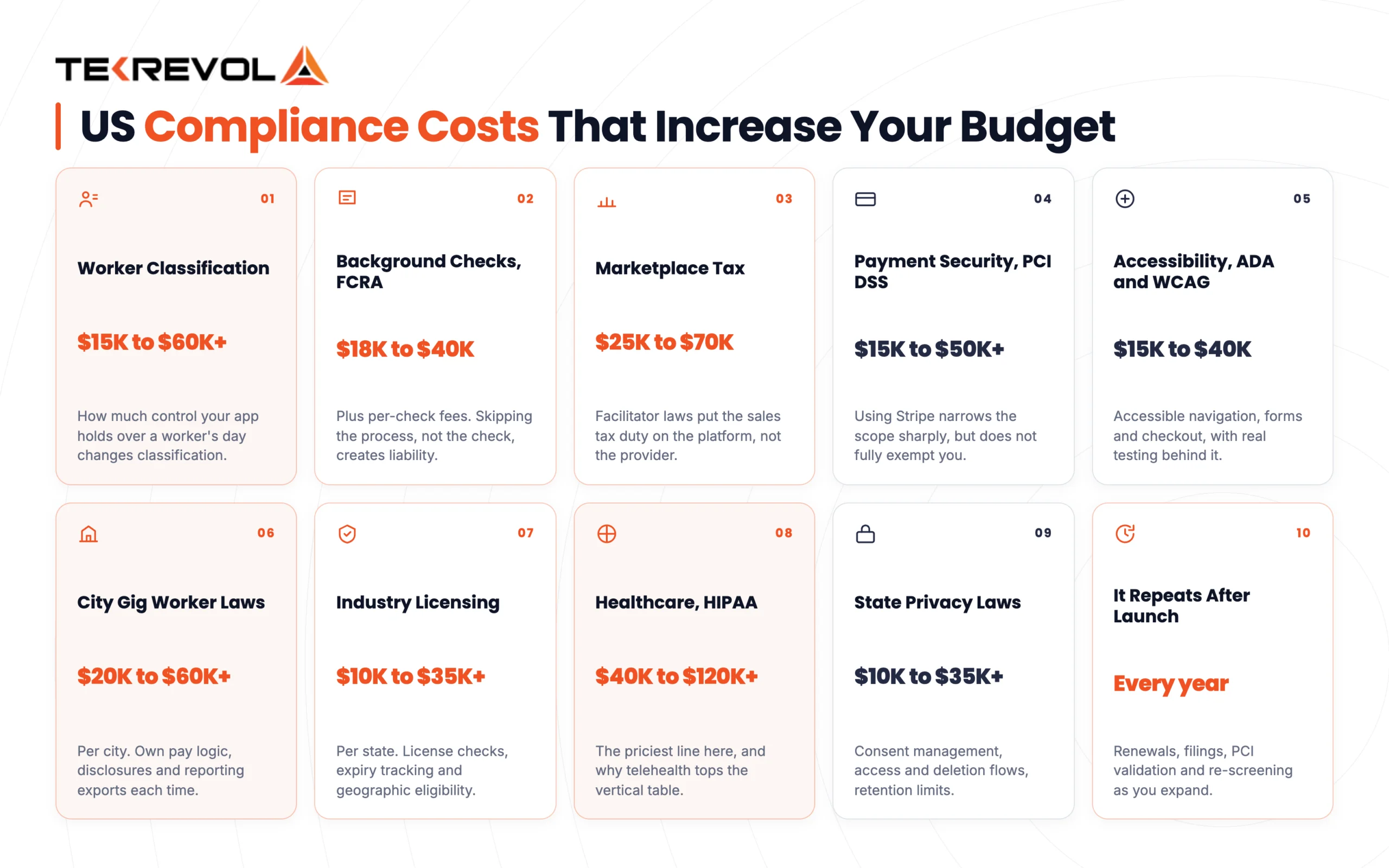
Worker Classification: FLSA and State ABC Tests
Cost: $15,000 – $60,000+
If your providers are independent contractors, your design choices affect your legal exposure. The Fair Labor Standards Act sets the federal baseline. States like California apply their own ABC test on top of it. These rules touch on onboarding, scheduling, job acceptance, and pay. How much control your app holds over a worker’s day changes how they are classified.
Background Checks: FCRA
Cost: $18,000 – $40,000, plus per-check fees
The Fair Credit Reporting Act applies the moment you use a third-party report to screen providers. You need a compliant disclosure and authorization flow. You need structured report handling. And if someone is rejected, you need pre-adverse and adverse action steps. Skipping the process, not the check itself, is what creates liability.
Marketplace Payments and Sales Tax
Cost: $25,000 – $70,000
In most states, marketplace facilitator laws put the sales tax duty on the platform rather than the individual provider. So you need tax calculated by jurisdiction, records kept per transaction, and a filing pipeline. Most teams reach for Avalara or TaxJar here.
Payment Security: PCI DSS 4.0
Cost: $15,000 – $50,000+
Any app that touches card payments falls under PCI DSS 4.0. Routing payments through a processor like Stripe narrows your compliance scope sharply, but you still need secure payment flows, tokenization, and proper access controls. “We use Stripe” does not fully exempt you.
Accessibility: ADA Title III and WCAG
Cost: $15,000 – $40,000
Courts have applied ADA Title III to consumer-facing digital services, with WCAG 2.2 AA often used as the accessibility benchmark. In practice, you need accessible navigation, forms, and checkout. You also need screen-reader support, strong contrast, and real testing rather than a stated intention.
City-Level Gig Worker Laws
Cost: $20,000 – $60,000+ per city
Cities impose rules beyond federal or state law, and New York City’s delivery worker laws are the most cited example. Seattle runs a parallel regime under its App-Based Worker Minimum Payment Ordinance, with its own rates and its own reporting.
Each one demands its own pay logic. Each job offer’s details are shown before a worker accepts a job. Also, each demands in-app tipping and its own reporting export. That cost repeats in every city with an ordinance, which is exactly why expansion is not free.
Industry Licensing: State TNC and Professional Licensing
Cost: $10,000 – $35,000+ per state
Ride-hailing falls under state Transportation Network Company laws. Home services run into contractor and trade licensing instead. Either way, the app needs license checks, expiry tracking, insurance records, and geographic eligibility rules. A plumber licensed in one state cannot, on its own,n take jobs in the next one over.
Healthcare: HIPAA
Cost: $40,000 – $120,000+
Any app handling protected health information needs safeguards for how that data is stored, sent, accessed, and audited. You also need signed agreements with every vendor who touches it. This is the priciest compliance line on the list, and it is why telehealth tops the vertical-cost table.
State Privacy Laws
Cost: $10,000 – $35,000+
CCPA and CPRA in California, plus a growing list of other state laws, require consent management and privacy notices. They also require data access and deletion flows, retention limits, and audit trails. What applies depends on where your users and your business sit.
What Compliance Actually Adds to a Real Launch
Take a food delivery platform launching in NYC and Seattle, using independent contractors and accepting card payments.
| Requirement | Low | High |
| Worker classification | $15,000 | $60,000 |
| FCRA background checks | $18,000 | $40,000 |
| Marketplace facilitator sales tax | $25,000 | $70,000 |
| PCI DSS 4.0 | $15,000 | $50,000 |
| ADA Title III and WCAG 2.2 AA | $15,000 | $40,000 |
| City gig-worker laws (2 cities) | $40,000 | $120,000 |
| State privacy laws | $10,000 | $35,000 |
Compliance continues beyond launch, with recurring costs for background checks, license renewals, tax filings, PCI validation, insurance, security audits, and regulatory updates, especially as you expand into new markets.
Not sure which regulations apply to your app?
We’ll map your business model and launch markets to the requirements you need to plan for.
Request a Compliance Assessment!On-Demand App Development Cost Breakdown by Stage
On-demand app development typically moves through seven stages, from discovery and design to development, testing, and launch. The breakdown below uses a $150,000 project as a reference point and shows the typical cost allocation for each stage.
Stage 1: Discovery and Compliance Scoping
Estimated cost: $15,000 (10% of build) | Timeline: 2 to 4 weeks
This is where you decide what you are really building. It is also the only stage where changing your mind is cheap. Discovery covers more ground here than it does for a standard app. Several of the decisions below carry legal weight:
- Provider model: Employees or independent contractors, and how much control the product will have over scheduling, job acceptance, and routing.
- Launch markets: Which cities and states, in what order, and which of them carry their own labor ordinances
- Flow of funds: Who holds the money, for how long, and who is the merchant of record?
- Role definition: Which user roles exist at launch, and which can be deferred?
- Regulatory mapping: Which of the rules above does your model actually trigger?
Stage 2: UX and UI Design
Estimated cost: $19,500 (13% of build) | Timeline: 3 to 5 weeks
Design costs more in on-demand than in most categories. You are designing three products, not one. Two of them are used by people who are working, not browsing.
Providers often use the app on the move, in vehicles, or with weak connectivity, so the interface needs larger touch targets, clear navigation, fewer steps, and offline-friendly behavior.
This stage typically produces:
- Complete flows for all three roles, including the unhappy paths.
- Any disclosure screens your markets require by law, such as pre-acceptance offer details.
- Error, empty, and offline states, which matter more here than in most categories.
- A design system that keeps three applications visually and functionally coherent.
Stage 3: Customer App Development
Estimated cost: $33,000 (22% of build) | Timeline: 6 to 10 weeks
Most founders focus on the customer app, but it typically represents less than a quarter of the total development budget. The higher costs sit in the provider, admin, backend, and dispatch layers.
Work in this stage covers onboarding and login, service discovery and search, booking and scheduling, live tracking, payments and tipping, ratings, and order history. Live tracking is usually the largest line inside it, at $8,000 to $16,000. A moving map with accurate ETAs is a harder problem than it looks.
Stage 4: Provider App Development
Estimated cost: $27,000 (18% of build) | Timeline: 5 to 8 weeks
Provider onboarding is not a sign-up form. It covers document collection, license and certification checks, and background screening through a legally set flow. In several markets, it also covers disclosures that must appear before a job is accepted. Earnings reporting has its own rules. In New York City, itemized pay statements are a legal duty rather than a feature request.
This is also the stage most often deferred. If your budget is tight, early providers will accept jobs through SMS or a simple web view. That removes $25,000 to $50,000 and several weeks from the plan.
Stage 5: Admin Console Development
Estimated cost: $22,500 (15% of build) | Timeline: 4 to 7 weeks
The admin console is the least glamorous stage. It is also the one that decides whether your operations team can function.
Every job that fails arrives here. Cancellations, no-shows, partial deliveries, damaged goods, wrong addresses, and disputed charges each need a resolution path. Each also needs somebody with the right screen in front of them. Payouts, refunds, provider suspension, zone setup, and pricing changes all live here too.
Teams that cut this stage do not avoid the cost. They move it into staff time instead. Then they run the business from a spreadsheet and a phone until they build it properly.
Stage 6: Dispatch Engine Development
Estimated cost: $18,000 (12% of build) | Timeline: 4 to 6 weeks
The dispatch engine decides which provider gets which job, in what order, and at what price. It may look like backend complexity, but we would argue it is the product itself.
At the $150,000 tier,er this usually means proximity matching with live ETAs. It also means reassignment when a provider declines or goes quiet, plus basic zone handling. Surge pricing, batching, and predictive matching are later investments. Build them when order volume earns them, and not before.
Stage 7: QA, Testing, and Launch
Estimated cost: $15,000 (10% of build) | Timeline: 3 to 5 weeks
Testing an on-demand platform means testing how three applications and a matching engine behave together. You cannot fully recreate those conditions in an office.
The testing scope that matters:
- Multi-role scenarios. A customer cancels while a provider is en route. A provider goes offline mid-job. Two customers request the last available provider at once.
- Location and signal. GPS drift, tunnels, dead zones, background tracking across long shifts, and battery behavior on both platforms.
- Payment edge cases. Failed charges, partial refunds, disputed transactions, and payouts to closed accounts.
- Load testing. Peak-hour traffic in delivery, is sharply spiked rather than evenly spread.
- Store submission. Justifying location permissions is the most common reason apps are rejected in this category.
Launch itself covers deployment, monitoring, alerting, and the runbooks your team needs to respond when something goes wrong after launch.
Should You Build Custom or Use a White-Label On-Demand Platform?
Build custom when your dispatch logic or your industry is what sets you apart. Choose white-label when speed beats control and your model already fits a template. The real question is not the upfront price. It is the cost of leaving
| Fcator | Custom Build | White-Label |
| Upfront cost | $50,000 to $350,000+ | $15,000 to $50,000 |
| Time to launch | 3 to 14 months | 6 to 10 weeks |
| Dispatch control | Full, tunable to your market | Whatever the vendor ships |
| Compliance | Yours to build and shape | Usually generic, rarely city-specific |
| Data and code ownership | Fully yours | Varies, read the contract carefully |
| Cost to change direction | High, but the codebase is yours | High, and you start again from zero |
White-label is useful for validating demand before making a large investment. But check whether the platform supports local requirements in the markets you plan to enter. If it cannot handle city-specific rules, you may face costly redevelopment
Our guide to building a successful on-demand delivery app covers what a first version genuinely needs.
How Long Does It Take to Build an On-Demand App?
On-demand apps take 3 to 14 months to build. A single-sided MVP ships in 3 to 5 months, a three-sided product in 5 to 8, and a multi-city marketplace in 8 to 14. Recruiting providers usually takes longer than building the software.
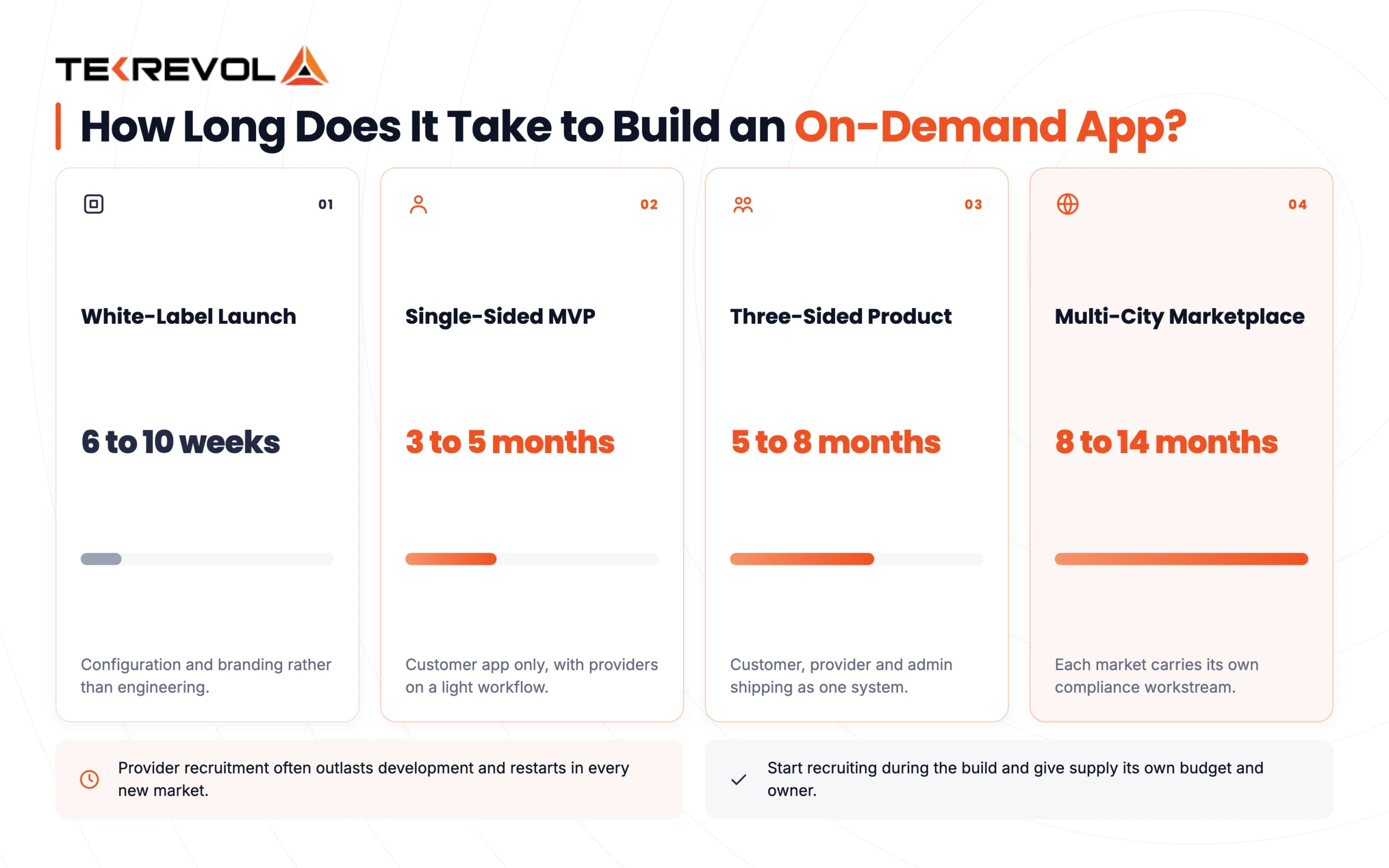
| Tier | Timeline | The critical path |
| White-label | 6 to 10 weeks | Branding, payment setup, app store review |
| Single-sided MVP | 3 to 5 months | Customer app and booking flow |
| Three-sided production app | 5 to 8 months | Provider app and dispatch, usually running in parallel |
| Multi-city marketplace | 8 to 14 months | Zones, tax infrastructure, city-specific compliance |
| Enterprise multi-vertical | 14 to 24 months | Deep integrations and predictive dispatch |
Provider recruitment can take longer than app development and often has to restart in each new market. For on-demand platforms, building a reliable provider network can be the real launch bottleneck.
Start recruiting providers during development and treat provider acquisition as a separate workstream with its own budget and owner.
What Does It Cost to Maintain an On-Demand App?
On-demand app maintenance typically costs 18%–25% of the original development budget annually. For a $150,000 app, that means around $27,000–$50,000 per year, excluding usage-based third-party fees.
Engineering and OS Updates: $15,000–$30,000/year
Covers bug fixes, performance improvements, dependency updates, operating system compatibility, and ongoing technical maintenance across platforms.
Cloud, Maps, and Real-Time Infrastructure: $8,000–$25,000/year
Costs increase with users, orders, location tracking, API requests, and real-time activity. Maps and routing can become a major recurring expense as job volume grows.
Security Testing and Monitoring: $8,000–$20,000/year
Includes security assessments, vulnerability monitoring, access-control reviews, logging, and ongoing protection against emerging threats.
Tax Filing and Registrations: $6,000–$20,000/year
Multi-market platforms may need ongoing support for sales tax calculations, registrations, filings, and changes to local tax requirements.
Provider Re-Screening: $5–$40 per provider/cycle
Platforms that rely on background checks or credential verification may need to re-screen providers periodically, creating a recurring cost as the provider network grows.
Payment Processing: 2.9% + $0.30 per transaction
Payment fees scale directly with transaction volume. Marketplace apps may also incur additional costs for split payments, payouts, refunds, and chargebacks.
Support and Operations: Varies by Order Volume
Customer and provider support costs grow with transaction volume. More orders typically mean more questions, cancellations, disputes, refunds, and operational issues to manage.
On-Demand App Business Models That Drive Revenue
On-demand apps typically combine multiple revenue streams rather than relying on a single model. Common options include commissions, service fees, subscriptions, surge pricing, promoted listings, and provider fees.
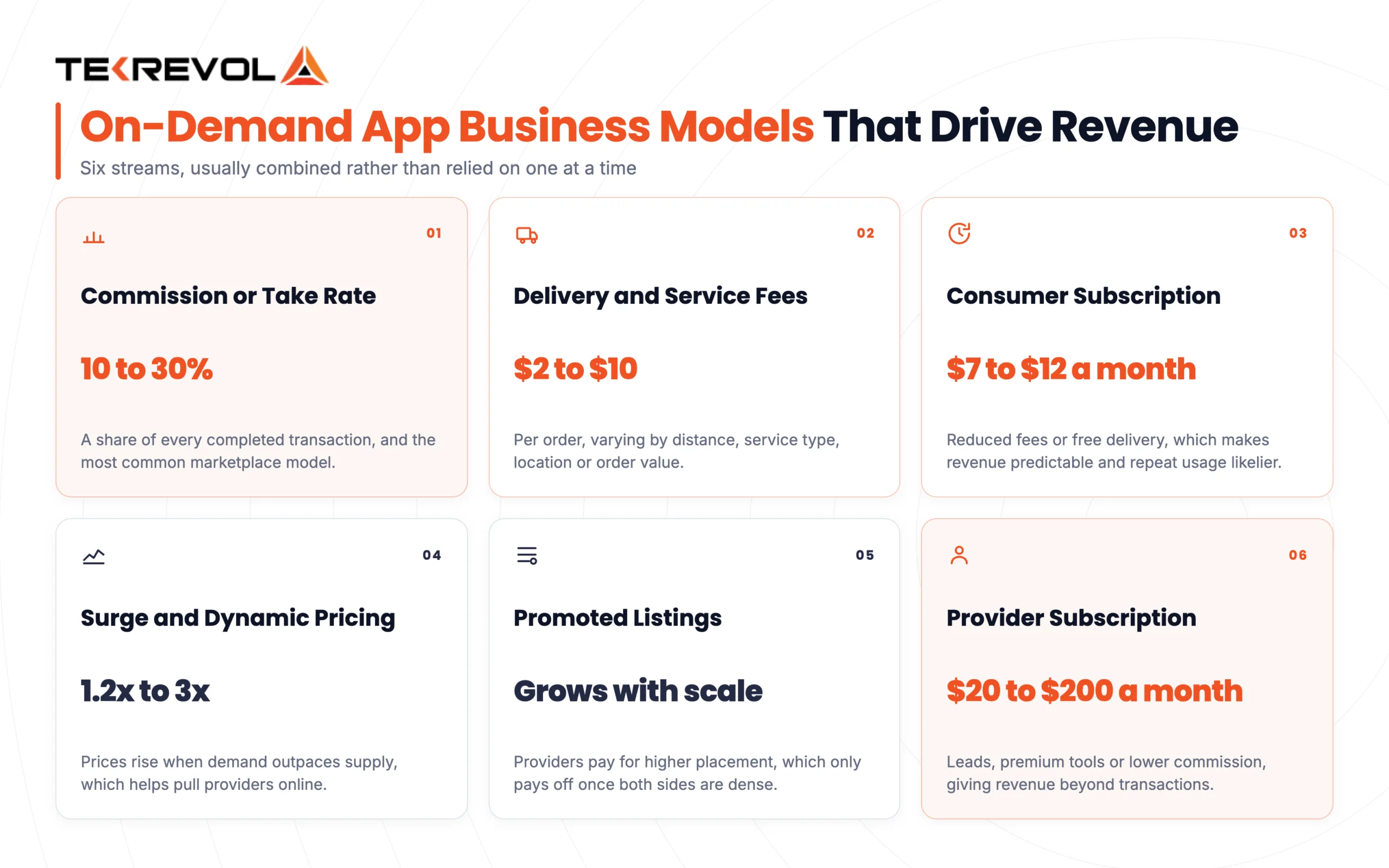
Commission or Take Rate: 10%–30%
The platform keeps a percentage of every completed transaction. This is one of the most common revenue models for on-demand marketplaces.
Delivery and Service Fees: $2–$10 per order
Customers pay a fixed or distance-based fee for each service or delivery. The fee can vary based on distance, service type, location, or order value.
Consumer Subscription: $7–$12/month
Customers pay a recurring fee in exchange for benefits such as reduced service fees, free delivery, or exclusive offers. This creates predictable recurring revenue while encouraging repeat usage.
Surge and Dynamic Pricing: 1.2×–3×
Prices increase during periods of high demand or limited provider availability. The additional revenue can help balance supply and demand while improving provider availability.
Promoted Listings: Varies
Providers or merchants pay to appear higher in search results or receive additional visibility. This model becomes more valuable as the platform grows its customer and provider base.
Provider Subscription: $20–$200/month
Providers pay a recurring fee for access to leads, premium tools, lower commission rates, or additional platform features. This can create a more predictable revenue stream beyond transaction commissions.
Development Costs of Popular On-Demand Apps
Building a version of a leading on-demand platform costs $120,000 to $400,000. The gap between them comes from regulatory footprint and operational depth, not from the number of screens each one shows.
Uber: $120,000 – $300,000
Uber finds the nearest driver, routes them to a rider, and settles payment on its own, in real time. Ride requests, GPS tracking, and in-app payments are well-understood engineering now. None of that is the real cost driver.
What costs money is that every city needs its own TNC permit, its own insurance setup, and enough drivers online before a rider gets a fast pickup. You can build the app in months. You cannot fake a driver pool on day one, and that liquidity problem decides whether the clone works.
For a deeper breakdown of the costs involved, see our guide to building an app like Uber.
DoorDash: $150,000 – $320,000
DoorDash runs a three-party system: customer, restaurant, and driver, all synced against one live order. Ride-hailing has one supply side to manage. Food delivery has two, and both must stay in step on the same order at the same time. The real build is onboarding hundreds of restaurants, each with its own menu, hours, and prep-time quirks. The dispatch and tracking logic everyone focuses on is the easy part.
For a deeper breakdown of the features, development costs, and technical requirements, explore our guide to developing an app like DoorDash.
Instacart: $180,000 – $400,000
Instacart needs live stock data, shopper workflows, substitutions, and pricing that adjusts to what was actually bought. Unlike a fixed menu, grocery stock changes by the hour. That makes stock syncing and shopper decision logic the main cost drivers here.
TaskRabbit: $90,000 – $220,000
TaskRabbit connects customers with taskers who quote prices job by job, while the platform vets the providers. It skips live GPS tracking and stock management. Costs rise instead through trade licenses, insurance, and background checks that vary by state and by service. Quote-based pricing adds one more layer of marketplace logic.
Zocdoc: $150,000 – $350,000
Zocdoc matches patients to doctors by insurance, specialty, and live availability pulled from practice calendars. Finding an available doctor is not the hard part. Finding one licensed in the patient’s state, in-network, and taking new patients is. Add live sync with practices still on legacy scheduling software. That is why this sits near the top of the range despite no delivery logistics at all.
How Can You Reduce On-Demand App Development Costs?
You can reduce on-demand app development costs by 30%–50% by limiting the initial scope and focusing on the workflows that matter most. The goal is to launch efficiently without compromising the core user experience.
1. Start With One Vertical and One City
Launching in a single market limits the number of provider types, pricing rules, and regulatory requirements you need to support. Expand only after validating demand and operations.
2. Start With a Lightweight Provider Experience
You do not always need a full provider app for the first release. A web-based interface or simple mobile workflow can handle early provider operations while saving development time and cost.
3. Use Basic Proximity Matching First
Start with location-based provider matching instead of advanced predictive dispatch. More sophisticated algorithms can be introduced once order volume provides enough data to justify the investment.
4. Use Third-Party Compliance Services
Use established providers for identity verification, background checks, tax calculation, and other compliance requirements. This is typically faster and more cost-effective than developing these systems in-house.
5. Choose Cross-Platform Development
Flutter or React Native can support both iOS and Android from a shared codebase. Unless your app requires advanced platform-specific capabilities, this approach can reduce development and maintenance costs.
6. Expand Markets Gradually
Avoid launching across multiple cities at once. Start with markets that have simpler regulatory requirements, then expand as revenue and operational capacity grow.
7. Define the Business Rules Early
Establish provider classifications, pricing rules, payment flows, and compliance requirements during discovery. Making these decisions early helps prevent expensive architectural changes later.
Partner With TekRevol for On-Demand App Development
We have built on-demand products across food delivery, healthcare, logistics, retail, and reservations. The pattern is always the same: the biggest cost decisions happen before development begins. As a leading mobile app development company, we help you define the right scope, architecture, and technology stack so you can build for today’s needs without creating expensive limitations for tomorrow.
With 10+ years of experience, 500+ successful projects, and ISO certification, you can count on us to handle your project from ideation to deployment. We deliver on time, within budget, and with the AI, automation, performance, and compliance capabilities your business needs to scale.
- Multi-role architecture from the outset: Customer, provider, and admin are designed as one system, rather than three projects joined together afterward.
- Dispatch is sized to your volume: We match the matching engine to your realistic order density instead of over-engineering it or under-building it.
- US compliance was scoped during discovery: Worker classification, city ordinances, marketplace tax, and screening flows priced before you commit.
- MVP delivery in 14 to 20 weeks: Roughly 30% faster than the industry average, since component-level scoping removes the guesswork.
- One accountable partner: Strategy, design, engineering, QA, compliance readiness, and post-launch support in a single place.
Ready to build your on-demand app?
Share your vertical, launch cities, and provider model, and we’ll map the requirements into a clear project roadmap and cost estimate.
Schedule A FREE Consultation Now!


![Real Estate App Development Cost in 2026 [Breakdown by Features & MLS Integration]](https://d3r5yd0374231.cloudfront.net/images-tek/uploads/2023/04/Feature-Image-6-400x226.png)


