



- Grocery delivery app development cost sits between $30,000 and $450,000, depending on panels and fulfillment model.
- Business model drives price more than feature count, because marketplaces need a vendor portal and settlement logic.
- Real-time inventory sync is the single line item that most first-time grocery app budgets underestimate badly.
- Published 2026 estimates disagree wildly because every vendor defines a “basic” grocery build differently.
- Annual upkeep runs 15% to 25% of build cost, and hosting scales with order volume, not user count.
- Advertising and retail media infrastructure now earns real margin, so budget the ad layer before launch.
A grocery delivery app can look deceptively simple on the surface: browse products, add them to a cart, pay, and wait for delivery.
But behind that smooth experience is a much bigger system: real-time inventory, payment processing, order management, driver dispatch, live tracking, substitutions, and separate dashboards for customers, drivers, stores, and admins.
That complexity is what makes grocery delivery app development costs vary so widely: $30,000 for a lean single-store MVP to $450,000 or more for a quick-commerce platform with dark stores, live dispatch, and multi-vendor settlement. Most funded startups land between $60,000 and $180,000.
This guide walks you through the detailed breakdown of grocery delivery app development cost. First, we will look at how different grocery business models and features change your spending. Next, we will explain how hidden expenses can impact your total bill.
We’ve built order management, dispatch, and multi-vendor platforms through our on-demand app development services, so the ranges here come from scoping conversations, not from a pricing page.
How Much Does Grocery Delivery App Development Cost in 2026?
The grocery delivery app development cost depends heavily on the “level” of the app you decide to build. A single-store MVP with a customer app and admin panel starts near $30,000. A marketplace with driver, vendor, and admin panels typically runs $120,000 to $250,000. Quick commerce goes higher.
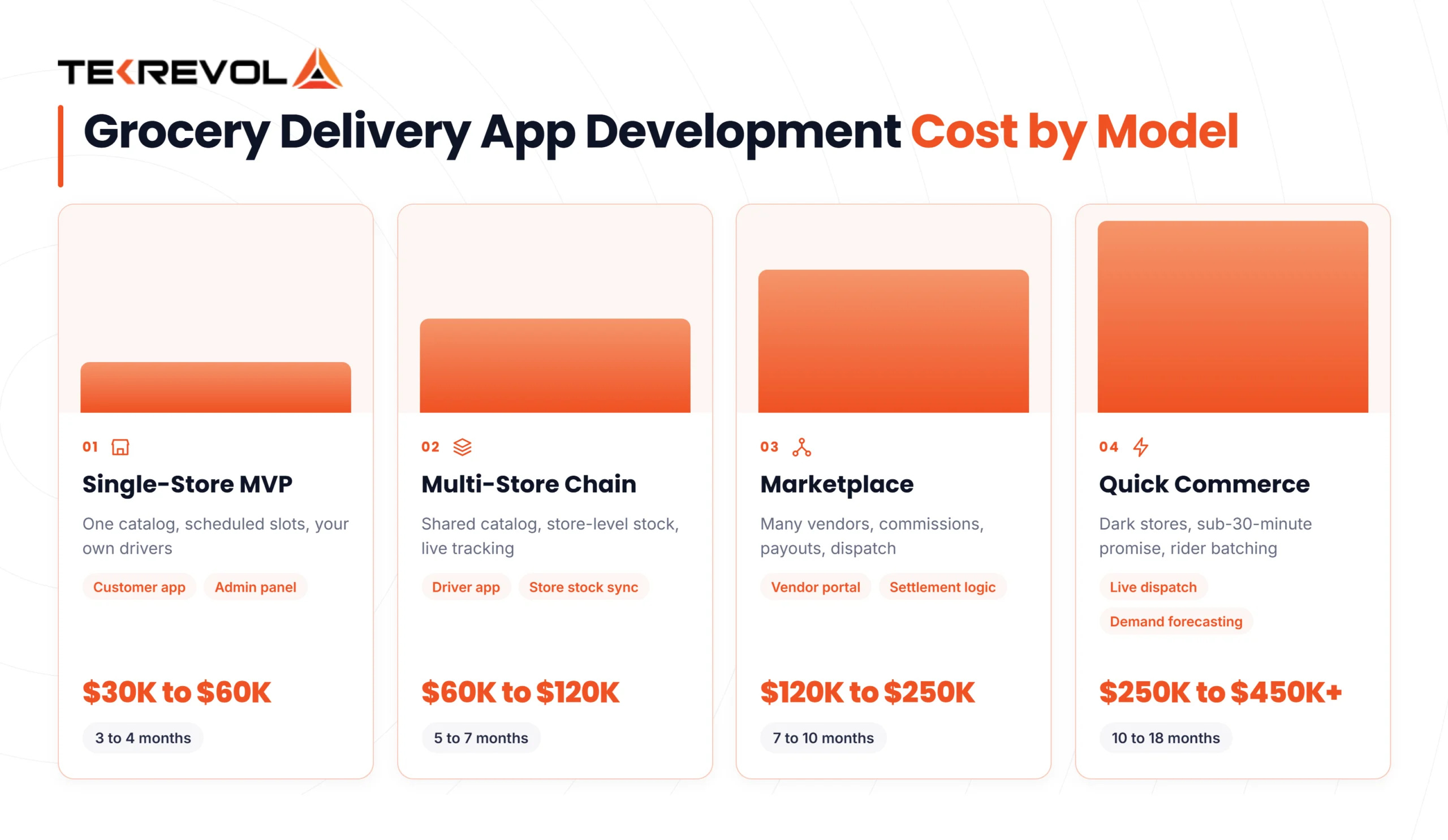
Here’s how the typical cost breaks down:
| App Type | What It Does | Cost Range | Timeline |
| Single-Store MVP | One catalog, scheduled delivery slots, and own drivers | $30,000 to $60,000 | 3 to 4 months |
| Multi-Store Chain App | Shared catalog, store-level inventory, and live delivery tracking | $60,000 to $120,000 | 5 to 7 months |
| Marketplace / Aggregator | Multiple vendors, commission management, payouts, and delivery dispatch | $120,000 to $250,000 | 7 to 10 months |
| Quick Commerce | Dark stores, sub-30-minute delivery, and order batching | $250,000 to $450,000+ | 10 to 18 months |
Most businesses that come to us think they’re in tier three and are actually better served starting in tier one. Launching a single-store version first gives you real order data before you pay for dispatch logic you might not need.
Not sure which price band your grocery app actually falls into?
Send us your feature list, and we'll map it to a real number and a realistic timeline before you commit a single dollar of budget.
Book Your Free Scoping Session →A Quick Look at the Grocery Delivery App Market 2026
Covid 19 spike the demand for grocery apps because of the lockdown, they were the only option to buy daily edibles. But then we get used to that, which obviously makes them a huge market.
- The global online grocery market reached a value of $670.8 billion in 2025. According to experts at Global Newswire, this number is expected to cross US$2,237.1 billion by 2035.
- Delivery leads the market: McKinsey reports that nearly two-thirds of online grocery orders are delivered, while 39% of shoppers expect same-day fulfillment.
- Advertising is becoming a major revenue stream: Instacart reported $10.35 billion in GTV across 90.3 million orders in Q2 2026, with advertising and other revenue reaching $297 million, up 16% year over year.
- Major players are prioritizing delivery: Amazon is expanding same-day grocery delivery to 5,000+ US cities and towns as it shifts its grocery strategy toward online fulfillment.
The takeaway: Delivery infrastructure, fulfillment speed, and scalable monetization matter more to the business case than storefront design alone.
Common Business Models That Shape Grocery Delivery App Development Cost
Your business model sets the floor on grocery delivery app cost. Inventory-led builds are cheapest because you control one catalog. Marketplace models cost more because they need vendor onboarding, commission logic, and payouts. Micro-fulfillment costs the most because it adds warehouse and routing software.
Inventory model ($30,000 to $90,000)
You own the stock, so there’s one source of truth. No vendor portal, no commission engine, no settlement reconciliation. Amazon Fresh works this way. It’s the cheapest build and the heaviest operation.
Marketplace or aggregator model ($100,000 to $250,000)
You connect existing stores to shoppers, which means a vendor portal, per-vendor pricing, commission rules, and payout schedules. A grocery app like Instacart is the reference point here. Roughly 30% to 40% of the budget goes to things the customer never sees.
Micro-fulfillment or hybrid ($200,000 to $450,000+)
You hold partial inventory in dark stores and pull the rest from partners. This adds slot management, rider batching, and demand forecasting. It’s the model behind most ten-minute delivery promises.
The model you choose affects both your development budget and revenue potential, especially when comparing which delivery app pays the most across different delivery models.
Panels Every Grocery Delivery App Need & Their Estimated Cost
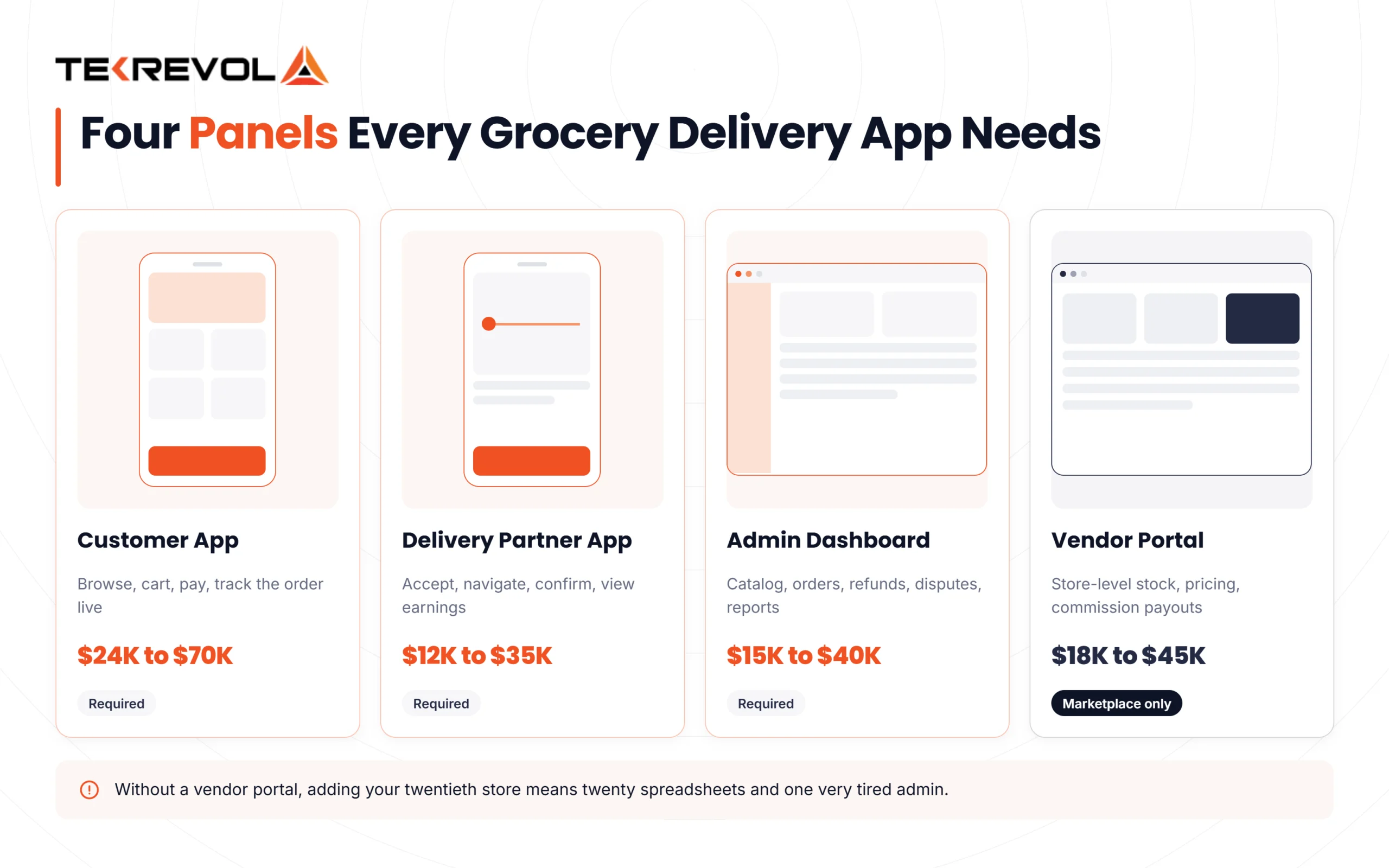
Every grocery delivery app needs three panels: a customer app, a delivery partner app, and an admin dashboard. Marketplace models need a fourth, a vendor portal, which typically adds $18,000 to $45,000. Skipping it means your admin team manually manages every store.
| Panel | Core Job | Typical Cost |
| Customer App | Browse products, manage cart, make payments, and track orders | $24,000 to $70,000 |
| Delivery Partner App | Accept orders, navigate, confirm deliveries, and manage earnings | $12,000 to $35,000 |
| Admin Dashboard | Manage catalog, orders, users, disputes, and reports | $15,000 to $40,000 |
| Vendor Portal | Manage store-level inventory, pricing, and payouts | $18,000 to $45,000 |
The vendor portal is the panel most first-time budgets leave out, and it’s the one that quietly decides whether your operations team can scale. Without it, adding your twentieth store means twenty spreadsheets and a very tired admin.
The admin panel is also where scope tends to creep hardest. Refunds, substitutions, driver disputes, and promo codes all live there, and each one is real engineering. Teams that treat it as an afterthought usually rebuild it in year two. Reading up on custom order management software before you scope the dashboard will save you a painful round of change requests.
Which Must-have Grocery App Features Cost the Most to Build?
The final grocery app development cost depends heavily on which functionalities you include.
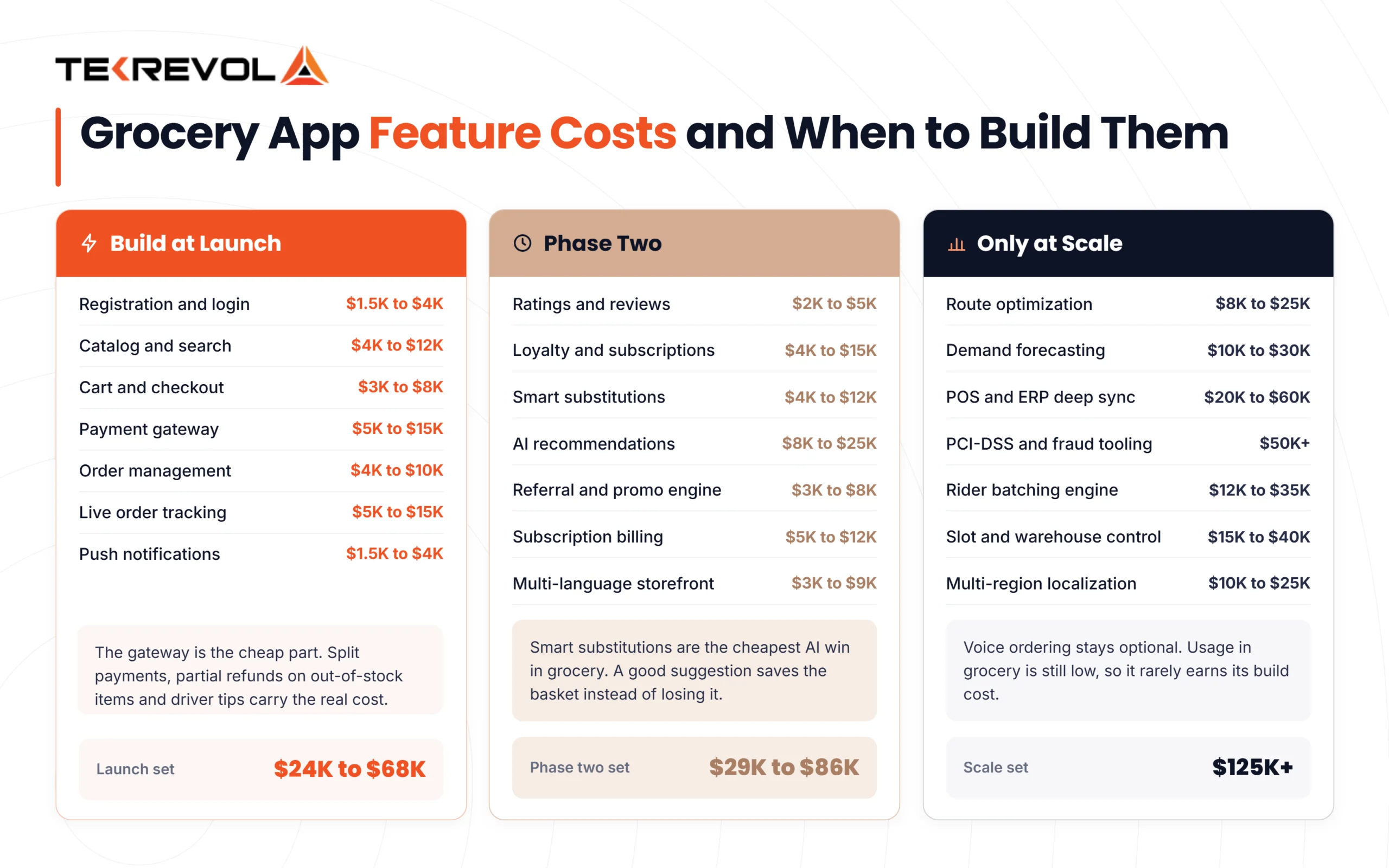
Must-have grocery app features like real-time order tracking, payment integration, and product catalog are essential for the user experience and cost between $1,500 and $15,000 each.
While advanced features such as AI personalization or route optimization are optional add-ons that improve ROI at the expense of $8,000 to $30,000 apiece.
Real-Time Tracking
Real-time tracking lets users follow their orders. Adding this feature costs around $4,000 to $12,000. It is a critical feature for on-demand grocery delivery apps, as it directly improves trust and reduces complaints.
Payment Gateways
Payment systems are another must-have for online grocery apps. Integrating secure payment gateways like Stripe or PayPal usually costs between $3,000 and $8,000. This makes sure your customers feel safe typing in their card details. It also handles the boring stuff like taxes and receipts automatically.
Loyalty Program
Everyone loves a good deal. If you want to add reward points or special discounts to keep people coming back, expect to add $5,000 to $15,000 to your budget. It’s a bit tricky to build because the app has to track every point and apply it correctly at checkout. However, it is one of the best ways to turn a one-time shopper into a regular.
Admin Panel
A strong admin panel allows management of products, orders, and delivery staff. A solid panel costs between $8,000 and $20,000. If you are building multi-vendor apps, this part is non-negotiable because you need to manage many different sellers at once.
AI Recommendations
Many trending food delivery app ideas include AI recommendations to suggest products based on user behavior. It improves sales but adds $8,000 to $20,000 to the app cost.
Feature-driven pricing means balancing your grocery app development cost with features. Planning carefully helps control grocery app development cost & features while still delivering a functional app.
What Factors Affect the Cost of Grocery Delivery App Development?
Six factors affect grocery delivery app development cost most: number of platforms, inventory sync complexity, third-party integrations, design depth, security and compliance requirements, and where your development team is located. Inventory sync is the one people underestimate.
Platform Choice
Cross-platform builds with Flutter or React Native cut 20% to 40% off a two-platform native build. Native gives you better performance on heavy catalog scrolling. For most grocery apps, cross-platform is the right call, and our cross-platform app development services explain where the tradeoffs actually bite.
Inventory Synchronization
This is the quiet budget killer. Manual CSV uploads cost almost nothing. Real-time sync with a POS across multiple stores can add $20,000 to $60,000 on its own, because you’re handling stock conflicts, price changes, and out-of-stock substitutions in flight.
Third-party Integrations
Maps, SMS, payments, and logistics APIs each carry both a build cost and a recurring bill. Basic integrations run $500 to $8,000; POS and ERP connections can hit $50,000 or more. Scoping these early through proper API integration services prevents mid-project surprises.
Design Depth
Template-led UI runs $5,000 to $12,000. Fully branded, motion-rich, accessible design runs $30,000 to $60,000. Deciding this before development starts matters, which is why understanding wireframes versus prototypes is worth an hour of your time.
Each of these factors makes your app better. However, adding too many can make the project more expensive. Many start a food delivery app business with minimal features and scale up as demand grows. This approach balances grocery app development cost and quality while avoiding unnecessary expenses.
How Does Cost by Region Change Your Grocery App Budget?
Cost by region changes grocery app budgets more than any single feature. The same 2,000-hour build costs roughly $300,000 in the US, $120,000 in Eastern Europe, and $70,000 in South Asia. Rate alone is a poor decision, though, since rework erases the savings fast.
| Region | Typical Hourly Rate | 2,000-Hour Build |
| US and Canada | $100 to $250 | $200,000 to $500,000 |
| Western Europe | $80 to $180 | $160,000 to $360,000 |
| Australia | $80 to $150 | $160,000 to $300,000 |
| Eastern Europe | $40 to $80 | $80,000 to $160,000 |
| Latin America | $40 to $80 | $80,000 to $160,000 |
| Southeast Asia | $30 to $65 | $60,000 to $130,000 |
| South Asia | $25 to $60 | $50,000 to $120,000 |
These are the rate bands we see quoted across the market in 2026, and they move with demand. What they don’t show is delivery risk. A team at $35 an hour that needs two extra months of rework is more expensive than a team at $70 that ships once.
The practical filter is portfolio evidence in your category, not the rate card, and our notes on choosing the right on-demand app development partner go deeper on how to run that check.
Phase-Wise Breakdown of Grocery App Development Cost & Timeline
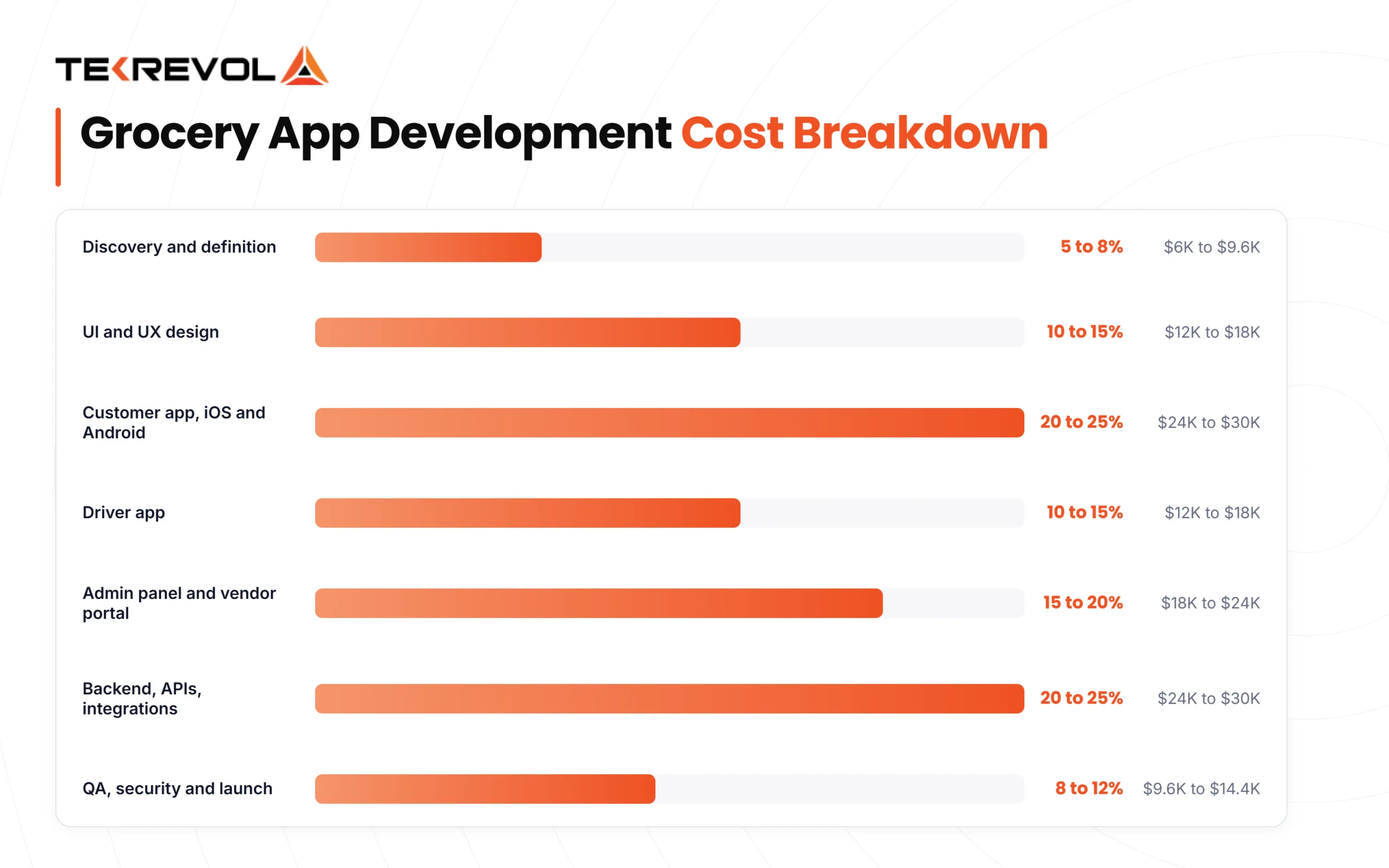
Right after planning, most teams follow a structured grocery app development process to manage money better. Each phase has a specific role and cost range based on features and complexity. Here is how the costs and timeline are usually spread out during the project.
| Development Phase | Time Duration | Est. Cost | Key Activities |
| UI and UX Design | 3–5 weeks | $3,000–$15,000 | Wireframes, layout, and animations |
| Backend Development | 8–10 weeks | $10,000–$60,000 | Server, database, and core logic |
| Frontend Development | 6–8 weeks | $5,000–$40,000 | User screens and app flows |
| Testing and QA | 4–6 weeks | $5,000–$15,000 | Bug fixing and device testing |
| Deployment & Launch | 1–2 weeks | $1,000–$5,000 | App stores and cloud setup |
UI/UX Design Costs
The first phase focuses on how the app looks and feels. A good grocery app interface costs from $3,000 to $15,000. If you want custom animations or many screens, the UX/UI investment will be higher.
Frontend Development Costs
Frontend is about building the screens that users touch and see. Developers create the user interface for iOS and Android. The mobile app frontend cost is often between $5,000 and $40,000, depending on platform choice and feature count.
Backend & API Development Costs
The backend supports the full app workflow. It handles the cloud infrastructure and stores all your data. Because of complexity, the
backend cost can range from $10,000 to $60,000. It is the most important part of your enterprise app build cost stages. Our primer on backend development for apps explains where that line usually sits.
Testing & QA Costs
Testing ensures the app works well across devices and platforms. The app testing cost generally ranges from $5,000 to $15,000 for manual testing, automated testing, and bug fixing. A strong QA investment reduces future failures and user complaints. It is a key part of the MVP development phase pricing.
Deployment & Launch Costs
The final step is putting your app on the App Store and Google Play. This phase covers the app submission cost and setting up your live servers. The expenses to launch a profitable on-demand app are usually the lowest, ranging from $1,000 to $5,000. After this, your business is officially open.
Development Timeline for Grocery Delivery Apps
The grocery delivery app development schedule usually takes 26 to 29 weeks. The timeline depends on app size and feature depth. A basic MVP launches faster, while advanced apps take more time. Clear planning keeps the build timeline stable and predictable.
Got a score but no scope?
Send us your feature list and we'll turn it into a costed, phase-by-phase build plan, with the cheap wins separated from the expensive must-haves.
Request Your Free Cost Breakdown →How Does Your Tech Stack Change Grocery Delivery App Cost?
Tech stack choices shift grocery app cost by 20% to 60%. Cross-platform frameworks like Flutter and React Native reduce build cost compared to dual native. Managed cloud services cost more monthly but cut engineering hours. Microservices add upfront cost and pay back only at scale.
| Layer | Common Choices | Cost Impact |
| Mobile | Flutter, React Native | 20% to 40% cheaper than dual native |
| Mobile (Native) | Swift, Kotlin | Best performance, but highest build cost |
| Backend | Node.js, Python, Java | Node.js is commonly used for real-time order flows |
| Database | PostgreSQL, MongoDB | PostgreSQL for transactions, MongoDB for catalogs |
| Cloud | AWS, Google Cloud, Azure | $500 to $5,000+ monthly, depending on order volume |
| Real-Time | WebSockets, Firebase | Firebase is faster to build but can cost more at scale |
The stack decision that matters most is your architecture, not your language. A monolith is cheaper to build and perfectly fine below a few thousand daily orders.
Which Hidden and Ongoing Costs Do Grocery App Budgets Miss?
The grocery app development cost does not end after launch. Ongoing grocery app costs include annual maintenance, usually 15% to 25% of build cost, cloud hosting costs ($500 to $5,000 per month), third-party API fees, app store commissions, and customer acquisition. Marketing is usually the largest surprise, often exceeding the build budget in year one.
Planning for these operational expenses helps businesses manage grocery app monetization better and avoid surprises.
App Maintenance
Maintenance includes bug fixes, security patches, and small feature updates. Yearly maintenance usually costs 15 to 25 percent of the initial build cost. Many businesses use reliable app maintenance services to manage updates and reduce downtime. Regular maintenance also protects user data and app ratings.
Hosting and Infrastructure
Most grocery apps use cloud platforms like AWS or Google Cloud for data storage. Monthly hosting costs range from $500 to $5,000 or more based on traffic and order volume. As users grow, server needs increase. This makes infrastructure a key part of operational expenses. Choosing scalable hosting helps control future costs.
Marketing and Launch
Marketing brings users to your app. Initial campaigns often cost between $50,000 and $200,000. This budget covers ads, app store optimization, and influencer support. Strong app marketing strategies improve visibility and downloads. Without marketing, even well-built apps struggle to grow.
Other Ongoing Costs
Other costs include customer support tools and analytics software. Payment gateway fees also apply per transaction. These costs affect grocery app monetization and profit margins. Tracking them helps improve pricing and offers. We’ve documented the wider list in how TekRevol helps clients avoid hidden app development costs.
How Do Grocery Apps Make Money?
Grocery apps make money through commissions of 8% to 20% per order, delivery fees of $3 to $8, subscription memberships, in-app advertising, and service fees. Advertising has become the highest-margin stream, which is why platform economics increasingly favor building an ad layer early.
| Revenue Stream | Typical Range | Notes |
| Commission Per Order | 8% to 20% | Marketplace models only |
| Delivery Fees | $3 to $8 per order | Rarely covers the full delivery cost |
| Subscriptions | $9 to $15 monthly | Drives retention more than revenue |
| In-App Advertising | Varies by traffic | Highest margin of the group |
| Service Fees | 5% to 10% | Easiest to raise, but easiest to reset |
| Surge Pricing | Situational | Use carefully; it can damage customer trust |
Instacart’s Q2 2026 numbers make the advertising case plainly: advertising and other revenue grew 16% year over year, faster than the 14% growth in gross transaction value. Delivery fees fund operations. Advertising funds profit.
Pick your revenue mix while you’re still scoping the build, because commissions and subscriptions both need infrastructure.
How Do You Optimize Grocery Delivery App Development Cost?
Optimize grocery delivery app development cost by launching a genuinely minimal MVP, choosing cross-platform, using proven third-party APIs instead of custom builds, and phasing features by revenue impact. Together, these choices typically cut first-release cost by 30% to 50%.
- Ship an MVP, not a small version of everything. The most effective cut we see is dropping from four panels to two at launch. Customer app plus admin panel gets you live. Driver and vendor panels come once order volume justifies them.
- Go cross-platform unless you have a reason not to. One codebase, two stores, roughly 30% less build cost, and performance that holds up for nearly every grocery use case.
- Buy the plumbing. Payments, maps, SMS, and analytics are solved problems. Custom-building any of them spends money on something a shopper will never notice.
- Phase by revenue, not by excitement. Loyalty programs and AI recommendations are worth far more in month eight than month one, when you have behavior data to feed them.
- Reuse what already works. Studying trending food delivery app ideas is a cheap way to borrow flows shoppers already understand.
Why Choose TekRevol For Grocery Delivery App Development?
Choosing the right development partner can influence your grocery delivery app development cost just as much as the feature list itself. TekRevol helps grocery retailers, delivery startups, and marketplace businesses define the right MVP and build the platform around real operational needs.
What we bring to a grocery build specifically is experience with the parts that don’t show up in a feature list. Multi-portal architecture, as in Stock n Ship, where stores, suppliers, and admins each needed their own view of the same inventory. Interfaces built for people who aren’t app-native, as in Martbook. Delivery and discovery flows, as in our multi-restaurant platform.
We also scope in phases rather than handing over a single number and hoping. You see which features are load-bearing for launch, which can wait, and what each phase costs, so you can plan around it. Browse the full range of work on our projects page.
For businesses planning a dedicated grocery platform, explore TekRevol’s on-demand delivery app development services. If your roadmap extends beyond grocery into a broader digital product, our mobile app development company covers strategy, design, engineering, testing, and post-launch scaling.
Ready to put a real number on your grocery app?
Spend 30 minutes with our product team and get a phased build roadmap, a cost range you can defend to investors, and a clear view of what to cut.
Schedule a Free Consultation →


![How Does Hybrid App Monetization Work For Houston [Strategies, Models & Trends]](https://assets.tekrevol.com/images-tek/uploads/2026/02/imgi_1_Hybrid-App-Monetization-400x182.webp)


