



- The main difference between the soft launch and hard launch is audience size: a limited testing group versus a full market release.
- Choosing a soft launch vs hard launch depends on product readiness, budget, and acceptable business risk.
- In a hard launch vs soft launch decision, an unfinished product favors soft testing before a full rollout.
- Soft launches can cut user acquisition costs by up to 90% by reducing wasted spend on unready products.
- A strong soft launch typically targets a 90-day retention rate of 25% or higher before scaling.
- Most successful apps blend both strategies: soft launch to refine the product, then hard launch to scale fast.
Choosing between a soft launch vs hard launch to introduce your mobile app is more than a marketing decision. It shapes how you test your app, how quickly you reach users, and how much risk you carry into launch day.
A soft launch releases your product to a limited audience: a single region, a beta group, or an early-access list, so you can test, learn, and fix issues quietly. A hard launch releases the finished product to your entire market at once, backed by full marketing momentum.
The primary soft launch and hard launch difference: one optimizes for learning; the other optimizes for impact. Neither is universally better. For most startups and app founders, the right choice depends on how proven your product is, how much budget you have, and how crowded your market is.
This guide breaks down the difference between a soft launch and a hard launch of a mobile app. You will learn how both strategies work, when each one makes sense, and how an experienced mobile app development company decides whether your app should launch softly, publicly, or through a phased approach that gives you the best of both.
Soft Launch vs Hard Launch: Quick Comparison
The key difference between a soft launch and a hard launch is how widely the product is released.
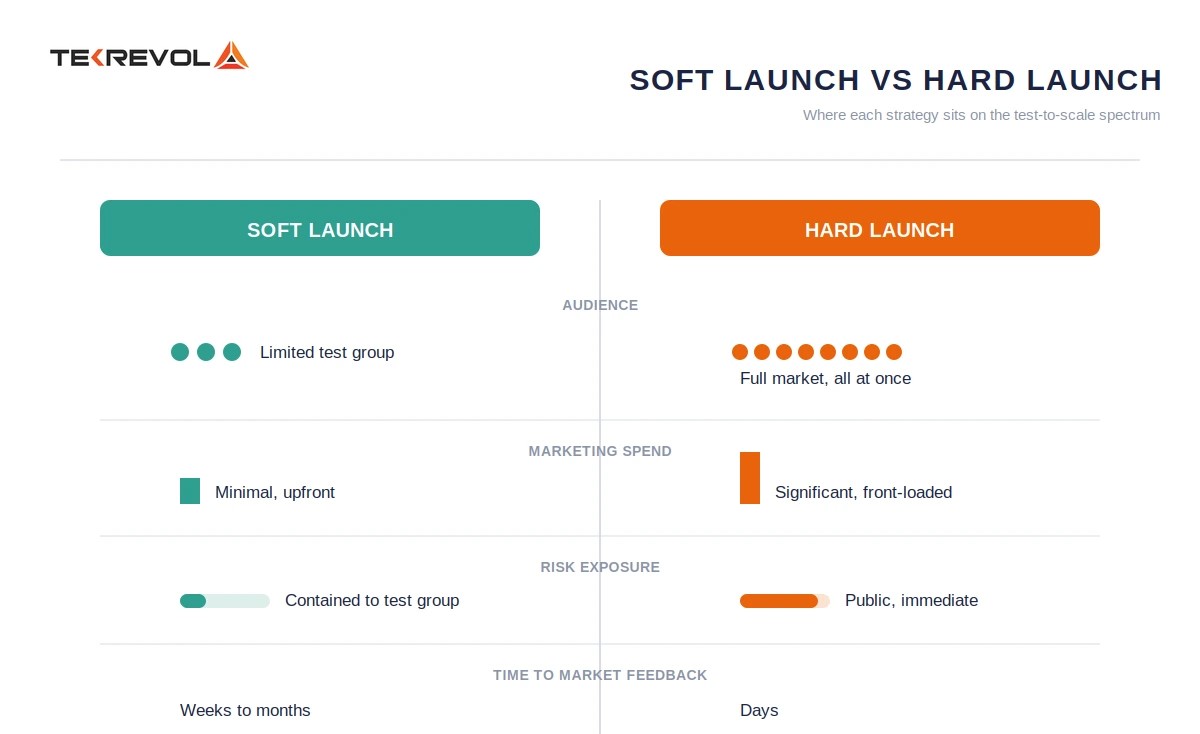
A soft launch is a limited release where an app is introduced to a smaller audience first. This helps the team test real user behavior, find bugs, improve onboarding, and validate market response before scaling.
A hard launch is a full public release to the wider market with stronger marketing, app store visibility, PR, paid campaigns, and user acquisition efforts.
| Aspect | Soft Launch | Hard Launch |
| Audience | Limited users, region, or beta group | Full target market |
| Main goal | Test, validate, and improve | Maximum exposure and sales |
| Risk level | Lower; problems are easier to fix | Higher; issues are visible to a wider audience |
| Marketing effort | Light and controlled | Heavy and public |
| Changes after launch | Easy to adjust | Harder to change quickly |
| Speed to scale | Gradual | Immediate |
| Best For | MVPs, new apps, startups, testing markets | Polished apps, strong brands, ready campaigns |
Not Sure Which Launch Strategy Fits Your App?
The soft launch vs hard launch choice depends on product readiness, target market, and growth plan. TekRevol helps founders build, test, and launch apps with the right rollout strategy.
Book Your Free Launch Strategy ConsultationWhat is a Soft Launch in Mobile App Development?
The soft launch is a controlled release of an app to a limited audience before it becomes available to the wider market. Instead of launching everywhere at once, the app is tested with a smaller group of users, a selected region, or a private beta audience.
For mobile apps, a soft launch means one of the following:
- Geo-limited rollout: publishing the app in one or two smaller markets (Canada, Australia, and New Zealand as test markets) before a global release.
- Closed or open beta: invite-only access through TestFlight, Google Play Early Access, or a waitlist.
- Feature-limited MVP: shipping the core feature set to early adopters and expanding based on what they actually use.
The purpose of a soft launch is to understand how real users interact with the app before major marketing spend begins. This helps mobile app development teams identify bugs, improve onboarding, test app performance, validate features, and collect early feedback in a lower-risk environment.
Popular Examples of Soft Launch
Many successful digital products started with a limited release before reaching a wider market. These examples show how a soft launch can help validate demand, improve the product, and reduce the risk of launching too early.
Drop Box
Dropbox used a simple product video and landing page to validate demand. Instead of spending heavily on a full launch, the team tested whether people understood the value of cloud file storage and were interested enough to sign up. This helped Dropbox build early traction before scaling.
Uber
Uber, now a billion-dollar car booking application, started as a web app with only one car – though it would show the location. No hype, no marketing, no free rides, and no collaborations. An idea that took root from internal organizational needs for transportation was soon appreciated by 10 more drivers.
One of the most famous examples of soft launching is Facebook. Facebook opened only to Harvard students in 2004, then expanded college by college. The restricted rollout let the team observe real usage patterns and harden the platform before each expansion.
Before becoming a global giant, WhatsApp started on just iOS. By testing with a small group of users, they could see what features people liked most. This careful start made it much easier for them to expand later. Today, building messaging apps like WhatsApp still points to smooth growth.
When Should You Consider Soft Launching Your Mobile App
Soft launching works best when you still need answers about the product, market, users, or monetization. A soft launch gives your team a safer way to validate the product, collect feedback, and improve the app before investing heavily in a hard launch.
Releasing an MVP
If you are launching an MVP, a soft launch is usually the smarter choice. Your goal at this stage is not to reach everyone but to learn whether the core idea solves a real problem. A soft launch helps you test the most important features, understand user expectations, and decide what to improve before adding more complexity.
App Still Needs User Feedback
Internal testing can catch technical issues, but real users reveal product issues. They show you where the app feels confusing, which features they ignore, what makes them leave, and what keeps them engaged. If you still need feedback on onboarding, navigation, design, usability, or feature value, soft launching gives you that insight.
Entering a New Market
If you are launching an app in a new city, country, niche, or audience segment, a soft launch helps you test market response. This is useful for launching dropshipping apps, marketplaces, fintech products, healthcare apps, lifestyle apps, and other products where user behavior can change by region or audience type.
Test Monetization
If your app uses subscriptions, in-app purchases, paid features, ads, booking fees, commissions, or freemium limits, you should test monetization. A soft launch helps you see whether users understand the value and what pricing model feels acceptable. This helps you improve revenue potential before spending more on acquisition.
Marketing Budget Is Limited
A hard launch can waste budget if the app is not ready. Paid campaigns may drive users, but poor onboarding, bugs, weak messaging, or unclear value can make those users leave quickly. A soft launch helps you protect your budget. You can improve the app first, then scale marketing once the product shows stronger signs of retention and engagement.
Reduce App Store Risk
Early ratings and reviews matter. If users face bugs or confusion during a full launch, they may leave negative reviews that hurt App Store performance. A soft launch gives your team time to fix issues, improve the first-time experience, and prepare the app for a stronger public release.
Need Investor or Stakeholder Validation
A soft launch can also help you collect early traction data. You can use real user feedback, activation rates, retention signals, feature usage, and revenue tests to support investor updates or internal stakeholder decisions.
Not Ready for a Full Launch Yet?
TekRevol helps you validate your app through a focused soft launch strategy.
Speak with our teamAdvantages of Soft Launch
A soft launch gives your team more control before a full public release. Instead of putting the app in front of everyone at once, you test it with a smaller audience, learn from real users, and improve the product before moving toward a hard launch.
Here are the main advantages of a soft launch vs hard launch of an app.
1. Reduces Launch Risk
A soft launch helps you catch issues before they become public problems. Your team can test the app with real users, identify bugs, fix broken flows, improve speed, and remove friction before the full release.
2. Improves the User Experience
Internal QA can confirm that the app works, but real users show how the app feels. A soft launch helps your team see where users get confused, which screens slow them down, and which steps cause drop-offs. You can use this feedback to improve onboarding, navigation, content, notifications, checkout, booking, sign-up, or any core flow that affects activation.
3. Validates Product Demand
A soft launch helps you move from assumptions to real evidence. You can check whether users sign up, complete key actions, return after the first session, invite others, make purchases, or use the features you expected. This gives your team a clearer view of product-market fit before the hard launch.
4. Protects Your Marketing Budget
Soft launching helps you improve the app before you scale paid campaigns, influencer outreach, PR, or app store promotion. Once the product performs better, your marketing spend has a stronger chance of turning into active users.
5. Strengthens Retention Before Scale
Getting installs is not enough. Users need a clear reason to return. A soft-launch application helps your team improve retention elements, such as onboarding, push notifications, personalization, rewards, content quality, and core feature usage. This gives your hard launch a stronger foundation.
6. Test Monetization Early
If your app depends on subscriptions, in-app purchases, premium features, ads, commissions, or booking fees, you should test monetization before scaling. A soft launch helps you understand whether users see enough value to pay, where they hesitate, and which pricing or upgrade flow needs improvement.
7. Builds a Smarter Hard Launch Plan
You can use early feedback, behavior patterns, app store signals, support questions, and retention insights to improve the final launch plan. By the time you move into a hard launch, your team can make better decisions about messaging, channels, budget, audience targeting, app store optimization, and support readiness.
Disadvantages of Soft Launch
A soft launch reduces risk, but it can also slow down growth if your team does not manage it properly. Since the release is limited, you may need more time to collect enough feedback, validate demand, and prepare for a wider launch.
| Disadvantage | Reason |
| Slower user growth | You reach fewer users at the start, so traction builds gradually. |
| Limited market buzz | A quiet release may not create strong awareness or excitement. |
| Smaller feedback pool | A small user group may not reveal every issue or use case. |
| Longer launch timeline | Testing, feedback, and product improvements can delay the full launch. |
| Risk of over-testing | Too many changes before launch can slow momentum and increase costs. |
| Limited revenue early on | A smaller audience usually means slower revenue generation in the beginning. |
| Competitor timing risk | While you test quietly, competitors may move faster in the market. |
In short, a soft launch works best when you use it with a clear timeline, testing goals, and success metrics. Without that structure, it can turn into a long testing phase that delays growth instead of preparing the app for scale.
What is a Hard Launch?
A hard launch (sometimes called a full launch) is the official, full-market release of a finished product, supported by a coordinated marketing push: PR, paid acquisition, social campaigns, influencer partnerships, and launch events. Everything goes live at once, for everyone.
In business, a hard launch is a statement of confidence. There is no “we’re still testing” safety net; the product is expected to be stable, complete, and ready for scrutiny from users, press, and competitors on day one.
Real Examples of Hard Launches
A hard launch works best when the product has strong demand, clear positioning, and enough infrastructure to handle public attention. These examples show how major apps and digital products used a full public release to create fast visibility.
1. Threads
Meta launched Threads publicly in July 2023 as a direct competitor to X, formerly Twitter. The app used Instagram’s existing user base to remove friction from sign-up and quickly build adoption. Threads crossed 100 million sign-ups within five days of launch, according to Reuters. This makes it a strong example of a hard launch.
2. Disney+
Disney+ launched publicly with a major brand push, a strong content library, and clear market positioning in the streaming space. The brand reported more than 10 million sign-ups after launch, showing how a hard launch can work when the brand already has demand, the product value feels clear, and the marketing campaign creates urgency from day one.
3. Pokémon GO
Pokémon GO launched as a public mobile game with global brand recognition and strong word-of-mouth appeal. The Pokémon Company reported that Pokémon GO exceeded 500 million downloads worldwide and noted that it held the App Store record for the most downloads in its first week of launch. This makes it one of the clearest examples of a hard launch in the mobile app world.
When Should You Consider Hard Launching a Product?
You should consider hard launching when your app is stable, tested, and ready for a wider audience. A hard launch works best when your team has already validated the product, prepared the launch campaign, and set up the support process.
App Is Fully Tested
If your app has passed QA, pre-launch testing, performance checks, and app store review preparation, a hard launch can help you reach more users with confidence. Your team should test core features, onboarding, payments, notifications, analytics, and support flows before going public.
Audience Is Already Waiting
If you already have a waitlist, community, email list, social following, or existing customer base, a hard launch can convert that demand quickly. This works well when users already understand the problem and expect your app to solve it.
Marketing Campaign Is Ready
A hard launch needs more than a live app. Your team should prepare app store optimization, paid ads, PR, social media marketing, email campaigns, landing pages, launch creatives, and tracking before release day. If your campaign assets are ready, a hard launch can create stronger momentum.
Need Fast Market Visibility
If you are entering a competitive space, a hard launch can help you create a stronger first impression. It allows you to position the app clearly, reach more users, and build awareness before competitors control the conversation.
Ready to Launch at Scale?
TekRevol helps you align product readiness, marketing, and support before the public release.
Speak with our teamAdvantages of Hard Launch
A hard launch helps your app reach a larger audience quickly. It works best when the product is ready, the campaign is prepared, and the team can handle user activity from day one.
Faster Market Visibility
A hard launch helps you reach more users quickly through coordinated marketing, app store optimization, PR, paid campaigns, social media, and partnerships.
Stronger Launch Momentum
When you align all launch activities around one release window, you create more energy around the app. This can help your product gain attention faster than a quiet or limited release.
Quicker User Acquisition
A hard launch can generate installs, sign-ups, and early traction faster because the app becomes available to the full target market from day one.
Clearer Market Positioning
A strong public launch gives your app a clear story in the market. You can control the message, explain the value, and position the product before competitors or users define it for you.
More Feedback in Less Time
Since more users access the app at once, your team can collect reviews, analytics, usage data, and feedback faster. This helps you understand what works and what needs improvement after launch.
Faster Revenue Opportunity
If your app has a tested monetization model, a hard launch can help you start generating subscriptions, purchases, bookings, or transactions earlier.
Stronger Brand Confidence
A well-planned hard launch can make your app feel more established and credible. When users see a polished product, clear messaging, and active promotion, they are more likely to trust it.
Disadvantages of Hard Launch
A hard launch can create strong visibility, but it also increases pressure. Since more users see the app immediately, product issues, weak messaging, or poor support can become public faster.
| Disadvantage | Reason |
| Higher launch risk | Bugs, crashes, or confusing flows can affect more users at once. |
| Larger budget requirement | You may need to spend more on ads, PR, creatives, ASO, and support. |
| Less room for quiet fixes | Users may leave negative reviews before your team resolves issues. |
| Higher team pressure | Product, marketing, analytics, and support teams must stay ready from day one. |
| Costly first impression | A weak launch can damage trust and reduce install conversion. |
| Faster public feedback | Users may quickly expose gaps in features, pricing, onboarding, or performance. |
| Risk of wasted traffic | Paid campaigns can bring users in, but poor retention can make that traffic expensive. |
A hard launch works best when your app is ready for attention. If the product still needs testing, a soft launch or hybrid launch will usually give you a safer path.
When Should You Choose a Soft Launch vs a Hard Launch?
Ask yourself these questions before deciding:
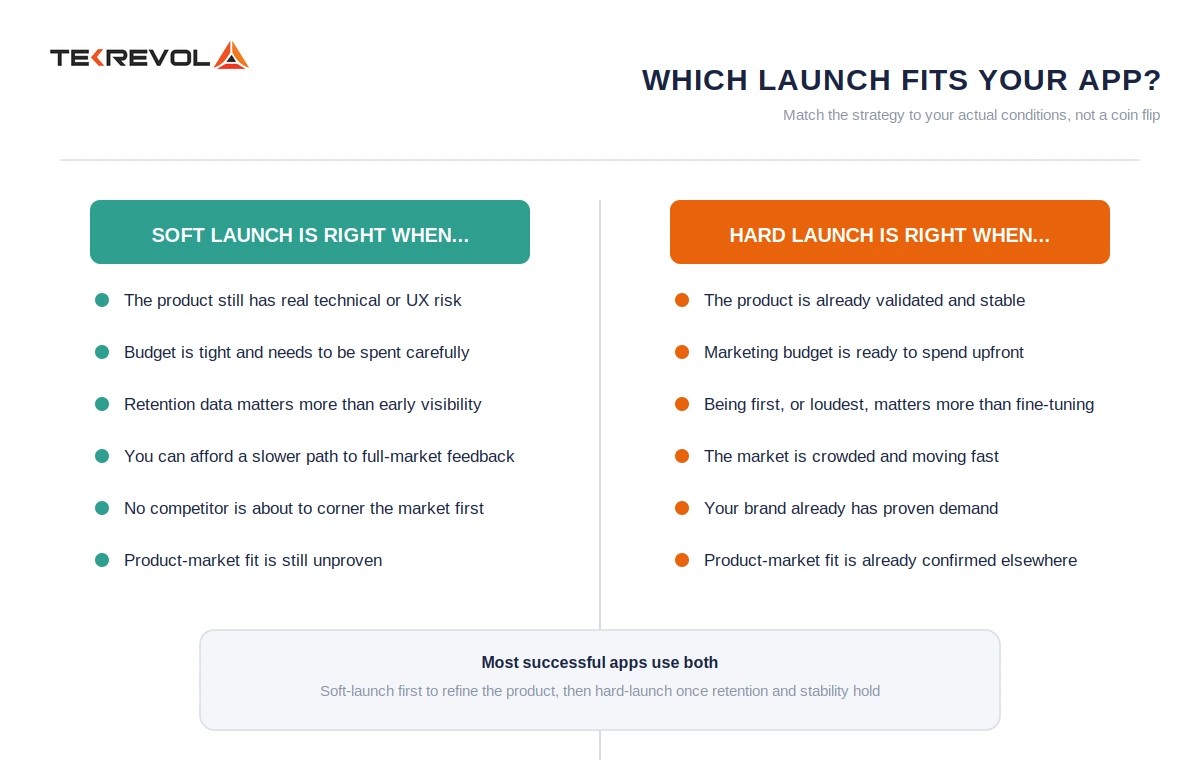
- Is the product actually finished? If there’s meaningful uncertainty about stability, performance under load, or core UX flows, that’s a soft-launch signal.
- What’s your risk tolerance? A soft launch protects your brand from a public failure; a hard launch bets that failure isn’t likely.
- What’s your budget? Hard launches front-load marketing spend that’s hard to recover if the product needs rework post-launch.
- How saturated is your market? In a crowded category, a strong hard launch can be the differentiator that gets you noticed before competitors copy the idea.
- Do you have a validated product-market fit already? If yes — through a previous soft launch, a rebrand, or a proven track record — a hard launch lets you capitalize on that instead of re-testing what you already know works.
Top 5 Ways to Soft Launch an App
A soft launch does not always mean releasing your app to the public. You can soft-launch an app in different ways depending on your product development stage, audience, budget, and launch goals.
Here are five practical ways to soft launch your mobile app before moving into a hard launch.
1. Launch With a Private Beta Group
A private beta gives selected users early access to your app before the public release. You can invite internal users, existing customers, early subscribers, investors, partners, or a small group from your target audience.
This method works well when you want detailed feedback from people who understand the problem your app solves. Ask beta users to test onboarding, core features, app performance, navigation, and any flows that directly affect activation or retention.
A private beta helps your team catch product gaps before a wider audience sees the app.
2. Release the App in One Region First
A regional soft launch means releasing your app in one city, state, country, or market before expanding to a larger audience.
This approach works well for apps where user behavior changes by location, such as delivery apps, ride-booking apps, fitness apps, healthcare apps, food apps, and local service platforms.
3. Use an Invite-Only Launch
An invite-only launch gives access to a limited number of users. This creates control, keeps early usage manageable, and helps your team learn from a focused audience.
This method works well when you want to build exclusivity, test demand, or avoid overwhelming your support and product teams. You can invite users through a waitlist, referral link, email campaign, community group, or founder network.
An invite-only soft launch also helps you test whether people care enough to request access before the app becomes widely available.
4. Launch With a Minimum Feature Set
You do not need every planned feature before a soft launch. In many cases, you should release the smallest useful version of the app and test whether users understand the core value.
This works especially well for MVP development. Instead of building too many features upfront, you launch with the essential flows, such as sign-up, onboarding, search, booking, checkout, messaging, content access, or the main user action your app depends on.
A minimum feature soft launch helps you learn what users actually need before you spend time and budget on features they may not use.
5. Run a Limited Marketing Campaign
A limited marketing campaign helps you attract early users. You can promote the app through a small paid campaign, email list, community post, social media campaign, or founder-led outreach.
The goal is not massive traffic but quality feedback. Track which messages bring users in, where users drop off, which features they use, and whether they return after the first session. This approach helps you test both the product and the market message before scaling your launch budget.
Which Soft Launch Method Should You Choose?
Choose the soft launch method based on what you need to validate first.
| Biggest Uncertainity | Soft Launch Method |
| Product Feedback | Private beta group |
| Market Validation | Regional soft launch |
| Controlled Demand | Invite-only launch |
| Testing an MVP | Minimum feature set launch |
| Messaging data | Limited marketing campaign |
5 Methods to Hard Launch a Mobile App
A hard launch needs a coordinated push. Your goal is not just to publish the app. Your goal is to create awareness, drive installs, activate users, and turn early attention into real traction.
Here are five practical ways to hard launch your mobile app.
1. Launch With App Store Optimization
App Store optimization helps your app get discovered on the App Store and Google Play. Before launch, optimize your app title, subtitle, description, keywords, screenshots, preview video, category, and ratings strategy.
This method works well when organic discovery matters. A strong app store listing can improve visibility, trust, and conversion from visitors to installs.
2. Run a Paid Acquisition Campaign
Paid campaigns can drive targeted users to your app from day one. You can use Google App Campaigns, Meta ads, TikTok ads, Apple Search Ads, influencer campaigns, or other channels based on your audience.
This method works best when your app has a clear value proposition, strong creatives, and tracking in place.
3. Use PR and Media Outreach
Digital PR helps your app gain credibility and public attention. You can pitch journalists, startup publications, industry blogs, podcast hosts, newsletters, and local media, depending on your category.
This method works well when your app has a strong story, unique feature, funding update, or market insight.
4. Activate Your Existing Audience
If you already have a waitlist, email list, community, customer base, or social following, use it during launch week. Send launch emails, post product walkthroughs, share founder videos, offer early access, and encourage users to download the app. This method works best when you have already built trust before launch.
5. Launch With Partnerships or Influencers
Partnerships can help you reach the right users faster. You can work with creators, communities, brands, associations, local businesses, or industry partners that already have your target audience. This method works well for fitness, lifestyle, fintech, education apps, and consumer platforms.
Which Hard Launch Method Should You Choose?
Choose the hard launch method based on your strongest growth channel.
| Main Goal | Hard Launch Strategy |
| Organic app store visibility | App store optimization |
| Fast user acquisition | Paid acquisition campaign |
| Credibility and awareness | PR and media outreach |
| Already have an audience | Audience activation |
| Access to a niche market | Partnerships or influencers |
Soft Launch vs Hard Launch: How Launch Strategies Define Long-Term Engagement
The above soft launch and hard launch differences affect more than your first downloads. It shapes how users experience the app, how quickly your team learns from them, and whether early users return after the first session.
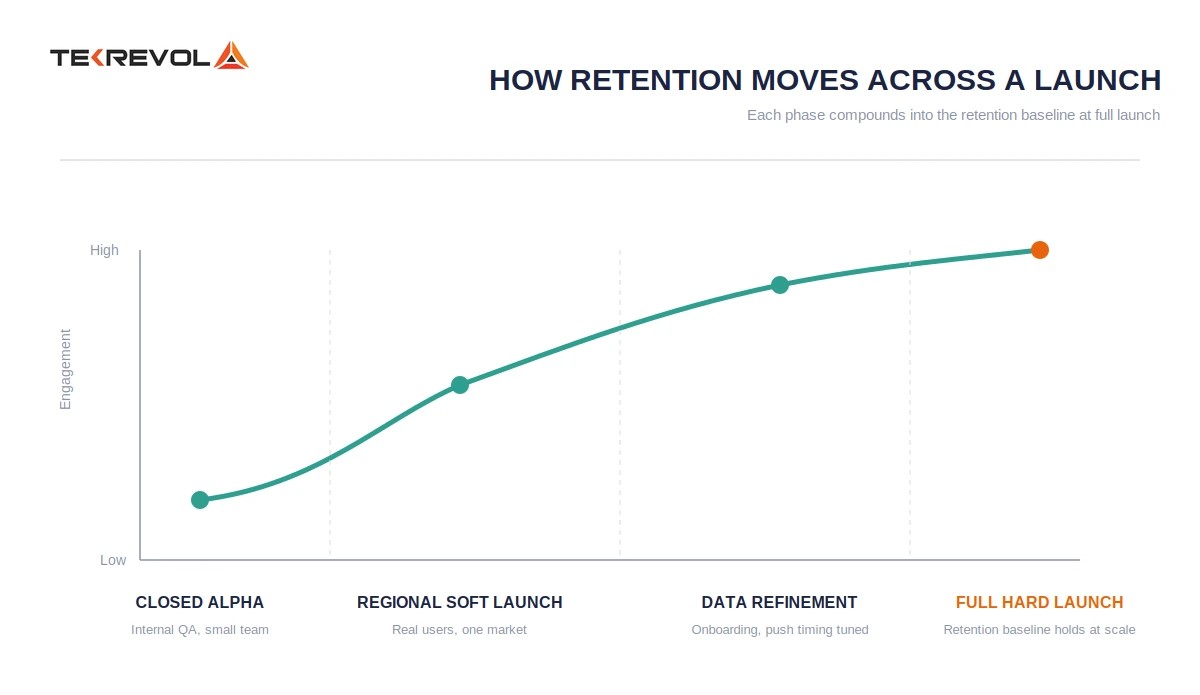
Three common goals point to three different strategies:
Validate Product-Market Fit
Choose a soft launch. Your scarce resource is learning, not attention. A geo-limited release with a few thousand users will tell you more than a hundred thousand installs that you can’t interpret.
Define the metrics that constitute “fit” (retention, activation rate, willingness to pay) before launch so the data can actually make the decision.
Revenue as Fast as Possible
Choose a hard launch but only if validation already exists. Investor timelines, seasonal windows (a fitness app before January, a shopping app before Q4), or a first-mover opportunity can justify going wide immediately.
The honest precondition: your product must already be stable, because a public failure costs more than the time a soft launch would have taken.
Win Share in a Crowded Market
Use the hybrid sequence. Soft launch in a market your competitors ignore, tune the product until your retention beats the category baseline, then hard launch with differentiation you can prove.
Entering a saturated market with an untested product and a big budget is the most expensive way to discover that your onboarding is broken.
The Hybrid Approach: Soft Launch First, Then Hard Launch
Comparing a hard launch vs soft launch isn’t really an either/or decision anymore. The dominant pattern among successful apps is sequential: soft launch to validate, hard launch to scale.
A typical hybrid timeline looks like this:
- Closed beta (Weeks 1–4): invite-only users, heavy feedback collection, rapid fixes.
- Geo-limited soft launch (Weeks 5–12): live in 1–2 test markets; monitor retention (aim for benchmarks like day-30 retention before scaling), CPI, and monetization.
- Gate check: only proceed when your core metrics meet pre-agreed thresholds. If they don’t, iterate; this is the entire point of soft launching.
- Hard launch: global release with the marketing budget you didn’t burn during testing, armed with proof that the product retains users.
This sequence converts the soft launch’s weakness (slow growth) into the hard launch’s strength (confidence), and the hard launch’s weakness (risk) is mostly eliminated by the time you take it.
Partner with TekRevol to Launch Your App with Confidence
A successful app launch needs more than development. It needs the right rollout strategy, product testing, launch planning, analytics, app store readiness, and post-launch support.
TekRevol helps startups and businesses choose the right path between soft launch, hard launch, and phased rollout based on product readiness, user behavior, market goals, and growth budget.
Our team of experts will:
- Analyze your market to determine the optimal launch approach.
- Develop a comprehensive marketing plan to maximize reach and engagement.
- Implement feedback mechanisms to refine your app post-launch.
Whether you are preparing an MVP, validating a new app idea, or planning a full public launch, our team can help you reduce risk and launch with a clear strategy.
Ready to Launch Your App the Right Way?
TekRevol helps you test, refine, and scale with a launch strategy built around your goals.
Book Your Free Launch Strategy Consultation.


