You may think that having a brilliant idea is enough to develop a viral game. The reality is, however, just the opposite. In actual working conditions, you have to map out your imagination. The characters and mechanics that you’ve thought in your heads need a physical representation on a piece of paper to turn that initial spark into a finished product. That map is the game design document.
Here, you question who read a massive 100-page document? Or say that old-school thinking is dead. To your surprise, the modern GDD still considers a single most critical tool for production clarity that saves you thousands of hours later. A well-written game design document is a skeletal structure that gives your idea a clear shape that everyone understands
Therefore, in this guide, we explain a step-by-step process for how to make a game design document. We even highlight the common mistakes and provide best practices in the blueprint for a practical GDD that works for modern agile teams.
What Is a Game Design Document?
A game design document is the core blueprint for your entire video game project. It serves as a central reference guide throughout the production pipeline. A well-written GDD defines the vision, ensuring everyone from the artist to the programmer is building the same product.
Team members across different disciplines depend on the GDD. Designers need it to confirm game mechanics. Programmers check the technical overview. Even startups and solo developers use a GDD to keep their thoughts organized and validate their game ideas. This makes learning how to make a game design document fundamental for game development.
Does your game idea get lost in translation?
TekRevol simplifies your vision into a clear game design document to avoid confusion.
Schedule Your Free Call NowWhy You Still Need Game Design Documents in 2026?
The notion that the GDD is obsolete is a common misunderstanding. Traditional 100-page GDDs written in rigid software are certainly gone, but the need for clear documentation remains critical.
Modern game development relies on iterative design. You no longer write a giant static contract before development begins. Instead, you create a living document that adapts alongside the game itself.
Manage Agile Workflow
Agile workflows also depend on structured game concept document. Teams can plan sprints, test features, and update tasks directly through their version-controlled GDD. When you treat it as a living file, it becomes part of your agile game development rhythm.
Prevent Scope Creep
A solid game dev document serves as your best defense against scope creep. Scope creep occurs when small, unplanned features accumulate, resulting in significant budget and timeline overruns. The GDD stops that by defining the project pillars. If a new idea doesn’t fit the pillars, you know it risks expanding the project unnecessarily.
Avoid Miscommunication
Modern GDDs are crucial for remote collaboration. They act as a collective brain, facilitating communication across distributed teams. Tools that support version control and comments help team members track changes and give feedback quickly.
What Should a Game Design Document Contain? (Anatomy of a GDD)
A great game design document serves different groups like artists, programmers, and marketers. Therefore, it must cover four major clusters: Game Overview, Game Mechanics and Systems, World Aesthetics, and Production Details.
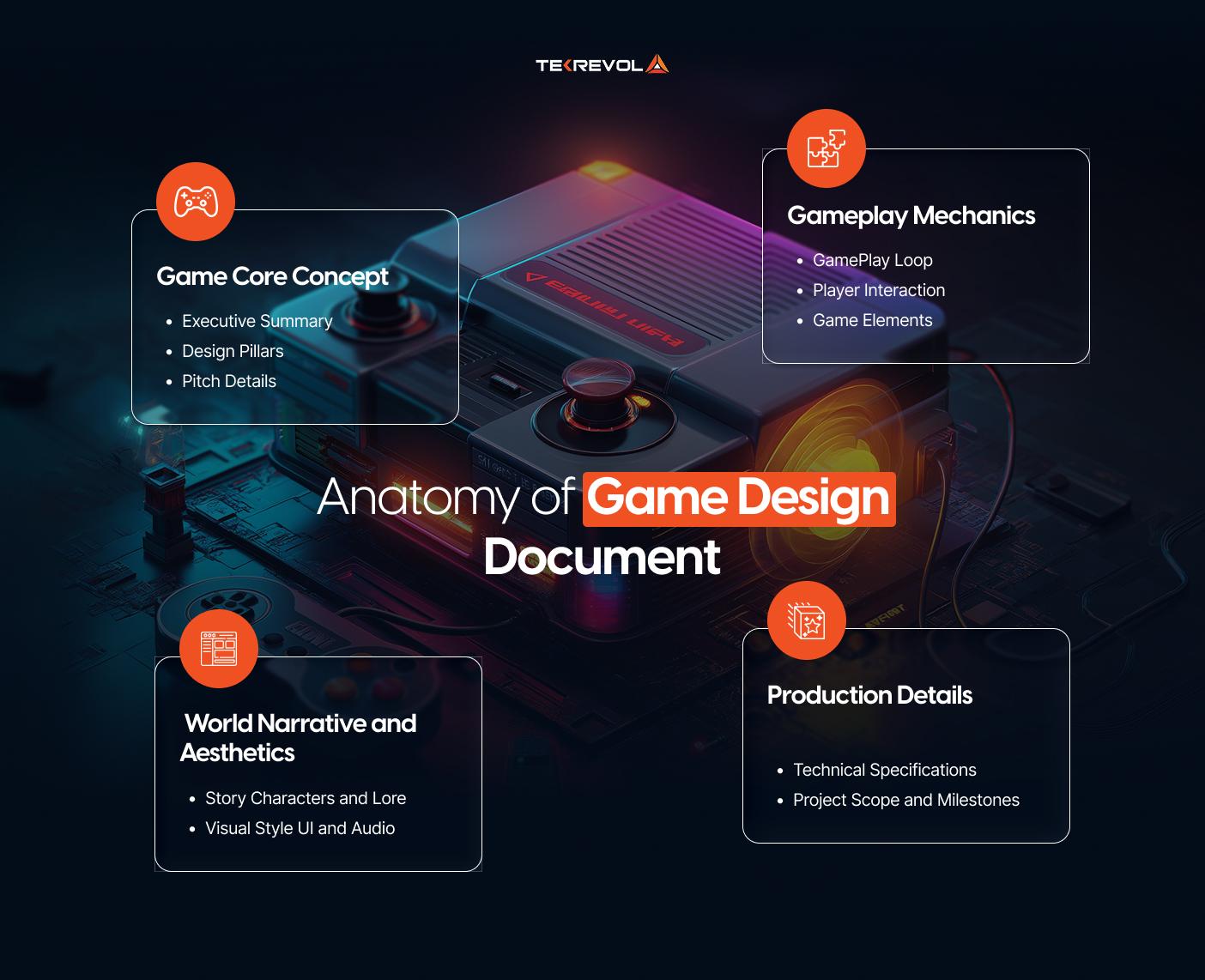
A. Game Overview and Core Concept
The intro section of your GDD provides a synopsis of the core game concept for stakeholders or potential investors.
Executive Summary and Design Pillars
The executive summary is a brief description of the theme and setting of the game. It should include a few bullet points introducing the main features.
The Design Pillars are the cornerstones of your game’s experience. Every subsequent decision about the game must align with these pillars. For example, a pillar might be Always provide the player with meaningful choice or Focus on high-speed combat.
Commercialization and Pitch Details
A structured game concept document also functions as a pitch for funding or publishing. So, you need to include the target audience. You must clearly define your Unique Selling Points or USPs. Why should a player choose your game over a competitor’s?
Explain how your game will sustain itself. Include pricing or potential monetization models. Outline release stages and future goals. This turns your game design document into a true business plan for your team and investors.
B. Gameplay Mechanics and Systems
This section is where you detail the player experience and the rules of the game. It provides the game dev information for the programming team.
The Core Gameplay Loop
Explain the general flow of your game. You can use a diagram to visualize the core gameplay loop with brief descriptions for each feature. Graphics or short videos better demonstrate how the player interacts with the game and repeats key actions.
A core gameplay loop example might be: Player finds resources or fights against a boss. Loop repeats. This shows the rhythm of the game.
Player Interaction and Game Elements
The most fluid section of your GDD is Game Elements. This includes game modes, controls, and social features. The segment is most likely to undergo fundamental changes during the game development process. You should include working prototypes or video clips of these features where possible.
C. World Narrative and Aesthetics
This section aligns the art and narrative teams, so it should be highly visual.
Story Characters and Lore
Explain the overall story flow and worldbuilding. If your game has multiple endings or branching narratives, keep track of them here to avoid later confusion.
Include detailed character profiles and their backstories with visual references. The GDD should cover the history and cultural background of your game world. This ensures narrative consistency across all written content.
Visual Style UI and Audio
Define the artistic direction, graphics, color palettes, and overall feel. The modern GDD uses reference materials like inspirational imagery and moodboards.
Document the app User Interface (UI) and User Experience (UX) flow. This includes mock-ups of menus and Heads-Up Displays or HUDs. Also specify the sound effects and music strategy.
D. Technical and Production Details
These are the non-design details vital for the engineering and production teams.
Technical Specifications
A comprehensive GDD must include specifications of the chosen game development tools and specific performance targets. This section prevents the common design trap of creating features that are too resource-intensive or simply unfeasible to implement.
Project Scope and Milestones
The details on the project scope are necessary to track the timeline and project management oversight. The GDD should include a section on major milestones you hope to hit.
A complete GDD might look different for every studio, but these sections always appear in some form. The format doesn’t matter as much as keeping your information structured and easy to update.
How to Write a Game Design Document (7 Key Steps)
Below is an iterative step-by-step process explaining how to make a game design document. Experts recommend starting small and building depth as you validate your ideas.
Step 1: Define Core Concept and Goals
Your first action is to put your idea into a single clear sentence. This rule prevents you from getting lost in the details later.
Identify your concept and the goals for the game. Address the problem statement in game design that you aim to solve or the opportunity it addresses. It helps you set the Design Pillars immediately.
Step 2: Select Your Tool and Format
Your GDD format makes a huge difference to its usability.
Rigid written documents become difficult to organize and manage. So, it is better to use collaborative cloud-based documentation tools. Common choices you have include Wikis like Nuclino or collaborative software like Notion. Visual board tools like Milanote are also excellent for the creative aspects.
Many people start with a game design document template available for free online. The approach gives the basic structure right away without any charge.
Step 3: Start with a One-Page GDD
Start with a simple one-page design document that focuses on high-level concepts. This is often called a game concept document. Decide what the document is supposed to do and choose the most effective format to explain the design.
Next, you can expand and write a ten-page design document that includes core game mechanics and story beats as the game starts to take shape.
Finally, move to create the full game design document PDF, including all content and details. Staging your documentation makes the process more efficient.
Step 4: Detail Gameplay and Create Visuals
This is the point where you define the core gameplay loop and add top-down maps for the environment. Describe the inhabitants using reference images and concept art for a video game character. For the mobile games, visual clarity is paramount. This step is critical to prevent unnecessary prototyping mistakes later.
Step 5. Outline Technical Tools and Requirements
Now, select your game development engine among Unreal, Unity, or Godot. Mention target devices and required specs. Add any workflow plugins or team responsibilities. Many studios use a game design document template in Unity to organize this data easily.
Step 6. Include Monetization and Metrics
Describe how the game will make money. List purchase models, ads, or downloadable content. Add a few key metrics to track success, such as player retention or level completion rates. That clarification connects creativity to business goals.
Step 7. Review and Update Collaboratively
Review the document collaboratively across your team. Share it through collaborative documentation tools like Notion or GitBook. Keep it version-controlled so your whole team can see changes.
Ensure every department understands its role and the document’s intent. Collaboration is essential since one person rarely knows everything about the game.
Still unsure how to write your first GDD?
Our agile method makes game design document creation simple and fast.
Get Expert Guidance NowGame Design Document Examples from Famous Titles
By looking at game design documents of famous games, you can realize the necessity of GDDs. These examples help you see how successful teams handle documentation.
Indie GDD Examples
Indie successes often show that the GDD doesn’t need to be massive. They emphasize the core gameplay loop and the overall feel of the game rather than massive technical detail.
| Title | Unique Perspective in GDD |
| Stardew Valley | The Stardew Valley design document began as simple notes that described the farming loop and seasonal gameplay. The simplicity made updates easy and guided years of work without confusion. |
| Hollow Knight | Team Cherry focused on feel rather than length. The document served more as a visual and emotional reference than a technical one. This helped maintain the game’s mood through every new level and boss |
2D GDD Examples
Expert 2D game development services often blend sketches, prototype notes, and animation cues. They connect design ideas with how the game looks and moves on screen.
| Title | Unique Perspective in GDD |
| Cuphead | The GDD mixed visuals with concise writing to describe mechanics and boss patterns. This visual-first format helped align the art and animation while keeping the nostalgic 1930s cartoon style intact. |
| Undertale | Undertale’s game concept described how players should feel after each interaction, which shaped both combat and dialogue design. The GDD’s simplicity made it easy to experiment without losing direction. |
3D GDD Examples
Modern 3D game development services approach the GDD as a bridge between creativity and production. These documents combine concept design and performance goals. They also include environment maps and system blueprints that align the creative vision with technical delivery.
| Title | Unique Perspective in GDD |
| The Witcher 3 | CD Projekt Red’s document linked gameplay to environment scale, NPC behavior, and lighting. This structure helped multiple teams across countries build one consistent open world. |
| Assassin’s Creed Origins | Ubisoft’s GDD for Origins outlined level structure and explained environmental logic, such as weather and lighting. Aligning technical details with design goals creates a smooth connection between art and gameplay. |
AAA Design Document Examples
AAA studios often use proprietary software or platforms for their GDDs. Their documents prioritize technical specifications and detailed level design maps.
| Title | Unique Perspective in GDD |
| Fallout | The early Fallout game design document was one of the most detailed of its time. It explained everything from world systems and factions to player stats and dialogue trees. |
| Overwatch | Blizzard’s game design document example focused on balance and collaboration. Because of constant updates, it became a living tool that guided both new content and gameplay balance after launch. |
If you are learning how to create a game design document, these examples can help you understand what to include and how to format it. The key takeaway is that the document must match the project’s scale.
Best Practices for Creating a Living GDD
The most successful GDDs are not shelved after the first week of production. They are treated as living documents that evolve with the stages of game development. The given best practices answer how to make a game design document that remains effective.
Collaboration and Accessibility
Use a cloud-based collaboration tool like GitBook or Confluence to allow easy access for everyone on the team. Enable the change requests feature to track edits. This ensures everyone knows why and when a change was made.
Clarity and Structure
Keep your document clear and concise. Nobody wants to read three paragraphs when one sentence does the job. Make things easy to find using powerful search tools and a modular structure with pages and subpages.
Glossary and Reference
Include a glossary of terms in your game design document. This ensures that every team member, including newcomers, understands industry-specific jargon. You can also create quick-reference guides or summaries for key sections to improve accessibility.
Encourage Cross-Team Input
Designers, developers, and artists should all share feedback. Regular updates make your game design documents a true collaboration tool instead of a checklist.
Schedule Regular Reviews
Treat the GDD like part of production, not paperwork. Assign review dates for every milestone. Quick updates keep your living document accurate and prevent confusion when features or mechanics change.
Common Mistakes to Avoid in Game Design Document
Learning how to make a game design document also means having a clarity of common pitfalls that turn documentation into a burden rather than a help. A good GDD should facilitate the game development process, not hinder it.
Overcomplication and Bloat
The single biggest mistake is making the GDD too big too early. Writing a giant 100-page file upfront is restrictive and wastes time because much of it will change. Avoid too much detail early on, especially before testing and validating your core ideas.
Neglecting Non-Design Stakeholders
Your GDD is not just for the design team. Failing to include sections for engineering, marketing, or management is a huge mistake. The document must include details around marketing and commercialization.
Ignoring Updates
A GDD with outdated versions or unclear ownership also defeats the purpose. Update your game design document constantly after every milestone. Leaving old notes in place leads to outdated features and wasted time.
Missing Visual References
Words alone can’t describe how a game feels. Add mockups, maps, or short clips inside your game design document pdf. This helps new team members understand your idea faster.
Skipping the Player Viewpoint
Some teams write from the developer’s side only. Always include how the game looks and feels for players. This ensures your video game design document stays focused on experience, not just function.
Conclusion
The game design document is the heart of structured creativity. It converts a simple idea into a marketable product. Mastering how to make a game design document is a necessary skill for production clarity and commercial success.
At TekRevol, our game development team uses the game design document as a foundation for every new project. It aligns design goals, production schedules, and technical pipelines. Whether you build a mobile or console title, we help you create a GDD that acts as the one reliable record.